




Abstract
This article mainly focuses on the influence of heat and mass transportation of micropolar second grade nanofluid toward porous medium of an exponentially stretched surface. The significance of activation energy and viscous dissipation with magnetic effect are taken into deliberated. Furthermore, to analyze the heat and mass transport scrutiny the concentration and thermal slip boundary conditions are assessed on the surface of the sheet. The convenient similarity variables are adopted to transfer the non-linear governing PDEs into the dimensionless ODEs and their corresponding boundary conditions also transformed. The nonlinear coupled ODEs are numerically solved by the usage of BVP4C MATLAB technique. The obtained numerical estimations are displayed graphically to display the significance of the various parameters against the velocity, temperature, microrotation, concentration distributions. It is noticed that larger estimations of micropolar and second grade parameter improves the fluid velocity consequently, while opposite trend is found for the higher estimation of porous medium parameter. Further, it is observed that the skin friction rate is boosted by the increment of
Keywords
Introduction
The non-Newtonian fluids are such kinds of fluids which do not follow the Newtonian’s law of viscosity. For examples lava, honey, gums, toothpaste, blood, shampoo, and ketchup etc. In these fluids, the fundamental relations for the apparent viscosity are usually more complicated. The apparent viscosity constantly decreases versus the applied shear stresses. Therefore, for non-Newtonian fluids the relation between shear stress and shear rate is non-linear. The mathematical characterizations of a non-Newtonian fluid have to a constitutive equation which governs the rheological fluid properties. These fluids are commonly distributed into three types, that is, the differential type, the rate type, and the integral type. The elementary subclass of the differential fluid is the second order fluid model which describes the viscous and elastic properties with specific conditions. This type of fluid is used in engineering and industrial procedures for examples, metal spinning, in production of paper, glass blowing, and extrusion of plastic sheets. Mostly researchers are working on the investigation of the non-Newtonian liquids. The examination of the flow of the non-Newtonian liquids on a stretchable sheet has a greater consciousness. Nowadays, the laminar boundary layer flow toward a sheet by virtue of stretching exponentially is a subject of sufficient studies for the sake of its perseverance in the distinct industrial and engineering techniques like the aerodynamic expulsion of plastic, the metallic cooling sheets in a cooling bath, the production of paper and glass fiber, the plastic sheet drawings and films, rubber sheets, and the annealing and thinning of copper wires etc. Initially, Sakiadis 1 used equations of the boundary layer for axisymmetric two-dimensional flow and Crane 2 deliberated the flow behavior through a stretching surface. Carragher and Crane 3 analyzed the mass and heat transportation toward a continuously stretching sheet. Further, Magyari and Keller 4 examined the stable boundary layers of a fluid flow on a continuously stretched sheet and analyzed the mass and heat transmission numerically and analytically. The flow of second grade fluid with the significance of the viscous dissipation on an exponentially stretchable surface was scrutinized numerically by Khan and Sanjaynanad. 5 Prabhaker et al. 6 scrutinized numerically with the consequences of MHD and chemical reaction of the flow behavior of non-Newtonian (Casson fluid) having nanoparticles by virtue of an exponentially stretching surface. Tlili 7 compare the hybrid nanofluid and nanofluid flow between concentric pipes and discussed the rheological behavior and thermophysical characteristic under the consequence of thermal conductivity. Tlili et al. 8 scrutinized computationally for the flow of Casson fluid under the existence of Joule heating, magnetic field, Souret or Dufort, thermophoresis, and Brownian motion impacts caused by a linearly stretching sheet. Aldabesh et al. 9 investigated the axisymmetric flow between parallel stretching disks of Casson nanofluid with magnetic field, Brownian motion, thermophoresis, thermal radiation impacts. Nayak et al. 10 examined the Darcy-Forchhemier flow of nanofluid into the carbon nanotubes with Cattaneo-Christov, non-linear thermal radiation and magnetic field effects, and discussed Entropy optimization. Khan et al. 11 discussed the Bio-convection model for the convective flow of a fluid having nanoparticles under the consequences of activation energy, magnetic field, thermophoresis, and Brownian motion impacts by virtue of a stretching sheet. A few explorations at the laminar boundary layer flow by virtue of the exponentially stretching surfaces are marked in Refs.12–16
The energy needed for the chemical reaction to come out is familiar as activation energy. In a chemical reaction, the entire atoms or molecules possess either kinetic energy or potential energy. Firstly, the activation energy was disclosed by Svabte Arrhenius (a Swedish scientist). Some compounds and elements respond simultaneously the existence of fixed energy amount. Awad et al. 17 reported the significance of the chemical reaction and activation energy on the flow of mass and heat through rotating incompressible viscous fluid by virtue of an unsteady flow on a stretchable sheet. Zaib et al. 18 analyzed the process of heat and mass transmission through the consequences of activation energy, thermophoresis, chemical reaction, and Brownian motion. Majeed et al. 19 evaluated numerically the significance of the activation energy to the flow and mass and heat transportation in the presence of the chemical reaction along MHD toward an exponentially stretched sheet. Irfan et al. 20 investigated the significances of activation energy for the mass and heat transportation of unsteady Carreau fluid having nanoparticles with the impacts of thermal radiation, viscous dissipation, and Joule heating toward the stretching sheet. Majeed et al. 21 used Darcy-Forchheimer model to report the significances of the chemical reaction, activation energy, second order slip, and magnetic field for the viscous fluid flow with a linear stretched sheet. Shah et al. 22 introduced Casson nanofluid to analyze the mass and heat transportation under the magnetic field, activation energy, joule heating, and thermal radiation effects with the convective boundary conditions. Khan et al. 23 investigated the influence of activation energy, magnetic field, motile microorganism, and non-linear thermal radiation effect on the flow of micropolar nanofluid toward a permeable rotating disk. Song et al. 24 scrutinized the heat and mass transportation into the micropolar nanofluid in bioconvection flow with the Darcy law, thermal radiation, and activation energy effects by virtue of rotating disk. Chu et al. 25 considered the influence of activation energy, thermophoresis, Brownian motion, magnetic field, chemical reaction, and bioconvection effects for the flow of third grade fluid flow with Buongiorno model of nanofluid induced by a stretching surface. Ramzan et al. 26 scrutinized the heat and mass transfer for the flow of tangent hyperbolic fluid having nano materials under the influence of activation energy, magnetic field, Hall, ion slip, and microorganism effects with in the presence of Cattaneo-Christov heat flux model due to a bidirectional stretchable sheet. Waqas et al. 27 study the consequences of melting process, non-linear thermal radiation, and activation energy for the Falkner-Skan transient bioconvection flow of Cross fluid having nano materials via of a stretching wedge. Xia et al. 28 discussed the heat and mass transmission into the flow of Eyring-Powell fluid through permeable medium having nanoparticles under the impact of Bio-convection and microorganism and discussed entropy analysis with a continuously stretching cylinder. Ramesh et al. 29 analyzed the convective flow of Maxwell fluid with Buongiorno model under the effects of Bioconvection, non-linear thermal radiation, and activation energy over a Riga plate. Moreover details, seen in the Refs.30–35
Micropolar fluids are such type of fluid which can undergo rotation and follow the basic equations of the deliberated non-Newtonian fluid model with an intimacy of the asymmetrical stress tensor. In fact, such types of fluids characterize the fluids including of arbitrarily acquainted particles suspended in a viscid medium. The fluid model with micropolar perhaps useful to describe the flow of suspension solutions, animal blood, liquid crystals, colloidal fluids, and so forth. Additionally, these fluids are strongly exaggerated by spin inertia, here the deformation of the particles is neglected. Initially Eringen 36 suggested the theory of the micropolar fluids. Hassanien and Gorla 37 used the micropolar fluids and scrutinized the mass and heat transmission into a micropolar nanofluid flow with the suction and blowing impacts toward a non-isothermal stretched sheet. Na and Pop 38 explored a conjectural analysis of the boundary layer flow of micropolar fluid by virtue of a continuously stretching sheet. Abd El-Aziz 39 examined the transportation of mass and heat with the properties for the micropolar mixed convection flow under the viscous dissipation effect due to a heated exponentially continuous stretching sheet. Nadeem et al. 40 examined the consequences of unsteady Bioconvection micropolar nanofluid with multiple slip conditions by virtue of an exponentially stretching sheet. Abbas et al. 41 discussed numerically the micropolar hybrid nanofluid flow under the impact of thermal slip boundary condition over non-linear stretchable Riga sheet. Nadeem et al. 42 scrutinized the heat and mass transportation into the micropolar fluid flow with the impact of time-dependent thermal conductivity past a Riga plate. Some important investigations on micropolar fluids are mentioned in Refs.43–50
The motivation of current investigation is to inquiry the heat and mass transport analysis of micropolar second grad nanofluid across the exponentially stretchable sheet with slip effects. The MHD and activation energy effect is also investigated. The main concern of study from the novelty point of view is to discuss the micropolar second grade nanofluid flow with porosity and irregular heat sources/sink effect induced by stretching surface, which are not studied yet in the literature. The obtained flow equation and energy equations in the form PDEs has transformed into coupled ODEs with the support of similarity variables. These coupled ODEs are tackled numerically by the usage of BVP4C MATLAB approach. The consequence of the various emerging parameters is discussed graphically and tabulated data. Moreover, comparison of current investigation is presented with available literature and shows good harmony between two.
Construction of the problem
Here, we consider 2D steady, incompressible, boundary layer flow of second grade micropolar nanofluid with the significances of porous medium toward an exponentially stretchable surface. The solutal and thermal energy equation has been modified with the impact of viscous dissipation and activation energy. The concentration and thermal slip effect also consider at the boundary of the sheet. The magnetic field

The physical flow chart and the coordinates.
Under boundary layer approximation and above-mentioned suppositions, the 2D steady laminar boundary layer flow and energy equations are followed as,


Here,

Where,
Boundary conditions are followed as,


Here
Similarity transformations follows as,
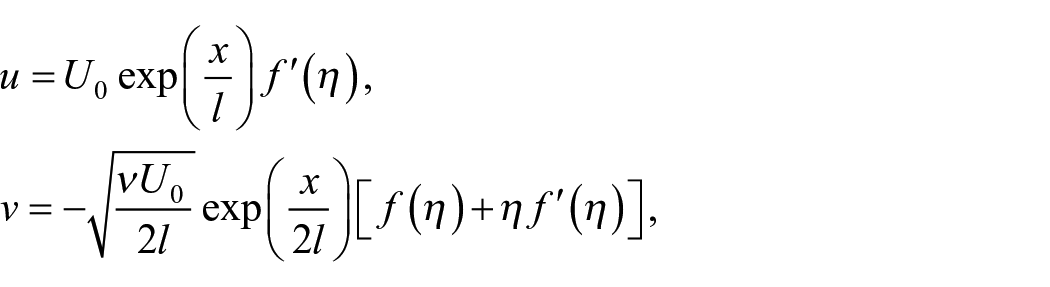

By using equation (7), the equations (2)–(5) are reduced in the following form,


Related boundary conditions are followed as,


Here, the symbols
Physical quantities
The physical parameters of interest such as Sherwood number, skin friction and Nusselt number are follows as:


In the non-dimensional form, the skin friction, Nusselt number, and Sherwood number are follows as,


Where
Results and discussion
In a prevailing research article, the two-dimensional second grade micropolar nanofluid in the occurrence of magnetic field and slip conditions past an exponentially stretched sheet is analyzed. The mass and heat transportation inspection are examined with the activation energy and viscous dissipation impacts. The consequences of the different arising parameters on the micropolar distribution, velocity distribution, temperature distribution, and concentration distribution are scrutinized via graphs. The Figure 2(a) displays the increasing behavior of
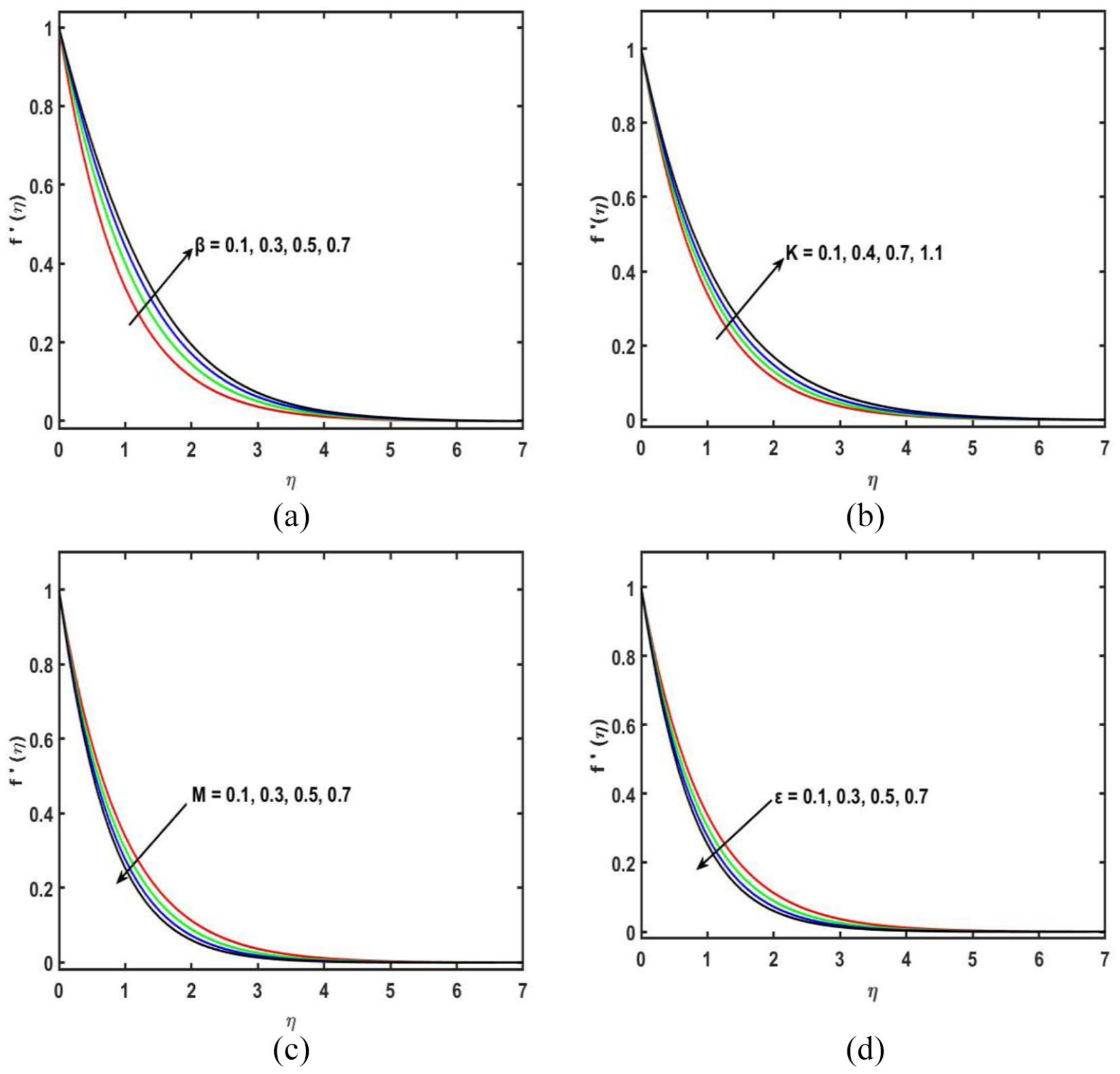
(a–d) Behavior of
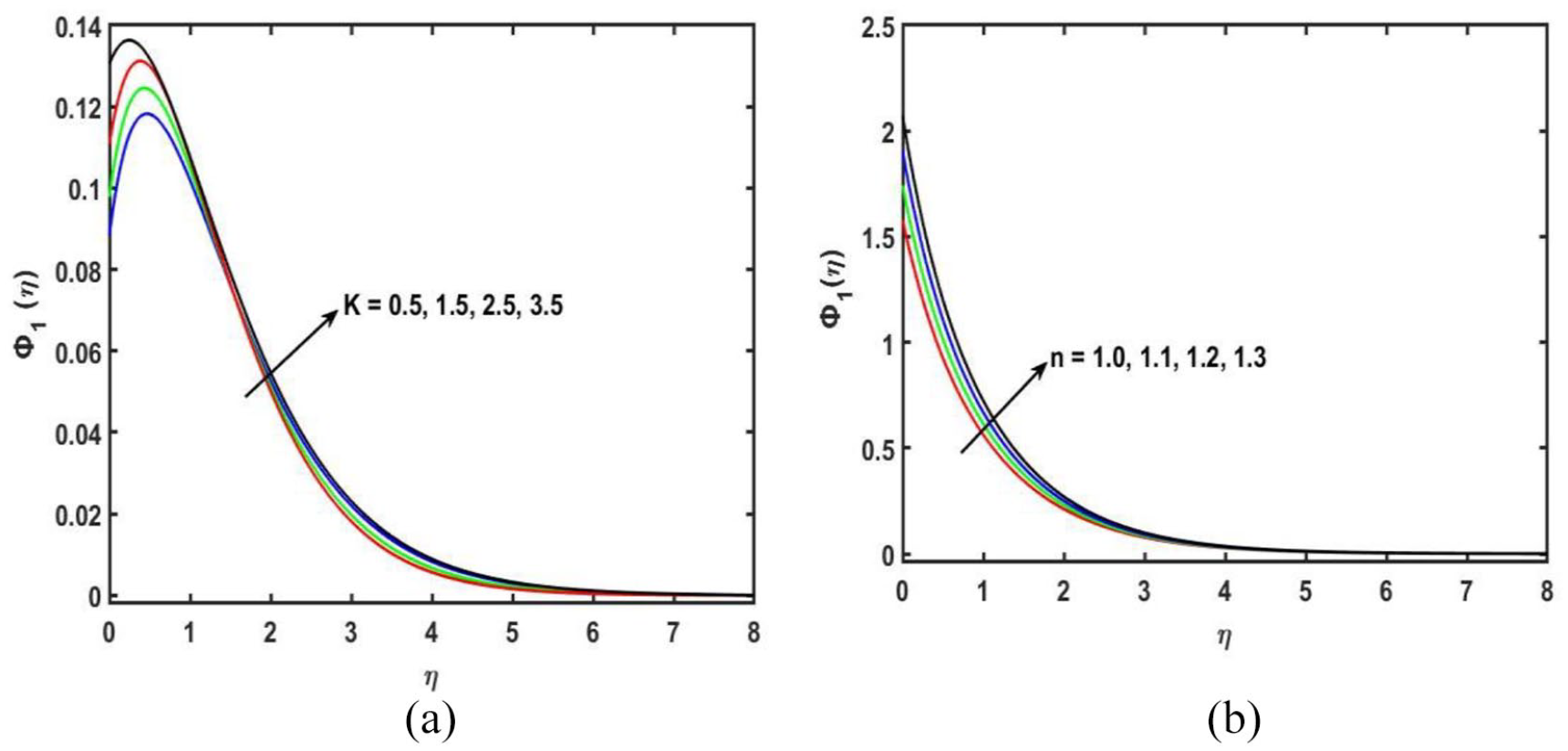
(a and b) Behavior of

(a–h) Behavior of

(a–h) Behavior of
Computed estimations of Skin friction coefficient

Computed estimations of the

Comparison table of

Concluding remarks
The MHD flow of micropolar second grade nanofluid toward an exponentially stretchable sheet with the activation energy and non-uniform heat source/sink. The heat and mass transmission investigation is discussed with the impact of thermophoresis and Brownian motion. The BVP4C technique by MATLAB is applied to resolve the coupled nonlinear ODEs. The vital outcomes of the present research study are followed as,
The velocity of fluid boosts by the increment of second grade parameter due to occurrence of resistive force, whereas opposite trend is noticed for porous medium parameter.
The linear and angular velocity improves for the larger variations of micropolar parameter.
The fluid velocity enhances for the stronger estimations of magnetic parameter, but opposite trend is seen against the temperature profile.
By the increment of thermophoresis parameter, both temperature and concentration improve.
The temperature profile increase for larger estimation of Brownian motion parameter, while concentration profile reduces.
Stronger estimations of the concentration and thermal slip decreases the temperature and concentration of fluid consequently.
The larger estimations of the micropolar and second grade parameter boost the skin friction rate.
The heat and mass transmission rate boosts for the larger values of the thermophoresis parameter and exhibits the opposite trend for the Brownian motion parameter.
Footnotes
Appendix
Declaration of conflicting interests
The author(s) declared no potential conflicts of interest with respect to the research, authorship, and/or publication of this article.
Funding
The author(s) disclosed receipt of the following financial support for the research, authorship, and/or publication of this article: The authors would like to thank the Deanship of Scientific Research at Umm Al-Qura University for supporting this work by Grant Code: 22UQU4331317DSR01.
