




Abstract
Applications:
The interaction of nanoparticles and base solvents of different nature attained much interest of the researchers in the recent time. These use in medication, detection of cancer cells, applied thermal engineering, and electrical and mechanical engineering. Among the broad range of applications, investigation of nanofluid through converging/diverging channel is important which is of much interest in the field of medical sciences.
Purpose and methodology:
The core purpose of this study is to introduce a new heat transfer model for two natures of nanofluids with bi host solvents. The model in hand achieved through nanofluid expressions, similarity equations and induction of novel dissipation effects. At later stage, numerical treatment is performed to explore the actual behaviour of nanofluids inside the oblique walls which is very important.
Core findings:
From the drawn results, it is found that the motion could be controlled by expanding the channel walls (
Nomenclature
α Converging/diverging parameter
u Component of velocity
θ Polar angle
T Temperature
ϕ volume fraction
ρnf Nanofluid density
μnf Nanofluid dynamic viscosity
μf Dynamic viscosity of the base solvent
Nu Nusselt number
Pr Prandtl number
Re Reynolds number
Ec Eckert number
r Radial direction
Introduction
Thermal transport between two non-parallel walls is one of the potential research motives. Such type of flow is also called flow between converging/diverging channel, flow between oblique channel or Jeffery–Hamel flow. The analysis of such sort of flows1,2 cannot be overlooked due to their wide uses in daily life as well as in industrial area. These comprised in mechanical, aerospace, chemical, environmental and civil engineering, etc. Also, flow bounded by two oblique walls occur naturally in rivers and oceans. The earlier contribution in this important direction gave by Jeffery 1 and Hamel. 2 That is why such flows named as Jeffery–Hamel flows.
It is a fact that common fluids have poor heat transfer characteristics. However, a huge amount of thermal transportation is essential to accomplish various industrial production processes. In such processes, regular fluids fail to provide considerable rate of heat transfer. The researcher’s thought that the heat transfer properties of conventional fluids can be increased if nano size of various metal particles and their oxides suspended in the common fluids.
To overcome the major problem of heat transfer enhancement, nanofluids developed which are colloidal suspensions of nano-sized particles dispersed in the conventional fluids stably and interruptedly. This newly developed class termed as Nanofluids. Choi 3 contributed earlier in this direction. The nanofluids are a colloidal mixture of metals like copper, Ag and Al2O3 in the host liquids. The dispersion of nanoparticles in the base solvent improves its thermal conductivity which is significant for thermal transport. Later on, many studies presented regarding the nanofluids heat transport in different scenarios. Ali etal. 4 and Sobamowo et al. 5 attracted towards the investigation of hybrid and third grade nanoliquids by considering the effects of stretchable surface, MHD, solar thermal radiations and squeezed parameters. The studies related to heat transport enhancement if cross nanoliquids with two sort of nanoparticles, Joule heating and moveable surface with changeable thickness are discussed by Chamkha et al. 6 and Wahed, 7 respectively.
The flow between parallel rotating plates is very significant due to their variety of applications in electric engine generator, cooling thermal system, etc. In the light of these facts, very recently Khan et al. 8 presented a three-dimensional nanofluids flow bounded between two parallel sheets. The plates and nanofluid rotate together. Further, they assumed that nanoparticles and regular liquids must be in thermal equilibrium. They examined very significant trends of various flow quantities on the momentum and thermal transport. The effects of under consideration flow parameters also computed. The mechanism of heat transport in water/Cu and water/Ag between converging/diverging channel by implementing Least Square Method and thermal radiation, magnetic field effects in the presence of stretching/shrinking effects of the walls reported in Usman et al., 9 Dogonchi and Ganji, 10 respectively. Latest significant investigation regarding heat transport between converging/diverging channel (Akinshilo et al. 11 ) under varying physical constraints like porous media effects, internal heat generation/absorption, the dynamics of blood suspended by nanoparticles 12 inside the channel with flexible walls, analytical treatment of heat transfer model through ADM, 13 and different nanofluids prepared by variety of nanoparticles and host solvent with different characteristics are examined by Ullah et al. 14 and Kumar et al., 15 respectively. The researchers concluded that the hybrid nanoliquids have unique heat transport mechanism and very useful for future applications.
Recently, Rashidi et al. 16 examined the flow of nanofluids over a stretching sheet. They observed that the fluid temperature declines with effective Prandtl model and rises without an effective Prandtl model. Also, entropy generation was part of his discussion. A review analysis on magneto-nanofluid and behavior of different nondimensional physical quantities presented in Sheikholeslami and Rokni. 17 The investigation of thermal transport mechanism in tangent hyperbolic fluid by taking physical impact of activation energy and zero mass flux flow condition reported in Kumar et al. 18 The solution of the model calculated via a numerical technique and varied the governing flow parameters to investigate the fluid flow behaviour. Intensifications in the local heat transport mechanism examined against Nr and the fluid velocity rises by increasing the value of We. The analysis of thermal and mass transportation in 2D flow over a paraboloid of revolution described in Zeeshan et al. 19 They analysed that the boundary layer thickness rises subject to the thickness parameter.
In the present time, researchers attracted towards the analysis of nanofluids inspired by MHD and inclined surfaces, 20 solar thermal radiation in the existence of no mass flux, 21 thermosolutal convection and cross diffusion gradients. 22 They observed interesting outcomes regarding the heat transport mechanism in nanoliquids under aforementioned conditions and suggested these would be useful for many industrial applications. In recent years, researchers contributed in the field of nanofluids and their applications and effectiveness in various disciplines under different scenarios.23–25 The inspection of reversible and irreversible cycles under physical aspects is important for thermodynamical studies and Tayebi et al. 26 covered the analysis in annular enclosure. Recently, scientists and engineers from different fields focused on the development of various improved thermal models in varying geometries. These analysed by Chamkha et al., 27 Eshaghi et al., 28 Dogonchi et al. 29 and Afshar et al. 30 and studies described therein will cover the literature.
The above cited literature reveals that different researchers reported significant studies from various physical aspects in different nanofluids. However, no one examined a comparative heat transfer analysis in water and EG (ethylene glycol) dispersed by
Comparative heat transport mechanism in
How Re and integrated dissipation effects will impact on the momentum and energy transport inside the channel.
The local heat transfer rate at the channel walls by changing Eckert number and solid volume fraction of nanoparticles.
How the fluid motion behaves near the channel walls.
Formulation of the models
Unidirectional laminar flow of nanofluids has crucial role in many applied research and in medical sciences. Such flows frequently occur in the practical life and flow between converging/diverging channel which exhibits unidirectional flow is of huge interest in the area of medical sciences and possess fascinating dynamics. The fluid moves with the velocity
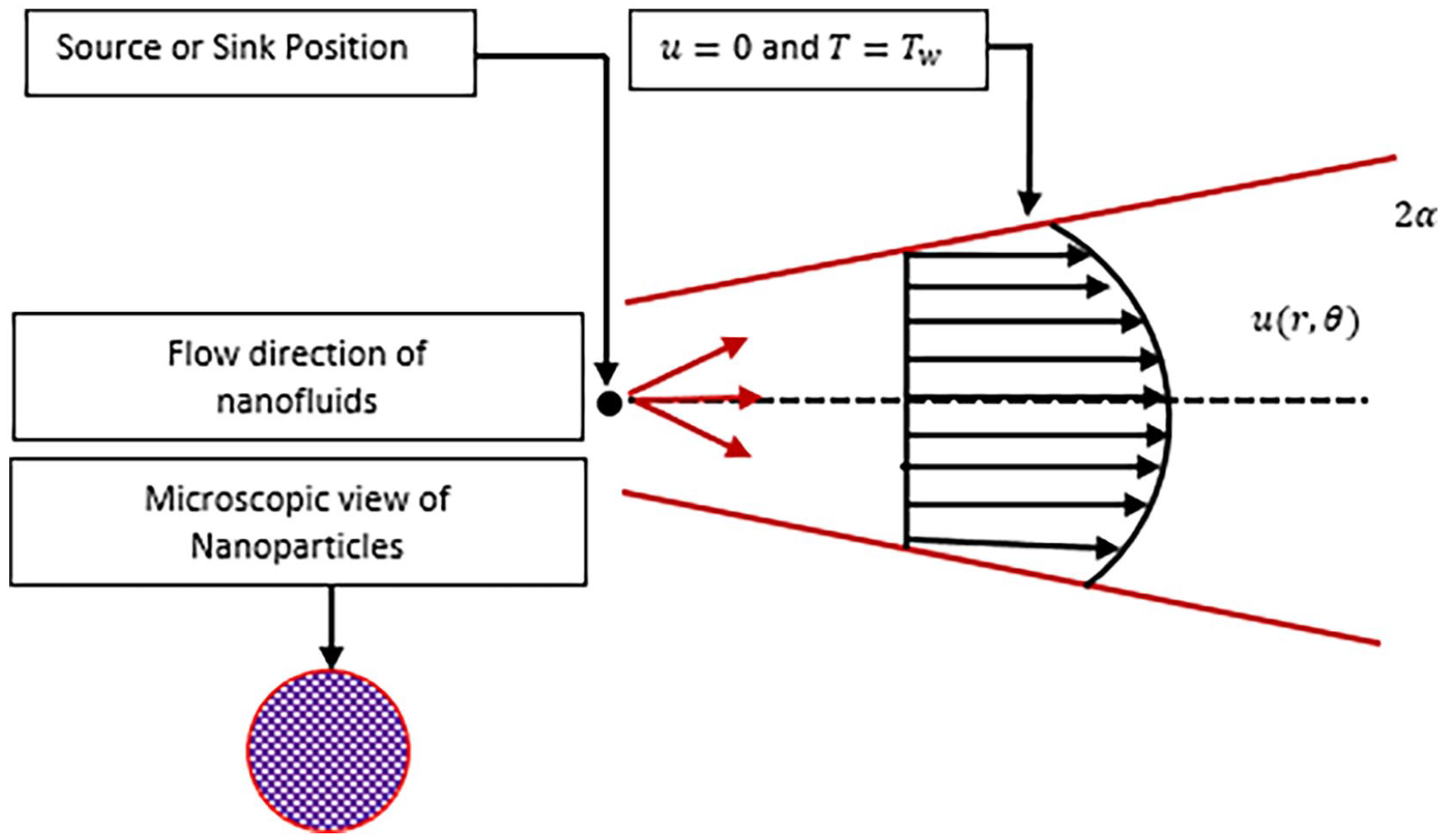
The flow of nanofluids between two non-parallel walls.
The particular set of PDEs that govern the flow of nanofluids between converging/diverging channel are as under 31 :




Here, law of conservation of mass represented by equation (1), equation (2–4) representing the momentum and energy equations, respectively. The feasible set of boundary conditions for the model are:


The suitable similarity transformations defined as:

Integrating equation (1), the following form:

The transport properties of the nanofluids estimated by using the following empirical correlations related thermophysical values (Table 1)32,33:

Using the self-similar variables embedded in equation (7) and the empirical correlations for the nanofluids, the following nonlinear and coupled nature of the flow model:
Final heat transfer models
The final version of the models is given as below:
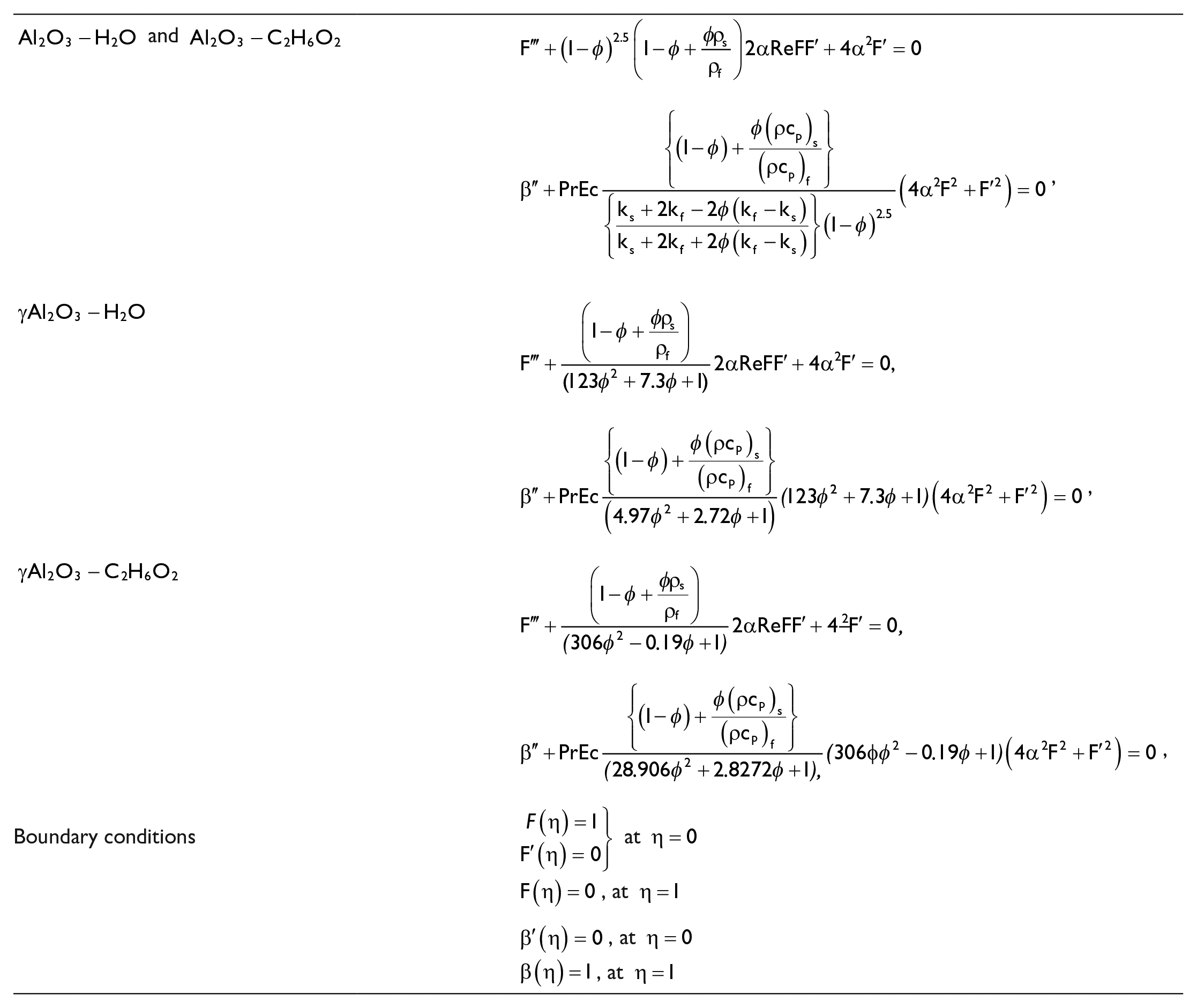
The nondimensional physical parameters appeared in above models are
Further, necessary mathematical action reduced the above expression in the following form (Table 2).

Mathematical analysis
As closed solutions are incredible for nonlinear nature of the flow models such as appeared in the study. Therefore, numerical technique is followed for the solution purpose. Implemented technique is easy to use, accurate and has less computational cost. Primarily, it works on the reduction of highly nonlinear model into joint system of first order which then solve using the numerical technique. The detailed implementation procedure is given below:


Firstly, written the models in the following version:
model


Thereafter, substitutions given in equations (9) and (10) utilized and obtained the following mathematical model:

model

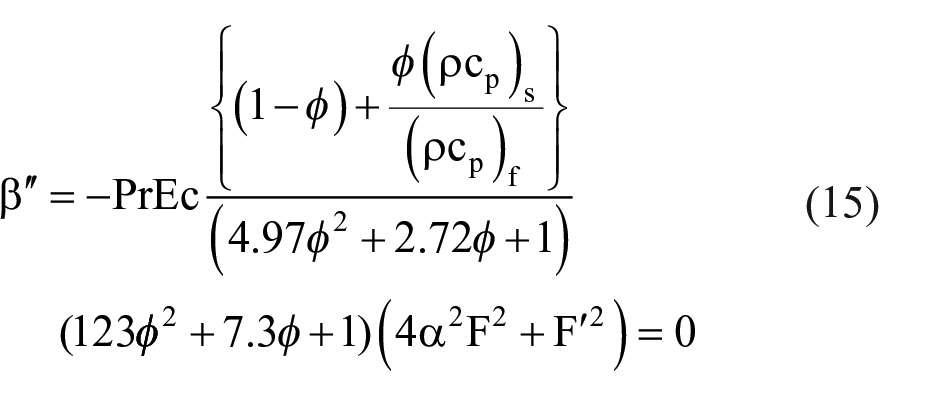
The corresponding system ODEs for α model reduced into the following form:

The system of first order ODEs is then computed by using Mathematica 10.0.
Results and discussion
The importance of various nondimensional physical flow parameters cannot be overlooked. Because these quantities play a very important role in the momentum and energy transport. In the present study, these are Reynolds number ‘Re’, convergent/divergent parameter ‘α’, Eckert number ‘Ec’, volumetric fraction of alumina
Velocity profile
The velocity of nanofluids alters significantly due to induction of nanoparticles and base solvent characteristics. Therefore, Figure 2((a)–(d)) summarizes the fluid velocity behaviour under variable converging/diverging parameter and Re values. The nanofluids move at high velocity while the channel converging and it declines for opening case. Physically, rapid movement of nanoliquid particles occurs due to decrement in the flow portion and the particles attained optimum motion at the middle line. Therefore, the particles gain momentum which directly enhance the fluid motion. On the other side, diverging case resists the fluid movement due to maximum flow region. The fluid particles dispersed inside the channel, as a consequent the motion drops. Moreover, for high Re values, yield back flow towards the channel walls for diverging case because the particles attract near the wall and follow backflow path. The nanoliquid backflow motion can be controlled for converging case. These effects along with comparative velocity analysis for Al2O3-H2O and γAl2O3-H2O depicted in Figure 2(c) and (d). Similarly, the results for Al2O3-C2H6O2 and γAl2O3-C2H6O2 nanoliquids decorated in Figure 3((a)–(d)) and this time quite dominant effects observed compared to Al2O3-H2O and γAl2O3-H2O in both opening and narrowing walls.

The nanofluids velocity against α (a) converging (b) diverging channel Re (c) converging (d) diverging channel for Al2O3-H2O and γAl2O3-H2O.

The nanofluids velocity against
Temperature profile
Figure 4((a)–(f)) deals with investigation of heat transport and Nusselt number by engaging the parameters under different ranges. The results demonstrated for Al2O3-H2O, γAl2O3-H2O, Al2O3-C2H6O2 and γAl2O3-C2H6O2 nanoliquids for converging and diverging cases. These results explored that γ nanoparticles based nanoliquids are very reliable for thermal improvement while H2O and C2H6O2 taken as host solvents. Physically, ultra-improved thermal conductivity of γ-nanoparticles enhances the temperature and is better than simple nanoparticles. Moreover, the enhancement in the temperature is very quick for narrowing case. Physically, in this case, the fluid motion is abrupt and collision phenomena between the particles is very rapid which potentially contributed in the temperature enhancement. These results demonstrated in Figure 4((a)–(d)), respectively.

The nanofluids temperature against
Nusselt number and skin friction
The graphical results for changing Nusselt number under Ec and concentration of the nanoparticles are furnished in Figure 4(e) and (f), respectively. The results plotted for four distinct nanofluids and examined that local heat transport gradient is very high for γAl2O3-C2H6O2 nanofluid because of their rich thermal conductivity which enhance the heat storage ability. Further, for more dissipative fluid and increasing concentration of nanoparticles have positive impact on Nu. Further, changes in skin friction under increasing Re for both
Numerical computation for skin friction via Re.

Validity of the study
This section is devoted to fine comparative analysis of the current study for
Comparison for

Conclusions
The study for different nanofluids laminar flow inside the oblique slanted walls is examined. The proper formulation of the model is performed through nanofluid models and similarity rules. After that, numerical treatment of the model has been done. The following core outcomes of the study investigated:
Increasing the flow region (diverging channel) and high strength of Re are better to control the fluid motion inside the channel, whereas opposite results inspected for converging case.
Integrated effects of viscous dissipation found to be good for thermal enhancement in nanofluids.
γ–aluminium base nanofluids have more ability to transmits heat and is observed very high in the surrounding of middle portion.
The local heat transport inside the walls is dominant for γAl2O3-C2H6O2 than rest of the nanofluids.
The analysis and code validated through existing scientific data and deduced that the study is replicated.
Footnotes
Acknowledgements
The authors would like to thank the Deanship of Scientific Research at Umm Al-Qura University for supporting this work by Grant Code 22UQU4310392DSR29.
Declaration of conflicting interests
The authors declared no potential conflicts of interest with respect to the research, authorship and/or publication of this article.
Funding
The author(s) disclosed receipt of the following financial support for the research, authorship, and/or publication of this article: The authors would like to thank the Deanship of Scientific Research at Umm Al-Qura University for supporting this work by Grant Code 22UQU4310392DSR29.
