




Abstract
Investigation of heat transport mechanism in swirling flow of viscous fluid containing silicon dioxide
Introduction
Researchers have been interested in the fluid flow characteristics and heat transfer aspects of a stretching/shrinking surfaces for a few years. There is no doubt that the theory of fluid flow and heat transfer at a stagnation point may be applied to a wide range of industrial processes, such as plastic extrusion, wire coating, and so on. Sakiadis 1 proposed the concept of a boundary layer formed by a moving flow on a rigid sheet with constant velocity from a slit through a fluid at rest. Based on the outcomes, with increasing distance from the slit, the thickness of the boundary layer increases. The concept of boundary on a moving surface was investigated by Crane. 2 Following Crane, 2 Carragher and Crane 3 examined the thermal approach to this problem. McLeod and Rajagopal 4 address the existence and uniqueness of these stretched flow solutions. Wang 5 has provided many references on stretching surfaces in a viscous fluid. Miklavčič and Wang 6 examined the shrinking case of a viscous fluid initially, followed by Fang 7 and Tie-Gang et al. 8 As Goldstein 9 discusses, a shrinking sheet flow is fundamentally a backward boundary-layer flow that exhibits physical features distinct from stretching sheet flows. Very recently, the numerical simulation for the nanofluid flow due to a stretching/shrinking sheet was discussed by Ferdows et al. 10 and Mousavi et al. 11
There are several applications of swirling flow due to rotating surfaces in industry such as paper drying, plastic manufacturing and wire coating. Many scientists put their effort to investigate the mechanism of swirling flow of viscous fluid with heat transport in the recent decade. Swirl motion of Newtonian fluid was investigated by Fang and Yao. 12 In this article authors established the suitable flow similarities for the conversion of governing three-dimensional flow equations. Naumov et al. 13 investigated the thin layer in interface of two immiscible fluids flow of swirl motion with the help of numerical technique. Hayat et al. 14 analyzed the 3D rotating flow of nanofluid in porous medium by using Darcy-Forchheimer model. Flow between two rotating disks of electro-viscous fluid in the presence of porous medium with Hall effect was studied by Krishna et al. 15 In this study the variation in pressure gradient was taken as time dependent. MHD flow of non-Newtonian fluid with help of Darcy-Forchheimer model was scrutinized by Ali et al. 16 by using well-known finite element method. The studies in this area can be found here (see Refs17–22).
Production of best quality products in polymers industry is mainly depends upon the flow as well as heat transport rate. As the conventional liquid have low thermal conduction so many engineering procedures were adopted to overcomes this problem. Such as fins (extended surfaces), surface roughness, use of interfacial forces etc. Scientists discover nanofluids (a new category of fluid) which comprises the suspended in nano-sized particles
The above comprehensive literature review prove that there is space for the investigation of nanofluid swirling flow. The focus of this article is to explore the thermal transportation characteristics of flow of viscous fluid containing
Mathematical formulation
Consider an elastic cylinder of radius



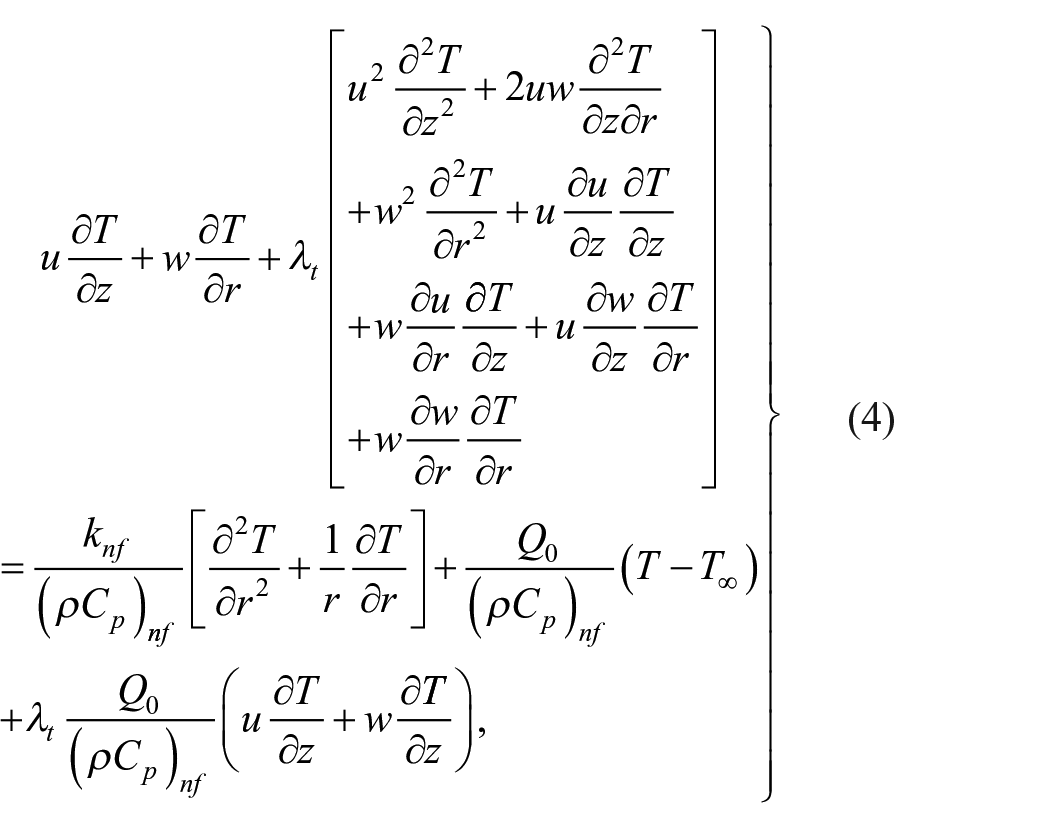
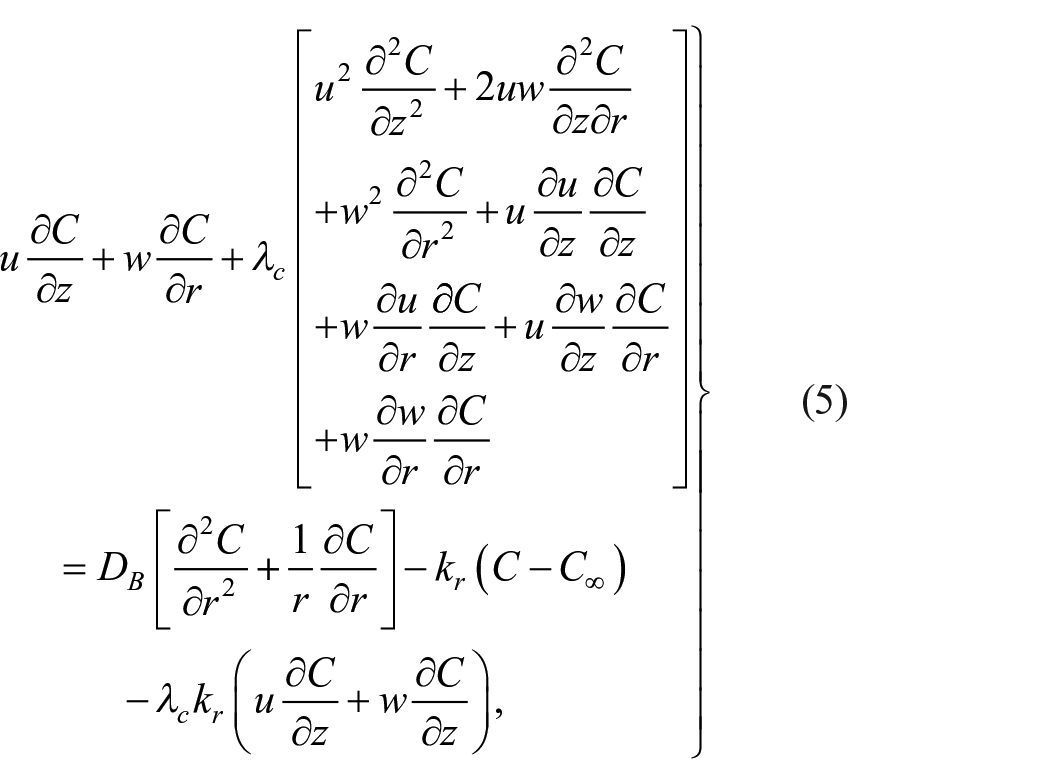
The following BC’s are utilized to analyze the above problem.


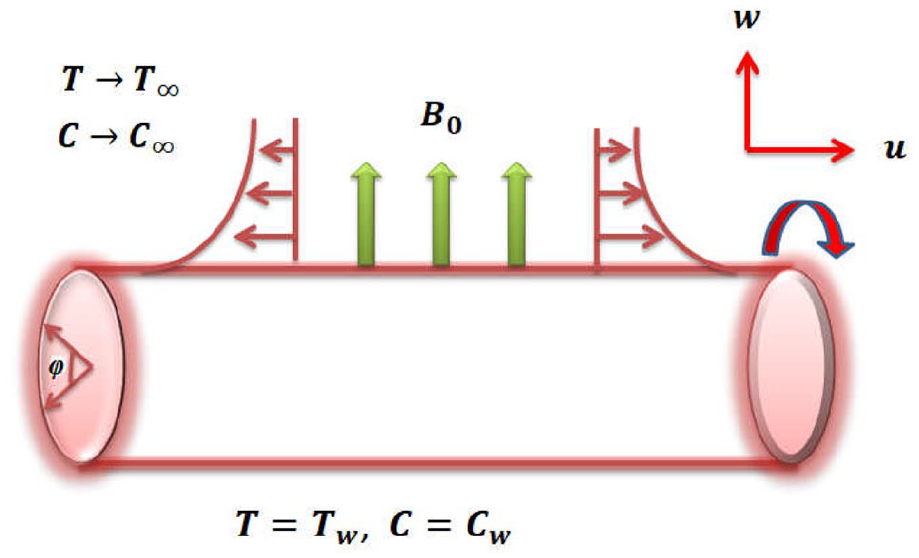
Flow configuration.
Here,
Presenting the following flow similarities and with the help of Table 1

the equation (1) is satisfied automatically and equations (2−5) yield



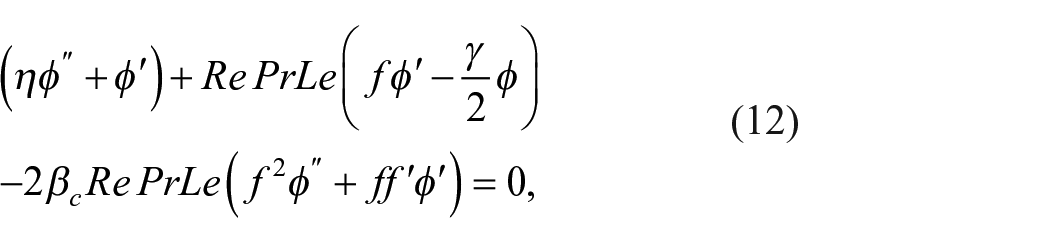
with transformed boundary conditions

Where

A further transformation


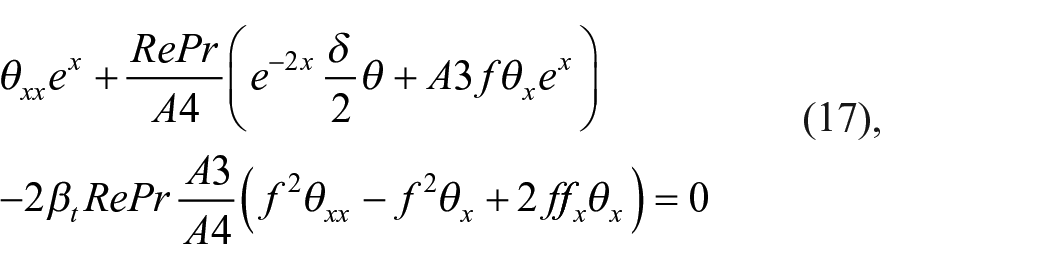
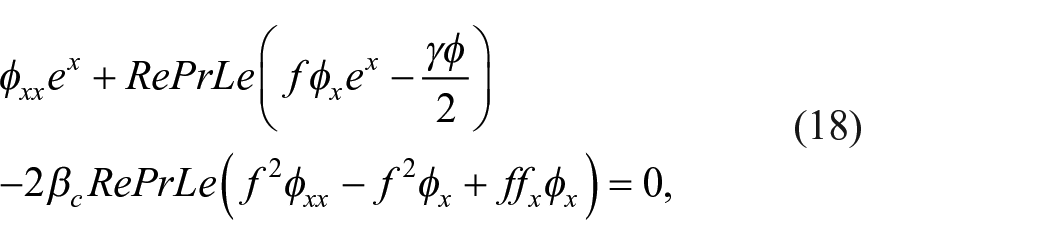
with BCs

Mathematical relations for thermophysical properties of nanofluids.

Physical reasoning of the outcomes
In this portion of research, the graphical results which are computed numerically describe the impact of physical parameters such as Reynolds number Re, magnetic field parameter M, volume fraction coefficient
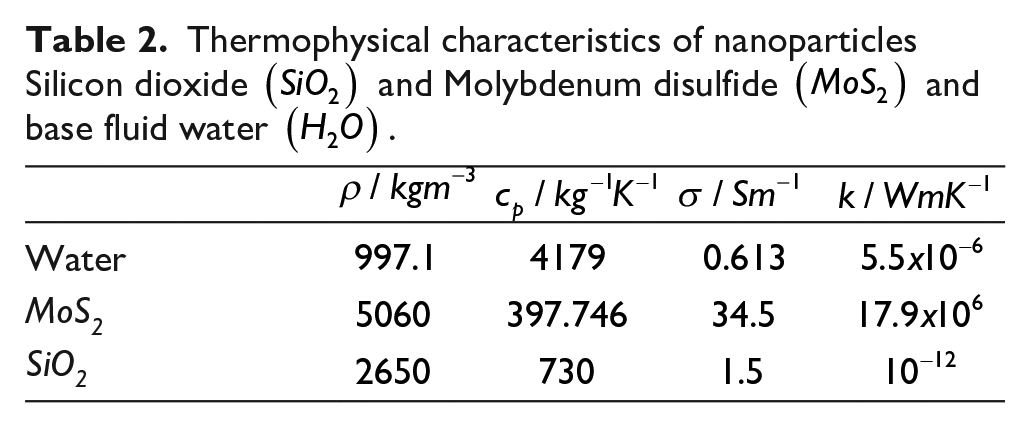
Thermophysical characteristics of nanoparticles Silicon dioxide

(a–c) Impact of Reynolds number Re on

(a and b) Impact of Reynolds number Re on

Impact of Prandtl number Pr on θ

(a–c) Impact of magnetic field parameter M on
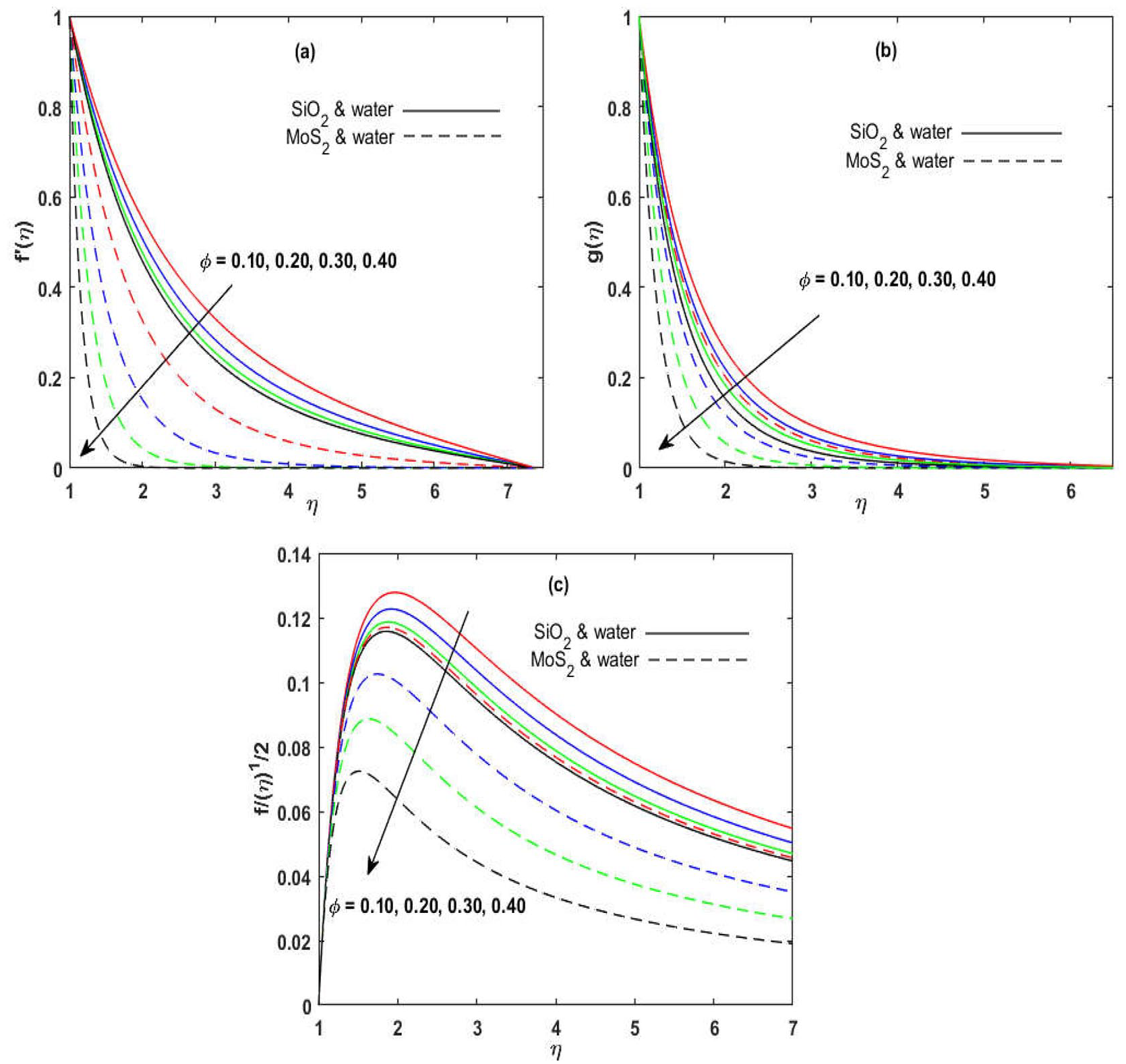
(a–c) Impact of volume fraction coefficient
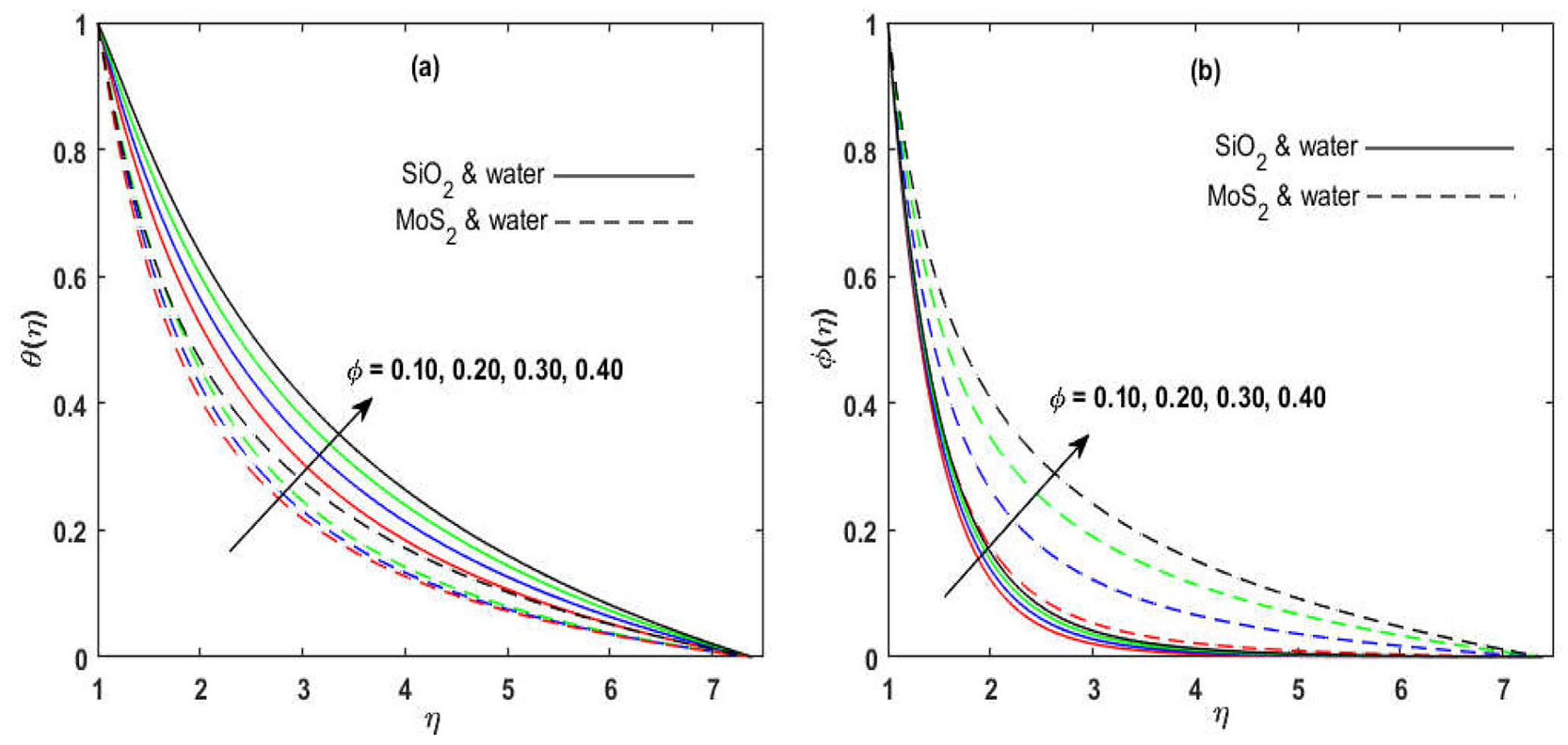
(a and b) Impact of volume fraction coefficient

(a and b) Impact of Lewis number

(a and b) Impact of thermal
The comparison table for numerical values of

Numerical values of

Concluding remarks
Thermal energy transport in the nanofluid flow caused by stretchable rotating cylinder investigated in this article. The water base fluid contains the two different nanoparticles (
The flow confined to the surface of cylinder when Reynolds number
Forced convection declined in case of higher inertial force.
Flow of nanofluid feels resistance when Lorentz force and solid particles concentration were boosted.
The temperature of the fluid rises as
Thermal and solutal relaxation phenomenon limited the energy transportation in the nanofluid flow
Future scope
The present work can be extend for the rheology of non-Newtonian fluids with heat transport. Moreover, entropy generation analysis can also be performed in the present investigated phenomenon.
Footnotes
Declaration of conflicting interests
The author(s) declared no potential conflicts of interest with respect to the research, authorship, and/or publication of this article.
Funding
The author(s) disclosed receipt of the following financial support for the research, authorship, and/or publication of this article: This research was funded by Princess Nourah bint Abdulrahman University Researchers Supporting Project number (PNURSP2022R61) Princess Nourah bint Abdulrahman University, Riyadh, Saudi Arabia.
