Entropy is the measure of the amount of energy in any physical system that is not accessible for the useful work, which causes a decrease in a system’s thermodynamic efficiency. The idea of entropy generation analysis plays a vital role in characterizing the evolution of thermal processes and minimizing the impending loss of available mechanical power in thermo-fluid systems from an analytical perspective. It has a wide range of applications in biological, information, and engineering systems, such as transportation, telecommunication, and rate processes. The analysis of the entropy generation of axisymmetric magnetohydrodynamic hybrid nanofluid /water flow induced by rotating and stretching cylinder in the presence of heat radiation, ohmic heating, and the magnetic field is focus of this study. Thermal energy transport of hybrid nanofluids is performed by applying the Maxwell model. Heat transport is carried out by using convective boundary condition. The dimensionless ordinary differential equations are acquired by similarity transformations. The numerical solution for these differential equations is obtained by the bvp4c program in MATLAB. A comparison between nanofluid and hybrid nanofluid is made for flow field, temperature, and entropy generation. Comparison of nanofluid flow with hybrid nanofluid flow exhibits a higher rate of heat transmission, while entropy generation exhibits the opposite behavior. It is observed that the flow and heat distribution increase as the solid volume fraction’s value grows. An increase in entropy is indicated by augmentation in the Brinkman number and temperature ratio parameter, but the Bejan number shows a declining trend. Furthermore, outcomes of the Nusselt number for hybrid nanofluid and nanofluid are calculated for various parameters. It is noticed that the Nusselt number is reduced for enlarging the magnetic field and Eckert number. The axial and azimuthal wall stress parameters are declined by augmenting the Reynolds number.
One of the extensively studied problems in fluid mechanics is the flow and thermal transport over-rotating and stretching surfaces because of its vast applications in engineering and industrial work. The various utilization of these flows has been seen in the cooling of electronic capacity gadgets, pivoting hardware, clinical kind of gear, and extrusion plastic and metal industries. Due to their viable significance, different investigations have been made in past. Crane1 took the initiative to work on the stretching surface by investigating the viscous fluid flow over the stretching surface in two dimensions and calculated the analytic solution to the problem. This work was additionally extended under an alternate arrangement of conditions by several analysts. In the light of the viable significance of rotating and stretching cylinder, Crane2 also discussed the boundary layer flow due to the stretching cylinder by assuming the linearly varying velocity. Wang3 protracted the Crane’s work by investigating the fluid flow outside the stretching cylinder and determining the heat transfer impact. Elbashbeshy and Bazid4 presented the exact solution for an unsteady flow where motion was resulted by the linearly stretching horizontal surface. Tsai et al.5 analyzed the Newtonian flow of fluid due to unsteady stretching sheet along with heat generation source by applying Chebyshev finite difference method. The numerical investigation of flow and heat transfer along with magnetic effects over-stretching cylinder was addressed by Ishak et al.6 The Keller box method is employed by the author to get the solution numerically. The study of unsteady boundary layer rotating viscous fluid flow with heat transfer analysis was conducted over a continuous stretching sheet by Abbas et al.7 Fang and Yao8 studied the combined effect on the flow produced by the stretching and torsional motion of the cylinder. The influence of the heat generation source on fluid flow induced by the stretching cylinder is examined via the finite difference method by Vajravelu et al.9 Due to great interest in excessive use of viscous dissipation, Gnaneswara Reddy et al.10 studied the magnetic field impact and introduced the viscous dissipation and heat source over the flow produced by a stretching sheet. Jusoh et al.11 presented the dual solutions of the MHD rotating ferrofluid over the stretching sheet via the bvp4c function. Incitation of flow due to extension and rotation of the disk along with magnetic and Joule heating impacts was concentrated by Ahmed et al.12 Using the heat source – sink parameter, Zhang et al.13 investigated the heat transfer characteristics of the nanofluid flow caused by stretching and torsional motion of the cylinder.
To improve heat transmission various techniques have been used for a long time by many experts. Nonetheless, presenting nano-size particles in the base liquid acquired a lot of importance. Choi14 revealed that the thermal conductivity of the liquids was upgraded by the suspension of nanoparticles into base liquids. Metallic solids utilized for this intention were copper, silver, gold, and non-metallic solids like silicon, aluminum, and so forth. The all-over utilization of nanofluid has acquired extra acknowledgment in heat transportation, medical, electronic cooling systems, and radiator, and is used as a coolant in the thermal exchange system. Because of the captivating characteristics of the nanofluids, numerous analysts inspected the thermal conduction of nanofluids and found thermal transport is enhanced due to their presence. Das et al.15 did the preliminary assessment to concentrate on the impacts of temperature on the progress of thermal conductivity of nano liquids. Buongiorno16 represented the influence of the Brownian motion and thermophoresis in nanofluids. Experts are enraptured using hybrid nanofluids in relationship with nanofluids. Dispersing two or more nanoparticles in the base liquid yields a hybrid nanofluid. Hayat and Nadeem17 noted that the heat transfer rate is higher in hybrid nanofluids as compared to nanofluids by using Ag and Cu as nanoparticles, and water as base fluid. On the account of the improved heat transfer rate of hybrid nano liquids, Tassaddiq et al.18 studied heat and mass transfer over swirling disks with hybrid nanofluids. Khan et al.19 inspected the flow and thermal analysis in the light of the Tiwari Das model for hybrid nano liquids by applying the bvp4c scheme. Ahmed et al.20 researched the flow and thermal analysis over rotating cylinder investigation of the flow and thermal analysis due to torsional motion of the cylinder by using (TiO2-Al2O3/water) hybrid nanofluid. Waqas et al.21 conducted a comparison study and looked at the heat radiation effects on the MHD hybrid nanofluid flow over the stretched sheet at a stagnation point. Waqas et al.22 intrigued the investigation using the melting and convective condition in the MHD hybrid nanofluid flow between two continually rotating surfaces.
One thing which is the center of interest is the complete usage of energy assets and staying away from energy misfortunes in thermal frameworks. The second law of thermodynamics states that irreversible changes occur in the flow and heat transfer process because of energy losses. So, to beat these losses researchers studied entropy generation to test the efficiency of the thermal system. For better execution of the system, the entropy generation ought to be decreased. Bejan23,24 pioneered the examination of entropy generation and its minimization strategies. Munawar et al.25 obtained the solutions to analyze the entropy because of the heat transfer and viscous dissipation by utilizing isothermal boundary conditions over a rotating and stretching cylinder. On the account of the eminent utilization of nanofluids over the stretching and swirling bodies assessment of the influence of the Brownian movement and thermophoresis was carried out along with entropy formation over the stretching surface by Butt et al.26 The collaboration of nanoparticles with entropy production alongside thermal radiation over a stretching surface was explored by Bhatti et al.27 The second law of thermodynamics was utilized by Ahmed et al.28 to search the irreversibility impacts within the study of hybrid nanofluid by executing the bvp4c procedure. The irreversibility due to thermal transport, fluid friction, and viscous dissipation all together with nanofluid between two turning and extending disks by implementing the RK technique was investigated by Hosseinzadeh et al.29 Imran et al.30 used numerical analysis to investigate the two-dimensional flow of kerosene oil containing SiC and TiO2 nanoparticles through a moving flat horizontal surface with various form effects and entropy production. The author also investigated the velocity slip and convective heat transfer.
Several researchers have examined the effects of entropy generation with respect to heat and mass transport on stretching and rotating surfaces. However, there are only a few studies that cover the analysis of entropy generation in the flow on stretching and rotating cylinder. Inspired by the useful applications of the rotating and stretching surfaces and the innovative heat transfer properties of the hybrid nanofluids, this paper intends to discuss the entropy generation in the MHD hybrid nanofluid flow in the sight of thermal radiation impact on over-rotating and stretching cylinder with convective boundary conditions. Metal extrusion, polymer technologies, turbine engines, and flywheels are the possible applications of rotating and stretching surfaces. Moreover, and (also in combination) serves as an essential biomaterial and functional material. Functional materials are engineered, and sophisticated materials developed and synthesized for a particular function and have defined surface shapes and characteristics. However, a substance or compound created to utilize in the therapeutic or diagnostic treatment is referred to as a biomaterial. The combination of these nanoparticles immersed in water provides a doorway to different applications in biosciences. The characteristics of flow and heat transfer analysis are studied by using the heat source-sink parameter and Ohmic heating effects. The current work is motivated by Zhang et al.13 and is an extension of their work. The governing PDEs are transformed into dimensionless ODEs by using similarity conversions. The bvp4c routine is executed to numerically solve the resulting equations. Highly non-linear differential equations are solved through this technique which uses the three-stage Lobatto IIIa formula. Nusselt number values for hybrid nanofluid and nanofluid for different parameters are also obtained. Graphical illustrations and results in tabular form depict the acquired outcomes.
Mathematical formulation
We assume a steady axisymmetric MHD hybrid nanofluid (-)/water flow over a stretching and rotating cylinder of radius . and are picked as nanoparticles while the base fluid is assumed to be water. To display the physical problem, cylindrical coordinates are utilized. The constituents of velocity for the flow system are taken along the axes and . The cylinder stretches with the velocity while rotates with a constant azimuthal velocity . With a uniform magnetic field, is enforced in the radial direction. Besides, heat source/sink , and radiation heat flux are also taken. The convective boundary conditions are taken and represents the ambient fluid temperature. The geometrical configuration is given in Figure 1.
Flow mechanism.
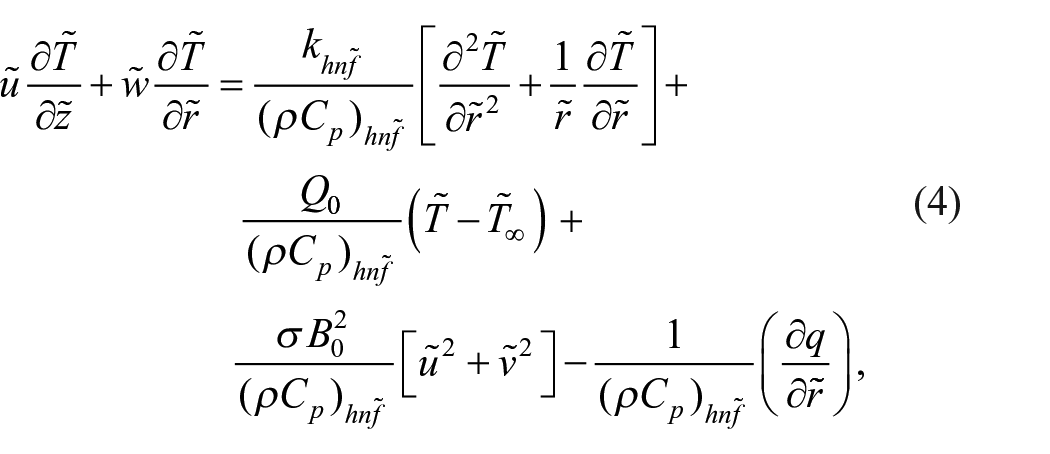
Following Fang and Yao8 the phenomenon governed by the following partial differential equations
where is the radiation heat flux, where and are the Stefan Boltzmann and mean absorption coefficients.
The BCs are
Here, are the components of the velocity in the and directions, respectively.
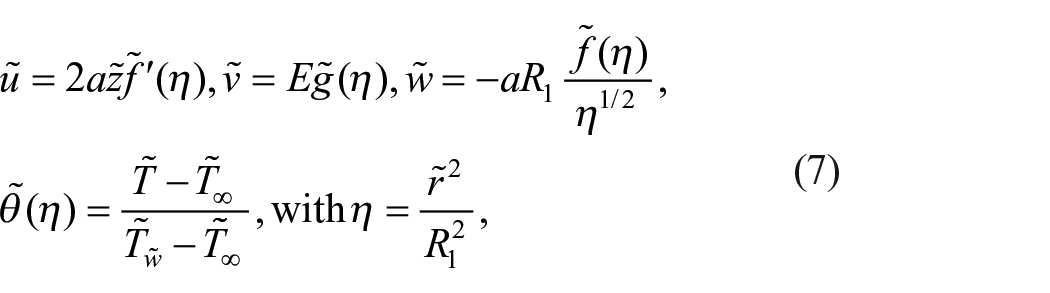
The similarity conversions are (following Zhang et al.13)
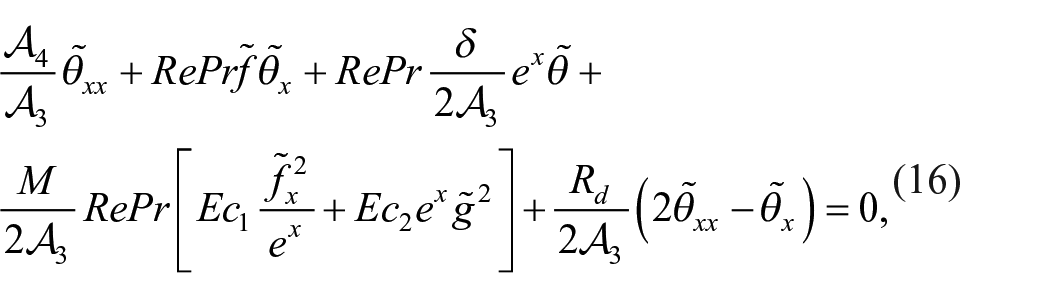
where and denote stretching rate and the tangential velocity, respectively. ( is kept constant: represents the torsional motion of the cylinder). After inserting these conversions, it is noted that equation (1) is satisfied and equations (2) to (4) take the forms
with BCs
The dimensionless parameters involve: is the magnetic field parameter, the source/sink parameter, the Reynolds number, the Eckert number due to stretching cylinder, is due to swirl motion, the Prandtl number, the radiation parameter, and the thermal Biot number.
Further, and are defined as
Using the transformation for fast convergence as used by Fang and Yao8.
BCs become
We have taken derivative w.r.t in the preceding equations. Table 1 presents the numerical values of thermophysical characteristics of water (base fluid) and nanoparticles. Table 2 gives the mathematical relations for the thermophysical properties of hybrid nanofluids and simple nanofluids.
Thermophysical characteristics of the water and nanoparticles (see Zhang et al.13).
Properties
997.1
5060
2650
4179
397.746
730
0.613
34.5
1.5
6.2
Mathematical relations for the properties of hybrid nanofluids and nanofluids.
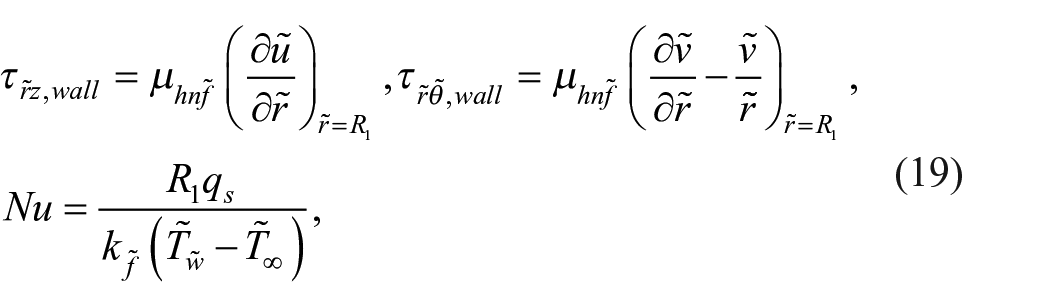
Engineering and industrial quantities of interest
Wall shear stress and Nusselt number have the following expression:
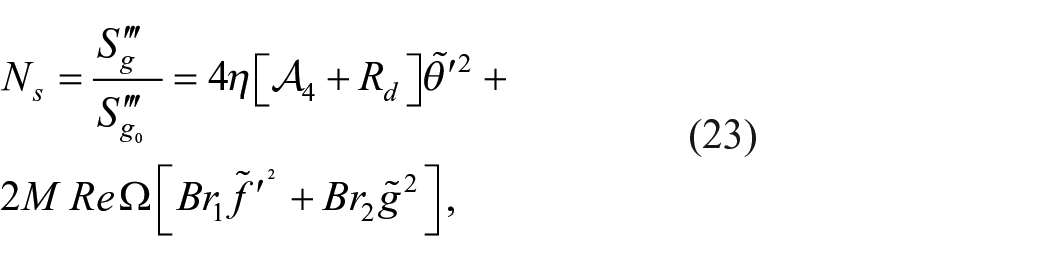
The expression for local entropy formation owing to heat transfer, magnetic field, and thermal radiation is as follows
The dimensionless form becomes
where and are the entropy generation rate, temperature ratio parameter, Brinkman numbers due to stretching and rotation of the cylinder, respectively.
Moreover, to converge faster, we use the transformation in the above equation.
Bejan number, another irreversibility parameter is written as:
Mathematically,
After transformation, it becomes
Bejan number has value ranging from to . Irreversibility is governed by heat transfer when . While entropy due to thermal transport, radiation parameter, and magnetic effects become equal when .
Numerical solution approach
Numerically, the solution of our dimensionless nonlinear flow and energy equations is obtained by the bvp4c MATLAB routine. It implements the Lobatto III formula providing continuous solutions having the accuracy of fourth order on the prescribed interval. By substituting the following variables, the third-order non-linear differential equation is then transformed into a first-order differential equation.
with
Results and discussion
This section describes the numerical outcomes with the physical significance of the impact of pertinent parameters. The technique bvp4c is used to obtain numerical solutions for flow and temperature fields, entropy generation, and Bejan number in the hybrid nanofluid and simple nanofluid flow subject to linear thermal radiation and Joule heating. The mixture of and is immersed in water (acting as a base fluid). Mesostructured nanoparticles made of silica () have become a whole family of biomaterials that can meet the needs of the bone regeneration process. Human cells responsible for synthesis and mineralization (osteoblast) are morphogenetically active and induce mineralization in the presence of bio-silica, which is a biocompatible and naturally occurring inorganic polymer formed by an enzymatic reaction. Similarly, nanomaterials function actively as a natural drug carrier for photothermal combination therapy, which includes chemotherapy, photodynamic therapy, radiation, and gene therapy. They have unique electrical, optical, and physicochemical properties. The impact of solid volume fraction , Reynolds number 1 ≤ Re ≤ 6, magnetic field parameter 1 ≤ M ≤ 10, thermal radiation parameter 0.5 ≤ Rd ≤ 25, Prandtl number 1 ≤ Pr ≤ 9, Eckert numbers 0.11 ≤ Ec1 ≤ 0.17 and 0.11 ≤ Ec2 ≤ 0.17, Brinkman numbers 1 ≤ Br1 ≤ 4 and 1 ≤ Br2 ≤ 4, Biot number 1 ≤ B1 ≤ 2.5, and temperature ratio parameter on axial and swirl velocities, temperature profile, entropy generation, and Bejan number are explored graphically and numerically.
It is noted that when the amount of nanoparticles increases, the arbitrary movement and vibration among the atoms are likewise enhanced, resulting in the addition of the system’s kinetic energy. As a result, as shown in the Figure 2, the velocity profiles and energy distribution phenomena are improved. It is also observed that the profiles of and are more developed for hybrid nanofluids as compared to simple nanofluids. The increasing behavior of these profiles is due to enhanced thermal and physicochemical characteristics of -/water hybrid nanofluids. Since both nanoparticles act as bio-functional materials, their combination will have a significant amount of effect on their thermo-physio-chemical features. To manage and assemble the interface of composite materials, the amount of filler (addition of nanoparticle concentration) or materials with enhanced conductive properties is an effective way to achieve high overall performance. Figure 3(a) and (b) exhibit that axial and swirl velocity lessen when the magnetic field is stronger. It is the direct result of the resistive force produced in the fluid flow due to a magnetic field called Lorentz force which hinders the motion of the fluid. Since Lorentz force speeds up the cooperation of the liquid particles resulting in the increment of thermal conduction. Consequently, the temperature profile of hybrid nanofluid improves more than that of nanofluid shown in Figure 3(c). Again, the thermal energy is augmented due to the advanced electrical characteristics of these and nanoparticles. Here, the combination of these nanoparticles acts as electromagnetic functional materials. By using common polymeric material forming techniques, these composite materials are transformed into conductive and magnetic products with the desired shape and mechanical characteristics. Figure 4(a) to (c) depict the impacts of the Reynolds number on the flow field and energy distribution. Decay in the velocity and temperature profiles is observed. As Reynolds number is the ratio of inertial forces to viscous forces; therefore, with higher values of Reynolds number, inertial forces increase, which oppose fluid flow in all directions. The system’s thermal transport is caused by forced convection, and fluid motion is caused by the cylinder’s rotation and stretching. As a result, flow and energy transport only occurs close to the cylinder’s surface. A decrease in the kinematic viscosity of the fluid flow causes a decline in forced convection and thermal transport. Figure 5(a) and (b) display the effects of and on the temperature distribution. is due to the stretching while is due to the rotation of the cylinder. Developing temperature profile in case of hybrid nanofluid is noted as compared to conventional nanofluid case. Augmentation in frictional forces inside the fluid is seen by incrementing the Eckert numbers, which improves the thermal energy transport. Physically, it is used to describe heat transfer in high-speed flows where significant viscous dissipation occurs. The outcomes of the Prandtl number, heat source parameter, and Radiation parameter on the distribution of thermal energy are provided in Figure 6. Prandtl number connects the viscosity and thermal conductivity of the fluids. Domination of momentum transport over thermal transport occurs by upgrading the Pr. Because of low thermal transport, the temperature profile drops. Small Prandtl values are suitable for heat-transmitting liquids since they are free-flowing liquids with enhanced thermal conductivity. The heat source parameter detects the temperature field development, which supplies more heat to the system by increasing thermal transport. Improvement in heat transfer phenomenon is noticed due to increment in . The radiation parameter characterizes the conduction of heat transport to thermal radiation transport. Expansion in radiation parameters brings about an increasing temperature profile. is a radiation-stable material. For certain radiations, silicon polymers work well as absorbers due to their ionizing effectiveness of radiations. Because of this, they make effective radiation shielding materials.
: ϕ1 on and
: on and .
: Re on and
: and on
: and on
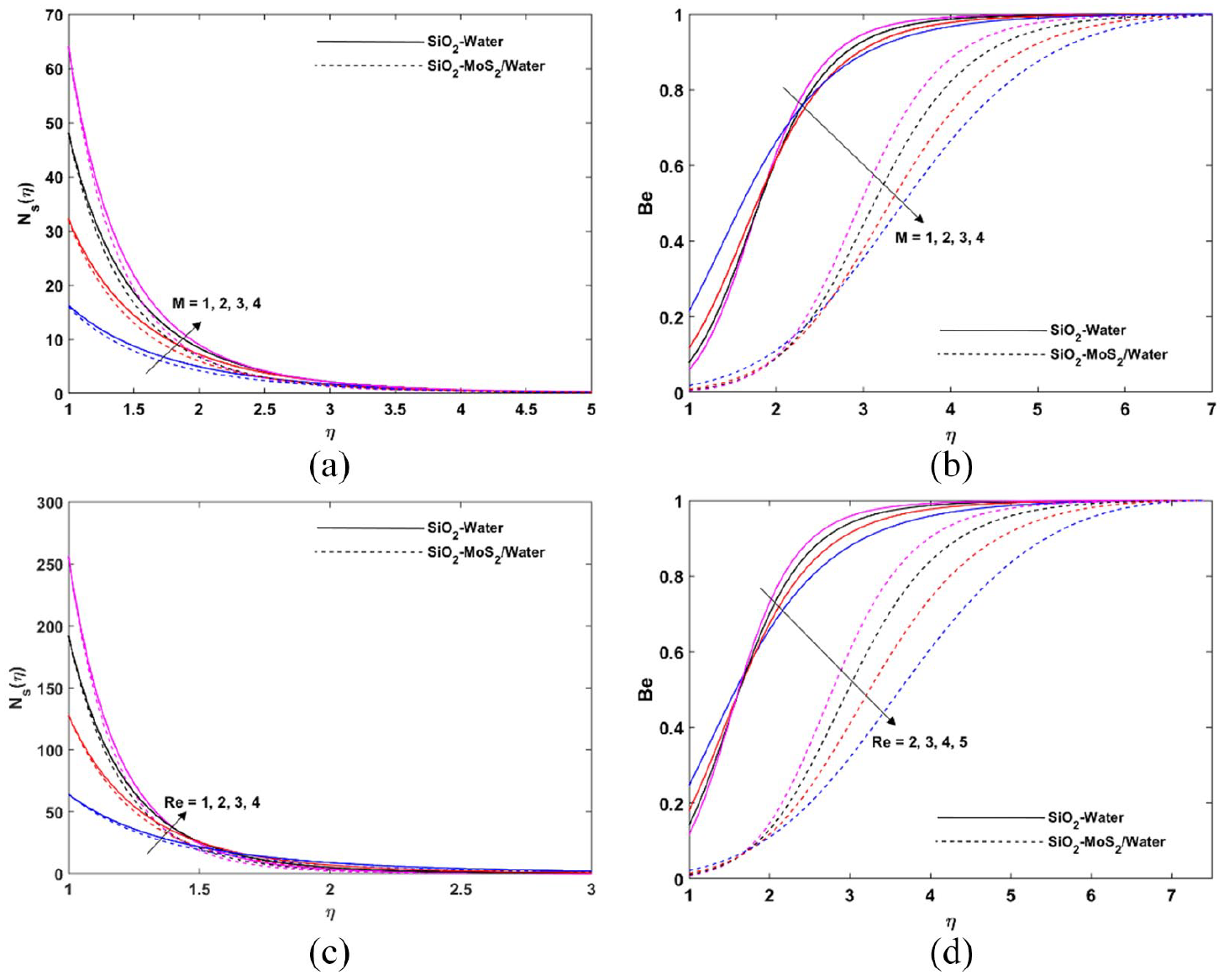
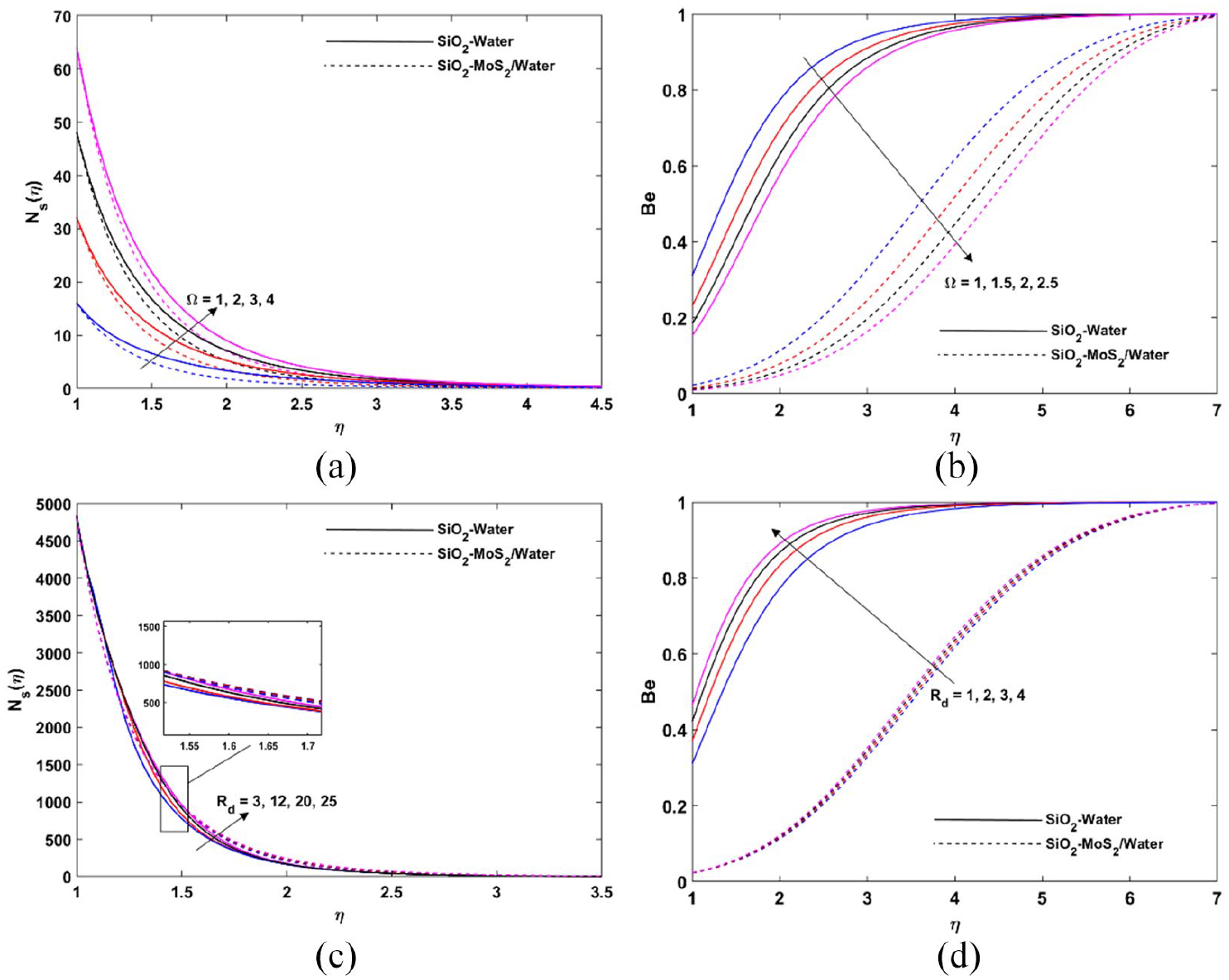
High entropy alloys, such as and alloys, exhibit wear and corrosion resistance properties while having a lower heat conductivity than pure metals. Because of their remarkable superconductivity, they are utilized in high-temperature, low-density refractories for aircraft engine components. The impact of magnetic field on and are portrayed in Figure 7(c) and (d). It is observed that due to the resisting nature of Lorentz force, created by the magnetic field, entropy rises. However, by maximizing the magnetic field parameter, Bejan number decreases. As the surface is exposed normally to the magnetic field, thus, irreversibility effects are more visible near the stretching surface. Figure 7(c) and (d) validate that the entropy generation number elevates and Bejan number decelerates by enhancing the Reynolds number. Increment in inertial forces occurs by making the Re high due to which entropy increases. The irreversible upshots owing to Brinkman numbers are visible in Figure 8(a) to (d). Entropy production is the raising function of and while Bejan number shows diminishing behavior. Here, is due to the stretching velocity of the cylinder, while is because of rotational velocity. As the Brinkman number is related to heat conduction from a wall to a moving viscous fluid, more heat is produced in the system which causes entropy to rise. Because of and irreversible impacts due to fluid friction and magnetic field increase. Figure 9(a) and (b) shows the variation of and by maximizing the temperature ratio parameter. It is anticipated that entropy generation shows increasing behavior while declines by increasing Ω. Heat transfer irreversibility rises by enhancing Ω. Figure 9(c) and (d) show how and changes as the radiation parameter increases. Entropy generation and shows an increasing trend by rising The radiation parameter adds extra heat to the system, so thermal irreversibility increases. Silicon and molybdenum-based alloys are better able to withstand radiation-induced swelling. Therefore, the silicon and molybdenum-based compounds may show great potential for use as structural materials for better reactor systems. Also, increasing trend is seen in entropy generation; however, reduction in Bejan number was displayed by increasing the nanoparticle concentration as shown in Figure 10(a) and (b). Here entropy effects due to fluid frictions are dominant as compared to heat irreversibility. The improved thermal and physicochemical properties of SiO2-MoS2/water hybrid nanofluids account for the increased behavior of these profiles. Their combination will significantly influence their thermo-physio-chemical features since both nanoparticles work as bio-functional materials. Figure 10(c) and (d) illustrates the impacts of Biot number on entropy. Entropy and Bejan number are the rising function of the Biot number. Physically, the Biot number causes a rise in the temperature gradient at the cylinder’s surface and entropy increases. Silicon and molybdenum are typically found in twinning-induced plasticity steels due to their exceptional strength and ductility. Additionally, a high ductility is achieved with a high strain hardening rate by including these components in the high-strength steel grade.
(a – d) : and on and
and on and
(a − d) : Ω and on and .
(a − d) : and on and .
Table 3 shows the numerical estimation of the Nusselt number for both nanofluid and hybrid nanofluid, using various parameters (δ, M, Ec1, Ec2, and ). It is noted that rising δ, M, , and reduce the Nusselt number while raising increases the Nusselt number. When comparing hybrid nanofluid to nanofluid, the Nusselt number is larger. The bvp4c approach is used to calculate the Nusselt number’s values. Table 4 is presented to validate the results of problem by comparing them with the previously published papers, Fang and Yao8 and Zhang et al.13 The table is constructed by varying the values of Reynolds number and neglecting hybrid nanofluid conduct and magnetic effects for coefficients of shear stresses. It is found that and decrease by augmenting the The results obtained are in good agreement with Fang and Yao8 and Zhang et al.13 as a special case, that is, for .
Numerical computation of with fixed , and
Nanofluid
Hybrid nanofluid
0.00
4
0.15
0.15
0.5
0.50581
0.7245
0.03
0.48712
0.72308
0.05
0.47376
0.72211
0.05
4
0.15
0.15
0.5
0.473
0.72134
5
0.35934
0.70887
6
0.24937
0.69746
0.05
4
0.11
0.15
0.5
0.54316
0.73087
0.13
0.50808
0.7261
0.15
0.473
0.72134
0.05
4
0.15
0.11
0.5
0.54854
0.73172
0.13
0.51077
0.72653
0.15
0.473
0.72134
0.05
4
0.15
0.15
0.5
0.473
0.72134
1.0
0.62242
0.72969
1.5
0.75673
0.73806
Numerical comparison with Fang and Yao8 and Zhang et al.13 of and when .
Fang and Yao8
Zhang et al.13
Fang and Yao8
Zhang et al.13
0.1
− 0.48960
− 0.48252
− 0.48229
− 0.51023
− 0.5102
− 0.51316
0.2
− 0.61425
− 0.6161
− 0.61455
− 0.52750
− 0.52595
− 0.52009
0.5
− 0.88702
− 0.884
− 0.87999
− 0.52750
− 0.5859
− 0.58137
1.0
− 1.17950
− 1.17821
− 1.17983
− 0.687943
− 0.68796
− 0.680172
2.0
− 1.59700
− 1.59785
− 1.59399
− 0.87264
− 0.87266
− 0.87211
5.0
− 2.41798
− 2.41817
− 2.41241
− 1.29788
− 1.29759
− 1.29211
10
− 3.34454
− 3.34445
− 3.34310
− 1.81007
− 1.81019
− 1.81119
Concluding remarks
We have investigated the entropy produced in an axisymmetric (MHD) hybrid nanofluid flow induced due to rotating and stretching cylinder. Here, irreversibility effects were considered because of heat transfer, radiation parameter, and Joule heating. The flow and thermal energy mechanisms are studied in the existence of thermal radiation and heat generation characterized by convective condition. Analysis of hybrid nanofluid was carried out by employing the Maxwell model. and were utilized as nanoparticles while water was selected as a base fluid. The results of our investigation are summed up underneath
An increased concentration of nanoparticles enhanced the velocity and temperature profile.
With increment in Reynolds number and magnetic number, the velocity profiles declined.
By upgrading Eckert numbers, heat generation/absorption parameter, thermal radiation, and magnetic number, the energy of the system was augmented.
The decline in thermal energy distribution occurred by incrementing Reynolds number and Prandtl number.
Improvement in the heat transfer was noted in hybrid versus simple nanofluid.
The entropy production was boosted for both hybrid and simple nanofluids by enhancing temperature ratio parameter, nanoparticle volume fraction, Brinkman numbers, Reynolds number, and magnetic number.
Bejan number showed decreasing behavior due to the variation of temperature ratio parameter, nanoparticle volume fraction, Brinkman numbers, Reynolds number, and magnetic number.
Bejan number and entropy generation were amplified due to linear thermal radiation and Biot number.
Comparison of nanofluid flow with hybrid nanofluid flow exhibited a higher rate of heat transmission, while entropy generation displayed the opposite behavior.
Nusselt number was reduced by raising the heat source/sink parameter, magnetic number, and Eckert numbers.
In the absence of magnetic and hybrid effects, the axial and azimuthal coefficients of wall shear stress were decreased due to an increase in the value of Reynolds number.
Footnotes
Appendix
Declaration of conflicting interests
The author(s) declared no potential conflicts of interest with respect to the research, authorship, and/or publication of this article.
Funding
The author(s) disclosed receipt of the following financial support for the research, authorship, and/or publication of this article: The Deanship of Scientific Research (DSR) at King Abdulaziz University (KAU), Jeddah, Saudi Arabia has funded this project, under grant no. (RG-2-130-43).
ORCID iD
Mahnoor Sarfraz
References
1.
CraneLJ. Flow past a stretching plate. Z Angew Math Phys1970; 21(4): 645–647.
2.
CraneLJ. Boundary layer flow due to a stretching cylinder. Z Angew Math Phys1975; 26(5): 619–622.
3.
WangCY. Fluid flow due to a stretching cylinder. Phys Fluids1988; 31(3): 466–468.
4.
ElbashbeshyEMABazidMAA. Heat transfer over an unsteady stretching surface. Heat Mass Transf2004; 41(1): 1–4.
5.
TsaiRHuangKHHuangJS. Flow and heat transfer over an unsteady stretching surface with non-uniform heat source. Int Commun Heat Mass Transf2008; 35(10): 1340–1343.
6.
IshakANazarRPopI. Magnetohydrodynamic (MHD) flow and heat transfer due to a stretching cylinder. Energy Convers Manag2008; 49(11): 3265–3269.
7.
AbbasZJavedTSajidMAliN. Unsteady MHD flow and heat transfer on a stretching sheet in a rotating fluid. J Taiwan Inst Chem Eng2010; 41(6): 644–650.
8.
FangTYaoS. Viscous swirling flow over a stretching cylinder. Chin Phys Lett2011; 28: 114702.
9.
VajraveluKPrasadKSanthiSRUmeshV. Fluid flow and heat transfer over a permeable stretching cylinder. J Appl Fluid Mech2014; 7(01): 111–120.
10.
Gnaneswara ReddyMPadmaPShankarB. Effects of viscous dissipation and heat source on unsteady MHD flow over a stretching sheet. Ain Shams Eng J2015; 6(4): 1195–1201.
11.
JusohRNazarRPopI. Magnetohydrodynamic rotating flow and heat transfer of ferrofluid due to an exponentially permeable stretching/shrinking sheet. J Magn Magn Mater2018; 465: 365–374.
12.
AhmadSHayatTAlsaediAUllahHShahF. Computational modeling and analysis for the effect of magnetic field on rotating stretched disk flow with heat transfer. Propulsion Power Res2021; 10(1): 48–57.
13.
ZhangJAhmedANaveed KhanMWangFAbdelmohsenSATariqH. Swirling flow of fluid containing (SiO2) and (MoS2) nanoparticles analyze via Cattaneo-Christov theory. J Appl Biomater Funct Mater2022; 20: 22808000221094685.
14.
ChoiSUS. Enhancing thermal conductivity of fluids with nanoparticles. ASME Int. Mech. Eng1995; 66: 99–105.
15.
DasSKPutraNThiesenPRoetzelW. Temperature dependence of thermal conductivity enhancement for nanofluids. J Heat Transf2003; 125(4): 567–574.
16.
BuongiornoJ. Convective transport in nanofluids. ASME J Heat Transf2006; 128: 240–250.
17.
HayatTNadeemS. Heat transfer enhancement with Ag–CuO/water hybrid nanofluid. Results Phys2017; 7: 2317–2324.
18.
TassaddiqAKhanSBilalM, et al. Heat and mass transfer together with hybrid nanofluid flow over a rotating disk. AIP Adv2020; 10(5): 055317.
19.
KhanMAhmedJSultanaFSarfrazM. Non-axisymmetric Homann MHD stagnation point flow of Al2O3-Cu/water hybrid nanofluid with shape factor impact. Appl Math Mech2020; 41(8): 1125–1138.
20.
AhmedJShahzadAFarooqAKamranMUd-Din KhanS. Thermal analysis in swirling flow of titanium dioxide–aluminum oxide water hybrid nanofluid over a rotating cylinder. J Therm Anal Calorim2021; 144(6): 2175–2185.
21.
WaqasHKhanSAMuhammadTRaza Shah NaqviSM. Heat transfer enhancement in stagnation point flow of ferro-copper oxide/water hybrid nanofluid: a special case study. Case Stud Therm Eng2021; 28: 101615.
22.
WaqasHAli KhanSMuhammadT. Thermal analysis of magnetized flow of AA7072-AA7075/blood-based hybrid nanofluids in a rotating channel. Alex Eng J2022; 61(4): 3059–3068.
23.
BejanA. A study of entropy generation in fundamental convective heat transfer. J Heat Transf1979; 101: 718–725.
24.
BejanA. Entropy generation minimization: the new thermodynamics of finite-size devices and finite-time processes. J Appl Phys1996; 79(3): 1191–1218.
25.
MunawarSSaleemNMehmoodA. Entropy production in the flow over a swirling stretchable cylinder. Thermophys Aeromechanics2016; 23(3): 435–444.
26.
ButtASAliAMehmoodA. Entropy analysis in MHD nanofluid flow near a convectively heated stretching surface. Int J Exergy2016; 20(3): 318–342.
27.
BhattiMMSheikholeslamiMShahidAHassanMAbbasT. Entropy generation on the interaction of nanoparticles over a stretched surface with thermal radiation. Colloids Surf A Physicochem Eng Asp2019; 570: 368–376.
28.
AhmadSNadeemSUllahN. Entropy generation and temperature-dependent viscosity in the study of SWCNT–MWCNT hybrid nanofluid. Appl Nanosci2020; 10(12): 5107–5119.
29.
HosseinzadehKMogharrebiARAsadiASheikhshahrokhdehkordiMMousavisaniSGanjiDD. Entropy generation analysis of mixture nanofluid (H2O/C2H6O2)–Fe3O4 flow between two stretching rotating disks under the effect of MHD and nonlinear thermal radiation. Int J Ambient Energy2022; 43(1): 1045–1057.
30.
ImranMYasminSWaqasH, et al. Computational analysis of nanoparticle shapes on hybrid nanofluid flow due to flat horizontal plate via solar collector. Nanomater2022; 12(4): 663.