




Abstract
Background:
Titanium dioxide (TiO2) is a high-reflectance material for preparing sheets used in detailed dry reagent chemical tests. In this study, bifunctional TiO2 sheets with diffusive and reflective properties were prepared using TiO2 microspheres (particle size 2–3 μm) and cellulose acetate (CA). Factors such as the CA dosage, water content, mixing time, and the choice of surfactant were investigated.
Methods:
The structure and properties of the bifunctional TiO2 sheets were characterized by thermogravimetry and differential thermal analysis, scanning electron microscopy, dynamic contact angle test, and reflectance spectroscopy.
Results:
The optimal conditions for preparing the bifunctional TiO2 sheets under natural drying conditions were as follows: mass ratio of CA to TiO2 microspheres 0.05:1; Triton-100 was used to improve the diffusion performance of the bifunctional sheets, after mixing for 5 h and coating. The light reflectivity of the bifunctional TiO2 sheets in the 420–800 nm range was higher than 90%. Serum diffused in the bifunctional TiO2 sheets reacted in the reagent sheets and formed uniform colorful spots. Considering the repeatability of spot proportion and light reflectivity, the sheet offered a uniform serum diffusion and good repeatability.
Conclusions:
The bifunctional TiO2 sheets are nominated as a promising material for dry chemical diagnostic reagents.
Introduction
Dry reagent chemical tests, which have advantages such as long stability, decreased pollution, and easy operation compared to liquid reagents, are widely applied in clinical and food analysis. The quantification of these tests is typically carried out by using reflectance spectroscopy. 1 High-reflectance materials such as titanium dioxide (TiO2), barium sulfate, zinc oxide, and lead oxide can be used to prepare reflective sheets. Porous diffusion sheets are absolutely necessary to uniformly distribute the test solution. While some commercial filter papers have been used as a diffusion sheet, they increase the test solution volume because of their water-absorbing capacity.
Of the high-reflectance materials mentioned above, TiO2 has been extensively studied because of its great potential in several fields: photocatalysis,2,3 energy storage and conversion,4–8 and sensors.9–14 Moreover, it has antifouling properties,15,16 antibacterial activity,17,18 and can be used for filters and pigments.15,19–21 Porous TiO2 sheets are prepared using a papermaking technique which blends ceramic fiber with TiO2. 22 Both TiO2 and S-doped TiO2 (S-TiO2) are immobilized on flexible low-cost aluminum sheets using a simple sol–gel dipping process. 23 Both methods mentioned are complicated to perform.
Some researchers have investigated the use of TiO2 blends in organic polymer membranes to increase its hydrophobicity. Those membranes prepared using an easy-operation and quick-preparation method have good performances on permeate flux in filtration. A study on cellulose acetate (CA)/TiO2 hybrid membranes reported that the addition of TiO2 nanoparticles leads to an enhanced permeate flux of water. 24 Another study on cellulose acetate butyrate/TiO2 hybrid membranes reported that the addition of TiO2 enhanced the rejection and permeate flux infiltration of bovine serum albumin solution. 25 Those membranes are modified organic polymer membranes with TiO2 concentration varying from 0 to 25 %. But few previous studies have been conducted to increase TiO2 concentration over 25% or even to prepare TiO2 sheets using a little CA as an organic polymer.
In this study, TiO2 microspheres and a CA solution were blended to prepare bifunctional TiO2 sheets with diffusive and reflective properties. The properties and performance of the prepared sheets during dry reagent chemical tests were investigated in detail. The structure and properties of the TiO2 sheet were analyzed using thermogravimetry and differential thermal analysis (TG-DTA), scanning electron microscopy (SEM), dynamic contact angle test, and reflectance spectroscopy.
Materials and methods
Materials
TiO2 microspheres (2–3 µm) were prepared in our own laboratory. 26 CA with an average molecular weight of 30,000 g mol−1 was procured from Sino Pharm Group. Triton-100 (J&K) was used as the surfactant. Acetone and dehydrated ethanol, which were procured from the Beijing reagent factory, were used as solvents. Distilled water was used as a non-solvent. Serum was donated by Ortho-clinical Diagnostics, Inc.
Sheet preparation
CA solution was prepared from 1 g CA and 12 mL acetone. Subsequently 1 g TiO2 microspheres, 5.26 μL Triton-100, and CA solution with mass fraction varied from 0.04 to 0.065 were added into the mixture. The mixture was agitated for 5 h at 350 r/min and kept at 25°C for 5 h to remove air bubbles.
Afterward, 300 µm thick sheets were cast on a glass plate using a film applicator. The cast sheets were subsequently steamed and then immersed in a 25°C distilled water bath. Finally, the membranes were heat treated in a 50°C deionized water bath for 20 min to remove the excess acetone.
Sheet characterization
Scanning electron microscopy
The top surface and cross-section of the sheets were observed with a ZEISS SUPRA55 scanning electron microscope. The sheets were cut to small pieces under liquid nitrogen to obtain a generally consistent and clean cut. The sheets were sputter-coated with a thin gold film and then mounted on brass plates with double-sided adhesive tape. Photomicrographs were taken in very high vacuum conditions at 5 kV.
Dynamic contact angle test
The dynamic contact angle of the sheets was tested using an Attension C-201 optical contact angle tester. The specific operation steps were as follows. The sample was fixed on the test platform. Then the droplets were dripped from the needle of the syringe on to the surface of the sample, and the dynamic value of the contact angle was read out by the instrument through rapid photography. The liquid used in the contact angle measurement was deionized water, and the amount of water in the needle was 3 μL when measured.
Thermal properties
The thermal degradation was conducted using a thermal gravimetric analyzer (SDT-Q600, TA). A 25 mg sample was loaded in a pre-tarred platinum pan and pre-heated it above 120°C to remove the moisture. After cooling to 25°C, the sample was reheated to 700°C at a 20°C/min rate.
Water content
The wet weights of the sheets were obtained after soaking the sheets in water for 24 h. The sheets were weighed after mopping with blotting paper. The wet sheets were placed in a vacuum drier at 75°C for 48 h and the dry weights of the sheets were determined.12,22 The percent of water content (WC) was calculated using the following equation:

where Wwet and Wdry are the wet and dry weights of the sheets, respectively.
Reflection tests
Reflection tests were performed using an UV-Vis-NIR spectrophotometer (Lambda 950, PerkinElmer) with an integral sphere (Lab sphere, 150 mm RSA ASSY).
Diffusion performance tests
Reagent sheet was prepared and cut into six pieces; then TiO2 bifunctional sheet was prepared on each reagent sheet. Six 10 μL serum samples with 600 mg/dL of glucose were added onto the surface of those TiO2 bifunctional sheets, separately, which were then batch operated at 37°C for 10 min. When the serum diffused through the sheets and reacted in the reagent sheets, colored spots formed. The diameters of the spots and the reflection rate were determined.
The SD was calculated using the following equations:


Results and discussion
Analysis of TiO2 particles
The result of the particle size analyzer evaluation of the TiO2 microparticles is shown in Figure 1. As shown in Figure 1, the average particle size of TiO2 is equal to 2.37 μm.
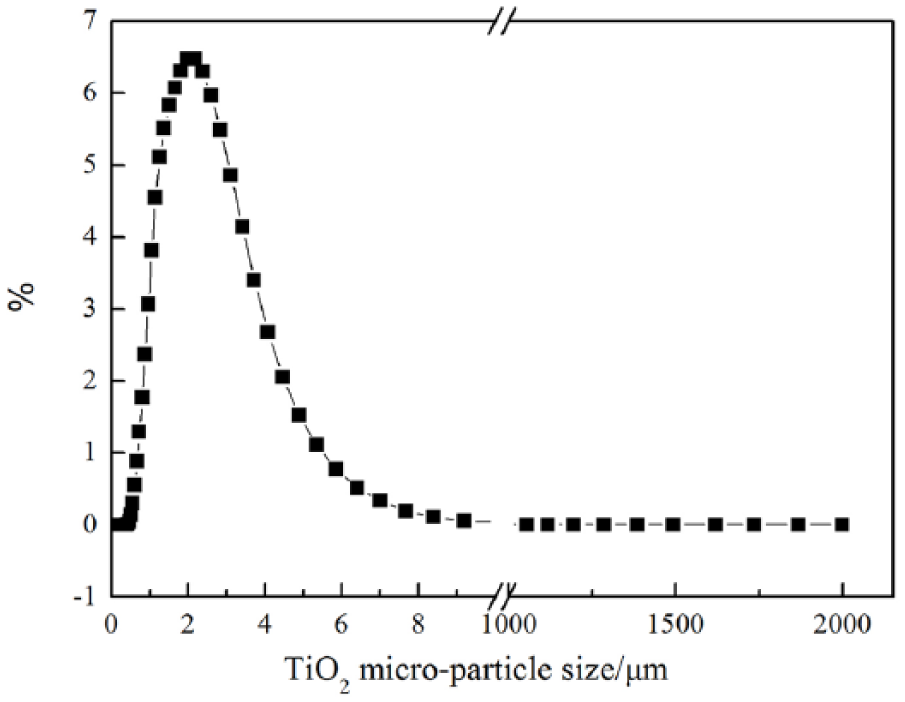
Particle size distribution for TiO2 microparticles.
Sheet morphology
Bifunctional sheets were prepared according to the above methods. When a low mass ratio of CA to TiO2 (0.04:1) is used, it was not possible to prepare uniform sheets and the sheets easily broke to pieces. As the mass ratio increases to 0.045:1, the adhesion degree between CA and TiO2 improves, but the sheets are still easy to crack. Using higher CA to TiO2 mass ratios of 0.05:1, 0.06:1, and 0.065:1, the sheets form uniform, white, and shiny monolithic laminar material, as shown in Figure 2.

Panorama image of TiO2 bifunctional sheets.
SEM images were used to observe the porous surface morphology and determine the effects of CA to TiO2 mass ratio varied from 0.05:1 to 0.06:1. The results are shown in Figure 3.

SEM micrographs of bifunctional TiO2 sheets with different mass ratio of CA and TiO2: (a) 0.05:1; (b) 0.055:1; (c) 0.06:1.
With a mass ratio of 0.05:1, the pore distribution of the TiO2 sheets is dense and easily exhibits a uniform aperture size (Figure 3(a)). When the mass ratio increases to 0.055:1, the aperture size decreases because the TiO2 microspheres are coated with CA (Figure 3(b)). As the CA to TiO2 mass ratio increases to 0.06:1, more TiO2 microspheres are wrapped or more pores are filled with CA (Figure 3(c)). In the preparation process, acetone solvent is used to completely dissolve CA, and TiO2 can be combined more evenly.
The different morphologies and properties of the TiO2 bifunctional sheets are mainly caused by different mass ratio of CA to TiO2. On the one hand, the effect of CA mainly shows adhesive characteristics in the system. With the mass ratio under 0.05:1, the sheets are easy to break into pieces because of poor adhesive strength with the TiO2 microspheres; on the other hand, the excess amount of CA can wrap the TiO2 microspheres or fill some pores, which is not conducive for the diffusivity of the solution.
Contact angle test
The contact angle dynamic continuous test analysis was performed on the sheet. When the droplets dropped, the surface of the sheet was wetted by the liquid then the apparent contact angle was measured from the composite surface composed of the fluid and the solid as a baseline at 3s, as shown in Figure4. It can be seen from the test results that as the mass ratio of CA to TiO2 increases, the diffusion of the droplets on the sheet slows down. Therefore, with a mass ratio of 0.05:1, it can not only form uniform sheets, but also diffuse liquid rapidly.

Dynamic contact angle test of bifunctional TiO2 sheets with different mass ratio of CA and TiO2: (a) 0.05:1; (b) 0.055:1; (c) 0.06:1. All the immersion liquid used in the contact angle measurement was deionized water, and the amount of water in the needle was 3 μL when measured. It can be seen from the test results that as the CA addition ratio increased, the sheet pores were gradually filled, and the diffusion of the droplets on the sheet was slowed down.
Mixing time
The optimum mass ratio of CA to TiO2 is 0.05:1 to prepare casting slurry. After different mixing times, the slurry solutions were cast on a coating machine using 300 µm-thick sheet applicators, which were dried naturally. Results are shown in Figure 5.

TiO2 bifunctional sheets prepared with different mixing times: (a) 30 min; (b) 1 h; (c) 2 h; (d) 3 h; (e) 4 h; (f) 5 h. The TiO2 bifunctional sheets became smoother with longer mixing time because the dissolution of CA in the slurry caused swelling, softening, and subsequent dissolution of the slurry.
As shown in Figure 5, the TiO2 bifunctional sheets become smoother with longer mixing times. When mixing times are 0.5, 1, 2, 3, and 4 h, respectively, TiO2 microspheres cannot disperse evenly because a part of TiO2 microspheres agglomerates, which leads to bulges on the sheet surface (Figure 5(a) to (e)). Moreover, agglomeration leads to a lower amount of CA in bulges, which means the sheets are more easily broken at the bulges areas. As the mixing time extends to 5 h, TiO2 microspheres evenly disperse and thus the surface of sheets is smooth (Figure 5(f)). Consequently, to generate TiO2 sheets with a uniform and smooth surface, the slurry mixing time should not be less than 5 h.
To investigate the dispersion effect of the TiO2 bifunctional sheets, 10 μL serum was added to sheets prepared at different mixing times of 30 min, 3 h, and 5 h, respectively. As shown in Figure 6, after 10 s of diffusion, the serum could hardly diffuse on the surface of the 30 min-stirred sheets. The diffusion ability of the TiO2 sheets prepared with 3 h stirring is slightly improved. The surface residual liquid decreases, but the diffusion effect is still not ideal. The serum diffuses fast without any residue on the surface of sheets prepared with 5 h stirring.
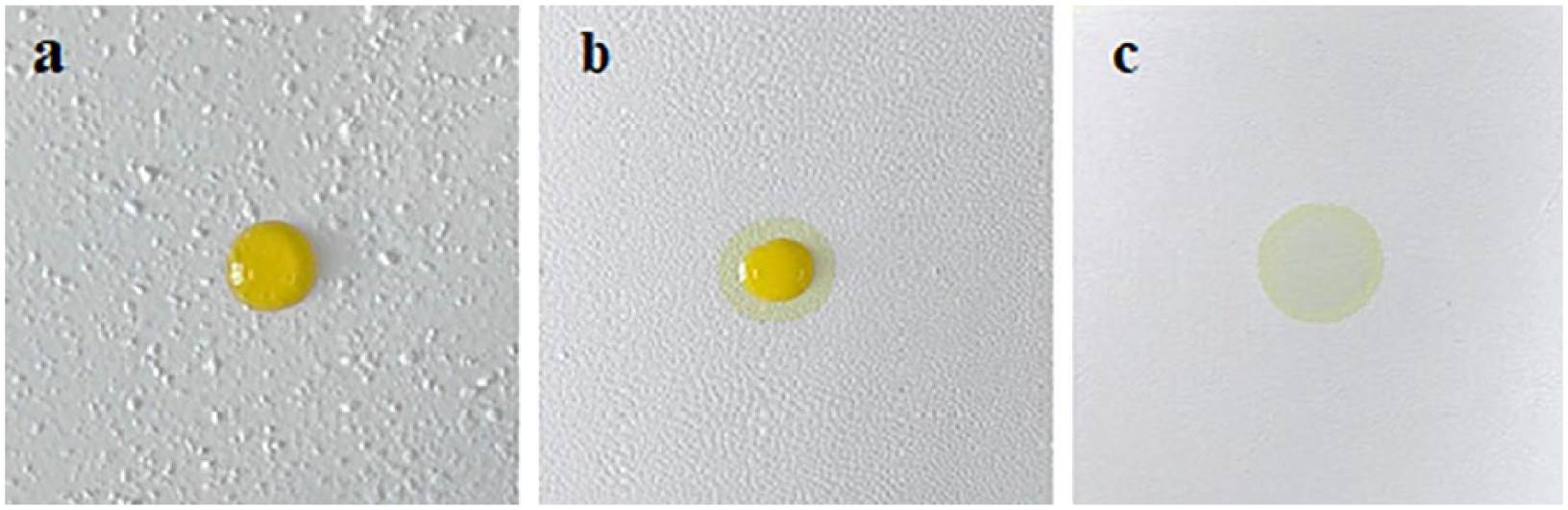
The diffusion of serum in TiO2 bifunctional sheets prepared at different mixing times: (a) 30 min; (b) 3 h; (c) 5 h.
At short stirring times, TiO2 microspheres agglomerate, which led to a lower amount of CA in bulges while a higher one in flats and on surface bulges. With a CA to TiO2 mass ratio higher than 0.50:1, diffusion is lower as described in 3.2. As time goes on, the water in the serum evaporates and a serum sheet gradually forms on the surface of the TiO2 bifunctional sheets, which is more difficult to diffuse to reaction sheets. Therefore, the mixing time has a crucial influence on the diffusion effect of serum.
Thermal properties
The thermal analysis results of the CA/TiO2 hybrid sheets are illustrated in Figure 7. The decomposition temperature decreases as the mass ratio of CA to TiO2 increases because TiO2 has a better thermal stability than CA. 27 It can be seen that the content of CA has influence on the thermal stability of the sheets. The sheets are used at room temperature or 37°C, so it does not affect the application of the sheets.
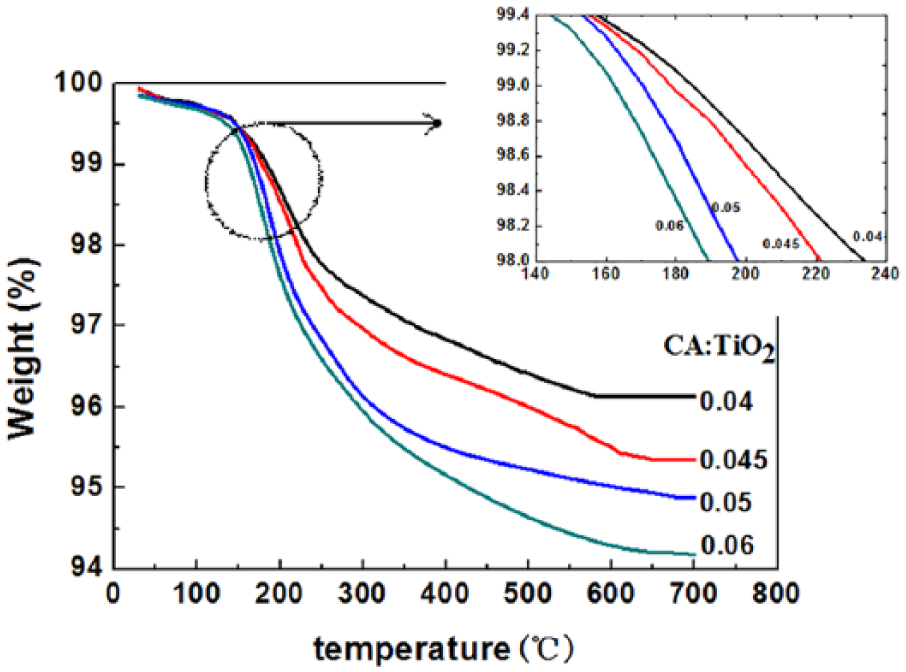
TG-DTA characterization of CA/TiO2 hybrid sheets.
Water content
Water content is related to the hydrophilic properties of the membrane. 28 The water content of each membrane was calculated using equation (1). As shown in Table 1, the water content was measured for six sheets prepared under the same conditions. The results show that the average water content of the sheets is 57.1%, which indicates that the sheets are hydrophilic. The standard deviation is 0.01, which illustrates that the sheets have good repeatability at water content and the pore distribution between CA and the TiO2 microspheres is uniform.
Different water content of each sheet.

Reflection tests
The reflectance of the TiO2 sheets was detected using a UV-Vis-NIR spectrophotometer and the results are shown in Figure 8.
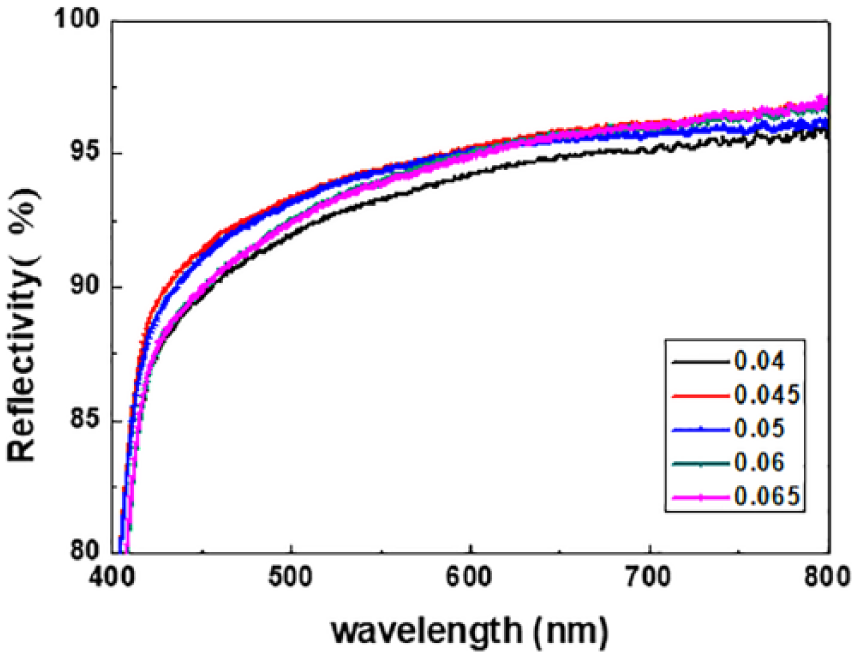
Light reflectivity of TiO2 bifunctional sheets.
Figure 8 shows that the light reflectivity of TiO2 bifunctional sheets at 420–800 nm is higher than 90%. When CA/TiO2 is 0.05:1, the light reflectivity of the prepared TiO2 sheets can reach more than 90%. Especially in the wavelength range of 540 nm (glucose detection wavelength) to 670 nm (uric acid detection wavelength), light reflectivity even reaches 94.2% and 95.7%, respectively. The light reflectivity values for a group of five samples with different amounts of CA added are all ideal; thus, small amounts of CA do not significantly affect the shading function of the TiO2 sheets. Therefore, TiO2 sheets with superior light-reflective properties can be used with in vitro diagnostic dry chemical reagents.
Diffusion performance tests
Generally, the serum is diffused by the TiO2 bifunctional sheets and reacts with the reagent sheet with a red the reaction color. To explore the reproducibility of the diffusion results for TiO2 bifunctional sheets, the following experiments were performed.
Reagent sheet was composed of the reaction substrate enzymes. In the reagent sheet, the main reaction of glucose and reagent was as follows:


Homemade glucose dry chemical reagent sheet in the lab was covered with the TiO2 bifunctional sheets to achieve glucose dry chemical diagnostic reagent conditions in vitro.
The chromogenic reaction results are shown in Figure 9. The light reflection density gauge detected the reflected light signal value for six points and the results are shown in Table 2.

Spot images of serum reaction.
Light reflection signal values of dry chemical diagnostic reagents in vitro.
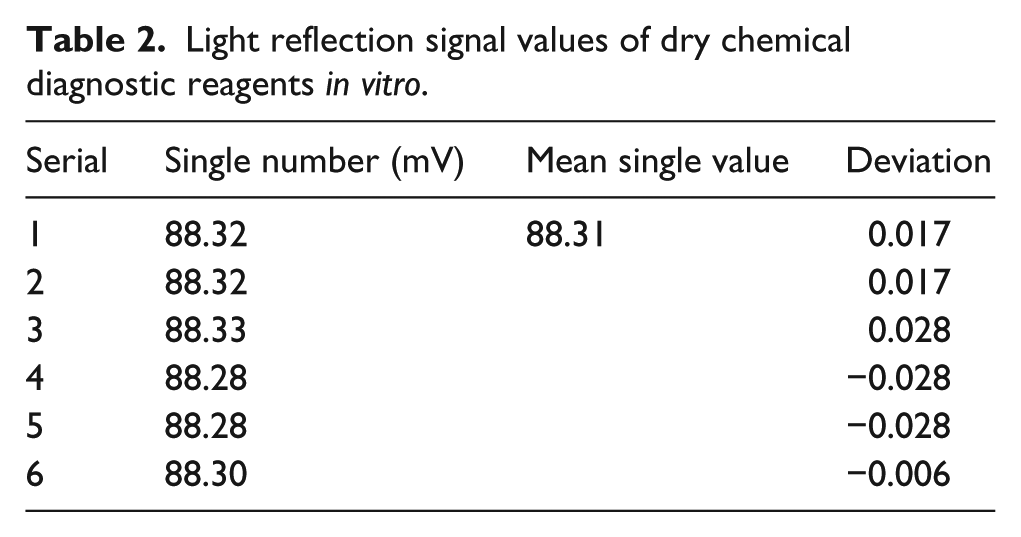
Figure 9 shows that the color of the reaction spots obtained on the reagent sheet are uniform, thus confirming that the serum diffused evenly. In addition, the areas of the six spots formed after the reaction is similar. The SD of the diameter of the six spots is 0.04, which illustrates that the sheets had good diffusion repeatability for the serum. Table 2 outlines the results for the dry chemical reagent color spots tested using reflected light density testing. The relative deviation of the light reflection signal value of the six groups ranges within ±0.028%, which illustrates that the dry chemical reagent has a good reproducibility. Therefore, using the same reagent sheet for the same batch, the sheets have good serum diffusivity and an excellent repeatability.
The above results indicate that the homemade TiO2 sheets have uniform pore distribution and aperture size on the surface, as well as inside. Therefore, TiO2 bifunctional sheets can be further used in dry chemical diagnostic reagents tests in vitro.
Conclusion
(1) The optimal preparation condition for the bifunctional TiO2 sheets under natural drying conditions are as follows: 0.05:1 CA/TiO2 mass ratio and 5 h mixing after coating.
(2) The reflection spectrometry detection results show that the reflectivity of TiO2 bifunctional sheets between 420 and 800 nm can reach more than 90%, which is enough to prove that the prepared sheets have a good function of reflection. The TG-DTA analysis results show that CA disperses evenly in the TiO2 bifunctional sheets.
(3) The bifunctional TiO2 sheets are applied to dry chemical in vitro diagnostic reagents prepared using dry glucose films. The test results confirm that the spot color is uniform when the bifunctional sheets are used for the same serum concentration. The SD for the diameter of six spots is 0.04, which illustrates that the sheets have good diffusion repeatability for the serum. The relative deviation of the light reflection signal value in the six groups range within ±0.029%, which illustrates that the dry chemical reagent had a very good reproducibility. Therefore, the preliminary results can be obtained bifunctional TiO2 sheets are ideal to be applied to dry chemical in vitro diagnostic reagents.
Footnotes
Declaration of Conflicting Interests
The author(s) declared no potential conflicts of interest with respect to the research, authorship, and/or publication of this article.
Funding
The author(s) disclosed receipt of the following financial support for the research, authorship, and/or publication of this article: This work was supported by the National Natural Science Foundation of China (grant number 91634101) and The Project of Construction of Innovative Teams and Teacher Career Development for Universities and Colleges under Beijing Municipality (grant number IDHT20180508).