




Abstract
Background:
Health warning labels (HWLs) are evidence-based tobacco control strategies; however, their application to e-cigarettes and related impacts (e.g. on perceived risk), including across countries with different regulations, are understudied.
Design and Methods:
Using 2021 survey data from 927 US and Israeli adults reporting past-month tobacco use, multivariate analyses examined: (1) sociodemographics in relation to self-reported impact of e-cigarette HWLs (i.e. more concerned about e-cigarette use, reassured, no effect) among those who noticed e-cigarette HWLs (multinomial regressions); and (2) HWL impacts in relation to use intentions and perceived addictiveness and harm (linear regressions).
Results:
Among those who noticed HWLs (n = 835, 90.1%), 34.1% reported HWLs resulted in greater concern about e-cigarette use, 45.5% no effect, and 20.4% reassurance. Factors associated with greater concern (vs no effect) included e-cigarette non-use (vs use; aOR = 1.69, 95% CI:1.22, 2.38), US (vs Israel) resident (aOR = 1.65, 95% CI:1.16, 2.34), age 18–25 (vs 36–45; aOR = 1.72, 95% CI:1.11, 2.67), and more education (aOR = 1.85, 95% CI:1.30, 2.63). Factors associated with being reassured (vs no effect) included use of cigarettes (aOR = 1.71, 95% CI:1.06, 2.75), e-cigarettes (aOR = 2.64, 95% CI:1.77, 3.94), and other tobacco (aOR = 2.11, 95% CI:1.39, 3.21), and Israeli resident (aOR = 2.33, 95% CI:1.47, 3.70). Not noticing HWLs (vs no effect) correlated with lower intentions (β = −0.44, 95% CI:−0.87, −0.01), perceived addictiveness (β = −0.61, 95% CI:−1.05, −0.18), and harm (β = −0.56, 95% CI:−0.95, −0.18); reassurance correlated with greater use intentions (β = 0.48, 95% CI:0.12, 0.83); and greater concern was unassociated with use intentions or perceived risk.
Conclusion:
Effects of differing e-cigarette HWLs in distinct subpopulations warrant research. Despite being noticed, they may have no effect or encourage e-cigarette use.
Significance for public health
Among the 90.1% of US and Israeli adults who used tobacco and noticed e-cigarette HWLs, 34.1% reported that the HWLs increased their concern about using e-cigarettes, 45.5% reported no effect, and 20.4% reported being reassured of e-cigarette use. Not noticing the HWLs was associated with lower use intentions and perceived risk, being reassured by the HWLs was associated with greater use intentions, and being more concerned was unassociated with use intentions or perceived risk. The desired outcomes of e-cigarette HWLs (e.g. increase knowledge, reduce use intentions) must be clearly indicated for specific populations (e.g. those who use cigarettes, nicotine-naïve), and measures need to be developed to precisely assess their effectiveness on these outcomes. Such clarity is imperative to inform research and practice to advance overall tobacco control efforts, including those related to harm reduction.
Introduction
The growing popularity of electronic cigarettes (e-cigarettes) has become a significant global health concern, which has been exacerbated by the aggressive advertising and promotion of these products.1,2 Despite being marketed as a reduced harm alternative and a smoking cessation aid to combustible cigarettes, 3 e-cigarettes still carry potential health risks, including respiratory and cardiovascular diseases.4,5 Notably, use prevalence also varies by subpopulations; for example, e-cigarette use is more prevalent among youth as well as vulnerable adult populations, such as sexual minorities, individuals with lower socio-economic status, and those with mental health conditions, raising concerns about population-level impact and related disparities. 6 Furthermore, while a meta-analysis of nine randomized controlled trials indicates that providing free e-cigarettes as a therapeutic intervention is associated with increased success in adult smoking cessation, findings based on 55 observational studies showed mixed evidence in real world settings. 7
Given the public health concerns and disparities associated with e-cigarette use, it is important to understand differences in use prevalence across regulatory contexts and to examine the impact of efforts to inform consumers about potential risks. The US and Israel represent different adult use prevalence, as well as e-cigarette regulatory contexts with many similarities but also some unique aspects. Regarding the former, in 2021, 4.5% of adults in the US reported using e-cigarettes in the past 30 days, 8 and the estimated prevalence of past-month use in Israel was 1.6% in 2022. 9
Regarding regulatory contexts, packaging and labeling are crucial elements to educate consumers. Health warning labels (HWLs) serve as a valuable tool for policymakers to effectively inform individuals about the risks associated with e-cigarettes and may ultimately discourage their use intentions.10 –13 In recent years, several countries, including the US and Israel, have implemented policies to regulate e-cigarette HWLs. In the US, e-cigarettes have been classified as tobacco products since the US Food and Drug Administration (FDA) 2016 deeming rule, and as of 2023, no e-cigarette products have been approved by the FDA for smoking cessation. The 2016 deeming rule mandated the inclusion of HWLs on packaging and advertisements starting in August 2018. 14 These warnings are required to include two statements related to the addictive nature of nicotine, covering at least 30% of the front and back sides of the packaging, including one of the three rotating Surgeon General’s warnings for cigarettes (e.g. “Surgeon General’s Warning: Quitting smoking now greatly reduces serious risks to your health”) and a statement that reads, “Warning: This product contains nicotine. Nicotine is an addictive chemical.” In Israel, e-cigarettes are required to have plain packaging and text-only health warnings covering 30% of the two largest surfaces of the packaging (the front in Hebrew and the back in Arabic), emphasizing both the addictive nature of the product and its harm (e.g. “Warning—This product a highly addictive and harmful to your health”). 15
The recent advancement in e-cigarette HWL regulation highlights the need to understand the impact of HWLs on intentions to use among adults who use tobacco and their perceptions of e-cigarettes. Current literature suggests that the effects of HWLs have been inconsistent and may depend on the risks they convey. For example, addiction-specific HWLs on tobacco products, including e-cigarettes, can improve consumers’ awareness and recall of health risks.16,17 However, previous studies indicate that tobacco HWLs are most effective when they highlight specific and severe health risks, such as cancer, stroke, and heart disease.18,19 With regard to e-cigarettes, experimental 10 and observational studies 11 suggest that warnings about health hazards, such as respiratory harm and chemical exposure, may be more effective than warnings about nicotine addiction in discouraging e-cigarette use. Moreover, a population-based study among youth and young adults in England, Canada and the US indicated that noticing HWLs was associated with a greater likelihood of believing that e-cigarettes can be addictive, and exposure to e-cigarette warnings may impact harm perceptions and intentions to use. 12
Despite several experimental studies investigating the effectiveness of e-cigarette HWLs,10,11,16,20,21 limited population-level studies have been conducted on the impacts of e-cigarette HWLs among adults who use tobacco, including impacts on use intentions and perceptions. 12 Additionally, there is a lack of research on the differential impacts of HWLs. It is crucial to explore potential unintended consequences of these warnings, including reassuring consumers about use or having no impact. In addition, there is currently limited evidence from population-based studies on HWL impacts on use intentions and perceptions. Furthermore, most previous studies were conducted in the US, which poses important limitations, given the divergent e-cigarette regulations across countries and the necessity for international research collaborations to advance global tobacco control initiatives. Notably, while the International Tobacco Control (ITC) Project surveys include assessments of the impact of HWLs of e-cigarettes including increased concern or reassurance about use, 22 little research has examined correlates of reporting reassurance despite some participants reporting being reassured.23,24 This is plausible given the marketing of these products as harm reduction products and the possibility of reactance to HWLs, as demonstrated in the literature regarding HWLs on traditional cigarettes.25–27
To address these gaps and limitations, this study examined the extent to which adults who use tobacco in the US and Israel noticed e-cigarette HWLs and estimated the associations between HWL impacts and e-cigarette use intentions and perceptions. Specifically, this study used cross-sectional survey data among US and Israel adult who use tobacco to examine: (1) factors associated with (a) noticing HWLs on e-cigarettes and (b) self-reported HWL impacts (i.e. increased concern of e-cigarette use, reassured them of use, or no effect); and (2) HWL impacts on use intentions and risk perceptions.
Methods
Study design and sample
This cross-sectional study utilized data from an online survey conducted by Ipsos between October and December 2021 in Israel and the US (detailed elsewhere 28 ). Eligibility criteria included: citizen of the respective countries, ages 18–45, English-speaking for US participants, and Hebrew- or Arabic-speaking for Israeli participants. The target sample size was 2000 total participants (1000/country), and purposive sampling was used to obtain approximately equal sample sizes of males and females, racial/ethnic representation, and ~40% tobacco users to ensure ≥80% power (at α = 0.05) to detect small to medium effects in relation to tobacco use outcomes among key demographic groups. The final dataset comprised 2222 participants (Israel: n = 1094; US: n = 1128).
The survey samples were constructed using somewhat different approaches in the two countries due to differences in the availability and nature of survey panels, a common limitation in international research.22,29
The US survey was conducted primarily using KnowledgePanel® (KP), a probability-based web panel designed to be representative, and recruited via random digit dialing and address-based sampling. KP members are incentivized by points redeemable for cash (~$5 for a 25-minute survey). Of 4960 panelists recruited, 2397 (48.3%) completed eligibility screening, and 1095 (45.7%) completed the survey. To meet subgroup recruitment targets, an opt-in (i.e. off-panel) convenience sample of US adults reporting Asian race and tobacco use were also recruited by Ipsos via banner ads, web pages, and e-mail invitations; those who clicked ads completed eligibility screening (i.e. sex, race/ethnicity, tobacco use). Of 353 individuals screened, 33 (9.3%) were eligible and completed the survey.
The Israeli survey was conducted among an opt-in sample, using the same approach specified above. Of 2970 individuals who completed the eligibility screening and were eligible, 1094 (36.8%) completed the survey.
In this study, the analytical sample was restricted to participants who reported past-month use of any tobacco products, including cigarettes, e-cigarettes, cigars, heated tobacco products, hookahs, pipes, and smokeless tobacco products. Therefore, a sample of 927 adults who used tobacco was analyzed (Israel: n = 551; US: n = 376). This study was approved by the institutional review boards of [omitted for blind review], and informed consent was obtained from all participants. This study is presented according to the Strengthening the Reporting of Observational Studies in Epidemiology (STROBE) guideline for cross-sectional studies.
Measures
All measures were adopted or adapted from the ITC Project 22 or the Global Adult Tobacco Survey (GATS). 29
Noticing e-cigarette HWLs and their impact on e-cigarette use
We adapted measures from the ITC Project 22 that assess whether participants notice e-cigarette HWLs and their impact. Participants who reported current use of any tobacco products were asked, “What effect have health warnings had on your thoughts about using vaping products (or e-cigarettes)?” 22 Response options included: “have not seen or noticed them, made me concerned about using them, reassured me about using them, had no effect, or don’t know.” Respondents who reported “have not seen or noticed them” were classified as never noticing HWLs, while those who chose any of the other options were grouped as ever noticing e-cigarette HWLs. Among participants who noticed HWLs, responses were categorized as: (1) concern (i.e. “made me concerned about using them”), (2) no effect (i.e. “had no effect” and “don’t know”), and (3) reassurance (i.e. “reassured me about using them”).
E-cigarette use intentions and perceptions
Future use intention was assessed by asking, “How likely are you to try or continue to use e-cigarettes in the next year?”22,29 Perceived addictiveness and harm was measured by asking, “How addictive do you think e-cigarettes are?” and “How harmful to your health do you think the use of e-cigarettes is?”22,29 Response options for each were 1 = not at all to 7 = extremely.
Current tobacco use status
Participants were asked to report if they had ever used cigarettes, e-cigarettes, heated tobacco products, hookah, cigar products, pipe tobacco, and smokeless tobacco in the past 30 days.22,29 Three variables were created to indicate current use status of cigarettes, e-cigarettes, and other tobacco products (yes vs no). For each product, the number of days used in the previous 30 days was measured as either any or none. To calculate current (past 30-day) use, heated tobacco products, hookah, cigars, pipe, and smokeless tobacco were combined into a single variable called “use of other tobacco.”
Sociodemographic characteristics
Sociodemographic covariates included age (18–25, 26–35, 36–45), sex (male, female), sexual orientation (heterosexual, not heterosexual), race/ethnicity (US: White, Black, Asian, Hispanic; Israel: Jewish, Arab), and education level.22,29
Patient and public involvement
Research questions and measures were based on the literature relevant to the needs and implications of the tobacco and e-cigarette industry for populations in the US and Israel, as well as more globally. Individuals representing these populations pilot tested the survey measures before the launch of the study but were not involved in the study design, recruitment, or conduct of the study. Given the nature of sample recruitment (i.e. from online panels with no contact information provided to the research team), the most effective dissemination strategy is via peer-reviewed publications and in the general press highlighting study findings.
Data analysis
All data management and analyses were conducted using Stata 15.1 (College Station, TX: StataCorp LLC. StataCorp. 2015). Univariate and bivariate analyses were conducted to characterize participants based on their noticing of e-cigarette HWLs and HWL impacts on e-cigarette use intentions and perceptions. Chi-square tests were used for categorical variables, while t-tests or ANOVAs were used for continuous variables. Multivariable logistic regression analyses were conducted to examine the associations between individual characteristics and noticing e-cigarette HWLs (yes vs no). Multivariable multinomial regression analyses were used to examine the associations between individual characteristics and HWL impacts on e-cigarette use (increased concerns about use, reassured them about use, no effect [referent]). Multivariate linear regression analyses were conducted to estimate the correlations between e-cigarette HWL impacts and use intentions, perceived addictiveness, and perceived harm. All multinomial regression or linear regression models controlled for demographics and current tobacco use status as covariates. Country-specific stratified models were also conducted; results were generally similar, so total sample models are presented. Any distinct country-specific model findings are noted as footnotes under the tables. All statistical tests were two-tailed, and the significance level was set at α = 0.05.
Results
Sample characteristics
Table 1 presents descriptive analyses and bivariate results of the percentages of people noticing HWLs on e-cigarettes and HWL impacts on e-cigarette use, overall and by selected demographic characteristics and current tobacco use status. In this sample, 44.0% were female, 26.0% aged 18–25 years, 36.6% aged 26–35 years, 16.0% not heterosexual, and 52.5% had less than college education. The proportion of current cigarette use was 73.0%, current e-cigarette use was 47.7%, and current use of other tobacco products was 55.8%. Among adults who used tobacco, 90.1% reported ever noticing e-cigarettes HWLs. Of those who noticed HWLs, 34.1% were concerned, 45.5% reported no effect, and 20.4% were reassured about using e-cigarettes (26.2% in Israel and 12.1% in the US, p < 0.001).
Correlates of noticing e-cigarette HWLs and HWL impacts among adults reporting current tobacco use (N = 927).

HWL: health warning label; US: United States.
Bold indicates significant at p < 0.05.
Other tobacco includes heated tobacco products, hookah, cigar, pipe, and smokeless tobacco.
Table 2 displays e-cigarette use intentions, perceived addictiveness, and perceived harm across the impacts of e-cigarette HWLs. Average use intention scores were 2.61 (SD = 2.07) among those who never noticed e-cigarette HWLs, 2.53 (SD = 2.02) among those reporting concern, 3.07 (SD = 2.30) among those reporting no effect, and 4.05 (SD = 2.10) among those reporting reassurance (p < 0.001). Average perceived addictiveness scores among those who reported never noticing HWLs, being concerned, no effect, and being reassured were 4.50 (SD = 2.14), 5.17 (SD = 1.98), 5.22 (SD = 1.81), and 4.75 (SD = 1.92; p = 0.001), respectively. Average perceived harm scores among those who reported never noticing HWLs, being concerned, no effect, and being reassured were 4.79 (SD = 2.12), 5.55 (SD = 1.66), 5.45 (SD = 1.61), and 5.02 (SD = 1.71; p < 0.001), respectively.
Correlates of e-cigarette use intentions and perceived addictiveness and harm among adults reporting current tobacco use (N = 927).

HWL: health warning label; SD: standard deviation; US: United States.
Bold indicates significant at p < 0.05.
Other tobacco includes heated tobacco products, hookah, cigar, pipe, and smokeless tobacco. Response options for use intentions, perceived addictiveness, and perceived harm were 1 = not at all to 7 = extremely.
Adjusted associations with noticing HWLs and HWL impacts
Table 3 presents the multivariable logistic and multinomial regression results. Controlling for other covariates, being female were associated with decreased odds of noticing HWLs on e-cigarettes. Regarding HWL impacts, compared to reporting no effect, current use of e-cigarettes (adjusted odds ratio (aOR) = 0.59, 95% confidence interval: 0.42, 0.82) and having less than college education (aOR = 0.54, 95% CI: 0.38, 0.77) were associated with lower odds of reporting increased concern from HWLs; living in the US (vs in Israel; aOR = 1.65, 95% CI: 1.16, 2.34) and being 18–25 (vs 36–45; aOR = 1.72, 95% CI: 1.11, 2.67) were associated with higher odds of reporting increased concern. In addition, compared to reporting no effect, current use of cigarettes (aOR = 1.71, 95% CI: 1.06, 2.75), e-cigarettes (aOR = 2.64, 95% CI: 1.77, 3.94), and other tobacco products (aOR = 2.11, 95% CI: 1.39, 3.21) were associated with higher odds of reporting being reassured by e-cigarette HWLs. Living in the US (aOR = 0.43, 95% CI: 0.27, 0.68) was associated with lower odds of reporting being reassured.
Multivariable logistic regression analyses examining correlates of noticing e-cigarette HWLs (N = 927) and HWL impacts (N = 835) among adults reporting current tobacco use.
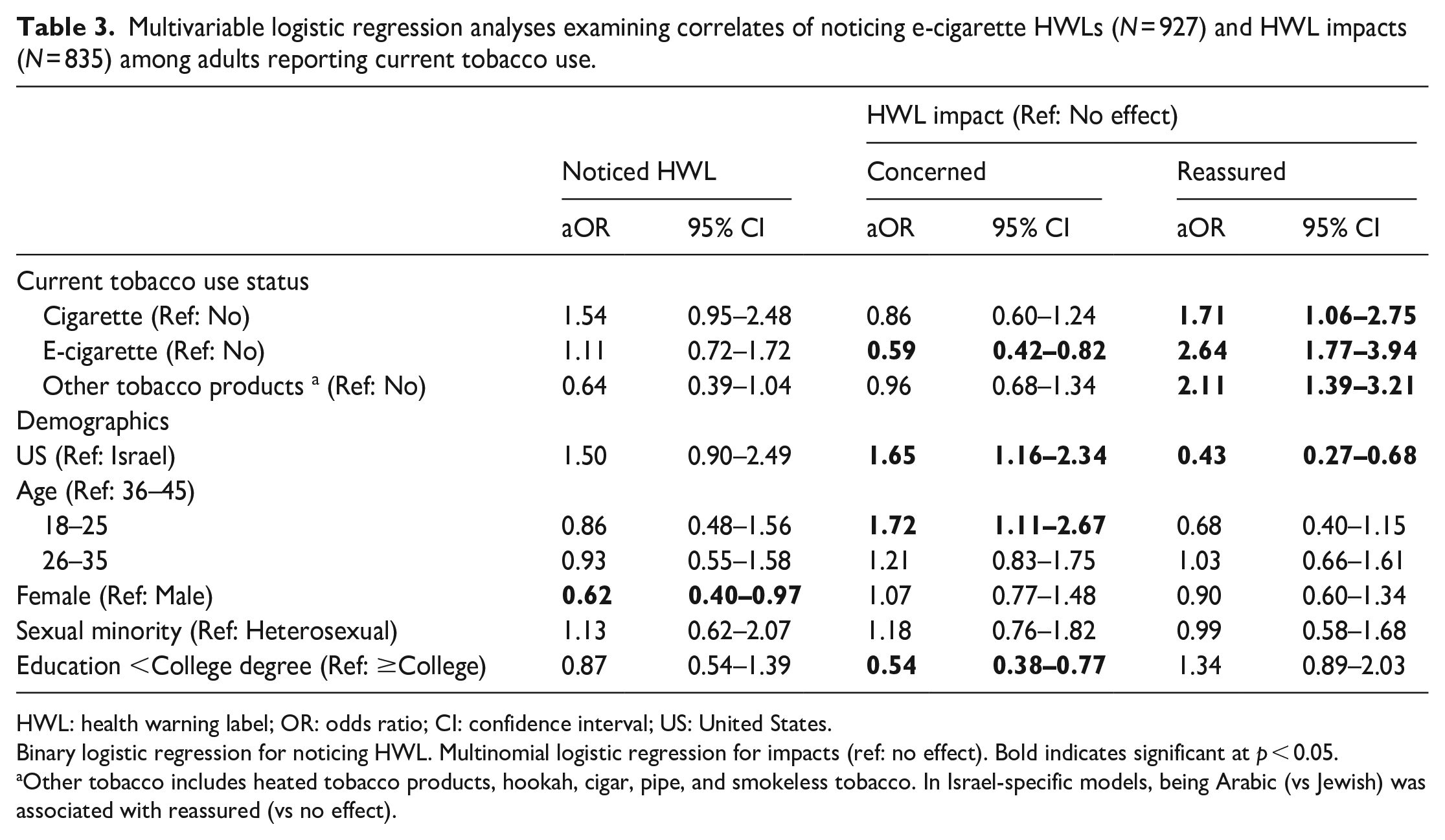
HWL: health warning label; OR: odds ratio; CI: confidence interval; US: United States.
Binary logistic regression for noticing HWL. Multinomial logistic regression for impacts (ref: no effect). Bold indicates significant at p < 0.05.
Other tobacco includes heated tobacco products, hookah, cigar, pipe, and smokeless tobacco. In Israel-specific models, being Arabic (vs Jewish) was associated with reassured (vs no effect).
Adjusted correlations with E-cigarette use intentions and perceptions
Table 4 shows the results of the multivariable linear regression analyses. Regarding use intentions, compared to reporting no effect, being reassured of e-cigarettes by HWLs (β = 0.48, 95% CI: 0.12, 0.83) was positively correlated with use intentions, while not noticing HWLs (β = −0.44, 95% CI: −0.87, −0.01) was negatively correlated with use intentions. Additionally, current use of e-cigarettes (β = 2.25, 95% CI: 2.00, 2.51) was positively correlated with use intentions. Related to perceived addictiveness, not noticing HWLs (β = −0.61, 95% CI: −1.05, −0.18) was negatively correlated with perceived addictiveness. In addition, current use of other tobacco products (β = −0.59, 95% CI: −0.86, −0.32) and having less than college education (β = −0.30, 95% CI: −0.57, −0.04) were negatively correlated with perceived addictiveness. Concerning perceived harm, not noticing HWLs (β = −0.56, 95% CI: −0.95, −0.18) was negatively correlated with perceived harm. In addition, current use of e-cigarettes (β = −0.51, 95% CI: −0.73, −0.28) and other tobacco products (β = −0.41, 95% CI: −0.64, −0.17) were negatively correlated with perceived harm.
Multivariable linear regression analyses examining e-cigarette HWL impacts in relation to use intentions and perceptions among adults reporting current tobacco use (N = 927).

HWL: health warning label; OR: odds ratio; CI: confidence interval; US: United States.
Bold indicates significant at p < 0.05.
Other tobacco includes heated tobacco products, hookah, cigar, pipe, and smokeless tobacco. In US-specific models, being Black or Asian (vs White) was negatively correlated with perceived addictiveness, being Asian (vs White) was negatively correlated with perceived harm.
Discussion
This study advances the literature regarding potential impacts of e-cigarette HWLs, including impacts on use intentions and perceptions. In this sample of US and Israeli adult who used tobacco, a significant proportion (90.1%) reported ever noticing e-cigarette HWLs, which highlighted the addictiveness of nicotine in both countries. Only about one-third of participants who noticed e-cigarette HWLs reported that the HWL made them concerned about using e-cigarettes, while nearly half reported no effect and >20% were reassured about using e-cigarettes. Furthermore, our study showed that, compared to reporting no effect, reporting reassurance of using e-cigarettes after noticing HWLs was positively associated with use intentions, and there were no significant correlations between HWL impacts (i.e. concern or reassurance vs no effect) and perceived harm or addictiveness. Collectively, these findings are consistent with previous studies showing limited efficacy of e-cigarette HWLs on young adults’ harm perceptions21,30 and highlight the need to improve the effectiveness of e-cigarette HWLs, potentially by highlighting specific and severe health risks, which has been shown to be an effective strategy for cigarette HWLs.18,19,31
Notably, the impact of e-cigarette HWLs may be influenced by marketing and promotional elements on packaging, which differ in the US versus Israel. While research has suggested that HWLs regarding addiction are effective in enhancing consumer understanding of associated risks,16,17,32 other research has indicated that promotional content on e-cigarette packaging can attract more consumer attention than HWLs, 33 and advertising content can exploit HWLs by suggesting that switching to alternative products, like heated tobacco products, can avoid tobacco-related harms. 34 Furthermore, in the current study, despite Israel implementing plain packaging and progressive advertising restrictions, participants residing in Israel were more likely to report reassurance from e-cigarette HWLs, while those in the US more likely reported being concerned, thus underscoring the need for additional research to better understand the impacts of e-cigarette HWLs and the extent to which their characteristics and the characteristics of promotional elements in packaging and advertising might interact.
Other factors associated with reporting being reassured after exposure to e-cigarette HWLs included current use of cigarettes, e-cigarettes, and other tobacco products, while not using e-cigarettes was associated with greater concern, which reflects known associations between use and risk perceptions.12,35 Additionally, those who were 18–25 (vs 36–45) and those who were more educated reported that e-cigarette HWLs resulted in greater concern. Given these subpopulation differences in HWL impacts, targeted messaging that address specific beliefs and attitudes toward e-cigarettes among different subpopulations warrant consideration. The development of targeted messaging strategies can be informed by reasons subgroups use or do not use e-cigarettes.36,37 For example, effective targeted messages may focus on specific and severe health risks (e.g. cardiovascular disease) among adults using cigarettes,11,18,19,31 on addictiveness for young adults and/or the nicotine-naïve,16,17,21,30,32 and on differing cultural factors or social norms for different countries.36,37 Additionally, pictorial HWLs are evidence-based tobacco control practices especially effective among those with less education, 38 and could be studied with regard to e-cigarette HWL outcomes. Notably, neither the US nor Israel require pictorial HWLs on any tobacco product; tobacco industry litigation postponed the US’s most recent (2020) effort to require them. 39
One important consideration is the desired outcomes of e-cigarette HWLs (e.g. increase knowledge, reduce use intentions), as these must be clearly indicated for specific populations (e.g. those who use cigarettes, nicotine-naïve). For adults currently using cigarettes, the goal may be to understand the relative risks of e-cigarettes versus cigarettes, and thus, use intentions and perceived risk should be considered within the context of the risks associated with cigarette use. Accordingly, measures need to be developed to precisely assess their effectiveness on outcomes that may be distinct for different subpopulations.
Our study findings have important implications for public health practices and policies related to e-cigarette HWLs. First, considering the high proportion of individuals who noticed HWLs on e-cigarettes, policymakers should strive to improve the effectiveness of these HWLs.18,19,31 Thus, research is needed to examine how consumers interpret different HWL messages (e.g. including cross-country research on different required HWLs and consumer groups), particularly alongside real-world advertising content and packaging. Findings from this type of research should inform regulations regarding e-cigarette HWLs, including specific regulations regarding HWL messaging informing consumers of the harmful effects of e-cigarette use and advertising content that is allowed (considering the potential to undermine HWLs 34 ). In addition, further experimental studies, including randomized controlled trials, are needed to assess the effectiveness of various types of e-cigarette HWLs (e.g. HWLs on plain packaging, pictorial HWLs, HWL size) on consumers’ perceptions and use behaviors. Second, certain population groups, such as people who use tobacco products, may hold different attitudes toward e-cigarette HWLs and be more intent to e-cigarette use while having lower risk perceptions. It is crucial to develop targeted messages that address these specific beliefs and attitudes to enhance the effectiveness of HWLs among these population groups. Relatedly, more precise measures are needed to assess the effects of e-cigarette HWLs for different subpopulations (e.g. current cigarette users, nicotine-naïve). Last, additional population-based studies and ongoing surveillance are needed to comprehensively evaluate the impact of e-cigarette marketing on the effects of HWLs on consumer attention, perception, and use behaviors, taking into account different profiles of current tobacco use status and tobacco regulatory contexts, in order to inform global tobacco control efforts, particularly those focused on marketing restrictions and health communication.3,40 In particular, longitudinal research should investigate whether e-cigarette HWL exposure is prospectively associated with tobacco use transition behaviors, such as experimentation, initiation, or cessation of e-cigarette use, as well as product switching and co-use, to better understand the impact of HWLs on these behaviors. 19
Despite this study’s contributions, it has limitations. First, findings may have limited generalizability because participants were recruited via panels in the US and Israel, who may not represent the broader population of people who use tobacco products. Second, the cross-sectional study design restricts our ability to establish causal relationships between HWL exposure and use intentions. Third, the reliance on self-reported measures introduces the possibility of recall bias. Finally, although a wide range of covariates were included in analyses, there is always a possibility of unknown confounders that were not accounted for.
Conclusions
In this study of US and Israeli adults who use tobacco, 90.1% reported noticing e-cigarette HWLs. However, the majority reported that HWLs had no effect or reassured them about using e-cigarettes, especially in Israel. These findings suggest that current e-cigarette HWLs have limited effectiveness in informing about the associated health risks. Moreover, participants who reported feeling reassured by the HWLs showed a higher intention to use e-cigarettes in the next year. Additionally, self-reported impacts of e-cigarette HWLs were not associated with perceptions of addictiveness or harm, further indicating their limited effectiveness in shaping intentions and perceptions of adults who use tobacco products. The findings indicate that continued monitoring is warranted on e-cigarette HWLs to inform global regulatory efforts. Efforts to reduce adult e-cigarette use may consider incorporating tailored strategies to improve the effectiveness of HWLs, including pictorial warnings.
Footnotes
Acknowledgements
N/A.
Data availability
The data presented in this study are available on request from the corresponding author. The data are not publicly available due to ethical reasons.
Declaration of conflicting interests
The author(s) declared the following potential conflicts of interest with respect to the research, authorship, and/or publication of this article: H.L. had received fees for lectures from Pfizer Israel Ltd. (distributor of a smoking cessation pharmacotherapy in Israel) in 2017. Y.B.-Z. has received fees for lectures from Pfizer, Novartis NCH and GSK Consume Health (distributors of pharmacotherapy in Israel) in the past (2012–July 2019). L.C.A. receives royalties for the sale of Text2Quit. No other conflicts of interest are declared.
Funding
The author(s) disclosed receipt of the following financial support for the research, authorship, and/or publication of this article: This research is supported by the US National Cancer Institute (R01CA239178, MPIs: Berg, Levine).
Research ethics and patient consent
Institutional Review Board approvals were obtained from [omitted for blind review]. All participants provided informed consent.
