




Abstract
Introduction:
The popularity of e-cigarettes has increased significantly in recent years. E-cigarettes are perceived as less harmful than cigarettes, and both dual-use of cigarette and e-cigarette use is common among adolescents. This study assessed cigarette and e-cigarette risk perception and associations with dual-product use among Canadian adolescents.
Methods:
We used data from the 2016-2017 Canadian Student Tobacco, Alcohol, and Drugs Survey. Perceived risks of cigarette and e-cigarette use were classified into 4 categories: “high-risk perception,” “high-e-cigarette-risk and low-cigarette-risk perception,” “low-e-cigarette-risk and high-cigarette-risk perception,” and “low-risk perception.” Adjusted odds ratios (aOR) were estimated from multinomial logistic regression.
Results:
Of the population, 92% perceived high risk from cigarettes, and 65% from e-cigarettes. Compared to students with low-risk perception, those with high-risk perception of both products had lower odds of dual-use (aOR: 0.21; 95% confidence interval [CI]: 0.15, 0.28), cigarette-only use (aOR: 0.33; 95% CI: 0.25, 0.45), and e-cigarette-only use (aOR: 0.64; 95% CI: 0.51, 0.79) relative to nonusers. Adolescents with high-e-cigarette and low-cigarette-risk perception had higher odds of e-cigarette-only use, relative to nonusers. Those with high-risk perception were more likely to be e-cigarette-only users relative to cigarette-only users.
Conclusion:
Results highlight that high perceived risk is associated with lower odds of use. However, those with a high-risk perception of both products had higher odds of e-cigarette use relative to cigarette-only users; as did those with high-e-cigarette and low-cigarette-risk perception, relative to nonusers. Future research should assess ways of communicating the risks of adolescent tobacco use.
Introduction
Tobacco remains a leading cause of preventable death and disease in Canada and contributes to the prevalence of cancer, heart disease, stroke, and chronic respiratory disease.1-4 In 2012, more than 45 000 deaths were attributed to smoking, adding to an economic burden of $16.2 billion. 5 About 36.6% of 16- to 19-year-old Canadians in 2018 reported ever using cigarettes and 15.5% had prior-30-day use, which was a significant increase from the prior year. 6 In 2016 to 2017, 1% of adolescents in Grades 7 to 9 were current smokers. 7 Although cigarettes have historically been the most commonly used tobacco product in Canada, electronic cigarette (e-cigarette) use has surpassed cigarette use among youth. In 2018, 37% of those aged 16 to 19 had tried e-cigarettes, and 14.6% reported use within the 30 days prior to the survey, also a significant increase in use from 2017. 6 About 6.3% of those in Grades 7 to 9 used e-cigarettes in the previous 30 days. 7 In addition, cigarettes and e-cigarettes are the most common products used concurrently, and 64.5% of e-cigarette users 15 and older in Canada also smoke cigarettes. 8
The perception that e-cigarettes are less harmful than conventional cigarettes may be an important aspect of adolescent uptake of e-cigarettes. Perceived risk has been shown to be a factor in cigarette and e-cigarette initiation and cessation. 9 Among U.S. adults, there was a decline in the perception that e-cigarettes were not as harmful as combustible cigarettes from 50.7% in 2012 to 34.5% in 2017. 10 However, a study of U.S. youth found that the belief that e-cigarettes were less harmful than cigarettes increased to 73.0% in 2014. 11 A 2015 qualitative study also found that 12- to 17-year-old Canadians perceive e-cigarettes as less harmful than combustible cigarettes. 12
Many previous studies have examined associations between tobacco product use and the perceived risks of use. Amrock et al 11 found that cigarette and e-cigarette use were each associated with a lower perception of harm and addictiveness. Likewise, ever-use of combustible or e-cigarettes was associated with a lower perceived risk of unfavorable outcomes among male high school students, with a significant difference in risk perceptions for e-cigarette users. 13 In a 2016 study among U.S. youth, 74.6% of e-cigarette users, and 15.5% of cigarette users said they believed all tobacco products were harmful, but their product was not. 14 Margolis et al 15 reported that nontobacco users who perceived e-cigarettes cause a lot of harm had lower odds of both openness and curiosity about e-cigarettes than those who perceived less harmfulness.
A few prior studies have also examined the perceived risks of cigarettes and e-cigarettes and their association with the use of multiple tobacco products. Some of these studies have found that perceived risk was negatively associated with dual-use.16,17 Cooper et al 16 found that college students’ perceptions of cigarette and e-cigarette harm were lower among exclusive and dual-users than nonusers. A 2014-2015 study of Texas youth found that 53% of multiple-product users reported e-cigarettes as not at all harmful to health, compared to 43% of single-product users. 17 Similarly, 21% of participants who were multiple-product users reported that cigarettes are not at all harmful, compared to 6% of single-product users. 17 In contrast, Ali et al 18 reported that U.S. adolescent dual-users were more likely to believe that all tobacco is harmful than single-product users. In addition, Farsalinos et al 19 found that a higher risk perception for e-cigarettes was a strong predictor of being a dual-user.
The lack of consensus in the literature leaves an unclear understanding of the associations between perceived risk and dual-use. Furthermore, several of the previous studies did not specify which products were being used concurrently, and none have clearly differentiated between perceived risks of multiple products.16-19 This study assessed 4 categories of cigarette, e-cigarette risk perception, and their associations with cigarette and e-cigarette use among Canadian adolescents.
Method
Data
This study used data from the 2016-2017 Canadian Student Tobacco, Alcohol, and Drugs Survey (CSTADS; formerly the Youth Smoking Survey), a biennial, cross-sectional, school-based survey of a generalizable sample of students intended to track adolescent substance-use behavior. 20 The target population consists of Canadians attending private, public, and Catholic schools enrolled in Grades 7 to 12 (secondary I through V in Quebec). The survey excluded those living on First Nations reserves, Canada’s 3 northern Territories (ie, Yukon, Nunavut, and Northwest Territories), and those attending special schools or schools on military bases. The CSTADS uses a stratified single-stage cluster design (with the exception of the province of Quebec, where almost all schools participated), with strata based on health-region smoking rate and type of school. For each province, 2 or 3 health-region smoking rate strata and 2 school-level strata are defined. Random selection of schools within each stratum allowed for a generalizable sample for each province. All eligible students within selected schools were administered the survey. Research ethics boards at multiple levels approved the study (eg, Health Canada, the University of Waterloo, institutions and school boards in each participating province). Consistent with school board requirements, parents provided permission for their child to participate in the study via active parent permission or active information-passive permission protocols. Only students with parental permission were invited to participate on the day the survey was administered. All schools that participated in the 2016-2017 survey, except for schools in Quebec, received a $100 honorarium. Students were not remunerated and could stop answering the survey at any time. The 2016-2017 CSTADS was implemented in schools between October 2016 and June 2017. The province of New Brunswick declined participation in the 2016-2017 cycle. A total of 52 103 (weighted 2 088 473) students in Grades 7 to 12 completed the survey, corresponding to 76% of the eligible student population in participating schools.
Measures
The main dependent variable of interest was dual-use status. Four categories of dual-use status were derived: current cigarette-only user, current e-cigarette-only-user, dual-user of both products, and nonuser. Current use was defined as any use within the 30 days prior to the survey. 21 Participants who did not use either product in the previous 30 days were considered nonusers.
Perceived risk, the main independent variable, was constructed using the question: “How much do you think people risk harming themselves when they do each of the following activities? . . . (risk behaviors) on a regular basis,” for cigarettes and e-cigarettes. “No risk” and “slight risk” responses were grouped to make the “low-risk” category. “Moderate risk” and “great risk” were grouped to form the “high-risk” category. We treated the responses “I do not know” and “not stated” as missing data. Responses were classified into 4 categories: “high-risk perception” of both products, “high-e-cigarette-risk and low-cigarette-risk perception,” “low-e-cigarette-risk and high-cigarette-risk perception,” and “low-risk perception.”
In addition, we included students’ demographic information: grade (7-12), sex (male/female), median household income for the district, urban area (urban/rural), province, marijuana use, and other tobacco product use. Grade, sex, and urban area were evaluated using the questions: “Are you female or male?,” “What grade are you in?” and “Is the respondent’s school in an urban or rural region?” Median household income was the median household income of the area where the respondent’s school is located according to the Canadian 2011 census data. Marijuana use was evaluated using responses to the question: “Have you ever used or tried marijuana or cannabis (a joint, pot, weed, hash, or hash oil)?” Other tobacco product use was defined as ever using tobacco products including little cigars, cigarillos, cigars, roll-your-own cigarettes, smokeless tobacco, nicotine patches, nicotine gum, nicotine lozenges, nicotine inhalers or nicotine spray, water-pipe (hookah) to smoke shisha (herbal or tobacco), or blunt wraps.
Statistical analysis
The analysis included demographic characteristics for all sample students. Wald chi-square tests were used in univariate analyses to determine the crude association between each of the students’ self-estimated behavioral risk perception (cigarette or e-cigarette) and students’ demographic characteristics. Given the categorical nature of the dependent measure, a multinomial logistic regression analysis was used to examine the association between risk perception and dual-use status. The regression adjusted for grade, sex, urbanity, province, median household income, marijuana use, and other tobacco product use to assess perceived risk in association with cigarette, e-cigarette, and dual-use. All tests were 2-sided and used a 5% significance level. We used bootstrap weights to account for the complex survey design and computed the variance by specifying balanced repeated replication (BRR) with the suggested Fay factor. All of the statistical analyses were performed using SAS 9.4 (SAS Institute, Inc, Cary, NC).
Results
Descriptive statistics of the sample are presented in Table 1. Of the 52 103 participating students, 51.3% (25 962) were male, 84.0% (39 469) were in an urban area, 44.9% (10 195) were in Ontario, and the median household income was $59 402. Students from each grade accounted for a range of 16.3% (8th grade) to 17.1% (9th grade) of all participants. About 86.3% of the population were nonusers, followed by e-cigarette-only users (7.5%), dual-users (3.4%), and cigarette-only smokers (2.8%). Table 2 presents the self-estimated risk perception of cigarettes and e-cigarettes by demographic characteristics. Of all study participants, 92.0% perceived high risk from regular cigarette use, and 65.1% from regular e-cigarette use. More female students than male students reported that using cigarettes and e-cigarettes puts people at high risk of harm. A high-risk perception of cigarette use was lowest among 7th graders and highest among 10th graders (89.8% vs 93.7%). In contrast, 7th graders were most likely to think regular use of e-cigarettes puts people at risk of harm, while 11th graders were least likely (73.5% vs 60.3%). More students who had never used marijuana reported that using e-cigarettes puts people at high risk of harm than those who had ever used marijuana. Reporting high-risk perception of e-cigarettes was more prevalent among never users of other tobacco products than ever-users.
Sample descriptive statistics among Canadian students in Grades 7 to 12, 2016-2017 (n = 52 103).
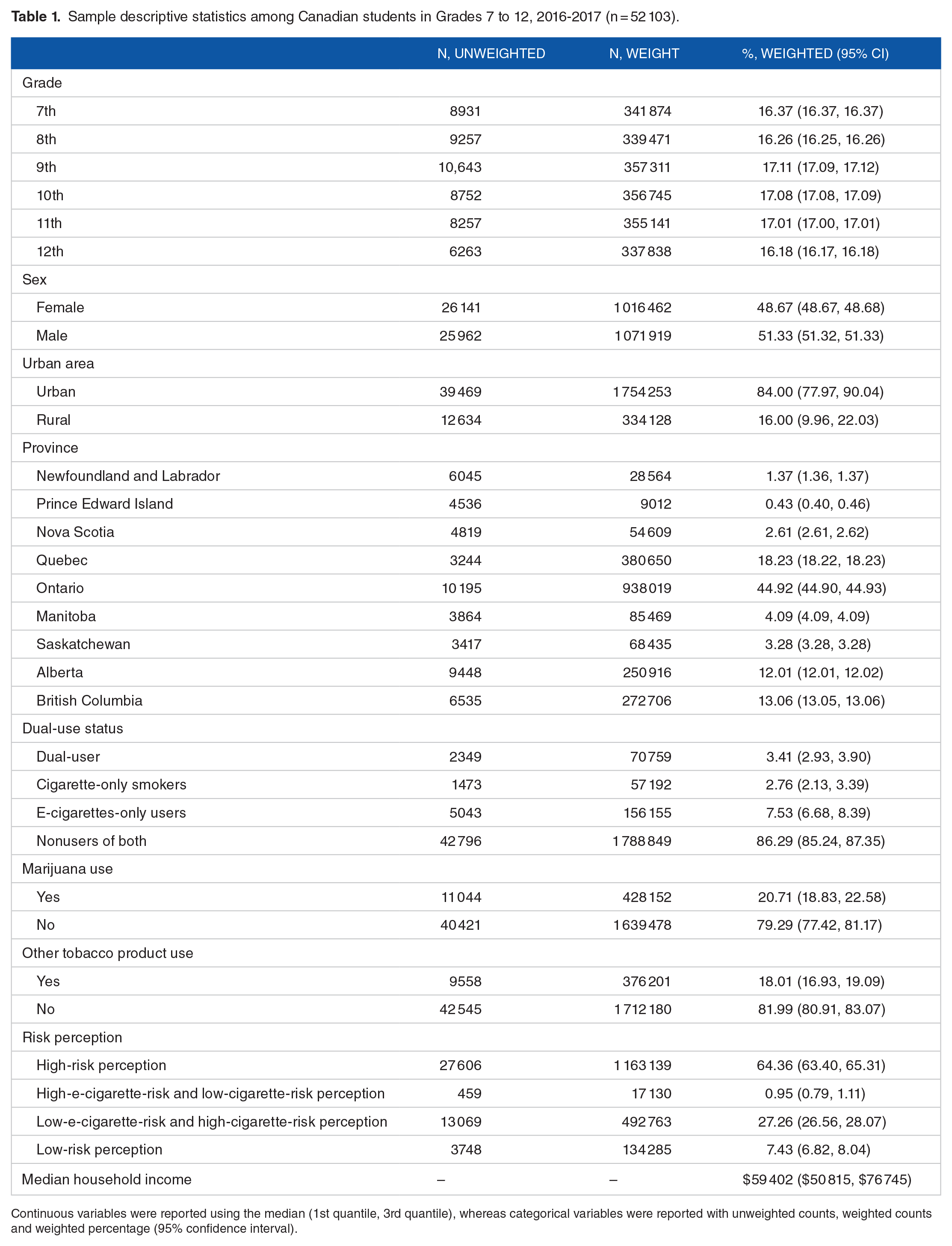
Continuous variables were reported using the median (1st quantile, 3rd quantile), whereas categorical variables were reported with unweighted counts, weighted counts and weighted percentage (95% confidence interval).
Risk perceptions of cigarette and e-cigarette use among Canadian students in Grades 7 to 12, 2016-2017.

Perception of cigarette/e-cigarette use was presented with unweighted n, weighted row percentage and its 95% confidence interval. Chi-square tests were performed to examine the association between risk perceptions of cigarette/e-cigarette use and demographic characteristics. P<0.05 is presented in bold.
Adjusted odds ratios (aOR) from the multinomial regression analysis are shown in Table 3 with the base category being nonusers of both cigarettes and e-cigarettes. Compared to students with a low-risk perception of both products, the likelihood of dual-use was lower among students with a high-risk perception of both products (aOR: 0.21; 95% confidence interval [CI]: 0.15, 0.28) and those with low-e-cigarette-risk and high-cigarette-risk perception (aOR: 0.49; 95% CI: 0.36, 0.67). Similarly, lower odds of cigarette-only use was found among students with a high-risk perception of both products (aOR: 0.33; 95% CI: 0.25, 0.45) and low-e-cigarette-risk and high cigarette-risk perception (aOR: 0.61; 95% CI: 0.45, 0.83) compared to students with a low-risk perception of both products. In addition, the likelihood of e-cigarette-only use was lower among students with a high-risk perception of both products but higher among other groups (ie, high-e-cigarette-risk and low-cigarette-risk perception, low-e-cigarette-risk, and high cigarette-risk perception).
The association between perceived risk of cigarette and e-cigarette use and dual-use status, relative to nonusers of both products.

Significant odds are presented in bold. The adjusted odds ratio was estimated from multinomial logistic regression and adjusted for all variables in the table, with the addition of median household income.
Table 4 presents the association between the perceived harm of cigarette and e-cigarette use and dual-use status. The results in column 2 have the base category of cigarette-only users. Those with a high-risk perception of both products had lower odds (aOR: 0.61; 95% CI: 0.41, 0.93) of dual-use compared to those with a low-risk perception of both products. In Column 3, the base category is e-cigarette-only users. Lower odds of dual-use relative to e-cigarette-only users was found among those with high-risk perception of both products (aOR: 0.32; 95% CI: 0.23, 0.45) and those with low-e-cigarette-risk and high-cigarette-risk perception (aOR: 0.29; 95% CI: 0.21, 0.39). The base category in Column 4 was cigarette-only users. The likelihood of e-cigarette-only use was higher among those with a high-risk perception of both products (aOR: 1.91; 95% CI: 1.38, 2.65) and those with low-e-cigarette-risk and high-cigarette-risk perception (aOR: 2.80; 95% CI: 2.07, 3.79) compared to those with a low-risk perception of both products.
The association between perceived risk of cigarette and e-cigarette use and dual-use status, relative to single-product users.

Significant odds are presented in bold. The adjusted odds ratio was estimated from multinomial logistic regression and adjusted for all variables in the table, with the addition of median household income.
Discussion
This study assessed 4 categories of cigarette and e-cigarette risk perception, and their associations with cigarette, e-cigarette, and dual-product use among Canadian youth. Results of this study indicate that those with a high-risk perception of both products were less likely to be dual-users, cigarette-only users, or e-cigarette-only users than those with a low-risk perception of both products. These findings are in line with prior studies that show associations between cigarette and e-cigarette use and a lower perception of harm.11,13 Prior studies also indicate that risk perception is associated with product use.10,21
In this study, relative to cigarette-only users, those with a high-risk perception of both products had lower odds of dual-use than those with a low-risk perception of both products. Participants with high perceived risk could be concerned about the possibility of increased nicotine dependence or other risks associated with dual-use.22,23 In addition, compared to those with low-risk perception, those with high-risk perception had higher odds of e-cigarette-only use relative to cigarette-only users. Our findings indicate that, relative to e-cigarette users, those with a high-risk perception of both products had lower odds of dual-use than those with a low-risk perception of both products.11,12,24,25 It is possible that though many adolescents perceived both products as harmful, they still considered e-cigarettes less risky than combustible cigarettes, as previous research suggests. Ali et al 18 reported that U.S. adolescent dual-users were more likely than single-product users to believe that tobacco is harmful, though the analysis did not differentiate between specific single products used.
Results of the current study indicate that adolescents with low-e-cigarette-risk and high cigarette-risk perception were less likely to be dual-users than those with a low-risk perception of both products. However, Cooper et al 16 found that perceptions of e-cigarette harm were lower among dual-users compared to nonusers. Relative to nonusers, we found that those with low-e-cigarette-risk and high-cigarette-risk perception were more likely to be e-cigarette-only users than those with a low-risk perception of both products. Prior studies also reported that e-cigarette users perceived less harm from e-cigarettes than nonusers.11,13,16 Conversely, this study shows that those with high-e-cigarette-risk and low-cigarette-risk perception were more likely to be e-cigarette-only users than those with low perception. This suggests that motivations to use e-cigarettes override the fear of risks for many adolescents.
Our results indicate that relative to cigarette-only users, those with low-e-cigarette-risk and high-cigarette-risk perception had higher odds of e-cigarette-only use than those with a low-risk perception of both products. Chaffee et al 13 found a lower perceived risk of e-cigarette use among e-cigarette users than the perceived risk of cigarettes among cigarette users. In this study, relative to e-cigarette users, those with low-e-cigarette risk and high-cigarette-risk perception had lower odds of dual-use than those with a low-risk perception of both products. In contrast, 53% of adolescent multiple-product users reported e-cigarettes as not at all harmful to health, compared to 43% of single-product users in Texas. 17 In addition, 21% of poly-tobacco users reported that cigarettes are not at all harmful, compared to 6% of single-product users. 17
Our findings suggest that those with a high-risk perception of either or both products have a lower likelihood of using cigarettes and e-cigarettes and their own or concurrently. Dual-users with a low-risk perception of both cigarettes and e-cigarettes could be exposed to additional risks. A prior study indicates that nicotine dependence may be higher among dual-users who used e-cigarettes frequently than cigarette-only users. 22 In addition, though there is some evidence of lower toxicant exposure from e-cigarettes than cigarettes, dual-use has not been shown to have the same toxicity reducing the effect as exclusive e-cigarette use.26,27 Several studies have shown e-cigarettes to be a successful smoking cessation tool when used in concurrence with behavioral support.28,29 However, the efficacy of using e-cigarettes for smoking cessation is inconclusive, as there are many conflicting findings. 30 Furthermore, vaping products are not without health risks, given the recent outbreak of e-cigarette, or vaping, product use associated lung injury (EVALI), which has resulted in 2291 hospitalized cases of lung injury and 48 deaths in the United States. 31 As such, addressing the prevalence of cigarette and e-cigarette use among youth should continue to be a priority.
This study had several limitations. The survey used was self-administered in a school setting, and so could be subject to recall bias and is not generalizable to youth who do not attend school. In addition, the sample size precluded further assessment of perceived risk and dual-use frequency. 22 Notwithstanding these limitations, this study makes an important contribution to the extant literature on perceived risk classification and dual-use of cigarettes and e-cigarettes.
Conclusion
This study examines risks perception classification of cigarette and e-cigarette among dual-users. Many of our findings suggest that high perceived risk is associated with lower odds of use. We found that relative to nonusers, those with a high-risk perception of both products had lower odds of dual-use, cigarette-only use, and e-cigarette-only use than those with a low-risk perception of both products. However, relative to cigarette-only users, those with a high-risk perception of both cigarettes and e-cigarettes still had greater odds of e-cigarette use, as did those with high-e-cigarette-risk and low-cigarette-risk perception, relative to nonusers. These findings suggest that a high-risk perception of e-cigarette use is not a sufficient deterrent for e-cigarette use among Canadian youth. Future research should examine the role of risk perception for e-cigarette use and assess methods of communicating tobacco risks to youth.
Footnotes
Funding:
The author(s) received no financial support for the research, authorship, and/or publication of this article.
Declaration of conflicting interests:
The author(s) declared no potential conflicts of interest with respect to the research, authorship, and/or publication of this article.
Author Contributions
LM: writing, review & editing; LS: analysis, writing, review & editing; SA: conceptualization, methodology, supervision, review & editing.
