




Abstract
Background:
RSUP Dr. M. Djamil was one of the COVID referral hospitals that treats patients with degrees of severity ranging from mild to critical. The high prevalence of COVID-19 differs from the severity of which it is necessary to know the risk factors as a preventive measure to minimize the higher risk. This study aims to determine the factors associated with the severity of COVID-19 in inpatients at Dr. M. Djamil Hospital, Padang, Indonesia.
Design and methods:
A quantitative study with a cross-sectional design was conducted by reviewing the medical record data of COVID-19 inpatients from March 2020 to February 2021. Sampling using a simple random sampling technique with a total of 95 patients. The Prevalence Odds Ratio (POR) is a statistical measure used in epidemiology and medical research to assess the association between an exposure or risk factor and a particular outcome in a cross-sectional study.
Results:
Based on research, there are 41 (43.2%) severe patients. There is a relationship between age with p-value 0.004 (POR 4.5; 95% CI; 1.48–12.1), cardiovascular disease with p-value 0.003 (POR 5.9; 95% CI 1.7–21.4), and respiratory disease with p-value 0.001 (POR 6.6; 95% CI; 2.1–20.8) against COVID-19 infection. Diabetes Mellitus is the confounding variable. Respiratory disease is the dominant factor associated with the severity of COVID-19. Respiratory disease has 6.6 POR or Prevalence Odds Ratio values which means that COVID-19 patients with respiratory disease 6.6 more severe than those who has not respiratory disease history.
Conclusions:
Age, cardiovascular, and respiratory diseases are associated with the severity of COVID-19 infection in patients at Dr. M. Djamil Hospital, Padang, Indonesia. It is highly recommended to increase health promotion regarding risk factors for the severity of COVID-19 to the community to avoid a more severe outcome.
Introduction
Coronavirus disease 2019 (COVID-19) is a contagious infectious disease of the respiratory tract caused by Severe Acute Respiratory Syndrome Coronavirus-2 (SARS-CoV-2) or what is often called the coronavirus. Virus is a zoonotic pathogen that has a high mutation rate so it can persist in humans and animals with a variety of clinical presentations, ranging from asymptomatic, mild to severe to death. Common indications and symptoms of COVID-19 infection include symptoms of acute respiratory distress such as fever, cough, and difficulty breathing. The average incubation period was 5 –6 days with the longest incubation period being 14 days. In severe cases of COVID-19, it can cause pneumonia, acute respiratory failure syndrome, kidney failure, and even death.1,2
According to data on the distribution of cases of COVID-19 in the world, the number of positive cases and deaths, fluctuates every day. Even tends to rise and increase significantly. Based on distribution data, as of August 4, 2021, there were 227 countries and territories around the world have contracted SARS-CoV-2. An additional 548,167 cases worldwide, bringing the total number of cases recorded to approximately 199 million cases with a cumulative total death of 4.2 million cases 3
The country with the highest number of positive cases is America States which reached 35 million cases, followed by India with 31.7 million cases, Brazil has about 19.9 million cases, and France has about 6 million cases, the UK around 5.9 million cases, Turkey around 5.7 million cases, Argentina around 4.9 million cases, Colombia about 4.8 million cases, Spain around 4.5 million cases confirmed globally. 3
West Sumatra which has been ranked 11th nationally as a province, has the highest number of positive cases of COVID-19 in Indonesia. The number of these cases is still fluctuating. Based on data on the spread of the coronavirus situation in West Sumatra as of August 4, 2021, the number of confirmed cases at around 806 cases, and the number of cases that died at around 52 cases. The regency or city with the most cases is Padang City with the number of confirmed cases, there were around 1760 positive cases and 44 cases of death. that field has the highest number of cases among other districts/cities that have been determined to be COVID-19 red zones 4 Central General Hospital DR. M. Djamil City of Padang, was appointed by the Ministry of Health as one of the referral hospitals for COVID-19 and carries out the management of COVID-19 cases in accordance with Ministry of Health Decree No. 169 of 2020 concerning Designation of Referral Hospitals Management of Certain Emerging Infectious Diseases. As a referral hospital, RSUD DR. M. Djamil not only accepts patients from within the city of Padang but also receives referral patients from out of town and various regions in West Sumatra. Based on the initial data obtained the amount of cumulative data COVID-19 patients from March 2020 to February 2021 recorded a total of 782 confirmed positive cases. This figure will change over time as more COVID-19 cases are reported each day. 5 Based on global research, WHO mentions that the severity or degree of severity of COVID-19 can be influenced by various risk factors such as age, smoking habit, underlying disease (comorbid) such as asthma, diabetes mellitus, and hypertension. This statement is also in line and strengthened by the results of the research Alqahtani et al. stated that the percentage of patients with diabetes, hypertension, or thyroid disease was significantly higher (p < 0.001, p < 0.001, p = 0.002) related to the severity of COVID-19. 6
Based on the initial data survey conducted, the high prevalence of COVID-19 with different levels of severity needs to be known as the risk factors for minimizing higher risks of severity to the patient. The aim of this study is to determine the modeling of risk factors associated with the degree of severity COVID-19 infection in inpatients at RSUP Dr. M. Djamil, Padang, Indonesia.
Methods
The research used is quantitative research using cross-sectional research design. The required number of samples is 95 respondents. Sample collection technique with simple random sampling. Data collection was carried out by reviewing inpatient medical record data for those who were confirmed positive for COVID-19 starting from March 2020 to February 2021. Data processing using univariate analysis, bivariate using chi-square to multivariate analysis using logistic regression test.
The study outcome variables refer to the severity degree of COVID-19 patients in M Djamil Hospital. Age, sex, hypertension status, diabetes mellitus status, cardiovascular disease status, respiratory disease status, and smoking history were independent variables in this study. This study was taken time from August 2021 to June 2022. This study used a medical record of DHF patients in M Djamil Hospital.
Univariate analysis aims to see the description of the distribution of the frequency of the variables studied. The results are presented in the form of an absolute frequency distribution table and percentages. At this stage, bivariate analysis was carried out to see whether there was a relationship between the independent variables and the dependent variable being studied. Then the results obtained are categorical data, then a chi-square analysis is performed with a 95% confidence level and α = 0.05. Analysis was performed using SPSS Statistics software 20. The relationship is said to be significant if the p-value<0.05. Whereas the risk value is described by the Prevalence Odds Ratio (POR) value which has the following meaning. Multivariate analysis was carried out for independent variables that had a p-value <0.25 bivariate analysis that has been done before. Then test the confounding is conducted to determine the relationship between the independent variables with the dependent variable after being controlled by the confounding variable. Variables are said to be confounding if they have ΔPOR greater than 10%.
Results
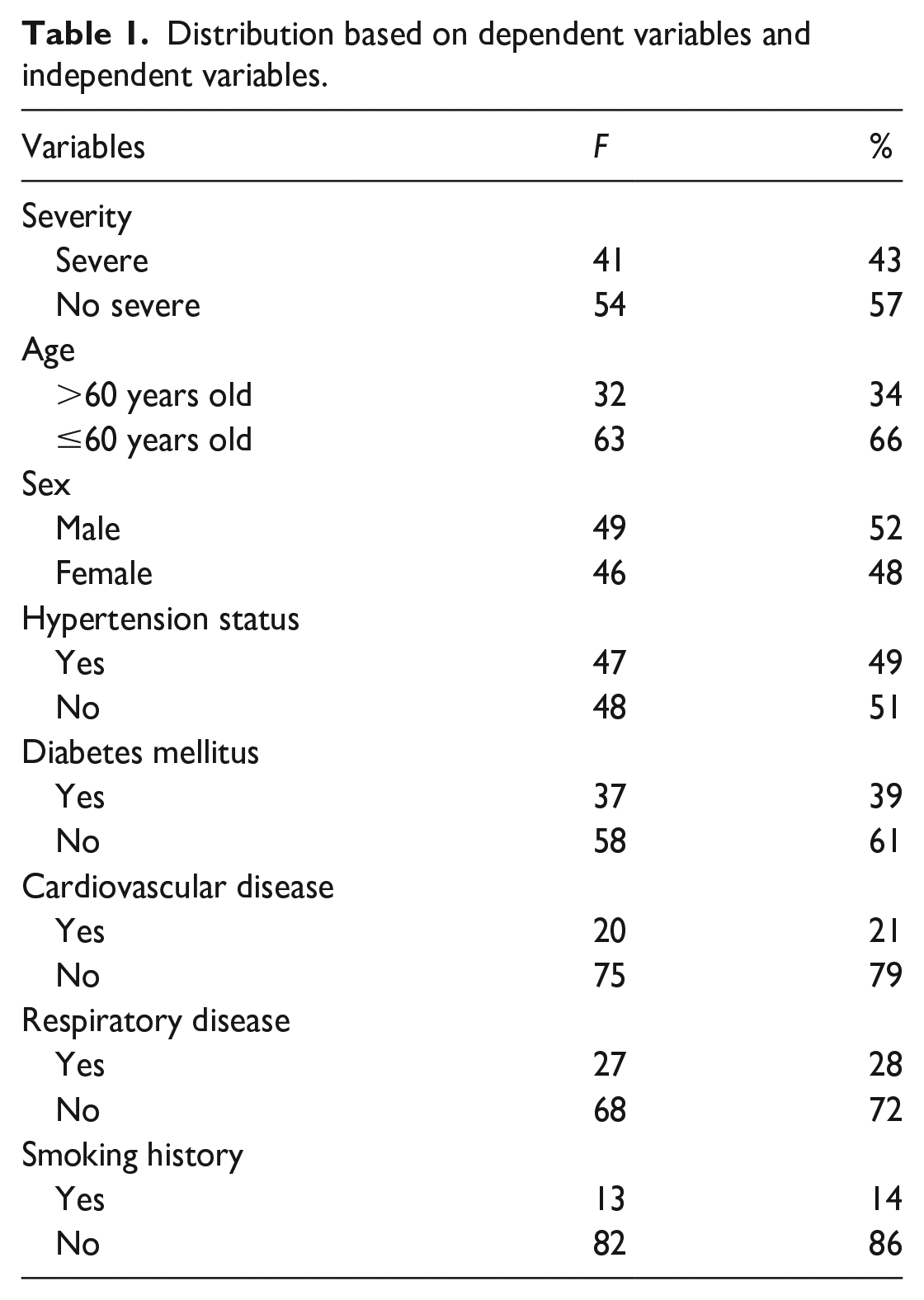
Table 1 provides the descriptive measures Based on Table 1, it was found that the proportion of patients infected with COVID-19 hospitalized at Dr. M. Djamil Padang Hospital in 2020–2021 found that 43% of patients with severe degrees, as many as 34% of patients were in the age group 60 years, while the proportion of sex was not much different between male patients (52%) and female patients (48%). Then, several comorbidities that the patient had, including patients with hypertension 49%, patients with diabetes mellitus 39%, patients with cardiovascular disease 21%, and patients with respiratory diseases 28%. Then as many as 14% of patients had a history of smoking.
Distribution based on dependent variables and independent variables.
Depending on the bivariate outcomes in Table 2, with a p-value of 0.002 and a POR of 4.10, it was shown that age was statistically associated with the severity of COVID-19, meaning that patients over 60 are 4.10 more at risk increase in COVID-19 severity (POR 4.10; 95% CI 1.66–10.1). Furthermore, the statistical results for gender revealed a p-value of 0.044 and a POR of 2.33, indicating that gender is associated with the severity of COVID-19 infection, with male patients at risk of a 2.33-fold increase in severity. According to the findings of the statistical analyses, as the p-value was more than 0.05, there was no correlation between hypertension and the severity of COVID-19.
Relationship between independent variables and Severity of COVID-19 in patients at RSUP Dr. M. Djamil, Padang.

Statistically significant at p-value < 0.05; α=5%.
Although diabetes mellitus has a p-value of 0.033 and a POR of 2.49 (95% CI 1.07–5.81), which means that it has a 2.49-fold chance of making COVID-19 more severe, it is linked to the severity of the condition. Based on the POR value obtained, cardiovascular disease has a risk of 5.65 times increasing the severity of COVID-19. The cardiovascular disease variable has p-value 0.001 showing a significant association with the severity of COVID-19. According to the results of the statistical analyses, there is a significant correlation between a history of respiratory illness and the severity of COVID-19. It is because the p-value was less than 0.05 and the POR result showed that there was a 6.39-fold possibility that respiratory illness would make COVID-19 even worse.
The p-value between smoking history and severity of COVID-19 was 0.041, indicating a significant correlation between smoking history and COVID-19 severity. The POR value was 3.51 at that point, indicating that smoking history carries a 3.5-fold risk of increasing COVID-19 infection.
Based on Table 3, it was obtained that five variables are highly correlated with the severity of COVID-19 in patients in M. Djamil Hospital, Padang, Indonesia. The variable such as Diabetes Mellitus status, Cardiovascular disease, and Respiratory disease was a medical history from the patient that occurred on patients before they had COVID-19 infections. Smoking history was also one of the variables that increased and had a correlation with the severity of COVID-19 patients at the M Djamil Hospital, Padang, Indonesia. The B value in chi-square analysis is the coefficient estimate from the logistic regression model, and Exp (B) represents the odds ratio, which helps interpret the effect of predictor variables on the binary outcome.
Correlation coefficients for each of the independent variables.

Based on Table 4, it was obtained several variables that had p-values <0.25 and would be included in the multivariate analysis modeling, namely the variables age, sex, diabetes mellitus, cardiovascular disease, respiratory disease, and smoking history.
Modeling of screening of independent variables for multivariate.

Based on Table 5, there are three variables that have a p-value > 0.05, namely gender, diabetes mellitus, and smoking history. The gender variable has the greatest p-value so it is the first variable to be excluded from the model and then diabetes mellitus and smoking history one by one.
Multivariate initial model.

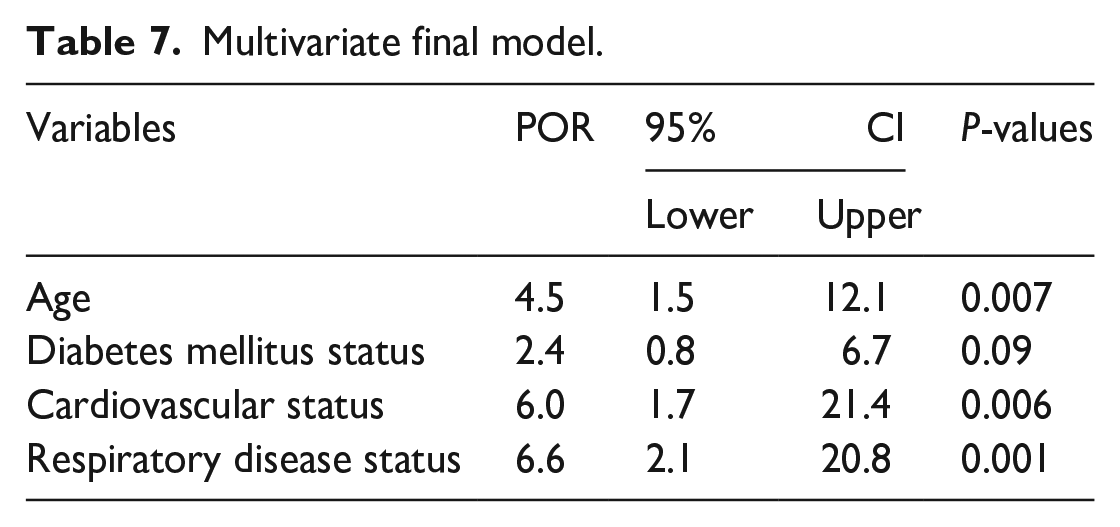
According to Table 6, each variable that has the largest p-value is removed in stages. POR is the ratio of each initial variable before the expenditure of other variables. POR1 is the variable ratio obtained after one variable is excluded. If after removing the variable there is a change in POR of more than 10%, then the variable is identified as a confounder and is put back into the model (the final model is presented in Table 7).
Multivariate modeling.

Multivariate final model.
Discussion
Based on the results of the study, it was found that age is related to the degree of severity of COVID-19. The results of this study are in line with research conducted by Wang et al., 7 Sohrabi et al., 8 and Pustahija et al. 9 Age greatly affects the degree of disease severity and mortality in COVID-19 patients. Age variable that has a high level of severity occurs in Elderly people are individuals who are over 60 years old. This is allegedly due to the fact that a person’s immune system’s competence decreases with age.7 –9
Based on the results of the study, it was found that gender is related of the degree of severity of COVID-19. The results of this study are in line with research conducted by Wang et al., 7 Sohrabi et al, 8 and Priya et al. 10 Variability of innate immunity, steroid Hormones and its factors linked to sex chromosomes makes men more susceptible to it viral infection. Men were found to be more prone to contracting SARSCoV-2 infection and have a lower life expectancy compared to women.8,9,11
In this study, it was found that hypertension was not related to the severity of the COVID-19 infection. The results of this study are in line with research carried out by Zhang, et al. 11 who got the result that hypertension is not related to the severity of COVID-19. But these results are contradictory with research conducted by Pustahija et al. 9 and Wang et al. 7 which states that hypertension is one of the factors that related to the severity of COVID-19. Differences in the results of this study could caused by several factors, including sufferers of COVID-19 who have a history of hypertension is also in large numbers in patients with no degree critical. Some patients who are not at risk or with an average degree of non-severe have a history of controlled hypertension, such as routinely taking medication and maintaining it better health.7,9,11
Based on the results of the study, it was found that diabetes mellitus is related to the degree of severity of COVID-19. The results of this study are in line with research that has been conducted by Alqahtani et al. 6 and Thasya. 12 Patients with diabetes mellitus have blood sugar levels that are not stable and easy to experience weight loss causing compromised immunity. The health condition of people with diabetes mellitus. This unstable condition makes it difficult for the body to fight other viral infections.6,12,13
According to the results of the study, it was found that cardiovascular disease is related to the degree of severity of COVID-19. The results of this study are in line with research that has been conducted by Wang et al., 7 Abd El-Raheem et al., 14 and Priya et al. 10
Cardiovascular disease is a comorbid commonly found in patients infected with COVID-19 that can increase severity to COVID-19 infected patients with CVD. This may be due to the presence of ACE2 receptors on the heart and lining organs vascular endothelium potentially involved in SARS-CoV-2 infection in the cardiovascular system.8,11,15
According to the findings of the study, respiratory disease is related to the degree of severity of COVID-19. The results of this study are in line with research that has been conducted by Priya et al. 10 and Wang et al. 7 The most common respiratory diseases were asthma (13.2%), COPD (2.3%), and bronchiectasis (0.5%). People with respiratory diseases have different physical conditions, so they are very vulnerable and at risk of infection with COVID-19.8,11
Vitamin D deficiency has long been associated with reduced immune function which can lead to viral infection. Several studies have shown that Vitamin D deficiency is associated with increases the risk of infection with COVID-1916 –18. Vitamin D deficiency over a long time also can trigger a Diabetes Mellitus and Cardiovascular Disease.15,19 And due to the result of this study, Diabetes Mellitus status and cardiovascular disease related to the severity of COVID-19 patients. Based on the result of Susianti et al. 20 conducted in Indonesia found that a low level of vitamin D occurs in in most hospitalized COVID-19 patients.
Based on the results of the study, it was found that smoking history related to the degree of severity of COVID-19 The results of this study are in line with research that has been conducted by Priya et al. 10 and Sohrabi et al. 8 WHO states that smoking is associated with an increased degree of severity and mortality due to COVID-19 patients who are treated in hospitals. WHO also recommends quitting smoking in view of the dangers of using tobacco and exposure to secondhand smoke.8,10
According to the findings of multivariate analysis, respiratory disease was the dominant factor associated with the degree of severity of COVID-19. These results reinforce the results of previous research conducted by Priya et al. 10 and Wang et al. 7 which states that respiratory disease is a one of the factors associated with the degree of severity of COVID-19. Respiratory diseases such as COPD, asthma, and TB as the dominant factors associated with the severity of COVID-19, this is because sufferers have lungs whose function has been disrupted so that they are particularly susceptible to viral infections viruses that also attack the respiratory system, such as SARS-CoV-2.7,10
Conclusion
Based on the results of research conducted on 95 patients, it was found that the majority of hospitalized patients are symptomatic patients not severe (mild to moderate). Factors related to the severity of COVID-19 in inpatients at RSUP Dr. M. Djamil Padang in 2020-2021 are the variables of age, gender, diabetes mellitus, cardiovascular disease, respiratory disease, and smoking history. While the most factor. The most dominant factor related to the degree of severity of COVID-19 is respiratory disease.
This study is highly recommended that the hospital should improve health promotion in respiratory disease, cardiovascular disease is the disease most often found in patients who have degrees of severity of COVID-19 infection. Hospitals are also expected to educate the elderly about prevention, which must be carried out more intensively by the elderly as they age, as they are more likely to contract the severe COVID-19 infection.
Footnotes
Acknowledgements
The authors would like to acknowledge M. Djamil General Hospital for the access to the data used in this study. This study was supported by a research grant from the LPPM Unand. The funders had no role in the design of the study and collection, analysis, and interpretation of data and in writing the manuscript.
Author contributions
MM, conceptualization; ASEP and NPR, data acquisition and curation; MM and ASEP, methodology; NPR, software; NPR a, formal analysis; NPR, interpretation; MA, manuscript drafting; MM, RN, NPR, MA, manuscript review and editing. All authors read and approved the final manuscript.
Availability of data and materials
Data are available upon request.
Declaration of conflicting interests
The author (s) declared no potential conflicts of interest with respect to the research, authorship, and/or publication of this article.
Funding
The author(s) disclosed receipt of the following financial support for the research, authorship, and/or publication of this article: This research was funded by the LPPM Unand, grant number T/115/UN.16.17/PT.01.03/KO-RPT/2022. The funders had no role in the design of the study; in the collection, analyses or interpretation of data; in the writing of the manuscript, or in the decision to publish the results.
Informed consent
Significance for public health. The results of this study can be used as input materials such as additional literature related to the severity or severity of COVID-19. This study can be used to inform the public about factors associated with the severity of COVID-19 and to provide insight to the community in order to help prevent and motivate people and the environment to maintain people’s health.