




Abstract
Background:
The epidemiological data on distribution of pediatric acute pancreatitis was deficiency. And the purpose of this research was to investigate the epidemiology and clinical features of pediatric acute pancreatitis in the population in north of Guizhou, China.
Design and methods:
A retrospective case analysis was conducted to accomplish the aim. Patients who were under 18 years old with acute pancreatitis were recruited. Data were collected directly from Hospital Information System (HIS) after patients were discharged from the hospital.
Results:
A total of 95 children aged from 3 to 17 years were collected, 49 patients were boys and 46 were girls. In addition, the percentage of acute pancreatitis occurring in girls aged 15–17 years was significantly higher than that of boys (54.3% vs 36.7%). Meanwhile, the percentage of severe patients over 12 years exceeded 90.0%. Moreover, the proportion of severe acute pancreatitis in girls was significantly higher than that in boys (26.1% vs 10.2%), and 64.7% of severe patients were from 12 to 14. What’s more, more patients occurred in May, June, and December and on weekends, 47.1% (8/17) severe cases occurred in May, June, and July, and 47.1% (8/17) severe patients occurred on weekend. The length of hospitalization and hospitalization costs of severe patients were found higher compared to mild patients.
Conclusions:
Higher risk of pediatric acute pancreatitis, especially severe acute pancreatitis, in north of Guizhou, China occurred on weekend, during May and June, and among children aged 12–17 years, especially girls. Additionally, severe acute pancreatitis was associated with higher hospitalization costs and longer hospitalization length.
Before we conducted this study, we had known:
(1) The increasing trend of pediatric acute pancreatitis
(2) The main etiology of pediatric acute pancreatitis
(3) The high cost of severe acute pancreatitis
While what we did not know include:
(1) The distribution of pediatric acute pancreatitis, especially the temporal and population distribution in northern Guizhou.
After we analyzed the data of a tertiary hospital in northern Guizhou, which was the best hospital in this area, we found that higher risk of pediatric acute pancreatitis, especially severe acute pancreatitis, occurred on weekend, during May and June, and among elder children aged 12–17 years, especially girls. Additionally, severe acute pancreatitis was more likely to give rise to higher hospitalization costs and longer length of hospitalization.
Introduction
Acute pancreatitis (AP) has become a common general pediatric condition with an increasing incidence over the past two decade. 1 While pediatric acute pancreatitis has distinct etiologic(etiologies), clinical, and prognostic characteristics in contrast to the adult form of the disease. 2 A foregoing study showed the incidence according to international data was 3.6–13.3 cases per 100,000 children. 3 Recent data have also demonstrated the considerable costs of AP, with estimated inpatients cost of about $200 million per year. 4 Obviously, neither the costs related to complicated or severe AP, that may require additional intensive care or invasive/surgical treatments, nor the indirect costs are taken into account with this estimation. 5
A previous study reported that a lot of etiologies were thought to contribute to AP in children, including structural, obstructive, infections, toxins, trauma, metabolic, systemic illness, inborn errors of metabolism, and genetic predispositions.6,7 Biliary/obstructive factors, medications, and traumas are the main causes of childhood AP and knowledge of these possible etiologies will guide the initial investigations. 6
Though there are no evidence-based diagnostic guidelines for AP in children, pediatric pancreatitis could be diagnosed with the presentation of at least two of three criteria according to the International Study Group of Pediatric Pancreatitis (INSPPIRE) guidelines. 8 Moreover, based on the criteria of North American Society of Pediatric Gastroenterology, Hepatology, and Nutrition (NASPGHAN), the severity of AP is classified into three categories: mild AP associated with no organ failure, moderate AP with either the development of transient organ failure/dysfunction (lasting no longer than 48 h), or development of local or systemic complications and severe AP with single or multisystem organ failure persisting greater than 48 h. 9 While there were no universally accepted clinical tools to predict a severe course at early stages which was higher fatality rate and longer length of hospitalization, as a result, it is still imperative to acquire more information about severe acute pancreatitis among children. Additionally, approximately 15%–35% of all children with AP will go on to have recurrences. 10 Notwithstanding the severity and unfortunate prognosis of AP, epidemiological data on distribution of this entity was scarce. And the previous researches were mainly focused on etiology or risk factors and manifestations.
A better understanding of the epidemiology on distribution and clinical features of pediatric acute pancreatitis is important for formulating policies apropos the future of pediatric acute pancreatitis prevention. While there were few studies related to the epidemiology on distribution of pediatric acute pancreatitis conducted in the southwest part of China, especially in Guizhou province, which was located on the Yunnan-Guizhou Plateau, low economic level and relative laggard in many aspects compared to east part of China, moreover, there was significant difference of lifestyle compared with other parts of China. Therefore, the specific aims of the present study are to investigate the epidemiology and clinical features of pediatric acute pancreatitis in the population in north of Guizhou, China. These aims are achieved through the extraction of patients’ data from the Hospital Information System (HIS) of the Affiliated Hospital of Zunyi Medical University covering the 6-year period from 2015 to 2020.
Methods
Participants
A retrospective case analysis was carried out at the Affiliated Hospital of Zunyi Medical University from October 1st, 2020 to December 31st, 2021. Patients under 18 years old 11 to match China Census age categories were admitted to the hospital with the occurrence of symptoms of acute pancreatitis, and whose discharge diagnosis was acute pancreatitis or severe acute pancreatitis were eligible for enrollment in the study. And the criteria used in this hospital was defined as the presence of at least two of the following three criteria: (1) typical clinical symptoms with consistent abdominal pain; (2) serum amylase and/or lipase higher than three times the upper limit of normal; and (3) characteristic manifestations of abdominal ultrasound and/or computed tomography. 12 Excluding criteria included that the outpatient diagnosis does not involve any symptoms of acute pancreatitis, and the discharge diagnosis was not acute pancreatitis or severe acute pancreatitis. Patients from the pediatrics department, hepatobiliary surgery department, emergency department, gastroenterology department, and even the ICU (Intensive Care Unit) were enrolled in the study. In addition, this study was approved by the Medical Ethics Committee of the Affiliated Hospital of Zunyi Medical University (No.: KLLY-2021-204), and the informed consent was exempted.
Data collection
After patients were discharged from the hospital, data were obtained directly from Hospital Information System (HIS), consisting of sex, age, date of admission, outpatient diagnosis, discharge diagnosis, date of discharge, hospitalization costs. We defined the severe pediatric pancreatitis based on whether need for treatment at an intensive care unit. 13
Statistical analysis
Excel was used to build the database. Data was analyzed with SPSS 18.0 (SPSS Inc., Chicago, IL, USA). The line chart was used to describe the trend of frequency changing with time. All measures variables followed a normal distribution determination. Abnormal distribution measurement data was described by median and interquartile range (M, IQR), differences between two groups (such as gender and types of AP) were tested by Mann-Whitney U test. Percentage was used to describe the count data, differences between groups were tested by Chi-square test. α = 0.05 was taken as the level of significance.
Results
Demographic characteristics
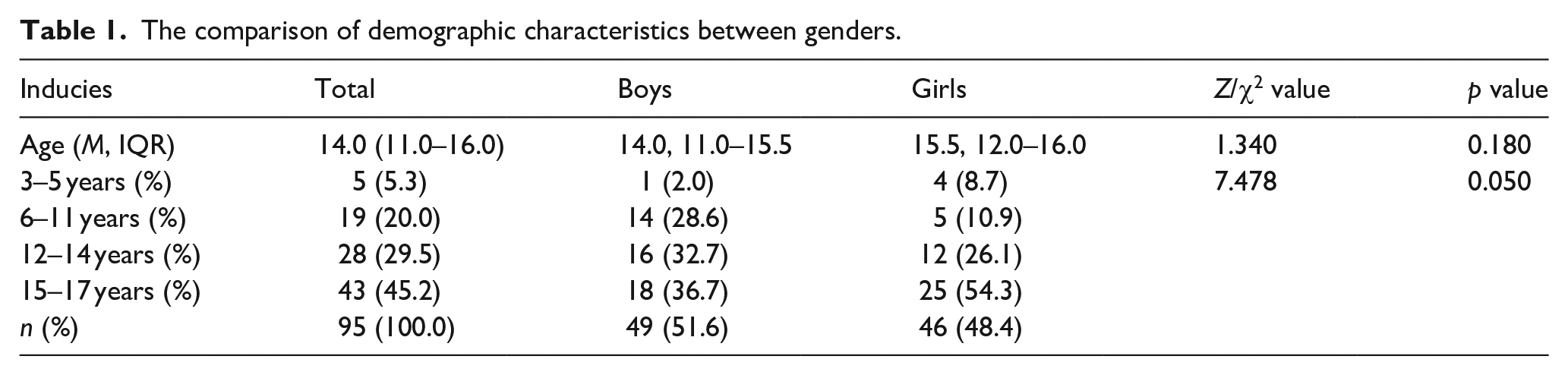
There were 95 visits who admitted to our hospital from January 1st 2015 to December 31st 2020. The age for all visits ranged from 3 to 17 years old, and the median age for all visits was 14 years (IQR 11–16), the median age for boys and girls was 14 years (IQR 11–15.5), and 15.5 years (IQR 12–16), respectively. Of all cases, 49 (51.6%) patients were boys and 46 (48.4%) were girls. In addition, the age of acute pancreatitis occurring in girls was a little higher than that of boys, but there was no significant difference found. When the age was classified into several categories based on the study stage, there was significant difference of distribution between genders, the percentage of girls aged 15 to 17 years was higher than that of boys(54.3% vs 36.7%), and the proportion increased with age (see Table 1).
The comparison of demographic characteristics between genders.
The consistent proportion of admission diagnosis and discharge diagnosis
Among the 52 cases filled in outpatient diagnosis, 37 cases were acute pancreatitis, 5 cases were abdominal pain, 10 cases were other diagnosis. Among the 17 severe cases, there were 6 severe cases, 1 mild case, 1 pneumonia patient, 1 subphrenic abscess case, and 8 were not filled with outpatient diagnosis; 7 cases were directly admitted to the intensive unit care, all others were admitted to the general ward. Additionally, this study indicated that the consistent proportion of outpatient diagnosis and discharge diagnosis was 71.2% (37/52) and 66.7% (6/9) for acute pancreatitis and severe acute pancreatitis, respectively.
The onset age distribution of acute pancreatitis
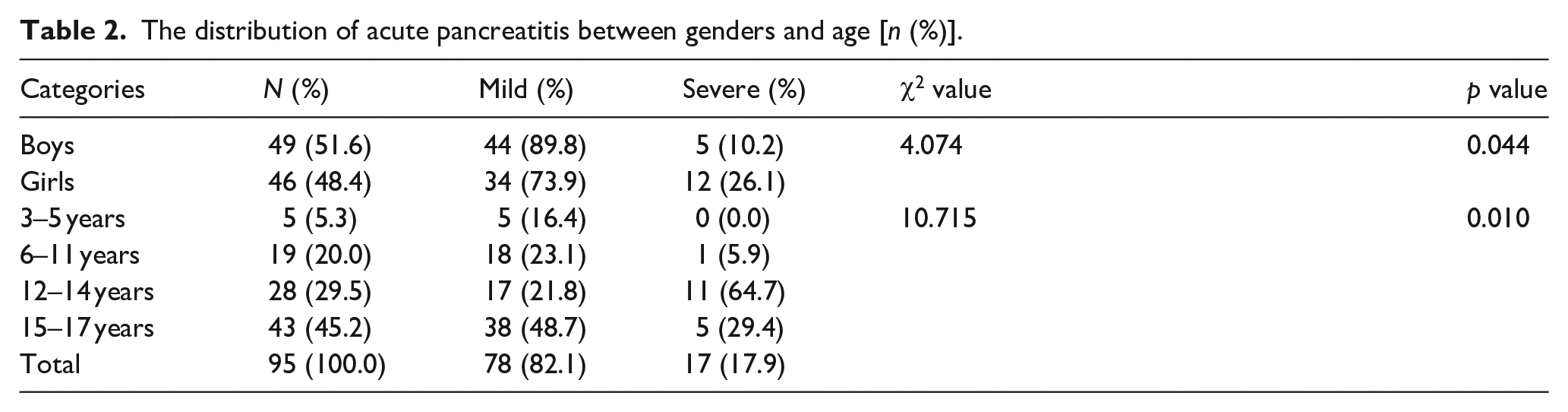
The proportion of severe pediatric acute pancreatitis was 17.9% (17/95). And the proportion of severe acute pancreatitis in girls was significantly higher than that in boys (26.1% vs 10.2%). When the age was classified into several categories based on the study stage, there were 5.3% (5/95), 20.0% (19/95), 29.5% (28/95), and 45.2% (43/95) for each stage, respectively. In addition, there were about 75.0% mild PAP patients over 12 years old, while over 90.0% of severe patients were over 12 years old. Moreover, 64.7% of severe patients were aged from 12 to 14 years old, and 48.7% mild patients were aged from 15 to 17 years old. Meanwhile, there was significant difference of the proportion found among study stages. Taken together, the number of acute pancreatitis increased with age, the peak was 16 years old (see Figure 1 and Table 2).

The frequency of acute pancreatitis changing with age, years, and day.
The distribution of acute pancreatitis between genders and age [n (%)].
The temporal distribution of acute pancreatitis
The results of year distribution revealed that there were two peaks, which was 2016 and 2019. Moreover, the figure which showed the number of cases changed with the month or week indicated that there were more patients occurring in May, June, and December, corresponding to 20th week, 24th week, 41st, and 51st week; subgroup analysis displayed that more patients aged 6–14 years occurred in May, June, and October, and patients aged 15–17 years had similar numbers of cases throughout the year except November; and there were 47.1% (8/17) severe cases occurring in May, June, and July. Additionally, the results also displayed that more patients occurred on weekends and Thursday, boys were more likely to occur on Saturday and girls were on Thursday, meanwhile, when the cases were divided into three groups based on their age, there were fewest patients aged 3–5 years, and more cases aged 6–14 years occurred on Thursday and most patients aged 15–17 years occurred on weekends; and 47.1% (8/17) severe patients occurred on Friday, Saturday, and Sunday (see Figures 1–3).

The frequency of acute pancreatitis changing with months.

The frequency of acute pancreatitis changing with weeks.
The comparison of the length of hospitalization and hospitalization costs between genders and types
There were significant differences found in the length of hospital stay and hospitalization costs of different types of pediatric acute pancreatitis, and the similar difference between mild and severe pediatric acute pancreatitis was found in girls. What’s more, the length of hospital stay and hospitalization costs of severe pediatric acute pancreatitis among girls were found higher compared to boys’, but there was no significant difference found (see in Table 3).
The comparison of the length of hospitalization and hospitalization costs between genders and types (M, IQR).

Versus Boys.
p > 0.05.
Discussion
With the increasing number cases reported in the last few decades’ publication reports, 14 pediatric acute pancreatitis is detrimental to children’s life, thus it is of great importance to understand the distribution of AP in children to formulate preventive measures and suggestions. Our report showed a total of 95 patients were collected, the age ranged from 3 to 17 years old, while there was research reporting infants suffered acute pancreatitis. 15 In addition, the age of acute pancreatitis occurring in girls was a little higher than that of boys, but there was no significant difference found. When the age was classified into several categories, the significant difference of distribution between genders was found, the percentage of girls aged 15–17 years was higher than that of boys, and the proportion increased with age. A previous study reported that AP in children was more likely to occur in children over 5 years old (median age, 17 years), 16 which was similar to our results that there were over 90.0% children over 5 years who suffered AP. Additionally, the male-to-female ratio was about 1.06:1, and another research reported that the male-to-female ratio in Taiwan was 1.1:1, 17 which was consistent to our results. While a forgoing study showed that the incidence of acute pancreatitis in pediatric patients in USA occurred slightly more frequently in girls than in boys, 16 the reason might be attributed to the different dietary habit and that the subjects in the study were aged from 1 to 20 years.
As acute pancreatitis often presents with nonspecific complaints of abdominal pain, vomiting, and nausea, 1 it is unavoidable to misdiagnose. The result of this study reported that the proportion of severe acute pancreatitis was 17.9%. Additionally, this study indicated that the consistent proportion of admission diagnosis and discharge diagnosis was 71.2% and 66.7% for acute pancreatitis and severe acute pancreatitis, respectively. So it was essential and feasible to improve the accuracy of diagnosis. Contrast enhanced computed tomography (CECT) and other imaging technologies can be used to predict severity and prognosis. 18 Though some authors argue that performing a CECT should be a part of the routine evaluation of patients with pancreatitis, considered the fiscal reasons, radiation and the existence of useful predictive scores, CECT was not recommended in guidelines. 19 An alternative could be ultrasound based severity prediction, which, although not routinely used, had some promising results in adults, but is yet to be examined in children. 19 In addition, when taking a history, it is of great importance to ask about drug usage, symptoms of viral illness, abdominal trauma, and a family or personal history of genetic disease.14,18 In short, the accurate diagnosis should be based on a combination of careful clinical evaluation and initial investigations. It is imperative to place great emphasis on early identification with the purpose of a prompt response and transfer to the intensive care unit when necessary.
When we analyzed the distribution of acute pancreatitis between genders, the male-to-female ratio was about 1.06:1, the proportion of severe acute pancreatitis among girls was significantly higher than that of boys. Meanwhile, though there were no differences found in mice induced by cerulean 20 and L-arginine 21 one previous animal research reported that female mice induced by ethionine were more likely to suffer severe acute pancreatitis in comparison with male mice, 22 and the results was consistent with the association of acute pancreatitis in humans with estrogen-containing medications, 22 which is consistent with our findings, however, the underlying mechanisms are unclear. Nevertheless, a foregoing study reported that female patients with acute pancreatitis in adults had significantly lower in hospital mortality rates and in hospital clinical outcomes compared to male patients, 23 which is contradiction with our results.
Moreover, the results also reported that about 75.0% acute pancreatitis occurred among children aged from 12 to 17 years, the proportion of 12–14 years old, and 15–17 years old was 29.5% and 45.2%, respectively. A previous research reported that obesity and eating disorders (EDs) were both prevalent in adolescents, and some adolescents might misinterpret what “healthy eating” is and engage in unhealthy behaviors, such as skipping meals or using fad diets in an attempt to “be healthier.” 24 And another systematic review showed there were positive associations between consumption of ultra-processed food and body fat during childhood and adolescence. In addition, there were about 70.0% mild acute pancreatitis patients over 12 years old, while over 90.0% of severe patients were over 12 years old. There was one previous study demonstrated that both prevalence of severe acute pancreatitis and in-hospital mortality were significantly higher in pediatric patients with obesity than those without, 25 which might be attributed in part to our findings. Thus there might be association between obesity and acute pancreatitis. Moreover, 64.7% of severe patients were aged from 12 to 14 years old, and 48.7% mild patients were aged from 15 to 17 years old. The consequence of this research indicated that more attention should be put on the elder children with the purpose of a better prognosis.
When we explored the temporal distribution of acute pancreatitis, the results revealed that there were two peaks in the year distribution, which was 2016 and 2019. To some extent, the national policy of family planning, the selective two child policy in November of 2013 and China’s universal two-child policy released in October of 2015, 26 might contribute to the increasing number of acute pancreatitis, since there were more infants born after the policy was enacted.
Moreover, the figure of the number of cases changing with the month or weeks indicated that more patients occurred in May, June, and December, corresponding to 20th week, 24th week, 41st, and 51st week. Subgroup analysis showed that more patients aged 6–14 years occurred in May, June, and October, and patients aged 15–17 years had similar numbers of cases throughout the year except November. The results might be that there were several Chinese traditional festivals and foreign festivals, such as the dragon Boat Festival, the Mid-Autumn Day, the Double Ninth Festival, the winter solstice, five-two-zero which means “I love you” and Christmas, people would dine together where they were easier for binge eating. A large number of researches have demonstrated that acute pancreatitis is associated with bulimia, 27 which could illuminate why there were more cases occurring on weekends and in the aforementioned months to a certain degree. On the other hand, virus infection could account for the more occurrence of acute pancreatitis in children occurring in the aforementioned months as well, such as rotavirus, 28 the influenza virus, varicella-zoster virus, and hepatotropic virus. 29 At present, the viral infection is now widely recognized as a common cause of pediatric pancreatitis.
Additionally, the results also displayed that there were more patients occurring on weekends and Thursday, boys were more likely to occur on Saturday and girls were on Thursday, meanwhile, when the cases were divided into three groups based on their age, there were fewest patients aged 3–5 years, and more cases aged 6–14 years occurred on Thursday and more patients aged 15–17 years occurred on weekends. The reason of that elder children suffered acute pancreatitis on weekends might be that consumption of vegetables, lunch, and snacks were significantly more adequate during the weekdays as compared to the weekends. 30 While another research conducted in America indicated that American, 2 years and older, consumed more energy on each weekend than they did on weekdays. 31 However, there were no reasonable explanation on that more cases occurred on Thursday, so it is necessary to implement more studies to account for why there were more cases on Thursday.
Additionally, the length of hospital stay and hospitalization costs of severe acute pancreatitis were significantly higher than those of mild acute pancreatitis, and the similar difference between mild and severe acute pancreatitis was found in girls. What’s more, the differences of the length of hospital stay and hospitalization costs of severe acute pancreatitis among girls were higher compared to boys’, while there was no significant difference found, which was not consistent with a previous study. 23 While there were researches indicating that female suffered more severe acute pancreatitis than male which might be related to estrogen. 22 Further researches are desired with a view to demonstrate the association between gender and severe acute pancreatitis.
Strengths and limitations
Perhaps the biggest strength of our work is that there were few previous researches about the temporal distribution of acute pancreatitis, especially about the week distribution and the month distribution. Among limitations, it should be stated that our study may not be representative for the full acute pancreatitis in children as patients was collected from one hospital which was located at the southwest China, considered the hospital was a national tertiary hospital in this area and there were relatively adequate patients who visited this hospital, to some degree, the results could represent the epidemiologic features of pediatric acute pancreatitis in north of Guizhou, China. Additionally, the data was collected from the hospital information system (HIS), we can only establish associations between variables, and not infer causation. Furthermore, another limitation is that – most likely due to the low number of severe cases—the difference between mild and severe acute pancreatitis was not found in gender and the confidence in these findings could be reduced.
Conclusions
In conclusion, this research suggested that there is a higher risk of pediatric acute pancreatitis in southwest China for weekend, May and June, elder children aged 12–17 years, especially girls. Additionally, severe acute pancreatitis was more likely to result in higher hospitalization costs and longer length of hospitalization. Parents and health workers should attach more importance to these population and time frame to prevent acute pancreatitis.
Footnotes
Author contributions
Shixing Bo, Chaohui Wang, and Wenmei Liang conceived and designed the experiments, performed the experiments, analyzed the data, prepared tables, authored or reviewed drafts of the paper, and approved the final draft. Shixing Bo, Yanna Zhou, and Jingyan Gao performed the experiments, collected data, prepared tables, and approved the final draft. Xiaoyun Fu conceived and designed the experiments, authored or reviewed drafts of the paper, and approved the final draft.
Data availability
The data that support this study are available in the article and accompanying online supplementary material.
Declaration of conflicting interests
The author(s) declared no potential conflicts of interest with respect to the research, authorship, and/or publication of this article.
Funding
The author(s) disclosed receipt of the following financial support for the research, authorship, and/or publication of this article: This research was supported by Science and Technology Fund Project of Guizhou Provincial Health Commission (Grant No. gzwkj2023-114, PI: Wenmei Liang). The funders had no role in study design, data collection and analysis, decision to publish, or preparation of the manuscript.
Human ethics
The following information was supplied relating to ethical approvals (i.e. approving body and any reference numbers): This study was approved by the Medical Ethics Committee of the Affiliated Hospital of Zunyi Medical University (No.: KLLY-2021-204).