



Abstract
Objectives
Syphilis is a globally prevalent sexually transmitted infection. This study aimed to elucidate the epidemiological characteristics of syphilis in China from 2004 to 2019.
Methods
Incidence data for syphilis across 31 provinces in mainland China were obtained from the Data Center of China Public Health Science for the period from 2004 to 2019. Epidemiological methods and the Chi-squared test were used to analyze the temporal, regional, and disease stage distributions of syphilis.
Results
In total, 5,527,399 syphilis cases were reported in China from 2004 to 2019, with an average annual prevalence of 25.7063 per 100,000 population and overall increasing trend. In terms of regional distribution, high-incidence provinces included Shanghai, Zhejiang, Fujian, Guangxi, Guangdong, Xinjiang, Ningxia, and Qinghai. The proportion of latent syphilis increased from 20.41% in 2004 to 82.95% in 2019, with an upward trend each year.
Conclusions
Syphilis incidence exhibited an overall increasing trend in China, and latent syphilis was predominant. Syphilis incidences considerably varied among regions, and syphilis was detected from coastal to inland provinces. Thus, syphilis prevention and control programs should be tailored according to the specific epidemiological characteristics of each region.
Keywords
Introduction
Syphilis is a sexually transmitted infection caused by Treponema pallidum; it can also be spread via blood transfusion and maternal–neonatal transmission. 1 Syphilis is one of the most common sexually transmitted infections worldwide, with 49.71 million cases in 2019 according to the World Health Organization. 2 Surveillance data from China showed a rapid increase in syphilis incidence between 2003 and 2014; the average annual growth rate was 16.3%. 3 Low- and middle-income countries have particularly high incidences of syphilis. 4 Previous research has linked syphilis incidence to population size and structure, per-capita health resources, and socioeconomic factors; areas with large population and few health resources often have high syphilis incidence. 5 In China, the highest incidence of syphilis has shifted from prosperous coastal areas to poor inland cities. 6 Syphilis has become a widespread public health problem with serious risks to human physical and mental health. The establishment of appropriate prevention and control strategies requires an exploration of the epidemiological characteristics of syphilis and identification of high-incidence areas. Therefore, this study aimed to investigate the epidemiological characteristics of syphilis in China from 2004 to 2019 using data from the China Centers for Disease Control’s direct network reporting system.
Materials and methods
Data source
Syphilis incidence data—covering 31 provinces, autonomous regions, and municipalities in mainland China from 2004 to 2019—were obtained from the Data Center of China Public Health Science (https://www.phsciencedata.cn/Share/index.jsp). No patient-level details were included in the dataset. No ethical approval was required for the use of these publicly available data. This study was reported in accordance with the STROBE guidelines. 7
Syphilis diagnosis
Before 2007, syphilis diagnoses adhered to the Diagnostic Criteria and Treatment Principles of Syphilis (GB15974-1995) issued by the State Bureau of Technology Supervision and the Ministry of Health of China. After 2007, diagnoses of syphilis were established using criteria (WS 273-2007) issued by the Ministry of Health of China. The clinical diagnosis and staging criteria were generally consistent between the two guidelines.
Statistical analyses
All statistical analyses were performed using SPSS 22.0 software (IBM Corp., Armonk, NY, USA), and data visualization was performed using Origin 2021 software (OriginLab Corp., Northampton, MA, USA). P-values <0.05 were considered statistically significant.
Results
Epidemic situation
In total, 5,527,399 syphilis cases were reported in China from 2004 to 2019, and the average annual prevalence was 25.7063 per 100,000 population. Overall, the incidence of syphilis increased from 2004 to 2019, although there was a slight decrease in 2013. The syphilis incidence rose from 7.1217 per 100,000 population in 2004 to 38.3677 per 100,000 population in 2019, indicating an average annual growth rate of 11.88%.
The incidences of all stages of syphilis increased from 2004 to 2019. The average annual growth rates for primary, secondary, tertiary, and latent stages of syphilis were 0.07%, 1.68%, 13.24%, and 22.84%, respectively. The annual incidence of congenital syphilis increased from 2004 to 2012 and then decreased from 2012 to 2019, reflecting an average annual growth rate of −1.90% (Figure 1 and Table 1).

From 2004 to 2019, the incidences of various types of syphilis in China increased.
Syphilis prevalence in China from 2004 to 2019.

PS, primary syphilis; SS, secondary syphilis; TS, tertiary syphilis; LS, latent syphilis; CS, congenital syphilis. aAverage annual prevalence.
Regional distribution
Syphilis incidences considerably varied across different regions of China. From 2004 to 2007, the provinces or municipalities with the five highest incidences of syphilis were Shanghai, Zhejiang, Fujian, Guangxi, and Guangdong. Furthermore, Shanghai, Zhejiang, Fujian, and Guangdong were consistently among the regions with the 10 highest incidences of syphilis from 2004 to 2019. The syphilis incidence in Guangxi decreased from third highest to 16th highest in 2013. The syphilis incidence in Xinjiang increased throughout the study period, such that it was the province with the highest incidence from 2012 to 2019. Moreover, the incidences in Shanghai, Zhejiang, Fujian, and Xinjiang exceeded 50 per 100,000 population. Ningxia and Qinghai also were among the regions with the 10 highest incidences of syphilis in 2012 (Figure 2 and Supplementary Table 1).
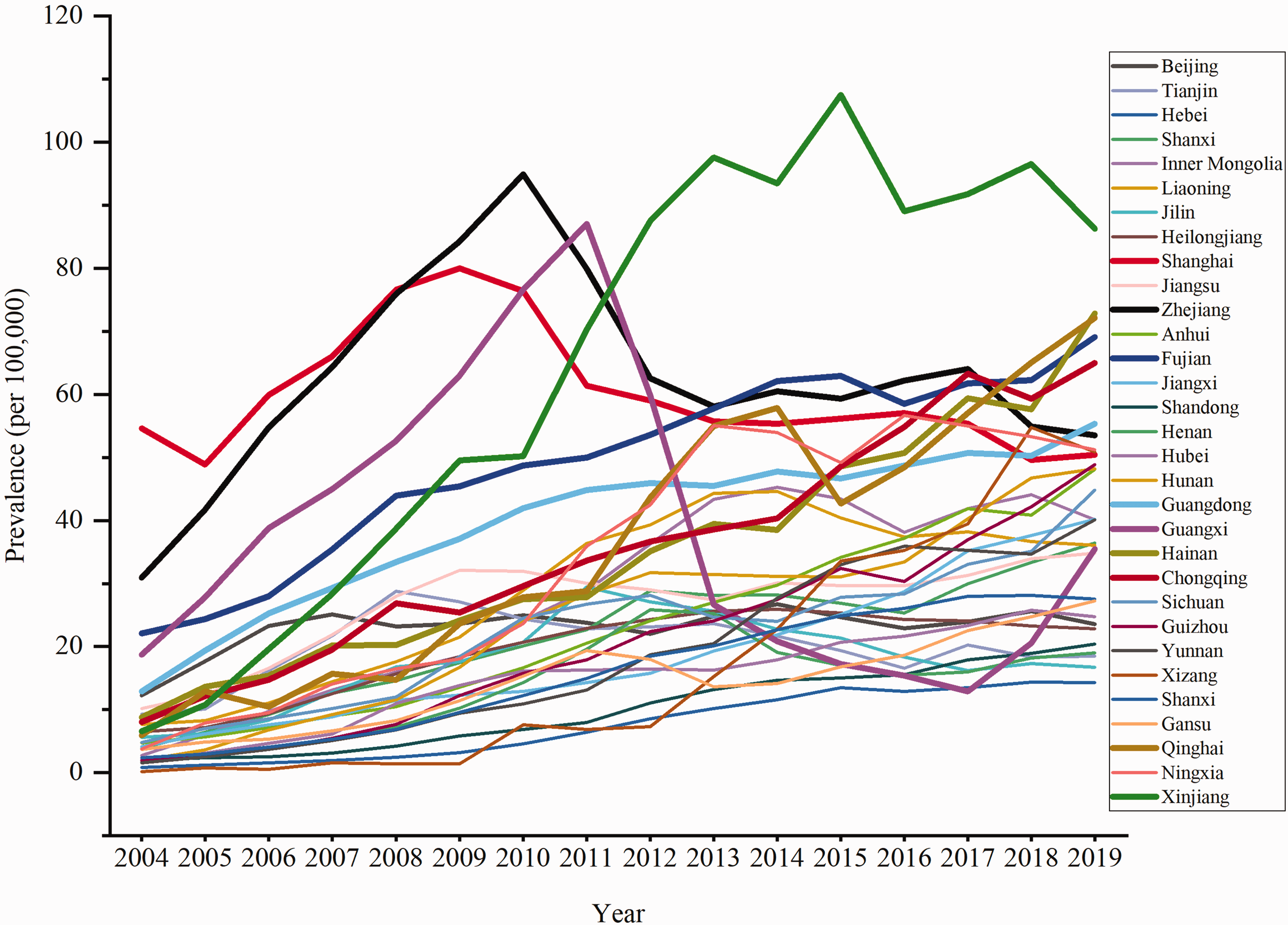
From 2004 to 2019, the incidences of syphilis considerably varied among regions of China. Overall, syphilis incidence increased across Chinese provinces.
From 2004 to 2019, the syphilis incidence increased in Chinese provinces. Among them, Xizang had the most rapid average annual growth rate (45.08%). Average annual growth rates exceeded 20% in Yunnan, Guizhou, Hubei, and Hunan; the growth rates were below 10% in Heilongjiang, Jiangsu, Fujian, Jilin, Tianjin, Beijing, Guangxi, Zhejiang, and Shanghai (Figure 3 and Supplementary Table 1).

Average annual growth rates of syphilis in Chinese provinces from 2004 to 2019.
Syphilis stages
The proportion of latent syphilis increased from 20.41% in 2004 to 82.95% in 2019 (χ2 = 159,415.63, P < 0.01), with an overall upward trend. The proportion of tertiary syphilis moderately increased from 0.56% to 0.68% (χ2 = 15.03, P < 0.01). Conversely, the respective proportions of primary, secondary, and congenital stages of syphilis decreased from 43.44% in 2004 to 8.15% in 2019 (χ2 = 85,009.09, P < 0.01), from 33.00% to 7.86% (χ2 = 48,714.36, P < 0.01), and from 2.59% to 0.36% (χ2 = 5747.72, P < 0.01) (Table 2).
Proportions of syphilis stages in 2004 and 2019

PS, primary syphilis; SS, secondary syphilis; TS, tertiary syphilis; LS, latent syphilis; CS, congenital syphilis.
Discussion
Syphilis encompasses primary, secondary, tertiary, congenital, and latent stages. Of these stages, primary, secondary, and congenital syphilis represent new-onset infections, whereas tertiary syphilis is the result of a long-term infection. Latent syphilis is asymptomatic and detected by screening; thus, it is difficult to determine whether this stage represents a new-onset or long-term infection. The World Health Organization uses the prevalences of primary, secondary, and congenital syphilis (rather than all forms of syphilis) as indicators of syphilis trends. 8 In the present study, the average annual growth rates of primary, secondary, and congenital syphilis were low; their proportions decreased from 2004 to 2019. These trends may be attributed to “The Syphilis Prevention and Control Program of China (2010–2020),” announced in 2010, and “The Implementation Plan for the prevention of mother-to-child transmission of acquired immunodeficiency syndrome (AIDS), syphilis, and hepatitis B,” issued in 2011. These government initiatives gradually implemented and strengthened syphilis prevention and control measures, particularly regarding mother-to-child transmission, yielding positive results.9,10 Conversely, latent syphilis exhibited the largest increase, such that its proportion rapidly grew. This phenomenon could be due to the extensive syphilis serological screening in medical institutions, focusing on inpatients, preoperative patients, and pregnant women. Therefore, many patients with latent syphilis were diagnosed based on seropositivity. 11
The overall trend in syphilis incidence increased from 2004 to 2019, with an average annual growth rate of 11.88%. The incidence rose from 7.1217 per 100,000 population in 2004 to 38.3677 per 100,000 population in 2019, comparable to the syphilis rate in the United States in 2019. 12 Economic development, medical resource availability, and high-risk sexual behavior may have contributed to the increased incidence of syphilis in China. Considering the continuing syphilis epidemic, the Chinese government should invest additional resources in prevention efforts. Influenced by Western culture, Chinese society has become more tolerant of diverse sexual behaviors, including non-marital and same-sex relationships. 13 There is evidence that syphilis prevalence is relatively high among female sex workers and men who have sex with men (MSM). 9 The proliferation of smartphones and the use of social media to seek partners may also have resulted in elevated rates of high-risk sexual behaviors.14,15
Syphilis incidence fluctuated but generally increased from 2004 to 2019 across Chinese provinces. The provinces and municipalities with the highest syphilis incidences were clustered along the eastern coast (e.g., Shanghai, Zhejiang, Guangxi, Fujian, and Guangdong) and in northwestern regions (e.g., Xinjiang, Ningxia, and Qinghai). Among these regions, Xizang had the most rapid average annual growth rate (45.08%), and the incidence in Xinjiang gradually increased. The incidences in eastern coastal regions (Guangdong and Fujian) were stable, whereas they tended to decrease in Guangxi, Zhejiang, and Shanghai. The coastal regions exhibit strong economies and substantial population movement, facilitating high-risk sexual behaviors including multiple partners and unprotected sex. 16 Notably, Tang et al. 5 observed an inverted U-shaped correlation between syphilis incidence and per-capita gross domestic product (GDP), rather than a linear relationship. During the early period of economic development in China, syphilis prevalence increased, possibly due to the rapid expansion of commercial industries and corresponding increases in commercial sex and high-risk sexual behaviors resulting from changes in societal attitudes towards sexuality. 9 As the economy developed further, public security measures were enhanced to control illegal prostitution and increase health awareness, resulting in lower syphilis incidence. 17 Consistent with our results, Tao et al. identified changes in the spatiotemporal distribution of syphilis in China; the eastern coastal provinces exhibited downward trends, whereas the interior provinces exhibited upward trends. 6 In regions with rapid economic development, the increase in syphilis incidence was attributed to the growth of the sex industry. Economic advances and the establishment of adequate healthcare resources enable syphilis patients to receive effective treatment, leading to decreased syphilis incidence. However, in underdeveloped inland regions, timely detection has been hindered by the lack of adequate healthcare resources; in recent years, case detection has been improved through increased investment in healthcare. Cultural differences, limited healthcare access, and lack of sexual health knowledge may also contribute to the high incidence of syphilis in western regions, such as Xinjiang. 18 Considering their high mobility, sex workers constitute a “bridge population” that can spread syphilis across inland regions. 6 During the coronavirus disease 2019 (COVID-19) pandemic, measures adopted by the Chinese government to control the spread of severe acute respiratory syndrome coronavirus 2 (SARS-CoV-2) also played a role in preventing sexually transmitted infections. The incidences of sexually transmitted infections (e.g., AIDS and syphilis) were considerably lower in 2020 than in 2019. 19 Lockdowns reduced the frequency of social interactions and limited the potential for high-risk sexual behaviors. Notably, the cancellation of non-urgent physical examinations during the COVID-19 pandemic may also explain the decrease in syphilis incidence from 2019 to 2020.
In China, the incidence of syphilis continues to increase, and latent syphilis is predominant. Notably, the increases in primary and secondary syphilis have significantly slowed, and their proportions have significantly decreased. However, the syphilis epidemic moved from coastal to inland provinces, suggesting that syphilis incidence has a complex relationship with economic development. Syphilis remains an important public health problem in China, and its incidence considerably varies among regions. Thus, syphilis prevention and control programs should be tailored according to the specific epidemiological characteristics of each region. In addition, innovative and effective mechanistic and technological methods should be adopted to promptly detect and treat syphilis cases, isolate sources of infection, track and manage sexual partners, perform extensive syphilis screening, and raise public awareness of syphilis.
This study had some limitations. First, the available data were limited, preventing stratification of syphilis incidence according to sex, age, or occupation. Second, the absence of health resource and socioeconomic data hindered comprehensive analysis of the association between syphilis incidence and economic development. Although these details could not be obtained from existing databases for the study period, we will continue to collect relevant data and analyze other factors influencing syphilis incidence to optimize future prevention and control strategies.
Supplemental Material
sj-pdf-1-imr-10.1177_03000605241258465 - Supplemental material for Epidemiological characteristics of syphilis in mainland China, 2004 to 2019
Supplemental material, sj-pdf-1-imr-10.1177_03000605241258465 for Epidemiological characteristics of syphilis in mainland China, 2004 to 2019 by Jingyi Li, Yuanchao Yang, Biran Huang and Jiaqi Zeng in Journal of International Medical Research
Footnotes
Acknowledgement
We thank the Data Center of China Public Health Science for providing the resources used in this study.
Author contributions
JL designed the study, collected data, and wrote the manuscript. YY and BH analyzed the data and helped to draft the manuscript. JZ contributed to the literature review and revised the manuscript for important intellectual content. All authors provided final approval for the submitted version of the manuscript.
Data accessibility statement
Data supporting the findings of this study are available from the corresponding author upon reasonable request.
Declaration of conflicting interest
The authors declare that there is no conflict of interest.
Funding
This research received no specific grant from any funding agency in the public, commercial, or not-for-profit sectors.

Supplemental material
Supplemental material for this article is available online.
References
Supplementary Material
Please find the following supplemental material available below.
For Open Access articles published under a Creative Commons License, all supplemental material carries the same license as the article it is associated with.
For non-Open Access articles published, all supplemental material carries a non-exclusive license, and permission requests for re-use of supplemental material or any part of supplemental material shall be sent directly to the copyright owner as specified in the copyright notice associated with the article.
