




Abstract
Introduction:
Heat stress is a physical hazard and a potential health risk which can result in various conditions ranging from discomfort, headaches, psychological disorders, heat stroke and even death in extreme cases. Factors which cause heat stress include high ambient temperature, limited air movement, strenuous physical work and direct exposure to the heat of the engine/ sun. Continuous heat stress, exacerbated by dehydration, can lead to kidney disease. This study is a literature review conducted to explore factors that influence heat stress and the relationship of heat stress with acute kidney disease and chronic kidney disease.
Methods:
Literature search was conducted in September 2021. Research sources were taken from several databases, namely Science Direct, ProQuest, PubMed, and Google Scholar. From the databases, 23,316 articles were from Science Direct, 140,319 articles were from ProQuest, 670 articles were from PubMed, and 288,000 articles were from Google Scholars. Out of the total database only 24 articles met the inclusion criteria. The variables in this study were heat stress, acute kidney disease, and chronic kidney disease.
Results:
This literature review shows that several factors which can affect heat stress are heat exposure, workload, rehydration, and rest period arrangements. Heat stress experienced by workers can cause decreased kidney function and chronic kidney disease. Heat stress conditions that are continuously experienced by workers can cause chronic kidney disease.
Conclusion:
Heat stress can be experienced by workers due to heat exposure, heavy workload, poor rehydration, and poor rest period arrangements. Heat stress can cause acute kidney disease and chronic kidney disease.
Introduction
Heat stress is a physical hazard and a potential health risk which can result in various conditions ranging from discomfort, headaches, psychological disorders, heat stroke, and even death in extreme cases. Heat stress can affect the health and productivity of workers. 1 Research in India showed that out of 442 workers, 71% of workers worked in places which were exposed to heat, either from the sun’s heat or incineration or other heat processes. For workers who worked in the summer, 82% of workers experienced heat stress. For workers who worked in colder seasons, 42% of workers experienced heat stress. Incidences of heat stress can occur in all sectors of work. Incidences of heat stress are common in automotive workers, iron factory workers, security guards, construction workers, and agricultural workers. 1 Thus, to prevent this, it is necessary to understand some factors that can cause heat stress. 1
The increase in extreme heat due to climate change and other factors is assumed to be able to increase the vulnerability of workers to heat stress. Factors causing heat stress include high ambient temperature, limited air movement, strenuous physical work and direct exposure to the heat of the engine/sun. 2
Continuous heat stress which is exacerbated by dehydration can lead to kidney disease. This occurs even in healthy adults. Many scientists believe that repeated dehydration and heat stress due to extreme working conditions can lead to subclinical kidney disease, leading to permanent kidney damage. The possibility that heat stress can result in acute kidney disease and chronic kidney disease is also becoming a global concern. Several studies have shown that heat stress can increase the risk of chronic kidney disease among workers in Sri Lanka, India, and Brazil. 3 Therefore, it is necessary to review the factors which influence heat stress and the relationship of heat stress with kidney disease, both acute kidney disease and chronic kidney disease.
Methods
This literature review was conducted to explore the factors which influence heat stress and the relationship of heat stress with acute kidney disease and chronic kidney disease. The literature search was carried out in September 2021. The researchers searched for data sources using several databases, including Science Direct, ProQuest, PubMed, and Google Scholar by connecting the terms of the main topic, namely “kidney injury,” and “heat stress.” The researcher set limits in searching for related journals, namely between 2011 and 2021, to find valid sources which were not outdated and in accordance with the current development.
The inclusion criteria included in the selection of this literature review study were that the journals must be related to heat stress and acute and chronic kidney disease, and full journal texts must be available in English or Indonesian. The exclusion criteria included in the selection of this literature review study were literature review articles. The variables in this study were heat stress, acute kidney disease, and chronic kidney disease.
Inclusion and exclusion criteria
The literature review aims to answer research questions “What the factors which influence heat stress and the relationship of heat stress with kidney disease, both acute kidney disease and chronic kidney disease?.” Studies to be included in this review had to match predetermined criteria according to the PICOS approach. Criteria for inclusion and exclusion are specified in Table 1.
PICOS criteria for inclusion and exclusion of studies.

Data extraction
Data Selection and Data Analysis: the journals were selected by the researcher independently. Science Direct, ProQuest, PubMed, and Google Scholar databases were searched using the same keywords, “kidney injury,” and “heat stress.” During data synthesis, 452,305 articles were obtained through searches in the Science Direct, ProQuest, PubMed, and Google Scholar databases. 406,719 articles were later removed after reviewing the year the article was published, namely 2011–2021. About 45,494 articles were removed by reviewing the title, and 26 articles were removed by reviewing the abstract. Thirty-one studies were found to be relevant because the article discussed heat stress, acute kidney disease, and chronic kidney disease. During the full-text analysis of the 31 studies, another 7 articles were excluded because the data did not match the inclusion criteria. This literature review ultimately selected 24 relevant studies that matched the research inclusion criteria.
Figure 1 describes the process of selecting articles according to the guidelines from the Preferred Reporting Literature Reviews and Meta-analysis (PRISMA). The initial search yielded a total of 452,305 articles that showed high relevance to the topic under review. After duplicating articles and filtering the year of publication, title and abstract, 31 articles entered the next stage, namely full-text review and eligibility based on the inclusion and exclusion criteria which had been determined by the researcher. Twenty-four research articles that met the requirements were further reviewed for quality and were synthesized in this final literature review report.

PRISMA flowchart for research literature review of studies included and excluded at each stage of screening.
Results
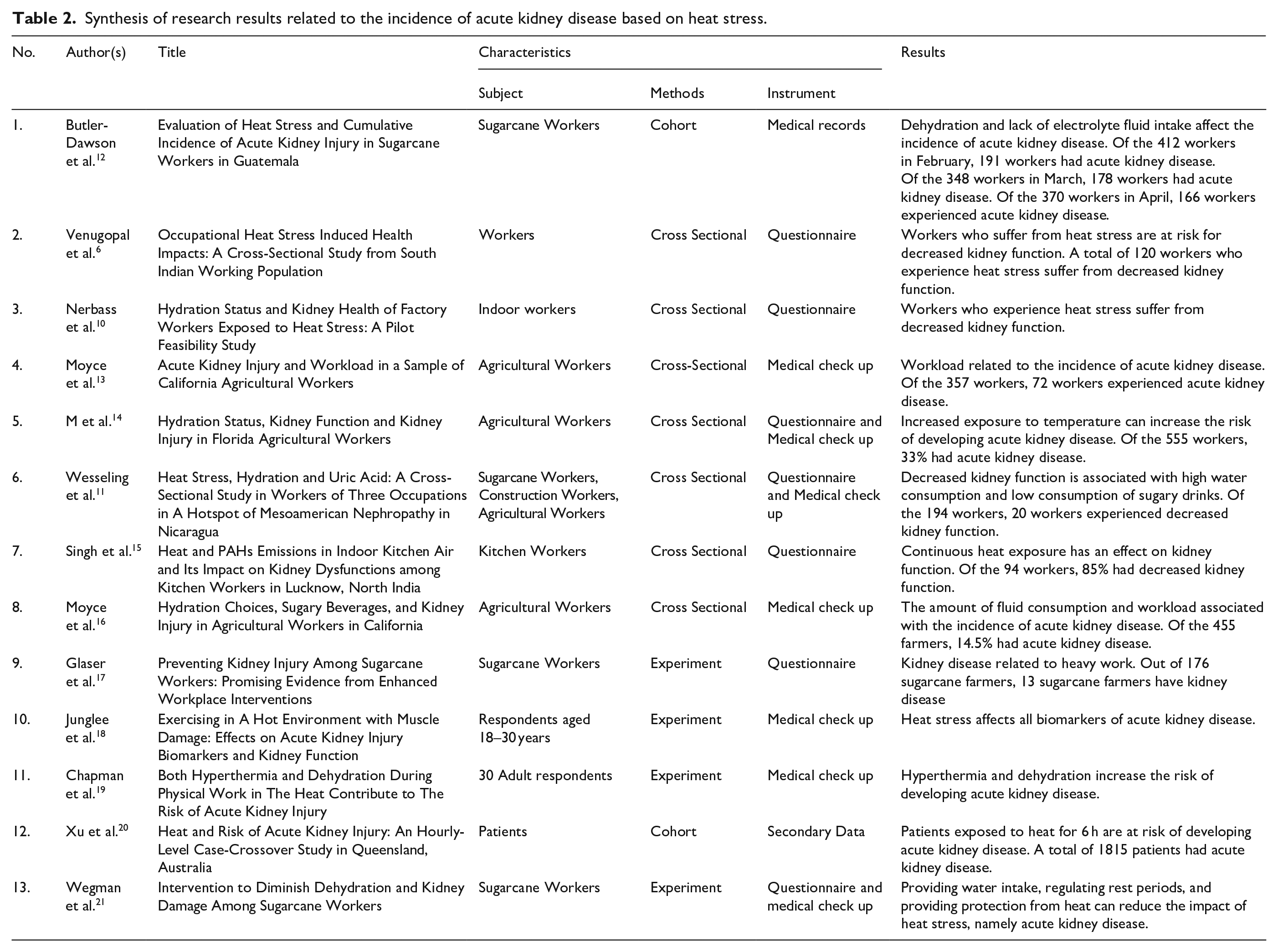
Based on Table 2 and Table 3, Several conditions and work environment of the workers can cause heat stress. Exposure to heat, workload, rehydration, and rest period arrangements are some of the factors that influence heat stress in workers. Workers who are more exposed to heat are more likely to experience heat stress.4,5 Jobs with heavy workload also increase the risk of workers experiencing heat stress.6,7 Adequate rehydration and proper rest period arrangements will reduce the risk of heat stress.8,9
Synthesis of research results related to the incidence of acute kidney disease based on heat stress.
Synthesis of research results related to the incidence of chronic kidney disease based on heat stress.

Heat stress in workers can affect their kidney function. Decreased kidney function can be experienced by workers suffering from heat stress or conditions that can cause heat stress such as poor rehydration.6,10,11 Heat stress, exposure to heat for more than 6 h, heavy workload, inadequate rehydration, and lack of proper rest periods can also cause acute kidney disease.12–21 If this condition is experienced by workers continuously, heat stress can also increase the risk of chronic kidney disease.22–27
Discussion
Based on the 24 articles that have been found, as many as 12 articles state that jobs at risk of heat stress are jobs in agriculture such as farmers and sugarcane farmers. A total of three articles state that construction workers and workers in the steel industry are also at risk of experiencing heat stress. This is in line with research in India which states that the incidence of heat stress often occurs in automotive workers, iron factory workers, security guards, construction workers, and agricultural workers. 1
Heat stress depends on several factors such as temperature, humidity, wind, clothing, heat shelters, physical activity, and other factors. These factors can vary greatly depending on the environment, occupation, and individuals. 28 Based on the six articles obtained about the factors of heat stress, it is found that workers can experience heat stress when they are exposed to heat, when they have heavy workload, when they have lack of rehydration, and when they have not enough rest periods. A total of four articles state that workers who are exposed to heat and who have heavy workload are more at risk of experiencing heat stress. Workers feel more uncomfortable working in hot and humid places than working in hot and dry environments. This condition becomes worse if the workers have heavy workload. 28
Heat stress experienced by workers has an impact on the health of workers. One of the effects of heat stress is a decrease in kidney function or acute kidney disease. There are four articles that discuss that acute kidney disease can be caused by heat stress. Meanwhile, nine other articles discuss several conditions related to heat stress which can also increase the risk of workers suffering from decreased kidney function or acute kidney disease. Lack of drinking water intake or dehydration is a condition that often causes acute kidney disease. This condition can make urine concentration high due to reduced amount of water in the body. High urine concentrations will also reduce the filtration rate of the glomerulus, and this will result in a decrease of kidney function and even acute kidney disease. 29
In addition to the lack of drinking water intake, workload can also increase the risk of workers experiencing acute kidney disease. This result is in accordance with research which states that workload, especially physical work, can increase biomarkers of acute kidney disease, especially in serum urea nitrogen and serum creatinine kinase, even when the changes in these biomarkers are seen less than 1 h after the physical work is done. Therefore, if the physical work is carried out longer, the changes in the biomarker will be greater. 30
In addition, heat stress that lasts a long time will also lead to the incidence of chronic kidney disease. A total of eight articles state that heat stress increases the risk of chronic kidney disease. Out of these eight articles, seven of them mention that heat stress and dehydration can cause chronic kidney disease. Heat stress can cause chronic kidney disease directly or in combination with other factors. Several studies suggest that the effects of nephrotoxicity of heat stress and dehydration can be exacerbated by rehydration with fluids that contain high fructose and can lead to kidney disease. 3
Conclusion
Heat stress can be experienced by workers who are exposed to heat, who have heavy workload, who are not hydrated enough, and who lack time to rest during work. Heat stress and conditions that cause heat stress can increase the risk of decreased kidney function and acute kidney disease. If heat stress conditions occur continuously to workers, then workers are at risk of developing chronic kidney disease.
Footnotes
Acknowledgements
We would like to thank the Faculty of Public Health Universitas Indonesia and Faculty of Public Health Universitas Airlangga for the full support in writing this literature review.
Author contributions
Putri Ayuni Alayyannur and Doni Hikmat Ramdhan concepting the idea and research method; Putri Ayuni Alayyannur write the manuscript; all authors revised the manuscript and approved the final version of the manuscript.
Declaration of conflicting interests
The author(s) declared no potential conflicts of interest with respect to the research, authorship, and/or publication of this article.
Funding
The author(s) received no financial support for the research, authorship, and/or publication of this article.
Significance for public health
This literature review proved heat stress can be experienced by workers due to heat exposure, heavy workload, poor rehydration, and poor rest period arrangements. Heat stress can cause acute kidney disease and chronic kidney disease.
Availability of data and materials
All data generated or analyzed during this study are included in this published article.