




Abstract
A circular economy (CE) is a promising solution to the looming sustainability crisis. Previous research has shown that a systemic transition from a linear economy to a CE requires stakeholder collaboration across all levels of society. Yet, little is known about stakeholder interests in a CE. The purpose of this study is to examine stakeholder interests regarding a sustainable CE in Finland. The data of 26 expert interviews is analyzed with qualitative content analysis. The study contributes to previous CE research by adding a stakeholder perspective in the examination of a sustainable CE. Stakeholder interests are explicated in terms of value-based motivations, expectations and stakes. We conclude that the consideration of stakeholder interests is relevant for understanding stakeholder collaboration in the CE context. The study shows that the economic, ecological and local social perspectives are emphasized in a sustainable CE. More attention to global social sustainability issues is needed.
Research questions:
The purpose of our study is to examine stakeholder interests with regard to the sustainable circular economy in Finland.
Link to theory:
The theoretical framework of the study builds on stakeholder theory, and uses the issue-focused stakeholder approach. We explore stakeholder interests as value-based motivations, expectations and stakes. Thereby, we advance the theoretical and empirical understanding of stakeholder interests and stakeholder collaboration in the context of CE.
Phenomenon studied:
Stakeholders have a prominent role in promoting the transition to the sustainable CE. This study focuses on a core issue in stakeholder theory: stakeholder interests. In doing so, the study creates knowledge on the nuanced interests and collaboration towards the sustainable CE.
Case context: The context of our study is Finland, the northernmost member state of the European Union. Finland provides with an interesting research context as the target of the Finnish government is to make Finland a global leader in the circular economy by 2025.
Findings:
The findings indicate that the key stakeholders share a joint interest in promoting a sustainable CE. Stakeholders are active in shaping actions towards a sustainable CE, too. Stakeholders emphasize the economic and ecological interests, while social interests - especially wider global social sustainability perspective - remains less important especially among companies and partly industrial organizations.
Discussions:
Building on stakeholder theory, the study provides a nuanced understanding of how stakeholder interests can be defined and examined as value-based motivations, expectations and stakes. The study demonstrates that stakeholders simultaneously pursue their own CE interests as well as shared interests to promote the sustainable CE in Finland. Moreover, the study suggests that stakeholder interests can be used to create understanding of the dimensions of sustainable development that constitute the sustainable CE. More specifically, the study shows that economic, ecological and local social perspectives related to the sustainable CE are predominantly emphasized. Analyzing stakeholder interests is important since they create a foundation for stakeholder engagement, stakeholder relationships and value creation.
Introduction
A circular economy (CE) is considered an approach to tackling grand socio-economic and environmental challenges, such as climate change, resource depletion and overconsumption (Geissdoerfer et al., 2017; Lieder & Rashid, 2016). Alarming statistics from 2020 indicate that only 8.6% of products made from natural resources circulate to at least one other use, whereas the remaining 91.4% are discarded (Circle Economy, 2020). The CE model questions the current dominant linear economic model, which is based on continuous growth and increasing use of natural resources (Geissdoerfer et al., 2017).
The CE has been researched from numerous perspectives, explicating, for example, its origin, conceptualizations, business models, supply chains and implementations on various levels worldwide (e.g., Ghisellini et al., 2016). Previous CE research can be characterized by a techno-environmental focus (Murray et al., 2017). To some extent, the stakeholder perspective, which acknowledges the societal aspect and the social dimension of the CE to complement the technical and environmental focus in the previous literature, has been discussed as well. For example, Lieder and Rashid (2016) argued that the mutual support of all stakeholders is needed to effectively implement the idea of the CE in society. Moreover, stakeholder relationship management and collaboration among supply chain members have been seen as key success factors in the CE (Gubta et al., 2019). Although the stakeholder perspective has regularly been acknowledged in the CE literature, little is known about the nature of nuanced and multiple stakeholder interests in the CE.
The purpose of this study is to examine stakeholder interests with regard to the sustainable CE in Finland. The theoretical framework of the study builds on stakeholder theory, which has increasingly been applied to address sustainability issues in management (e.g., Hörisch et al., 2014), consequently providing us with an applicable framework to investigate the sustainable CE. We rely on an issue-focused stakeholder approach (Roloff, 2008) and thereby define stakeholders as those groups and individuals who can affect or be affected by the sustainable CE (cf., Freeman, 1984). In stakeholder theory, stakeholder interests represent a key concept (Freeman et al., 2010). We define stakeholder interests as value-based motivations, expectations and stakes (Carroll, 1989; Myllykangas, 2009) and focus on these interests as our unit of analysis. Focusing on stakeholder interests is crucial, as these interests create a foundation for stakeholder relationships and engagement, as well as value creation (e.g., Kujala et al., 2012). Further, we contribute to the CE literature by introducing the examination of stakeholder interests to CE discussions.
The rest of this article proceeds as follows. In the next section, we establish a theoretical linkage between the CE and research on stakeholder interests as well as define stakeholder interests. Then, we describe the methods for data collection and analysis. The findings section presents the stakeholder interests in terms of value-based motivations, expectations and stakes. To conclude, we discuss the theoretical and practical contributions, outline the limitations of the study and offer suggestions for future research.
CE and Stakeholder Interests
The CE concept can be defined in different ways. In this study, we rely on the definition provided by Geissdoerfer et al. (2017) by understanding the CE as a ‘regenerative system in which resource input and waste, emission, and energy leakage are minimised by slowing, closing, and narrowing material and energy loops. This can be achieved through long-lasting design, maintenance, repair, reuse, remanufacturing, refurbishing, and recycling’ (p. 766). Regarding the relationship between the CE and sustainability, the CE has been presented as a tool for sustainable development (Geissdoerfer et al., 2017; Korhonen et al., 2018). For example, Korhonen et al. (2018) argued that a successfully implemented CE contributes to all three dimensions of sustainable development—that is, to economic, ecological and social sustainability. Similarly, Buch et al. (2018) stressed that a sustainable CE explicitly includes the social dimension along with the economic and ecological dimensions of sustainability.
The extant literature has indicated that stakeholders play a significant role in the transition to a CE (Geissdoerfer et al., 2017; Lieder & Rashid, 2016). In this study, we rely on the issue-focused stakeholder approach (Roloff, 2008). This approach complements the traditional stakeholder management view (e.g., Freeman, 1984), which situates a focal firm at the centre of stakeholder relationships. According to the issue-focused stakeholder approach, a mutual problem, crisis, conflict or complex phenomenon, such as a CE, requires multi-stakeholder networks as well as the active involvement and negotiation of the interests of several stakeholders. Thus, the issue is at the centre of the stakeholders’ attention (Roloff, 2008).
Stakeholder interests represent a key concept in stakeholder theory. Freeman et al. (2010) highlighted the jointness of interests and argued that they are inherently interconnected. Hörisch et al. (2014) argued that stakeholders need to negotiate to create mutual sustainability interests, building on the values and priorities of different stakeholders. Stakeholder interests not only characterize and differentiate stakeholders from one another but also explain why stakeholders want to cooperate. Kujala et al. (2019) stressed that mutual interests do not necessarily refer to an objective shared between different stakeholders but to the value that each stakeholder sees in collaboration, as well as their desire to allocate resources to it. Furthermore, stakeholders’ ability to cooperate helps them to develop their own interests alongside those they share with other stakeholders (Kujala et al., 2019).
Traditionally, in stakeholder research, stakeholder interests are understood as stakes (Kujala et al., 2019; Näsi, 1995). However, stakeholder interests can also relate, for example, to the joint interests of stakeholders, to stakeholder collaboration and trust between stakeholders (Kujala et al., 2019) or to stakeholder communication and learning with and from stakeholders (Kujala & Sachs, 2019). In this study, we understand stakeholder interests as value-based motivations, expectations and stakes (Carroll, 1989; Myllykangas, 2009).
First, Carroll (1989, p. 56) argued that value-based motivations (in the form of taste, priority and preference) generate interest in decisions affecting stakeholders. Consequently, we contend that values influence the emergence of a certain motivation, which, in turn, leads to actions. Similarly, Kujala and Kuvaja (2002) highlighted that values define and justify actions and, therefore, embody interests and vice versa.
Second, stakeholder interests include expectations that stakeholders perceive to be important with regard to the issue at hand (Myllykangas, 2009). According to Kujala and Kuvaja (2002), because stakeholder expectations are important, they should be considered when making decisions and future strategies. Moreover, stakeholders expect their own needs to be met in a relatively balanced way. In the context of the CE, stakeholder expectations can include, for example, economic, ecological, social, legal and/or ethical aspects (cf., Freeman et al., 2010; Myllykangas, 2009).
Third, stakeholder research often uses the concept of stakes to refer to moral or legal rights, ownership, claims or other economic efforts or influence (Carroll, 1989; Näsi, 1995). The stakes of stakeholders can include varying degrees of power. Powerful stakeholders possess notable financial funds, ownership or societal influence (Carroll, 1989). Traditionally, stakeholders’ stakes can be considered as contributions for which stakeholders mutually expect a reward (Näsi, 1995).
Stakeholder interests related to CE implementation has been discussed in previous literature (Gubta et al., 2019; Lieder & Rashid, 2016). For example, Lieder and Rashid (2016) stressed that, in the context of the CE, inverse motivations and interests exist among stakeholders and as such must be considered, aligned and combined. Similarly, Geissdoerfer et al. (2017) argued that not only is a cooperation between stakeholders desirable and necessary in the CE, it is also imperative for satisfying the stakeholders’ various expectations. Finally, joint interests comprise stepping stones for stakeholder collaboration and trust (Kujala et al., 2019).
Data Collection and Analysis
The study was carried out using qualitative research methods. The data collection process began by defining key stakeholders in Finnish society who promote the transition towards a sustainable CE. As a result, the following six key stakeholder groups were identified: ministries; industry organizations; research, innovation and support (RIS) organizations; regional actors, cities and municipalities, and companies. Ministries and industry and RIS organizations represent national-level stakeholders; regional actors represent regional-level stakeholders; and cities, municipalities and companies represent local-level stakeholders.
Thematic interviews with open-ended questions (Alvesson, 2003; Eriksson & Kovalainen, 2016) were used to generate data on stakeholder interests with respect to a sustainable CE. The interviewers aimed to create a discussion-like atmosphere rather than following a question–answer dialogue format. The interview questions covered themes relating to the CE and its understanding, the linkage between the CE and sustainable development, CE practices and collaboration in informants’ work organizations and in Finland in general, as well as future perspectives on the sustainable CE in Finland.
The interviews were carried out in May-December 2019 as part of the CICAT2025 Circular Economy Catalysts: From Innovation to Business Ecosystems research project. In total, 26 professionals representing the key stakeholders were interviewed (see Table 1). On two occasions, two experts participated in the interview. Twenty interviews were conducted face to face, and four were conducted via Skype. The length of the interviews varied from 31 to 81 minutes, totalling nearly 25 hours of material. All interview data were tape-recorded and transcribed verbatim. The transcribed data consisted of 354 pages.
The Interview Data
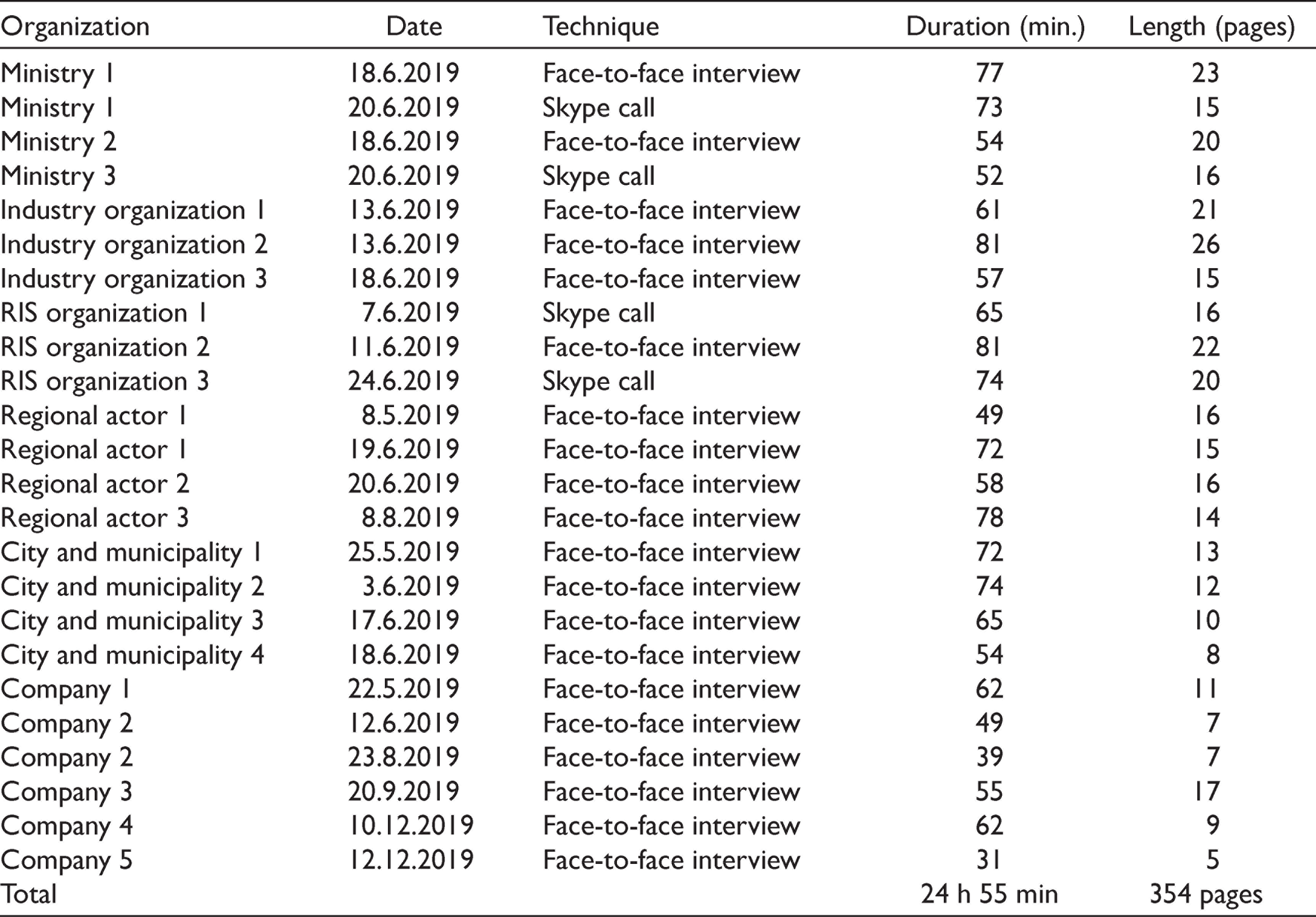
Qualitative content analysis was chosen as an analysis method for the study as it enables a systematic framework for analysing and describing a specific phenomenon (Graneheim & Lundman, 2004; Schreier, 2014; Tuomi & Sarajärvi, 2009). The analysis of the data was carried out by five researchers. Two researchers began the content analysis by reading the data and deciding on the coding frame. One or several sentences were used as the unit of analysis (Graneheim & Lundman, 2004). Stakeholder interests comprised the main coding frame for this study, with sentences and other expressions concerning stakeholder interests explicitly being identified and coded from the data. Atlas.ti software was used for coding.
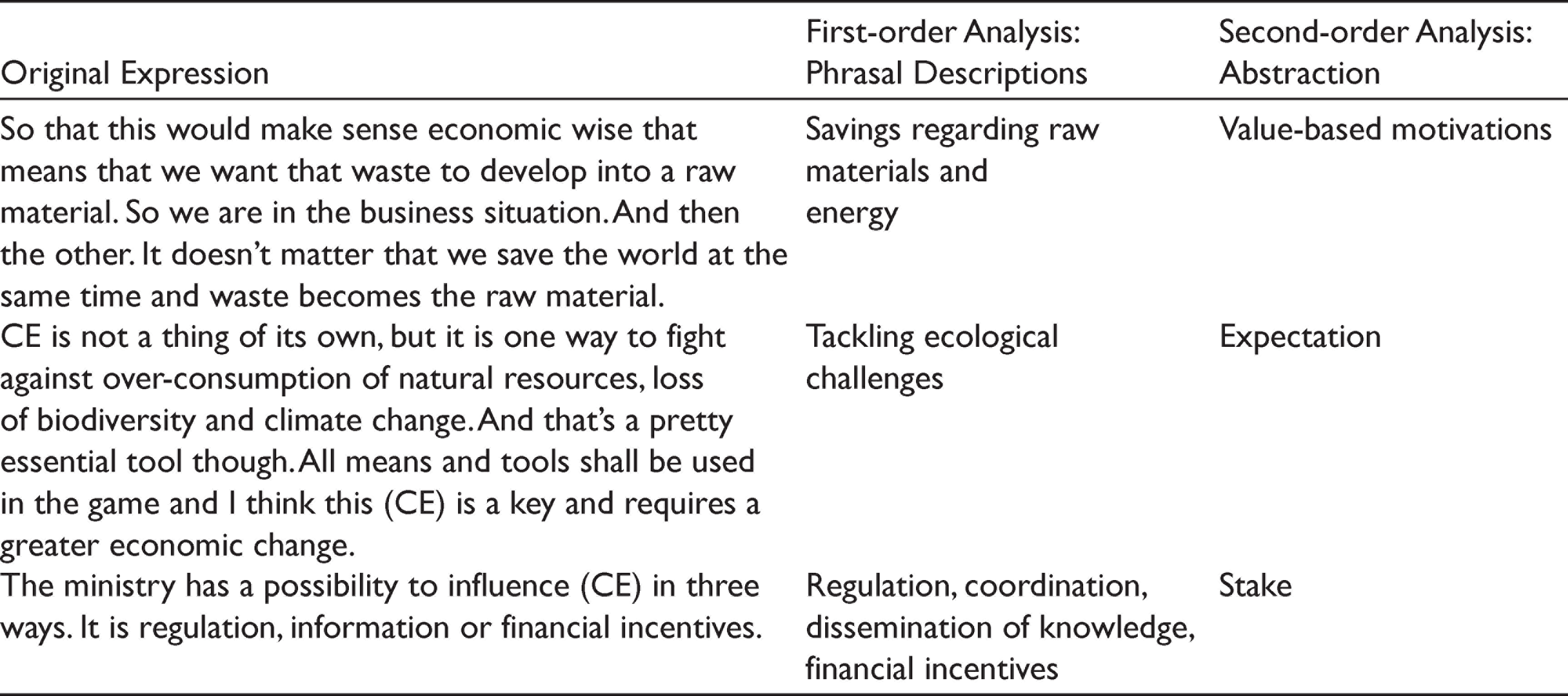
Next, similarities and differences in the coded expressions and sentences were identified. By applying first-order analysis (Gioia et al., 2013), the corpus of expressions and sentences was reduced to a manageable number of categories, each of which was given a generalized phrasal description.
In the next step, the second-order analysis was used to convert the phrasal descriptions into abstractions that expressed the key dimensions of stakeholder interests (value-based motivations, expectations and stakes; Gioia et al., 2013). Table 2 illustrates the data analysis abstraction process from empirical expressions to theoretical abstractions.
Example of the Abstraction Process
Finally, the results of the analysis were discussed and then synthesized by five researchers in several collaborative meetings for the purpose of validating the findings via researcher and data triangulation (Yin, 2014).
Findings
Table 3 provides a summary of the interests of the key stakeholders with regard to a sustainable CE in Finland in terms of value-based motivations, expectations and stakes.
Value-based Motivations
Value-based motivations regarding a sustainable CE varied among the studied stakeholders. Overall, the holistic promotion of the CE and sustainability was considered an important and necessary value, and as such these themes are prioritized in Finnish political agendas. The ministries’ value-based motivations towards a sustainable CE were closely related to the implementation of the current Finland’s official government programme for 2019–2023 (Finnish Government, 2019) as well as EU-level regulations. For example, in the Finnish governmental programme, the CE is mentioned 27 times (Finnish Government, 2019). Additionally, Finland’s Presidency of the EU Council in 2019 was seen as an opportunity to influence EU-level decision making by emphasizing the importance of the CE. As the CE is an integral part of the current government programme in Finland, more resources are being provided to ministries for the promotion of the CE in general.
A Summary of the Value-based Motivations, Expectations and Stakes of Key Stakeholders
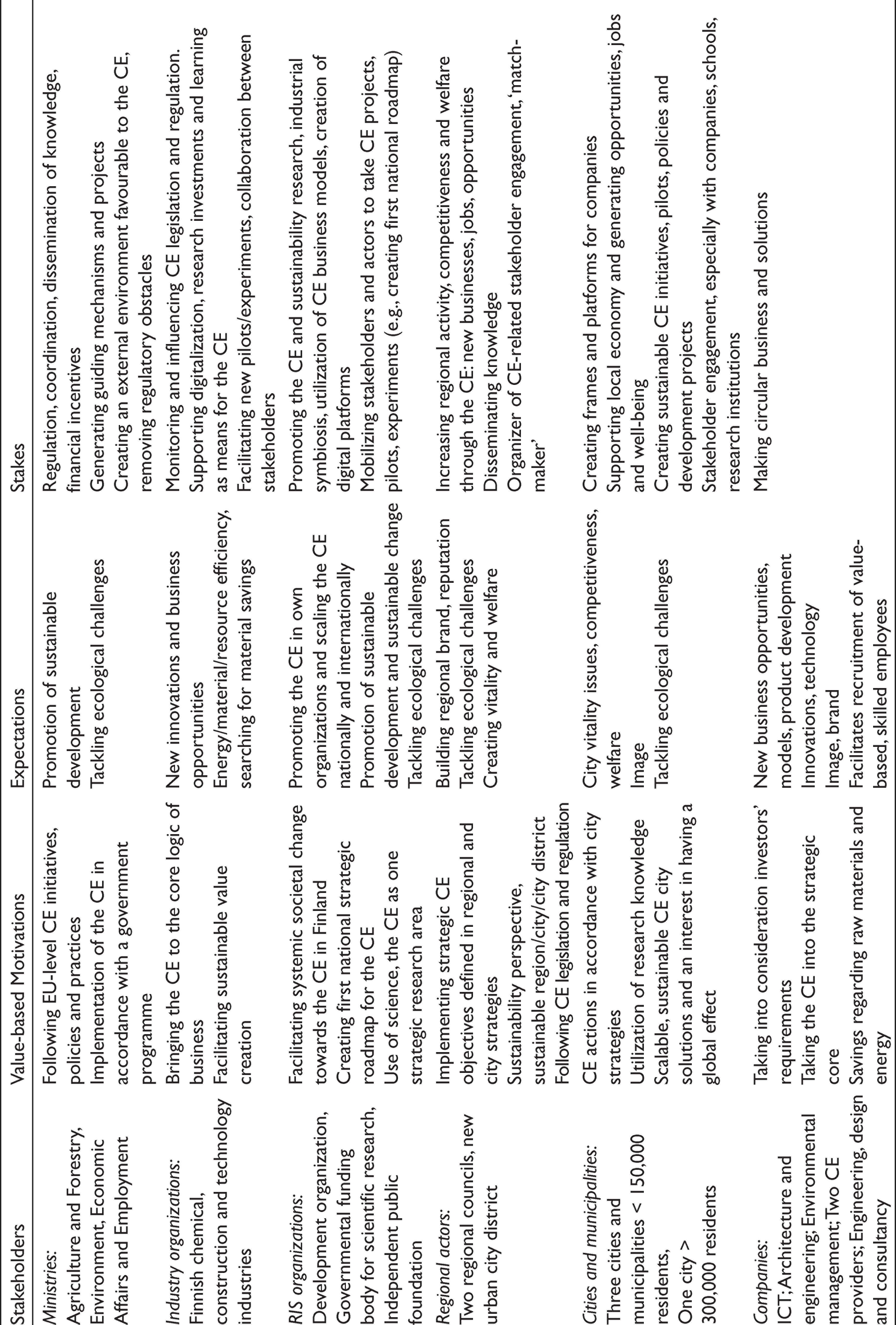
Other national-level stakeholders—industry organizations and RIS organizations—have similar value-based motivations that broadly consider economic, ecological and social sustainability factors in both the short and long run. Industry organizations viewed the CE as a tool for introducing sustainability to the core logic of business and for facilitating holistic, sustainable value creation. RIS organizations, on the other hand, were more future-oriented, aiming to push and shape systemic societal change towards a sustainable CE in Finland and pioneering related projects in many areas. For example, one of the RIS organizations was involved in making the first national strategic roadmap for Finland—the first of its kind both at the national level and abroad. Moreover, one RIS organization perceived the promotion of the CE to have strategic value and identified sustainable growth as one of a number of strategic research areas in Finland.
At the regional and local levels, stakeholders’ value-based motivations were aligned. Regional actors considered the CE to be a strategic issue and assumed a wide sustainability perspective. Their value-based motivations were clearly connected to making their regions or city districts more economically, ecologically and socially sustainable. In addition, following the national CE legislation and regulations was considered to be important and beneficial for sustainable CE development in various regions.
All interviewed cities and municipalities in Finland were committed to sustainability, positioning the CE as a focal area in their local strategies and strategic roadmaps. One of the cities had a designated director for sustainable development. The aim of this city was to develop and co-create scalable, sustainable city solutions and to identify CE ideas and solutions related to energy, construction, mobility, accommodation and trade together with regional companies. The city had set an ambitious and value-based goal of having a global impact and assuming the role of a global frontrunner in the CE and in sustainability.
The companies were mainly motivated by economic perspectives, with environmental and social dimensions rarely being discussed. However, the value-based motivations of companies require a consideration of the views of their external stakeholders, such as institutional investors’ requirements regarding responsibility and sustainability issues. In general, all of the interviewed companies had situated the CE at their strategic core, managing and implementing the CE in their own operations and engaging in CE development projects. In addition, the companies valued economic and material savings, specifically raw materials and energy, as well as the creation of new materials from waste. In this respect, these values incorporated features of both economic and, to a small extent, ecological sustainability.
Expectations
Stakeholders’ expectations regarding the sustainable CE varied from broad sustainability objectives to more precise actor-oriented expectations. At the national level, the expectations of the ministries were related to the promotion of sustainable development at large and to the ability to tackle some specific ecological challenges, such as nutrient cycles and food waste, on which the ministries were actively working. The industry organizations perceived the CE to be an important objective that will create new business and innovation opportunities for companies and thereby promote economic sustainability in Finland. Furthermore, the industry organizations expected that the CE would help their member companies to overcome some economic and ecological sustainability challenges related to energy, material and resource efficiency, as well as the extensive consumption of natural resources. The RIS organizations that were actively working with CE-related projects hoped that the sustainable CE would spread in their own organizations, nationally and internationally, through their efforts. People working in these organizations considered the CE to be an opportunity to promote sustainable development and change as well as to resolve ecological problems in society.
At the regional and local levels, the regional actors, cities and municipalities expected that the sustainable CE would address ecological problems such as climate change and biodiversity loss. They viewed the CE as an interesting and timely approach that would build a good reputation and enhance the brand value for their organizations and regions. They considered the CE to be a valuable way to improve a city’s image, vitality and global competitiveness and to generate welfare. Similar expectations were identified among the companies. CE-related activities were expected to enhance a company’s image and brand as well as to facilitate the recruitment of value-based, skilled employees in the future.
Above all, the companies expected that the CE would create opportunities to develop new business and business models and to expand to new business areas and markets through the introduction of novel products, innovations and technologies. The expectations of the companies were mainly economic and business oriented.
Stakes
All studied stakeholders had their own unique stakes but, simultaneously, also possessed similarities related to legal and economic stakes. At the national level, ministries aimed to influence other stakeholders through regulation, information, economic incentives and international collaboration. Political support for promoting the CE has enabled the ministries to create new guiding mechanisms and to set up new CE-related projects. The main focus of the ministries has been to create a nationwide external environment that would be favourable for the sustainable CE by removing regulative and practical obstacles.
At the same time, at the national level, the industry organizations monitored and influenced, in particular, CE legislation and regulations, and affected political, legal and business levels through their core tasks. The industry organizations supported, for example, digitalization, research investments, learning and CE business models as key enablers for the sustainable CE. The industry organizations also focused on facilitating new pilots and experiments and on creating collaboration between stakeholders. The RIS organizations supported and facilitated, for example, industrial symbiosis, utilization of CE business models, digital platforms and research funding towards the sustainable CE. In addition, they mobilized different actors, like companies and municipalities, to implement the CE in their operations and systems and allocated resources to CE experiments and pilots.
At the regional level, the stakeholders strived to activate and promote the development of companies in order to enhance their local value chains and to facilitate the creation of CE-related business, employment, experiments and novel solutions. Disseminating knowledge and collaboration with local schools, research institutions, companies and other actors was considered valuable and crucial. The regional actors were organizers of CE-related stakeholder engagement and collaboration, that is, ‘match-makers’ that enabled businesses and people to meet and discuss their needs and ideas. All in all, the regional actors sought to further increase regional activity, enable CE-related business, employment and vitality, and, through these actions, improve welfare for the whole region.
At the local level, the cities and the municipalities focused on creating frames and platforms for companies to allow them to innovate, identify new possibilities and solutions for environmental challenges, and create new business. Thereby, the cities and the municipalities supported their local economy and generated opportunities, jobs and well-being for local people at the same time. In addition, the cities and the municipalities worked with various initiatives to implement the CE and sustainability principles, such as no-waste and carbon neutrality programmes, climate and environmental programmes, and various CE development projects, policies and pilots. All cities and municipalities strived to develop sustainable CE solutions in collaboration with various stakeholders, including companies, schools, higher education institutions and research institutions.
At the company level, the stakes were linked to the creation, development and implementation of CE-related business. The companies were involved in the CE business to some extent, as they provided customers with the CE solutions and worked to embed circularity into their operations and business areas.
Discussion
Research on the CE in the sustainability context and the role of stakeholders and their interests in the CE have been gaining increasing attention (see, e.g., Geissdoerfer et al., 2017; Korhonen et al., 2018). In this article, we built on the stakeholder literature to define stakeholder interests as value-based motivations, expectations and stakes. We utilized the concept of stakeholder interests to examine CE stakeholders in Finland. The findings demonstrate that the key stakeholders value the sustainable CE and share a mutual interest in promoting it. We contribute to the CE literature by introducing the examination of stakeholder interests to the CE discussion. We maintain that stakeholder interests represent a relevant concept for understanding stakeholder collaboration in the context of the CE.
Regarding value-based motivations, values can be seen to affect motivation, which in turn creates interest in action (Carroll, 1989; Kujala & Kuvaja, 2002). The findings of this study showed that the key stakeholders’ value-based motivations were tightly coupled with the national vision of implementing the sustainable CE. This has led, for example, to the execution of governmental, regional and city CE programmes, strategies and objectives. Value-based motivations were manifested in the utilization of research knowledge and in the creation of solutions with a global influence at the national, regional and local levels. Understanding the motivational diversity of stakeholders has been acknowledged to be important to consider alongside the interests of the stakeholders in the implementation of the CE (Lieder & Rashid, 2016).
Concerning stakeholder expectations, our findings demonstrate that these expectations are related to economic, ecological and social factors. These sustainability factors are balanced in the expectations of the ministries, RIS organizations, and regional actors, cities and municipalities. For example, the ministries and the RIS organizations expected the CE to be a means by which to realize a more sustainable society. The same can be said of the regional actors as well as the cities and municipalities: They showed support for all expectation categories, as they saw that the CE can enable economic sustainability, create new business opportunities and generate well-being for people while also tackling ecological challenges. However, economic expectations were emphasized among industry organizations and companies as they perceived the CE mainly as an opportunity for businesses and innovations through which it was possible to pursue ecological benefits, such as energy savings.
Stakes are mainly related to moral or legal rights, as well as to economic and regulatory efforts and influence (cf., Näsi, 1995). In this study, stakes refer primarily to stakeholders’ efforts and influence to promote the transition towards the sustainable CE. All stakeholders were making efforts to create CE business directly or indirectly, whereas national-level stakeholders, in particular, concentrated on creating and shaping the regulatory environment in the society. In addition, stakes were associated with supporting, for example, digitalization and industrial symbiosis, in addition to various projects, pilots and platforms, as well as fostering collaboration among stakeholders. This finding supports previous studies that have emphasized the importance of stakeholder collaboration in accelerating the transition towards the CE (Gubta et al., 2019; Lieder & Rashid, 2016).
Regarding practical implications, our study examined the sustainable CE through an issue-focused stakeholder approach (Roloff, 2008) in the national context of Finland, thereby providing a country example of the interests and involvement of active stakeholders in addressing challenges related to the sustainable CE. We suggest that analysing the stakeholder interests in relation to the sustainability dimensions allows for understanding what constitutes the sustainable CE. The sustainable CE is seen as an urgent and necessary next step for society to mitigate various sustainability-related challenges, such as resource scarcity and high greenhouse gas emissions. However, the economic and ecological perspectives related to the sustainable CE are more often emphasized, whereas social perspectives are typically overshadowed, especially by companies and partly by industry organizations. Research has recognized that economic systems and activities that benefit the environment and only implicitly take into consideration social issues are emphasized in the CE (Geissdoerfer et al., 2017). Our study demonstrated that enhancing CE-related competencies and skills, creating new jobs, and providing sustainable services and beneficial living environments for citizens are examples of social sustainability in the Finnish CE context. However, global aspects of social sustainability, such as eliminating poverty and reducing inequality through the CE, have not been discussed in the Finnish CE context (see, e.g., Murray et al., 2017).
The current study has the following limitations that also represent pathways for future research. The empirical data were limited to stakeholders that have played an active role in promoting and realizing the transition towards the sustainable CE in Finnish society. Future research should pay attention to those actors, such as companies, which are not yet involved in the CE. Furthermore, as other stakeholders, such as consumers, media and NGOs, can also influence the transition towards the sustainable CE, they deserve attention in future studies. For example, the ways in which consumer knowledge and awareness could be enhanced could constitute an important topic for future research. Moreover, stakeholder interests regarding the sustainable CE as expressed in other national and cultural contexts should be researched. Further, while the focus of this study was on stakeholder interests, stakeholder collaboration and value creation in the context of the sustainable CE could also serve as an interesting research avenue. Finally, more knowledge is needed on how to combine sustainability aspects with the CE in more depth.
Conclusion
A systemic transition from a linear economy to a CE requires stakeholder collaboration and the integration of their interests. This study examined stakeholder interests in the context of the CE. Building on stakeholder theory, the study provided a nuanced understanding of how such interests can be defined and examined as value-based motivations, expectations and stakes. The study also demonstrated that stakeholders simultaneously pursue their own CE interests as well as shared interests to promote a sustainable CE in Finland. More specifically, the study showed that economic, ecological and local social perspectives related to the sustainable CE are predominantly emphasized. As such, more attention to global social sustainability issues in CE discussions is needed. Last, the study concluded that understanding stakeholder interests is not just relevant but indeed critical to the promotion of decisive action and collaboration for the purpose of realizing the sustainable CE.
Footnotes
Acknowledgements
The authors would like to sincerely thank the Editor and the anonymous reviewers for their constructive feedback as well as the participants of the International Conference of Management Cases 2019, New Delhi, India, and Responsible Business Research Seminar 2020, Tampere, Finland, for their suggestions and comments. We particularly want to thank our research colleagues A. Jokinen, K. Koistinen, M. Mäkelä, T. Onkila, M. Sarja, and S. Teerikangas from CICAT2025 Circular Economy Catalysts: From Innovation to Business Ecosystems Research Consortium for their collaboration in data generation.
Declaration of Conflicting Interests
The authors declared no potential conflicts of interest with respect to the research, authorship and/or publication of this article.
Funding
The authors gratefully acknowledge the financial support from the Strategic Research Council at the Academy of Finland, decision numbers 320194 and 320206.