




Abstract
While much research has focused on embedding circular economy (CE) practices in urban contexts, there is growing interest in the opportunities and challenges of rural settings. Adopting a regional lens can account for local knowledge, collective practices and community memory, yet CE conceptualisations often lack both a place-based dimension and a consideration of regional stakeholders. The aim of this paper is to explore the role of various stakeholders, in driving the adoption and implementation of CE practices at a regional level. We do this through engagement with 31 participants from business, governance and community groups in a peripheral region situated in the Southwest of the UK. Using stakeholder theory and thematic analysis of interviews, participant observation and workshop scripts, we identify ‘influencers’ as a key stakeholder group leading the implementation of regional CE goals and practices. Furthermore, we highlight key barriers and enabling factors which underpin interactions among different stakeholder groups and discuss their implications for regional CE transition.
Introduction
The concept of a circular economy (CE) has gained significant attention in recent years as a narrative to provide economic and environmental gains (Corvellec et al., 2021; Kirchherr et al., 2017). The approach focusses on designing out waste and pollution, keeping products and materials in use for as long as possible, and regenerating natural systems. Much research focusses on CE practices in urban contexts (Domenech and Borrion, 2022; Joensuu et al., 2020); yet there is a growing interest in their adoption in rural environments (Mihai et al., 2022), where they have the potential to foster community development (Siemens, 2012).
Rural contexts present unique challenges and opportunities for implementation of CE practices. Often characterised by a strong connection to the land, and natural resource-based livelihoods (Deakins et al., 2016) they play a crucial role in global food system (Pinstrup-Anderson and Watson II, 2011) but are on the frontline of climate change, further challenged by economic and social marginalisation, limited access to resources, and a lack of infrastructure (Steinerowski and Steinerowska-Streb, 2012; Siemens, 2012). It has been suggested that CE practices can help rural regions overcome some of these challenges (Ciani et al., 2016). Early CE practices such as reusing animal waste in everyday life have historic links with closed and pre-industrial, agrarian economic systems (Ciani et al., 2016). CE practices have been shown to create new economic opportunities, such as reducing waste, and supporting sustainable livelihoods in a variety of contexts (Ferronato and Torretta, 2019). Thus, considering the unique characteristics of rural communities can develop context-specific CE strategies that support sustainable and resilient rural communities and contribute to the transition towards a more sustainable and equitable global economy (Anderson-Seminario and Alvarez-Risco, 2022).
However, CE conceptualisations frequently lack a regional context, thus failing to consider existing practices, collective knowledge, skills and community memory (Real et al., 2022). Despite growing interest in this area (Ghisellini et al., 2016), studies tend to be empirically driven and in need of conceptual grounding, to account for any nascent and emerging dynamics between businesses and their social, cultural and political local environments (see, for example, Arsova et al., 2022). Consequently, the aim of this paper is to explore the role of various stakeholders, in driving adoption and implementation of CE practices at a regional level. Extant stakeholder theory literature covers a plurality of viewpoints and contributions (Miles, 2017). It broadly coalesces around the definition provided by Freeman (1994), viewing stakeholders as actors influencing or influenced by behaviour/s of (an) organisation/s, able to demonstrate an interest, or make moral or ethical claims (Gupta et al., 2019) on this behaviour. In this paper, we offer several, empirically substantiated contributions to the emergent field of regional CE studies. First, we test and extend Miles’ (2017) theoretical stakeholder role classification. Second, we show that the main stakeholder groups leading the transition to a CE in our empirical context are ‘influencers’, interacting with other ‘influencers’, ‘collaborators’ and ‘claimants’, represented by business, governance and community actors (including community interest companies (CICs)), respectively. Finally, we show enablers and obstacles in the way of interactions among the stakeholder groups we study, and comment on implications for future research. By employing stakeholder theory to CE research, we enrich CE scholarship with structured findings which serve to formulate a new theoretical framework for analysing relationships between stakeholder groups in the context of CE transition.
The rest of the article is structured as follows. Following an overview of the theoretical context, we outline the methodology, which includes the approach, data collection, analysis and outlines the regional context. We then present our findings which details the four key themes that emerged from analysis of the semi-structured interviews, participant observation and workshops. We conclude by highlighting key barriers and enabling factors which underpin interactions among these stakeholder groups and conclude with implications for regional CE transition.
Theoretical context
Context shapes enterprise (Gaddefors and Anderson, 2018) and yet rural regional contexts have changed during the past several decades (Skerratt, 2012; Steiner and Teasdale, 2019). Many are no longer dominated by traditional agricultural business, but rather a multipurpose space for living, working and recreation. Even though many rural regions still face significant economic and demographic challenges (Korsgaard et al., 2015), regional communities can display ‘adaptive capability’ in ‘co-creating’ opportunities with local and ‘micro-structural forces’ (Steinerowski and Steinerowska-Streb, 2012). Historic Cornish examples date back to the first farmers (Richards and Bulkley, 2007) and miners (Willett, 2013), who produced valuable goods while co-operating with local authorities towards developing environmental standards, risk mitigation practices and infrastructure development. Research on business within rural communities has become an increasingly important topic in economic development in recent years, as rural businesses face significant challenges relating to the physical environment (Muñoz and Kimmitt, 2019) alongside the general disadvantages of smaller business size and distance from major centres of economic activity (Eder, 2019).
This increase in place-based scholarship is also notable in the CE literature. Traditionally, the concept of the CE has been subject to system-level conceptualisation and used to reconsider the relationship between business, society and the environment (Howard et al., 2022). Studies have also underscored its material dimension, arguing that a transition to a CE can remove waste from production and instead allow materials to be kept at their highest value for as long as possible. Although the central argument is that we need new business models and practices to keep materials in constant circulation on a global scale (Greyson, 2007), the concept is still open to debate and interpretation (Friant et al., 2020; Korhonen et al., 2018). As a result, an emerging body of CE literature has started to challenge existing understanding of the CE as an abstract, macro-level, material-flow concept. Instead, recent contributions to the CE literature have suggested the need to study the contexts in which such circular process are embedded, framing the CE in relation to specific places e.g. in terms of regional geography, sociology, architecture and anthropology (DeBoer et al., 2017; Guthey et al., 2014; Shrivastava and Kennelly, 2013). Extending this further, Real et al. (2022) discuss the need to establish ‘place’ in the context of the CE and understand shared collective memory, knowledge and experience, as nested in specific locations and communities.
Taking ‘place’ seriously has several implications for CE scholars. First, it challenges the idea that multinational, location-less firms may move their activities anywhere in the world at whim without considering the effects on local populations and ecosystems. Second, it requires to researchers to demonstrate how organisations ‘enter into authentic relationships with places and people, and to develop the necessary fields of care, without which appropriate stewardship of both the natural environment and other components of place may be impossible’ (Shrivastava and Kennelly, 2013). Finally, it calls for further research on how regional actors create a sense of place (Guthey et al., 2014; Whiteman and Cooper, 2000) accounting for both cultural (community-embedded) and physical linkage (rivers, mountains, farms, etc.) dimensions of the CE.
Rural regional communities are particularly significant in this context on account of their socio-economic profile. Rural regions often have lower levels of financial and human resources (Davies and Michie, 2011), so can highlight the real world, practical and significant challenges that businesses, employees, government officials, citizens, community activists, consumers and other actors must deal with to successfully implement a regional CE transition. However, we have insufficient understanding of how a specific social-spatial context might support business outside of this ‘high growth’ world, where individuals see new opportunities to maintain and enhance local livelihoods (Johnstone and Lionais, 2004). There is limited research on the influence of cultural (Huggins and Thompson, 2014) and institutional factors (Kalantaridis and Fletcher, 2012), including the role of traditions, values and policies (Dauletova and Al-Busaidi, 2022). Connectedly, there is also limited focus on the role and potential for rural stakeholders to contribute to the development of sustainable and resilient communities (Barr and Devine-Wright, 2012; Callaghan and Colton, 2008).
Consequently, we propose that adopting a stakeholder theory lens can address this gap, by helping to foreground the under-theorised socio-cultural dimension in the place-based CE literature (Bauwens, 2021). For this, we operationalise Miles’ (2017) extension of Kaler's (2009, 2003) earlier stakeholder theory classification. Kaler's (2003) model consolidates the extant literature into three stakeholder types: a ‘claimant’, being an actor who can make a claim on an organisation, an ‘influencer’, being an actor able to directly influence the work of the business and a ‘combinatory’ type, which is a mixture of both properties. Acknowledging the limitations of Kaler's (2003) use of only 27 sources, Miles (2017) seeks to provide a much more comprehensive overview of over 30 years of stakeholder theory scholarship, from Freeman (1984) up to the present point. We represent Miles’ (2017) typology in Figure 1 (see below).
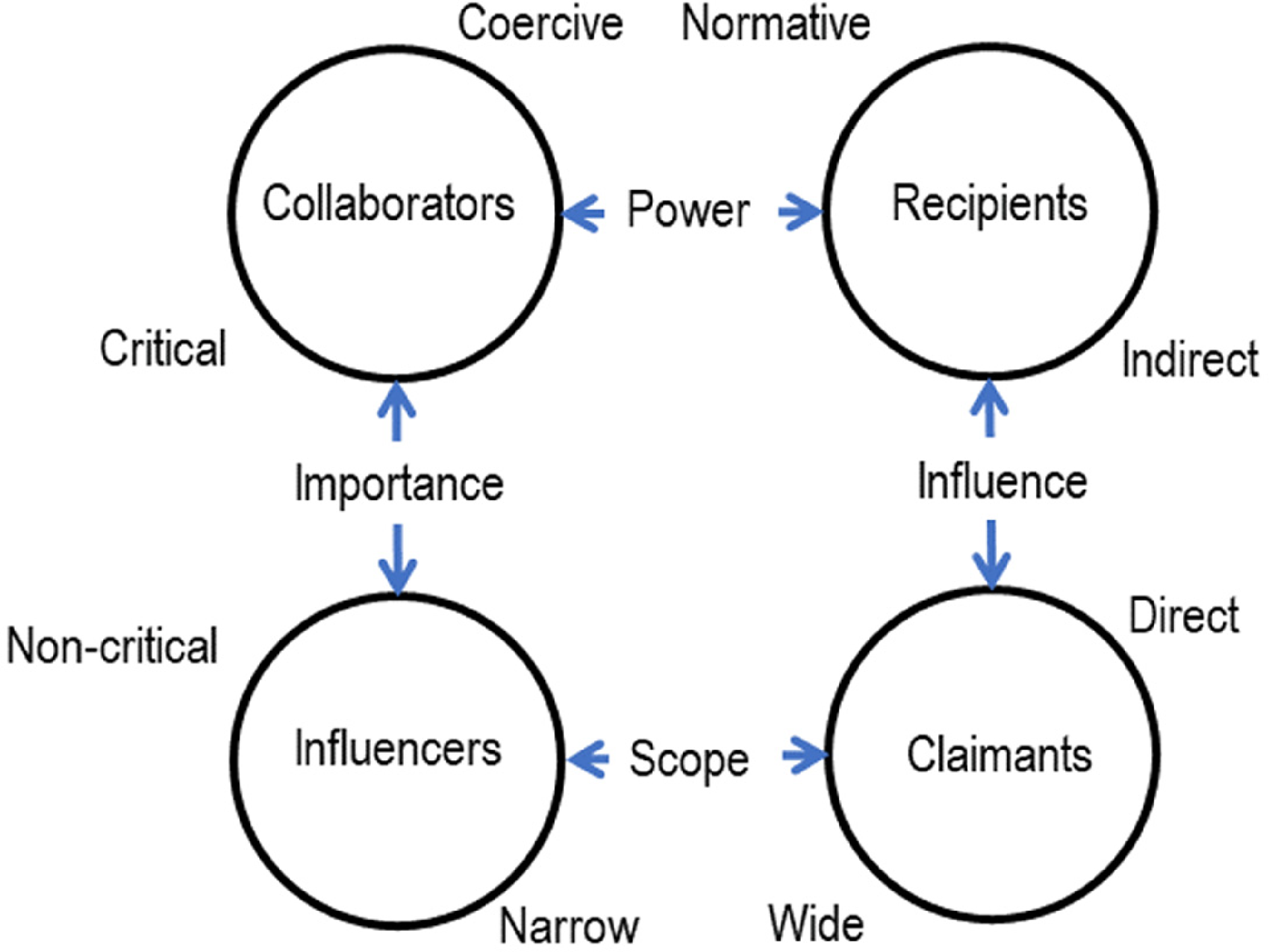
A typology of stakeholder roles, based on Miles (2017).
Miles (2017) retains the influencer and claimant labels from Kaler (2003) but proposes a four-dimensional distinction in terms of scope, importance, power and influence. Thus, while influencers have an active capacity to influence, the scope of such influence is narrow. Relatedly, claimants have a wide capacity to influence and are stakeholders who have a form of entitlement, for instance, an interest, a right or a commitment (Carroll, 1989; Heugens and Oosterhout, 2002). In turn, although influencers have capacity for active action, a characteristic which leads Donaldson and Preston (1995) to identify them as shareholders, they lack the critical importance and the coercive power of collaborators, which may be legally derived. Importantly, however, collaborators are stakeholders only relationally – their purpose and interest may lie outside participation in the given context. Finally, recipients are a stakeholder on account of being impacted. They have no direct power or authority, but may exert a moral, ethical or risk-based (Clarkson et al., 1994) claim.
In our study, we use Miles’ (2017) typology to identify three key stakeholder groups. We regard influencers to be representative of CE businesses in the region, on account of their active ability to introduce CE practices, goods and services. We identify claimants with community groups, charities and community networks, who have a wide scope of operation and a direct community influence. We categorise local and town authority representatives as collaborators on account of their coercive and legally derived authority. Finally, although we omit consumers and customers in their capacity as recipients intentionally and anticipating them to have only indirect power over the region's CE transition, we find them able to impact the behaviour of influencers – a point we return to in the Findings sections. We continue with a discussion of our participant profile and the wider empirical context of the study.
Methodology
Case study outline
Research emphasises the need for qualitative exploration into local systems and processes to understand the complexities of business and location (Redhead and Bika, 2022). Focused on Cornwall, a rural region in Southwest of England with a population of roughly 568,000 and spanning 3563 square kilometres, this study delves into its unique culture, history and economy (Cornwall Council, 2021).
Cornwall faces socio-economic challenges, stemming from its shift away from agriculture and mining to a heavy reliance on tourism. Despite its popularity as a visitor hotspot, the region grapples with limited transportation infrastructure, hindering external business connections and internal movement of goods and services (Willett, 2020). Moreover, rural areas suffer from poor connectivity, posing barriers for entrepreneurs reliant on digital technologies. However, recent European investments in broadband and the creative industries aim to bolster economic growth and attract talent (Willett, 2013).
Workforce development emerges as a critical issue in Cornwall's entrepreneurial landscape due to a scarcity of highly skilled workers and social deprivation impacting skill levels (Cornwall & Isles of Scilly Local Enterprise Partnership, 2020). This challenge is compounded by the dominance of smaller businesses and limited investment in research and innovation (Mealy and Coyle, 2022).
Contrary to urban perceptions, Cornwall's image often centres on its rural periphery, creating a complex narrative landscape. The area is seen as inherently distinct yet symbolically desirable, reflecting a ‘Cornish way of life’ that values deeper values over material gains (Dickinson, 2008).
Approach
Our approach involves a combination of ‘engaged scholarship’, which recommends interacting with a wide collective of participants (Van de Ven, 2007; Van de Ven, 2018) and a case study method as part of a framework for analysis. The study of complex, emergent, non-sequential events typically involves asking ‘how’ and ‘why’, which are best understood in the context of their natural environment and for that reason a case study technique is often the best research methodology to apply (Yin, 2018). Engaged scholarship is an approach to research that involves collaboration between researchers and community stakeholders to produce research that is both academically rigorous and practically relevant (Bansal and Corley, 2011). This methodology recognises that knowledge creation is a collaborative process and that community members often have valuable insights and expertise that can inform research (Easter et al., 2021).
Engaged scholarship methodology in a multi-step, immersive process (Bansal and Corley, 2011). The first step is to identify the community stakeholders who are affected by the research question. This may involve partnering with community organisations or working with individuals directly impacted by the issue at hand. The second step is to establish a collaborative relationship with the community stakeholders. This involves building trust and rapport with the stakeholders and involving them in the research process. This may involve co-creating research questions, collecting data and interpreting results. The final step is to collect data, often, through multiple modes of engagement.
Data collection and analysis
This study employed a qualitative approach, utilising multiple data sources to explore and analyse the opportunities and challenges of embedding CE practices in rural settings. Data collection took place between Sept 2022 and March 2023 and the triangulation of data was achieved through the integration of transcripts from semi-structured interviews, workshop discussions and extensive participant observation notes. The study was embedded in the process of longitudinal community engagement, which has included training workshops and networking events, as well as a long-standing collaborative relationship between the researchers and the community.
Semi-structured interviews were conducted with 19 individuals and were aimed at capturing in-depth perspectives, experiences and opinions related to the research focus. The study also drew upon data obtained from workshops conducted within the targeted context. These workshops facilitated group discussions with a further 12 participants, fostering an environment conducive to the exploration of themes and concepts pertinent to the research objectives. Participants were asked to introduce themselves and roles, which later helped to categorise the stakeholder groups. Snowballing techniques were used to identify further participants who could provide insight to inform the research (Patton, 2002). Table 1 provides an overview of the participants and the nature of their organisation. Introductions to people who were knowledgeable about the subject and region were requested and potential participants were contacted to engage in the study. The data obtained from these sessions provided valuable insights into the opportunities and challenges in the region of Cornwall. In addition to interviews and workshops, extensive participant observation was conducted throughout the study duration (Spradley, 2016). This involved immersive engagement and systematic recording of observations at external engagements related to the research focus.
Overview of participants and nature of organisation.
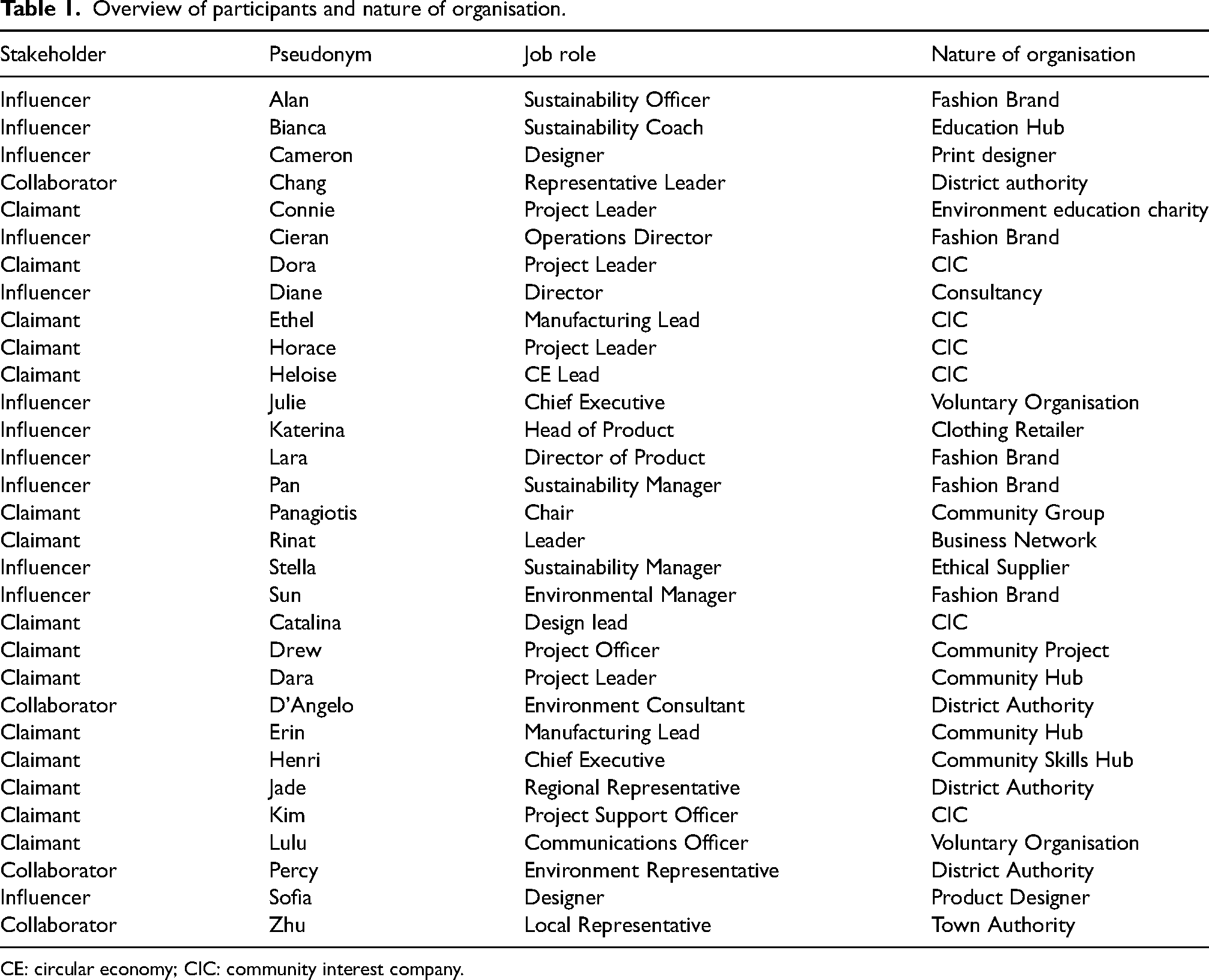
CE: circular economy; CIC: community interest company.
Thematic analysis was used as a qualitative method to identify, analyse and report patterns (themes) within qualitative data from interviews and workshop groups (Maanen et al., 2007). Initially, transcripts from interviews, workshop data and participant observation notes were meticulously reviewed to immerse the researchers in the data, enabling a comprehensive understanding of the context and nuances (Eisenhardt, 1989). Codes were generated from the data, encapsulating meaningful segments and concepts (Dutton and Dukerich, 1991). These initial codes were then organised and clustered to identify potential themes and patterns emerging across the various sources of data (Miles and Huberman, 1994). The identified themes underwent iterative review and refinement to ensure their alignment with the dataset (Braun and Clarke, 2006). This involved revisiting the transcripts, workshop data and observation notes to validate and consolidate the themes, striving for coherence and relevance.
Triangulation was a cornerstone of this study, employing multiple data sources – interviews, workshops and participant observation – to cross-validate findings and enhance the credibility of the analysis. While team coding is generally welcomed as a source of ‘shared interpretation’ (Weston et al., 2001: 382) whereby research team members provide a ‘reality-check’ (Saldaña, 2016: 37) for each other, in previous projects it has also been a source of disagreement and even frustration. On this occasion, we followed guidance by MacQueen et al. (2008) and assigned one team member primary responsibility for first-cycle coding. When this was completed, we came together as a team to discuss and agree on the emerging themes and relationships between initial categories (Saldaña, 2016), doing so iteratively, and comparing findings with the key premises of stakeholder theory as our adoptive theoretical framework. We discuss these findings next.
Findings
In this section, we consider the interactions between different stakeholder groups that emerged from the data analysis, which we evaluate against the dynamics conceptualised in Miles’ (2017) typology.
Circular innovation and consumer expectation: influencers – recipient adaptability
We did not have any recipients in our participant sample and thus did not find any reference to collaborator– recipient, or claimant–recipient relationships. However, we did find influencer–recipient interaction in the context of questioning prevailing consumerist beliefs and behaviours in business and society. Such relationships were connected by the degree of adaptability to change, and specifically, CE change as viewed by both groups and positioned within a larger cultural context of linear production processes. As a result, a shift to a CE was a ‘wicked issue’ that needed to be addressed as part of a global change plan. However, influencers thought that such a shift would be difficult on several levels.
First, they felt that linear systems have necessitated companies to constantly extend their offer to boost local economies and increase profits, by offering value to recipients. This reasoning was thought to essentially conflict with the CE principles of eliminating waste and circulating products and materials, rendering them somewhat incompatible. We found an example of resulting tensions in Lara's experience. Lara worked at a British fashion and lifestyle brand that draws inspiration from Cornwall's coastal surroundings. Established in 1981, it created clothing, footwear and accessories for women, men and children, often incorporating designs influenced by the Cornish landscape, maritime heritage and traditional craftsmanship. She described this tension of trying to balance profit with implementing sustainable principles in an established business. “The way businesses trade now where we are trying to make profit all the time…unless that changes, it is very hard to make a circular model work.” (Lara, Head of Product Technology, Fashion Brand) “This is something I love about the social enterprise world distinct from the business world is that businesses operate on competition and social enterprises operate much more on collaboration. And if this world could learn from that, and…not see everybody as a potential threat to my business and my share of it, then yeah, it would be much easier.” (Bianca, Sustainability Coach, Education Hub)
Enforcing legislation and lobbying for change: shared influencer – collaborator importance
Miles (2017) proposes that influencers and collaborators are connected by the importance of their roles. Accordingly, our influencers were conscious that a CE cannot exist in abstraction, cut off from important societal organisations like the national and local regulatory system. In addition to the economic considerations discussed above, influencers sought to engage with their wider, socio-political context. This connection between influencers and collaborators emerged in parallel to a body of writing on the need for a sustained commitment to circular objectives (Bansal and DesJardine, 2014), for instance, by policymakers. This suggested that two-way dialogue is needed to ensure every organisation complies with regulations, while ensuring such regulations do not hinder CE initiatives. This point was raised by Stella, who works as the sustainability manager for an organisation with multiple establishments across Cornwall. She was passionate about educating consumers on the origins and characteristics of their products, promoting a deeper appreciation for the craft and ethics in the supply chain. “[We] should be a consciousness of how technical innovation and legislation [are] not keeping up with each other… I think that's quite challenging, and I think that would be something that would be really beneficial, especially for like bigger companies who are having quite a big impact.” (Stella, Sustainability Manager, Ethical Supplier) “If there was legislation, for example that levelled the playing field, say everyone has to produce products within the set parameters, then we're still all gonna be competitive” (Alan, Sustainability Officer, Fashion Brand) “The Environment Act included the producer responsibility for goods (so the producer pays responsibility) and so you know that was a huge piece of legislation really. But we have to wait for it to start to come into effect.” (Jade, Regional Representative, District Authority)
Global networks and regional context: influencer –claimant connectedness
Our study also found evidence for influencer – claimant interaction, yet the main dynamic was not one of scope, as in Miles’ (2017) typology but connectedness. The connectedness continuum highlighted tensions, associated with participation in global networks, while being embedded in regional contexts. With regard to the former, influencers acknowledged industry-level rivalry as a business reality and distinguished it from the distinctive regional space inhabited by companies with a social conscience. However, participants like Connie understood the value of connectedness, which united different organisations and businesses. Connie was the producer for an award-winning charity making a series of documentaries focussed on issues relevant to the region of Cornwall. “The way society structured at the moment is very economically driven… so in terms of businesses doing the right thing, it's quite difficult. We're in competition with each other rather than together collectively addressing this huge challenge.” (Connie, Project Leader, Environment Education Charity)
“Actually, it's a worldwide problem. It's not a British problem, it's not an American problem. It's like across the entire planet.” (Katerina, Head of Product, Clothing Retailer)
However, global opportunities and national provisions had to be adequately adaptable to be put into practise and tailored to the requirements of the local community, maintaining the global-regional connectedness in a CE context, also. This required an approach which ensured that the voices of claimants are heard, by enabling local communities to express their perspectives and knowledge with national organisations, resulting in a feedback-driven approach.
Knowledge exchange and brand protection: inter-influencer collaboration
Inter-influencer interaction was a stakeholder dimension not envisaged by Miles (2017) and although unsurprising in hindsight, proved initially unexpected. Our influencer participants highlighted several essential components that contributed to CE innovation in different ways. Time was a reoccurring element mentioned by many and played a crucial role in innovation as it provided the necessary space for research and development to occur. Innovation required time to identify opportunities, generate ideas, and test and refine solutions. However, the adoption and integration of new ideas into existing systems and processes also required time which smaller businesses often lacked. Furthermore, innovation required investment, and finance played a vital role in supporting the research and development of new ideas. Without adequate funding, it could be challenging to undertake the necessary research, development and testing required for successful innovation. Collaboration with established CE leaders offered a way forward and there were opportunities for doing so – at local networking and business breakfast events. However, leading CE companies were often guarded and preferred to protect their brand, than join forces with others in the name of a regional CE shift. This collaboration tension was especially evident in the interviews with smaller businesses who spoke about the day-to-day dynamics, running expenses and financing availability. Heloise was a CE lead for a CIC, working with businesses to identify opportunities for waste reduction, turn their waste into new products, develop sustainable supply chains and adopt circular business models. She talked about the cost barrier for businesses adopting more circular models: “The biggest one is probably the cost barrier and the perception that many businesses feel that there is no additional support or any degree of incentives for them to do it. They understand that in the medium to longer term perhaps, they need to become more efficient, lower carbon footprint, etc., etc. But the challenges and barriers that they face day-to day outweigh [this].” (Heloise, CE Lead, Community Interest Company) “We've just started partnering with guys to … support our new generation fabrics and all of their green shirt accredited mills. We're still trying to pursue…new generation fabric, recycled cotton or single fibre to see if we can substitute or enhance our collection at the moment.” (Lara, Head of Product technology, Fashion Brand) “A key factor to bear in mind is that waste is not just about CO2 emissions, it is also about the need to conserve Planet Earth's natural resources which are being used up at an alarming and unsustainable rate.” (Panagiotis, Chair, Community Group)
Discussion
The process of moving to a circular method of production is neither fast nor easy, including complex exchanges and interactions between several stakeholder groups. This research has highlighted both enabling factors and difficulties that a range of participants from community, governmental and business organisations in the rural region of Cornwall have encountered in their pursuit of CE transition.
As a result, our findings both empirically validate Miles’ (2017) conceptual framework and extend it, by reorganising the relationship between stakeholder groups in the context of CE transition. Unlike the triadic relationships in the literature, where each stakeholder group relates to two other groups, we find that influencers are the drivers of CE transition, acting as a central hub and connected to all other groups. Furthermore, we find that (a) influencers relate to recipients through each group's (circular) adaptability, (b) inter-influencer levels of collaboration form a significant part of CE practice, while (c) influencer-claimant interaction is guided by connectedness, rather than scope, as Miles (2017) envisages. We represent our iteration of Miles’ (2017) typology within the context of a regional CE transition in Figure 2 (below).
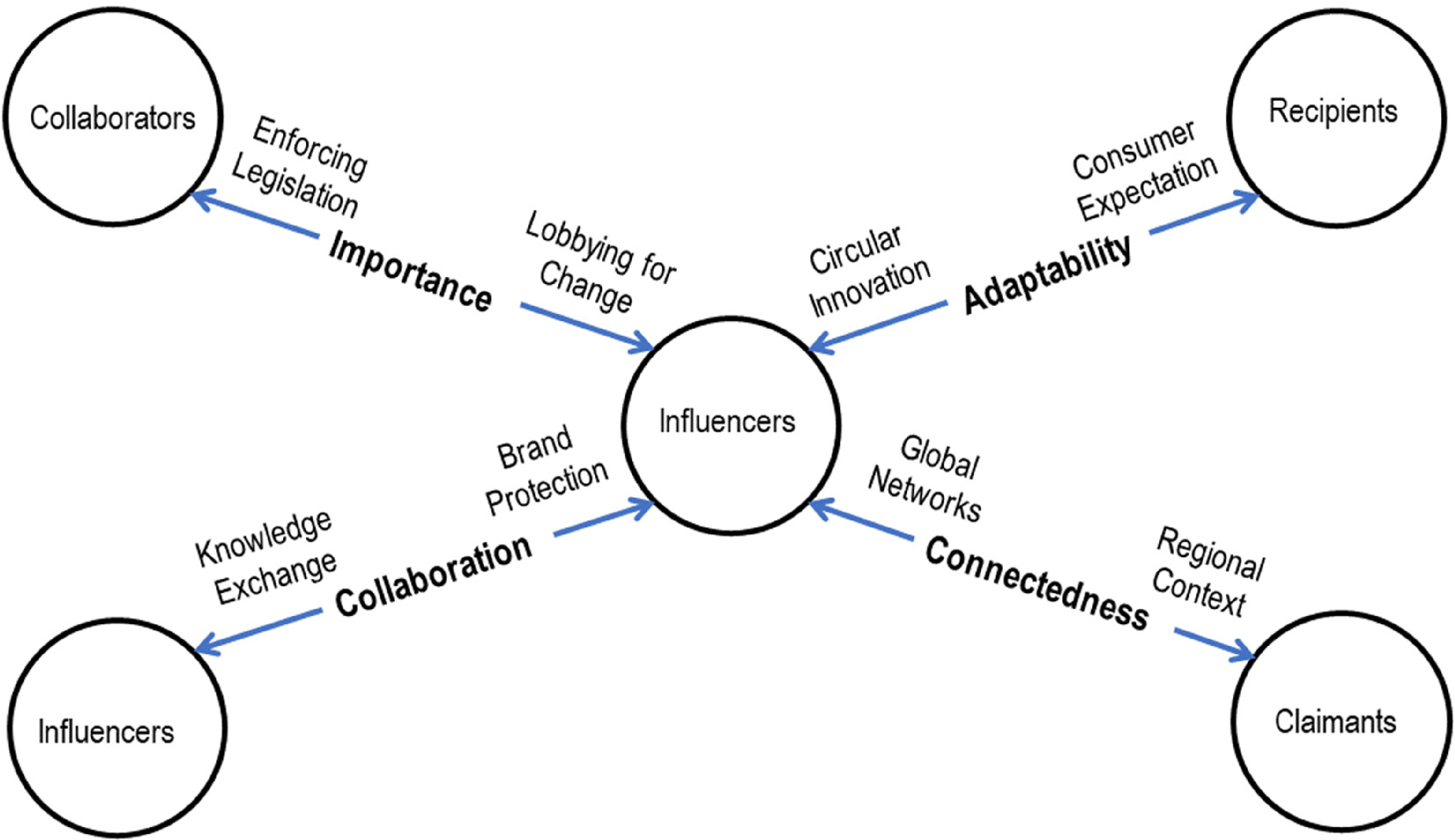
Stakeholder roles and CE relationships in the context of Cornwall. CE: circular economy.
Our iteration of the framework developed by Miles (2017) shows that businesses, customers, communities and government manage complex and at times through multi-lateral interactions. As an example, Guthey et al. (2014) comment on how regional actors operate locally to create a sense of place [regional context dynamic in Figure 2], yet in our study this was balanced by the need to engage and foster global relationships with supply networks [global networks theme]. Existing studies offer evidence of top-down CE policy interventions [enforcing legislation theme], both on a national and international level (Cainelli et al., 2020). However, we found stakeholder involvement in bottom-up processes also, where policy discussions were initiated with local and central government [lobbying for change theme]. Our participants also discussed the need for enabling and normalising business-to-business collaboration to support knowledge sharing and idea generation [knowledge exchange theme]. Yet, such a transition required a change in business–consumer interaction also. For example, the dominant logic of protecting a business’ product offering [brand protection theme] to pursue profit and growth (George et al., 2016) had to be replaced by CE-aligned values. This included raising consumer awareness of the economic, environmental and social impacts of buying choices [consumer expectation theme].
Thus, our revised framework can be used by researchers studying the social (stakeholder) dimensions of place-based CE transitions. As a starting point, our model highlights key stakeholder groups driving regional CE processes and points to possible representative members from each stakeholder group that can be helpful to develop further CE transition scholarship. It also describes the dynamics between those stakeholder groups in a specific geographic region – the UK Southwest. Future researcher may wish to explore if and how these dynamics differ across other rural regions in the UK or compare with areas of similar socio-economic background. In turn, longitudinal research design may be deployed to investigate how stakeholder relationships and dynamics emerge over time in a CE context.
These findings suggest that moving towards a CE requires changes in current production and consumption patterns and adjusting to new objectives that are geographically entrenched and connected by both economic practices and cultural meanings. To facilitate such changes, it is necessary to address existing legal barriers, by updating sector policies, and connecting regional environmental goals to national policy. This would require businesses to further understand the effectiveness of current legislation and regulation as it stands, with the aim of playing an active role and providing input for improvement.
In considering the specific characteristic of the region we studied, we align with scholars who suggest that research into CE transition (Whiteman and Cooper, 2000) needs to account for the role of ‘place’ (Guthey et al., 2014). As a result, we recommend that future research and policy making should view communities as fruitful grounds for change rather than just as users of change determined elsewhere. Thus, both research and policymaking should consider what is ‘right for this place’ rather than taking a board-brush generic approach. Local environment, skills, identity and culture hold challenges and opportunities for change. This is the opposite of an industrialised mentality, which promotes uniformity and one-size-fits-all solutions in its pursuit of volume and efficiency. Working locally, however, is more in line with how nature operates, where variety, and diversity produce robust, dynamic systems.
Conclusions
This research was intended to provide new insights to inform further work, shape industrial strategy and influence future regional and national policy and practice. First, we propose that more support is required for local, CE influencers. We saw many examples of organisations working toward a place-based vision of a CE but lacked the resource to continue or extend their ideas. For these to be able to connect across system levels, institutional collaborators must provide support to overcome localised change and become more widely transformative through the creation and exchange of shared goals, anchored in historic regional identity. To nurture innovative ideas, we should encourage a narrative where we are all creators, designers and collaborators on a shared challenge. This will focus the shift away from products and citizens as consumers to education and skills development where we create a relatable responsibility of care. Second, we propose that local infrastructure is needed to bridge the gap between community claimants and national collaborators, to ensure national policy is relevant at the local level. Government support is often focussed on individual or project-level intervention that undervalues the space required to connect and create change. Creating entirely new relationships between the material and social components is necessary to alter the flow of resources in our system. These new connections can only develop with intentional support and resource to convene disparate stakeholders and catalyse new connections. Without access to funding and investment for strategic systems change, individual interventions will struggle to create wider impact.
While our study sheds light on CE ecosystem development in rural areas, limitations exist. The research focused on a specific region, potentially lacking generalizability. Bias might have influenced data collection, despite rigorous analysis. Our study emphasised enabling processes over implementation and outcomes. Although our research did consider the potential negative impacts of CE practices on rural communities, it was not fully discussed in this paper.
In conclusion, while CE practices have the potential to create new economic opportunities and support sustainable livelihoods, they can also displace traditional livelihoods and cultural practices. It is important to carefully consider the potential negative impacts of CE practices on rural communities and work to mitigate these impacts through a participatory and inclusive approach. Overall, our research has aimed to provide insight into the enabling processes for CE transition in rural communities; it is a step on a much longer journey. We are confident that we will not travel alone.
Footnotes
Acknowledgements
The data that support the findings of this study are available on request from the corresponding author. The full dataset is not publicly available due to restrictions (the containing information could compromise the privacy of research participants).
The authors would like to thank the editor and reviewers for their useful comments and suggestions during the revision process.
Declaration of conflicting interests
The authors declared no potential conflicts of interest with respect to the research, authorship, and/or publication of this article.
Funding
The authors disclosed receipt of the following financial support for the research, authorship, and/or publication of this article: This work was supported by the Economic and Social Research Council, (grant number ES/T000570/2).
