




Abstract
Research questions:
The aim of this study is to explore and conceptualize responsible leadership. The topic is viewed from the viewpoint of the dyadic level between managers and employees. The following research questions are answered: What principles do managers and employees perceive as being significant for responsible leadership in the manager–employee relationship? What social contexts in the relationship call for the principles to occur? To whom do the parties place responsibility for the advancement of the principles?
Theory:
The study draws on relational leadership theory as well as literature on responsible leadership. Responsible leadership is understood as a dynamic and contextual process of social construction through relationships between managers and employees rooted in principles, which guide the parties’ actions.
Type of the case:
An explorative case study strategy was adopted. Two executive MBA groups are the cases through which the research phenomenon, responsible leadership, is explored. The data consists of a sample of 22 participants in the groups. Content analysis was used to analyse the data.
Basis of the case:
The participants in the executive MBA groups offer real-life data from which the results can be built. The participants represent professionals who have a broad and versatile perspective to leadership issues from the viewpoint of employee and manager. In general, an executive MBA programme advances its participants’ competency to reflect and analyse leadership topics.
Findings:
Conceptualization that shows the principles of responsibility in leadership—fairness, empowerment, openness, trust and caring—and their contextual and dynamic nature in the manager–employee relationship was formed.
Discussions:
This case study implies that exercising responsible leadership is produced differently in different social contexts: in some contexts the manager is expected to take the lead and be in charge, while at other times it is expected that practising responsible leadership principles will be shared between partners. A limitation is that this study explored its topic only at the dyadic level between manager and employee.
Introduction
In this article, our aim is to conceptualize responsible leadership. Following a qualitative case study, the principles of responsible leadership at the dyadic level between two parties, namely managers and employees are explored. The following research questions are answered: What principles do managers and employees perceive as being significant for responsible leadership in the manager–employee relationship? What social contexts in the relationship call for the principles to occur? To whom do the parties place responsibility for the advancement of the principles?
This case study is relevant to discussions on responsible leadership (e.g., Antunes & Franco, 2016; Maak, 2007; Maak & Pless, 2006, 2009; Maak et al., 2016; Voegtlin et al., 2012; ) in the following ways. First, in understanding responsible leadership as a process of social construction through relationships (Uhl-Bien, 2006), we move from traditional models of leadership, in which the leader is seen as the one person exercising leadership, to a more dynamic and relational perspective of the phenomenon. Meindl (1995) contends in his seminal article concerning the ‘romance of leadership’ that over-reliance on the ideals of individualistic leadership models is flawed; we need to examine the relationships involved to understand the leadership dynamic. Second, we understand responsible leadership as contextually situated (Ladkin, 2010), and consequently, in line with this idea, we show how contextual dynamics occurs in the responsible leadership relationship between managers and employees.
Theoretical Background
In the field of leadership studies, responsibility has usually been approached through the concepts and theories of servant leadership (Greenleaf, 2002), transformational leadership (Bass & Avolio, 1994), authentic leadership (Avolio et al., 2004), and ethical leadership (Treviño & Brown, 2004), among others. Servant leadership is based on the principle that the leader’s task is to serve the followers’ needs (Greenleaf, 2002). In transformational leadership the leader must engage the followers in meeting the organization’s goals and further the moral development of all parties (Bass & Avolio, 1994). Also crucial is enabling a sense of freedom, personal judgment and independent decision-making in one’s work. This enabling principle is also referred to as empowerment (Voegtlin et al., 2012). Empowerment means that people feel that they are engaged in meaningful work which allows them to make full use of their capabilities and unleash responsibility (Speitzer, 1995).
Authentic leadership stresses being as consistent and honest as possible towards oneself as well as towards others (Avolio et al., 2004). The purpose of ethical leadership is to promote the commitment of the parties in leadership to shared ethical principles. According to Brown et al. (2005), ethical leadership refers to normatively appropriate behaviour in the leader’s own actions as well as in interpersonal relationships. The leader who acts as a role model to employees ought to encourage such behaviour among followers through interaction, reinforcement and decision-making (Brown & Treviño, 2006; Brown et al., 2005). Voegtlin et al. (2012) suggest that responsible leadership should be constructed through equally powerful or resource commanding entities. This would positively affect the followers’ attitudes and thus enhance job satisfaction and motivation. Maak and Pless (2009) stress inclusion and cooperation as key principles in leadership relationships. Responsible leadership practices that allow employees to participate in decision-making and planning of work procedures are crucial.
The core meaning of relational responsibility adopted in this study is that no individual person carries the responsibility, but it is rather emergent in the process of leading (Cunliffe & Eriksen, 2011). Maak and Pless (2009) propose that responsible leadership is a cooperative relationship between leaders and stakeholders and rooted in principles which guide the parties’ actions.
Methods
The topic is studied in two executive MBA (EMBA) groups, which are our cases. The participants in these special groups have a lot of experience of leadership as both manager and employee. A sample of 22 individuals were recruited. Six nationalities were represented. All the participants had several years’ (from 11 to 31) work experience both as employee and manager. We think that this experience is a sufficient time period for a person to learn to know how leadership is exercised in working life organizations. Fifteen respondents were women. The data consists of critical incidents about the respondents’ personal experiences of responsible leadership in the manager–employee relationship from the perspectives of both manager and employee. The explorative case study strategy was chosen because its application provides an opportunity to increase the understanding of and advance the conceptualization of the research phenomenon (Dooley, 2002). This strategy allows us to improve both the empirical and theoretical understanding of our phenomenon of interest (Stake, 2000). The cases, EMBA groups, were selected because their participants can offer real life data from which the results can be built (Tight, 2017). The participants are experienced professionals who have a broad viewpoint to leadership issues. Studying in the EMBA programme has advanced their competency to reflect and analyse leadership practices in a versatile way (Lämsä & Savela, 2014; Mumford et al., 2000).
The adopted content analysis proceeded as follows (Graneheim & Lundman, 2004). To start the analysis, the data was sorted by respondent and critical incident and then coded. Table 1 gives examples of the coding system.
Examples of the Coding of the Empirical Data
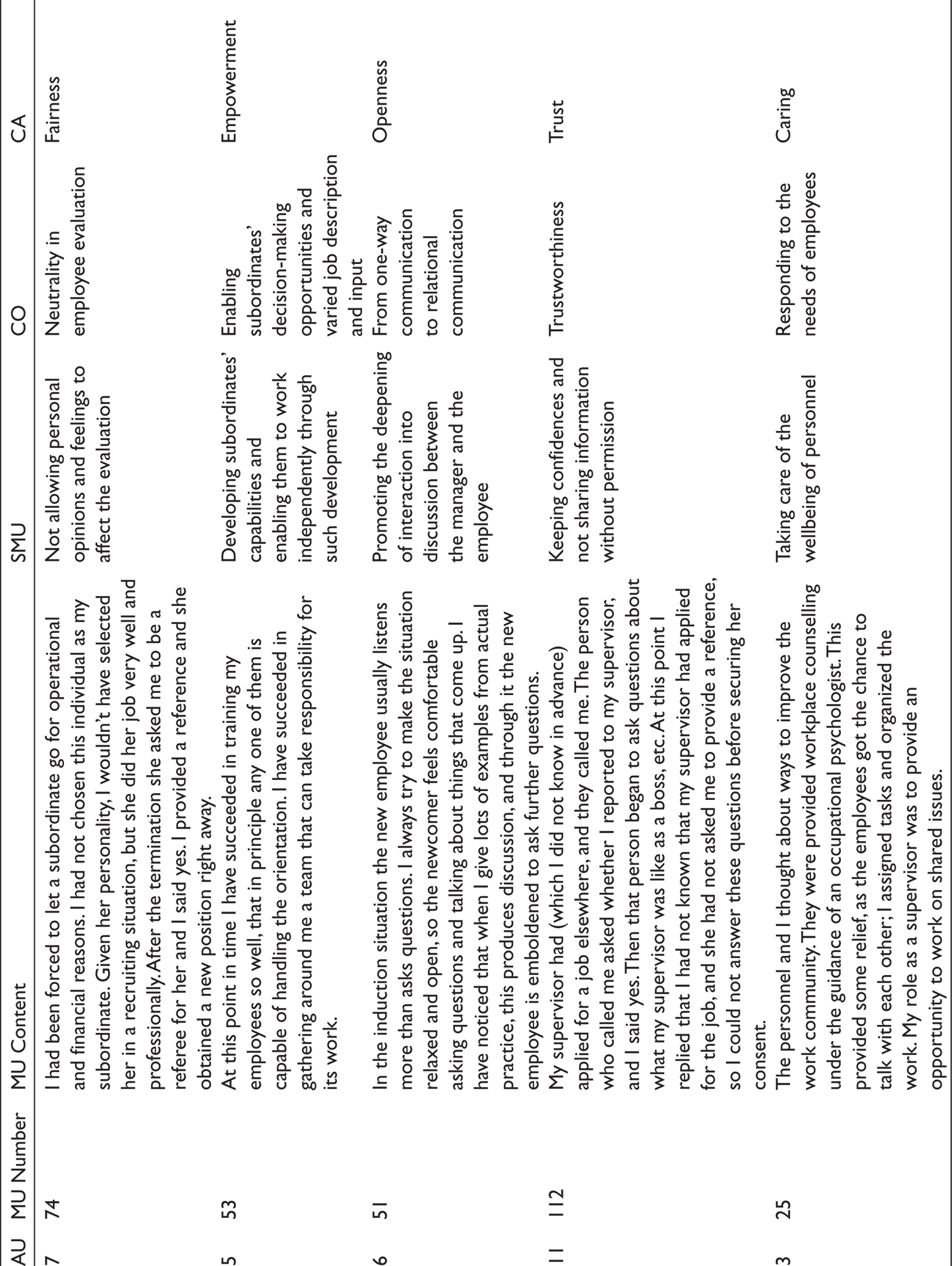
First, the data was entered into a table in which each respondent’s response constituted one analytical unit (AU). Since there were 22 respondents, they were labelled numerically from 1 to 22. The same numerical codes are used below in the results section to identify the sources of direct quotations. In the next step, the incidents within each analytical unit were examined one by one, and passages that expressed meanings assigned to responsible leadership by the respondent were extracted. Each such passage formed one meaning unit (MU). Each meaning unit comprised one or more sentences. A total of 128 meaning units were identified in the data. The content of each meaning unit was then summarized (SMU), which yielded the first interpretation within the terms of the theoretical background. The summarized meaning units were coded by assigning each a verbal label (CO). The codes were based on expectations of the respondents’ regarding the nature of responsible leadership. Finally, the codes were categorized. A category (CA) was a broad entity that described the content of responsible leadership. Two researchers each analysed half of the data independently. Afterwards they compared and discussed their coding. At this point, the two sets of codes were harmonized and refined in greater detail. This procedure of independent coding, comparison and discussion was chosen with the goal of improving the creditability of the analysis. Subsequently the researchers finalized the coding together. In the final phase, the data was abstracted and distilled into principles of responsible leadership. They are fairness, empowerment, openness, trust and caring.
Results
We will now examine one by one the principles which were detected from the data as crucial to answer our research questions.
Fairness
Pursuing the principle of fairness makes it possible for the parties involved to feel that they are treated with respect and are seen as equals in the relationship. As one respondent put it, ‘To me it’s a matter of principle that all subordinates must be treated equally’ (10). It was mentioned that, for example, gender or age should not play a role in anyone’s decision-making. The burden of advancing fairness falls especially on managers, because their position gives them greater power to influence the matter. Particularly in a question concerning the allocation of resources between employees, the employees’ experiences regarding the fairness of the manager’s behaviour are important. Although the respondents considered the principle of fairness important in evaluating the results of resource distribution, the importance of this principle in the process of decision-making concerning resources allocation was also evident in the data.
The respondents also described the importance of efforts by the manager to explain the basis of their decisions to subordinates and to involve them in discussion about the decisions as embodying fairness. A typical scenario that puts fairness to the test is one in which cuts to benefits are necessary. One manager talked about a difficult leadership situation in which she succeeded to ensure that an important perspective to subordinates was taken into account in the organization’s decision-making: granting those team members who were affected by the decision an opportunity to express their views during the decision-making process was perceived as fair.
In sum, the importance of procedural fairness was particularly stressed; the respondents mentioned that it was often more important than distributive fairness for the experience of fairness. The social context of resources allocation called for the principle of fairness. The respondents placed the manager in the relationship as having more chance to act according to the principle. In particular, due to their formal power positions in the organization, responsibility for the advancement of fairness in allocating resources was placed as lying with the managers. Maak and Pless (2006) stress that it is a moral obligation that responsible leaders ensure that employees regardless of background (e.g., gender and age) need to be provided fair and equal employment opportunities.
Empowerment
Empowerment refers to the process in which the parties can express ideas and influence an issue. The parties are supported by each other and learn to take more responsibility to promote issues and ideas under development and change. According to the respondents, empowerment depends on how enabling the work environment in general is. The respondents felt it was important that everyone in the workplace knows what the goals of the work are, but also that everyone has an opportunity to participate in defining those goals. However, merely setting the goals is not sufficient; their achievement also needs to be evaluated.
Empowerment is linked to taking active responsibility, and employees’ participation promotes empowerment. In the respondents’ view, managers and employees have capacities to develop the organization and work. One respondent described the participation of subordinates from a manager’s perspective: ‘One should listen more to subordinates because they, too, have great ideas for developing the company’ (8). One manager (11) described a situation in which joint negotiations were started for the purpose of terminating the contract of some personnel, and even in these difficult circumstances the manager included subordinates in the search for a solution. This had a positive influence on the entire negotiation process.
In sum, the respondents mentioned that an important factor in enabling empowerment is the participation of all parties in decision-making in the workplace. Empowerment was connected to the social context of development and change—in one’s own work as well as in the broader organizational context. Although both parties were constructed as enablers of each other’s empowerment, the advancement of the conditions of empowerment was mainly placed in the relationship as the manager’s responsibility. A reason for this was said to be the manager’s formal position in the organization, which gave her/him better opportunities to influence and use power. Speitzer (1995) stresses that an individualistic understanding of empowerment, which sees empowerment as a trait of an individual is limited. The role of organizational opportunities such as the behaviour of the manager for allowing the participation in the workplace is important for people’s empowerment. By exercising responsible leadership managers shape organizational environment, for example, in terms of role modelling (Brown & Treviño, 2006; Brown et al., 2005) that supports employee empowerment and directs the ethical behaviour in organizations in general (Voegtlin et al., 2012).
Openness
Openness could simply mean communication between the parties, for example, when managers made sure that everyone has up-to-date information about matters affecting the workplace. However, a deeper level of open interaction, with the goal of fostering discussion between the parties about relevant matters, was also brought out by the respondents. The ability of the parties to discuss things openly helps to clarify mutual expectations. One manager gave an example of a failure to accommodate the needs of a subordinate’s life and to discuss them with the subordinate. In the manager’s view, this failure of open interaction did not reflect well on the quality of leadership. The manager described the importance of sensitivity to subordinates’ views in the following way:
In some work situations, one has to be patient with one’s team members so they can do their jobs. I realized that I had sometimes overlooked the need to talk about employees’ feelings. One of them experienced difficulty in reconciling the flexibility required by the job with her family situation. (16)
Managers often found themselves in situations in which they could not share all they knew with their subordinates. The issue is particularly pronounced for middle management, who receives directions from senior management, as the following example illustrates:
I feel that I did not act responsibly when we supervisors had been forbidden to talk about a particular incomplete process with the personnel, but the personnel had been tipped off that the process was underway. (1)
In sum, the study participants emphasized that the social context in which there is a call for this principle is in communication between the manager and employee. Understanding of how open the relationship is may vary, and this variation can be categorized into three levels: (a) one-way communication—predominantly from the manager to the employee; (b) a deeper level of openness when the parties also give each other feedback, and responsibility for initiating the development to this level of openness was constructed by the respondents as lying with the manager and (c) dialogue between the parties. On this level, which, according to the respondents, occurred rather rarely in practice, both parties were described as active initiators of open discussion. In line with Voegtlin et al. (2012) and Antunes and Franco (2016) the study suggests that responsible leadership is a conduct, which aims to promote open interaction and communication between parties continuously and frequently to build mutually beneficial relationships. Interaction is the daily practice of leaders to be involved in communicative engagement with their subordinates (Voegtlin et al., 2012).
Trust
The significant characteristics of trust between the managers and the employees are that both parties honour mutual agreements and respect promises even when an opportunity not to do so arises. In particular, consistency between words and actions is essential to the construction of a relationship of trust. The promise was described as deriving not only from personal values but also from those of the workplace. The following comment offers another example: ‘Keeping the management’s promises to personnel as well as to our clients is consonant with the values of our company’ (8).
A significant determinant of employees’ trust in the manager is whether the manager addresses promptly any problems that emerge in the workplace and does not sweep them under the carpet or allow any unnecessary delay in responding to them. One manager described a problematic situation in which trust that had been undermined had to be rebuilt:
There was an employee with an alcohol problem in the workplace, and no previous supervisor had intervened in the matter. Co-workers had also ‘protected’ the employee in order to avoid gaining a reputation as an informer. This was because the subordinates could not trust the supervisor. The supervisor had always made known the name of anyone bringing a problem to their attention and thus violated the obligation of secrecy. (12)
In sum, trust is at the same time a condition for responsibility to occur and a result of responsible leadership. The central characteristic of trust is that the parties honour mutual agreements and do not break promises even if an opportunity to do so presents itself. Thus, the social context in which the importance of trust is said to occur is the context of both formal and informal agreements between the parties. Responsibility for trust was positioned with both parties; both the manager and the employee are constructed as active promoters of the principle of trust in their relationship. This finding is in line with Maak (2007) who argues that neither position nor status but the ability to build trust is a crucial facilitator of social relationships. Voegtlin et al. (2012) claim that because leadership has important effect on the quality of relationships in organizational life, building and maintaining trustful relationships is a key aspect of responsible leadership.
Caring
The core of caring lies in the ability to recognize the needs of another person and responds to those needs in the way that the person expects. Caring implies that no one is left in the lurch; rather, one supports others in difficult circumstances. However, the respondents found it challenging that expectations are often mutually conflicting. Fulfilling expectations, therefore, requires balancing and mediation. The following example addresses the diverse circumstances of subordinates, including balancing the expectations of work and family life:
One way in which I certainly acted responsibly is that I always took my subordinates’ wishes into account in assigning shifts. Some had commitments due to various activities, others’ family situations were such that they couldn’t do any evening shifts, for example. (15)
The importance of caring is emphasized in challenging situations that involve coping with stress and resolving interpersonal tensions that strain the harmony of the relationship. The resolution of such problems and the achievement of genuine caring require seeing the situation through another person’s eyes. It is not, however, always easy to identify the appropriate way to care for others. One person described such a scenario. This person had suspected that a subordinate was a victim of domestic violence, ‘but I didn’t dare intervene because I was afraid that the individual’s situation at home would become even more difficult’ (12).
The respondents felt that faced with difficult problems, one need not always personally be the provider of help and support. It may not even be desirable, if suitable action requires greater professional expertise or skills than one possesses. Recognizing when one is capable of providing help and support and when one ought to seek expert assistance from elsewhere is part of responsible caring.
In sum, the core of caring lies in the ability to recognize the needs of another person and respond to those needs in the way that the person hopes and expects. It was stressed that this entails acknowledging the other as a subject and an individual; seeking to understand genuinely his or her needs; and responding to those needs constructively and appropriately. Caring implies that one makes a particular effort to support others in demanding and difficult circumstances. The social context in which the principle of caring was said to be of importance is when either of the parties experiences problems, often difficult and ambiguous ones, mainly in the work arena but also in private life. Both parties—manager and employee—were placed as possible care givers and care takers in the leadership relationship. In the field of ethical leadership theories, the servant leadership model puts serving others and caring behaviour as the priority in leadership (Greenleaf, 2002). Maak (2007) and Maak and Pless (2009) argue that inherent in responsible leadership ethos is a sense of care for the needs of others. Maak and Pless (2009) say that showing care towards those in need is based on mutually shared feelings of human flourishing and vulnerability.
Discussion
Based on our results, we suggest a conceptualization for responsible leadership in the relationship between manager and employee. The conceptualization is presented in Figure 1.
As highlighted in Figure 1, the principles that were found to be significant in the construction of responsible leadership in the manager–employee dyad are fairness, empowerment, openness, trust and caring. Additionally, to show the contextual nature of the principles, the specific social contexts which call for the occurrence of each of the principles are presented. Finally, the vertical dimension in Figure 1 shows the leadership dynamics between the managers and the employees; to whom do the parties place responsibility for the advancement of the principles? Managerial responsibility in Figure 1 emphasizes the influential role of the manager acting as the initiator and builder of responsibility particularly due to her/his position in organizational hierarchy, whereas relational responsibility refers to the shared and cooperative nature of responsible leadership. All in all, the study shows, as its premise was that is the social context matters in the leadership relationship (Cunliffe & Eriksen, 2011; Ladkin, 2010), and consequently, in line with this idea, we showed how contextual dynamics occurs in the responsible leadership relationship especially between managers and employees.
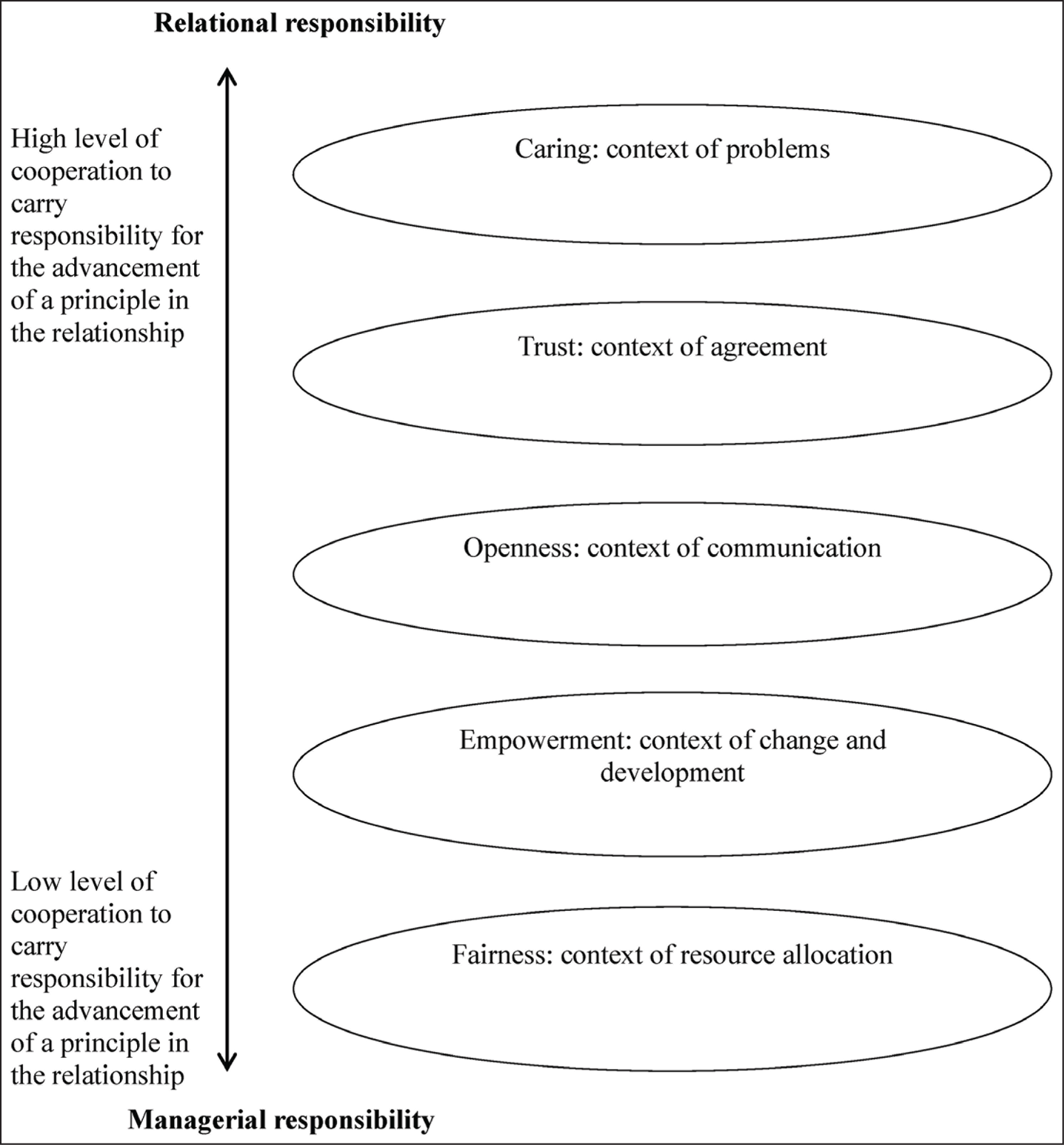
The results show that, in particular, responsibility for fairness, which is important in the context of resource allocation, is placed on the manager’s shoulders, whereas caring, which emerges in work-related and personal problems, and trust, crucial in the context of agreements and promises, are relationship-oriented principles: either of the parties can initiate and advance these principles. Empowerment, significant in the context of change and development, and openness, which occurs in the context of communication, are located between the managerial- and relational-based levels of responsibility, typically understood in such a way that the initiative for advancing these principles lies with the manager, and the employee then joins in the process.
To summarize, in the conceptualization developed in this study, the principles of responsible leadership are organized in a hierarchical order, based on the level of cooperation between manager and employee (Figure 1). The level of cooperation between the parties, to carry responsibility in the relationship, can be low or high depending on the principle and its context. Managerial responsibility, in the vertical continuum below, highlights that cooperation between the parties is low. Relational responsibility, which is up in the continuum, illustrates that the level of cooperation in the relationship is high. Thus, the upward direction in the continuum highlights how cooperation between the parties, to carry responsibility for the advancement of a principle, increases and becomes more shared.
This case study implies that exercising responsible leadership is a dynamic and changing process (Cunliffe & Eriksen, 2011; Ladkin, 2010; Uhl-Bien, 2006; Voegtlin et al., 2012), yet, produced differently in different social contexts: in some contexts the manager is expected to take the lead and be in charge, while at other times it is expected that practising responsible leadership principles will be shared between partners. Given the evidence in this study that the manager is understood to have a more powerful role in taking the initiative in quite a lot of areas of responsible leadership, we suggest that also where leadership can be shared, the formal position of the manager may affect the exercise of responsible leadership principles.
In line with several authors (e.g., Maak, 2007; Maak et al., 2016) we suggest that particularly an ethical aspect is crucial in responsible leadership. However, contrary to widely adopted ideas of ethical leadership (e.g., Avolio et al., 2004; Brown & Treviño, 2006; Brown et al., 2005; Greenleaf, 2002; Maak, 2007), which tend to stress the individual leader’s motivation and characteristics in the advancement of responsibility in leadership, the results of this study indicate that all parties in the relationship need this kind of ability; the employees no less so than the managers. Finally, this study focused on responsible leadership at the dyadic level—between manager and employee. Although this might be seen as a limitation, in fact it enabled us to describe explicitly and in detail the topic.
Footnotes
Acknowledgements
This research was part of by programme Equality in Society (WeAll project no. 292 883) by strategic research funding of the Academy of Finland. We gratefully acknowledge their support.
Declaration of Conflicting Interests
The authors declared no potential conflicts of interest with respect to the research, authorship and/or publication of this article.
Funding
The authors received no financial support for the research, authorship and/or publication of this article.