




Abstract
Poor leadership practice is not inconsequential. It has material effects yet is rarely considered in leadership research and learning. We explore what poor leadership practice ‘looks and feels like’, provide space for those on the ‘receiving end’ to be heard and discuss leadership learners’ responses to the study. We illustrate poor leadership practice empirically as humiliation, chaos, lack of care, abdication and abandonment and extend conceptualisation of poor leadership practice to include ever-changing excessive decision-making and lack of care. The study contributes novel insights, empirically highlighting the practical implications and theorising the emotional pain, loss of respect, trust and dignity for those subject to the practice. With agency, people struggle, bargain with and work around poor leadership practice. The extended accounts are a rich learning resource for leadership learning, with utility in provoking learning, raising consciousness to and challenging poor leadership practice.
Keywords
Introduction
This study advances critical perspectives of leadership and leadership learning and explores experiences of those on the ‘receiving end’ of poor leadership practice. We use the term ‘poor leadership’ suggested by Kelloway et al. (2005) to reflect conceptualisation of inadequate, ineffective and/or passive leadership practice (Grunberg et al., 2021; Kelloway et al., 2005; Milosevic et al., 2020). While theorised as one of four dark leadership styles, alongside destructive, abusive and toxic leadership, poor leadership practice differs because of its ‘lack of intent’ to harm (Milosevic et al., 2020: 119), lack of ‘calculative behaviors or self-promotion’ (p. 121) and, we argue, its perceived everyday mundane nature. Leadership studies carry an embedded contention that leadership impacts individuals and work group outcomes through impact on individuals’ emotional reactions (Gooty et al., 2010). However, while dark leadership is in the early stages of conceptualisation, beyond the toxic (e.g. Lipman-Blumen, 2010; Mackey et al., 2021) and extreme (e.g. Boddy et al., 2015), there is a lack of research into and empirical evidence of poor leadership practice (Mehraein et al., 2023). Furthermore, the emotional impact on those who receive it and their agency in response has been ‘insufficiently examined’ (Milosevic et al., 2020: 117).
From our relational, social and situated perspective (Cunliffe, 2009), we conceptualise leadership as practice that ‘emerges and unfolds through day-to-day experiences, not as the physical or mental capacity of any one individual’ (Raelin, 2016: 134). We consider individuals as socially constructed, always in relation to others, and acknowledge how ‘our social realities and sense of self are created between us in our everyday interactions and conversations’ (Cunliffe, 2016: 750). We take a critical approach to leadership (e.g. Ford and Harding, 2007, 2018; Learmonth and Morrell, 2019), understanding leadership as relational (Uhl-Bien, 2006), within wider, complex contexts and dynamics. Leadership as situated and contextual raises awareness of socially constructed experiences, not just of those ‘in’ leadership but also those on the ‘receiving end’ of leadership (e.g. Schyns et al., 2013). Our aim is to contribute to critical leadership research and learning through a study of poor leadership practice which questions assumptions, what is taken-for-granted, and analyses power relations in support of social justice (Reynolds and Vince, 2020).
We take up the call by Carroll et al. (2008) for leadership research which apprehends the lived experiences of leadership, as ‘the scene of everyday action (Chia, 2004: 30) and which can articulate this landscape through words’ (p. 364). We discuss a qualitative study of 14 people who experience everyday poor leadership practice in UK public sector organisations. We focus on five extended accounts of ‘material encounters between people in workplaces’ (Ford and Harding, 2018: 20) which offer access to experiences of poor leadership practice, previously absent in theory. In addition, to illustrate the value of the extended accounts as a pedagogic resource for leadership learning, we report how executive leadership learners (following a part-time, blended MSc Strategic Leadership programme), respond to these accounts when asked to engage with them and reflexively make sense of their own experiences.
Despite the call for more critical studies of leadership, including the negative effects of leadership and for these to be reflected in business school curriculum (Tourish et al., 2010), experiences of poor leadership practice are mostly absent from leadership research and leadership development. Where it is considered in research, poor leadership practice is conceptualised as inadequate, ineffective and/or passive in given contexts (Kelloway et al., 2005; Milosevic et al., 2020) due to the lack of self-awareness or social awareness, initiative, competence, knowledge and skills, responsibility and/or the leaders’ absence (physical or psychological) or weakness (psychological or lack of influence; Grunberg et al., 2021; Milosevic et al., 2020). The lack of understandings of what poor leadership practice ‘looks and feels like’ and how people respond has consequences for leadership learning and development. It constrains critique of ‘the romanticism of leadership’ (Collinson and Tourish, 2015: 561) and interrogation of leadership power dynamics (Lavine et al., 2022: 10) and limits the ways in which facilitators of leadership learning can raise consciousness to everyday poor leadership practice with learners. ‘Leadership and leader work involves continued learning’ including ‘lessons learned from inevitable mistakes’ (Hibbert, 2024: 6). As continuous learning is socially constructed, relational (Cunliffe, 2009) and experiential (Stead and Elliott, 2009), it has the potential for ‘new readings of experience, challenging assumptions, [and] critically questioning our practice’ (Cunliffe, 2002: 37). Demonstrating empirically and theorising poor leadership practice therefore provides a missing resource for leadership learning, where dynamic social processes of leadership practice and leadership learning can connect sensemaking, knowledge and action (Kempster and Stewart, 2010; Raelin, 2009).
The study makes two central contributions. First, we carve a space from which voices other than ‘leaders’ can be heard and advance critical leadership theory and learning by extending understandings of poor leadership practice and theorising what poor leadership practice ‘looks and feels like’. While the somewhat commonplace nature of poor leadership practice means it can be perceived and dismissed as insignificant and inconsequential, the study unveils new insights. Demonstrating the toll of poor leadership practice, we uncover some of its material effects and painful emotional impact often ignored in leadership theory and illustrate how people, subjected to these practices, can respond with agency. Second, we advance approaches to leadership learning and leadership development. Responses from leadership learners illuminate how the extended accounts of poor leadership practice and its implications are a rich learning resource for those who facilitate leadership learning. The accounts and learner responses demonstrate the importance of connecting leadership learning to the ‘emotional, relational and political context’ of leadership and ‘its capacity to unsettle and challenge’ (Reynolds and Vince, 2020: 138). Significantly, the accounts have wider utility for leadership learners, in raising consciousness to poor leadership practice, provoking critique, sensemaking and learning and challenging poor leadership practice.
Leadership practice and those who ‘receive’ it
We know less about experiences of those on the ‘receiving end’ of leadership practice, with leadership studies predominately focused on leaders, rather than followers or ‘the relationship between leaders and followers (Fairhurst & Uhl-Bien, 2012; Milosevic et al., 2020: 131; Uhl-Bien et al., 2014)’. For example, in a review of day-to-day leading, examining the causes and consequences of leadership behaviours, no studies were found that explored everyday followership (Kelemen et al., 2020). However, those who ‘receive’ leadership have agency and are co-constructors of leadership practice (Milosevic et al., 2020). Petriglieri and Petriglieri (2015: 625) see a ‘growing disconnect between leaders, people who are supposed to follow them, and the institutions they are meant to serve’ as a ‘dehumanization of leadership’. From a critical perspective, there is also motivation to address the ongoing disparity between idealised leadership theory and everyday realities of leadership practice (Ford and Harding, 2018); interrogate ‘power dynamics and integrated systems of discrimination and exclusion’ (Lavine et al., 2022: 10) and ‘rethink followership’ and destabilise ‘the romanticism of leadership’ (Collinson and Tourish, 2015: 561).
In leadership studies, less attention has been given to poor leadership practice (e.g. Milosevic et al., 2020), conceptualised as inadequate, ineffective and/or passive in given contexts (Grunberg et al., 2021; Kelloway et al., 2005; Milosevic et al., 2020) and theorised in the literature as not contributing ‘in role’ due to the lack of competence, self-awareness, absence, weakness (Grunberg et al., 2021) and passivity and ineptness in certain contexts (Kelloway et al., 2005; Milosevic et al., 2020). The passive element reflects aspects of ‘the laissez-faire and management-by-exception (passive) styles articulated in the theory of transformational leadership (Bass & Avolio, 1997; Kelloway et al., 2005: 92; and see Milosevic et al., 2020). Poor leadership practice can be ‘driven by security, safety and non-losses’ (Milosevic et al., 2020: 133) and can reflect lack of intervention and avoidance of decision-making and role responsibilities, until problems are raised or become so serious as to demand action (Bass, 1990). This is considered ineffective (Kelloway et al., 2005) and evasive of leadership responsibility through general inaptitude and/or low motivation to lead (Milosevic et al., 2020).
Poor leadership practice reflecting abdication of responsibilities and being unavailable, unpredictable and/or passive (Haerens et al., 2022) can leave a team or organisation in chaos (Bennis and Nanus, 1974). A rare study of poor leadership by Kelloway et al. (2005: 90) summarises how ineffective, passive and ‘inadequate leadership abilities for a given context’ can cause increased levels of employee stress and retaliation; heightened levels of psychological distress; lower levels of job and life satisfaction, or affective commitment; increased work-family conflict; anxiety and depression. Everyone pays the price for ineffective leadership, as it ‘is present in most companies at almost all levels’ (Aboyassin and Abood, 2013: 78), so that the lack of socially constructed understandings of what poor leadership practice ‘looks and feels like’, its implications and how people respond has consequences for leadership practice and for leadership learning.
Leadership learning
Tourish (2013) blames the teaching of ‘leaders’, to focus on their own thinking and to discount perspectives from those who receive leadership, for the hubris and narcissism found in company boardrooms. Schwartz (2015) recommends talking to learners about the dark side of leadership. However, beyond the theoretical or extreme, it is challenging to find relatable illustrations for leadership learning of what everyday poor leadership ‘looks and feels like’. Poor leadership practice can be perceived as mundane and inconsequential in contrast to romanticised heroic stories of success or horrifyingly gripping leadership scandals. In university business schools, the norms of leadership learning are generally focused on the individual and technical, ignoring highly-complex and ambiguous social work environments (Dehler et al., 2001) and tending to rely ‘on narrow leader-centric psychological assumptions and models that stress miracle worker, charismatic, White men, selling strategies and visions, without attention to power, context, dissent and resistance (Collinson and Tourish, 2015; Mavin et al., 2024: 2).’
These dominant norms in leadership learning fail to recognise leadership as socially constructed in agentic relations (Mavin et al., 2024; Raelin, 2016) or to facilitate a critical attitude towards leadership practice (Dehler and Edmonds, 2006) in a context of complex social relations, structure and power dynamics (Schweiger et al., 2020). The norms tend to disregard how experiences in organisations ‘generate both positive and negative feelings, and irrespective of whether these are acknowledged or suppressed, they will influence choices’ (James and Arroba, 2005: 300). While normative approaches to leadership learning may ignore emotions in leadership, ‘emotional impacts are an implicit part of leadership phenomena’ (Connelly and Gooty, 2015: 485). This is illustrated in leadership studies by ‘how affect, emotional intelligence, moods, emotion contagion, and emotional labour are everywhere’, how ‘the heart of emotions in leadership’ is perceived to be ‘a leader managing follower emotion’ (Connelly and Gooty, 2015: 486) and how it is important for ‘leaders to understand the emotion and emotionality within the organisations they lead’ (James and Arroba, 2005: 299). Therefore, for leadership learning to have relevance, there is responsibility to raise consciousness with learners to how leadership practice is socially constructed, the emotionality involved and how those who receive leadership are not passive containers but can respond to leadership practice and emotional pain with agency. Against this background, we explore experiences of poor leadership practice to contribute new understandings of poor leadership and its implications and engage with leadership learners to advance leadership learning.
The research approach
We follow a social constructionist perspective, understanding subjective individual experiences as occurring within a ‘web of relationships’ (Cunliffe, 2008: 129) and assume leadership practices are part of continual social construction between people in particular contexts (Collinson and Tourish, 2015). The qualitative study engages 14 participants purposely selected from a range of UK public sector organisations, including central and local government services, healthcare, education and defence services. Participants were recipients of leadership practice, and some were also in leadership. Table 1 details the participants and range of public sector organisations.
Participant details.
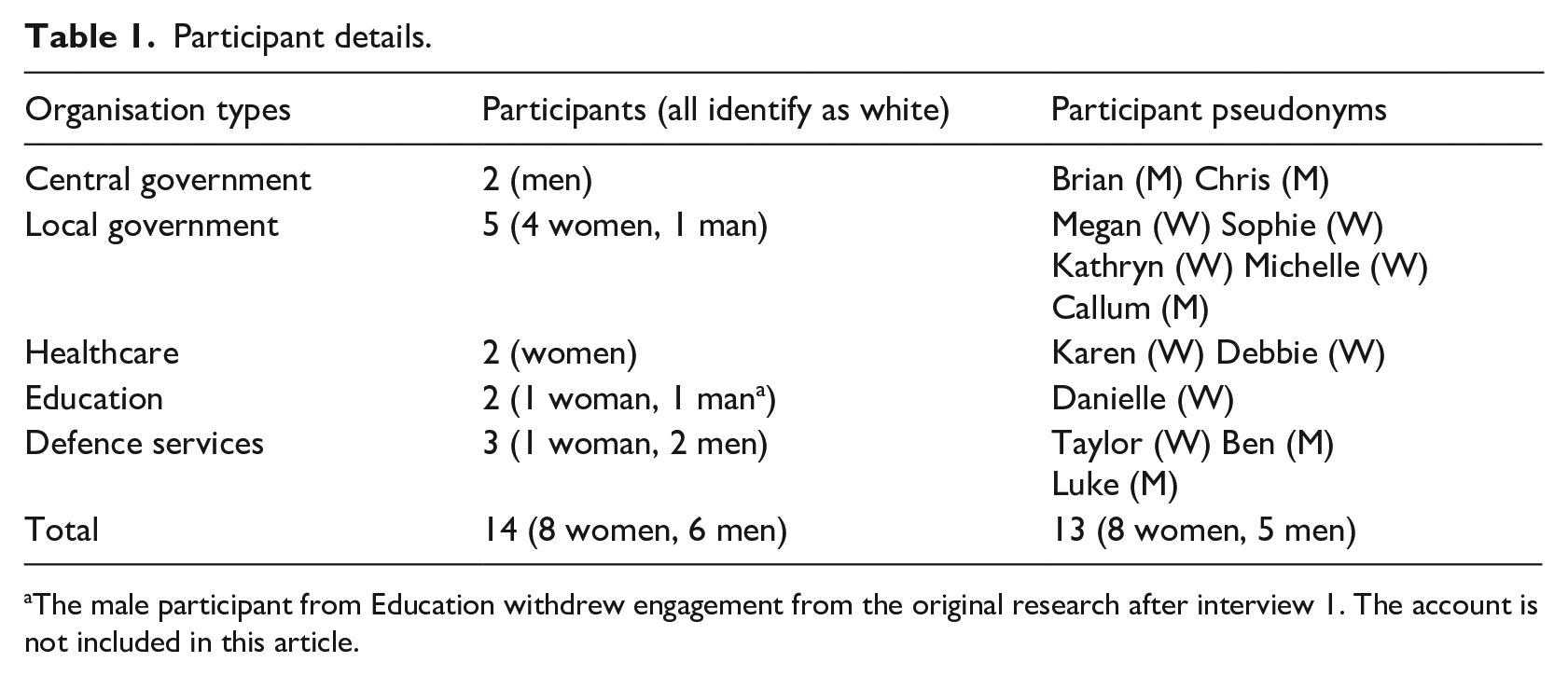
The male participant from Education withdrew engagement from the original research after interview 1. The account is not included in this article.
Multiple methods of data generation
The data are drawn from a wider multi-method qualitative study by the first author, exploring employees’ understanding of ‘following’. The study generated data in three phases: (1) a semi-structured interview; (2) participant visual research diaries and (3) a photo elicitation interview. The semi-structured interview included five main areas: introductions; understandings of following; processes and practices of following; contexts of following and self as follower. Interviews with the first author, lasting between 1 and 2 hours, were held face-to-face or via videoconference. The research design provided reflective space for participants by using a visual research diary, over 4 weeks, which included taking photos, selecting images and making annotations to reflect their understandings and experiences. All interviews were audio-recorded, transcribed verbatim and anonymised for analysis by redacting context-specific names and allocating pseudonyms.
Data analysis
Over the course of analysis, both the study and research team changed shape. When reading the data, the original researchers recognised how participants talked about so much more than how and why they follow particular leaders. As a result, the team expanded and began a new reading. We were struck (Corlett, 2013) by the emotional expressions in participant accounts when talking about experiences of leadership, which we felt conveyed implications of leadership practice, and were provoked into reflexivity about our own emotional responses. To make sense of our emotional responses, we turned to the literature on heartbreak (Van Maanen, 2010) and recognised that the participants’ accounts hurt us (Whiteman, 2010). We felt the pain, moral injustice, frustration, fractured and lost relationships, worthlessness and, in some accounts, hopelessness. We recognise that these responses and subsequent interpretations of the data are ‘dependent on the intellectual resources, moral groundings, emotional states, and cultivated curiosities . . . [we carry] to (and from) the scene’ (Van Maanen, 2010: 339). This recognition of our heartbreak was ‘a significant moment’ (Van Maanen, 2010: 340), arising from ‘a deep and personal sense that things aren’t as they should be and no one is doing anything about it’ (p. 339), and propelled the study.
We interpret emotions as context-specific, transient, intense reactions to an event, person or entity (Gooty et al., 2010). Emotions, understood as social constructions that materialise through ongoing and dynamic human interaction (Hochschild, 1983), ‘can affect us immediately or later through (triggered) memories. In either case, they alert us to some potential information about a situation (and perhaps ourselves) that is worth gathering’ (Hibbert, 2024: 11). We make interpretations of socially constructed experiences of poor leadership practice related to ‘subjective and deeply felt states that makes people raw and emotionally vulnerable’ (Whiteman, 2010: 328), reflected in feelings, for example, of emotional pain, sadness and disappointment.
We began analysis of the interview transcripts through an iterative and inductive process (Miles et al., 2018). We read three selected transcripts (Kathryn, Megan and Brian) and met to share interpretations and emergent patterns. Reassured that we were interpreting the data in similar ways, we allocated remaining interviews across the team who moved iteratively between the data and existing literature to identify further emerging patterns (Miles et al., 2018). Following Van Maanen (2010) and Whiteman (2010), we gave ourselves permission to ‘feel’ subject to [the participants’] moral regulations, their discomforts, confusions, hard-won competences, grievances and heartbreaks’ which helped interpret the accounts. We considered how the accounts articulated leadership practice such as chaotic, inconsistent behaviours, not taking responsibility, being ignored and the emotional impacts (e.g. feeling unhappy, upset, alone, abandoned) and how participants responded with agency in various ways such as challenging those in leadership, behaving professionally and exercising discretionary effort. With reference to the conceptualisation of poor leadership, we focused on surfacing what poor leadership practice ‘looks like’ and participants’ emotional responses (what it ‘feels like’) and considered the implications.
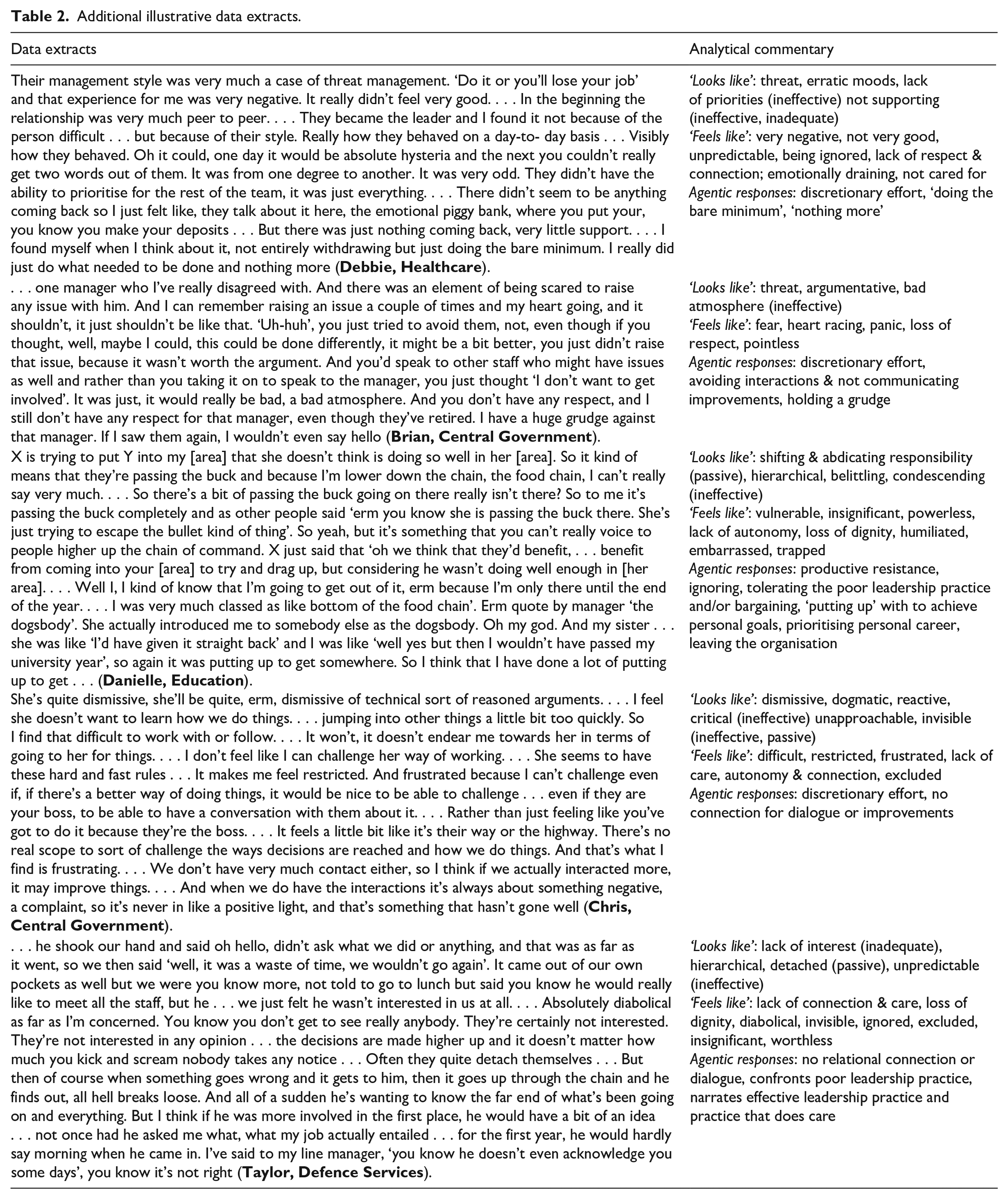
We selected five extended accounts from Kathryn, Callum, Megan, Sophie and Karen as ‘compelling bits of data . . . that effectively illustrate’ (Pratt, 2009: 860) patterns across the wider data (power quotes). These reflect gender diversity in leadership relations, that is, man in leadership, woman participant (Kathryn, Sophie, Megan); woman in leadership, man participant (Callum); woman in leadership, woman participant (Karen). We named the accounts Humiliation, Chaos, Lack of Care, Abdication and Abandonment. In discussing the accounts, we focus on the participants themselves and ‘their concern with what happens in a particular incident’ and how they deal with it in their account (Van Hulst and Tsoukas, 2023: 735) and what poor leadership practice ‘looks like’, ‘feels like’, responses and implications. We include, in Table 2, illustrative data from a further six participants as proof quotes (Pratt, 2009).
Following Van Maanen (2010), aware that the accounts can be interpreted differently, to reflect some advocacy for ‘those groups [in leadership studies] who are not served well’ (p. 340) and to signal our route to theorising the accounts, we made an authorial choice to be explicit in the analysis about our ‘emotional responses to the world portrayed’ (p. 339). We also choose not to use the term ‘follower’ and use the terms ‘those in leadership’ and ‘leader’, only where necessary, to refer to those who have a formal leadership role with position power in organisations (the participants refer to director, programme manager, managers, line managers, head of). This strategy reflects our relational and situated understanding of leadership as practice.
In a final step, appreciating that ‘text has no life of its own, it is incomplete until it is read and it is the reader who brings “something” to complete it’ (Hyland and Lehman, 2020: 9), we engaged executive leadership learners following a university business school MSc Strategic Leadership programme in the research, to explore the utility of the extended accounts for leadership learning. While the programme is underpinned by a critical pedagogy, poor leadership practice had not been previously discussed with the learners. Using an online platform, learners were asked to voluntarily read an earlier draft of this article, guided by questions (see Appendix 1) and to post their thoughts and responses to an online Discussion Board. We first discuss the study of poor leadership practice and then present succinct excerpts from four learners’ responses, to illustrate patterns in their thoughts and responses and illustrate the extended accounts as a learning resource.
Humiliation, chaos, lack of care, abdication and abandonment
Here we present five extended accounts to illustrate experiences of poor leadership practice, followed by our analysis. In each account, we identify what we interpret as poor leadership practice (what it ‘looks like’), the relational and emotional impact of the practice (‘what it feels like’), and highlight responses to the poor leadership practice.
Humiliation: Kathryn [UK local government] ‘I think it’s the director that we have partly. I think it’s partly the profession. . . He’s very, he can be very patronising. . . and you know, he can be quite upsetting. I’ve been in a meeting, where he’s asked me to go along to a meeting and talk about cost pressures, so I’ve gone into the meeting and you know everybody’s glaring at you, it’s not welcoming . . .you feel intimidated straightaway. You feel, you get that fight or flight response. And you think, ‘I just want to get out of here’. And then, you know, I have the director say, ‘Why are you here?’ and I said, ‘Well you’ve invited me to talk about cost pressures’ and you know he banged his notes on the table ‘Do you think this is an effective use of my time?’ And, my response was, I just said ‘Well, we have to do it. Because we have a corporate deadline. If we put these cost pressures into the Director of Finance, we might get more money for X, so that’s a good thing. So, let’s get on, let’s go through it and I’ll be as quick as I can’. You know, I just kind of got on with it quite well. And when I came out of the meeting, I felt really upset. I thought ‘No, I’m not going to cry, I’m not going to cry or get upset’. I thought I’m going to go and talk to him and say ‘Look, please don’t talk to me like that because I’m on your side. I’m working with you, I’m doing this work to benefit you. Please don’t talk to me like that’. I was going to go and talk to him, and I saw him in the corridor and he said ‘Oh, we’ll have a chat about this’ and you know he was like, it was almost like he just flipped to Nice Director and he’d just completely forgotten about it, so I thought ‘Well, there’s no point me mentioning it’. He’s obviously had an off day and . . . he is affecting all of his managers, and it then filters down. And it means that when I ask questions, they’re a lot more defensive, which means that I can’t get the work done that other directors are asking me to do, so it leads to a lot of conflict. Because he doesn’t have that natural trust with managers. You feel like you’re constantly on the defence.
In setting the scene, we learn that the leadership practice and wider context (‘the profession’) are ‘patronising’ and ‘intimidat[ing]’ (‘quite upsetting’) and become aware that Kathryn feels vulnerable, in danger somehow from leadership practice. Kathryn is invited to the meeting and feels humiliated. We feel the excruciating embarrassment of all eyes on Kathryn when she enters the meeting. The atmosphere feels hostile (‘not welcoming’, ‘everybody’s glaring’). She is unexpected, entering a group where she feels unwelcome and possibly under attack. This compounds Kathryn’s feelings of ‘fight or flight’ and ‘upset’. We interpret an intense power dynamic, where the Director appears to have forgotten Kathryn’s invitation and does not want the interruption or the discussion. The leadership practice becomes defensive in front of the team, is ineffective and lacking in care. The leadership practice questions her presence (‘Why are you here?’) through grandstanding (‘Do you think this is an effective use of my time?’), which is humiliating. She is alone and vulnerable, an ‘outsider’ who has interrupted. Kathryn responds professionally (‘just kind of got on with it quite well’). We wonder how we might have responded. Afterwards in the corridor, the person in leadership ‘flips to Nice director’ and forgets ‘about it’.
The poor leadership practice reflects ineffective leadership abilities (Kelloway et al., 2005), reflecting a lack of self-awareness or social awareness which manifests as frustration and/or defensiveness. The impact on Kathryn is visceral (‘really upset’), and we feel her vulnerability and emotional pain (‘not going to cry. Not going to cry’). There is self-talk and emotional management in how Kathryn responds, reclaiming her sense of self from this loss of dignity (‘please don’t talk to me like that . . . Please don’t talk to me like that’). We sense how she is silenced as ‘nice director’ disrupts Kathryn in-the-moment; she feels powerless (‘no point’) and rationalises the practice as ‘an off day’. We know the poor leadership practice is not a ‘one off’ and impacts on others (‘filters down’, ‘no natural trust’) and on Kathryn in performing her work (‘more defensive’, ‘constantly defensive’, ‘can’t get work done’ for other directors), which leads to further conflict. We sense Kathryn’s struggle in relation to agency and resistance and how Kathryn simultaneously ‘consents, copes and resists’ (Kondo, 1990: 224) in relation to this poor leadership practice. We are left with further questions such as, what was the response of those others who observed the leadership practice? How do they feel? How do the ‘managers’ feel in relation to the leadership practice? Are the other directors, with whom Kathryn feels defensive, complicit in or oblivious to this leadership practice and what is their responsibility? Chaos: Callum [UK local government] It was part of a big transformation programme, but the programme manager, it was like watching a whirly top going, she was quite chaotic, she was always. . . on the move, always making decisions on the fly and, you know, creating policy [snaps his fingers] like that, and the result of a conversation in a corridor, you come back into the office and ‘I’ve thought about this project. Right, we’re going to do something completely different’. Just spent six months doing this work and all of a sudden, you’ve kind of thrown it into, into, into chaos, and I find it really hard to work in that kind of way, because the goal posts are always shifting and I think what was wrong for me, difficult for me, I don’t mind that the world is constantly changing, but actually there needs to be some basic consistent charac-, principles, ways of doing that. And when you’re constantly having to keep up with . . .I think I just, I, I . . .I kind of disengage myself and stop, it’s almost like I just let it wash over me a little bit, and, and stop, almost stop challenging. Because what would be the point. . . because it’s almost like it’s going to change anyway, she’s going to change her mind before too long, so what is the point in having the argument now? I might as well try and muddle through and deliver this bit of work in the best way I can. . . Oh, it’s crap. Don’t like it at all. It’s really difficult for me to work in that kind of constantly chaotic changing world. . . .not just making snap decisions about the direction that the programme or individual projects or the work that we’re gonna do is going to take, because it makes you feel a bit, it undermines what you’re supposed to be there to do if you’ve got a project, you’ve got a team that you’re leading. . . you’ve got to set up objectives, you’ve got to try and achieve them, and you have to try and manage the risks of the external environment to that project, but when one of your risks is your manager, it’s quite hard. I found it really difficult to deal with. And ended up actually losing a bit of respect for that manager, because I didn’t agree with the way she managed the programme and her staff. I didn’t think it was fair. . . because you often found the stuff was piled on top of people who were already really busy and she took a particular source of pride in the fact that she never says no to a request for work . . .But actually, it gets to a point where you have to start saying no. . . I didn’t think that was right.
We immediately feel the energy, chaos and fast pace of leadership practice in Callum’s context (‘always on the move’, ‘decisions on the fly’, ‘goal posts always shifting’) and the informality of quick and continually changing policy decision-making (‘in a corridor’, ‘do something completely different’). Chaos, generally understood as unpredictable and a ‘not knowing what is coming next’, can cause high anxiety. In recognising contemporary organisations as unpredictable and ambiguous, a reasonable expectation for leadership practice is to provide ‘a structure grounded in reality’ (Galacgac and Singh, 2016: 524) and to support others to become more accepting of levels of unpredictability and ambiguity. Thus, ineffective poor leadership practice, as illustrated by Callum’s context, is that which creates more unpredictability and ambiguity, is inconsistent and fails to provide any guiding structure or support to others.
While current understandings of poor leadership practice reflect the avoidance of decision-making (Kelloway et al., 2005), here poor leadership practice is evident as ‘ever changing decision-making’ reflected through the imagery of a ‘whirly top’, a child’s spinning and moving toy. This is striking in terms of pandemonium and unpredictability, and we feel how exhausting it must be working with this practice. The poor leadership practice is ineffective and reflects a lack of accountability for the consequences of leadership and social awareness in terms of relational impact, illustrated by how this causes chaos for the person, team and organisation (Bennis and Nanus, 1974). We sense Callum’s invisibility and insignificance and how ‘overloaded’ he feels without due care and his opposition to the leadership practice and moral injustice (‘I didn’t think that was right’) when ‘you have to start saying no’. We feel how this leadership practice is ineffective, provoking a lack of satisfaction and increasing levels of frustration for Callum. Furthermore, the ever-changing decision-making, ‘constantly changing’ and ‘never say[ing] no’ convey not inadequacy, as conceptualised in the literature, but rather excessiveness. Callum perceives the practice as an additional ‘risk’ in the environment. Significantly, the implications of poor leadership practice which leads to chaos are under-explored (e.g. Haerens et al., 2022).
This poor leadership practice means that Callum’s work and that of the team are ignored, not valued and dismissed. Callum feels undermined in his own leadership practice with his team. There is pain, sadness and disappointment in how hard Callum feels he works, just for him and his work to be ‘thrown into chaos’. We recognise how challenging it is to work without a supportive guiding structure; ‘some basic consistent . . . principles, basic consistent ways of doing’. Callum finds it ‘really hard’, ‘really difficult’, ‘it’s crap’ ‘constantly having to keep up’ without clarity, consistency and consultation about changes to his work. We feel the leadership practice weighing him, and us, down. He ‘loses a bit of respect’ and responds with agency by disengaging. Callum lets it ‘wash over me’ and stops ‘challenging’. He withdraws emotionally to survive, knowing that the practice will change again. We feel his powerlessness, through ‘what would be the point’ in challenging because ‘it’s going to change anyway’ and his agency and resistance to the leadership practice (how they ‘managed the programme and managed staff’). Callum’s struggle with ever-changing excessive decision-making provokes him to respond with an alternative option and a different leadership practice (Alvesson and Spicer, 2014); focusing on his work, conveying professionalism in trying to ‘muddle through . . . best way I can’ in leading his team.
Lack of care: Megan [UK local government] You will get an unhappy team if the person leading you. . . makes it known that they’re not happy. And not that they’re not happy for just a single incidence but overall. What he’s done very recently is because of the friction in the office. . . He’s swapped some people round. Instead of him sitting in the middle of his team, he’s in the top left-hand corner, so now he can’t hear the moaner, he can’t hear my friend laughing, . . .he’s as far away as possible from the wanker, and the faffer and the one that wanders around. He’s as far away as possible and he’s surrounded himself with people he likes. Part of us says ‘fine, you know, ok do I want my manager leaning over my shoulder all the time? Listening to what I do, watching, listening to what I say’. . . but part of you says this person does really not care about this team. . . .He has made it known ‘I want to come in in the morning half past seven, go home at four o’clock and just do not give me any hassle during the day’. It’s purely professional pride that makes me do what I do. I certainly don’t do it for him, I do it purely to be able to say I have done the best I can and regardless of how my leader views me. . . You know, oh sorry [becomes a little upset] I know in my own mind that I’ve done the best I possibly can and regardless of what, excuse me, a piece of shit it is I’m working for. . . .That’s the most I can do. He’s never said ‘ok let’s sit down and find out why things are taking you so much time. You don’t need to do this, ok, you don’t need to do that, ok’, but none of that. He comes in, sits down at the bottom end and you only need to speak to him if he wants you to, if you want him to sign something. Other than that, he has no involvement with my work whatsoever. . . It’s just complete lack of communication and obviously he’s not happy in his work and nobody else is. . . The way that I feel, I don’t even want to have a conversation with him if I can avoid it. I don’t want to speak to him socially. The way the guy has carried on over the last year I just, the less I speak to him the happier I am. . . [When asked about notes in her diary] It’s got lack of communication, contempt, favouritism, separatism, sarcasm, lack of respect, lack of praise for a job well done, apathy, resentment, isolation, moaning, absenteeism, no job satisfaction, stress, whispers, cliques, barriers, and then there’s the difference (shows different sheet) [which is] communication, recognition, coaching, complaining only up, thanks, praise, mutual respect–and that is the difference. Hopefully a leader will know enough about a person and take the time to find out enough to know how to actually get through to them. Which is what I found with X and Y, they were really effective as leaders, they just understood how to get through to people, whereas this one doesn’t.
Megan sets the context; the team is ‘unhappy’, the person in leadership is ‘not happy, overall’ and, indicative of poor leadership practice, they have physically distanced from others ‘as far away as possible’. This ineffective tactic to avoid ‘friction’ lacks social awareness and reflects inadequate leadership abilities (Grunberg et al., 2021) and passive leadership practice, even when the situation is serious enough to demand action (Kelloway et al., 2005). We sense ourselves in Megan’s physical workspace with regards to who is ‘in’ (‘people he likes’) and ‘out’ of favour, through the characters outlined. We understand Megan’s ambivalence in an oppressive environment, not wanting and yet wanting attention, in a context of poor leadership practice which does not ‘really care’. We feel shocked that someone in leadership has shared their disengagement and psychological contract in a way that warns others to stay away and minimise ‘hassling’ them. This practice is a passive-aggressive approach to avoid leadership responsibilities (Kelloway et al., 2005) and is significant in advancing understandings as we lack empirical studies illustrating how leaders withdraw themselves from the workplace and the impacts (e.g. Kelemen et al., 2020).
In Megan’s account, we see an acute power imbalance in this poor leadership practice, emphasised through unavailability, physical and psychological absence (Grunberg et al., 2021; Milosevic et al., 2020) and absence of care, in that ‘you only need to speak to him if he wants you to’. We sense vulnerability and pain in Megan’s struggle with work and the lack of interest in her (no ‘let’s sit down and find out why things are taking you so much time’). The leadership practice excludes Megan from meaningful relationships, and she feels uncared for. She has nowhere to go and feels powerless. We feel her isolation, loneliness and lack of support in relation to the leadership practice and in how she perceives she is viewed. The absence of care in the leadership practice is repeated (‘he has no involvement with my work whatsoever’).
The poor leadership practice strips Megan of her dignity; she is invisible, insignificant, worthless. We interpret Megan as in a raw emotional state and vulnerable (Whiteman, 2010), conveying intense emotions in relation to leadership practice. We feel Megan’s moral injustice and the rejection she experiences in a context where there is no relationship or communication. Megan, however, responds with agency by re-centering her sense of self through ‘pure, personal pride’ in doing ‘the best I can . . . regardless of how my leader views me’. Megan’s response aims to restore self-respect (Van Maanen, 1991) in contrast to her lack of respect and contempt for the ‘piece of shit’ she works for. With further prompting, Megan explicitly describes the poor leadership practice she is subject to (‘this one doesn’t’ (know how to get through to people)), compares this to her experiences of effective leadership practice and narrates leadership practice that does care. The poor leadership practice has implications for Megan in that she loses relational connection with the person in leadership and responds by disengaging and avoiding (‘I don’t even want to have a conversation with him’, ‘the less I speak to him the happier I am’). We are hurt by Megan’s feelings of insignificance, sadness and unhappiness and how she feels uncared for.
Abdication: Sophie [UK local government] I had discussions with my manager about changing some of the work I do and taking on other work, and it was quite an informal meeting, and I feel like it wasn’t very clear, so I did follow it up with an email, which I never had a reply to. So, I felt a bit let down. Because for me that was important, if it’s to do with my work, my role. I tried to clarify it at the time and I was asked to take on some work from another person, but they did a range of different work, so I asked what type of work, which area. And my manager couldn’t tell me, he couldn’t specifically say ‘well it would be this, this and this’, he just said ‘well it would be in this area’. I didn’t feel like he knew what he was talking about to then pass it on to me. It was a very quick meeting because we had another meeting straight afterwards. So, we had time constraints, we couldn’t discuss it properly so that experience wasn’t very good for me. . . .Well, it did change my attitude actually because I felt well if you can’t be bothered to tell me what I need to be doing, then really I can’t be bothered to do it. . . .It was more afterwards . . .I started thinking about what implications it might have for me. I feel like I’ve hidden my feelings about it. Mainly because, I wanted a reply to my email initially to see what the actual situation was in case I’d misinterpreted it, and I haven’t really discussed it since. But that’s been deliberate on my part so I have been a little bit mischievous. . . But I thought well if I bring it up does that mean I’ll get forced to do it, so it hasn’t actually happened yet. It’s been left. I hadn’t made any sort of, any inclination that I was unhappy about it, I just carried on as normal. I think now, there’s so much time passed that I’m not really worried about it but at the time I did feel like I need to get this out in the open because it does sort of eat you up but then, I had mixed feelings, half of me wanted to just get it out in the open and have a bit of a discussion about it, you know a more honest one and half of me thought well, I’ve sent an email therefore the ball’s in his court.
Poor leadership practice can be perceived as mundane and inconsequential; however, Sophie highlights fundamental disrespect with significant impact. In not preparing, not having sufficient information, not communicating clearly and not providing sufficient time to discuss changes to Sophie’s work, the leadership practice is interpreted as inadequate, ineffective and passive (Grunberg et al., 2021; Kelloway et al., 2005; Milosevic et al., 2020). There is abdication of decision-making and role responsibilities (Kelloway et al., 2005) in not responding to the email and not following up the requested work changes. Initially, the leadership practice may appear careless and insignificant, but it lacks self-awareness and social awareness (Grunberg et al., 2021) and care and sensitivity, which has emotional impact and threatens Sophie’s autonomy at work. The poor leadership practice is critical to her sensemaking and how she feels about herself and her work. Sophie feels unimportant, insignificant, disappointed and ‘let down’. She loses respect (‘I didn’t feel like he knew what he was talking about’) and the experience ‘wasn’t very good’. In response, Sophie changes her attitude to work. She can no longer ‘be bothered’ and resists in a disguised and partial way, ‘blurring the boundaries between dissent and consent’ (Collinson, 2005: 1430).
We sense Sophie’s anxiety building as she considers her loss of autonomy and any ‘implications’ of the work changes and feel her agency in asking for email clarification. She conveys her struggle with the leadership practice through her ‘mixed emotions’. We feel the stress and suspense of waiting for a response. When this does not come, Sophie feels ignored, invisible and unimportant. She has ‘hidden [her] feelings’ of vulnerability while mischievously resisting leadership practice; she does not raise it and does not change her work. Yet she is worrying about being ‘forced to do it [the work]’. She’s ‘not really worried about it’ but feels she wants to sort this out (‘in the open’), as it is ‘eating [her] up’. We feel deep sadness at Sophie’s unnecessary, ongoing worry, in a context where she resists (‘ball’s in his court’) and simultaneously waits, suspended, powerless, not knowing if a response will come or whether her work will change. In the meantime, practically, no changes of work take place. Sophie illustrates how ‘resistance and conformity interact with power and coping’ (Carroll and Nicholson, 2014: 1429); she simultaneously resists, consents and works to cope (Kondo, 1990).
Abandonment: Karen [UK healthcare] I went to a meeting that usually [I] wouldn’t be included in [child investigatory issue] and . . .He had to stay with us, so we were in a position where the child couldn’t be removed, so I ended up going to a meeting that normally I wouldn’t have gone to but I had to go as I was the [acting role]. ‘Right, I’m one of the people implicated but I’ve got to also be the [acting role] and take that on’, and the [senior] Head of was there. And she got up and walked out at the end of the meeting and didn’t ask how the ward was, how any of us felt and I suppose in some ways I felt let down. She was quite new in her role. . . and I think I’d only met her once, very briefly. But I was sure our previous Head would have said something to me, even if it was just to say ‘Are you okay? We can’t say too much because of the situation. . . we’ve got to keep this very much above suspicion and just make sure everything’s done properly, so nobody can say well you didn’t follow that procedure’, but I know she would have come back and said ‘Is the ward okay? How are you?’ and you know just asked generally how everybody was. And she got up and left the meeting. . . .As I say, just got up and walked out of the meeting and we sat there quite stunned. And I just thought ‘Mmm, I don’t think I would ever do that’ and I felt quite let down. . . .She was probably thinking ‘I’ve got to get to the next meeting’ because the nature of those meetings are they’re called and everything has to be shifted, you know, you’re told by the external people that they meet at this time and you have to attend. So, possibly she was walking off and hadn’t given it that thought, . . .and I walked back onto the ward and said, ‘This is what we need to do’ and the practicalities of it, because I think I’m quite a pragmatic and practical person, . . .and the sense of, I suppose, protecting my staff as much as I could as well as the parents. I then had to go to speak to the parents. . . and be the person that sat with the parents while they were screaming and shouting at me and threatening me with solicitors . . .making sure they were okay, . . .so that was sort of pushed to the back of your mind and thinking ‘I’ve just got to get on with this and take the lead and be that person that she wasn’t’.
Like Sophie, the leadership practice appears only fleetingly and may be perceived as inconsequential yet has powerful impact on Karen. We immediately sense this is an important context for leadership practice in that Karen is ‘acting’, the person in leadership is ‘new’, the two do not have a relationship and the subject is critical. There is a power dynamic with the most senior person in the room. The impact of ‘getting up’ and walking out, without speaking to colleagues or asking ‘how any of us felt’ reverberates through Karen’s account. The poor leadership practice reflects absence of care; care to find out how equipped Karen was, in an acting role, to deal with this new and important situation and care in checking out how Karen and other colleagues were feeling. It demonstrates practice which is ineffective and passive (Kelloway et al., 2005) through being unavailable (Grunberg et al., 2021; Haerens et al., 2022). There is abdication of role responsibilities in not considering how expert colleagues were to deal capably with a complex and political situation and in relinquishing and avoiding leadership by not following up, considering the known risks to colleagues (e.g. when parents are involved). This is passive, ineffective and inadequate leadership practice. Karen repeats and emphasises the leadership practice several times (‘she got up and left the meeting. . . . As I say, just got up and walked out of the meeting’), underlining her feelings of being alone and abandoned. Karen is ‘quite stunned’ at what happens (‘I don’t think I would ever have done that’) and feels disappointment (‘let down’ and ‘quite let down’). She compares poor with effective leadership practice, where she would have had support, ‘even if it was just to say, “Are you okay?”’.
It is confronting to realise how one leadership practice leaves others feeling vulnerable, abandoned and alone to deal with the consequences in difficult situations, and how what happens and does not happen in the moment of leadership practice has tremendous legacy. Karen simultaneously rationalises the poor practice as due to time pressures while feeling insignificant (‘[she] hadn’t given it that thought’). Karen contrasts this with her own practice (‘I walked back onto the ward and said.’), highlighting how her response is to do the opposite and to ‘protect my staff’, and narrates leadership practice that does care. Karen is left on her own, and we feel her emotional management as she meets the parents, pushing poor leadership practice ‘to the back of your mind’. Karen takes control and resists poor ineffective, inadequate and passive leadership by taking up alternative leadership practice (Alvesson and Spicer, 2014), moving into a ‘pragmatic and professional’ mode in ‘tak(ing) the lead and be(ing) that person that she wasn’t’.
In summary, these everyday lived experiences illustrate that poor leadership practice can ‘look like’ inadequate, ineffective and sometimes passive practice (Kelloway et al., 2005; Milosevic et al., 2020), involving a lack of self-awareness and/or social awareness, initiative, competence, knowledge and skills, responsibility and/or the leaders’ absence (physical or psychological) or weakness (psychological or lack of influence; Grunberg et al., 2021; Milosevic et al., 2020). The accounts also extend previous conceptualisation of poor leadership practice to include ever-changing, excessive decision-making without a guiding structure or support (chaos) and lack of care, reflecting absence of care for relational others; physical and/or psychological withdrawal from others and the workplace and abandoning relational others. The analysis highlights how poor leadership practice ‘feels like’ great sadness, disappointment and the emotional pain of being uncared for, lack of relational connection and related vulnerabilities and loss of respect, dignity and trust. The accounts reveal various forms of resistance and agency reflecting a range of participants’ struggles with poor leadership practice, including how they simultaneously resist, consent and work to cope (Kondo, 1990); blur dissent and consent and persist, disengage and withdraw (Collinson, 2005); work to retore self-respect (Van Maanen, 1991) and respond with alternative leadership practice (Alvesson and Spicer, 2014).
To further illustrate our interpretations of poor leadership practice, we provide data extracts and summary analysis from five additional participants as ‘proof quotes’ (Pratt, 2009) (at Table 2). Considering these additional lived experiences, the study also highlights the practical implications of poor leadership practice in how those in leadership positions become key risks to the work (e.g. Callum, Megan, Karen); relationships break down (all); there is negative impact on the way work is completed (Kathryn, Megan, Taylor, Karen); the work is not done, not challenged or improved (Brian, Callum, Chris, Sophie, Debbie) and people leave the team or organisation (Danielle).
Additional illustrative data extracts.
Leadership learners’ responses
Exploring the extended accounts as a pedagogic resource for leadership learning, next we consider excerpts from four learners’ posts from an online discussion board, which illustrate patterns across those who engaged. One learner conveys how the accounts provoke sensemaking and learning, and how normative leadership development lacks consideration of complex relational issues in leadership: This study has made me think carefully about the leadership baggage which others may carry and how that should be taken into account in my leadership practice with them. . . I empathised with every experience both in past lives and my current lived in (daily) experiences. Some of the experiences made me cringe and shudder then came an overwhelming sadness because nothing shocked me within the study and whilst there is a huge movement in business to train leaders, sometimes it is just a box ticking exercise [Woman learner].
Another learner illustrates how the extended accounts express the emotionality of leadership, and they make sense of a repeating cycle of poor leadership practice: People feel wounded, ignored, belittled. . . Leaders do not know the impact that their behaviour, their words or their lack of attention has on their colleagues. The cycle repeats. . . until someone breaks it–by leaving, withdrawing or giving up. . . .Seemingly ‘mundane and inconsequential’ leadership behaviours can lead to a profound emotional impact. . . [Woman learner].
The extended accounts also provoke a level of consciousness-raising to poor leadership practice and support sensemaking and learning: Some of the experiences are shocking; lack of compassion, understanding of job roles/abilities, straight-up abusive communication (verbal and body). All traits that should not be present in a modern leader’s identity. The concept of intentional and unintentional injury was interesting. I hadn’t thought of experiencing poor leadership as in the examples as an injury, but psychological harm makes sense now. It really makes me think about my actions as a leader, and potential consequences (Man learner).
A particularly courageous learner shared their embodied and emotional reflexivity (Hibbert, 2024) about their engagement in poor leadership practice: I guard myself from the danger of ‘giving it all’ and ‘creating and offering vulnerability’. It makes me sad; I slow down; I go deep into myself to think about what has caused it; my heart is aching; my mind is fighting various positive and negative thoughts, and my face feels warm. I recognise it as a reaction to the sadness of losing myself to poor leadership practices, negative leadership, and destructive approaches leading to a deeply ingrained toxicity in my previous team. I also recognise a feeling of anger and frustration at becoming guarded and losing agency but also becoming absent, passive, and ineffective as a leader to my previous team (Man learner).
By engaging relationally with leadership learners, we gained resonance for our interpretations of the extended accounts and were reassured that the accounts have utility as a resource for leadership learning. As senior leaders in organisations, the learners reported that they had not had the opportunity to learn about or talk about poor leadership practice before now. They wanted to know more and talk more about poor leadership practice, emphasising how, without reflexive awareness, people can lapse into this practice. They encouraged us to create opportunities for discussions about poor leadership practice in the programme and suggested we collect data on their personal experiences of being subject to poor leadership practice and when practising poor leadership practice, opening up new research avenues.
What poor leadership practice ‘looks and feels like’ and responses
We begin with reflexive awareness of our responsibility as researchers in retelling experiences of leadership. We are co-constructing voices of those who receive leadership, yet the ‘leaders’ in question have no right to reply. Leadership theory can glamourise those in leadership, and dark leadership theory can demonise ‘leaders’ as villains. Our intention is to do neither. The accounts do not provide the contexts or lived experiences of those in leadership, and we cannot interpret why particular leadership practices were chosen. By focusing solely on voices who receive leadership, the study may be read as absolving participants of responsibility (Reisner, 2003). However, we have been explicit in recognising that leadership practice is emergent, relational and co-constructed in particular contexts (Cunliffe, 2009; Raelin, 2016) and that individual participants are both co-creators and observers of socially constructed situations (Stead and Elliott, 2013). Therefore, everyone involved has responsibility.
Against this backdrop, we next discuss the two central contributions from our study. First, we create space for voices other than ‘leaders’ to be heard and advance critical leadership theory and learning by extending understandings of poor leadership practice and theorising what poor leadership practice ‘looks and feels like’ and its material effects. We discuss how the accounts reflect emotional pain for participants and, for us as researchers, how they break our hearts. Second, we advance approaches to critical leadership learning and leadership development by engaging leadership learners and propose that the extended accounts have wider utility as a rich resource of examples of poor leadership practice, with the potential to provoke critique and leadership learning.
We theorise the less-wholesome activities of leadership practice often ignored in leadership theory (Learmonth and Morrell, 2019), contributing new insights into what perceived poor leadership practice ‘looks like’. We empirically illustrate experiences of everyday poor leadership practice which can be perceived and dismissed as insignificant and unreflexively adopted and advance understandings of how, rather than being inconsequential, these practices are disliked and denounced by those who experience them (Schilling, 2009). The leadership practices are inadequate, ineffective and/or passive (Grunberg et al., 2021; Kelloway et al., 2005; Milosevic et al., 2020), reflecting absence, abdication and avoidance of leadership responsibilities. Of particular interest is Callum’s account, which brings to life how poor leadership practice includes ever-changing and excessive decision-making without a guiding structure or support and advances theory (e.g. Haerens et al., 2022) in conveying the chaotic implications of poor leadership practice for an individual’s relationships, emotions and work. Karen and Megan’s accounts extend the study by Kelemen et al. (2020) on experiences and consequences of everyday leadership behaviours, providing new understandings of how poor leadership practice can involve abandoning others and withdrawing from others and the workplace, highlighting the relational consequences. Furthermore, analysis across the accounts adds new empirical demonstration of the practical implications of poor leadership practice; those in leadership become key risks to the work; relationships break down; there is negative impact on the way work is done; the work is not done, not challenged or improved and people leave the team or organisation.
We add real-world, empirical experiences of the emotional implications (Gooty et al., 2010) of poor leadership practice and theorise how these ‘interfere with other’s ability to perform work’ (Milosevic et al., 2020: 121, italics in original). We bring to life what poor leadership practice ‘feels like’, extending the summary provided by Kelloway et al. (2005) and advancing the theory by illustrating how these are far from inconsequential and demonstrating how emotional impacts are an implicit part of leadership phenomena (Connelly and Gooty, 2015). Poor leadership practice can result in painful experiences of suffering (Kanov, 2021). Emotional pain is illustrated in Kathryn’s account of feeling intimidated and fight or flight; in Callum’s feelings of invisibility, being disregarded and overwhelmed by chaos; in Megan’s feelings of worthlessness and lack of support and care; in Sophie’s feelings of insignificance and unimportance and in Karen’s feelings of being abandoned and left alone to deal with the consequences.
Part of this emotional pain is loss of dignity. To have dignity is to be in control of oneself, to be able to express and experience autonomy and to be taken seriously (Sayer, 2007). The emotional pain we uncovered results from poor leadership practice which lacks subjective recognition and strips people of their dignity (Grandy and Mavin, 2014), for example, in being humiliated (Kathryn), feeling threatened (Brian), having work disregarded (Callum), losing autonomy (Sophie, Danielle, Chris) and being ignored (Megan, Karen, Debbie, Taylor). The study adds new understandings of how this practice can provoke deeply-felt sadness, disappointment and the emotional pain and vulnerabilities of being uncared for and the loss of relational connection, respect and dignity. This ‘suffering [from poor leadership practice] matters’ and is a ‘significant inescapable aspect of organizational life’ (Kanov, 2021: 85).
We theorise across accounts that there is an absence of care for relational others, currently unrecognised in theory, as a core element of poor leadership practice. This absence of care highlights an inherent contradiction in leadership studies, for instance, standing in opposition to the behavioural dimension of ‘individualized consideration’ in transformational leadership, ‘where leaders establish a supportive environment in which they attend carefully to the individual and unique needs of followers’ (Simola et al., 2010: 180). However, the experiences take place in the UK public sector, a context which has been infiltrated by neoliberalism through the ‘new public management’ discourse. This powerful discourse influences leadership practice through embedded expectations of hierarchical control, the free market and the ‘values, structures and processes of private management’, including ‘a shift from professional to executive power, a focus on performance measured by quantitative targets and widespread use of financial incentives’ (Radice, 2013: 408). We see this active discourse, for example, in the context of Kathryn’s account; ‘the profession, cost pressures, corporate deadlines, may get more money’. Neoliberalism also expects enterprising subjects, where failure is individualised and who, through individual effort, become successful entrepreneurs of themselves (Lemke, 2001). This is expressed, for example, by Danielle’s references to ‘passing the buck’ and ‘trying to escape the bullet’, and in Callum’s account through the fast-paced, inconsiderate, ever-changing and excessive decision-making, including never saying no to work. Without conscious awareness to its power, we propose that neoliberalism in the UK public sector constrains the prioritisation of care for others in leadership, placing it secondary to individualism, performance and profit.
Struggle in response to poor leadership practice
In revealing how those subject to poor leadership practice respond to this practice, the study extends understandings of agency in leadership (e.g. Carroll et al., 2008; Milosevic et al., 2020). Following Carroll and Nicholson (2014: 1416), we understand resistance to poor leadership practice as a conflation, rather than a binary, of power and resistance, ‘where people consent, cope and resist at different levels of consciousness at a single point in time (Kondo, 1990: 224)’, so that ‘struggle’ more aptly captures the interconnected dynamic of power and resistance within ‘nuanced and ambivalent reality (Fleming and Spicer, 2008: 305)’. Our study highlights how power dynamics in leadership practice can result in struggle where the poor leadership practice is questioned, rejected and/or ignored (Collinson, 2005) sometimes simultaneously, which can be evident in avoidance, resistance and/or opting for alternatives (Alvesson and Spicer, 2014). These struggles are situationally contextual, a means of constructing a more positive context than what the leadership practice prescribes (Collinson and Ackroyd, 2005) and often involve restoring self-respect (Van Maanen, 1991). Situationally specific workplace power asymmetries are understood to constrain and support various forms of agency and resistance (Collinson, 2005), influencing how people may respond to leadership practice. For example, when discussing the dialectics of resistance, Collinson (2005) draws on Hirschman’s (1970) proposal that resistance is understood to support people to voice dissent, and this is less likely where exit is possible and more likely when exit opportunities are limited. Here Sophie and Megan, who do not talk of an exit, respond through mischievous resistance, thus supporting this proposal, yet Danielle responds with productive resistance because of her exit. While we cannot specify why those subject to poor leadership practice respond in various and often simultaneous ways, as demonstrated by the emotional impact of this practice, self-protection is a likely driver. In light of neoliberalism’s influence, we also interpret certain hierarchical power dynamics in the accounts and, for some, recognise an important attachment to professionalism as motivation to protect themselves and the work.
Significantly, our study surfaces a range of responses to poor leadership practice, including those established in the literature such as discretionary effort, disengagement and distancing (e.g. Collinson, 2000). Sophie, Taylor and Kathryn Confront poor leadership, standing up to leadership practice via email, their line manager and face-to-face and articulate their personal boundaries. Megan, Sophie and Danielle use Mischievous and productive resistance, ignoring the poor leadership practice, communicating only when necessary and/or bargaining and ‘putting up’ with it to achieve personal goals. Brian, Callum, Chris, Sophie and Debbie use Discretionary effort; they disengage, withhold, withdraw, stop or do not challenge; do the bare minimum; are no longer involved and do not raise improvements. These responses empirically demonstrate how ‘while power creates the conditions for its own resistance, opposition draws on the very power it rejects’ (Collinson, 2005: 1426). Resonating with the study by Milosevic et al. (2020: 130) who demonstrate how, when subject to toxic leadership, people ‘protect the work’, shielding it from toxic influence, and take up learning and development to minimise harmful impact, Kathryn, Megan, Callum, Sophie and Karen protect the work, and themselves, by taking a professional approach, taking control of work and taking up leadership practice because of professional pride and self-satisfaction. Megan, Sophie, Taylor, Callum and Karen compare poor leadership and effective leadership practice, including categorising deficiencies and in aligning with the effective. Megan, Taylor and Karen narrate alternative leadership practices which do care. These findings extend Alvesson and Spicer’s (2014: 375) contention that ‘attempts to resist (a particular kind of) leadership often also require or demand leadership in themselves’ so that taking up ‘leadership can actually be a vital aspect in facilitating resistance (Levay, 2010)’. The study therefore extends the theory in how those subject to poor leadership practice can respond in ways that aim to upgrade the ineffectiveness and inadequateness found in the leadership practice they received. 1 Importantly, as the accounts show, those who receive poor leadership practice also compensate through emotional management, in that they engage in conscious effort and emotion work to shape, suppress and/or hide their feelings, managing emotions to help deal with the situation (Bolton and Boyd, 2003) and to restore their self-respect (Van Maanen, 1991). The study provides analysis of situationally-specific engagement with poor leadership practice, providing valuable new insights into how those experiencing poor leadership can choose ‘not only to unfollow leadership’ but ‘actively work to neutralize its influence through workarounds and learning’ (Milosevic et al., 2020: 117–118).
To summarise, the study contributes visceral and nuanced understandings of socio-political, relational and emotional power dynamics embedded in real-world leadership practice and the implications (see Figure 1).
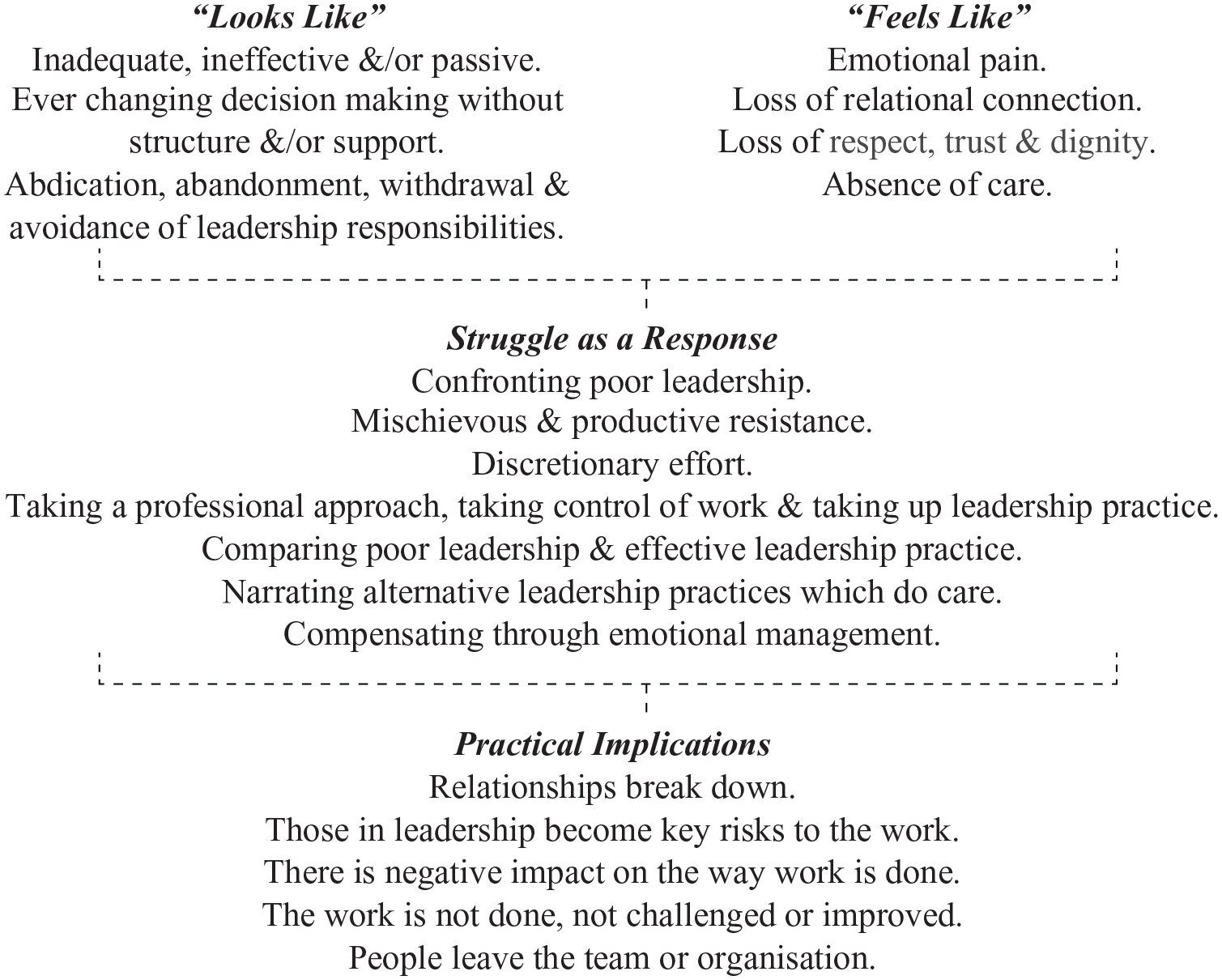
Poor leadership practice.
We advance the theory by extending conceptualisation of poor leadership practice to include ever-changing excessive decision-making without a guiding structure or support (chaos), and lack of care, reflecting the absence of care for relational others; physical and/or psychological withdrawal from others and the workplace and abandoning relational others. We contribute new insights into the material effects of poor leadership practice by empirically illustrating the practical implications and theorising the emotional pain, loss of respect, trust and dignity for those subject to the practice and how, with agency, people resist, bargain with and work around poor leadership practice.
Leadership learner engagement with poor leadership practice
Reflexively, when analysing the data, we discussed how we each ‘educate’ learners about poor leadership practice and realised the lack of empirical, research-based and relatable learning resources. This is a significant gap which motivated us to engage the leadership learners in this research. The study offers new opportunities to examine and learn from relational power dynamics when poor leadership practice is enacted (Lavine et al., 2022) and to provoke discussion about alternative realities of leadership (Collinson and Tourish, 2015). We propose the extended accounts as a rich pedagogic resource for leadership learning with the potential to connect learners to organisational contexts where learning is implemented (Reynolds and Vince, 2020). Bringing the extended accounts of poor leadership practice and its implications into learning spaces offers learners opportunities to hear different voices and not just those ‘in’ leadership (e.g. Schyns et al., 2013; Stead and Elliott, 2009) and addresses criticism that leadership development is ‘divorced from practice’ (Ford and Harding, 2018: 20). As a rich learning resource for those who facilitate leadership learning and development, the accounts can act as a safe-enough (Corlett et al., 2021) learning intervention to unsettle and challenge leadership learning (Reynolds and Vince, 2020). The accounts acknowledge that emotional pain and suffering occur in everyday leadership relations, and how care for relational others in leadership is in short supply when under discursive pressure to prioritise ‘the business’. While being cautious not to romanticise resistance (Carroll and Nicholson, 2014), the accounts highlight alternative ‘effective’ versions of leadership that the participants wished had been practised and reveal how people can respond to poor leadership practice, unsettling glamourised understandings and demonstrating how everyone involved in leadership practice is human and fallible, rather than ‘teaching’ grandiose unachievable exemplars (Ford and Harding, 2007; Ford et al., 2008).
The illustrative excerpts from current leadership learners demonstrate their sensemaking of the accounts and their own experiences and how the extended accounts provoked reflexivity and learning. Their responses demonstrate the potential of the accounts to connect leadership learning to the complexities of emotional, relational and political contexts of leadership (Reynolds and Vince, 2020), facilitate new understandings of experience, reflexively challenge assumptions (Cunliffe, 2002) and connect sensemaking, knowledge and action (Kempster and Stewart, 2010; Raelin, 2009). Therefore, rather than socialising learners into the status quo (Dehler, 2009), significantly the extended accounts have utility for leadership learning in exposing learners to empirical everyday experiences that encourage analysis of leadership relations within situated contexts (Elliott, 2008), explain how ‘our social realities [of leadership practice] and sense of self are relationally created between us’ (Cunliffe, 2016: 750) and provoke reflexive practice for those in leadership (Hibbert, 2024).
The questions we provided to engage learners in this research (Appendix 1) frame the extended accounts as a leadership learning resource for deliberation individually and for group discussions; they consider the context of each account and ask learners to identify poor leadership practice, power dynamics and the implications, and Figure 1 can be used in plenary discussions. We plan to utilise the extended accounts with future leadership learners by, first, inviting them to engage in self-reflexivity by questioning their positionality in relation to the accounts and challenging what they may be taking for granted and, second, facilitating in-class dialogic relational reflexivity (Corlett, 2013), inviting learners to question ‘what others may be taking for granted, what we are seeing, saying and doing . . . and not seeing, saying and doing’ (Cunliffe, 2022: 20), in our leadership practice and relations with others. This has the potential for raising consciousness to and disrupting poor leadership practice.
Researcher reflexivity
In our writing, we have ignored normative expectations of author neutrality and aimed for a relational relationship with readers by making clear our reflexive practices in ‘crafting [what we hope is] an accessible and meaningful text’ (Lehman et al., 2024: 5). We aimed ‘for a dialogical engagement’ (Lehman et al., 2024: 3) with our audience: those who have experienced poor leadership practice; those in leadership; management learning scholars and leadership learners. We aimed to be respectful of ‘those we write about (our subjects of inquiry), those we write for (our audience) and those we write with (our co-authors)’ (Lehman et al., 2024: 22). Following the work of McMurray (2022: 453), we make explicit how ‘research is an engaged and emotional experience that carries ethical responsibilities for others (Cunliffe, 2018) and self (Hubbard et al., 2001)’. Aware of how readers might respond (Lehman et al., 2024), we have outlined our concepts, made visible our processes of knowledge production, including engagement with leadership learners and our emotional and reflexive responses to the data, along with our ongoing questions, and [hopefully] demonstrated respect for stakeholders in the study. In writing reflexively, next we detail the backstage emotional realities of data analysis and theorising as part of researcher reflexivity.
As researchers moving between data and literature, we came to understand our vulnerable reactions as ‘scholarly heartbreak’, in that ‘heartbreak can arise from the data themselves (if they touch us deeply) and through shared experience’ (Whiteman, 2010: 328) and to realise how writing about this ‘is not a common occurrence’ (p. 328). The accounts hurt us in varying ways (Whiteman, 2010), provoking reflexive recall and a return to our own experiences as people in and in receipt of leadership. As people in leadership, we felt vulnerable and visceral guilt and shame, in recognition of ‘walking away’ in our own leadership practice, and deep loss in terms of fractured relationships. As those receiving poor leadership practice, we felt threatened, at risk of harm and insecure, remembering and sharing experiences and feelings similar to the participants; the emotional pain of feeling oppressed, powerless, insignificant, invisible, not recognised, unimportant, losing dignity and humiliated when subject to certain leadership practice.
In the analysis, some of us experienced heartbreak as ‘an interpretive ache’ in that ‘we are inextricably involved and vulnerable’ (Whiteman, 2010: 331). As discussed earlier, our emotional responses to the accounts ‘were a powerful analytic signal’ (Whiteman, 2010: 330) which brought us to the study. This was apparent in how we rehearsed several theoretical frames for the data (including demonising those in leadership). Our scholarly heartbreak then brought us to compassion, in ‘noticing, feeling and responding to [our own and the participants’] suffering’ (Dutton et al., 2006: 60), and we moved to advocacy in wanting these voices to be heard and others to become consciously aware. We propose that our relational and reflexive approach to research and writing has the potential to influence future studies.
Poor leadership practice is not inconsequential. Understanding emotional pain from everyday poor leadership practice is important for people and organisations. Recognising that all harm in leadership cannot be avoided, that people experience poor leadership practice differently and at various points in their personal contexts and careers and, importantly, that those in leadership can easily lapse into these practices assuming they are harmless, there is significant value in talking about and conducting future studies exploring poor leadership practice and its emotional impact. There is more to learn about poor leadership practice in contexts, for example, where people are new to leadership or disengaged from their leadership work and/or where people’s well-being is already tested because of their work (e.g. health and social care, police, fire officers). Chaos from poor leadership practice can have widespread impact and is an intriguing site for research. There are opportunities to further explore the relational dynamics of respect, dignity and trust in poor leadership practice. Future research through a gender and/or intersectional lens is important and including those with minority identities and/or who identify as neurodiverse with diverse emotional processing. Further studies could extend research into agency and resistance to poor leadership practice and explore how ‘suffering at work can be better handled and ultimately reduced or alleviated’ (Kanov, 2021: 87).
As a final note, while writing the article, one author received a message from an academic colleague and friend who was absent from work because of: How leadership is making me feel undermined, undervalued, not trusted, spoken to like shit on a number of occasions and in public, and being made to feel worthless. . . .I can’t just dismiss their behaviour, I take it to heart. They tell me I care too much. I want to know why they don’t care enough.
The resonance of these feelings with our own and those of the participants and in response to particular leadership practice was not lost on us and emphasises the significance of learning more about poor leadership practice, disrupting poor leadership practice and doing better.
Footnotes
Appendix 1
Acknowledgements
We would like to extend our thanks to all participants in the study, both in the public sector and the leadership learners. Thank you to the Associate Editor and the anonymous reviewers, and also to those who gave us previous feedback on the data which nudged us to consider participant experiences in a different way.
Funding
The author(s) received no financial support for the research, authorship, and/or publication of this article.
