




Abstract
This article reassesses agrarian questions by using the ongoing explosion in urban and urbanization theories to explain Jakarta’s urban poor (the Kaum Miskin Kota) as an extended agrarian question. It shows how the two capitalist development trajectories identified by Lenin as the Russian and American paths, or the transformation of feudal large-scale and small landholders into capitalists, respectively, do not apply in Indonesia. In the latter, a “concessionary capitalism” of large-scale land claims and allocations by the state is observed. This specific process produces specific agrarian questions of soil/land and labor through which the urban poor germinated. It closes with a political project, that is, to open more alliance-building possibilities between urban and rural social movements.
Introduction: Urbanization Theory and the Agrarian Question
The re-emergence of socio-spatial theories regarding what is known as “planetary urbanization” (PU) to explain how urbanization processes move the way around the world (see Brenner, 2014) has led to an explosion of conversation among urbanization scholars (Angelo & Goh, 2021; Arboleda, 2016; Brenner, 2018; Buckley & Strauss, 2016; Castriota & Tonucci, 2018; Connolly, 2018; Derickson, 2018; Goonewardena, 2018; Jazeel, 2018; Keil, 2018; Khatam & Haas, 2018; Kipfer, 2018; McLean, 2018; O’Callaghan, 2018; Oswin, 2018; Oswin & Pratt, 2021; Peake et al., 2018; Pratt, 2018; Reddy, 2018; Schmid, 2018; Vegliò, 2021). It is a re-emergence because the main backbone of PU theory is Henri Lefebvre’s (2014[1970], p. 36) old hypothesis that “society has been completely urbanized.” The notion of extended urbanization, one of the triad socio-spatial infrastructures of PU that unidirectionally assumes the countryside as an “operational landscape” for the city, has been used to identify openings to recalibrate agrarian questions (Ghosh & Meer, 2020).
Ghosh and Meer (2020, p. 2) argue that the urban or urbanization question is an “inextricable” part of the agrarian question: “[a]ny thoroughgoing epistemological reformulation of the former,” according to them, “requires sustained dialectical engagement with the latter.” They identify the “then and now” variegated trajectories of the agrarian question into “agrarian question of capital” and “agrarian question of labor.” According to Ghosh and Meer (2020), the agrarian question of capital has its roots in Marx’s own explanation of the emergence of classes in society. The subsumption of the countryside under the rule of town is the point of departure for capital expansion. Marx identifies this process as primitive accumulation with its double edges: the separation of the countryside’s people from land and the transformation of the dispossessed into wage labor. The city’s industrial capital, in this model, extends to the countryside. This model was taken up by Kautsky (1988[1899]) on the agrarian question and Lenin’s work (1972[1908]) on Russian agrarian reform. According to Ghosh and Meer (2020, p. 7), Lenin (1972[1908]) identified two processes from which capital in the countryside unfolds. The first is the Russian path, in which the feudal rural large landholders transformed themselves into agricultural capitalists—constituting a capitalism “form above.” According to Lenin (1972[1908], p. 239), this is a feudal “landlord economy.” The second is American path, in which, with the absence of large feudal landholders, the small landholders competed and became differentiated between themselves for the formation of agricultural capitalists—a capitalism “from below” (Ghosh & Meer, 2020, p. 7). In this second path, according to Lenin (1972[1908], p. 239), “the patriarchal peasant” was transformed into a “bourgeois farmer.”
Ghosh and Meer (2020) engage with the agrarian question of labor through Henry Bernstein’s (2006) claim that the agrarian question of capital is no longer relevant, particularly from the 1970s onwards. According to Bernstein (2006), this happened because the end of predatory landed property due to the rise in land reform programs in the 1970s, state-led developmentalism, and agricultural production. Taking the agrarian question of labor as a gauging device, Ghosh and Meer (2020) identify three openings to recalibrate the agrarian question: the global de-peasantization and de-ruralization since the 1970s, formulated by Araghi (1995) as a labor dimension of extended urbanization; land dispossession through the colossal processes not only led by state and powerful actors but also through the “intimate exclusion” (Li, 2014) between neighbors; and the periodization of the agrarian transformation.
We appreciate Ghosh and Meer’s (2020) call for recalibrating the agrarian question. Yet, we are also aware that every knowledge production has to be “situated” (Haraway, 1988) in a specific political coordinate. Therefore, we aim to situate those openings in the Indonesian context without neglecting that Indonesia is a world’s core site of extraction (Gellert, 2003) and part of the geography of the global capitalist division of labor. From specific Indonesian experiences, we identify two problems in capitalist development trajectories, as explained by Ghosh and Meer (2020). First, capitalist development in Indonesia—the so-called agrarian question of capital—takes neither Russian nor American paths: neither the feudal large-scale landlord path nor that of small-scale landholding entrepreneurs who managed to advance as dominant capitalists (see Habibi, 2021b; White, 2018). Second, nor does it fit Bernstein’s claim on the agrarian question of labor. This is because land reform in Indonesia was abolished (Bachriadi & Wiradi, 2013) in the ideological battle and the move of the newly independent nation-state from a nationalist-left position to one of pro-global capitalism in 1965 (Farid, 2005; Larasati, 2013; Melvin, 2018; Redfren, 2010; Robinson, 2018; Rossa, 2006; Simpson, 2008) and because rice sufficiency as a result of the Green Revolution only worked for around a decade, from 1984 to 1995 (McCarthy, 2013, p. 192).
It is precisely here that we engage with Ghosh and Meer’s argument (2020). First, we re-engage with the “agrarian question of capital” by paying specific attention to how the agrarian question unfolded in Indonesia in the colonial era and continued in the postcolonial era, particularly through large-scale land claims and allocations by the state. We explain this type of capitalist development as “concessionary capitalism.” Second, we engage with the agrarian question of labor by showing that in Indonesia, proletarianization, that is, the transformation of human labor in general into human labor in capital relations, was hindered because of the insufficiency of spaces in the industrial sector to absorb the dispossessed; population became surplus to industrial needs, as per Marx’s “relative surplus population” (RSP). We use RSP to explain the boom of urban poor in “near-South” Indonesia—“near-South” in the sense that its underdevelopment is neither unique to the Global South nor necessarily catching up with the Global North (Simone, 2014). We identify Jakarta’s urban poor as part of “stagnant RSP,” as identified by Marx’s, that is, people who have been expelled from the countryside and become surplus to industrial needs; they acquire irregular jobs and live in precarious urban spaces and are constantly under the threat of urban eviction. The term Kaum Miskin Kota (KMK, urban poor), following Lane (2010), is a specific term in Bahasa Indonesia that describes this group of people. We identify the KMK as an “extended agrarian question,” a rural problem that extends into the city. In other words, we see that Kautsky’s (1988[1899]) agrarian and Engels’ (1887) housing questions are inseparable.
We do not neglect capitalist development by means of agrarian differentiation in rural Indonesia through uneven land access and ownership within villages/communities, as has been eloquently and convincingly elaborated by others (Bachriadi & Wiradi, 2013; Breman & Wiradi, 2004; Hart, 1978; Li, 2014; Pincus, 1996; Rachman, 1999; White, 1977; 2018). However, there is a different way to explain Indonesia’s capitalist development, that is, as concessionary capitalism. The uneven/differentiated land access and ownership works together with the large-scale land concession. Both models exist in Indonesia. We narrate our story of extended agrarian question and concessionary capitalism through theoretical conversations among concession, extractive regime, primitive accumulation, and RSP.
Concessionary Capitalism for the Agrarian Question of Land and Labor
Capitalism is understood here as a system of capital valorization. Marx (1867[1982]; 1885[1978]) conceives the starting point of capital valorization as a process through which capitalists distribute a sum of money to buy both means of production: constant capital and labor power, or variable capital. The former refers to the portion of money used to buy machinery, equipment, and raw materials. The latter refers to the portion of money that is used to pay wage labor and human labor under the capitalist relation. The capitalist, then, runs the production processes to produce commodities in which surplus value, the unpaid portion of the work of wage-labor, is exploited by and for capitalists.
We draw “concession” from Veeser (2013) and Selolwane (1980). Veeser (2013, p. 1136) specifically defines concession as “contracts given by government in less developed states to foreign investors,” either for development projects, such as roads, railways, and telecommunications, or for extractive industries such as oil and mineral mining. Selolwane (1980) views concession as a part of colonization through which European capital penetrated and expanded into the heart of Africa, termed a “colonization by concession.” Studies by Gordon (1982) and Knight (1982) are classics for understanding capitalist development in colonial Indonesia through a specific type of concession, that is, colonial plantations.
Our second theoretical interlocutor in coining “concessionary capitalism” is Gellert’s (2019, p. 2) “extractive regime,” that is, “a sociopolitical formation that relies for its power and longevity on extraction of natural resources wealth as commodities and on the importance of these commodities to the world-system’s core.” Gellert’s (2019) example of an extractive regime is Indonesia’s persistence of natural resources (crude oil, gas, coal, palm oil, paper and paper products, wood products, metals, and tuna and shrimp) extraction, particularly since the New Order regime (1965–1998), with a deep marketization of the state under the neoliberal era.
Gellert (2019) does not make explicit what “extractive” means in terms of capitalist production of surplus value. We explain this through Marx’s (1867[1982]), p. 287) distinctions regarding extractive industries and all other industries that use raw materials:
[w]ith the exception of the extractive industries, such as mining, hunting, fishing (and agricultural, but only in so far as it starts by breaking up virgin soil), where the material for labor is provided directly by nature, all branches of industry deal with raw material, i.e. an object of labour which has already been filtered through labour, which is itself already a product of labour.
Extraction concerns the ways in which capitalists use resources “directly provided by nature,” while “raw material” is an object of wage labor produced through previous work of wage labor. Contextualized in Gellert’s (2019) lens of “extractive regime,” the similarity between extracted and raw material is that both will be used to feed the next round of capitalist production of the world’s core to which the extracted resources from the margin Indonesia has moved. Large-scale land claims and allocations/concessions are the foundation of Gellert’s (2019) extractive regime. Here, the concession meets the extractive regime.
Land, though, in accordance with Marx, is not the only source of wealth; labor is also a source of wealth. Together, land and labor are always central to Marx’s formulation of capital valorization. Under the capitalist system of valorization, the two—land and labor—are one. Land is included as constant capital, and labor is included as variable capital. Marx (1867[1982], p. 683, italics added) closes Chapter 15 of Volume I of Capital, entitled “Machinery and Large-Scale Industry” with this sentence:
[c]apitalist production, therefore, only develops the techniques and the degree of combination of the social process of production by simultaneously undermining the original sources of all wealth—the soil and the worker.
The combination of “the soil and the worker” was unpacked and was more visible towards the end of Volume I of Capital, where Marx discussed primitive accumulation. Before dedicating the entire Chapter 26 to the “The Secret of Primitive Accumulation,” Marx (1867[1982]) signaled its meaning in Chapter 25 on “The General Law of Capitalist Accumulation,” when he explained how capitalist production reduces variable capital and increases constant capital to increase its own productivity. The transition from handicrafts to capitalist industry in which the need for wage labor is reduced, and which forces down wages because of labor abundance, “may be called primitive accumulation [ursprűngliche Akkumulation],” according to Marx (1867[1982], p. 775), “because it is the historical basis, instead of the result, of specifically capitalist production.”
In Chapter 26, he further defines the primitive accumulation of land and labor. Capitalist accumulation is a never-ending process. However, to begin, a preceding condition is required. This preceding condition is assumed as a primitive accumulation, “which precedes capitalist accumulation; an accumulation which is not the result of capitalist mode of production but its point of departure” (Marx 1867[1982], p. 873). This preceding condition can be in the form of soil/land and labor. The secret of primitive accumulation is how to transform and absorb the existing soil/land and population into the logic of capital. To make them both constitute constant and variable capital. Primitive accumulation, therefore, is an act of making “gold out of nothing,” that makes “[g]reat fortunes spr[ing] up like mushrooms in a day” (Marx 1867[1982], p. 917) for the capitalist.
The couple of soil/land and worker continuously appear in Marx’s Capital (1867[1982], p. 915, italics added):
The discovery of gold and silver in America, the extirpation, enslavement and entombment in mines of the indigenous population of that continent, the beginning of the conquest and plunder of India, and the conversion of Africa into a preserve for the commercial hunting of blackskins, are all things which characterize the dawn of the era of capitalist production. These idyllic proceedings are the chief moments of primitive accumulation.
It again appears in the process of colonialization, the last chapter of Volume I of Capital. In a colony, a specific technique of sort of “systematic colonization” is employed through several steps of transforming the existing communally owned soil/land into private property, increasing land price to avoid land ownership by existing populations (both native and migrants), and importing labor from the mother country, while waiting for the existing population to be transformed into wage labor (Marx 1867[1982], pp. 931–940). The entire process of primitive accumulation is made possible under both state and non-state regulatory and/or coercive frameworks.
In a near-South like Indonesia, not all dispossessed are absorbed in factories as wage labor. This is simply because they are surplus to the industrial needs, as has been shown by Batubara et al. (2022) in how the rural dispossessed population of Central Java ended up in the informal settlement of slum areas in the city of Jakarta. Marx (1982[1867], pp. 781–794) explains these people as RSP, which consists of four groups (Marx, 1982[1867], pp. 794–802), namely floating, latent, stagnant, and paupers (for a more systematic organization of Marx’s RSP, see Habibi & Juliawan, 2018). The term “informality” (Bhalla, 2017) has replaced Marx’s concept of RSP. Batubara et al. (2022) identify Jakarta’s urban poor, or the “nonindustrial proletariat,” or the KMK, as they are identified by Lane (2010, pp. 185, 188), who live in the urban informal settlement, the majority of them being workers of the “unregistered, untaxed and generally unregulated” informal economy (Habibi & Juliawan, 2018, p. 4), as nothing more than Marx’s “stagnant” RSP. Their main characteristics are “active labor army, but with extremely irregular employment” (Marx, [1986(1867)], p. 796; quoted in Habibi & Juliawan [2018, p. 4]). Marx’s stagnant RSP or Lane’s KMK basically consists of, among others, people who were compelled to have a rural-to-urban move either temporally, seasonally, or permanently in search for a better life and, therefore, is an extended part of the near-South agrarian question.
We combined these theoretical conversations in order to meet our purposes. Broadly defined, “concessionary capitalism” refers to ways in which capitalist development evolves mainly in natural resource extraction, facilitated by primitive accumulation through large-scale land claims by and for the state, and large-scale land allocations issued by the state, to produce RSP, of which KMK is part. We use this theoretical cross-pollination to explain the extended agrarian question of land and “labor” in Indonesia.
Agrarian Question of Land: Large-scale Concessions Through Primitive Accumulation
Indonesia’s primitive accumulation proceeds through land concessions. Rachman (2013, p. 3) identifies large-scale land claims and allocations through concession for myriad purposes of “production, extraction, and conservation” as the root of “chronic, acute, and systematic” outburst of agrarian conflicts in contemporary Indonesia (see Table 1). Simply put, all the large-scale lands claimed and allocated are not empty spaces. They dispossessed the existing inhabitants, which very often are indigenous people who live from, in, and as a part of those lands. This dispossession works by excluding the existing population from accessing or possessing these lands. In other words, large-scale land claims and allocations destroy the ruang hidup (space for living) of the existing population. This is not specific to the New Order regime of Indonesia (1965–1998) as the way “extractive regime” is conceived by Gellert (2019) but is rooted in the appropriation of forests in colonial Java.
The appropriation of Java’s forest was marked by the penetration of the Dutch East India Company (Vereenigde Ooostindische Compagnie, VOC) into the heart of Java Island in the 1660s. The VOC managed to establish an agreement with the feudal sultanates in Java for forest extraction. In 1776, around 3% of the area in Java was operationalized for teak wood production (Boomgard, 1992, p. 12). This transformed Java’s land into commercial extraction of wood, Java’s people into labor and their buffalos into means of wood transportation. This primitive accumulation through the penetration of the colonial VOC into Java Island by dispossessing land from existing inhabitants and transforming them into labor, therefore, accelerated the class formation in the countryside.
The transformation of the VOC into the Netherlands East Indies state provided space for the latter to set the first forest department in Java in the first decade of the nineteenth century. This was followed by the enactment of the Indisch Staatsblad 96 in 1865 to regulate forest extraction by the state and the right of the state to issue forest concessions. This newly enacted law opened the door for non-state actors to enter Java’s wood extraction through land/forest concessions. From 1865 to 1875, the number of large-scale land concessions for teak extraction increased from 7 to 25, which increased teak production by non-state actors from 43% to 70% of the total Java teak product (Boomgard, 1992).
The Agrarian Law of 1870 and the subsequent agrarian decree (agrarische besluit) 1870/119 declared domainverklaring (domain declaration) in Java and Madura Islands to claim that all land, except land with eigendom claim (privately owned), is state land. The Agrarian Law of 1870 also brought in regulation for erfpacht lease that enabled land concessions to non-state actors for up to 75 years (Djalins, 2012, p. 97), which could be extended according to the need of the user, for example, plantation owner (Tauchid, 2009[1952], p. 54). In the 1930s, under the erfpacht scheme, there were 590,858 ha of land used as big plantations and 11,510 ha for small plantations, only in Java. Together with the non-erfpacht land, according to 1938 national statistics, there were 1,250,706 ha and 1,690,023 ha of plantation in Java and the outer islands, respectively (Tauchid, 2009[1952], pp. 58–59).
Postcolonial claims over land are enforced by the Indonesian nation-state that inherits Dutch domeinverklaring. Control over forests in Java and Madura Islands was ruled through the state-owned forest company of Perhutani, which inherited many branches of the Netherlands East Indies forest offices, together with the knowledge to govern forest. Peluso (1993; 2011) and Vandergeest and Peluso (2006a) have termed this as “political forest,” which is the land governed by the forestry department. In today’s Indonesia, the company of Perhutani controls around 2.5 millions ha of land, within which around 6,381 villages in Java and Madura Islands are fully or partially enclaved (Diantoro, 2011, p. 22; Perhutani, 2019, p. 2).
The enactment of the Basic Forestry Act 5/1967 by the New Order regime gave space to the state to expand the political forest beyond the Java and Madura Islands (Barr, 1998; Gellert, 2003; Vandergeest & Peluso, 2006a, 2006b). In 2018, approximately 63% of the entire land of Indonesia was designated as a political forest by the state (Ministry of Environment and Forestry [MEF], 2018a, p. 7), with around 30,000 villages inside the forest (KPA, 2012, p. 5). The Basic Forestry Act 5/1967 also gives authority to the state to release large-scale land concessions for forest extraction. From 1967 to 1989, an area of 53 million ha was parceled out into 519 land concessions for non-state enterprises (Barr, 1998, p. 6).
Large-scale land allocation is not only specific to the timber sector but also to other sectors, such as dam development, mining, palm oil plantations, and forest conservation. From the colonial era in the early twentieth century until its boom under the New Order regime in 1990, 52 large dams were built in Indonesia (Aditjondro, 1998, pp. 30–31). Only for the development of the most contested Kedung Ombo Dam in Central Java Province in the late 1980s, 25,084 households in 22 villages were sacrificed, and a total of 61 sq. km of land was appropriated (Aditjondro, 1993, pp. 12, 129). In the mining sector, for example, only for two giant mining companies, Freeport McMoRan Copper and Gold in Papua and the giant nickel mining firm of Vale/Inco in Sulawesi, a total of 6.85 million ha of inhabited land was enclosed under the scheme of Kontrak Karya, literally meaning “contract of work,” a specific type of land concession for mining (Sangaji, 2019). 1 In Indonesia, approximately 11.7 million ha of land are occupied by palm oil plantations (KPA, 2017, p. 8). Forest conservation, or Taman Nasional, occupies 27,140,384.04 ha of land, dispersed into 552 parcels/units in the entire Indonesia (MEF, 2018b, pp. 3–6).
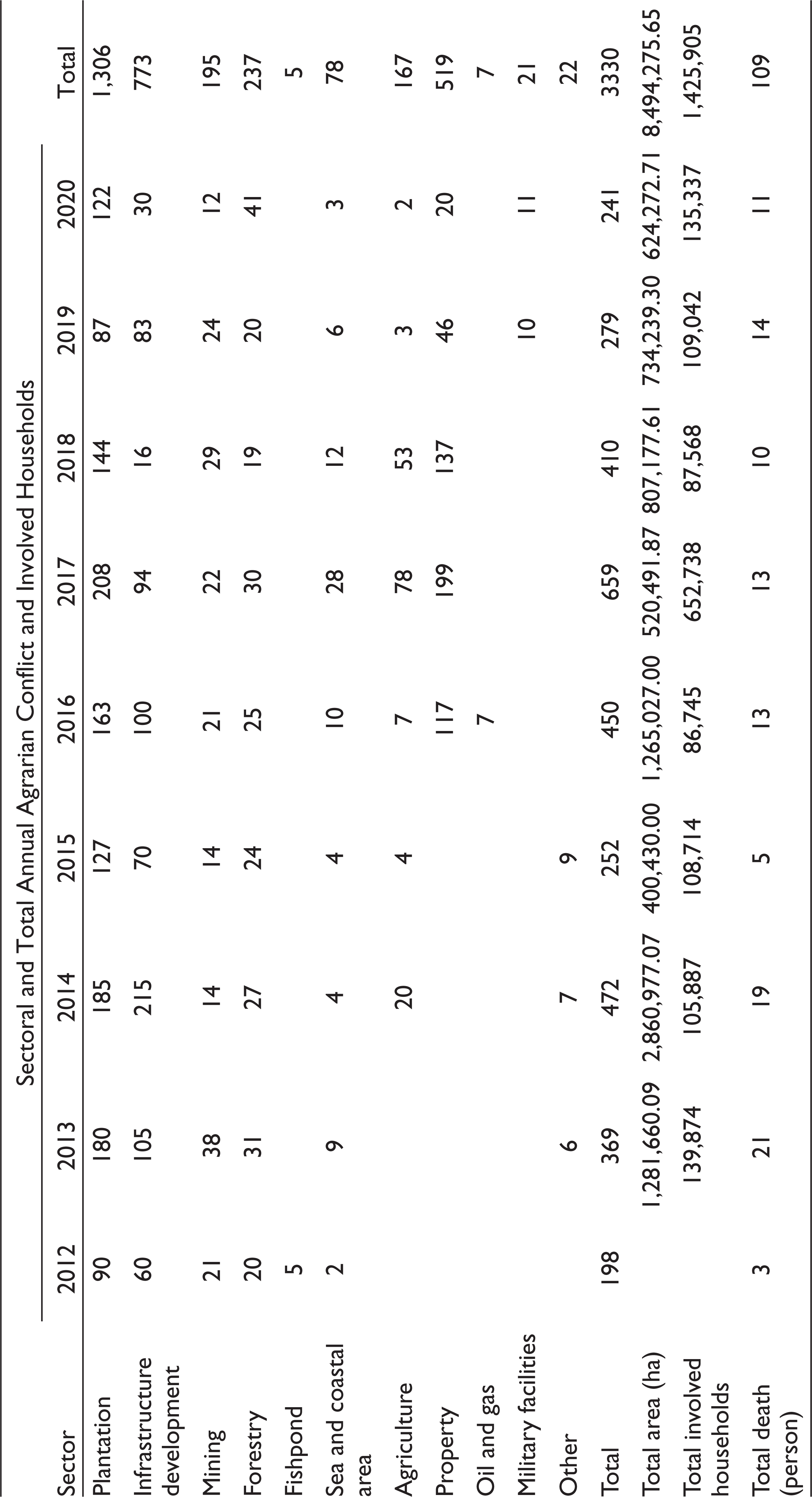
Concessionary capitalism through large-scale land claims and allocations produces agrarian conflicts, as recorded by the Consortium for Agrarian Reform (KPA, Konsorsium Pembaruan Agraria) (Table 1). KPA (2014, p. 9; 2015, p. 3; 2016, p. 4; 2017, p. 5) defines the recorded conflict as konflik agraria struktural (structural agrarian conflict), that is, ‘agrarian conflicts caused by (central and regional) government’s decision, involving myriads of victims and gives rise to various social, economic, and political impacts’ (KPA, 2017, p. 5). KPA sources for agrarian conflict data are the reports from its members—145 organizations throughout Indonesia (KPA, 2017, p. 1)—and network, field assessments, and mass media coverage (KPA, 2013, p. 2; 2014, pp. 9–10; 2015, pp. 3–5; 2016, p. 4). The plantation sector is the one with the greatest contribution to generating this structural agrarian conflict. It is consistently at the top, except in 2014. Most of the plantations in Indonesia are inherited from the colonial era (KPA, 2012, pp. 4–5; 2013, p. 6; 2014, p. 19). This means that colonial primitive accumulation through large-scale land allocation has affected the outburst of postcolonial agrarian conflicts.
Structural Agrarian Conflict
Agrarian Question of Labor: Rural-to-urban Migration
The growth of plantations for export crops in rural areas across Java has expelled or excluded people from their access to, and control of, land and produced poverty. This has given them few options. The one available option is to move to the city. Since the colonial era, rural-to-urban landless or near-landless migrants have inundated the colonial city of Batavia (Abeyasekere, 1989; Kooy & Bakker, 2008, p. 383; Kusno, 2020, p. 2; Leitner & Sheppard, 2018, p. 7; Milone, 1967, p. 250; Putri, 2018, p. 5). The flow of people to cities like Jakarta continues in the postcolonial state (Azuma, 2000; Bachriadi & Lucas, 2001; Breman & Wiradi, 2004; Sheppard, 2006; Hugo, 1982; Kusno, 2011; 2013; Nooteboom, 2019; Papanek, 1975; Temple, 1975; White, 1977; Texier, 2008; Texier-Teixeira & Edelblutte, 2017; van Voorst, 2015; Yarina, 2018). This rural-to-urban migration is a constitutive part of the city’s urban poor (Habibi, 2021a).
In the 1970s, in Jakarta, rural-to-urban migration constituted more than half of the city’s population growth (Papanek, 1975, p. 1; see also Temple, 1975). As summarized by Azuma (2000), one of the consistent factors behind the economic problems in rural areas that motivated rural-to-urban migrants to seek work in Jakarta’s informal sector is the high rate of landlessness in their rural place of origin: 70.6% of the rural-to-urban migrants in 1976 did not have land in their rural place of origin, 73.2% in 1980, and 63.5% and 79.0%, respectively, in 1984—two surveys were conducted in 1984. Other economic factors, such as the search for subsistence food, lack of job opportunities in the place of origin, and better income in cities, have consistently been the driving factors for this rural-to-urban migration for the people who were working in the informal sector (74.4% of the respondents in 1955, 62.8% in 1976, 94.8% in 1979, 65.4% in 1981, 98.1% in 1988–1989, and 78.0% in 1990) (summarized by Azuma, 2000 from several publications).
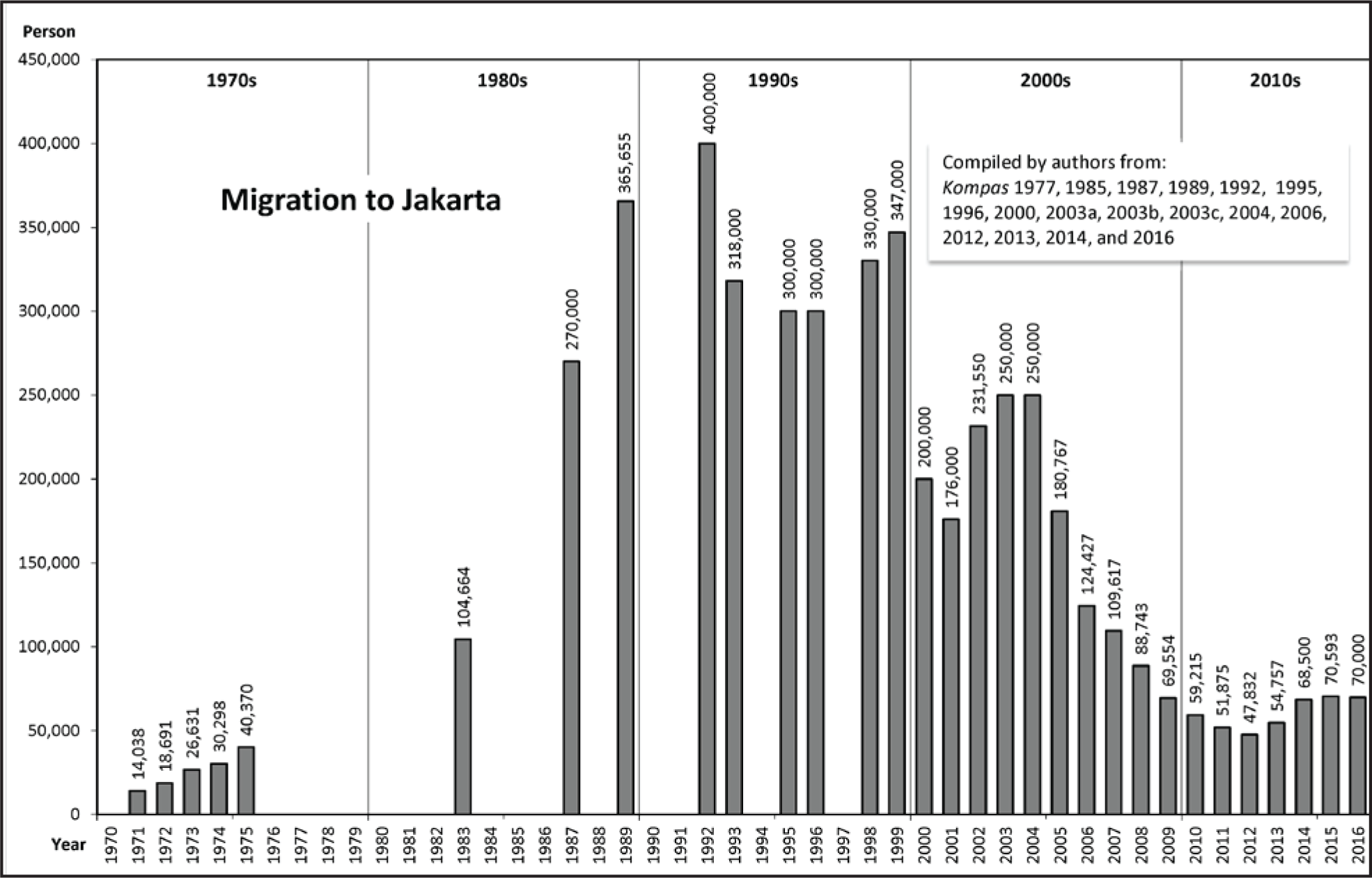
A good indicator of rural-to-urban migration, as provided by Kompas, a Jakarta-based newspaper, is related to Eid, the Muslim religious holiday (Idul Fitri), which is celebrated by returning to one’s location of origin (natal place). The majority of Indonesia’s population is Muslim at 87.2% (BPS, 2014). Every year, people who come from outside Jakarta return to their natal place to celebrate Eid with other members of their family—a return which is called arus mudik, or “flowing home.” After staying in the place of origin for many days, people return to Jakarta, which is known as arus balik, or “flowing back.” Figure 1 shows migration to Jakarta by the difference between arus balik and arus mudik. The difference is due to the fact that people returning to Jakarta bring other family members to look for a better life in the capital city.
Extended Agrarian Question: The Explosion and Eviction of Kaum Miskin Kota
The flow of rural-to-urban migrants has exploded the city’s population. Most of these people are not accepted by the “formal sectors,” like in manufacturing, simply because the number of people exceeds the factories’ demand for labor. The urban informal sector is the only space for them to join. There is much information that connects migrants in Figure 1 to urban informality. For instance, in 1985, the DKI Jakarta Provincial officer mentioned that most migrants jump to (menyerbu) the slum area in the city (Kompas, 1985). In 1996, Kompas (1996) interviewed migrants who said they would work in a construction project in Tangerang, Jakarta’s satellite city. In 2003, Sylviana, the head of the Special Capital Region of (DKI) Jakarta Population and Registration Agency, mentioned that most migrants work in the informal sector like street vendors or housemaids (Kompas, 2003c).
For Jakarta alone, the urban population living in informal settlements is estimated to be between 30% and 60% (Leitner & Sheppard, 2018, p. 2). For Indonesia, the total number of stagnant RSP since the New Order regime, according to a calculation, continuously increased from around 5 million to 9 million to 14 million to 16 million and to 20 million people in 1986, 1996, 2001, 2006, and 2014, respectively (Habibi & Juliawan, 2018). Currently, the Ministry of Public Works and Housing (MPWH, 2016, p. 2) predicts that approximately 29 million Indonesians live in slums. They are, of course, not a single-class entity, but differentiated. Small business activities of “petty commodity producers” (Habibi, 2021a, p. 22) is one of the mechanisms through which class differentiation unfolds among the KMK.
The explosion of the KMK population living in precarious urban spaces meets and confronts the capital intensification of urban spaces through the eviction of urban poor settlements (Leitner & Sheppard, 2018). In Jakarta, the eviction of urban poor settlements has occurred since the colonial era (Gunawan, 2010, pp. 305–361). Contemporary eviction is covered/masked by several reasons. According to Jakarta Legal Aid Institute (LBHJ, 2016a), in the year 2015 alone, there were 131 evictions legitimated by flood management (48 evictions), development of green area or taman kota (8), to clear non-state or state-owned company’s lands/assets (5), development of transportation infrastructure (14), to clear army’s and police’s facilities (4), to implement the provincial regulation about public order (43), and for other public facilities (9).
The evictees of 8,145 households were dispersed across the city into other marginal lands if they could afford to restart lives, excluded from the city’s land, and some were relocated to rusunawa (rumah susun sederhana sewa/low-cost apartment buildings) provided by the government in which they had to pay monthly rent. The government provided no solutions for 63% of the evictions. In terms of income, according to LBHJ’s research (2016b) with 250 respondents during 9–16 April 2016, who were living at 18 rusunawas, 72.8% had an income below DKI Jakarta minimum wage (IDR 3.1 million in 2016). This means that most evictees are the city’s lower class. Moreover, after the relocation, the general trend of their income is decreasing, while their expenditure is increasing because they have to pay for water and rent, and more for transportation and electricity (LBHJ, 2016b, p. 57).
According to LBHJ (2016b), there are two trends among evictees before and after eviction. First, there is an increase in the number of people in the lower-income category. Second, there is a decrease in the number of people in the higher-income category. The overall meaning of these patterns is a further decline in the economic capacity of the urban poor. Eviction can then be seen as a mechanism through which the urban poor are being further marginalized in terms of economic capacity.
Political Project: Opens Possibilities for Alliance-building
In this article, we focus on different types of capitalist development in near-South Indonesia. Starting from primitive accumulation through large-scale land claims and allocations for the purpose of extractive activities by the VOC in the early seventeenth century, sustained and enlarged within postcolonial Indonesia, the state as a political framework has successfully excluded its own population from access to the means of production, pushed them to join the flows of rural-to-urban migration, and transformed them into KMK (Marx’s stagnant RSP) through the development of what we call concessionary capitalism. Of course, we acknowledge that landlessness in the countryside is not the only factor motivating the rural-to-urban migration, and to be a laborer in factories is not the only aspiration of the migrants. The contemporary Indonesian state, ruled by oligarchs, evolved through this process. The change is visible in the last half of the century. The conglomerates under the tutelage of New Order leader Suharto, with so many concessions on their hands (see Robison, 2009[1986]; Robison & Hadiz, 2004), have become patrons for current politicians (Chua, 2008), and hijacked the decision-making process. The enactment of the omnibus bill of job creation (Omnibus Law Cipta Kerja) is a case in point, in which many versions of the draft were crafted by groups of capitalists or their representatives for their own interests (Gebrak, 2020; Talan et al., 2020).
We take a different approach from urbanization scholars (Ghosh & Meer, 2020, p. 2) who have entered the discussion by using the explosion in urbanization theory to develop a “reflective epistemological framework” and identify openings to recalibrate agrarian questions. We benefit from this, but we do so differently. We move from the agrarian side with a specific engagement with the trajectory of capitalist development in Indonesia and the practices of urban land/agrarian reform in Jakarta. For better or worse, the urban land/agrarian reform is being implemented in Indonesia through the scheme of reforma agraria perkotaan (Jakarta’s urban land/agrarian reform) (Guntoro, 2020; Luthfi, 2021; see also the critique of current Indonesia’s land reform program by Li, 2021). This program is motivated by both the massive rural agrarian conflicts and urban eviction, and it helps us to coin and advance the conversation into an extended agrarian question anchored in the specificity of Indonesia’s concessionary capitalism. Even though the way we name it as an “extended agrarian question” somehow reflects our starting point in the countryside, by no means do we aim to put the urban-based movement as a subfield of the agrarian movement.
Through extended form, we see the agrarian question as an inseparable part of the “housing question” (Engels, 1887), the problems of “housing hunger” and “informal workers” (Araghi, 2000, pp. 153–154), and the social reproduction of labor in informal economy households in cities (Gidwani, 2008; Gidwani & Ramamurthy, 2018). Our main purpose is to open more possibilities for connecting rural dispossession and urban eviction. We believe, as it is put articulately by Araghi (2000, pp. 152, 159), that “the substance of the peasant or agrarian question” is “always a programmatic effort to link diverse manifestations of the ongoing progressive social movement” to open more “alliance-building” possibilities between rural-based social movements and their urban counterparts.
Footnotes
Acknowledgements
The authors would like to thank Indonesia Endowment Fund for Education (LPDP) for doctoral scholarship of the first author; University of Amsterdam for providing first author part-time job (NWO project number: W 07.50.1806); Margreet Zwarteveen, Michelle Kooy, and Yves Van Leynseele for years of discussion on this topic; and all participants of our panel in People, Power, Politics, Pandemics, & Other Perils in Southeast Asia 35th Biennial Conference of The Canadian Council for Southeast Asian Studies 21–24 October 2021, in which we presented this article, and in particular, Rita Padawangi (one of panel organizers), for her comments on our draft. The responsibility for the final version stays with us.
Declaration of Conflicting Interests
The authors declared no potential conflicts of interest with respect to the research, authorship, and/or publication of this article.
Funding
Doctoral scholarship of the first author, to which research for this article is part of, is funded by Indonesia Endowment Fund for Education.