




Abstract
In the context of the prevailing global rightward and populist shift, there exists a largely unexplored yet profound nexus between authoritarian neoliberalism and infrastructure-led extended urbanisation beyond the city. Drawing on insights from extensive ethnographic fieldwork conducted along India’s highway corridors, this paper examines the authoritarianism and social fragmentation inherent in the state’s attempts to extend infrastructure-led urbanisation into economically bypassed regions. By exploring the intersections between the construction of recent highway corridors through previously bypassed regions inhabited by marginalised religious and caste groups and the outbreak of state-backed violence, this paper analyses authoritarian urbanism emerging amidst social struggles over enclosure and urbanisation of agrarian land. Specifically, the paper delves in depth into the planning of two recent highway corridors – the Delhi–Mumbai Expressway and the India–Myanmar–Thailand highway – and the escalation of state-sponsored religious conflicts and polarisation in the regions these corridors traverse. This research demonstrates how national-scale infrastructure projects, such as the Bharatmala highway programme, allow for the framing of a national-popular project that selectively incorporates hegemonic socio-religious groups such as certain Hindu caste groups who have reaped the primary benefits of economic liberalisation while disenfranchising marginalised communities. The paper defines authoritarian urbanism as a more-than-neoliberal configuration emerging from a toxic amalgamation of state power, bellicose militarism, infrastructure-led urbanisation and religious nationalism. It concludes that this emerging authoritarian urbanism obscures the neoliberal crises of jobless growth and fails to address the uneven development and social inequalities resulting from infrastructure-led urbanisation.
Introduction
Whether it be Erdogan’s Turkey, Modi’s India, Mohammed bin Salman’s Saudi Arabia or Orban’s Hungary, there has been a resurgence of the infrastructure-led urbanisation model alongside the emergence of a more coercive form of ‘authoritarian neoliberalism’ (Apostolopoulou, 2021; Bruff and Tansel, 2020; Bruff, 2014). Turkey’s massive Canal Istanbul project, which both catalyses a new urban corridor on Istanbul’s peripheries and provides an alternative Mediterranean–Black Sea link (Eldem, 2021), and India’s ambitious Bharatmala (Garland of roads around India) and Sagarmala (Garland of seaports) projects, which aim to challenge the Chinese Belt and Road Initiative (BRI), illustrate this trend of ‘authoritarian worldmaking.’
The recent ‘infrastructure turn’ (Dodson, 2017) has thus not only been driven by a renewed geopolitical rivalry between China and the US (Schindler et al., 2022) but has also been accompanied by ‘a subordination to constitutional and legal rules that are deemed necessary for prosperity to be achieved’ (Bruff, 2014: 116). Under emerging authoritarian neoliberalism, ‘dominant social groups are less interested in neutralising resistance and dissent via concessions and forms of compromise that maintain their hegemony’, favouring instead the shutting down of dissent, religious persecution and the bypassing of democratic institutions (Bruff, 2014: 116; Hendrikse, 2018). There is thus an urgent need to engage with more-than-neoliberal configurations of planning and urbanisation (e.g. Burte and Kamath, 2023; Olt et al., 2024) of which authoritarian urbanism is an important emerging aspect. Engaging with the comparative category of ‘authoritarian urbanism’ (e.g. Can and Fanton Ribeiro da Silva, 2024; Ergenc and Yuksekkaya, 2024), this paper provides an urgent analysis of the transforming role of the state unfolding under authoritarian neoliberalism.
Through engagement with the rich scholarship on extended urbanisation (e.g. Bathla, 2023; Brenner, 2015; Schmid and Topalović, 2023), this paper focuses on exploring the emergence of authoritarian urbanism beyond the city, particularly through an analysis of the Indian context. In recent years, India has witnessed the emergence of a more coercive form of neoliberalism, manifesting through a massive rise in state-backed violence, home demolitions, and religious polarisation, coinciding spatially with the rationalisation of its agrarian countryside through infrastructure-led extended urbanisation (e.g. Bathla, 2023; Brenner, 2015; Schmid and Topalović, 2023). For instance, in May 2023, violent ethnic clashes broke out between the valley-dwelling, largely Hindu Meitei communities, and the forest-dwelling Christian Kuki tribal communities in the Indian borderland region of Manipur, neighbouring Myanmar. As detailed later in this paper, this violence coincided with the state’s efforts to construct the India–Myanmar–Thailand (IMT) Highway corridor as part of the Bharatmala highway programme through Manipur to boost connectivity with Southeast Asia and open new frontiers for urban land speculation (Kimura et al., 2020; Naing et al., 2019). The conflict was sparked by an unsolicited move by the state to grant the Hindu Meitei communities from Imphal valley the privileges to acquire land in Manipur’s forested hills inhabited by the Christian Kuki and other Adivasi (tribal) communities (Donthi, 2023). The violence, which continues unabated at the time of this paper’s drafting, has been driven by neoliberalism’s authoritarian tendencies, under which the state has backed the Hindu Meitei communities in its development projects while disenfranchising the Kuki communities using overt forms of violence and socio-religious polarisation (Hangsing and Tonsing, 2023).
Far from the Indian borderlands, closer to India’s capital city Delhi, a similar intersection between infrastructure-led extended urbanisation, religious polarisation, and authoritarian neoliberalism has been unfolding. In July 2023, communal violence broke out in the Nuh district of the Mewat region, adjacent to the ‘millennium city’ of Gurgaon in the Delhi National Capital Region (NCR). As described in further detail later in this paper, the Muslim-majority Nuh district has suffered chronic underdevelopment despite being located adjacent to the districts of Gurgaon and Faridabad, which have witnessed some of the most spectacular urbanisation across India in the last two decades (see for e.g. Bathla, 2022a; Cowan, 2023; Gururani and Dasgupta, 2018; Searle, 2016). While the recent construction of the National Expressway 4 (NE4) corridor between Delhi and Mumbai passing through Nuh was described as a gamechanger for the region’s development (Tiwari, 2023), it coincided with the breakout of extensive state-backed religious violence against Muslims with the participation of hegemonic Hindu landowners from neighbouring districts. Similar intersections between infrastructure-led extended urbanisation, religious polarisation and authoritarian neoliberalism have simultaneously been underway in other regions across India such as in Uttar Pradesh and Uttarakhand (see Trivedi and Singh, 2022).
Rather than bringing the promised prosperity and development, the extension of infrastructure-led urbanisation through these previously bypassed territories has unleashed the wrecking-ball of home demolitions in its wake (see also Apostolopoulou, 2021). Furthermore, the state has overtly sided with communities along religious and caste lines to either incorporate or disenfranchise them in its development projects. This marks the emergence of a new phase of neoliberal urbanisation characterised by a violent opening of urban property frontiers in previously bypassed regions of the country inhabited by religious minorities and marginalised caste groups. While polarisation and the uneven incorporation of communities based on their socio-religious affiliations are emerging as major features of this latest phase of neoliberal urbanisation, these dynamics are also becoming sites of popular struggle. I propose exploring this emerging intersection between infrastructure-led extended urbanisation and authoritarian neoliberalism through the incipient theorisation of authoritarian urbanism (see also Apostolopoulou, 2021). In doing so, I deploy Jessop’s (2007) strategic relational approach to understanding the state as a social relation in which certain groups are selectively incorporated (see also Poulantzas, 2001). Further, I glean the rich scholarship on authoritarian neoliberalisation that has emerged in India in the recent years (e.g. Chacko, 2018; Sud, 2022). Through this analysis, the paper defines authoritarian urbanism as a more-than-neoliberal configuration emerging from a toxic amalgamation of state power, bellicose militarism, infrastructure-led urbanisation, and religious nationalism. It concludes that this emerging authoritarian urbanism obscures the neoliberal crises of jobless growth and fails to address the uneven development and social inequalities resulting from infrastructure-led urbanisation.
The paper draws upon extensive ethnographic fieldwork conducted along highway corridors in India since 2017, particularly in the Mewat region, and upon remotely conducted online interviews and secondary literature for Manipur. The choice of online interviews for Manipur was driven by the physical inaccessibility imposed by the ongoing conflict in the region. In total, I conducted about 15 semi-structured expert interviews each for the cases of Mewat and Manipur to understand the planning of the highway corridors through the region and changes in land markets brought about by their construction. These interviews were conducted with local bureaucrats, planners and community members. Further, I conducted participant observation at highway launch events, land revenue offices, community congregations, and consultation events. Additionally, I analysed government documents, planning proposals, reports by civil society groups and legal proceedings of court cases, and conducted cartographic analysis of the two regions. This paper builds upon the analysis of this data. In the following sections, I will survey important literature on authoritarian urbanism and extended urbanisation. I will then analyse and periodise infrastructure-led extended urbanisation in India to identify points of departure and trace political economic shifts in the trajectory of infrastructure-led urbanisation in recent decades. Finally, I will engage in a comparative analysis of the two case studies of IMT and NE4 highway corridors to explore how authoritarian urbanism unfolds beyond the city. The paper concludes with notes on identifying incompletion within the fabric of authoritarian urbanism and possible reversals through slippages within this model.
Authoritarian urbanism and extended urbanisation
‘Every crisis produces its own city’ (Di Giovanni, 2017), much like how the capitalist mode of production subordinates everything to its operations, extending itself over the entirety of space (Lefebvre, 1976 [1973]: 38). In recent years, a growing body of scholarship under the ‘authoritarian urbanism’ framework (e.g. Ergenc and Yuksekkaya, 2024; Koch, 2022) has sought to spatialise the evolving dynamics of neoliberalism. As a spatially selective political strategy, neoliberalism’s contextually specific strategies not only exacerbate regulatory failures (Brenner and Theodore, 2005) but increasingly subordinate constitutional and legal norms to the imperatives of economic growth (see Bruff, 2014: 116).
Authoritarian neoliberalism and its corollary authoritarian urbanism, represent one of several configurations that such more-than-neoliberal planning and urbanisation practices can assume (e.g. Burte and Kamath, 2023; Olt et al., 2024). A novel aspect of this theorisation is its operability beyond the often-naturalised divide between authoritarian and democratic states (Koch, 2022). This analytical approach is primarily motivated by the understanding of authoritarianism as an organised power embedded in the institutional structure of the state, which covertly exists until its overt manifestation, contingent upon the presence or absence of formal democratic structures (Jalal, 1995: 3). Moving beyond this binary highlights the situated ways in which authoritarianism unfolds, affecting lives unevenly (Koch, 2022: 2).
The theorisation of authoritarian urbanism broadens the scope of critical urban studies, moving beyond a narrow focus on the state’s economic motivations under neoliberal urbanisation. It also incorporates the state’s role in reinforcing and legitimising social inequalities based on religion, race and caste (see Kimari and Ernstson, 2020). This is an important and urgent theorisation to which this paper seeks to contribute by offering comparative experiences from India.
One of the ways through which authoritarian urbanism has unfolded in recent decades is through the recentralisation of the state as a consequence of the 2008 global financial crisis (GFC). In their analysis of post-crisis Turkey, Ergenc and Yuksekkaya (2024) highlight how the recentralisation of the state in the wake of the 2008 GFC was driven by the need for fast and centralised decision-making to enable urban financialisation. According to the authors, this ‘has undermined the power and participation of the city council members in the general assembly’ (Ergenc and Yuksekkaya, 2024: 411). This authoritarian urbanism through recentralisation often manifests in the form of ‘crazy megaprojects’ (Di Giovanni, 2017) in the city, such as the contested transformation of Gezi Park in Istanbul and the ‘Central Vista’ redevelopment in Delhi. Beyond these grand architectural gestures, as Rugkhapan (2022: 130, 133) notes in his analysis of Bangkok, authoritarian urbanism can also unfold through the targeted use of micro-level urban planning instruments and tools of governance such as building codes, ordinances and zoning law.
While opening the analysis of urbanisation within the context-specific, yet evolving neoliberalism, the current theorisation of authoritarian urbanism suffers from two key gaps. The first of these gaps relate to the city-centric conceptualisation of urbanisation within authoritarian urbanism, and the second to the static conceptualisation of the state itself.
Firstly, while emerging theories on authoritarian urbanism capture the evolving nature of cities under ‘authoritarian neoliberalism’ (Bruff, 2014), they have yet to address a crucial feature of 21st-century neoliberal urbanisation: the unprecedented expansion of urbanisation beyond the city. Conversely, the ‘extended urbanisation’ framework (Brenner, 2015, see also Schmid and Topalović, 2023), while addressing this urban extension and being attendant to its dialectical entanglement with ‘concentrated urbanisation’ of cities, remains largely indifferent to the increasingly authoritarian dynamics within neoliberalism itself. As Brenner (2015: 167) highlight, extended urbanisation is a multifarious phenomenon, involving the metabolic operationalisation of territories to support the everyday activities and socio-economic dynamics of urban life and the ongoing construction and extension of physical infrastructures such as highway corridors, as well as the enclosure of land from established social uses to profit-oriented modes.
Recent scholarship on extended urbanisation employing ethnographic analysis has focussed on how urbanisation is locally constituted alongside communities inhabiting territories of extended urbanisation, thus expanding the concept’s usefulness beyond narrow analyses of state processes and economic factors (e.g. Castriota, 2023; Katsikis, 2023; Markaki, 2023). However, these analyses still engage only minimally with the more-than-neoliberal configurations unfolding on the ground, such as under authoritarian neoliberalism. The engagement between authoritarian urbanism and extended urbanisation attempted in this paper can thus be mutually generative, allowing the former to overcome its city-centred bias and the latter to gain nuance on processes of state making through engagement with the more-than-neoliberal configurations unfolding on the ground.
Secondly, the analysis of authoritarian urbanism needs to transcend the society–state binary that has currently characterises its analysis. Following Jessop (2007: 1) strategic relational approach, the state should be understood as a broader ensemble of social relations rather than as a subject. ‘The state is thus constituted of: modes of political representation, institutional articulation and intervention; a hegemonic bloc, encompassing the power bloc and their supporting classes, alliances or social forces; a state project; and a hegemonic vision’ (Chacko, 2018: 544). However, despite efforts to move beyond the authoritarian–democratic state binary, analyses of authoritarian urbanism have largely focussed on the so-called Global South. This perspective, however, can also illuminate the rapid transformations occurring in Western democracies, which have so far been excluded from the analysis of authoritarian urbanism.
This paper aims to contribute to the growing theorisation of authoritarian and more-than-neoliberal forms of urbanism by discussing the case of infrastructure-led extended urbanisation unfolding amidst ascendant authoritarian neoliberalism in India. It examines how, in parallel with classic megaprojects that entail centralisation and unconstitutional evictions of marginalised communities (e.g. Bhan, 2016; Ghertner, 2015), another key aspect of more-than-neoliberalism in India is the infrastructure-led urbanisation of agrarian hinterlands beyond the city, accompanied by processes of authoritarian state-making. This model of infrastructure-led development is multiscalar, occurring on the peripheries of existing cities as peripheral and bypass highway corridors, and as regional intercity and even transnational urban corridors. In this model, the state selectively includes certain political groups while marginalising others through violence and the threat of home demolitions, thus naturalising the inequalities of neoliberalism based on religion, caste, and ethnicity. In the following section, I attempt to periodise the political–economic shifts that have shaped this model of infrastructure-led urbanisation over recent decades, situating it within recent scholarship on authoritarian neoliberalism.
Infrastructure-led extended urbanisation and the rise of authoritarian urbanism
While launching the Bharatmala (Garland of roads) highway programme in 2019, Minister of Road Transport and Highways Nitin Gadkari emphasised the importance of infrastructure-led development in his government’s ambition to transform India into a USD 5 trillion economy. Gadkari noted that the Bhartiya Janta Party-led (BJP) National Democratic Alliance (NDA) government had laid the foundations of this infrastructure-led growth model when they first came to power in 1999, amidst the Asian Financial Crisis. 1 He claimed that this approach allowed his predecessors in the NDA-I government to stimulate growth by opening agricultural land to international capital investments.
The policies of the right-wing, free-market driven, Hindu-nationalist NDA-I government appeared contradictory on the surface. They combined a hyper-nationalist and openly Hindu political stance with a vision for a world-class infrastructure state, modelled explicitly after the US Interstate system. The first phase of this infrastructure-led urbanisation, known as the Golden Quadrilateral, connected four major metropolitan cities in the North, South, East and West of India with ‘world-class highways’. The daily rate of highway construction became a key metric for promoting neoliberal economic growth during this period, serving as a cornerstone of the government’s ‘India Shining’ campaign for a ‘New India’ (see Kaur, 2016).
This rapid infrastructure construction was largely facilitated by centralisation of large-scale territorial transformation through parastatal organisations such as the National Highways Authority of India (NHAI). These hybrid public–commercial entities allowed the state bureaucracy to engage in private enterprise and incorporate market values (see Balakrishnan, 2013; Bowman, 2020). While these parastatals centralised control over agrarian land, bypassing local revenue departments and democratic accountability, they often relied on local bureaucrats and hegemonic caste groups to mediate land acquisition and avoid conflicts (Balakrishnan, 2013: 789). Consequently, these highway corridors inherited the geography of uneven agrarian capitalism, following the arc of fertile agrarian regions modernised under the Green Revolution (Balakrishnan, 2019a: 619; Bathla, 2023: 352). This widened regional disparities across India, selectively benefitting hegemonic Hindu caste groups such as the Gujjars and Jats in Delhi NCR and the Vokkaligas in Bangalore–Mysore, who emerged as middle-class rentier capitalist ‘investor-citizens’ (Cowan, 2018; Levien, 2012).
However, this infrastructure-led urbanisation model failed to resonate with India’s largely poor majorities, who suffered from reduced welfare programmes and were excluded from this development model. This led to a political shift towards the centre-left Congress party-led United Progressive Alliance (UPA) in 2004.
Under the UPA-I & -II regimes, there was a continuation of infrastructure-led development, but the rate of construction plateaued. The focus shifted to introducing safety nets to mitigate the negative impacts of pro-market policies (Chacko, 2018: 550). While the UPA consolidated existing urban corridors, such as through the launch of the Delhi–Mumbai Industrial Corridor (DMIC) in 2008, it also introduced new welfare schemes as part of its ‘inclusive growth’ model. However, the implementation of these schemes was uneven, and the regime was marred by scandals, leading to increased popularity of the ‘Gujarat–Modi’ model from the home state of current Prime Minister Narendra Modi. This model promised private sector-driven growth, high economic growth rates, business-friendly policies, foreign investment, urbanisation and industrial development (Chacko, 2018: 543), and was seen as an antidote to the corruption-ridden inclusive growth model.
Sud (2022: 119) highlights that the real existing ‘Gujarat Model’ on the ground was exclusionary, thriving on discontent and even hatred towards perceived ‘others’, including religious minorities and dissenters. While it promised high growth, this model left little for social services, resulting in high polarisation and continued impoverishment among vulnerable groups such as Muslims, Dalits, and Adivasis (Chacko, 2018: 557). Sud (2022: 119) argues that the authoritarianism in this model is characterised by a close alliance between the state and big capital. In the 2014 election, the BJP successfully campaigned on a promise to scale the Gujarat Model nationally. Sud (2022: 106) finds that under neoliberalisation, the crises of welfare and politics were addressed in ways that further centralised state power in executive, non-democratic decision-making, leading to an even more authoritarian era under Modi’s strongman, populist rule.
The re-election of the BJP-led NDA-II government in 2014 allowed for a scaling up of the ‘Gujarat–Modi’ model and a resumption of the infrastructure-led urbanisation model. This new phase was marked by an exponential increase in the pace of construction, bypassing infrastructure corridors built just a decade earlier. According to the Ministry of Road Transport and Highways (MoRTH), the daily highway construction rate jumped from 3 km in 2013 to 12 km in 2014, reaching 31 km by 2020 (MoRTH and NHAI, 2018).
Gadkari claimed that passing these new highway corridors through ‘backward and tribal areas’ would open new frontiers for capital investment into ‘cheap agrarian land’ and bring development to these regions. The ongoing Bharatmala highways programme aims to valorise the uneven development produced in previous cycles of neoliberal highway urbanisation. A total of 100 new urban corridors (44 primary and 56 inter-economic corridors) spanning 34,600 km have been proposed (see Figure 1). These new corridors often run parallel to existing highways through territories bypassed in previous development cycles. An example is the NE4 highway corridor planned between Delhi and Mumbai, parallel to the National Highway 48, constructed as part of the Golden Quadrilateral project two decades ago. Instead of benefitting the communities through whose land these corridors pass, middle-class rentier capitalists from previous infrastructure development cycles benefit from speculative land markets. These rentier capitalists become part of the state-making process, facilitating land acquisitions for financial gains, while the state explicitly supports these hegemonic groups through extralegal means.
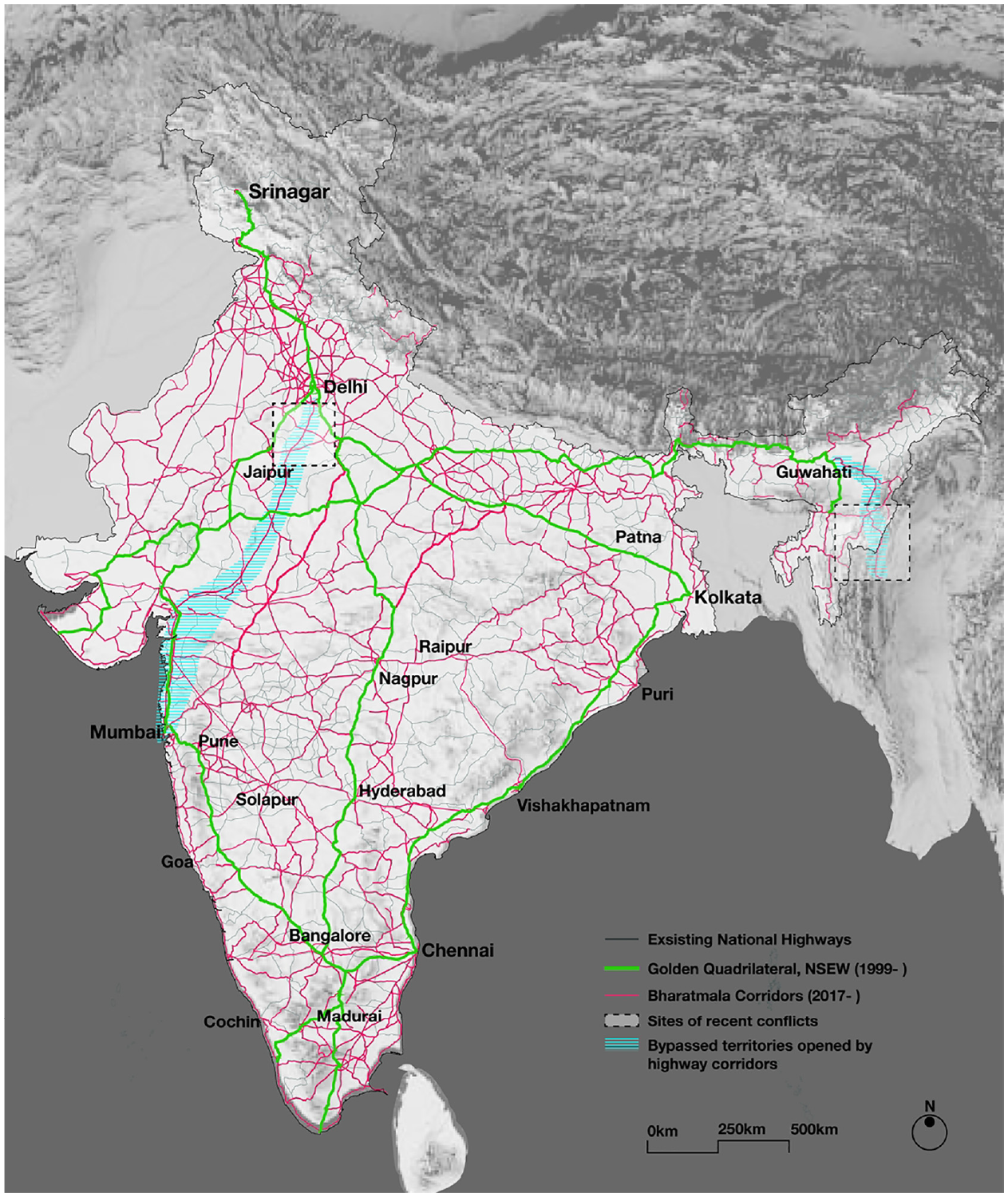
A map describing the different phases of India’s neoliberal highway programme. Source: The author.
State-led infrastructure construction, promoted as a quick fix for development, has instead exacerbated existing inequalities from previous developmental cycles (Balakrishnan, 2019b; Bathla, 2022b, 2023). This is concerning as Gadkari aims to triple the highway construction rate to 100 km per day by 2025 to achieve a USD 5 trillion economy (PTI, 2019). The persistent disconnect between capital and labour has given rise to urban governance regimes focussed on transforming territory rather than improving populations (Schindler, 2017: 52). Instead of creating industrial jobs for displaced peasantry, the infrastructure-led urbanisation model aims for economic growth through land market investments. As Priya Chacko highlights, such ‘jobless growth’, cuts to public spending, and informal sector growth weaken existing modes of political incorporation, leading to authoritarian statism (Chacko, 2018: 543).
In the face of jobless growth, the infrastructure-led growth model catalyses real estate and rental markets, creating a rentier class of entrepreneurs from land and property-owning peasants (Balakrishnan, 2019b; Cowan, 2018; Levien, 2012). Entry into this rentier class is conditioned by existing inequities of land ownership, caste, religion and ethnicity. This urbanism recombines existing feudal relations and inequalities into a new urban fabric, which should be understood as authoritarian urbanism (see Balakrishnan, 2019a). This recombinant authoritarian urbanism is characterised by ‘intensified state control over every sphere of socio-economic life combined with radical decline of institutions of political democracy and draconian and multiform curtailment of so-called formal liberties’ (Poulantzas, 2001: 203). Additionally, this involves articulating ‘a national-popular project to secure the political, intellectual and moral leadership of the dominant class(es)’ and castes (Jessop, 2007: 12). I will examine the emergence of authoritarian urbanism within this national-popular project in the subsequent section.
Infrastructure and the national-popular project
Concomitant with the bipolar geopolitical–economic competition between China and the US (Schindler et al., 2022), the ongoing infrastructure push is also being shaped by locally constituted and differentiated projects of authoritarian worldmaking. Recently, a mural of Akhand Bharat (Greater India) installed in the newly inaugurated Indian parliament building attracted much controversy and condemnation from India’s neighbouring countries (Kallol, 2023). The mural cartographically depicted the South Asian subcontinent imagined as a glorified, Hindu ‘Ancient India’, alongside an assemblage of anachronistic objects from various time periods of South Asian history. While the controversy over the mural can be dismissed as an act of cartographic aggression between India and its neighbours, reimagining India’s ancient geography as a glorified Hindu Bharat has served an important role in framing infrastructure-led extended urbanisation as a national-popular project. This geographical imaginary, as I will explore in this section, has galvanised support and national purpose around the Bharatmala infrastructure programme, framing it as a means to invent an imagined Hindu past and connect it with the exclusionary and communally divisive present unfolding under infrastructure-led extended urbanisation.
Historically, state-led infrastructure construction not only opened access to previously unconnected and under-connected territories but also allowed the production of state space (Brenner, 2004; Goswami, 2010; Lefebvre, 2009). This was crucial for exercising national sovereignty over space while producing ideas of national identity, citizenship, landscape and belonging, as exemplified by national-popular projects such as the German Autobahn system (Zeller, 2007), the Italian Autostrada (Moraglio, 2017) and the US Interstate (Rose and Mohl, 2012). In her book ‘Producing India’, Goswami (2010) highlights how the construction of railways was crucial to the production of colonial ‘state space’. However, Hindu right-wing historians such as Shiva Prasad co-opted the colonial state space, ideologically remodelling its territorial boundaries into a distinctly bounded geographical and historical national space referred to as Bharat (Goswami, 2010: 172 and 176). This nation space, imagined as a mother goddess, Bharat Mata‘served as a boundary marker for the spiritually inviolability of the organic (Hindu) core of the nation, visually embodying a natural-cultural purity’ (Goswami, 2010: 182, 201). While the imagined space of Bharat Mata is exercised symbolically in sites such as the temple of Mother India in Varanasi (Figure 2, see also Ramaswamy, 2010), infrastructure-led urbanisation allows the BJP to assert Bharat as a nationalist chronotope, 2 exercising historic continuities between an imagined Hindu past and a Hindu future of ‘New India.’
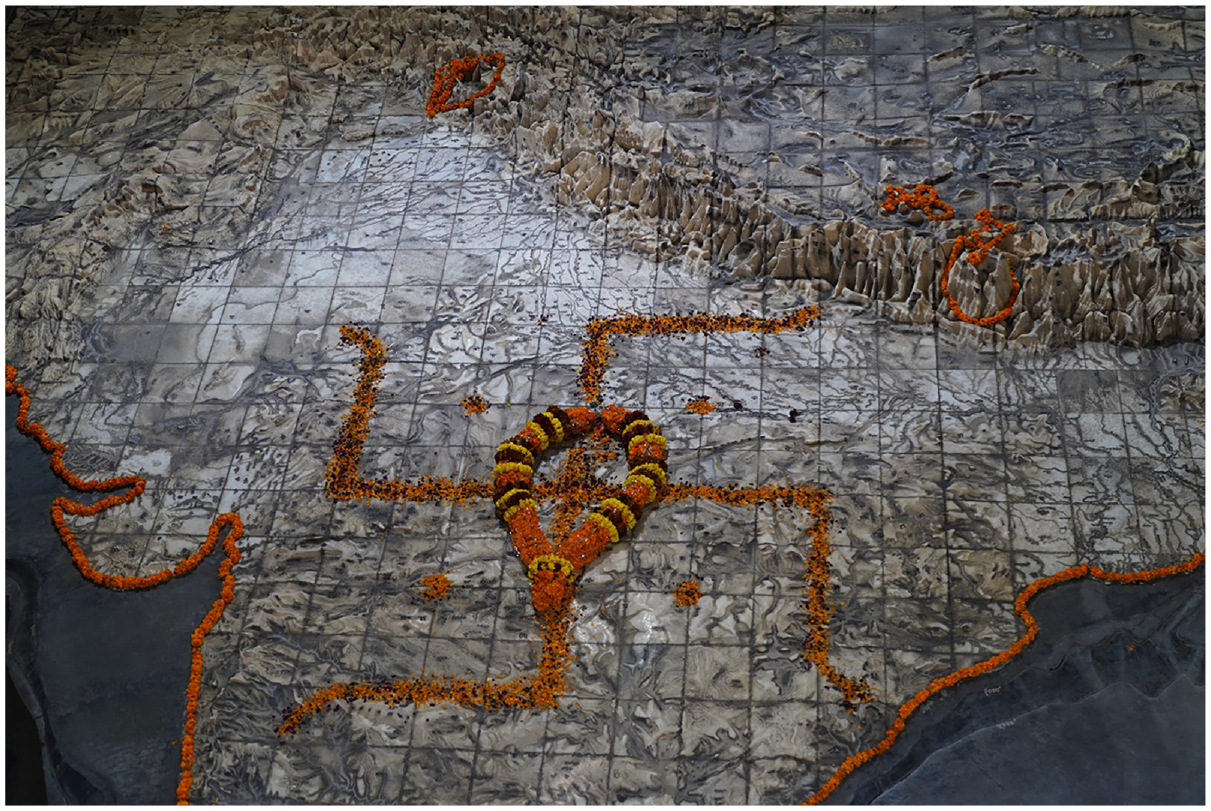
A relief map of Akhand Bharat (Greater India) in the sanctum of Bharat Mata (Mother India) temple in Varanasi. This photo was taken by the author on the Indian Republic Day celebrated on 26 January 2023. Note how territorial conquests in Jammu and Kashmir and territorial disputes with China in north-eastern India have been garlanded. Sites like these are important for the production of national space.
Founded by right-wing revolutionaries inspired by global authoritarian and racist movements and regimes (Motadel, 2019), the BJP’s developmental vision has been guided by the ideology of ‘integral humanism’. It advocated against the secularist and interventionist role of the state, instead favouring liberal free-market economy combined with an imaginary of the state based on Hindu traditionalist philosophy of Dharma (Chacko, 2019: 387). Infrastructure finance and development have provided a successful mechanism for the implementation and promulgation of integral humanism (Gadkari and Sinha, 2014; Simpson, 2022: 160), and have been exercised in intersection with the nation space chronotope of Bharat, allowing the extension of state-making to peripheral territories and enacting a politics under which certain dominant castes of Hindus are considered legitimate citizens while others are not (Bathla, 2023: 357; Simpson, 2022: 162). Moreover, the urban middle classes have been lured into this national-popular project through financial incentives such as the NHAI Infra Trust (InvIT) bonds that offer the middle-class a lucrative 8.5% rate of interest (Agarwal, 2023). In fact, the naming of the current highway programme as Bharatmala (Garland of roads around Mother India) foremost attempts to connect India’s infrastructural future with its imagined Hindu glorious past, thereby imparting a nationalist purpose and meaning to the encompassing project.
Today, this national-popular project manifests as ‘banal nationalism’ (Skey, 2009) pervading urban everyday life in India, ranging from the display of national flags and symbols in public spaces to exert citizenship to an outright splintering of the civil society that pits social classes and religious groups against each other, categorising them as pro- or anti-national. Specifically, dominant Hindu caste groups that have benefitted from neoliberal urbanisation have identified with this national-popular project, pitted against a university-educated, English-speaking left-liberal secular elite that is presented as ‘anti-national’ and standing in the way of development (Chacko, 2018: 557). The following two sections offer situated accounts on how the authoritarian nationalism project and infrastructure-led extended urbanisation have amalgamated.
A view on authoritarian urbanism from the agrarian periphery
Shortly after the start of the newly constructed Delhi Mumbai Expressway, also known as National Expressway (NE4), the glistening glass skyscrapers of Gurgaon give way to the lush agricultural fields of Nuh district. Being a Muslim-majority district located in the Mewat region just south of Delhi, Nuh has been bypassed by multiple cycles of urbanisation until recently. Sandwiched between the rapidly urbanising corridor of Gurgaon and Faridabad, the region is pockmarked with quarries that supplied material aggregates necessary for concrete construction in neighbouring districts. Nuh is often described as the dark underbelly of Delhi NCR, underdeveloped despite being adjacent to sprawling urbanisation. To divert attention from the material conditions driving its underdevelopment, the blame is often falsely attributed to its Meo-Muslim inhabitants, who are further marginalised under labels like ‘infiltrators’ and ‘illegal citizens’. Contrarily, as highlighted by historian Mayaram (2004), the communities inhabiting Mewat have historically evaded the practices of state-making.
Exit Number 1, located at the halfway mark along NE4’s 65 km stretch through Nuh district, leads to the small town of Ferozpur Zikra. The local roads crisscrossing Ferozpur Zikra, which used to be lined with signboards of building aggregate suppliers, now advertise the buying and selling of agricultural land. ‘Market garam hain’ (the market is hot), informs Aslam (name changed), a land broker in Nuh, during an interview at his office near the revenue office of Ferozpur Zikra. During our conversation, Aslam added: The average price of agricultural land in the district has increased fourfold since the announcement of NE4 in 2019. Yet, the land price is only a fraction of the price compared the neighbouring districts of Gurgaon and Faridabad. While people are making money from the sale of land, there are few opportunities for investment or finding jobs in Nuh.
Despite promises that NE4 would change the face of the district by bringing industry and jobs, little has changed. The highway corridor has brought further immiseration in the region. Aside from the planning of the expressway and the widening of the old Gurgaon–Alwar Road passing through Nuh, no other industrial clusters or townships have been planned. What is unfolding instead, observes Aslam, is a change in the landownership structure of Nuh. Large landowners belonging to the hegemonic Hindu Gujjar and Jat castes in neighbouring district have been aggregating large tracts of agrarian land in Nuh, speculating on potential future developments in the region.
Not only have people from the district failed to gain meaningful employment from the highway development and consequent land speculation, but traditional employment sectors such as slaughterhouses have come under increasing marginalisation due to the politicisation of meat consumption in India in recent years. In 2017, a Muslim man from Nuh was lynched by cow vigilantes in Rajasthan on the mere suspicion of transporting beef. This has led to a climate of fear and the shrinking of the meat industry in Nuh. Furthermore, environmental regulations over mining in Delhi NCR have led to a further loss of job and economic opportunities (Bathla, 2024a). Unemployment is especially acute among the youth in Nuh, who feel marginalised by the ongoing urbanisation in the region. The expressway has instead facilitated a ‘space–time compression’ (Harvey, 1990) for rich Hindu landowners from dominant caste groups in Gurgaon. The distance between Gurgaon and Nuh, which used to take 30–45 minutes on difficult roads, now takes a mere 10 minutes. Large SUVs belonging to Hindu landowners, featuring stickers of right-wing Hindu organisations and political parties, are frequently spotted in the region. Extremely large farmhouses owned by Hindu landowners from Gurgaon dot the landscape.
Mukesh (name changed) is one of the several landowners I became acquainted with during the research. In 2004, Mukesh received compensation for the acquisition of his agricultural land for the development of the Industrial Model Township in Manesar, located in Gurgaon along NH48. After failing to secure employment in the industries that came up at the IMT, Mukesh entered the real estate business with members of his extended family. Using the compensation from his land, Mukesh first invested in developing tenement housing for migrant workers around Manesar and later in buying agricultural land in Sohna (Bathla, 2021; see also Cowan, 2018). Mukesh’s investments in Sohna reaped significant profits in 2015, when a premium housing developer acquired his land for three times the price. To the question of buying land in Nuh, Mukesh responded: It is impossible to buy land at those prices anymore in Sohna; instead, Nuh is where the new ‘property frontier’ lies. Land is still cheap, and thanks to the expressway, the region now sits within a comfortable commutable distance from Gurgaon. The only thing holding back appreciation of property prices in this region, Mukesh claims, is its Muslim image, which we need to change.
Mukesh has managed to acquire over 100 acres of farmland from different landowners in Nuh and has enclosed it with 3m-high walls on all sides. His farmhouse compound is guarded by armed men from his village and is monitored by CCTV cameras.
This changing property structure is the backdrop upon which the communal violence of 1 August 2023 broke out. The flashpoint of the violence was over the Brajmandal Yatra pilgrimage organised by the Vishva Hindu Parishad (World Hindu Council), a close ideological ally of the BJP. The Brajmandal Yatra, a recent pilgrimage started only in the last three years, aims to impart an imagined history to the region. The pilgrimage is attended in huge numbers by Hindu landowners such as Mukesh and their staff. It passes through important Hindu ‘sacred sites’ in Nuh district and is accompanied by aggressive posturing towards the Muslim community in the region. According to the organisers of the pilgrimage, the aim is to ‘return the Meo Muslims of Nuh back into the Hindu faith and purify the land’. The pilgrimage in 2023 resulted in violence in which seven people were killed. Following the outbreak of violence, state-backed demolitions selectively targeted Muslim-owned homes and properties (Vats and Chouhan, 2023). Over 1200 structures were illegally demolished as part of an unlawful demolition drive, a common phenomenon in recent years in India, termed ‘bulldozer justice’ (Makhal, 2023). The High Court of Punjab and Haryana, observing the selectivity and illegality of the state-led demolitions, termed the demolitions in Nuh as an act of ethnic cleansing (HT Correspondent, 2023).
Authoritarian urbanism in the Indian borderlands
The confluence of infrastructure-led urbanisation and communal violence in Manipur presents an analogous case of authoritarian urbanism unfolding along India’s highway corridors. The India–Myanmar–Thailand (IMT) Highway corridor, initially proposed during the NDA-I government in 2002, gained renewed attention with the re-election of NDA-II government in 2014 and its integration into the Bharatmala programme in 2018 (Naing et al., 2019). Similar to NE4, the IMT was presented as a game-changer for the ‘backward and tribal’ peripheries of Manipur. The highway created a renewed buzz in the Imphal valley as well as the border town of Moreh. Hegemonic caste groups belonging to the Hindu Meitei community captured initial gains from the highway corridor through land speculation in the Imphal valley.
As the highway snakes up from the Imphal valley through the Letha hill range towards Myanmar, it crosses through dense forests inhabited by Scheduled Tribes, mostly from the Kuki Christian community. The highway has sparked real estate speculation in the Letha hills, with tourist resorts and businesses emerging along its course. The highway’s pathway through the hills presents an ‘untapped property frontier’, remarked Oinam, a real estate broker from Imphal, during a telephone interview in 2023. He added: There is a huge demand for getaway properties and summer homes in the hills among the Indian middle classes. Letha hills are scenic and unexplored, yet with the IMT highway, it is only 30 minute to an hour drive away from Imphal.
What prevents the land brokers from exploiting the land markets that the IMT has galvanised in the Letha hills are the safeguards framed under Article 371C of the Indian Constitution and Manipur Land Revenue and Reforms Act, 1960 (Kamei, 2018). These constitutional safeguards ensure that non-tribals, including the Meitei, cannot purchase land in the hills to protect the livelihood and identity of marginalised groups such as the Kuki. The Meitei, despite being hegemonic, have long demanded an equal Scheduled Tribe status, which was finally recommended by the Manipur High Court and the BJP-led Manipur government as part of a political move. Among other things, this would have meant that the Meitei could buy and sell land in the forested areas inhabited by the Kuki (Donthi, 2023). Here again, a narrative that the Meitei are the original inhabitants of the land and Kuki invaders from Myanmar has been built in recent years as part of the land politics unfolding as part of infrastructure-led urbanisation in the region (Kipgen, 2019).
Against this backdrop, communal violence erupted in the state in May 2023. Here again, the state explicitly sided with the Hegemonic Meitei community, resulting in the killing of over 200 people and displacement of a further 60,000 (Hangsing and Tonsing, 2023). ‘Bulldozer justice’, similar to what unfolded in Nuh, is routinely applied by the state, involving Kuki militants to intimidate the Kuki community. Similar land disputes preceeded by polarisation have become commonplace in many regions across India that the highway corridors being constructed as part of the Bharatmala programme cut through (Baruah, 2018). 3 Indian borderland states of Uttarakhand and Jammu and Kashmir have seen similar tensions as the state extends property frontiers through fresh rounds of infrastructure-led extended urbanisation.
Bharatmala, with its ambitious vision to add 34,600 km of new highway across 100 new highway corridors, presents a challenge, especially when it lands on the complex structure of agrarian land ownership in India. This opening up of previously bypassed territories inhabited by marginalised groups and minorities through the use of infrastructure has entailed further centralisation through the PM Gati Shakti 4 (Speed Force) Mission to steamroll over the concerns and challenges it represents. The cracks and crises in the infrastructure-led urbanisation model, such as rampant joblessness and increasing inequalities are presented as short-term inconveniences requiring citizen sacrifice, necessary for transcending into what the Indian finance minister Nirmala Sitharaman has described as the ‘Amrit Kaal’ or ‘auspicious phase’ of India’s economic future (India Today Web Desk, 2023).
Conclusion
As Apostolopoulou (2021: 848) aptly highlights, infrastructure-led, authoritarian neoliberal urbanism arises from neoliberalism’s declining legitimacy. It seeks to discipline resistance and shield multibillion-dollar projects from social and political dissent, thereby enforcing exclusionary urban development models that conflict with people’s historical demands. However, as infrastructure-led urbanisation extends beyond the city in search of new territories and communities to be incorporated into the realm of authoritarian neoliberalism, it does so unevenly. Certain hegemonic social blocs are integrated into state power, while others are marginalised. Building on Jessop’s (2007) strategic-relational approach and its interpretations by Sud and Chacko, this paper highlights that the mutually reinforcing extension of infrastructure-led urbanisation and authoritarian urbanism beyond the city does not simply emerge across a state–society binary. Instead, it unfolds through the complicity and selective incorporation of hegemonic blocs, including supporting classes, racial and religious groups, and castes. While the case studies discussed in this paper are specific to the Indian case, they provide a lens for exploring the emerging conjuncture between the rise of authoritarian neoliberalism and infrastructure-led extended urbanisation unfolding beyond the city.
An important intrinsic feature of this infrastructure-led extended urbanisation beyond the city unfolding amidst authoritarian neoliberalism is its capacity to re-scale the national-popular project at the local level, specifically, the rescaling of the ideologically constructed chronotope of a Hindu Nationalist ‘New India’ or Bharat, where certain hegemonic religious and caste groups are framed as its natural constituents, while others are relegated as outsiders. Thus, authoritarian urbanism legitimises neoliberalisation, manages its crises, and shields it from dissent through polarisation and the selective incorporation of certain hegemonic groups. In the case of infrastructure-led extended urbanisation discussed here, the crisis involves jobless growth and the inability to address uneven development and social inequalities. Authoritarian urbanism allows for the ‘reconfiguring of state and institutional power in an attempt to insulate certain policies and institutional practices from social and political dissent’ (Bruff, 2014: 115). Following Sud (2022: 110), it can be argued that authoritarian urbanism perpetuates unequal, unjust capitalist development while whipping up religious nationalist fervour through socio-religious polarisation.
While concurring with Goldman’s (2011) observation that state–citizen relationships under neoliberalisation have been shaped around a culture of real estate and land speculation, this paper reveals the uneven ways hegemonic blocs access speculative circuits of capital. The pathways of infrastructure-led extended urbanisation thus inherit not only the geography of uneven agrarian development but also the ideologies of nationalist development that seek to incorporate certain groups while marginalising others as ‘outsiders’. Extending upon Chacko’s (2018: 543) argument, authoritarian urbanism not only insulates neoliberal policies and practices from dissent but also builds consent for neoliberalisation and authoritarian statism through a populist discourse.
As we saw in this paper, authoritarian urbanism is emerging through an explosion and recomposition of fragments of uneven geography produced in the previous cycles of development. This includes the re-appropriation of fragments of colonial state space, the city–country binaries produced in earlier cycles of colonial and postcolonial development, and the mass demolition of informal settlements belonging to religious minorities and other marginalised groups in Indian cities. Authoritarian urbanism can thus be understood as a toxic amalgamation of state power, bellicose militarism, infrastructure-led urbanisation and religious nationalism. As the authoritarian infrastructure state enacts further property frontiers, the appeal to authoritarian populism in response to the long-term crisis of the state to establish the legitimacy of neoliberalisation is set to continue (see Deutsch, 2021).
In this view, an increasing cognisance to how ‘the state apparatus itself is increasingly becoming a target of popular struggle’ (Poulantzas, 2001: 244) is necessary. Recent political events have vividly shown how highway corridors are not only harbingers of urbanisation but also flashpoints for protests and political struggles, which have the potential to not only upend authoritarian urbanism, but also transform it into an urban otherwise (Bathla, 2024b; Bunnell, 2019). In 2020, farmers’ unions from the states of Punjab, Haryana and Uttar Pradesh (adjoining Delhi) occupied six major highways leading up to the city as part of the Dilli Chalo (March to Delhi) protests. These protests, reported to be one of the largest in global history, were organised in opposition to the introduction of new farm laws that attempted to privatise agriculture procurement in the country. The farmers built large encampments along highways, holding their ground for over a year, blocking crucial access to the city for commuters, visitors and commodities, and ensuring the repeal of the privatisation laws. Additionally, Muslim women occupied roads and highways in Delhi and other cities across the country to protest against Indian government’s highly discriminatory Citizenship Amendment Laws. More recently, highway corridors have become sites for walking rallies organised by the centre-left opposition alliance in the form of the Bharat Jodo Yatra (Unite India March).
These democratic struggles together were instrumental in influencing recent Indian elections, where the BJP-led NDA government suffered heavy electoral losses in districts where new highway corridors have emerged. For instance, constituents in both seats in Manipur unanimously voted the NDA out, rejecting its divisive and exclusionary authoritarian politics. While the authoritarian urbanism produced through infrastructure-led extended urbanisation is currently marked by militant nationalism, exclusion and spectacle, the fractures within it suggest possibilities for transforming this urbanism into one that is pluralistic, democratic, and inclusive. This transformation hinges on raising political awareness of the expanded political terrain that these developments are generating.
Footnotes
Acknowledgements
An early draft of this paper was presented at the Planetary Urbanisation: Agendas for Research and Action conference in Zurich and the Annual Conference of the Institute for European Urban Studies 2023 in Weimar. I am deeply grateful for the feedback received from the conference organisers, co-panellists and interlocutors. I would like to extend my particular thanks to Christian Schmid, Milica Topalović, Seth Schindler, Yimin Zhao, Asebe Regassa, Luke Harris, Metaxia Markaki and Jennifer Robinson for their invaluable insights on the arguments regarding the state and more-than-neoliberalism presented in this paper. Additionally, I appreciate the constructive feedback from Nadja-Christina Schneider. I am also thankful for the generous support of my interlocutors, who, despite their precarious circumstances, graciously shared their stories and lived experiences with me.
Declaration of conflicting interests
The author declared no potential conflicts of interest with respect to the research, authorship, and/or publication of this article.
Funding
The author received no financial support for the research, authorship, and/or publication of this article.
