




Abstract
This paper analyses the personal strategy driving COVID-19 crisis behaviours of 20 country leaders. It explains the concept of personal strategy and establishes its theoretical basis. It also reviews leaders’ COVID-19 action contexts, actions and associated dynamics to infer the personal strategy driving their behaviour. The article finds the best personal strategy for COVID-19 crisis management as ‘crisis resolution’ and its variants adopted by leaders with a track record in crisis management or facing serious political compulsions—the latter, with a ‘career turnaround’ motive, were focused on erasing unfavourable political image. Leaders following personal strategies of self or negative orientations were the least successful or most unpopular. The article categorizes personal strategies broadly as crisis-focused, negative-focused, ideology-focused and mixed-focused, and it shows that personal goals and personal strategies of country leaders could be interpreted with existing theories. Drawing from a previous study on the same 20 leaders, the article shows that personal strategy of ‘crisis-focus’ is associated with positive styles of crisis action and leader behaviour, ‘negative-focus’ is related to negative action and behavioural styles, and ‘mixed-focus’ is linked to ‘strategic’ actions and transactional behaviour. Except for ideology-focus, leaders’ choice of personal strategy is not found exclusively related to the developmental or geopolitical status of their countries, which proves that personal strategy is a leader phenomenon. Differences in personal strategy among leaders led to different results in different countries—positive orientation resulted in positive outcomes and negative focus caused negative outcomes. The article concludes that personal strategy as a medium of transmitting leader traits into leader behaviour through support of personal goal can fill the gap in the current literature in connecting personal traits to leader behaviour.
Keywords
A recent paper on the COVID-19 crisis (Rameshan, 2021) examined the relation of the crisis response of 20 countries with the leadership style and behaviour of their heads (presidents or prime ministers). Using anecdotal evidences from media sources and the available crisis management and leadership literature, that paper had classified the crisis-action styles of leaders. It, then, identified the varied behavioural styles of leaders. While that paper underlined the impact of leaders’ action and behavioural styles on the COVID-19 response and effectiveness, it did not explain why particular leaders acted and behaved in a certain way when they had other style options to act and behave. When he was trying to analyse the leader behaviour in some other contexts, Rameshan (2017, 2019) had hypothesized that leaders behave in a certain way due to what he called their personal strategy, which he defined as a leader’s personal action-framework - a personal plan or an action motive (particularly ‘self-attributed’, but could include ‘implicit’; see McClelland et al., 1989), which is driven by personal goals to be achieved through the leader’s organizational actions aimed at organizational performance-outcomes that indirectly serve the leader’s personal goals. Personal strategy recognizes the powerful touch of a leader’s personal agenda and inner motives. In other words, the concept of personal strategy signifies that when a leader acts in the name of organization and its goals, they are not acting solely for the sake of the organization and its goals, but also to fulfil their own objectives through the vehicle of organization and its goals. In fact, a leader’s personal strategy forms the undercurrent of the leader’s role in the formulation and execution of organizational goals. While applying personal strategy and its underlying goal(s) to a specific organization or context, a leader adapts its manifestation without compromising its core by duly incorporating the leader’s awareness of the organization and the role (see Atwater & Yammarino, 1992; Bass & Yammarino, 1991; Church, 1997), and its associated demands. However, personal goal(s) could overwhelm organizational preferences when personal strategy spawns negative leadership styles (such as an autocratic, authoritarian or narcissistic style) due to the leader’s self-focus, while it might broadly tally with organizational priorities when personal strategy breeds positive styles (like a stewardship or transformational style), where, following Bass (1999), the leader’s preferred achievements can match with organizational goals and outcomes. In this article, I propose that the 20 country heads studied in Rameshan (2021) acted and behaved in certain ways that caused different COVID-19 outcomes in different countries in the given period due to differences in the leaders’ personal strategies and its consequent impact on the countries’ crisis-missions.
Methodology
In this article, I analyse the personal strategy of 20 country leaders in tackling the early phase of the COVID-19 crisis that commenced in China in early January 2020 and subsequently spread to other countries in a rapid manner. Table 1 lists the selected countries and leaders. The listed countries were selected because, as per at least one global source including WHO, they were leading the world or different classification regions (e.g., based on WHO data) during the study period either in successful tackling of the pandemic or in COVID-19 cases or COVID-19 risk emanating from poor crisis-handling. These countries accounted for over four-fifths of the global COVID-19 cases and nearly three-fifths of deaths by the later part of the study period.
List of Selected Leaders and Countries.
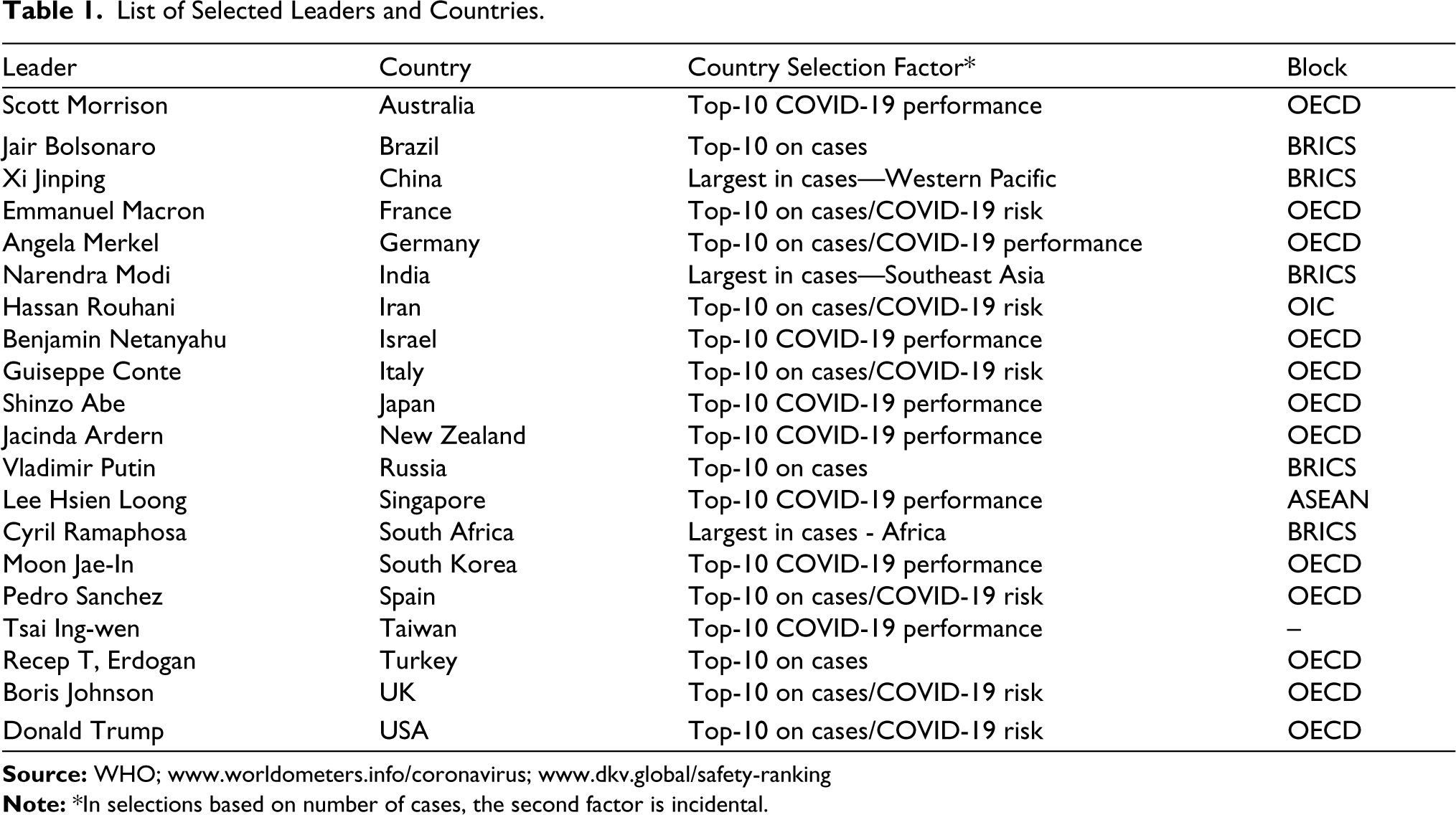
Analysis of this study relates to a 6-month period of January–June 2020. This period constituted the initial, or first, cycle of COVID-19 spread that can be truly called a crisis because no one anticipated either such a pandemic or its humongous global dimensions; hence, it tested the crisis management skills of leaders and countries very seriously. At that point of time, how leaders dealt with the crisis was fully based on their inherent leadership qualities and their willingness and ability to visualize its magnitude, duration and likely short- and long-run consequences. So, this is the time when leaders’ personal strategies, if any, will come into play the most. As the crisis and time wore on, all leaders and countries were likely to converge to a reasonable level of commonality as lessons would be learnt and the learning curve across the world would be used to modify intentions, preparations and actions everywhere.
To understand the nuances of selected leaders’ crisis actions during the pandemic, I reviewed the media through online searches of articles, surveys and reports published on these leaders all over the world during the 6-month period and I identified their personal strategy orientations by broadly following the grounded theory (Glaser, 1992; Glaser & Strauss, 1967; Partington, 2000). All sources were identified through an extensive online search with key words such as ‘COVID-19’, ‘country name’, ‘leader name’ and ‘leadership’ in various combinations. This was followed up with a pointed search combining a leader name and a source name (such as BBC) wherever it was necessary.
The choice of media reports as sources of information in a research study on leadership might be criticized based on factors of reliability and authenticity. While this criticism can be conceded as valid in a normal context where past published sources exist, it is to be recognized that there existed little academic research materials on leader behaviour of the selected country heads during a rare global crisis that had no parallel in the past 100 years. Hence, the only alternative was to use media sources, but with steps to enhance reliability. Accordingly, to minimize the impact of biased and inaccurate reporting, maximum efforts were made to use well-known or reputed sources (such as BBC, CNN, Forbes, The Economist, The Guardian and The New York Times) wherever available and to cross-check statements on a leader in one media source with another to cross out media biases (e.g., leftist vs. rightist, pro-USA vs. anti-USA or pro-leader vs. anti-leader). The international sources were supplemented with accessible regional and local media sources. In total, the average of the number of sources used for 20 leaders stood at over four international and about five local, while the absolute number of sources available on individual leaders ranged between four and thirteen.
Concept of Personal Strategy
The interplay of personality (or leader traits) and leader behaviour has been a subject of research for long (Bass, 1990; Bass & Bass, 2009; Lord et al., 1986, p. 90; McGregor, 1960). Hence, strands of an array of theoretical frameworks, such as interactionist theory of personality (Reynolds et al., 2010), personality psychology (Cloninger, 2009), trait activation theory (Tett & Burnett, 2003), social exchange theory (Cropanzano & Mitchell, 2005; Emerson, 1976), and upper echelons (UE; Hambrick & Mason, 1984) and TMT perspectives, can be used in defining and explaining the concept of personal strategy. The value of a new concept of personal strategy lies in the fact that the past literature was silent in explaining a distinct medium through which, as Malhotra et al. (2017) note, personality translated to leader behaviour (this is not the only limitation of leadership literature though - Avolio (2007) laments its lack of theoretical integration; there are also many studies suggesting how the past literature is inadequate in grasping leaders’ destructive behaviour (e.g., Burke, 2006; Kellerman, 2004; Kelloway et al., 2005)). While the trait activation logic (see Tett & Burnett, 2003; Tett & Guterman, 2000) suggests the interaction of situational factors with leader behaviour as well as performance (Barrick & Mount, 1991), past treatment was as if personality (or leader traits) intrinsically affected the leader behaviour without a full-bodied medium. This appears to have led to a gap disconnecting the two sides. DeRue et al. (2011) emphasizes this point by referring to a lack of clarity on how leader traits (or competencies; Pillai et al., 2015) and behaviour complement or supplement each other.
However, consistent with the tenets of personality psychology theories (for a short appraisal, see Cloninger, 2009; Wagerman & Funder, 2009), a leader might use their personality traits, along with other influencing factors—such as professional judgement, cumulative career insights, choice of forward direction and the knowledge of current organization (which implies internalization of external environment)—to strategize their behaviour (in terms of focus, expectations, styles, philosophy, actions and reactions) according to their personal preferences as reflected in their personal goals. This strategizing process may be culminating in a ‘personal strategy’, which may act as a framework for self-regulating the leader behaviour. Its implication for organizational dynamics can be anticipated by referring to the interactionist framework (see Endler & Parker, 1992) that connects personality and social psychologies (Reynolds et al, 2010; Turner et al., 1994). While personal strategy can provide an action medium for the interplay of a leader’s personality (or traits) and behaviour, there has been no work studying the role of personal strategy in leader behaviour, despite the long-prevalent great-man leader (Woods, 1913, p. 1182) type of phenomenon where a leader is the focus of outcomes (which Bass [1990] also seems to corroborate). Therefore, this article strives to build a concept of personal strategy and examine its impact on leader behaviour.
Personal goals, extensively recognized in psychology as a key factor in human life (Klinger, 1998), are a crucial component in defining and explaining one’s personal strategy. Personal goals are a source of motivation and mental happiness (Frisch, 1998; Karoly, 1999; Lawton, 1996) as much to a leader as to any individual. However, unlike that of an ordinary individual, a leader’s personal goals have a powerful bearing on others they lead. Personal goals could differ across leaders as it is speculated to vary by personal traits (DeNeve & Cooper, 1998) that contribute to alternative leadership styles. A leader can strategize achieving their goals, based on their personal traits, by placing their followers and the organization they lead at the centre stage. Personal strategizing is important because the intrinsic and extrinsic elements of personal goals are related (Kasser & Ryan, 1996), and achieving the latter requires managing external forces in the environment. The welfare consequence of the intrinsic and extrinsic emphasis of personal goals (Sheldon & Kasser, 1998) might also explain the part of differences between leadership approaches. Thus, personal strategy as a concept has been used in this article in the context of one’s personal goals as a leader.
Personal strategy can be defined as a person’s underlying approach of execution with respect to one’s personal goals while dealing with professional, social and personal activities having a bearing on others. In other words, personal strategy refers to a leader’s personal framework for influencing organizational plans and, where relevant, executing them in one’s preferred way for outcomes consistent with one’s own goals. More precisely, a leader’s personal strategy in their organizational leadership role is their personal (or private) action framework to achieve their personal (or private) goals (or agenda) in the leadership role through organizational leadership actions carried out in the guise of achieving organizational goals or objectives. Personal strategy goes beyond ‘role requirement’ (Miner, 1993), and it incorporates personality-social interactions (Turner et al., 1994).
Personal strategy consists of a person’s operating philosophy, associated operating methodology and commensurate operational actions against a long-term horizon. To illustrate, a manager’s philosophy may be rooted in certain lofty ideas of human values or it may be one that is driven by self-interest. One with a lofty value system, such as a transformational leader, may operate with a long-run orientation and a desire to ensure the good of both the organization and its stakeholders. On the other hand, one driven by their own or others’ self-interests, such as a self-oriented transactional leader, may focus on their own returns and a short-run horizon (for quick results). The first type of approach entails actions that are most desirable for the common good, while the second type, on its flip side, may involve temporary results, sub-group patronage and window-dressing. Here, the choice to be a transformational or a transactional leader could be a part or an outcome of one’s personal strategy evolved over long years of life. By social exchange theory, a leader’s actions, such as their style choices, which emanate from leader’s personal strategic choices, entail (Blau, 1964) a series of social interactions and obligations (Emerson, 1976) leading to specific organizational culture and outcomes. However, personal strategy can, by its intent, muddy the nature of reciprocity that social exchange theory underlines (Cropanzano & Mitchell, 2005).
Even a leader’s most spontaneous thinking and subtle actions may be shaped by their personal strategy. For instance, their organizational vision, while appearing to be fully spontaneous, may be nuanced by contours of their personal strategy—because, for a leader, where the organization should reach needs to be consistent, as a founder-leader of an organization might imply (Mamatha & Geetanjali, 2020), with what personal goals the leader has set for themselves, and what the organization should achieve in the long run needs to be consistent with the viability of their personal strategy. Kellerman (2004) seems to confirm this by acknowledging the precedence of the leader’s self-interest over organizational interests (see also Vrendenburgh & Brender, 1998). Yet, a leader may not explicitly reveal their personal strategy for fear of organizational backlash if it implied deviance behaviour (Kumari & Eguruze, 2022) vis-a-vis organizational expectancies (Raymondie & Stainer, 2021). However, the key elements of a leader’s personal strategy can be identified by inter-temporally observing their visible behavioural methodology, in both the past and current organizations, comprising of leadership style (negative or positive), reward philosophy, people approach, decision-making process (centralized or participative) and attitude to criticism. An organization could also recognize a leader’s personal choices and the personal strategy driving them by comparing the leader’s preferences and actions with the organization’s desirable goals in the given circumstances. For instance, during a crisis, a leader with a personal goal of gaining reputation through a personal strategy of problem-solving will do their best to resolve the crisis, whereas a leader keen on protecting their image from any negative fallout of the crisis might choose a personal strategy of shielding themselves through denial (as in politics; see Hinterleitner, 2017; Weaver, 1986) and cover up.
In terms of how personal strategy manifests in a leader’s actions, it consists of two components. The first one is captured in a leader’s career achievement actions (which they may play irrespective of which organization they are currently associated with) and arises from a leader’s past personal circumstances (which Pande & Kumar [2020] too seem to hint); this component is intrinsic to a leader’s personal goals (such as a desire to be hailed as a great leader). The second component is embodied in the leader’s organizational execution actions (which they may employ with due adaptations depending on organizational contexts and organizational execution requirements) and occurs due to emerging opportunities and professional assessments; it’s more of conditional aspiration related to organizational circumstances (such as being able to dominate the decision process). Malhotra et al. (2017) acknowledge the situational effect (Mischel, 1977) on leader behaviour.
Personal strategy might evolve over time as a leader progresses through different personal and organizational circumstances. Normal evolution can help the leader in adapting their personal strategy (especially its organization-related component) to organizational temporal needs and might affect mostly its details, leaving its core intact. Sometimes a leader could grow over-confident about their personal strategy due to its repeated success, especially when it is associated with negative leadership styles. An over-confident leader particularly pursuing a negative style could become complacent about potential changes in followers’ perceptions and reactions, which could ultimately lead to a backlash against the leader (Raymondie & Stainer, 2021). When a backlash is severe, a leader might face a leadership crisis (which is different from the organizational crisis). In this case, either the organization (or followers) might reject the leader if the leader did not transform themselves to meet the new demands or the leader could secure themselves by transforming their personal strategy and the underlying actions to suit organizational expectancies. In other words, normally, personal strategy should remain stable, subject to evolutionary changes, over a leader’s long career; but under circumstances of a career-crisis emanating from a particular personal strategy or its application, a leader might be forced to radically change it to ensure their survival. However, there is no guarantee that when the leader gets back to their original circumstances again, at any time later they would not bring back elements of their initial personal strategy.
The personal strategy of a leader is shaped by several influencing factors linked to their personal and organizational environments; in turn, personal strategy impacts different organizational aspects. Figure 1 presents an abstract form of such ex-ante and ex-post relationships.
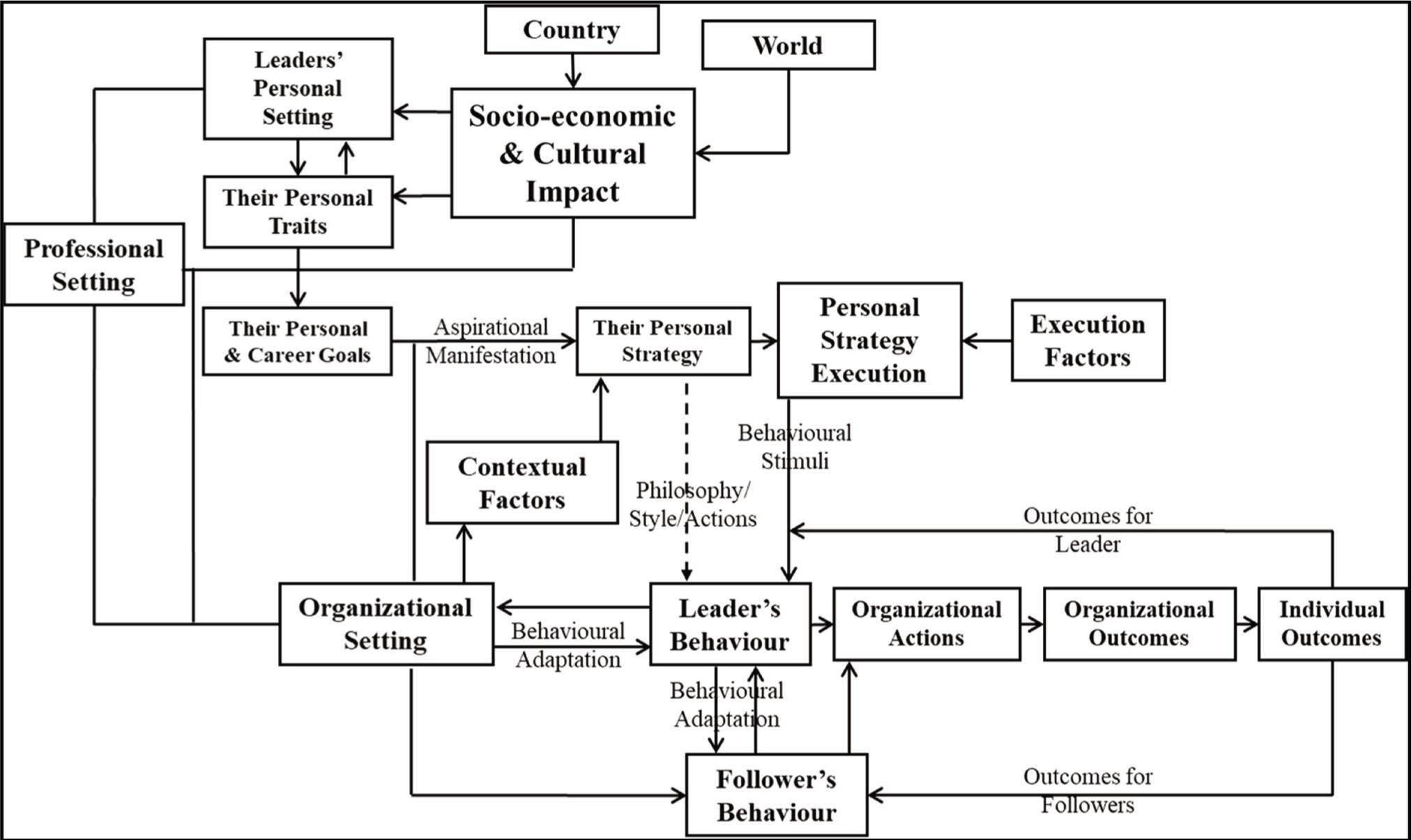
As evident in the conceptual model in Figure 1, a leader’s personal traits—interactively shaped by his/her personal setting and influenced by various socio-economic and cultural factors emanating in a region and the world at large, together with his/her professional setting, which is also influenced by the personal setting (of a leader)—provides grounds for (the leader’s) personal goals. The relation of personal goals with personal factors has been underscored in Lord et al. (1986). Personal goals, as conditioned by the organizational setting (past and current) and the contextual factors of personal strategy, give rise to (the leader’s) personal strategy that signifies a manifestation of the leader’s aspirations. Organiza-tional contextual factors of personal strategy include structure of internal stakeholders, power of the board or an alternative supervisory entity, the leader’s own competence in leading and problem solving (which fits with the interactionist ‘whole’ context; Reynolds et al., 2010), nature of the organization and the role of external stakeholders. Organizational contextual factors impact the way personal strategy is applied to an organization. It may sound like a moderating effect, but the contextual factors determine how personal strategy, which is not explicitly revealed by a leader, manifests in the organizational actions—thus, implying a causal influence. Further, organizational contextual factors might act in two other ways: First, when a leader joins a new organization, they carry a personal strategy that may be directly applied if organizational context is amenable or adapted where organizational context necessitates its moderation. In addition, during a leader’s stay in an organization, their personal strategy might have caused changes in the organizational contextual factors depending on the organization’s amenability. Second, by the time a leader leaves an organization, the organization’s contextual factors might have already impacted the leader’s personal strategy, to cause it to evolve (in normal process) or change (by backlashes). Thus, organizational contextual factors can have a two-way relationship with a leader’s personal strategy. The longer the leader’s stay in an organization (e.g., Jack Welch in GE for 20 years), the stronger the relationship.
The personal setting, as well as personal traits, of a leader, on the other hand, is shaped by the socio-economic and cultural environment of a country (or countries) to which a leader is substantially exposed. Concurrently, the execution of leader’s personal strategy and the organizational setting jointly shape, through causal and moderating effects, the leader behaviour.
Factors affecting execution of personal strategy can include the leader’s execution philosophy (such as relations- or task-orientation; Yukl, 2012), clarity of leader’s personal goals, leader’s people approach (such as directing vs. empowering (Kaiser & Overfield, 2010)), their planned benefit-sharing formula (e.g., a fair approach (De Cremer et al., 2005) vs. discretion), their feedback integration mechanism (e.g., reinforcing follower feelings; Conger & Kanungo, 1998), their adversity strategy (in case of organizational hurdles to executing personal strategy; see Elkington & Breen, 2015; Stoner & Gilligan, 2002) and their alternative plan (against the organizational hurdles to executing personal strategy, such as behavioural or style adaptation; Elkington & Breen, 2015)). There may be an interaction of leader behaviour with hierarchical forces in an organization. At the same time, leader behaviour causes the leader’s organizational actions (for intended outcomes; Yukl’s [1989] narration fits with this). Also, successive leader actions and followers’ own personal strategy generate follower responses. Thus, broadly, leader behaviour stimulated by the leader’s personal strategy and manifested in their organizational actions and the follower behaviour captured in their responses together determine organizational (and individual, i.e., self and other) outcomes. This will also further explain how leadership translates into performance as Barrick and Mount (1993) infer. In summary, the conceptual model of personal strategy helps us understand the personal strategic process and its impact on an organization in a flawless way.
All leaders are expected to have their personal strategy (or its multiple variants reflecting a leader’s evolution over time). A leader executing their personal strategy will try to shape or reshape organizational plans, strategies and actions according to their own personal strategy so that the consequent organizational results can satisfy the leader’s personal goals underlying the personal strategy (in doing so, they need to make use of their self-awareness, including role-awareness and organizational awareness (see Atwater and Yammarino [1992], Bass and Yammarino [1991] and Church [1997] on the role of self-awareness in leadership). In this sense, personal strategy contributes, to the extent it succeeds, to substantially redirecting organizational plans and their execution as intended in the personal goals of a leader. Past studies have already shown how a CEO, as top leader of an organization, influences strategic decisions (e.g., Agle et al. 1999; Chin et al. 2013) while there was hardly an appropriate concept to capture what framework a leader uses for it; hence, the concept of personal strategy is proposed here as a crucial element.
While every individual handling a leadership role is likely to use a personal strategy, the higher a leader’s realm of operation, the greater may be the impact of their personal strategy. For instance, a CEO’s personal strategy may have a more powerful influence on their organization than a unit manager’s. Similarly, a province or a country leader’s personal strategy is more powerful than that of a family or a village head. But, in both social and organizational contexts, every member’s personal strategy is certain to affect group outcomes by some degree. How strongly it affects is determined by various factors including the position of authority of a leader and the institutional contexts.
The concept and operation of personal strategy have several implications. First, it signifies that the differences among task-oriented (such as transactional), relation-oriented (such as paternalistic), change-oriented (such as transformational) and passive leadership behaviours (Yukl, 2012) could be traced to differing personal strategies of leaders. Second, it could be a leader’s personal strategy (rather than emotional intelligence skills) that drives them to write ‘action scripts’ for channelizing people’s emotions as well as their skills and energies, to organizational actions and results. Third, successful execution of personal strategy using a leader’s leadership expertise and experience helps them realize the personal goals together with organizational goals, but an ambitious personal strategy unmatched by necessary competence or leadership style to execute it can be dangerous to an organization. Fourth, for a leader with strong will-power and/or distinct leadership competences, moving an organization having amenable internal systems and culture to a new direction preferred by a leader (as done by Jack Welch in GE) is easier with a personal strategy even if the personal strategy is incompatible with the organization’s existing internal framework or long-term well-being. Fifth, when a leader loses control on aggressive methods used to support their ambitious personal strategy due to changes in organizational or business circumstances, its consequences on organization can sometimes be as catastrophic as what happened to Enron under Kenneth Lay, Jeff Skilling and Andrew Fastow. Finally, it is important to understand a prospective leader’s personal strategy and their leadership competence and style by analysing their track records and, then, ascertaining the mutual compatibility before entrusting organizational leadership (Hogan et al.’s [1994] observations are relevant here; Myers-Briggs-type personality classification (see
Now, exploring a theoretical basis in strategic leadership for the conceptual framework of personal strategy presented in Figure 1 and the subsequent analysis, it can be seen to be consistent with insights available in existing theoretical strands of strategic leadership. These strands arise from the UE theory (Hambrick & Mason, 1984), Top Management Team (TMT) proposition, ideas of bounded rationality (Simon, 1955), managerial coalition (Cyert & March, 1963) and satisficing behaviour (Simon, 1955), and also the transactions cost theory (Williamson, 1975) applicable to TMT relations.
To begin with, March and Simon had alluded as early as in 1958 to the personal role of a decision-maker in a managerial situation through the ‘givens’ they bring (March & Simon, 1958). The ‘givens’ are used to judge a situation and influence subsequent events—implying a personal impact of a manager or leader. Malhotra et al. (2017) underlined this aspect in the context of CEO extraversion. The notion of contingency approach explained in Vroom (2000) is also not far removed from this. The idea is further reiterated in Hambrick and Mason (1984) while arguing out the primacy of UE —managers’ perception and values form the basis of strategic choices and their backgrounds impact strategic outcomes (see also Collins & Moore, 1970). Both UE and TMT frameworks emphasize the interdependence of the CEO, the top leader of a firm, and its other top executives; hence, if a CEO devises a personal strategy, it can work when it is adjusted to accommodate the latter, who are the CEO’s immediate next-level followers. The notion of coalition propounded by Cyert and March (1963) adds strength to this line since the CEO and TMT constitute a dominant coalition. Another insight on the personal choice affecting organizational action comes from Carlsson and Karlsson (1970): older organizational leaders are likely to prefer own financial and career security to disruptive organizational actions, irrespective of their advantages to organization. On the other hand, young leaders are found to espouse more risk and cause faster growth; (Child, 1974), despite its other consequences. The full implication of leaders’ personal choices shaping organizational decisions and outcomes cannot be gauged by principals (shareholders) or their representatives (the board) because of the force of bounded rationality (Simon, 1957, 1979) that rests on the information, time and competence limits of decisions and actions (beyond the support of technological decision systems that Huber [1981] highlights). This gives additional freedom to leaders to pursue their personal strategy, doing which can, in fact, be considered, contrary to the restraint of bounded rationality, rational from the leaders’ own point of view. In addition, since stakeholders do not necessarily seek maximization of returns but may be content with a satisficing outcome (Simon, 1955), leaders have a leeway to mix organizational requirements with their personal goals (underlying their personal strategy) and cause results that are satisficing to both stakeholders and themselves. Further, there are substantial transaction costs (Coase, 1937; Williamson, 1975, 1985) involved in hiring (and even firing) competent CEOs and other top leaders; hence, the board or the investors cannot meddle with the CEO’s actions beyond a certain limit and cause CEO departures. So, CEOs can pursue some level of self-interest without the fear of being reprimanded from above so long as they get satisficing results. Similar factors can play out between a CEO and the top team—a top manager may face a significant transaction cost by not supporting the CEO’s ideas or preferences, and CEO solidarity can bring better rewards for other top managers. Hence, following the leader-follower relation that Cowley (1928) and Tead (1935, p. 1182) imply, the CEO can manoeuvre the TMT to practise their personal strategy plan without being overly opposed by senior management so long as the CEO takes care of their interests too. This is consistent with leader-member exchange argument (Deluga, 1994).
In summary, personal strategy context can be juxtaposed with the past literature, as in Figure 2, to understand the significance of current research work.
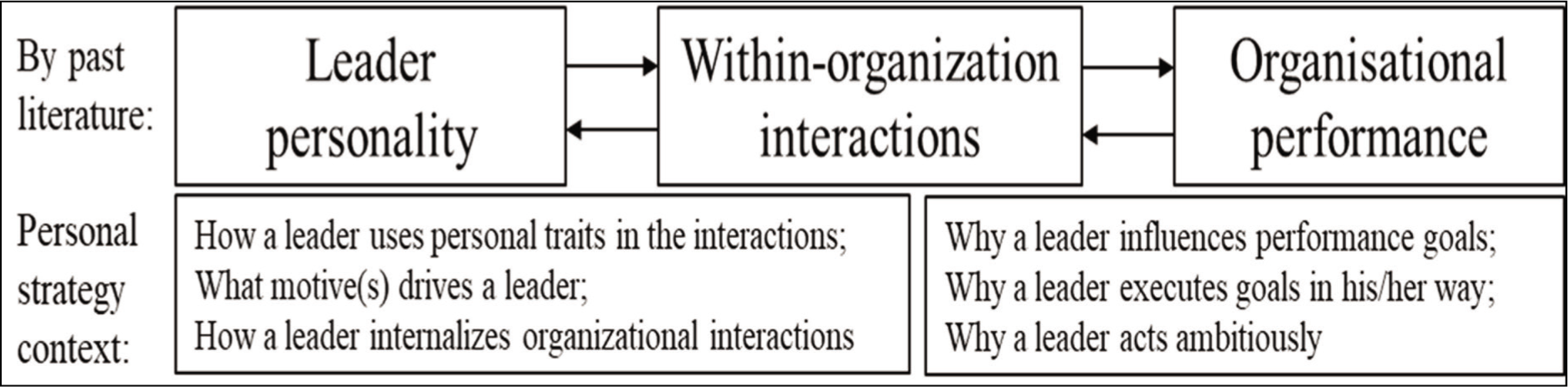
Explaining Figure 2, a leader uses personal strategy to leverage his/her particular personality (with assistance from motives and styles underlying the personal strategy) to create the best possibilities for them in the within- organization interactions involving followers (or various stakeholders) including the TMT. As part of this process, a leader uses their personal strategy (and the style selected as part of it) to shape organizational goals and drive execution actions with a level of ambition commensurate with the intensity of leader’s personal strategy. Looking through the phenomenon of personal strategy, it is easier to understand how a leader and their personality – which, following Cattell (1950, 1979), represents leader’s behavioural character revealed under given circumstances - interact with the organizational black box and cause such and such outcomes. The concept of personal strategy also has the potential to address Graeff’s (1997) criticism of situational leadership because the idea of personal strategy fits with the varying choice of leadership styles under different organizational and leader circumstances.
COVID-19 Crisis and the Leader Behaviour
Did the 20 leaders evaluated in this article emit traces of personal strategy while fighting the crisis? To understand this, I briefly review their COVID-19 actions and underlying dynamics, after highlighting sources of personal focus of each leader.
Scott Morrison: On the eve of Australia’s COVID-19 crisis, Morrison’s failures with the Australian bushfire crisis (Remeikis, 2020) triggered a public backlash. Reminding how ‘Nero “fiddled while Rome burned”’, Morrison took a family holiday in Hawaii while the wild inferno raged (Davies, 2020), killing millions of animals. Later, Morrison had to cut short his visit and publicly apologize (BBC News, 2019). The coronavirus gave a new opportunity to prove his crisis skills, salvage his public image and turn his political future around.
Accordingly, unlike his heroism in the bushfire crisis (Glover, 2020), Morrison was proactive and consensual with COVID-19 management. He formed a national cabinet involving provincial heads from the opposition as well. He pursued a science-based approach, putting health experts in the forefront (Mao, 2020). There was policy participation of trade unions. He enforced an early lockdown, which Australians willingly followed (Glover, 2020). As a result, Australia controlled the initial phase of COVID-19 spread well, and, like New Zealand, it earned higher global ranking. His success elevated his domestic ratings (Murphy, 2020; The Economist, 2020e) and attracted favourable global rankings.
Bolosonaro was frequently in denial (Chiu, 2020) on Brazil’s COVID-19 severity. He equated the virus to an ordinary cold (Colarossi, 2020; Rasheed, 2020). As people died in large numbers, he ridiculed lockdown measures despite its global appeal. For him, some deaths were an essential part of life (Colarossi, 2020). His contempt for quarantine measures prompted him to sabotage it (Phillips et al., 2020). He was openly critical of state governors (and his health minister) who reposed faith in strict social distancing (Campante et al., 2020; Hindustan Times, 2020c). He was concerned about its impact on business and industries. Social media censured Bolsonaro for unpalatable comments on social distancing (Colarossi, 2020). Defying medical advice, he toured places (Rasheed, 2020) and mingled with crowds in political campaigns. He turned against Brazil’s Supreme Court and incited followers to create pressure on the Court (Hindustan Times, 2020c). He forced his health minister to resign in the thick of crisis, and the new health minister too looked shaky. In short, Bolsonaro was rather an impediment in Brazil’s COVID-19 management efforts, which the state governors had to lead. At times, state governors had to urge people to ignore the president’s exhortations to violate restrictions. Some analysts called Brazil leaderless (Hindustan Times, 2020c). Unsurprisingly, Bolsonaro faced protests (Phillips et al., 2020) and poor ratings in Brazil (Klebnikov, 2020; Sims, 2020; The Economist, 2020e). Also, the hardening hostility of Bolsonaro to Brazil’s COVID-19 fight could prolong the crisis.
A global belief was strong that China had triggered the COVID-19 crisis (Glazer, 2020) by failing to take drastic measures to control the Wuhan virus and alert other countries about its risk (Colarossi, 2020; Wu et al., 2020). China’s cover up (Rasheed, 2020; Phillips et al., 2020) and suppression efforts (Colarossi, 2020; Roth, 2020; Waldman, 2020) were revealed when it muzzled its health personnel, who cautioned about an impending disaster (Colarossi, 2020; Chiu, 2020; Glazer, 2020). Jinping knew that the upcoming Chinese New Year would cause tourist outflows, but he delayed a lockdown. When he did it, millions had already crossed borders (Roth, 2020; Wu et al., 2020), accentuating a global crisis. Intriguingly, major Chinese cities such as Beijing and Shanghai and friendly countries like North Korea remained unscathed! Jinping’s lapses and a simmering domestic discontent were speculated to spark a potential threat to his authority (Phillips et al., 2020). Even WHO lost its credibility laundering China’s suspected guilt (Collins, 2020). Strengthening global suspicions (Roth, 2020), China tried to block a UN move for international enquiry into the pandemic’s origins. Jinping’s authoritarian behaviour supported past research findings about crisis-frustrations associated with performance failures (Greve et al., 2010; Lehman & Ramanujam, 2009). Later, China used its command-and-control structure (Glazer, 2020) for virus control and a drone-vigil (Reilly, 2020) for stringent lockdown in Wuhan (Maier & Brockmann, 2020) and elsewhere. Jinping quickly took credit for it, despite its poor transparency and low credibility, by re-emerging from the background (Phillips et al., 2020). However, when China could help other countries, it tried to profiteer (Reilly, 2020), disregarding its moral responsibility. Further, when neighbouring countries were busy fighting COVID-19, China escalated border disputes with encroachments, displaying their moral turpitude. So, Jinping’s was an example of irresponsible leadership. Yet, a positive outlook on China’s virus situation helped Jinping get favourable ratings (The Japan Times, 2020).
Virus incidence was severe in France. Macron’s inept approach was blamed for the higher number of cases and deaths (Ward, 2020). There were shortages requiring redeployment of facilities (Ward, 2020). The federal government was accused of miscalculations. After the first cases were reported, precious time was wasted in marginal actions. Social distancing, tracking and intensive testing did not get the deserving attention. Dependence on Chinese supplies was another bottleneck. Masks were in short supply. At some point, patients had to be taken to neighbouring countries for cost-effective facilities. Meanwhile, Macron toured Italy, another seriously affected country, visited public places, mingled with crowds without even a mask (Arab News, 2020) and shook hands, disregarding medical advice. Later, when France closed schools in some regions, many public-gathering activities still continued. Macron himself attended a theatre performance and visited sensitive places with political motives. One tipping point was a church gathering of delegates from many countries that became a huge source of virus spread in France and other countries (Salaun, 2020; Ward, 2020). By then, the Italian situation had turned severe. Macron took further time to ‘find a new spirit of solidarity’ (Barker, 2020); but when he declared serious national control measures, shopping was excluded. He had the audacity to continue with a scheduled country-wide mayoral election. As a public show of displeasure on Macron government’s crisis response (Belenky, 2020), his party was handed a drubbing in the first round that compelled him to postpone the next round. By the time he declared a complete lockdown, dead bodies were piling up. Understandably, France found itself among the top 10 riskiest countries on COVID-19. This did not prevent Macron from trying to hoist himself as a global leader (Andelman, 2020) by advocating peace in global conflict areas. Luckily for him, the later-stage positive actions contributed to his rebounding popularity (Klebnikov, 2020).
Merkel allowed her colleagues and Germany’s decentralized governance structure (Barker, 2020; The Irish Times, 2020) to lead COVID-19 fighting—a sign of leadership withdrawal. But Germany experienced a critical leadership deficit, spawning mounting cases and deaths. The European Union turned anxious as Merkel was to assume leadership by mid-2020. Media began an unusually harsh portrayal of her—low-key and laidback (Barker, 2020; Kottasova, 2020), ‘softly-softly’ (The Irish Times, 2020), uncharismatic (Rameshan, 2021), unemotional and cautious (Miller, 2020), lame-duck (Kluth, 2020; Kottasova, 2020), fading (Deccan Herald, 2020a), ‘not a great orator’ and facing a ‘huge backlash’ (Kottasova, 2020). However, as the German crisis deepened and she received flak, denting her reputation, she transformed to produce different crisis outcomes (Chiu, 2020). Resultantly, she changed public opinion (The Economist, 2020e) as Germans trusted her (Barker, 2020; DW, 2020; New Zealand Herald, 2020; Wittenberg-Cox, 2020).
Modi declared a national lockdown when India had relatively fewer cases and deaths. He could enforce lockdown measures comfortably (Ramachandaran, 2020) even in opposition-ruled provinces, due to his popularity, timing and approach. One report said his efforts were appreciated by Bill Gates (Joy, 2020). Reaching out as a ‘family elder’ (Gandikota-Nellutla, 2020), he could persuade the public to perform such theatrical acts as beating vessels and lighting lamps on balconies, dedicated to medical and other personnel fighting COVID-19. Indeed, he failed to anticipate a reverse migration of workers affected by pandemic fear and lockdown woes. He was also castigated for delayed actions and relaxing lockdown curbs for political and macroeconomic reasons, with COVID-19 still spiking. Nonetheless, his actions helped India contain the number of deaths within less than 1% of the global figure—equivalent to around 3% of total cases in India; comparable proportions for Italy and France were much higher. He earned praise for this (Pradhan & Sen, 2020). As the lockdown wound down, he declared economic revival packages in distributed doses to fit his budgetary and political calculations. Later, he embraced an adaptive policy process involving periodic consultations with provincial heads, including those of opposition parties, for inputs on extending or relaxing lockdown (Ramachandaran, 2020). This act of a somewhat ‘post-heroic’ approach (see Bradford & Cohen, 1998; Fletcher, 2004) created a sense of shared responsibility among leaders across political spectrum. His COVID-19 acts could take away a part of his pre-coronavirus political woes (Pradhan & Sen, 2020). Modi also targeted global goodwill by calling a virtual meeting of SAARC countries and inspiring a G-20 meeting. He coordinated with world leaders to safeguard Indians stranded in other countries. He backed global efforts at crisis management by despatching supplies including of Hydroxychloro-quine. Modi’s actions unravelled a strategist behaviour. Unsurprisingly, he attracted favourable ratings on COVID-19 performance (CNBC TV18, 2020; Klebnikov, 2020; Pradhan & Sen, 2020; The Economist, 2020e; The Statesman, 2020b).
Despite occasional cheering up (Redondo, 2020), what Rouhani guided was Iran’s authoritarian approach to the crisis. Some called Iran’s COVID-19 management shambolic (Shahane, 2020). Iran was too slow (Al Jazeera, 2020) to caution the public as the leadership thought COVID-19 would not harm Iran. Religious ideology (Behravesh, 2020), geopolitical predicaments, a crippling US embargo and friendly relations with China–all clouded Iran’s fight back. Chinese flights could not be stopped even after deciding to do so due to crucial Chinese investments and support. Iran’s complacency made it consider even sending face masks to China (Colarossi, 2020). Finally, Chinese visitors brought the virus, and it began spreading into all regions by early-March (The Hindu, 2020). Some top officials lost their lives (The Economist, 2020b), yet Iranian leaders differed on control measures. Religious leaders were unhelpful. Recommendations of the Revolutionary Guard’s head were ignored. A conspiracy theory, subscribed by Rouhani himself (Chakravarty, 2020), attributed the virus to the United States; it impacted crisis actions. Foreign doctors were restrained on suspicion of their intentions. When a lockdown ultimately came, it was too late (The Economist, 2020b), and there was early relaxation of lockdown (Wintour, 2020) too. Iranian leadership was accused of hiding information—they even threatened medical workers against disclosures (Colarossi, 2020). Hence, an accurate estimate of Iran’s cases and deaths (The Economist, 2020b; Wintour, 2020) might not exist. Yet, despite a slowdown of spread by end of April (Chakravarty, 2020), Iran was counted among the worst affected (Chakravarty, 2020) and the top-10 riskiest countries. Thus, Rouhani’s poor leadership and compromised actions were obvious.
Despite a delayed start, Netanyahu’s COVID-19 actions earned satisfaction in Israel and praise abroad. Through early steps at closing borders, self-quarantine and social distancing (Ahren, 2020), he could give hopes of crisis resolution. Both Israeli intelligentsia and outside observers appreciated how Netanyahu’s early actions controlled the spread of the virus. Such success also qualified Israel to be among world’s top-10 COVID-19 performers. Nonetheless, Netanyahu was accused of stepping up surveillance (Rasheed, 2020) and trying to use the COVID-19 scare to strengthen his political interests (Ahren, 2020)—particularly to ward off threats from the fractured election verdict (Hecht, 2020; Roth, 2020;). Netanyahu openly claimed credit for every positive outcome. Incorporating the world in his actions, he frequently connected with friendly counterparts in other countries (Zonshine & Harkov, 2020) and presented their support, for domestic political mileage, as his personal achievement.
The crisis was severe in Italy; still, Conte downplayed it. His ministers accused the media of hyping up (Colarossi, 2020). The government lacked consistency in actions, which created confusion (Glazer, 2020). Enamoured by tourism revenues and Italy’s strong relations with China, Italy advised citizens to embrace Chinese visitors, thereby compounding the crisis. Conte initially discouraged testing in an affected province (Chiu, 2020) for fear of case escalation due to higher testing (Colarossi, 2020). Conte’s lethargic intervention slowed down government machinery as the crisis peaked. Even cities closer to epicentres were slow in enforcing stay-home and social distancing. Resultantly, Italy passed through a long spell of death, devastation and misery. Later, he realized the gravity and progressed to drastic decisions (The Irish Times, 2020), including a prolonged lockdown (The Statesman, 2020a). Conte even admonished provincial heads for hurried easing of lockdown (Hindustan Times, 2020b). His serious actions caused immense public resentment (Belenky, 2020) and his belated toiling did not prevent Italy from falling among the top 10 riskiest countries. However, Conte’s popular rating revived (Klebnikov, 2020) with refinements in his approach.
Abe’s government began acting early—Japan was among the three early countries, Thailand and South Korea being others, to act (WHO, 2020, pp. 1–3). Following WHO advice on preventing the spread of the virus, Japan commenced contact tracing and virus investigations. Abe constituted a coordination team of health experts and declared various timely action steps. Hence, Japan had a comfortable situation in the early weeks of the COVID-19 outbreak. The Summer Olympics was postponed by one year after an initial hesitation. These enabled plaudits for Abe’s leadership (Moss, 2020) and Japan’s initial better ranking in COVID-19 performance. However, the situation changed as gaps in Japan’s health system became clear (Kingston, 2020) and Abe dillydallied with a mild approach (Klebnikov, 2020), avoiding stricter actions (The Japan Times, 2020) fearing political fallouts. As cases surged, Abe’s leadership image was dented (Financial Times, 2020; Moss, 2020) despite Japan’s much lower numbers (The Economist, 2020f). His indecisiveness and confusion were apparent. He was slow in declaring nation-wide emergency measures (Kingston, 2020). This was rectified later, but there were further delays in action (Mulgan, 2020). Abe’s one particular social media stay-home image was interpreted as aristocratic behaviour. Unsurprisingly, his review ratings tanked (Klebnikov, 2020; Kingston, 2020; Mulgan, 2020; The Economist, 2020e; 2020f; The Japan Times, 2020).
Ardern launched her first steps before the crisis outbreak (Wittenberg-Cox, 2020). Chinese travellers were banned without a single COVID-19 case. This delayed the first case by a month compared to several other countries. By mid-March, borders were closed for all non-residents. A complete strongly enforced lockdown (Wilson, 2020) was declared. She targeted eliminating the virus, not flattening the curve, as priority. She did rigorous contact tracing, testing and quarantining, foretelling New Zealand’s possible success (Friedman, 2020; News 18, 2020). She demoted her health minister for lockdown violations, while she showed empathy to people (Friedman, 2020), including foreign students, affected by the lockdown. She did not indulge in blame games, and she led from the front. She could win popular support for her robust COVID-19 efforts. Ardern’s popularity ratings soared; some described her a symbol of compassionate leadership (Clark, 2020) and the best Western corona-crisis leader (Wilson, 2020). Resultantly, New Zealand won recognition as the world’s top 10 best COVID-19 performing country.
Putin started off proactively with a desire to control the virus. Chinese borders were closed by end of January itself (Rodgers, 2020) and other borders subsequently. So the crisis did not bloom till mid-April, notwithstanding a low testing rate. Russia’s planned anti-Nazi victory parade looked on course, before it was derailed (Higgins, 2020). Putin thought the virus to be harmless to Russia because of a conspiracy theory that the United States created it to harm China. When the crisis actually occurred, Putin avoided terms such as quarantine and lockdown due to fear of people suspecting his competence and thus lowering his ratings; he chose terms like ‘non-working days’ to describe a closure. Later Russia led Europe in number of cases despite many distrusting Russian official numbers. Still, Putin went for relaxing the controls (Walker, 2020). Then, he began delegating crisis responsibility to provincial leaders as if he was washing his hands off the crisis (The Economist, 2020c), allegedly due to his poor crisis-management skill. Some argued he was failing (Walker, 2020) and some called him a weak or disinterested crisis-leader (Higgins, 2020). Whatever it was, the crisis actually turned him passive and bored as he could not perform his leadership magic and live up to his strongman image. Besides, the inability of Russia’s weakened health system to absorb the virus shock was stoking political issues (Standish, 2020).
Loong successfully did this through immediate decisive (Warrell, 2020) and aggressive (Rasheed, 2020) actions including certain ‘circuit breaker’ measures (The Economic Times, 2020a), especially to contain deaths. He used expert consultations (Chiu, 2020) in the fight. He followed a transparent approach to his actions. Singapore, accordingly, achieved excellent results. It earned global praise and a top 10 peer ranking despite a subsequent flare up of infections that was also tackled resolutely. It can be seen that fighting the pandemic for required results was Loong’s focus.
Responding intelligently, Ramaphosa followed the dictum of ‘act fast, act hard’ (Vandome, 2020). His prime motto was to prevent virus transmission. Hence, medical experts were given the upper hand. Ramaphosa created a national command council to guide the COVID-19 battle. Emitting leadership sparks of a high-reliability organization described by Bigley and Roberts (2001), Ramaphosa’s actions were timely—he closed borders, borrowed lessons from past pandemic efforts, consulted experts, opted for a science-based approach (Devermont & Mugulu, 2020), used mobile testing facilities and communicated with different stakeholders. A regime of tracing, extensive testing and isolating was instituted. Hand sanitizing and social distancing were advised. Health workers were mobilized to visit homes and do screenings. Lockdown measures were imposed early and strictly enforced (Campbell, 2020; Vandome, 2020). Religious leaders, who had greater credibility in African countries, were used to prevent risky congregations. Political parties were involved in the crisis-management process. It was a stark contrast with his pre-crisis approach. He followed it up with a bailout package for those affected. The virus fightback in the whole of Africa was influenced (Vandome, 2020) by the success of Ramaphosa, who was chair of African Union—a factor helping him to liaise constructively with WHO as a key African link. He solicited international support for economic rehabilitation and invited Cuban medical teams for complementing internal efforts. International media appreciated Ramaphosa’s crisis leadership in South Africa.
Jae-in acted aggressively to contain the virus–with lots of testing, use of innovative strategies and active tracking of patients. Hence, South Korea could control the crisis quite early. It also tried to help other struggling countries by exporting test kits. Leaders of some Western countries consulted Jae-in on containment measures (Rich et al., 2020), and international media praised him for his achievement. Some opinion surveys ranked South Korea among the top 10 in COVID-19 fighting and Jae-in among the best COVID-19 crisis leaders. South Korea’s COVID-19 success involving several steps (Chiu, 2020) transformed the public opinion of Jae-in, and he won a re-election (Choon, 2020) in the middle of the pandemic (Hindustan Times, 2020a).
Spain was hit hard by the COVID-19 wave, but Sanchez’s initial crisis actions evoked a mixed response (Belenky, 2020). He was too slow to react (Daily Sabah, 2020b). He could not fathom the threat’s potential. He allowed gatherings in sports complexes and other places (Colarossi, 2020), ignoring signs of danger. He declared lockdown measures in mid-March (The Statesman, 2020c), but many considered it late (Colarossi, 2020). He justified the delay. Later, he was eager to relax lockdown prematurely when many were suggesting otherwise (Belenky, 2020; Deccan Herald, 2020b). Thus, Spain’s international characterization as a top 10 risky nation on COVID-19 looked justified. Nonetheless, improvements in Sanchez’s approach over time revived his popularity.
On confirming the virus problem in China (Wittenberg-Cox, 2020), Ing-wen quickly declared proactive measures (Ing-wen, 2020). She banned China flights before any other country did, constituted a central coordination agency, set up quarantine processes (Ing-wen, 2020) and expanded the production of personal protection materials to ensure its universal availability. The virus indeed entered Taiwan; but Ing-wen’s varied actions (Chiu, 2020) could curtail the severity even without a harsh lockdown. Taiwan also exported masks to other affected countries (Focus Taiwan, 2020). Subsequently, Ing-wen earned international appreciation, and Taiwan was grouped among the best COVID-19 performers.
Initially Erdogan took the right decisions at the right time—monitoring developments, granting relevant ministers their role and so on (Daily Sabah, 2020a). Turkey began screening and other preventive measures when the Chinese crisis became visible, and no case was yet reported in Turkey. Turkey’s health system worked to pre-empt the virus occurrence. But soon, Erdogan turned myopic—political constituency and economic priorities (Tisdall, 2020) began dominating him. Quarantine measures were not instituted even for haj returnees (Kirisci, 2020), causing the coronavirus to spread to remote areas. Erdogan believed that COVID-19 would not affect Turkey but would benefit it. When WHO declared COVID-19 a pandemic, Erdogan was confident of resolving it in a few weeks (Kirisci, 2020). He was hesitant to stop public gatherings, particularly in mosques. When other officials tried to act, Erdogan convened gatherings at his palace (Kirisci, 2020). Erdogan declared unplanned restrictions, even causing the resignation of a minister. As a result, despite a delayed appearance of the first case, the number of cases zoomed quickly. Fortunately, Erdogan had allowed Turkey’s health minister to follow a science-based approach (Kirisci, 2020). The latter, who earned appreciation, constituted expert panels, declared control measures including social distancing and disseminated information transparently. Perhaps due to this, deaths and cases could be contained. But Erdogan quickly relaxed lockdown restrictions to appease political constituencies to consolidate his power (Kirisci, 2020). Abusing his authoritarian power (Roth, 2020; Waldman, 2020), Erdogan consciously constrained crisis management efforts of the opposition-ruled regions and blocked crowd-funds of municipal bodies controlled by opponents (Tisdall, 2020), who had planned a cash pay-out to poor people affected by lockdown measures (Buyuk, 2020). When Erdogan released thousands of prisoners from jails, he omitted his opponents and journalists (Kuru, 2020; Waldman, 2020). To shore up his domestic position, he turned to influence global opinion—for example, by subscribing to a global fund for fighting the virus. Thus, Erdogan strongly dovetailed his actions with political objectives, whose impact was offset by actions of his health minister, to cause a net effect of Turkey’s negative and positive vibes (Kirisci, 2020).
Johnson’s COVID-19 approach erased his past goodwill (The Irish Times, 2020). His lenient actions created hurdles for imposing essential restrictions. Exuding overconfidence, he boasted he would pack off the virus. Protecting civil liberties (Belenky, 2020; McTague, 2020) and the highest-risk groups (Daily Sabah, 2020a) led his priorities. As herd-immunity was his cliché (Colarossi, 2020), he ignored containment strategies even when other European countries shut down. Testing deficits persisted. Political dynamics prevented him from collaborating with the European Union for ventilator supply. Thus, a catastrophe was guaranteed. Revealing his casual approach, he kept shaking hands with the public openly even during hospital visits (Colarossi, 2020), and gloated that nothing happened to him. Eventually, the virus caught him, pushing him into great health risk. Still, to project his charisma and appease his constituency, his rhetoric continued. Some thought he was seeking the stature of Winston Churchill (McTague, 2020). His visible acts of ‘heroism’ (Allison et al., 2017) boosted his public rating; but fighting a pandemic required post-heroic (see Bradford & Cohen, 1998; Fletcher, 2004) acts (Stokes & Stern, 2020). Johnson hesitated to consult and empower. Opponents questioned his limited testing, inadequacy of medical supplies and inaccuracy of death data. The government was unable to explain its actions and inactions (The Economic Times, 2020b). Johnson’s behavioural tenets forced some observers (e.g., see Stokes & Stern, 2020) to counsel him to move from heroism to, say, post-heroism (Bradford & Cohen, 1998). However, Britain’s approach refined later (The Irish Times, 2020) and the pressure of the deepening crisis improved Johnson’s stance (The Economic Times, 2020b). He began consulting the opposition (The Indian Express, 2020) and introducing control measures including a lockdown. His lockdown declaration emphasized government instruction and compliance but lacked the appeal of, say, Jacinda Ardern (Wilson, 2020). In the post-COVID period, Johnson might face questions from parties (Belenky, 2020) on his responsiveness and lapses (The Economic Times, 2020b); but his improved actions were acknowledged by people through better ratings (Klebnikov, 2020).
Trump’s COVID-19 approach was ambivalent, crisis-deepening and controversial. Eager to control the narratives and deflect criticisms, Trump downplayed the crisis (Chiu, 2020; Collinson, 2020; Glazer, 2020). The United States knew about China’s COVID-19 onset quite early (Blake, 2020) and some initial steps were taken. But systemic and individual idiosyncrasies (Lipton et al., 2020) delayed serious civil control measures until mid-March (Blake, 2020). Still, despite lots of cases and deaths, an advisory substituted a national lockdown (Colarossi, 2020). States individually declared and enforced lockdowns, but often not stringently. As the virus spread globally, Trump kept describing it a hoax (The Irish Times, 2020; Rasheed, 2020), a flu and his opponents’ campaign, revealing his emotional and cognitive inability to provide a reliable leadership (Kahn et al., 2013; Roux-Dufort, 2007) and his narcissistic traits (see Rosenthal & Pittinsky, 2006). Trump considered some deaths as the price of business and economic priorities. When his top officials tried to underscore the seriousness (Blake, 2020) and to induce stringent measures, he clung to a denial syndrome. Trump tended to disregard or question their assessments (Collinson, 2020), while insisting the virus would go away (Barker, 2020; Lipton et al., 2020; Rasheed, 2020). Trump finally recognized the gravity only in mid-March (Blake, 2020). This affected crisis-planning for financial and medical resources. Trump differed with state governors over lockdowns (Collinson, 2020). Pursuing reckless political calculations to put pressure on governors to ease controls, he encouraged his followers to resist restrictions, disregarding the pandemic’s impact. He questioned China for its role in the pandemic and the WHO (BBC News, 2020; Newey, 2020; The Economist, 2020d; The Strait Times, 2020) on its failures, and threatened to cut WHO funding. This complicated the global fight. In summary, Trump lacked leadership coherence (Daily Sabah, 2020a). His low ratings on COVID-19 performance (Klebnikov, 2020) reflected his shortcomings. However, Trump was frustrated as months passed, motivating him to improve his actions.
Personal Strategy of Country Leaders
Personal strategy, as elaborated elsewhere, is the personal approach (or individual strategic mental scheme or agenda) that drives leader behaviour (Rameshan, 2017, 2019). Personal strategy arises from the personal motives (or goals) of a leader in pursuing a leadership role; it will be adjusted according to their leadership circumstances. In the global COVID-19 crisis, a leader with a ‘political’ motive might have a personal strategy of ‘following a liberal ideology’ to ‘safeguard one’s self-image’ among followers, while one facing a leadership crisis might use it to ‘turnaround’ their political fortune or reputation. Table 2 presents a summary of the personal strategies and the underlying personal goals, points of action focus (i.e., organization or leader), and organizational and personal outcomes of personal strategy of the 20 leaders studied in this article. Personal strategies have been intuitively identified following Rameshan (2017, 2019), by using qualitative information compiled from various media sources referred in the previous section.
Country Leaders’ Personal Goal, Personal Strategy and Outcome.
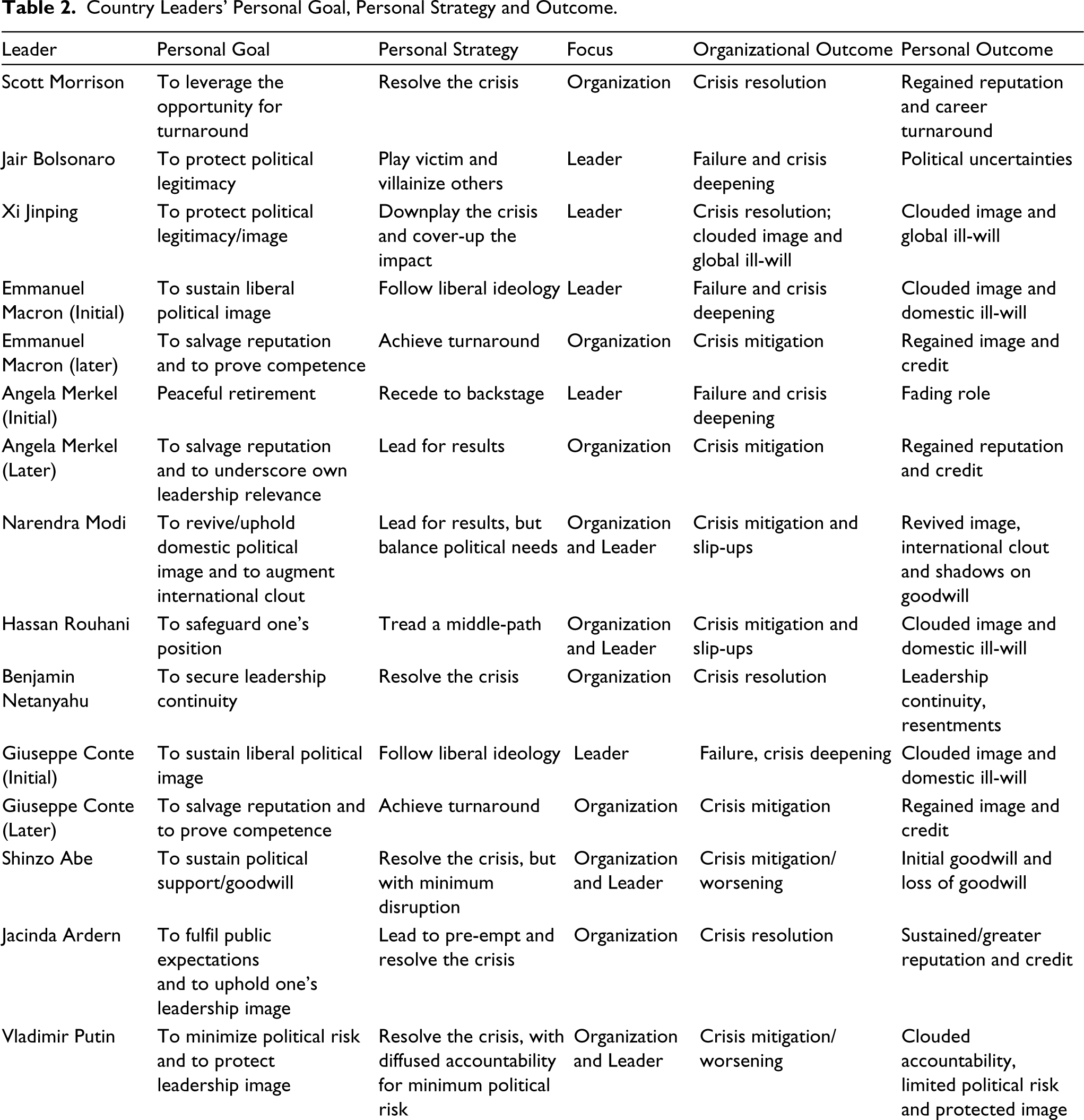
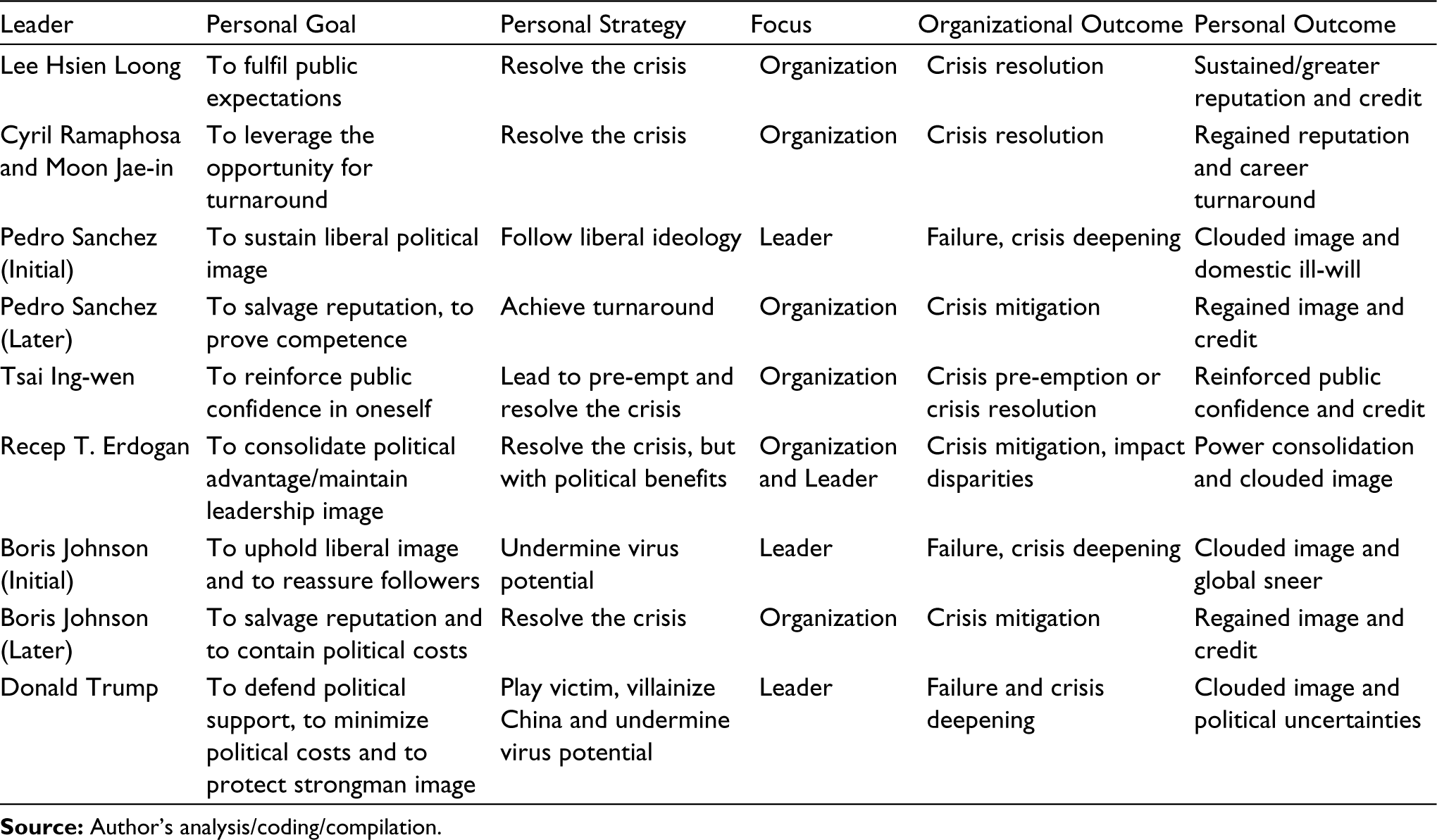
Coding for Tables 2 and 3 was done based on the spirit of grounded theory (Glaser, 2005; C. A. Hernandez, 2008; 2009), through a manual iterative process in which, first, the action demands placed by circumstances on each leader were assessed based on media references and then each leader’s underlying goals and orientation of actions during the sample period was identified. Next, the relevant leader indent was deduced step by step by matching the action orientations with the attributes of various leadership styles and the elements of personal strategy concept outlined in this article. This helped in deciding whether the leader’s focus was on organization or self. Finally, the actual action outcomes to the organization and the leader were ascertained by reviewing the results obtained in the earlier steps along with the source materials. After completing this process, the commonality among personal goals and personal strategies was identified to group the country leaders by personal goals and personal strategies as done in Tables 3 and 4, respectively. The grouping of leader focus (i.e., organization vs. leader) and outcomes (both organizational and leader) followed from the aforementioned.
Coding done in the study was single-person-based, but availability of multiple media sources enabled cross-checking of coding results to minimize the chance of biases. Indeed, multiple coding would have enhanced the reliability of the coding; however, due to practical issues arising from the huge volume of media materials used in the study and the intricacies of the relationships studied, multiple coding could not be followed. But multiple coding could be considered in similar or confirmatory future studies.
Columns 3 and 4 of Table 4 draw from Rameshan (2021), while its first and last columns were obtained through coding explained in the preceding paragraphs.
What personal strategy was driving each country leader’s behaviour in the COVID-19 crisis? While Table 2 throws light on this, a brief summary of the leader-wise personal strategy is given further.
One can see that not all leaders facing the same crisis had the same personal strategy; rather, it differed from leader to leader based on one’s circumstances. Nonetheless, certain patterns are discernible, which is summarized in Table 3.
Selected Leaders’ Personal Strategy Dynamics.
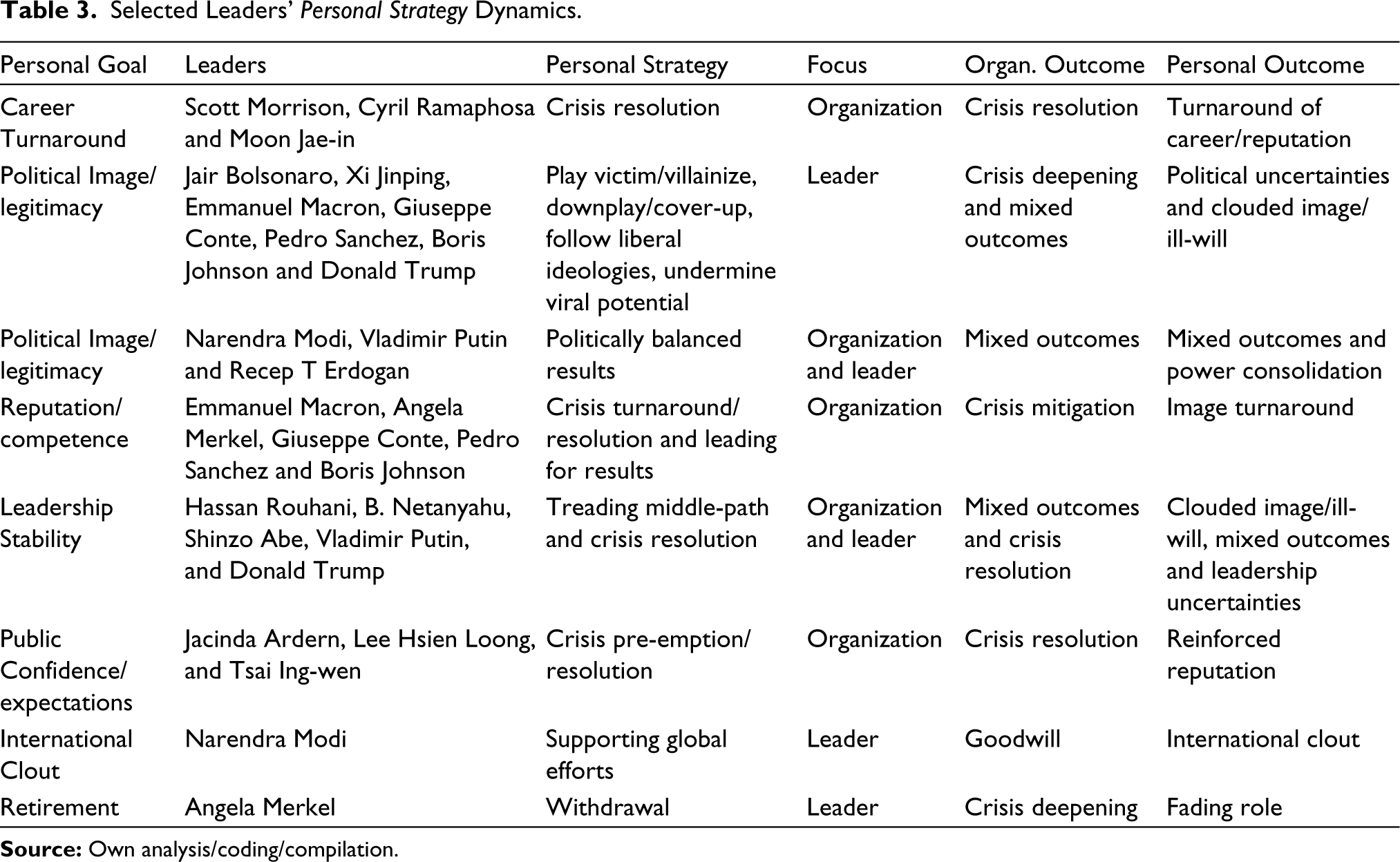
Table 3 shows that when personal strategies of ‘crisis pre-emption’, ‘crisis resolution’, ‘crisis turnaround’ and ‘leading for results’ were associated with personal goals of ‘career turnaround’, reviving or strengthening ‘reputation’ or re-affirming ‘competence’, and responding to ‘public confidence’ or ‘expectations’, the outcome focus was on the organization (i.e., country) alone whereas outcome focus was on both organization and leader when those personal strategies were driven by a personal goal of ‘leadership stability’. In the former case, outcomes were ‘crisis resolution’ or ‘crisis mitigation’ at organizational level and ‘turnaround’ or ‘reinforcement’ of leader ‘image’, and ‘reputation’ or ‘career’ at personal level; in the latter case, organizational outcomes were either ‘crisis resolution’ or ‘mixed’, and personal outcomes were either ‘mixed’ or unfavourable (such as clouded image, uncertainties etc). On the other hand, when personal strategies were driven by personal goals of ‘political image’ or ‘legitimacy’ or leader ‘retirement’, whether outcomes were leader-focused or organization-leader dual-focused, organizational outcomes were at best ‘mixed’ and generally ‘crisis deepening’ while personal outcomes were ‘mixed’ or negative (such as uncertainties and clouded image). Overall, the best personal strategy for COVID-19 crisis management was ‘crisis resolution’ and its variations, and it was adopted mostly when either a leader had a track record in crisis management (e.g., Ardern) or when a leader was under serious political compulsions (e.g., Morrison, Jae-in, Macron and Merkel). Table 3 also indicates changes in the personal goal and personal strategies of some leaders as the crisis situation unfolded. A notable point here is that a leader following a particular personal goal and personal strategy could drive the organizational system to fit into one’s preferences.
The most obvious inferences subsumed in Table 3 are that (a) leaders with ‘crisis resolution’ or its variations (like crisis turnaround and pre-emption) as personal strategy are the most successful in the fight against COVID-19, perhaps due to their mission zeal; (b) leaders using ‘political image’ or ‘legitimacy’ and ‘leadership stability’ as personal strategy were not straightforward in their actions, and they had other accompanying objectives – concurrently or at the beginning; (c) leaders having personal strategies that were hostile to fight against the virus and focusing on the leader itself (such as ‘play victim/villainize’ and ‘downplay/cover up’) were the least successful or the most unpopular in their COVID-19 efforts; (d) leaders who had personal strategies requiring ‘leader’ focus, exclusively or combined with ‘organization’ had to face reputational setback and public ill-will that forced many of them to change their course over time; and (e) leaders with a ‘career turnaround’ goal driving their personal strategy worked hard to erase their past political image through effective ‘crisis resolution’ actions.
Discussion
A review of the personal goals and personal strategies of the 20 leaders evaluated in the previous section reveals that some personal goals and personal strategies can be interpreted with certain existing theories. Considering personal goals, a career turnaround goal finds resonance in the social cognitive career theory (Lent, 2005; Lent et al., 2002) and the self-efficacy theory (Bandura, 1977, 1997); a political image/legitimacy goal can be rationalized with an extension of the organizational legitimacy theory (Dowling & Pfeffer, 1975; Suchman, 1995); a reputation related goal can be justified with the reputation theory (Zinko et al., 2007); and a leadership stability goal can fit with Machiavellianism (Christie and Geis, 1970; Drory & Gluskinos, 1980). Similarly, a positive personal strategy aiming at crisis pre-emption, resolution or turnaround can be explained with the frameworks of positive leadership (Avolio & Gardner, 2005); negative-focus personal strategies (play victim, villainize, cover-up, etc.) can connect with styles of negative leadership (Einarsen et al., 2010), and personal strategies aiming at politically balanced results or middle-path are consistent with Simon’s (1955) satisficing behaviour.
Further, personal strategies of the 20 leaders can be classified in four broad categories: crisis-focus, negative-focus, ideology-focus and mixed-focus. The corresponding personal goals are career turnaround, reputation, public expectations and public confidence in crisis-focus and various political goals in the other three categories. Power consolidation and positional stability are additional personal goals of some leaders (mostly with mixed-focus personal strategy). What action and behavioural styles can we expect against particular personal strategies chosen by these leaders? I tried to relate the personal strategies identified in this article with the action and behavioural styles of the same 20 leaders discussed in Rameshan (2021). The result is presented in Table 4.
Relation of Personal Strategy with Leader’s Action and Behavioural Styles.
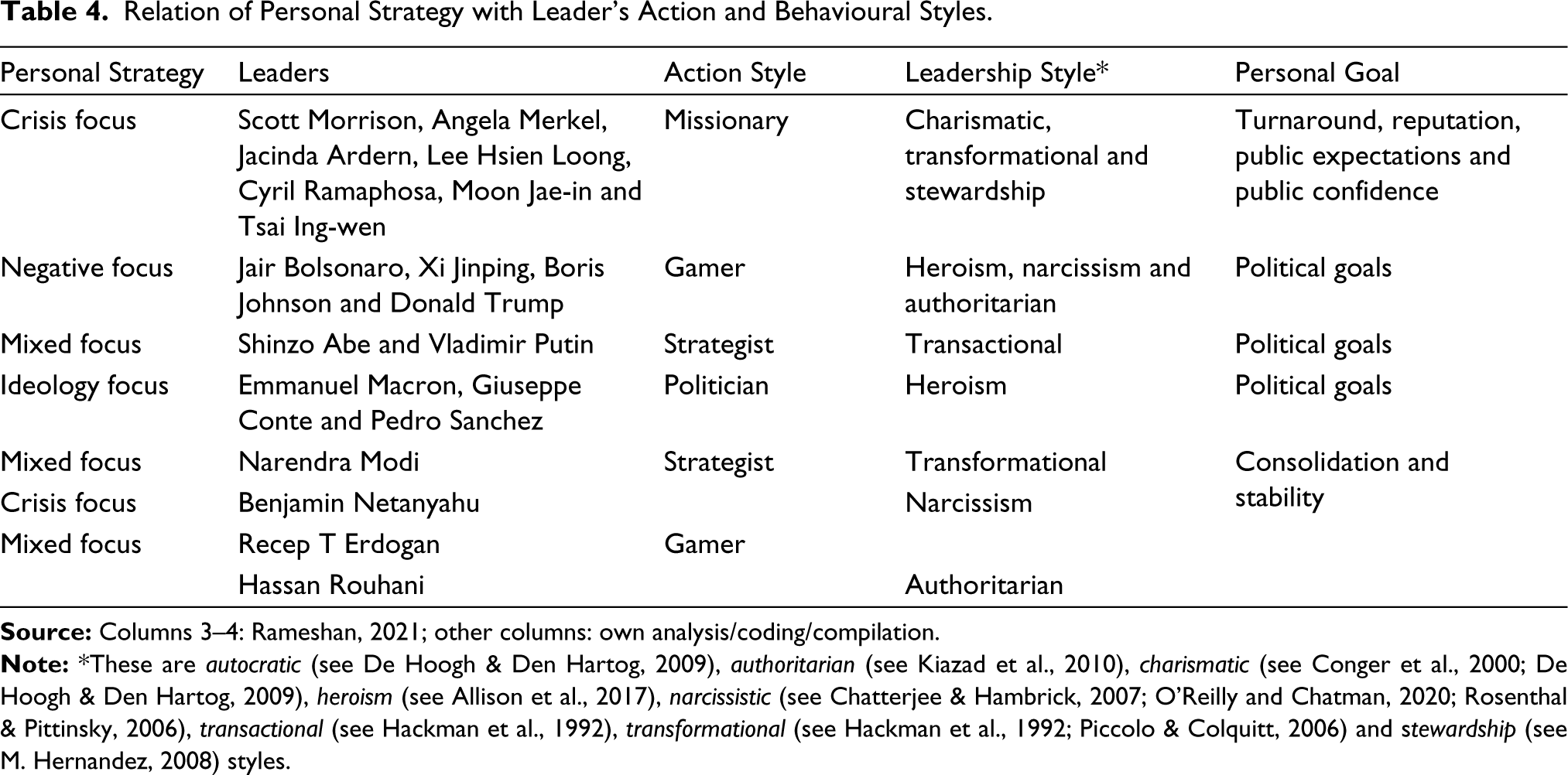
It can be seen from Table 4 that (a) crisis-focus as personal strategy is associated with missionary action style and charismatic, transformational or stewardship leader-behaviour style for seven leaders; (b) negative-focus is related, in four cases, to gamer action style and heroism, narcissism or authoritarian (negative) behavioural style; (c) ideology-focus is linked, as applicable to three leaders, to politician action style and heroism behavioural style; and (d) in two cases, mixed-focus personal strategies show association with strategist action style and transactional behavioural style. However, the aforementioned relations do not hold for one crisis-focused and three mixed-focused leaders having power consolidation or positional stability among personal goals—two of them have strategist or gamer action style, while the behavioural style of two (Benjamin Netanyahu and Recep T Erdogan) was narcissistic, one was transformational (Narendra Modi) and one was authoritarian (Hassan Rouhani).
Besides, looking through the relation of countries with geopolitical blocs, among leaders with the personal strategy of crisis-focus, five belonged to OECD while one each were of BRICS, ASEAN and no bloc; two each of negative-focus leaders are from OECD and BRICS; all three leaders with personal strategy of ideology-focus are of OECD; and two each of OECD and BRICS and the member of OIC followed a mixed-focus personal strategy. It implies that, except in the case of ideology-focus, the leaders’ choice of personal strategy is not exclusively related to the developmental or geopolitical status of their countries but, plausibly, to their own preferences. This underlines the point that personal strategy is a leader phenomenon driven by the leader’s personal goals.
At the end, a word of caution is in order. The analysis of this article is based on the COVID-19 situation during the initial 6-month period in 2020. A high degree of uncertainty and tentativeness in actions characterized this period. Both leaders and health experts alike had little idea as to what would work and what would not, and what steps could reduce pandemic cases and deaths. So, the actions of leaders reflected this confusion and it relied more on their own assessment and on their willingness to accept the advice of health and policy experts. However, as time progressed, the growing knowledge about the disease and the cumulative international experience in handling it strengthened the leaders’ actions depending on their ability to process and use information. This is the key reason why the personal strategy of some leaders evolved or shifted within the sample period of this article itself. Whether or not the new personal strategic position will sustain over time or relapse to the initial choice when the current challenges on leadership vanes is a question to be examined. Further, as months passed, the pandemic went through multiple cycles of rise and fall of different intensities and durations in different countries (as in some OECD and BRICS ones) that confused even leaders who were effective earlier (e.g., Lee Hsien Loong and Tsai Ing-wen, who had to fight off surging cases and deaths by the second half of 2021 after a long spell of relative stability) and countries that successfully tackled the pandemic before (such as New Zealand, which saw a spike in deaths by the end of 2021 after a prolonged stable situation). This article did not incorporate those experiences and evidences. Therefore, there is ample scope for further studies to validate the efficacy of the concept of personal strategy and its implications under changing circumstances. Further, new insights could be gained through such analysis on the application of the tenets of interactionist (Reynolds et al., 2010), trait activation (Tett & Burnett, 2003), social exchange (Cropanzano & Mitchell, 2005) and UE (Hambrick & Mason, 1984) theories to the personal strategy framework.
Conclusions
This article evaluated the personal strategy, and corresponding personal goals, of 20 selected country leaders, as identified from their leadership behaviour during their actions in the early phase of the COVID-19 crisis, which had truly tested every leader’s competence and resolve. The study reveals that it is possible to ascertain a leader’s personal strategy as well as personal goal(s) from their action/behaviour and its background. Differences in personal strategies among leaders created differences in action-focus and intensity that led to different results in different countries. A positive orientation of personal strategy is found to be associated with positive outcomes for both the organization (i.e., the country) and the individual leader, while a negative focus of personal strategy caused greater organizational suffering and leader ignominy. Yet, leaders were myopic about what will work and what will not, due to their personal goals often driving them to choose personal strategies that were not matching organizational needs. On the whole, the article establishes that personal strategy is, indeed, a concept that can fill the gap existing in the current literature between personal traits and leader behaviour by signifying how it acts as a medium to transmit leader traits into leader behaviour with help from a catalyst, personal goal, which helps personal strategy to integrate with organizational goals and actions.
Footnotes
Acknowledgements
The author wishes to gratefully acknowledge all sources of information and comments on this article. He also wishes to acknowledge the support of his current employer for facilitating the work. Further, the author pays his respects to all those who had to sacrifice their lives at the feet of COVID-19 due to leadership lapses.
Declaration of conflicting interests
The authors declared no potential conflicts of interest with respect to the research, authorship and/or publication of this article.
Funding
The authors received no financial support for the research, authorship, and/or publication of this article.