




Abstract
This research asks: ‘were there any objectively identifiable signals in the words leaders used in the early stages of the Covid-19 pandemic that can be associated with ineffective management of the crisis?’ We chose to focus on the leaders of the two English-speaking nations that fared worst and best in the pandemic, the United States and New Zealand. By way of background and in order to contextualise the research, we compared and contrasted Trump’s and Ardern’s leaderships using the toxic triangle framework of destructive leadership. We then focused on the leader behaviour element of the triangle by using computerised text analysis (CTA) to analyse Trump’s and Ardern’s public pronouncements during the critical early stages of the pandemic. Based on a similarity index (S), we identified linguistic markers associated with destructive leader behaviours and negative outcomes (Trump) and non-destructive leader behaviours and positive outcomes (Ardern). We discuss future applications of these linguistic markers for the diagnosis both of incumbent and potential leaders’ responses to crises management.
Keywords
Introduction
Countries have varied greatly in how they responded to and fared in the Covid-19 pandemic. In times of such crises, people look to leaders and governance institutions to ensure public safety and provide direction (Ansell et al., 2020; Van Wart and Kapucu, 2011). National political leaders bear the ‘greatest responsibility’ for public health systems and policies (Remuzzi and Remuzzi, 2020: p. 1226) and for protecting and preserving the health, safety and well-being of their nation’s citizens. Whilst there are many possible reasons for observed patterns of events in the coronavirus pandemic, research suggests that political leadership is a significant factor in determining how effective nations’ governance institutions and processes were in containing and combatting Covid-19. For example, a report commissioned by the World Health Organization (WHO) from the Independent Panel for Pandemic Preparedness and Response (IPPPR) (May 2021) found that countries with the poorest results in Covid-19 had uncoordinated approaches that devalued science and denied the potential impact of the pandemic. Medeiros et al. (2021) in a study of 35 world leaders found that the use of a pragmatic leadership style was associated with fewer infections, whilst a charismatic leadership style was associated with higher observed infection rates. Kavakli (2020) found that ‘strongly populist governments gave a weaker response to Covid-19 than other governments’ and relative to other countries, populist leaders ‘implemented fewer health measures in February and fewer closures in March [that is, early in the pandemic]’ (p. 17). McKee and colleagues (2020) argued that governments headed by populist leaders implemented fewer effective countermeasures at crucial junctures during the onset of the crisis. Lincoln (2020) claimed that the pandemic provides a natural experiment on the public health effects of hubris and notable examples include Brazil under Jair Bolsonaro, India under Narendra Modi and the UK under Boris Johnson. It would be helpful for stakeholders to know if there were any easy-to-assess objective criteria associated with such destructive leader behaviours which could serve as warning signs and thereby help to mitigate leader derailments and failures in future crises either by intervention (i.e. when a leader has attained a position of power) or prevention (i.e. when a person seeks to attain a position of power).
Aims
In this research, we aimed to find out if there are any recognisable signals in the words leaders used in their public pronouncements in the crucial early stages of the Covid-19 pandemic (‘linguistic markers’) which were associated with effective and ineffective management of the ensuing crisis. We focused on the leaders of the two English-speaking nations that fared worst and best in the coronavirus pandemic, based on the data from the Johns Hopkins University’s data (creator of the dashboard visualisation that has been used widely to gauge the spread of the coronavirus disease 2019 (COVID-19) pandemic) (see https://coronavirus.jhu.edu/map.html). The English-speaking nation that fared worst was the United States of America with a death rate of 2208 persons per million at the time of writing. The English-speaking country that fared best was New Zealand, with a death rate of six persons per million. During the worst stages of the pandemic, the United States was led by President Donald J Trump, whilst New Zealand was led by Prime Minister Jacinda Ardern (see ‘Sample’ section below). To understand how political leaders’ behaviour may have helped create the conditions for the spread of Covid-19, we turned computational linguistics (specifically computerised text analysis, CTA) as a means to answer the research question: ‘are there linguistic markers that distinguish between effective (Ardern) and ineffective (Trump) management of the coronavirus pandemic?’
We offer general conclusions based on the analysis of Trump’s and Ardern’s responses and outline the applicability of the linguistic markers we identify for the management of future crises through intervention and prevention. For example, lessons learned from leadership failures in the Covid-19 crisis and the linguistic markers that indicate such behaviours could serve to inform stakeholders, such as the electorate or public health officials, whether an incumbent or prospective leader is more likely or less likely to be able to manage future crises effectively (prevention) or how well they are performing and whether a response is required (intervention). In so doing, we respond to appeals from leadership scholars for work that redresses the balance in leadership research away from unequivocally ‘upbeat leadership’ with a more nuanced and balanced perspective of the positive and negative aspects of leadership (Alvesson, 2020).
Background: The toxic triangle
By way of background, we compare and contrast how Ardern and Trump managed the early stages of the coronavirus pandemic using the ‘toxic triangle’ of destructive leadership (Padilla et al., 2007). Destructive leadership is defined as repeated behaviour by a leader which violates the interests and well-being of those he/she leads (Einarsen et al., 2007; Krasikova et al., 2013; Schyns and Schilling, 2013). Although leader behaviours may not be destructive intentionally, nonetheless, recklessness, lack of competence or insensitivity of a destructive leader can lead to harmful outcomes (Pelletier, 2010). The outcomes of destructive leadership are a result of interactions between the three domains of the toxic triangle (leader, followers and context) as follows.
Destructive leader behaviours
Destructive leaders tend to be charismatic, manifesting primarily through their vision, self-presentational skills and personal energy, and exhibit personalised power needs related to narcissism and hubris (Asad and Sadler-Smith, 2020), and lack of humility underlain by negative life themes (e.g. traumatic childhood) and malicious ideologies (e.g. Hitler’s anti-Semitic beliefs) (Padilla et al., 2007).
Susceptible followers
Followers play a significant role in enabling destructive leadership and its toxic outcomes. For example, Padilla et al. (2007) distinguished between ‘conformers’ and ‘colluders’, whilst Thoroughgood et al. (2012) further identified five types of followers (‘lost souls’, ‘authoritarians’, ‘bystanders’, ‘opportunists’ and ‘acolytes’). The first three are the sub-types of conformer (unmet needs, low core self-evaluations and low maturity), whilst the latter two are the sub-types of colluder (high ambition and Machiavellianism and low impulse control (Thoroughgood et al., 2012).
Conducive context
Contexts conducive to the emergence of destructive leadership are characterised by instability and lack of checks and balances. Such situations allow destructive leaders to emerge, enhance their power and reinforce their potentially destructive behaviours (Einarsen et al., 2007; Schyns and Schilling, 2013). Other relevant factors include perceived threat (e.g. Trump’s claim that China had deliberately released Covid-19 virus, see Lipton et al., 2020), cultural values encouraging uncertainty and collectivism (e.g. growing populism and nationalism), absence of checks and balances (e.g. presidential or prime ministerial power enacted without restraint).
Comparison of Ardern’s and Trump’s leadership in the coronavirus pandemic.
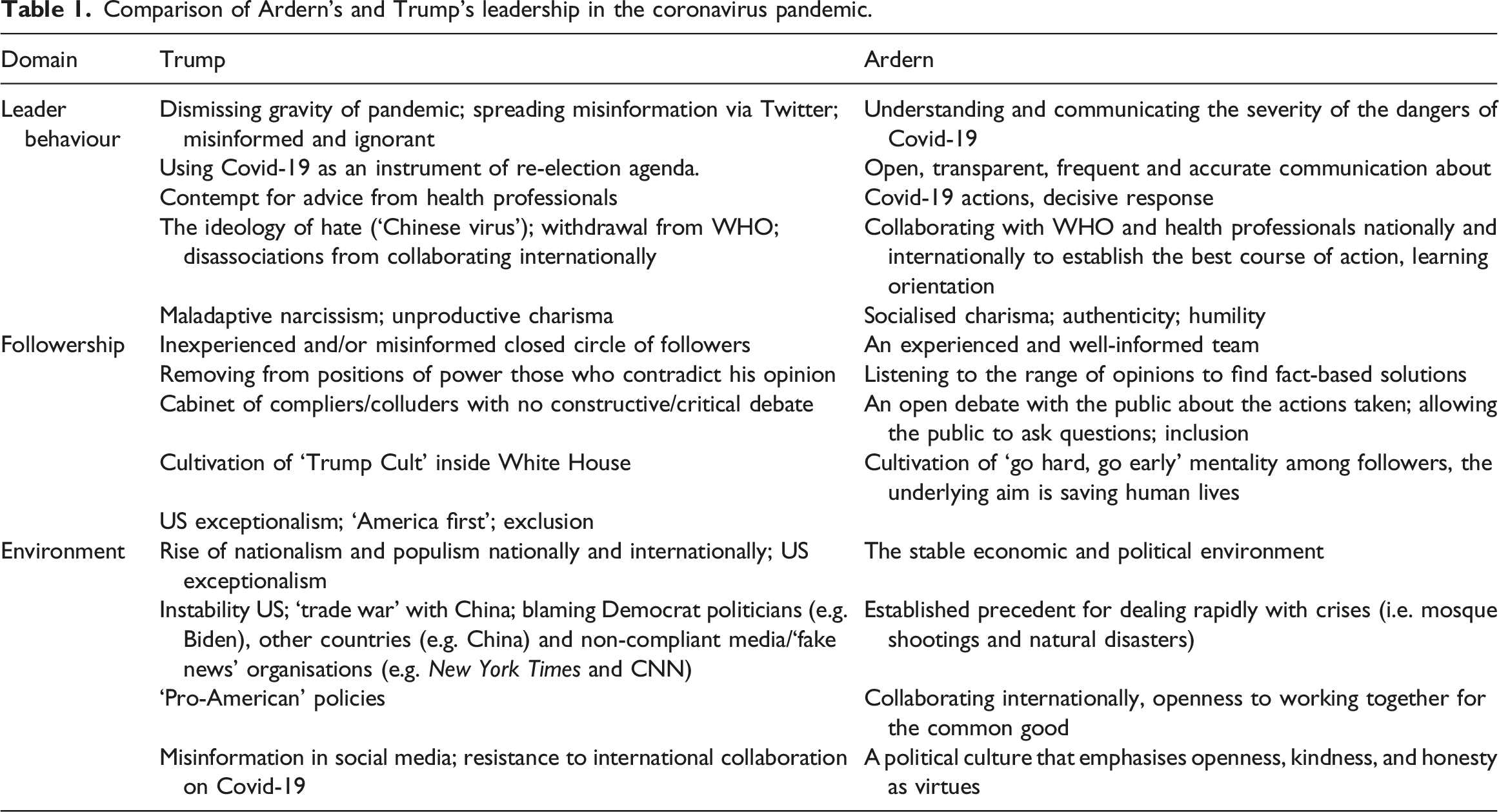
It is important to note that our study is informed by the toxic triangle as a frame for conceptualising the research but in itself comprises data and analysis only of the leader behaviour element of the toxic triangle. We do not, in the empirical section of this article, analyse all three elements of the toxic triangle. Because our focus is solely on the leader behaviour element of the toxic triangle, our research is located at the nexus of research into destructive leadership and hubris research given that hubristic leadership (Sadler-Smith, 2019) may be considered to be one variety of destructive leadership. As such, it offers contributions both to destructive leadership and hubris research.
In terms of its effects and outcomes, Trump’s leadership in the pandemic ‘precipitated a response strategy that focused on appeals to his entrenched political base, allusions to American superiority and rejection of scientific expertise’ (Crayne and Medeiros, 2020: p. 9). Trump’s pandemic leadership was objectively bad: as noted above, the death rate for the United States of America at the time of writing was 2208 persons per million and was the worst amongst English-speaking countries, whilst the death rate for New Zealand was six persons per million (a factor of 368 times lower) and was the lowest death rate for any country (see https://coronavirus.jhu.edu/map.html). The confluence of Trump’s destructive leader behaviours, a conducive context and susceptible followers resulted in: (1) the USA being too late to lockdown, for example, the first case reported in the US was on 20th January, the lockdown was 2 months later; (2) a lack of testing, for example, significant testing started only mid-March 2020; (3) epistemic hubris breeding false assumptions and incompetent actions, for example, Trump suggested that disinfectants or ultraviolet light could be used to kill the virus; and (4) a misinformed and mistaken herd immunity policy, for example, Trump’s adviser Scott Atlas advocated a herd immunity strategy (Bell, 2020; De Swielande, 2020; Deegan Krause, 2019; Dixon, 2020; Gaouette et al., 2020; Krmack, 2020; Lacatus, 2020; Lacatus and Meibauer, 2020; Mayer, 2020; Renshon, 2020; Rhodes and Sutton, 2017; Schumaker, 2020; Shear et al., 2020; Stokols and Biermann, 2020; Waldman, 2020; Wehle, 2020; Wehner, 2020; Williams et al., 2018, 2020). On the other hand, New Zealand enacted Covid-19 prevention measures promptly 3 days after the WHO announcement on 30th January of Covid-19 as a public health emergency (e.g. it stopped entry to foreign travellers from China). New Zealand has one of the smallest numbers of recorded Covid-19 cases and deaths resulting from ‘early and hard action to tackle Covid-19’ (WHO, 2020: p. 1) using rapid testing, isolation and strict social distancing guidelines through rapid response and lockdown, active testing, science-based decision-making, etc. (Baker et al., 2020; Burnette, 2020; Campbell, 2020; Fraher, 2020; Macaulay, 2020; Ray, 2020; Wilson, 2020).
We are not arguing that these interpretations are a definitive or absolute account of the observed outcomes, but we do offer them as ‘a plausible explanation for a similar outcome given a similar set of circumstances’ (Nowell and Albrecht, 2019: p. 352). The foregoing discussion of Trump’s and Ardern’s leadership in the pandemic and the different outcomes in their respective countries prompted us to ask: (1) are there any early warning signs that could alert institutions to the emergence of destructive behaviours and negative outcomes in crisis leadership and (2) could such early warning signs be used to avert negative outcomes as a result of destructive leadership in the future through intervention or prevention?
Language, linguistic markers and computerised text analysis
Given that ‘words are the central feature of social, clinical, personality, and cognitive psychology’ (Pennebaker et al., 2003: p. 572), they can be used to analyse and interpret individuals’ psychological processes and behaviours across a wide variety of contexts. Analysing senior leaders’ speech has distinct advantages: it is unobtrusive, enables the assessment of large data sets in various formats and can be used at-a-distance (Akstinaite et al., 2020). Moreover, the linguistic features which characterise leaders’ speech may be subtle to the extent that speakers themselves are unaware of them (Garrard et al., 2014). As such, linguistic markers act as ‘honest signals’ (Pentland and Heibeck, 2008) of destructive leader behaviours because their suppression and concealment in written and spoken language by deliberate and consistent masking is difficult (Garrard, 2016: p. 152); hence, it is acknowledged generally that they are hard to fake (Cohen, 2012; Roberts, 2013).
Assessments of leader behaviours using computational linguistics have been used in previous research to determine linguistic markers in spoken and written communications in various domains (e.g. Holtzman et al., 2019; Pennebaker et al., 2015). Hence, language can be used as an indicator of the emergence of destructive leader behaviours and offers great promise in the early detection and hence intervention in and prevention of such behaviours (Akstinaite et al., 2020, 2021; Garrard et al., 2014). Previous research has used computational linguistics to identify the various micro-scale linguistic features of hubristic leadership in business and politics (Akstinaite et al., 2020, 2021; Garrard et al., 2014). For example, in operationalising the use of linguistic markers for the identification of political leaders’ hubris, Garrard et al. (2014) examined the transcribed spoken discourse samples of two hubristic British Prime Ministers (Margaret Thatcher and Tony Blair) and one non-hubristic British Prime Minister (Sir John Major). Garrard et al. (2014) observed differences between Thatcher/Blair and Major regarding several notable aspects of language use, for example, greater use of personal pronouns. Akstinaite et al. (2020) pursued a similar strategy in the comparison of hubristic and non-hubristic CEOs.
An established technique for identifying linguistic markers is counting the words used in different psychological categories, for example, cognitive processes and affective processes. Most word count approaches are computerised (hence computerised text analysis, hereafter abbreviated to CTA), and several word count software packages have been developed to capture specific aspects of language use. There are a number of benefits associated with the use of CTA, namely speed (fast compared with other techniques, e.g. close reading), reliability and accuracy (not dependent on human judges), precision (enables comparison between different samples), scalability (can be used on large data sets) and comparatively inexpensive. Several CTA packages can be used to capture specific aspects of language use (e.g. Diction, Hermetic, Linguistic Inquiry and Word Count (LIWC)).
LIWC was chosen in preference to other software packages for the following reasons: (1) functionality of the other packages does not support, or is not applicable for, this research (i.e. the need to perform word counts in psychologically-relevant categories); (2) other packages focus on linguistic dimensions that are not applicable to this research and (3) dictionaries used for reference in the other software packages are not as well-aligned with the aims of organisational behaviour research as is the LIWC dictionary. Moreover, LIWC is based on a substantive theory, that of natural language use (Pennebaker et al., 2003), which posits that the words people use provide linguistic markers of cognitive processes, personality style and social integration (Pennebaker and Graybeal, 2001). Moreover, LIWC has found a number of recent applications in relevant areas of behavioural science, management and leadership (Akstinaite et al., 2020; Brandt and Herzberg, 2020; Fisch and Block, 2021; Sadler-Smith et al., 2018). LIWC ‘counts words within a given text sample’ (Pennebaker et al., 2003: p. 554) and computes scores based on word counts for predefined categories of interest, for example, ‘authenticity’, ‘cognitive processes’, ‘affective processes’, etc. (for the full list see LIWC, 2015).
We used LIWC to determine if there were any linguistic markers that distinguished between Ardern’s and Trump’s public proclamations during the vital early stages of the pandemic. If such markers could be identified, they may prove diagnostic of leaders’ responses, offer insights into underlying cognitive, personality and social factors and serve as early warning signals for the emergence of destructive leader behaviours in future crises. By integrating the different elements of our literature review, we show the relationships between the three elements of the toxic triangle (leader, followers and context), linguistic markers, actions and outcomes in our overall conceptual framework (Figure 1). Conceptual framework showing the relationships between crisis signals, toxic triangle, early warnings, action and outcomes.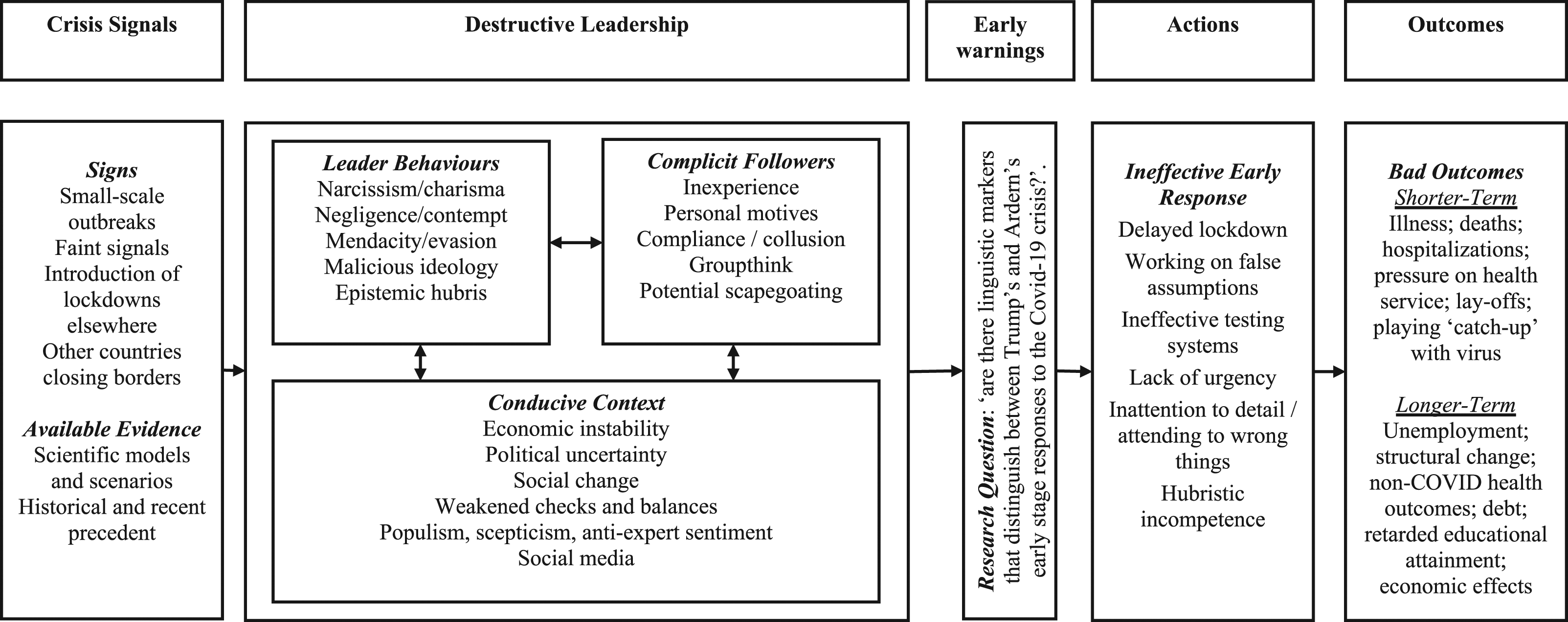
Sample and data
The need for effective early response has been the main conclusion drawn by several independent inquiries into the course of the pandemic (McKee et al., 2020; Park and Cheung, 2021). Hence, the foci of our analyses are Ardern’s and Trump’s early responses (pre-June 2020); this approach is consistent with other research which has focused on early-stage responses (Medeiros et al., 2021). Our sample has been selected purposively because the US and New Zealand represent theoretically interesting exemplars of the phenomenon of interest (destructive leader behaviours during times of crisis) that are ‘rare and unusual’ (Nowell and Albrecht, 2019: p. 353). In our sampling strategy, we sought extreme examples of crisis management so that interesting findings related to our phenomenon of interest (linguistic markers) might emerge more quickly and cleanly (Langley and Abdallah, 2011) and not be ‘obscured with other noise in the data’ (Morse, 2011: p. 234). We chose the United States and New Zealand because they were objectively the worst- and best-performing English-speaking countries in terms of death rates (see Johns Hopkins’ data cited above). The fact that they are both English-speaking is relevant given that there are no LIWC versions or dictionaries for the native languages of the small number of countries that had higher death rates than the United States.
Ardern’s and Trump’s spoken public statements on Covid-19 during the early stages of the pandemic (January 2020 to March 2020) were obtained from two principal sources. First, for Trump, we analysed transcripts available from the governmental briefings related to Covid-19 from 26th February to 30th March 2020. These transcripts are provided by the transcription company ‘Rev’, and they are available on the company’s website (https://www.rev.com/). Previous research has used this resource successfully to analyse State Governors’ briefings relating to Covid-19 (Sergent and Stajkovich, 2020). Secondly, for Ardern, we analysed transcripts available from governmental briefings related to Covid-19 that took place from 29th January to 25th March 2020. The transcripts are available on the New Zealand Government website (https://www.beehive.govt.nz/speeches).
Analysis
LIWC provides the results for two types of analyses: (1) Percentage of total words. For example, an analysis of a portion of text which gave a ‘causation’ score of 4.25 means that 4.25% of all words in the text were ‘causation’ words; ‘causation’ itself is part of the ‘cognitive process’ category; (2) Summary language variables. Each of the summary language variables (‘analytical thinking’, ‘clout’, ‘authenticity’ and ‘emotional tone’) are derived from algorithms based on previous research with results presented as standardised scores converted to percentiles ranging from zero to 100. 1 Details of how the summary language variables algorithms were developed can be found in Newman et al. (2003), Cohn et al. (2004), Tausczik and Pennebaker (2010) and Kacewicz et al. (2014). Because LIWC operates on the basis of word counts, it does not account for cadence or pauses; however, it does assess tone via the emotional tone category.
LIWC counts words in 93 different dimensions. In this study, we included the four summary language variables, which are general indicators of language use: (1) ‘Analytical thinking’, which captures the degree to which people use words that suggest formal, logical and hierarchical thinking patterns; (2) ‘Clout’, which refers to the relative social status, confidence or leadership that people display through their writing or talking; (3) ‘Authenticity’, which summarises when people reveal themselves in an authentic or honest way; authentic language is more personal, humble and vulnerable and (4) ‘Emotional tone’, which combines positive emotion and negative emotion dimensions into a single summary emotional tone variable. In what follows, LIWC dimensions and categories are indicated by ‘single quotation marks’.
We also included the following LIWC categories (dimensions in brackets) since they are indicative of relevant cognitive and emotional processes as identified by prior CTA leadership research (e.g. Akstinaite et al., 2020, 2021; Garrard et al., 2014; Sergent and Stajkovic, 2020) as follows: (1) ‘pronouns’ (I, we, you, etc.); (2) ‘affective processes’ (‘positive emotion’, ‘negative emotion’, ‘anxiety’, ‘anger’ and ‘sadness’); (3) ‘cognitive processes’ (‘reasoning’, ‘causation’, ‘discrepancies’, ‘tentativeness’, ‘certainty’ and ‘differentiation’) and (4) ‘drives’ (‘affiliation’, ‘achievement’, power, reward and risk). We report the absolute scores for each of the variables mentioned above and the similarity index (S) as follows:
An S value greater than one indicates that Ardern is higher on this variable; an S value lower than one indicates Trump is higher. Scores for all LIWC dimensions and categories are available from the authors upon request.
Results
Scores for relevant LIWC dimensions, similarities and grand means.
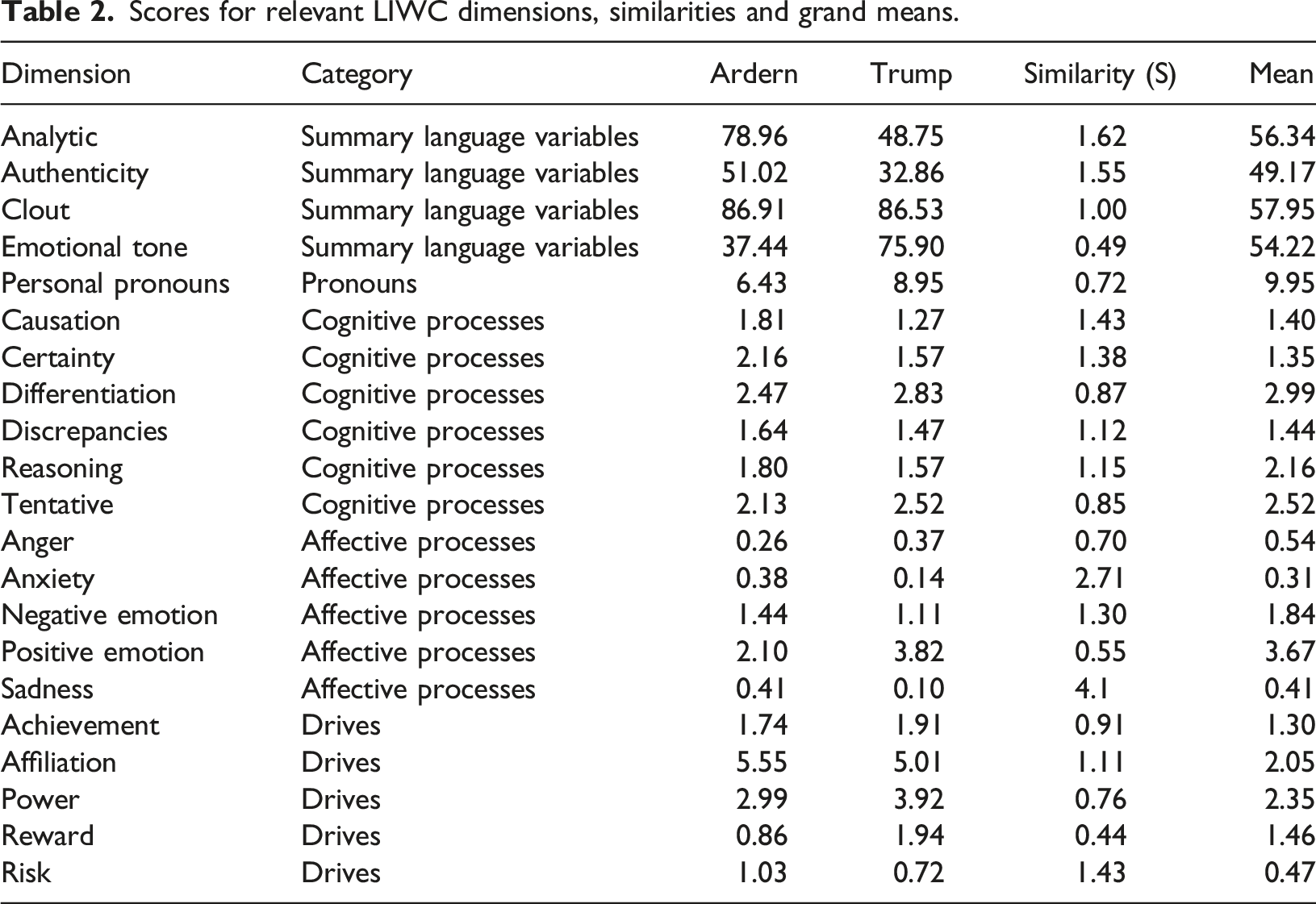
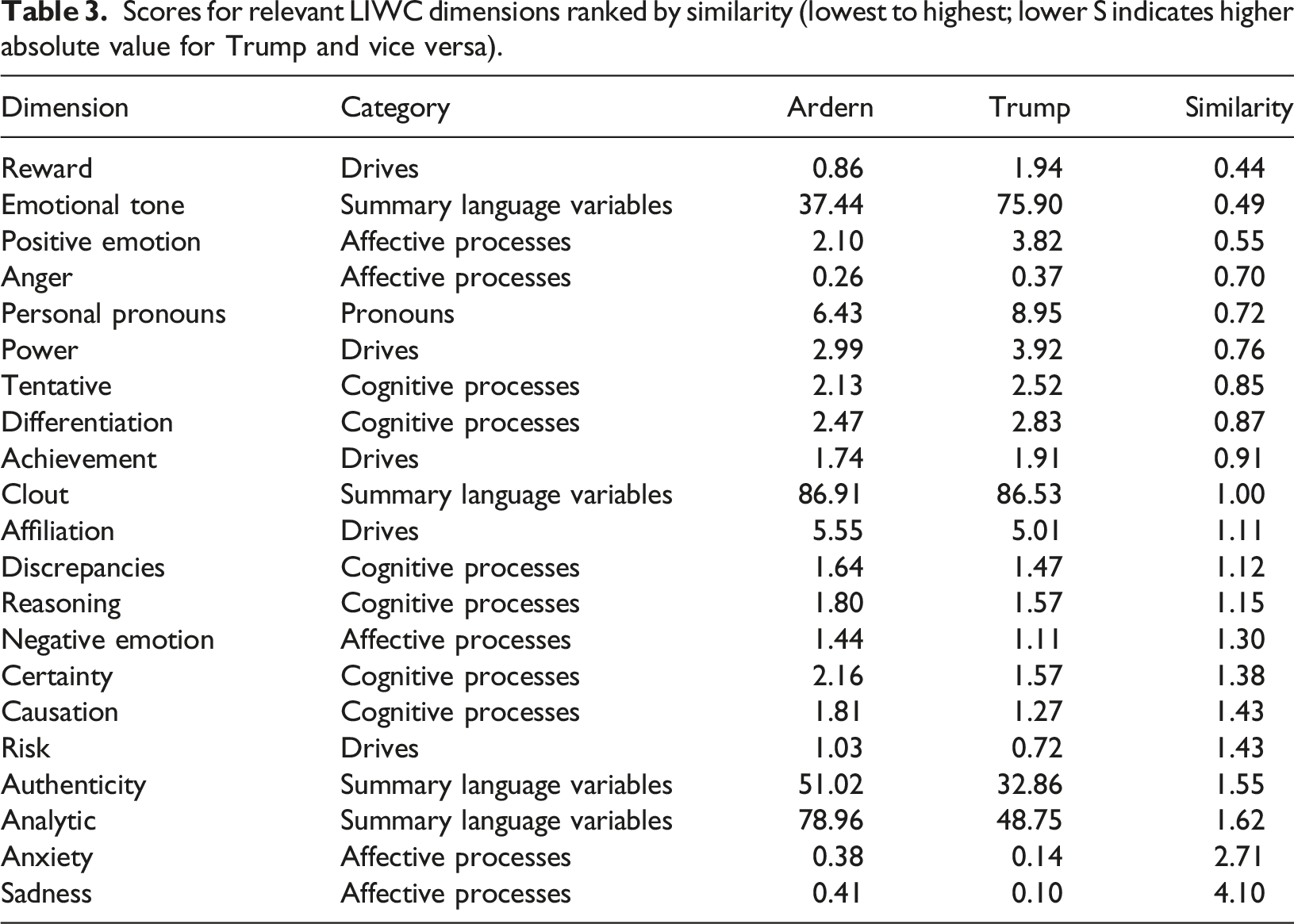
In terms of clout (a marker of the leader’s relative social status and confidence), Ardern and Trump are identical (S = 1.00). In terms of authentic and analytical speech, Ardern is higher on both dimensions (S = 1.62; S = 1.55), whilst for emotional tone, Trump is higher (S = 0.49) (see Table 2).
Based on the LIWC manual’s description of these variables, Ardern’s language indicates formal, logical and hierarchical thinking patterns delivered in a personal, humble and vulnerable way. On the other hand, Trump’s words indicate thinking patterns that are less formal and logical, delivered in a less personal way lacking in humility and vulnerability and with a higher overall positive emotional tone. Trump’s speech is also marked by a lack of humility, formality and logic. Conversely, Ardern’s speech was marked by authenticity, formality, logic and a lower overall emotional tone (see Figure 2). LIWC scores for summary language variables.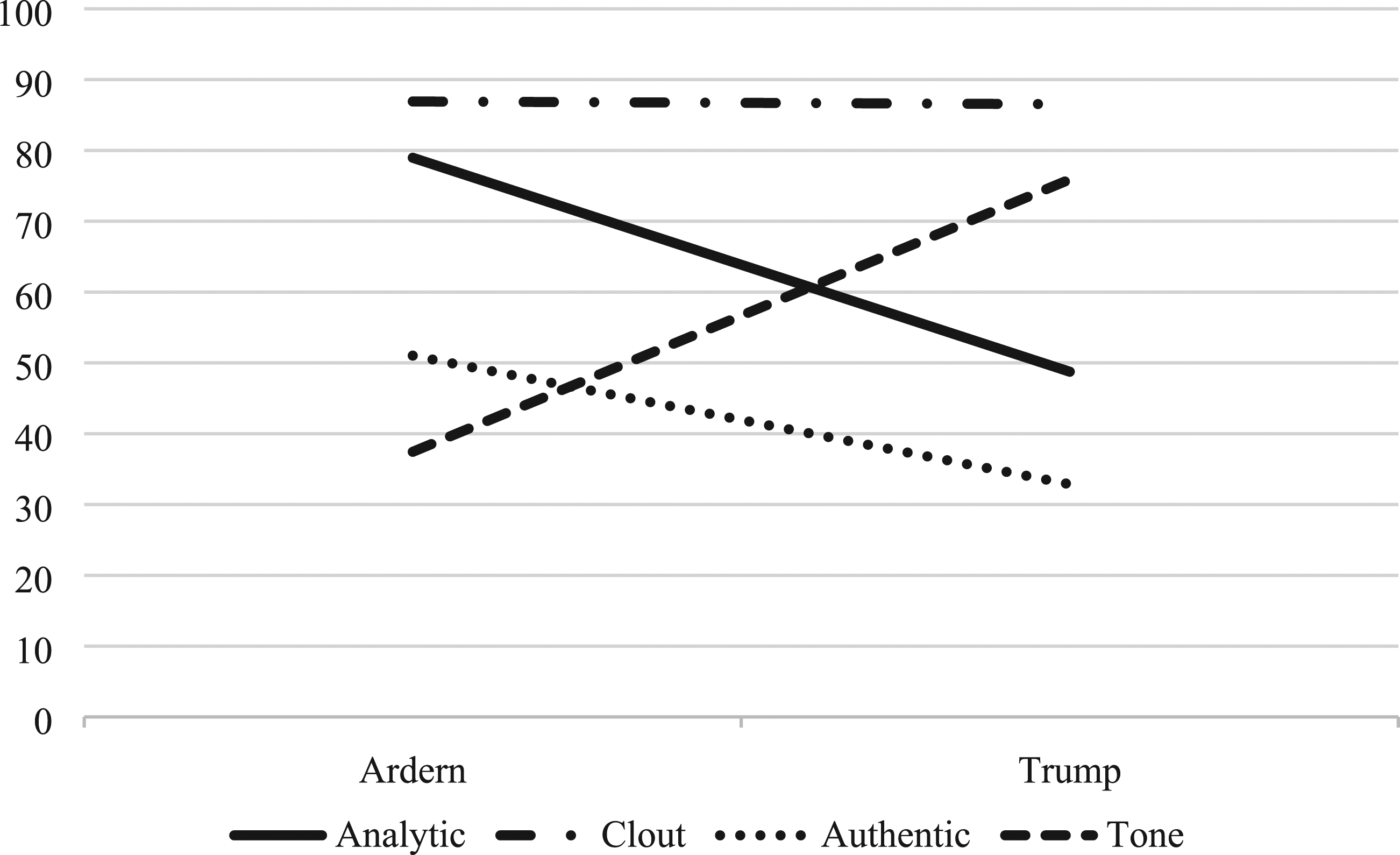
Scores for the other linguistic categories are as follows: (1) Personal pronouns. Trump’s scores are higher than Ardern’s for personal pronouns (S = 0.72). This observation is consistent with previous research in which it was observed that hubristic political leaders (e.g. Margaret Thatcher and Tony Blair) made greater use of pronouns in their speeches (Garrard et al., 2014); (2) Affective processes. LIWC decomposes the affective processes category into five dimensions. The major difference in affective processes was Trump’s much higher positive emotional tone (S = 0.55) indicating that Trump’s pronouncements on the pandemic were over-confident and optimistic (see also Table 4); (3) Cognitive processes. Ardern used more words related to causation (S = 1.43), certainty (S = 1.38), reasoning (S =1.15) and discrepancies (S =1.12). Trump used more words relating to differentiation (S = 0.87) and tentativeness (S = 0.85). This finding indicates that Ardern explained her government’s response to the pandemic in terms of reasoning and causation and with greater certainty and less tentativeness than Trump; (4) Drives. Trump’s drives were geared more towards reward (S = 0.44), power (S =0.76) and achievement (S = 0.91), whilst Ardern’s drives were more concerned with risk (S = 1.43) and affiliation (S = 1.11).
Scores for relevant LIWC dimensions ranked by similarity (lowest to highest; lower S indicates higher absolute value for Trump and vice versa).
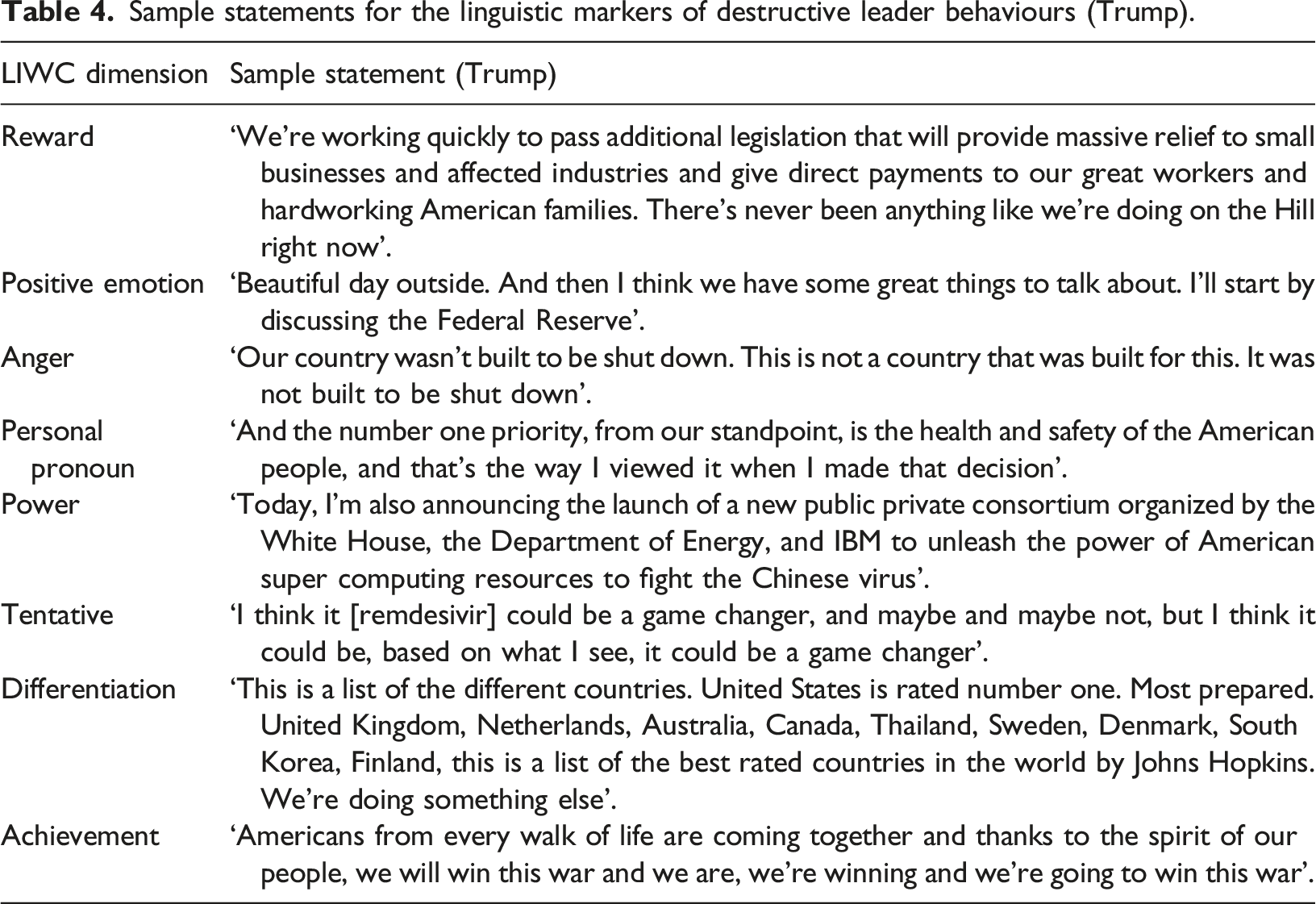
Sample statements for the linguistic markers of destructive leader behaviours (Trump).
Sample statements for the linguistic markers of non-destructive leader behaviours (Ardern).
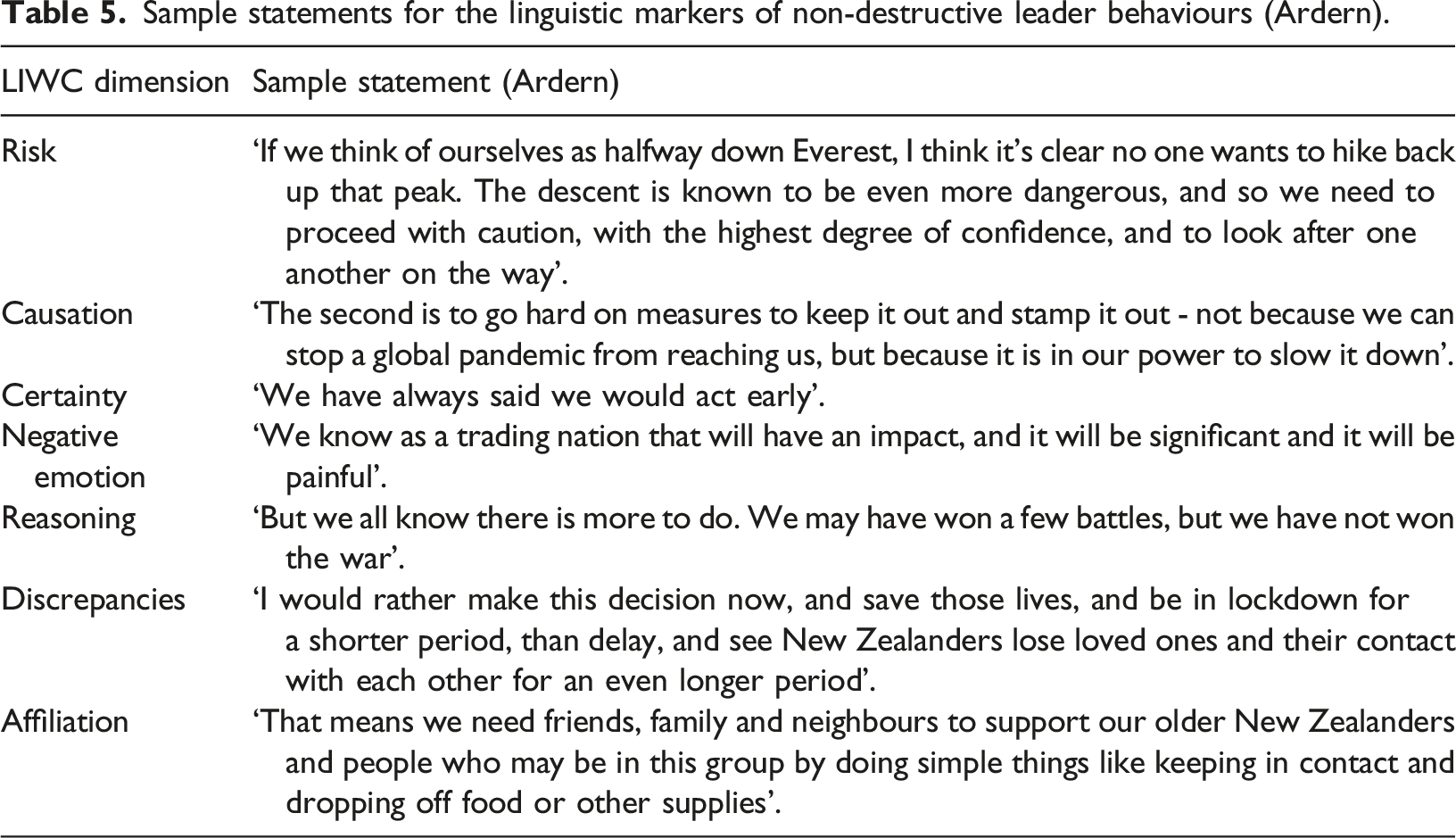
In terms of the markers of ineffective crisis management and destructive leader behaviours, the sample statements from Trump indicate: (1) a focus on financial reward (e.g. payments to ‘great workers’ and ‘hardworking families’); (2) positive, but not directly relevant, emotional factors (e.g. the weather and the state of the federal reserve); (3) liberal use of personal pronouns; (4) framing potential shut-down in terms of anger, power in terms of ‘unleashing’ and ‘fighting’, and achievement in terms of ‘war’ and ‘winning’; (5) sowing confusion regarding potential remedies (e.g. remarks about the anti-viral drug remdesivir) and (6) and inaccurately differentiating the USA from other countries. Trump’s focus on the economic rewards and consequences whilst simultaneously downplaying the severity of the public health crisis despite ‘catastrophic case numbers’ has been noted in previous research (Medeiros et al., 2021: p. 4). In terms of the markers of effective crisis management and non-destructive leader behaviours, Ardern’s sample statements indicate a focus on risk and proceeding with caution, realism with regard to slowing but not stopping the pandemic, early decisive action, acknowledging economic hardships, being rational and reasonable, trading short-term pain for longer-term gain and a practical focus on how to work communally to help each other.
That said, not everything that Trump said and did in the pandemic was unequivocally bad. For example, passing bills to give small businesses relief, trying to keep the US open and being equivocal about new drugs may be interpreted as being entirely reasonable. The same can be said of the actions of Boris Johnson in the UK, who like Trump has been frequently categorised as a leader of bad character and even as a ‘moral barbarian’ (e.g. Oborne, 2021). Researchers should resist the temptation to seize on seductive concepts such as Trump’s hubris and narcissism and use that to explain and/or condemn everything he did by simply ‘overpackaging’ (see Alvesson, 2020: p. 5).
By taking the top five and the bottom five LIWC dimensions from Table 3 and the main differences in summary language variables, we propose the following linguistic markers for ineffective and effective crisis management of the Covid-19 pandemic: (1) Linguistic markers of ineffective crisis management: non-analytical thinking delivered in an inauthentic tone; focus on reward (rather than risk); delivery in an emotional tone (with an over-emphasis on positively valenced emotions); anger of expression and personal pronouns and (2) Linguistic markers of effective crisis management: analytical thinking delivered with authenticity; an emotional tone characterised by sadness and anxiety; analytical discourse delivered in an authentic tone and focus on the risk (rather than reward).
General discussion
The purpose of this general discussion section is to put our study’s findings in the context of prior research on the subject of hubris and destructive leadership and to show how we extend this research into the study of crisis management and the detection of early warning signs of negative outcomes which could be used for the purposes of intervention or prevention.
Crises are ‘low probability/high consequence events’ that threaten organisations and societies and impose severe demands on leaders’ sensemaking (Weick, 1988: p. 305). Crisis signals in the external and internal environment indicate the potential for both unanticipated and unintended consequences. This research focused on crisis signals in the internal environment of the governments of the US and New Zealand emanating from the head of government for each country. Crisis signals, especially linguistic markers, are potentially useful in decision-making and crisis management because scanning, capturing and making sense of them is a basis for further probing and acting (Day and Schoemaker, 2008; Weick, 1988).
Our linguistic analysis revealed that Trump used highly emotional language that contained both expressions of anger and positive emotion words. In addition compared to Ardern, Trump used a higher number of personal pronouns and reward-related words and these have been identified in previous research as linguistic markers of hubris (Akstinaite et al., 2020). Moreover, Trump’s communications in the early stages of the pandemic were irrational, inauthentic and high on emotional tone, whilst Ardern’s were rational, authentic and unemotional. Ardern’s language was characterised by words relating to risk, anxiety and sadness. Additionally, the overall tenor of Ardern’s speech pattern was analytic and authentic. This finding of authenticity is in line with McGuire et al.’s (2020) research which found that Ardern’s authentic style was one of the key elements for successful pandemic communication, planning and crisis management.
Differences between Trump (low) and Ardern (high) were observed in the linguistic markers associated with the analytical summary language variable. Destructive leader behaviours (e.g. concern with self, ideological priorities and jockeying for position) crowd-out rationality (Claxton et al., 2015) and impede the ability to focus on interpreting crisis signals and their likely consequences. This finding is compatible with prior research which found an association between a pragmatic leadership style (i.e. focusing on immediate needs, avoiding hyperbole, actively enlisting exert help to generate evidence-based solutions) and fewer infections in the longer term (Medeiros et al., 2021). Leader humility, on the other hand ― as in the case of Ardern (Karelaia and Van der Heyden, 2020) ― has a ‘rebalancing’ effect on cognition and behaviour (Owens et al., 2013), thereby freeing-up the requisite cognitive resources for focus and pragmatic sensemaking (Crayne and Medeiros, 2020; Medeiros et al., 2021). On the other hand, destructive and ideologically driven leader behaviours are antithetical to evidence-based crisis management, and they produce confusion and ultimately undermine follower trust and confidence (Crayne and Medeiros, 2020; Medeiros et al., 2021; Weick, 1988). Although both were concerned with leaders’ speech, our research is quite distinct from that of Medeiros et al. (2021) on two counts: (1) methodologically we used word counts whilst they used content analysis to code speech in terms of the CIP framework and (2) theoretically in that our research was based in the Pennebaker’s theory of natural language use (Pennebaker et al., 2003) whilst Medeiros et al. (2021) used Mumford’s (2006) CIP sensemaking framework (charismatic, ideological and pragmatic). Hence, our research makes different contributions both methodologically and theoretically.
Our research indicates that leaders’ speech patterns may be indicative of dysfunctional cognitive/affective processing and personality style and that these patterns may serve as signals of potential derailment in times of crisis (Hogan et al., 1994). Such signals could be used in two ways, i.e. for the purposes of intervention and prevention: (1) intervention: linguistic markers could be used as a basis for early-stage intervention where a leader holds power, for example, in liberal democracies through the checks and balances of cabinet government and parliamentary processes, exposure through a free and investigatory press and media and popular uprisings (as in the case of the gilets jaunes [yellow vests] in France in 2018). Intervention in leadership is more problematical, not to say impossible, in other types of regimes but for such regimes locking-down whole cities in a zero-tolerance approach to managing a pandemic is a viable option and (2) prevention: linguistic markers could be used as a basis for prevention where a potential leader is seeking power by highlighting latent derailment factors associated with linguistic markers such as epistemic hubris (Sadler-Smith and Cojuharenco, 2021) to stakeholders such as voters, shareholders or employees. A further way in which such signals could be used is for retrospective research purposes, for example, to identify objective markers of potentially destructive leader behaviours and their unintended negative consequences in the mismanagement of crises and build theory.
Limitations and future research
This research is subject to a number of limitations. First, our evaluation of leaders’ communications was restricted to messages spoken in English because the LIWC software is based on dictionaries in English. No suitable dictionaries were available to assess the language of other leaders who were non-native English speakers. In the end, this is not necessarily problematical because the English-speaking leaders that we have analysed were at the extreme ends of the performance spectrum in the coronavirus pandemic (see https://coronavirus.jhu.edu/map.html). Second, in common with other research that was conducted in the ‘live laboratory’ of the pandemic (e.g. Crayne and Medeiros, 2020; Medeiros et al., 2021), leaders’ speeches were analysed in the early stages. We did not analyse how leaders’ responses may have changed during the course of the pandemic. Nonetheless, we are confident that early-stage responses were the most appropriate sampling frame for research which is focused on early warning signals with a view to suggesting ways of intervention and prevention. Third, the two data sets did not correspond absolutely precisely due to minor discrepancies in data availability from the Rev transcription data set, which was the source of the Trump data (used successfully in prior research, see Sergent and Stajkovic, 2020) and the New Zealand government data sets. Nonetheless, in common with Medeiros et al. (2021) both data sets captured leaders’ responses in the vital early stage of the pandemic, that is, when both countries had experienced their first cases and potentially significant increases in infection rates. Finally, our assessment is based on a post hoc assessment of how each country fared with respect to the coronavirus pandemic, rather than using linguistic data to predict real-time pandemic-related outcomes (see below).
Mindful of Alvesson’s (2020) critique, we did not set out to compare the obviously good with the obviously bad. We arrived at this comparison objectively by choosing to analyse the leaders of the best- and worst-performing English-speaking countries (where best and worst are not our subjective judgements but are defined by actual death rates from the authoritative Johns Hopkins’ data sets), and this gave us Trump and Ardern. Mindful of this aspect of our data, future research might look at a spectrum of outcomes and the associated leader behaviours rather than comparing what could be perceived as the obviously good with the obviously bad (Alvesson, 2020). Future research could also further extend the use of CTA to assess such linguistic markers in other crisis management situations in real-time to predict relevant outcomes. The CTA technique is scalable and ultimately could be automated through machine learning (Akstinaite et al., 2021). Such methods have applications beyond the present context, for example, as a practical tool for crisis management, and future research could aim to expand the use of linguistic markers as a measure for crisis prevention. For example, the identified markers could be applied and tested in the current climate crisis in order to assess the extent to which world leaders’ behaviours (or those of business leaders) are variously contributing to or detracting from dealing with the crisis effectively. Linguistic markers give leadership researchers a powerful general set of tools for analysing leader behaviours in crisis management across a variety of contexts including politics and business.
Conclusion
The problems of hubristic and destructive leadership raise many leadership, governance and public administration issues, present a leader derailment hazard and heighten the risks of negative outcomes from the interactions of destructive leader behaviours, complicit followership and conducive contexts (Padilla et al., 2007) and from the incompetent behaviours that are one of the hallmarks of hubris (Owen and Davidson, 2009). Authentic leaders are willing and capable of recognising the limits of their knowledge (thereby avoiding epistemic hubris) and prepared to listen to experts and heed advice (thereby cultivating epistemic humility), ask probing questions and be open to reflecting in and on action (Pisano et al., 2020; Sadler-Smith and Cojuharenco, 2021). Given that authenticity is a highly desirable leadership behaviour, leaders should be prepared to learn from past crises and adopt solutions that worked in the past or have worked in other similar situations (O’Flynn, 2020). Leaders should also be prepared to admit when they might be wrong and when their policies are not working (Pisano et al., 2020). Political leaders who fail to do so can be held to account by the electorate in liberal democracies, as can CEOs by shareholders.
Linguistic analysis of leaders’ utterances during the early stages of potential crises is a potential means by which followers and other stakeholders might identify incipient destructive leader behaviours, manifesting as epistemic hubris. Such linguistic markers are likely to manifest as words indicative of thinking patterns that are less formal and logical, delivered in a less personal way, lacking in humility and vulnerability but with a higher overall emotional tone, as opposed to words that indicate formal, logical and hierarchical thinking patterns delivered in a personal, humble and vulnerable way. As noted above, linguistic markers of ineffective crisis management as found in this research manifest in focus on reward (rather than risk), high emotional tone, emphasis on positively valenced emotions, the expression of anger and the use of personal pronouns. On the other hand, linguistic markers of effective crisis management are characterised by an analytical and pragmatic discourse, a tone of sadness, anxiety and authenticity and a focus on risks (rather than reward). We have been careful only to claim association and not causality in this research but nonetheless argue that the linguistic markers we have identified could be construed as signals that a leader is creating the conditions out of which negative consequences, albeit unintended, may be more likely to arise and may therefore warrant intervention and ideally prevention, given that ‘an ounce of prevention is worth a pound of cure’.
Scholars have long-warned of the perils associated with destructive leadership. Preventing or intervening in destructive leadership constitutes a major priority and challenge in politics, public administration and business in order to deal effectively with future crises that are knowable (such as new pandemics, climate or a political crisis) as well as those that are unknowable (but for which a potentially destructive leader may be unsuited). Failure to learn from crises has allowed the negative consequences of destructive leadership in the pandemic to spill-over and entangle individuals, institutions, firms, industries and entire economies and societies with grave repercussions nationally and internationally at an immense economic and human cost. The identification and analysis of linguistic markers as a basis for intervention or prevention could be an objective, simple and scalable tool that might help mitigate against the occurrence of such crises in the future.
Footnotes
Declaration of conflicting interests
The author(s) declared no potential conflicts of interest with respect to the research, authorship, and/or publication of this article.
Funding
The author(s) received no financial support for the research, authorship, and/or publication of this article.
