



Abstract
This theoretical paper presents an extended Job Demands–Resources (JD–R) theory aimed at understanding how organizations and their employees can best deal with COVID-19 and other crises in the workplace. The crisis showed that job characteristics alone are insufficient to explain employee health and motivation, i.e., the two focal outcomes of the JD-R theory. Rather, demands and resources of the individual, the family, the job and the organization interact with each other to predict outcomes. Moreover, next to individual regulatory strategies also the regulatory strategies of the family, the leader and organization/team are suggested to modify the impact of demands and resources on outcomes. This was possible by integrating the crisis management literature in JD-R theory. Viewing the crisis from a job design perspective helped us to introduce several new and testable propositions that specify how employee well-being and functioning are impacted by crises and turbulent times.
Plain Language Summary
Organizations have been struggling to find out how their employees are affected by the COVID-19 pandemic and what they can do to support their well-being and improve their functioning during the pandemic and beyond. The well-being and job performance of individual employees are difficult to predict which becomes even more complicated during times of crisis. The Job Demands–Resources theory is a helpful means because it suggests that employee health and motivation are outcomes of two different processes, i.e., the health impairment process and the motivational process. Job demands, such as work pressure and demanding customers, exhaust the energy of employees and consequently diminish their health, whereas job resources, such as autonomy and social support, help employees to deal with the demands and to develop themselves. The pandemic showed that the interplay between demands and resources of the individual, the job, the family and the organization predict outcomes. Moreover, next to individual regulatory strategies also the regulatory strategies of the family, the leader and organization/team are suggested to modify the impact of demands and resources on outcomes. Viewing the crisis from a job design perspective helped us to introduce in the Job Demands–Resources theory several testable propositions that specify how employee well-being and functioning are impacted by crises and turbulent times.
Like earlier crises, the COVID-19 pandemic is linked to increased ambiguity and uncertainty, forcing organizations to manage risks by taking various measures to protect employee health and improve the organization's chance for survival (Combe & Carrington, 2015). How the pandemic influences employees’ health and the organization's functioning depends on the specific measures that are taken to deal with the crisis. The pandemic has forced political leaders to take measures on a national level, but also forced organizational leaders to take measures in teams, families to take measures at home, and individuals to take personal measures (Kniffin et al., 2021). Uncovering the factors that determine the impact of major societal crises, like COVID-19, on employee health and well-being as well as organizational survival is essential. Moreover, COVID-19 represents a health crisis that has important implications for occupational health.
Job Demands-Resources (JD-R) theory is widely used to explain organizational processes influencing employee health, well-being, and performance. Moreover, there is ample evidence confirming its main propositions (Bakker & Demerouti, 2017; Lesener et al., 2019). However, has JD-R theory been able to explain employee outcomes during crises like the COVID-19 pandemic? Our impression is that the answer is affirmative. Several recent studies have used JD-R theory as a conceptual framework to investigate the impact of (remote) work on employee, family, organizational, and societal outcomes (Bapuji et al., 2020). These studies introduced some pandemic-specific demands and resources (e.g., risk of infection of team members, operational readiness; e.g., Thielsch et al., 2021), whereas others discussed (e.g., Bilotta et al., 2021) or tested the importance of specific job characteristics (e.g., destructive leadership; Dolce et al., 2020).
The question that now arises is whether JD-R theory is sufficiently able to predict well-being and performance during crises and whether the COVID-19 crisis may have led to new insights that require adaptations of the theory to increase its applicability and ability to predict outcomes also in turbulent times. We aim to make three contributions to the literature. First, we contribute to JD-R theory by expanding the scope of its propositions such that they integrate various life domains. In this way, we increase JD-R's predictive value during crisis situations and beyond. This may give a further boost to research on well-being and performance. Second, we contribute to the crisis management literature by linking this body of work to job design and employee well-being as conceptualized in JD-R theory (Bakker & Demerouti, 2017; Demerouti et al., 2001). By integrating these literatures, we are able to specify the impact of the pandemic on employees and their jobs which will eventually determine how effective crisis management measures are. Third, we contribute to job design and employee well-being literatures by focusing on the processes through which jobs and employees are influenced by macro factors (i.e., crises). What are the processes through which a crisis, like COVID-19, changes job characteristics and influences employee well-being?
Crisis management in organizations
Organizational crises refer to highly ambiguous and threatening situations where causes and effects are unknown (Quarantelli, 1988). Such crises have a low probability of occurring but pose a major threat to the survival of an organization (Shrivastava et al., 1988). A crisis sometimes surprises organizational members (Hermann, 1963), and usually offers only limited time to respond (Quarantelli, 1988). It presents a dilemma in need of a decision or judgment that will result in change for better or worse (Aguilera, 1990).
In this context, crisis management is generally viewed as a cycle or process. Crisis management practices include any action that can help prevent incidents, as well as enhance workplace risk perceptions and performance (Haas & Yorio, 2018). Recent research has examined crises as the interplay between internal and external forces occurring in multiple phases (Sherman & Roberto, 2020). These phases generally include (a) the identification and assessment of internal and external threats (e.g., how damaging COVID-19 is for the business as well as employee health and safety), (b) the specification of strategic resource deployments to counter those threats (e.g., changing the workflow and building design, providing proper/adequate equipment and tools as well as personal protective equipment, organizing work remotely), (c) the management and follow-up actions once the crisis occurs (e.g., adjustment of buildings or ways of communication), and (d) the identification of lessons learned both internally and by others after the crisis (Crandall et al., 2015; Sherman & Roberto, 2020).
According to Pearson and Clair (1998), crisis management efforts are effective when ongoing operations are sustained or resumed (i.e., the organization is able to maintain or regain the momentum of core activities necessary for transforming input to output at levels that satisfy the needs of key customers), organizational and external stakeholder losses are minimized, and learning occurs so that lessons are transferred to future incidents. Managers who effectively manage a crisis ensure that key stakeholders can improvise and interact. In this way, individual employees, teams, and departments are stimulated to engage in collective sensemaking, develop shared meaning, and reconstruct organizational roles. Eventually, effective crisis management entails individuals and organizational groups changing their basic assumptions, emotions, and behaviors with the aim to readjust from the crisis and recover (Pearson & Clair, 1998).
Individuals and teams managing unexpected events or crises are faced with a dilemma (Maitlis et al., 2013). On the one hand, hazardous and rapidly unfolding situations are usually difficult to comprehend, which means that individuals need to collect information before they can determine the most appropriate action. On the other hand, urgent situational demands usually require people to take immediate action even with incomplete information as doing something is usually better than doing nothing. Taking action during a crisis thus involves a trade-off between “dangerous action which produces understanding and safe inaction which produces confusion” (Weick, 1988, p. 305). Whereas early actions in a crisis determine the trajectory of the crisis (Weick, 1988), during a crisis, actions strengthen commitment at precisely the time that flexibility and improvisation are required (Maitlis et al., 2013). Eventually, crisis management may change the decision making of an organization and motivate managers to alter organizational policies and procedures (Seeger et al., 1998).
The role of management
Scholars have suggested that crisis preparedness starts with executive perceptions of risks and risk-taking (Mitroff et al., 1996; Pauchant & Mitroff, 1992; Pearson & Clair, 1998). If executives do not believe their organization is vulnerable to crises, they will not allocate resources to prepare for or safeguard against those risks. Perceptions of senior executives determine cultural beliefs in the organization about the value of and need for crisis management (Pauchant & Mitroff, 1992). Even in industries that are regulated or where crisis management practices have been institutionalized, executive perceptions and the cultural environment must support crisis management for programs to be highly effective (Pearson & Clair, 1998).
Although top management provides important details about the crisis and specifies the necessary measures, middle managers are left to construct their own meanings of it, and therefore play a crucial role in how measures to combat the crisis ultimately get passed on to frontline employees (Maitlis & Sonenshein, 2010). Moreover, middle managers mediate the sensemaking between top managers and frontline employees, because due to their position they can affect both employee cognitions and actions. Specifically, Beck and Plowman (2009) highlight how middle managers frame and enrich the interpretation of unusual events in organizations, an activity they are uniquely positioned to do because of their proximity to interpretations of both strategic and frontline managers. Another key activity for middle managers during crises is engaging in sensegiving. Middle managers’ sensegiving regulates subordinates’ emotions and actions and creates a sense of continuity and change (Huy, 2002). We will discuss later on how they do this. Whereas a focus on top and middle managers is important, frontline employees are often responsible for implementing the bulk of crisis management efforts. Accordingly, the key is to unpack how frontline employees make sense of a crisis in ways that align with the sensemaking of management and reduces competing enactments of organizational crisis management.
The role of employees
Engaging in sensemaking of risks may help organizations and their leaders to stimulate individuals to invest cognitive, social, and motivational resources to accurately perceive and participate in risk management (Haas & Yorio, 2018). Engaging workers so that they can perceive and initiate responsibility, regardless of the risk, is essential to managing a dynamic environment (Haas & Yorio, 2018). Employees play a pivotal role in crisis management although their role is not really recognized in the literature. We specify their contributions in three ways. First, since employees have the most thorough knowledge about their job and how to best execute it, they may be best able to suggest effective measures to minimize the impact of the crisis on their work. For example, a university president may decide to allocate budget to buying licenses for remote teaching tools, but the faculty of various disciplines will decide which specific tool to buy for the form of teaching that is used. Second, even measures with a lot of potential will not effectively reduce the impact of the crisis if these measures are not correctly implemented, or if the measures are not used at all by those who are supposed to use them. For instance, COVID-19 measures required that customers keep distance from each other and the service employee. This could only be effectuated by front-line employees who need to implement this measure by organizing the service such that the distance can be kept. Third, since organizational viability and performance depend on employee performance, employees are key for the survival of the organization—particularly when performance is threatened due to the challenges of the crisis. This requires that employees are motivated to perform well and that that they are able to do so even during crisis. The question is how this can be achieved.
The roles of multiple actors
Up to now, we saw that effective crisis management depends on action of the organization or top management, the middle management and the work teams that they lead as well as frontline employees. These actors are important but not sufficient. Because individuals bring their work stress home and their home stress to work, in a crisis where individuals must work remotely, boundaries between these spaces become even more blurred. This increases the role of family or friends as important actors that may pose another stressor or provide support during crisis management as crises often reveal the importance of close relationships (Gabriel & Aguinis, 2022). This was particularly the case during the COVID-19 pandemic that forced employees to work from home but has been found relevant also to other crises, e.g., hurricane Katrina (McCanlies et al., 2018) or the economic recession of 2008 (Burgard & Kalousova, 2015). Although the government with its state regulations represents another key actor during a crisis, this falls outside the scope of this article since it requires specific analyses. Moreover, some of the impact of state regulations may occur through organizational policies, which are largely influenced by governmental or state regulations (Parker et al., 2017). Next to the government or state level, another player that gained importance during the COVID-19 pandemic is the family. Perhaps this is contingent on the nature of the crisis, but the literature seems to suggest that the family system is important during crises.
Already in the 50's Hill (1949, 1958) developed the ABCX model to describe the adjustment of families to the crises caused by the Second World War. Accordingly, the adjustment and adaptation of families to crisis-precipitating events can be explained by the following formula: A (the crisis-precipitating events or demands) interacts with B (the family's crisis-meeting resources) and with C (the definition the family gives to the event) in order to produce X (the crisis). The stressor or crisis-precipitating event represents a life event that places demands on the family system that have to be managed in order to prevent the system from going into a crisis (Paterson, 1988). Resistance resources or crisis-meeting resources are defined as the family's ability to prevent change in its system from leading to disruptiveness or a crisis. Examples of such resistance resources are personal resources of individual family members (e.g., self-esteem and sense of mastery), family resources (e.g., cohesion, adaptability, and effective communication skills), and community resources (e.g., health-care facilities and social support) (Paterson, 1988). Whether the family will move from the stressor event into a state of crisis depends on the family's definition of the stressor event or sensemaking which is based on family's value system, and its previous experience and mechanisms in meeting crises. Family's inability to restore stability during crisis events occurs when there is a deficiency in existing resources (B factor), when they misinterpret stressor events and when the family has low capability in family coping behavior (i.e., coordinated and complementary problem-solving efforts of the family members within the system) (Paterson, 1988).
This model highlights precisely the idea that we will discuss in this paper namely that multiple actors, including the organization, the leader, the family, and the individuals themselves, influence the well-being and functioning of employees during crises and that the impact of the crisis depends on the level of demands it poses, the available resources as well as coping capacity to deal with the crisis and the sensemaking or interpretation of the crisis by the different players. The question is how these multiple actors explicitly influence the well-being and performance of employees during a crisis and what can be done to retain these outcomes at high levels when they are threatened (by the crisis). To answer this question, we focus on the work context and introduce an expanded version of JD-R theory to explain the specific processes that influence employee well-being and performance. We do this by discussing how the crisis led to falsification or expansion of JD-R theory and by putting forward new theoretical propositions.
Job demands–resources theory during crises
According to Job Demands-Resources (JD-R) theory (Bakker & Demerouti, 2017; Demerouti et al., 2001), every work context can be characterized using two categories of job characteristics: job demands and job resources. Job demands are defined as those aspects of the job that require sustained physical and/or psychological effort (e.g., work pressure, cognitive demands) and are associated with physiological and/or psychological costs (Demerouti et al., 2001). Job resources refer to those aspects of the job that are functional in achieving work goals, reduce job demands and the associated physiological and psychological costs, or stimulate personal growth, learning, and development (Demerouti et al., 2001)—examples are social support, task significance, and opportunities for growth.
The essence of job demands is that they consume energy because demands must be addressed. The essence of job resources is that they generate motivation (i.e., the voluntary initiation of action to achieve goals) and buffer the effects of job demands on employee well-being and performance (Bakker & Demerouti, 2017). These principles imply that the absence of a job demand has no motivating potential, whereas the absence of a job resource is not necessarily stressful—rather, the voluntary initiation of action to achieve work-related goals is not facilitated.
Mapping the relevant demands and resources of a specific job can be used as a diagnostic tool to uncover whether this job has too much or too little of any of the two. This is important, since job demands and resources may initiate two independent processes—a health-impairment process and a motivational process, respectively. In the health-impairment process, chronic job demands use up employees’ cognitive and physical resources (can do), and may therefore lead to energy depletion (i.e., a state of chronic exhaustion, which is a core component of burnout). When individuals need to constantly invest high effort to deal with their job demands, they deplete their energetic resources, start to develop health complaints, and undermine their own functioning (Bakker & Demerouti, 2017; Hockey, 1993). In the motivational process, job resources may either function as intrinsic motivators by fostering employee's growth, learning and development, or as extrinsic motivators by facilitating the achievement of work goals. The experience of motivation (want to) consequently leads to improved functioning.
JD-R theory further proposes that jobs are designed optimally when they set manageable demands on employees and provide sufficient resources to deal with these job demands. In other words, the interaction between job demands and job resources is also important—next to the sole existence of any job characteristic (e.g., Bakker et al., 2005). More specifically, according to JD-Rs buffer hypothesis, job resources can weaken or buffer job demands’ unfavorable impact on health and well-being (e.g., Bakker et al., 2005; Shin & Hur, 2021a, 2021b). This means that job demands will be less effortful and less straining when there are many resources available in the work environment. In addition, according to JD-Rs boosting hypothesis, challenging job demands can strengthen or boost job resources’ favorable impact on work engagement (e.g., Breevaart & Bakker, 2018; Tadic et al., 2015). This means that job resources will be more motivating when work is really complex and a serious test of one's abilities.
Rather than being a mechanistic theory (stimulus-organism-response), JD-R theory acknowledges that employees’ personal demands and resources may play an important role. Personal resources refer to aspects of the self that are generally linked to resiliency and capture employees’ ability to control and impact upon their environment successfully (Hobfoll et al., 2018). Personal resources play a similar role as contextual job resources protecting individuals from job demands and the associated costs, stimulating their growth, and facilitating goal achievement (Xanthopoulou et al., 2009). Furthermore, personal demands have been defined as “the requirements that individuals set for their own performance and behavior that force them to invest effort in their work and are therefore associated with physical and psychological costs” (Barbier et al., 2013, p. 751). Depending on their nature, personal demands may be involved in the health-impairment process proposed by JD-R theory (like workaholism; e.g., Guglielmi et al., 2012) or in the motivational process (like performance expectations; e.g., Barbier et al., 2013). Highlighting the importance of personal resources during COVID-19, Losada-Baltar and colleagues (2021) found that personal resources (e.g., self-efficacy, entertainment resources) were negatively associated with loneliness and psychological distress in the first week of the lock-down due to the COVID-19 outbreak. Britt et al. (2021) found, however, that personal demands (health threats to self and others, including partner and colleagues) were positively related to psychological distress. This implies that personal resources are favorable whereas personal demands are unfavorable individual characteristics during the COVID-19 crisis.
JD-R theory can be used by researchers and practitioners as a job analysis framework to diagnose possible causes of diminished health and motivation during the pandemic. The application of the JD-R theory for this purpose requires a focus on employees’ activities, the interactions with people within and outside the organization, the context in which work takes place, and the organizational processes and procedures that frame how things are done in the organization. After that, a specific level of abstraction is applied in order to understand which demand or resource is relevant and (un)favorably designed in the specific work context. For instance, for intensive care nurses who have to provide care to COVID-19 patients and who are confronted with suffering patients and absent colleagues, we may conclude that they work under time pressure and are exposed to high emotional demands. To specify a job characteristic as a job demand or job resource, it is important to consider the definition of job demands and resources instead of considering all negative work aspects as demands and all positive aspects as resources.
There is ample evidence for the two separate processes in JD-R theory and for the suggested unique outcomes of those processes (Bakker & Demerouti, 2017). High or unfavorably designed job demands initiate a health impairment process resulting in exhaustion and health problems (e.g., anxiety, depression, PTSD). Job resources initiate a motivational process and increase employee work engagement and performance. Moreover, work contexts combining high job resources like appreciation and innovativeness, are most predictive of work engagement when job demands (e.g., pupil misbehavior, unfavorable physical working environment) are high (Bakker et al., 2007). On the contrary, employees report the highest levels of exhaustion and cynicism when high job demands (i.e., workload, physical demands, emotional demands and work-home interference) coincide with low job resources (i.e., autonomy, social support, relationship with the supervisor, and performance feedback) (Bakker et al., 2005).
Impact of COVID-19 on job demands, job resources, and employee outcomes
The COVID-19 crisis has had a major impact on our work and the way we execute it. Governmental regulations forced organizations to adjust their organizational practices to restrict the spread of the virus. These regulations were translated into altered organizational demands (e.g., additional health and safety measures, online meetings/provision of service) and altered resources (e.g., ICT support, financial resources). It can therefore be expected that COVID-19 has altered the job demands and job resources for most occupational groups (Kniffin et al., 2021). Some job demands increased for all employees, like risk of contagion, social isolation, and loss of usual working routine (Brooks et al., 2020). Other job demands only increased for some occupations, like workload for health care, security, and logistics; job insecurity for the touristic and retail sectors; and role demands such as work-to-family conflict for those forced to work from home (Barello et al., 2020; Gössling et al., 2021; Vaziri et al., 2020).
For specific occupations, like the education and service sector, the COVID-19 crisis resulted in altered job demands because professionals had to adjust their work as they had to work remotely (Wang et al., 2021). Still, there are occupations in which the workload was drastically reduced because of local lockdowns, for example, cleaning personnel and receptionists as well as catering and cultural businesses. Organizations have generally offered job resources to help employees deal with the pandemic—with the provision of information (regarding measures to combat the pandemic) being the most important resource (also for sensemaking). Due to the necessity to work from home, autonomy and computer-mediated communication may have increased if leaders understood their importance to deal with the increased job demands as they are essential to motivate employees and to help them reach their work goals (Wang et al., 2021).
Irrespective of the occupation, the crisis has led to increased job demands because all employees have been required to work differently as a consequence of the pandemic. In this way, the crisis has changed job demands and increased threats for own and public health which require additional effort by employees (Kniffin et al., 2021). This increase in job demands is not unique for the COVID-19 pandemic. Centra and Gualtieri (2014) showed that the economic crisis, via the employment crisis, had significantly changed quality of work by increasing job complexity and worsening ergonomics, whereas Bussing (1999) highlighted the increase in ambiguity/uncertainty and insecurity. At the same time, some job resources have gained importance due to the requirements of remote working or overload. For example, a supportive work environment in the form of supervisor and colleague support has been shown to be essential during the current (Britt et al., 2021) and during earlier crises (e.g., Belfroid et al., 2018). Social support seems to act as a “negativity buffer” (Bavik et al., 2020). Another job resource that has become essential during the crisis because it reduced the ambiguity related to it is adequate communication by the organization regarding issues related to the pandemic (Britt et al., 2021). Therefore, our first proposition is:
Crises influence job characteristics by increasing the level of job demands (such as insecurity and role ambiguity/uncertainty) and the importance of job resources (such as social support and adequate communication).
Employee outcomes
The pandemic has impacted occupational health and safety in many respects, although the degree of impact differs between occupational groups (Rudolph et al., 2021). Research on the impact of COVID-19 has focused on health and well-being (e.g., burnout, life satisfaction, loneliness, procrastination; Van Roekel et al., 2021; Wang et al., 2021) and performance-related outcomes (e.g., task performance; Bakker et al., 2021; Wang et al., 2021). In principle, we want employees to effectively adapt to a crisis situation and maintain a satisfactory level of well-being and performance (cf. Krok et al., 2021). In line with JD-R theory, this can be achieved when job demands are high but manageable and job resources are sufficiently high. Within this constellation of working conditions, employees will remain healthy and motivated to perform their work tasks effectively. Failing to provide sufficient job resources to employees during a crisis, or setting too high job demands in light of the crisis, will increase the likelihood that employees become fatigued and demotivated (see Figure 1). This implies that employees will lack the engagement needed to contribute to organizational outcomes (productivity, high-quality services) or will be unable to make a valuable contribution due to diminished energy resources or health problems. More than ever, it is important during crisis to aim for or retain an optimal constellation of job characteristics (manageable job demands and high job resources) as this is challenged by the threats of the crisis. Because a crisis leads to scarcity of resources, information about how resources are currently allocated is critical to individuals’ ability to redirect resources to where they are most needed to deal with the crisis (Mishra, 1996). For instance, Bussing (1999) found that the level of job satisfaction was not impaired due to job insecurity during an economic crisis when the level of control and social support were high. Thus:
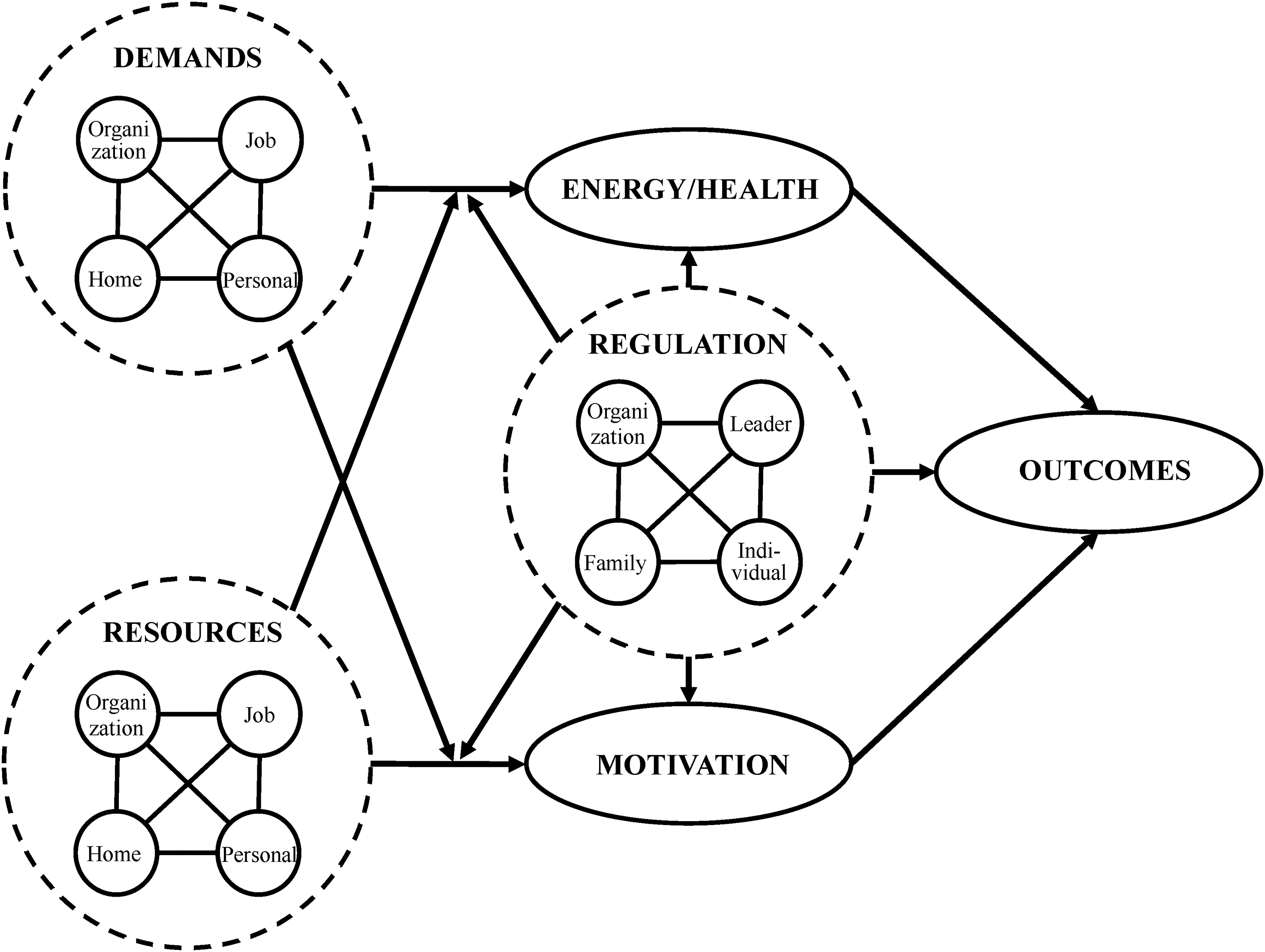
Extended demands–resources model.
During a crisis, employees with manageable (vs. high) job demands and high (vs. low) job resources can better adapt to the situation and maintain a satisfactory level of well-being and performance.
Integrating Various types of demands in JD-R Theory
The specific nature of the pandemic forced people to work remotely, and created the condition that job demands became interwoven with family/home demands but also with organizational and personal demands. Note, however, that JD-R theory originally focused on job characteristics only (for an exception, see Demerouti et al., 2004, who applied JD-R theory to the home domain). Similarly, most stress theories consider only one role at a time (e.g., job strain theory; Karasek & Theorell, 1990), yet most employees occupy multiple roles, thereby creating a gap in our understanding of the complexity of the stress process (Barnett et al., 2012). The crisis showed that work characteristics alone are insufficient to explain outcomes. Remote work blurred the boundaries between work and nonwork, which makes it necessary to simultaneously consider the characteristics of multiple domains. Therefore, one lesson learned by COVID-19 is that the demands (and resources) of the various life domains—namely personal, family, work, and organizational demands—are interconnected (see Figure 1) and that individuals are constantly required to regulate these demands and to keep them in balance.
Kreiner (2012, p. 417) acknowledges that organizational processes are ‘embedded in wider ecologies of processes, the interactional outcomes of which remain matters of unpredictability and surprise’. Thus, each demand experienced by an individual does not occur in isolation from other demands (Turner & Lingard, 2016). The interaction between various job demands has been found to worsen absence behavior even further than each job demand separately. For instance, van Woerkom et al. (2016) found that different types of job demands interacted such that the combination exacerbated company registered absenteeism. The authors explained this effect by using conservation of resources theory (COR; Hobfoll et al., 2018), which suggests that the energetic resource losses that result from high demands in one aspect of the job may lead to a depletion of resource reserves for confronting another demand, thereby triggering a loss spiral. Scarce research on the work-nonwork interface even seems to favor the idea that the influence of job demands may depend upon the presence or absence of high family role demands, which is rooted in role theories (Hughes & Galinsky, 1994; Pleck, 1977).
The complex interplay between work (job and organizational) and nonwork (family and personal) role characteristics (see Figure 1) may be better able to explain how people react to demands because time and energy are finite resources. Moreover, individuals are usually not in the advantageous situation to manage only one single demand at the time. Instead, they need to address several work- and nonwork-related demands simultaneously and employees’ reactions to a job demand will most probably be affected if they simultaneously need to address a high demand outside the work domain. Pleck's (1977) delineation of the work-family role system even suggests that workers’ occupational demands are managed or regulated at a family level rather than the individual level. Similarly, Barnett et al. (2012) suggested that when the demands of one role threaten the depletion of one type of resource, other resources from other roles may be called upon. This strategy may lead to actual or threatened cross-role resource depletion. In an effort to avoid further resource depletion, individuals draw on resources from family or personal domains (e.g., time, energy, support) and devote these resources to fulfil work demands.
Indeed, Hughes and Galinsky (1994) found that job characteristics such as work pressure, extended work times, and job insecurity interacted with family role stressors i.e., the presence of children under 13 in the home, household labor inequity, and dual-earner family status, to predict family outcomes like mood, tension, and mutual support. Structurally demanding jobs make it more difficult for workers to accommodate their spouse's limited participation in housework, which may increase the frequency of negative marital interactions. The same kind of reasoning may apply when high job demands need to be fulfilled by individuals who set high demands on themselves (e.g., perfectionism) or when the organization sets additional organizational demands e.g., safety measures due to COVID-19. For instance, organizational production pressure climate exacerbated the effect of individual job demands on risky safety behaviors during (Ghezzi et al., 2020). Therefore, we propose the following new proposition in JD-R theory:
Organizational, job, home, and personal demands interact with each other such that the effect of either demand (e.g., job demands) on health-related outcomes is exacerbated when other demands (e.g., home demands) are high.
Integrating Various types of resources in JD-R Theory
Not only should the interplay of demands from various life domains explain the health impairing impact of demands on outcomes, the interplay between resources from various life domains may better explain their motivating impact. According to COR theory (Hobfoll, 1989; Hobfoll et al., 2018)—a general stress theory—people strive to build, protect, and retain the personal characteristics, conditions, and energies that enable them to cope with job demands. When individuals are unable to do so in the face of substantial job demands, the depletion of their resources can lead to stress or exhaustion. To protect their psychological and physical well-being, individuals are thought to turn to other resources that serve as indispensable elements of their “stress resistance armamentarium” (Hobfoll, 2002, p. 312). As resources are finite in their availability (e.g., time, physical and cognitive energy; Ten Brummelhuis & Bakker, 2012); when they are utilized to cope with one job demand, individuals may be left with fewer resource reserves to cope with other demands (Van Woerkom et al., 2016).
Based on Ross and Mirowsky (2010), having resources from various domains at one's disposal may influence the role of resources while dealing with demands in at least two ways. The first scenario represents what Ross and Mirowsky call “reinforcement of advantage” or “resource multiplication” in which “advantaged groups gain most from the resources they have, so that their resources multiply to reinforce their advantage” (p. 2–3). The second scenario represents the resource substitution hypothesis, which predicts that the buffering potency of job resources should be stronger among those who lack other (e.g., personal) resources. In this case, Ross and Mirowsky suggest that “the effect of having a specific resource is greater for those who have fewer alternative resources” and “that each has less of an effect if the other is present” (p.7). Resources might, therefore, substitute for each other in order to manage demands.
In this view, simultaneously possessing multiple resources (i.e., more job autonomy as well as higher education) makes outcomes less dependent on any one resource. In line with the reinforcement hypothesis, family support strengthened the positive effect of work-family enrichment and family-work enrichment on well-being (Kalliath et al., 2019) or the impact of organizational communication about COVID-19 on employee coping beliefs (Tuan, 2021). Similarly, the effect of organizational health climate on work engagement was stronger when the leader had a more outspoken health mindset towards employees (Shin & Hur, 2021a, 2021b). In line with the substitution hypothesis, Koltai and Schieman (2015) found that the impact of autonomy or challenging work was lower for those with a higher level of the personal resource of SES. Taken together, these theoretical approaches and empirical evidence suggest that looking at the interplay between various resources in predicting motivational outcomes particularly for those in need (as during crises) is essential (Ross & Mirowsky's, 2010). As it is unclear which resources can substitute others in causing motivational outcomes, it is critical that future research uncovers the substitutability of specific resources. This leads to the next new proposition in JD-R theory:
Organizational, job, home, and personal resources interact with each other such that the effect of either resource (e.g., job resources) on motivational outcomes is exacerbated when other resources (e.g., home resources) are high (i.e., resource reinforcement), or diminishes in the presence of other resources (i.e., resource substitution).
The buffering effect of Various resources
Whereas JD-R theory suggests that job resources buffer the impact of job demands on outcomes, the COVID-19 crisis has shown that this view may be rather restricted. It is well conceivable that demands and resources emanating from different life domains interact in more complex ways, for example, by changing the nature and/or impact of other demands or resources (Bakker et al., 2019; Du et al., 2018; Turner & Lingard, 2016). From the perspective of ecological systems theory, individuals participate in various life domains (systems) that are related to each other and that influence the individual (Bronfenbrenner, 1989). Cross-domain processes include resource drain, resource generation, and positive and negative spillover (Edwards & Rothbard, 2000; Ten Brummelhuis & Bakker, 2012). Particularly when the boundaries between the work and family microsystems are permeable and flexible (as was the case during the COVID-19 pandemic), aspects of the work and family domains influence each other (Ashforth et al., 2000).
Voydanoff (2005) theorized that people assess whether work and family resources are sufficient to meet work and family demands such that participation is effective in both domains. More specifically, individuals assess whether family resources are adequate to meet work demands and whether job resources can meet family demands. Consequently, they use boundary-spanning strategies to reach harmony, equilibrium, and an integration of work and family life (see Figure 1). When the demands of one role threaten depletion of one type of resource, other resources from other roles may be called upon (Barnett et al., 2012). Employed caregivers whose work demands threaten to outstrip their resources may, in an effort to avoid further resource depletion, draw on their family resources such as family time and devote more time and/or other personal resources to work (Barnett et al., 2012) or draw on organizational resources such as leave possibilities. For instance, the interaction between (in)security during the COVID-19 pandemic and organizational resources (i.e., workplace disaster preparedness, policy, social capital) was found to predict various aspects of distress (Pacheco et al., 2020)), whereas organizational safety climate significantly mitigated the effect of individual job demands on risky safety behaviors (Ghezzi et al., 2020). There is considerable evidence for the buffering effect that resources, successes and satisfaction in one role may have on the negative effects of stressors or failures in another role (Barnett & Gareis, 2006).
This perspective is consistent with a central proposition of COR theory that people with more resources are less negatively affected when they face resource drains because they can substitute resources. This may occur because resources in one domain are likely to facilitate employees to accomplish goals in the other domain via more increased personal resources or energies (Ten Brummelhuis & Bakker, 2012). Resources from one domain may also generate new resources in another domain that provide the means for enhancing participation in the second domain, or may increase the competence and capacities of individuals to perform in other domains (Voydanoff, 2005). In addition, resources in one domain can ‘enable’ an individual to manage multiple demands across multiple domains, e.g., partner practical support enables individuals to participate in long work hours and overtime hours (Turner & Lingard, 2016).
The evidence regarding the buffering effects of cross-domain resources is somewhat mixed. Luk and Shaffer (2005) found that the effect of work time commitment on work-family conflict was buffered by family-friendly policies (an organizational resource) and that domestic support (a home resource) reduced the effect of work role expectations on work-family conflict. Butler et al. (2009) failed to find that the effect of daily job demands on work-family conflict was buffered by spousal support. However, Luk and Shaffer (2005) found that family-friendly policies and supervisor support exacerbated instead of buffered the effect of family role expectations on family-work conflict. They explained this finding as an attempt to reciprocate to the domain that provides the resource. From a cognitive dissonance perspective (Festinger, 1957), when support from another domain is received, an implicit obligation to reciprocate may result in increased anxiety and tension rather than reduced stress. If employees have supportive supervisors or work in supportive organizations, they may perceive stronger obligations to return high-quality work in order not to disappoint their supervisors and organizations. Therefore, and expanding JD-R theory, our next, new propositions suggest two types of moderation effects. First, we suggest the buffering hypothesis but instead of same-domain buffering—i.e., job resources buffer the impact of job demands on health outcomes—we suggest that the buffering can occur across domains, e.g., job resources can buffer the impact of home demands on health outcomes. Thus:
Resources from either domain (i.e., organization, job, home, personal) can buffer the effect of demands from the same or other domains on health-related outcomes (e.g., health problems, exhaustion).
In addition, based on the reviewed literature, we suggest that resources can also exacerbate the health impairment process of another domain when individuals reciprocate to the domain that provided them the resources instead of investing energy in the other domain. Future research should specify whether this occurs for specific resources e.g., when receiving support from a specific domain (e.g., family support) or when confronted with demands from specific domains. Therefore, we suggest:
Resources from either domain (i.e., organization, job, home, personal) can exacerbate the effect of demands from another domain on health-related outcomes.
The boosting effect of Various demands
One of the assumptions in JD-R theory is that challenging job demands can boost the impact of job resources (Breevaart & Bakker, 2018; Tadic et al., 2015). This means that the motivational potential of resources increases when one is confronted with demanding situations. This notion is consistent with Hobfoll's (2002) proposition that resources are of greatest use when they are needed most (i.e., during times of high job demands due to the crisis), and that resource gain is most salient in the face of resource loss. The more specific boosting hypothesis in JD-R theory posits that job demands accentuate the positive effects of job resources on outcomes by stimulating learning and intrinsic motivation (Schneider et al., 2017) or by prompting active use of job resources (van den Broeck et al., 2011).
There are a few studies on the moderating effect of job demands in the resources-work engagement relationship (e.g., Bakker et al., 2007; Breevaart & Bakker, 2018; Hakanen et al., 2005; Tadic et al., 2015; van den Broeck et al., 2011). Similar boosting effects have been found between resources and demands from different domains. For instance, Hughes and Galinsky (1994) found that having a child younger than 13 years of age moderated relationships between job flexibility and marital quality. Specifically, the relationship between job flexibility (i.e., a job resource) and marital support was positive only among employees with children under the age of 13 (i.e., a home demand). For those employees with children above the age of 13, the relationship between job flexibility and marital support was not significant. Therefore, and as can be seen in Figure 1, we expand JD-R theory and suggest:
Demands from either domain (i.e., organization, job, home, personal) can exacerbate the positive impact of job resources on motivational outcomes (such as work engagement, adaptivity, extra-role behavior).
Regulatory strategies by Various actors
Individual strategies
If there is something we learned during the COVID-19 pandemic, it is the importance of individual strategies to manage functioning in the various life domains. The importance of the availability of specific coping strategies has been shown in research executed in extreme work environments such as the military or bushfire brigades revealing the strategies that are important for coping with extremely stressful situations (Nassif et al., 2019). There are at least two types of individual strategies relevant to the JD-R theory. First, individuals may change their work environment. Employees may proactively increase their job resources (e.g., ask for feedback and help) and may actively seek challenge job demands (e.g., start a new project, learn to master a new skill). Moreover, employees may decrease or optimize their hindrance job demands (e.g., reduce task interruptions and overcome bureaucracy). This proactive behavior is called job crafting, the process of employees taking the personal initiative to shape and redefine their job to create a better person–job fit (Tims & Bakker, 2010; Wrzesniewski & Dutton, 2001).
Job crafting can help individuals to cope with challenges in remote working as, in addition to the top-down approaches (i.e., re-designing remote work), people can proactively optimize their working environment to stay motivated (bottom-up approach; Kniffin et al., 2021; Wang et al., 2021). Similarly, individuals may use playful work design defined as the process of proactively creating conditions during work activities that foster fun and competition (Bakker & Van Wingerden, 2021; Scharp et al., 2021). Several field and quasi-experimental studies have shown that job crafting leads to changes in (self-reported) job demands and resources, as well as increases in work engagement and decreases in burnout (Demerouti et al., 2015; Gordon et al., 2018; Van Wingerden et al., 2017). In addition, research has indicated that when employees redesign their work tasks to be more fun or more challenging, they can effectively manage hindrance job demands (e.g., solitude when working from home, repetitive work; Scharp et al., 2021).
Next, individuals may use strategies to directly influence their own level of energy and motivation. These strategies can be constructive like proactive vitality management, or destructive like self-undermining. Proactive vitality management is self-initiated behavior aiming to change and improve one's own physical and psychological state (Bakker et al., 2020; Op den Kamp et al., 2020) and may take the form of mindfulness so that people manage their physical and cognitive resources so that they are fit for work. Other examples are an art gallery visit to find new inspiration, or a walk in the park with the goal to change one's mood (Sianoja et al., 2018). On days or weeks individuals proactively manage their levels of vitality they are more engaged in their work and more creative (Bakker et al., 2020; Op den Kamp et al., 2020). In contrast, self-undermining is defined as “specific behaviors through which people create new obstacles that may compromise their performance” such as making careless mistakes, poor communication, and creating interpersonal conflicts (Bakker & Costa, 2014; p. 115). According to JD-R theory (Bakker & Demerouti, 2017), self-undermining may occur when employees perceive high job demands or when they experience high levels of strain indicating that self-undermining represents the fuel of a vicious cycle of high job demands and strain (Bakker & Demerouti, 2017). Indeed, Bakker and Wang (2020) found that self-undermining was consistently related to increased levels of burnout (exhaustion and cynicism). In a recent weekly diary study, Bakker et al. (2022) showed that weekly job demands were related to weekly self-undermining behaviors through weekly burnout symptoms (exhaustion and cynicism). The impact of weekly job demands on burnout symptoms and self-undermining was stronger for individuals who were already relatively high (vs. low) on chronic burnout. In addition, Roczniewska and Bakker (2021) found that nurses with lower self-regulation capacity at the beginning of the day were more likely to show self-undermining during the day, which impaired daily job performance.
There is very little insight in the effectiveness of proactive individual strategies to deal with crisis situations like the COVID pandemic. Exception is the diary study of Bakker et al. (2021) among employees who worked from home during the COVID-19 crisis. The results showed that employees performed better on the days they used more self-leadership (e.g., goal-setting, self-reward, self-monitoring) and playful work design (i.e., use play during tasks to make their work activities more fun or more competitive). In addition, self-leadership was particularly important for need satisfaction and performance on days employees ruminated a lot about COVID-19. In another recent study, Bakker and Van Wingerden (2021) showed that playful work design weakened the relationship between rumination about COVID-19 and employee well-being. Rumination was positively related to depressive symptoms and exhaustion and negatively related to vigor when employees scored lower (vs. higher) on designing fun. Moreover, Allen et al. (2021) examined strategies that individuals use to deal with the blurred boundaries between work and nonwork domains due to forced remote working and to meet the high demands of the situation. They showed that being able to create time and physical borders to separate work from nonwork helped individuals to better balance roles in both domains. In contrast, it was not helpful for individuals to integrate both roles, e.g., by constantly thinking about work or by not specifying work and nonwork time. Taken together, these findings suggest that employees may use personal initiative when confronted with a crisis event like the (partial) lock-down or social distancing conditions—that is, when they are confined to their homes and are very much dependent on themselves.
In crisis situations such as the COVID-19 pandemic, individuals’ functioning and well-being is more challenged. Proactive regulatory attempts help people control, direct, and correct their own actions in order to achieve their goals (cf. Aspinwall, 2004). Such attempts may help individuals manage their emotions, thoughts, and behaviors which is particularly necessary when confronting adversity/crisis in which they lose control of the situation (Carver & Scheier, 1999). Such proactive regulatory strategies are suggested to enhance the motivating effect of resources and to minimize the health impairment effect of demands. There is some evidence confirming such effects. For instance, job crafting particularly buffered the impact of job demands (e.g., workload, physical demands) on burnout and also to a somewhat lesser extent on work engagement (Hakanen et al., 2017). Proactive strategies are suggested to be effective, whereas destructive strategies are more reactive and demands-driven. They concern behaviors that potentially harm adequate functioning because of a lack of self-regulatory resources (Bakker & Wang, 2020). Therefore, we suggest:
Proactive regulatory strategies of the individual (such as job crafting, playful work design, proactive vitality management, self-leadership) buffer the unfavorable impact of demands from either domain (i.e., organization, job, home, personal) on health-related outcomes.
Proactive regulatory strategies of the individual boost the positive impact of resources from either domain (i.e., organization, job, home, personal) on motivational outcomes.
Destructive regulatory strategies of the individual strengthen the impact of demands from either domain (i.e., organization, job, home, personal) on health-related outcomes.
Family strategies
Crisis situations may have discontinuous effects on individuals and couples (Eby et al., 2015) and reveal new, complex associations between division of labor and outcomes. Given the crisis context, one can assume that couples may have developed new management strategies to deal with the crisis (Shockley et al., 2021). Crawford et al. (2019) suggest that dual-earner couples navigate during work-life shock events (i.e., disruptive, novel, and critical events) by making decisions on how to invest the couple's resources. Partners initially make sense of the event as individuals and then engage in couple-level sensemaking. When a couple has limited resources, the partner's role becomes even more critical. By considering how a crisis is perceived and regulated at the couple level, we can start to understand how resources are negotiated, exchanged, and managed (Crawford et al., 2019). This is also in line with the theoretical ideas in the ABCX model (Hill, 1949, 1958) described earlier.
In terms of empirical evidence about family strategies during crisis, there are several mainly qualitative studies that uncovered the strategies that couples used to deal with COVID-19 crisis. For instance, using interviews with couples, Beigi et al. (2021) showed that families adopted collaborative, attentive, and relational strategies to fit their demands and resources, while using delegative and negligent strategies to manage their unmet demands. In another study, Shockley et al. (2021) focused on the division of labor between partners with young children during COVID-19. They found that couples used (a) egalitarian strategies where both partners were highly committed to both work and family demands; or (b) gendered strategies where one person (usually the man) devoted more time to work while the other (usually the woman) devoted more time to the family—or where one person (usually the woman) took responsibility for all family demands while not scaling back at work. Results suggested that when women worked remotely and did all childcare, they reported the lowest well-being and performance. Egalitarian strategies (more specifically when partners alternated childcare days) were the best ways to preserve wives’ and husbands’ well-being, while allowing both to maintain adequate job performance.
In a related vein, Allen et al. (2021) identified four categories of boundary management tactics that were relevant during COVID-19: (a) behavioral tactics such as arranging help from others, (b) temporal tactics, such as specifying time for work and time for nonwork, (c) physical tactics, such as altering the physical space, and (d) communication tactics like confronting those who violate boundaries. Overall, their findings suggested that during the pandemic individuals attempted to separate work from home and to mimic the rhythm of “going to work” outside of the home.
These studies conducted during crisis (the COVID-19 pandemic) indicate that families seem to use various strategies to manage individuals’ and family demands and resources and to allow each family member to perform at various life domains (see Figure 1). Moreover, the studies showed that the regulation strategies used by one partner influenced not only own well-being and performance, but also that of the partner. For instance, Higgins et al. (2010) found that when perceived overload was high, dual-earner employees, regardless of gender, coped by sacrificing their own needs (e.g., leaving things undone at home), and coped by expecting their families to accommodate their work demands (e.g., covering family responsibilities for each other). Similarly, Zou et al. (2021) showed that mothers’ work-to-family conflict was positively related to fathers’ depressive symptoms when the partners undermined each other, and mothers’ family-to-work conflict was positively related to fathers’ depressive symptoms when the cooperation between partners was low.
Coping by restructuring family roles attenuated the work overload-stress relationship for both men and women. This suggests that dual-earner couples can reduce stress associated with greater role overload by getting their family to do more at home. Coping by restructuring work roles attenuated the overload-stress relationship for men but not for women. Also, Hughes and Galinsky (1994) found that extended work time of the individual was associated with increased marital tension among those receiving little help from their spouse but was associated with decreased marital tension among respondents who received substantial help. Taken together, we may conclude from the above that partners’ strategies or strategies used on the family/couple level influence the well-being of individuals or modify the way that external environment influences the individual. Therefore, we suggest:
Regulatory strategies of the family (e.g., boundary management, division of labour) buffer the impact of demands from either domain (i.e., organization, job, home personal) on health-related outcomes when they are directed towards providing support or an egalitarian division of labor.
Regulatory strategies of the family (e.g., boundary management, division of labour) boost the positive impact of resources from either domain (i.e., organization, job, home personal) on motivational outcomes when they are directed towards providing support or an egalitarian division of labor.
Destructive regulatory strategies of the family such as undermining behaviors or gendered division of labor strengthen the impact of demands from either domain (i.e., organization, job, home personal) on health-related outcomes.
Leadership strategies
Leaders may play a crucial role in the process of resource allocation and coordination and their role has been discussed extensively during the COVID-19 pandemic. Tourish (2020) even argued that the COVID-19 crisis is also a crisis of leadership theory and practice. As we already discussed in the section on crisis management, crisis and leadership are closely intertwined phenomena (Santos et al., 2016). Boin et al. (2009) define crisis leadership as the set of strategic tasks that encompasses all activities associated with the stages of crisis management namely sensemaking, decision-making, terminating, and learning. First, leaders are those persons in an organization that must appraise the threat and decide what the crisis is about i.e., sensemaking (Santos et al., 2016). Next, since leaders may have insight into information regarding the whole organization, they are the most eligible persons to determine the impact of the crisis on the organization, (e.g., in terms of health and safety, viability of the business) and the necessary action (e.g., about the means to deal with the impact of the crisis on the organization). As crises force organizations to confront issues they do not face daily, they present a challenge for leadership (Heifetz et al., 2009), which leaders may only be able to deal with after consulting specialists, employees or other stakeholders. The next task of leaders is to communicate with the employees about the impact of the crisis on the organization and the necessary measures so that leaders help employees to make sense of the crisis, reduce ambiguity and enhance employees’ effort to manage it (Santos et al., 2016). Finally, as the crisis experience offers the possibility to learn potential lessons about contingency planning and training as well as how to prepare the organization for future crises, it is the leader who needs to make sure that learning and innovation occurs by maintaining a long-term perspective (Boin et al., 2009; Santos et al., 2016).
Next to these top-down strategies which are necessary due to time pressure and knowledge concentration, leaders’ most-used strategy also in terms of JD-R theory (e.g., Crayne & Medeiros, 2021) is to provide resources like information, clarity, means and direction. In this way, leaders are instrumental and motivate individuals and teams to contribute to the viability/performance of the organization. The global crisis caused by COVID-19 has seen remote collaboration increase dramatically and ‘virtual’ teams forming almost overnight. Scientific evidence shows that the most successful leaders in managing telework arrangements are found to be those who display both agentic or task-oriented behaviors (e.g., clear communication and project management), and communal or relational behaviors (e.g., providing social support and displaying sensitivity; Eichenauer et al. 2021; Taylor & Kavanaugh, 2005).
In terms of JD-R theory (Bakker & Demerouti, 2017, 2018; Breevaart et al., 2015), leading during crises such as the COVID-19 pandemic requires leaders to provide sufficient tangible and psychosocial resources. Relevant tangible resources are ICT-tools, sufficient rewards, career opportunities, and increased job security. Psychosocial resources that leaders may provide to their teams/subordinates are emotional and instrumental support, role clarity, coaching, recognition of the hard work, constructive feedback, relevant and timely information, and fair treatment. At the same time, leaders are those who determine the targets and requirements that employees have to fulfil—or, in terms of JD-R theory, the job demands (Kniffin et al., 2021). As the crisis forms by itself an additional demand, leaders need to be vigilant of their employees’ levels of job demands, so that the demands do not become overwhelming. In line with this, Possamai (2007) suggests that while both agentic and communal leader behaviors are important to safe workplaces, to develop a strong workplace safety culture, leaders need to listen to workers’ concerns, suggesting that communal behaviors may be seen as particularly important during a time of reduced safety at work.
Not only does the crisis influence which leadership behaviors are effective, it also influences which characteristics make leaders more appropriate to take leadership positions during crisis. One such characteristic is gender. Women are found to display a more communal and men a more agentic leadership style due to behavioral constraints placed upon them by prescriptive role expectations (Eagly & Karau, 2002) and by evaluative penalties, or “backlash” effects, if they engage in counter-role behavior (e.g., Heilman & Wallen, 2010). The gendered character of crisis leadership is further suggested by the so-called “glass cliff” phenomenon. Accordingly, women are more often chosen to lead organizations during times of crisis (a ‘think crisis—think female’ association Morgenroth et al., 2020; Ryan & Haslam, 2007). This is because of the expectation that women will show more communal leadership, which is effective during crisis, or because organizations want to signal change by shifting away from previous leadership choices (i.e., white men) during crisis or because women are put forward to take leadership positions that are less desirable and more prone to failure (Morgenroth et al., 2020). The meta-analysis of archival studies by the latter authors revealed a small glass cliff effect with women and members of underrepresented racial and ethnic groups being more likely to be selected over men in times of crisis—particularly in countries with higher gender inequality. On the contrary, Eichenauer et al. (2021) found that during the COVID-19 crisis employees desire communality regardless of the leader's gender, disconfirming gender differences in the display of agentic or communal behaviors. Similarly, when leaders were perceived as inclusive irrespective of gender, employees experienced lower distress during the pandemic (Ahmed et al., 2020).
Taken together, we think that an effective leader (who combats the impact of the pandemic and who positively influences employee outcomes) is a person who is able to enact the above-mentioned behaviors during the various phases of crisis management. From a JD-R perspective (Bakker & Demerouti, 2018), an effective leader provides resources to employees such that they can contribute to the viability of the organization with their performance while managing the demands such that employees remain healthy and safe. Therefore, we suggest:
Regulatory strategies of the leader, such as sensemaking, communality and management of employee job resources, buffer the impact of demands of either domain (i.e., organization, job, home, personal) on health-related outcomes.
Regulatory strategies of the leader such as sensemaking, communality and management of employee job resources, boost the positive impact of resources of either domain (i.e., organization, job, home, personal) on motivational outcomes.
Organizational and work group strategies
Viewing the crisis management literature from a JD-R perspective shows that effective crisis management involves management of essential resources that are crucial to minimize risks and improve performance. To this end, organizations need to do more than increase the frequency of communication. Specifically, a primary task of top management is to create an organizational culture that values and rewards assessment and communication pertaining to risk-related events (Clarke & Ward, 2006). As we saw in the crisis management section, because risk mitigation often depends on collective work and because workers are often interdependent, it is important for everyone to establish a common perception of, agreement about, and response to workplace risks/crisis (Weick et al., 2005). Shared responsibility and worker involvement are important ways to establish organization-wide consensus regarding what should be done. Consensus requires competent leaders who are willing to engage in an open dialogue with workers, which eventually can make workers more motivated in helping the organization achieve its strategic goals during the crisis (Bowen & Ostroff, 2004).
Effective group effort increases the variety of perspectives and skills available, fosters synergistic contributions of the members, and facilitates access to essential resources for the crisis (Zander, 1982). A diversity of relevant perspectives that captures the different aspects of the crisis and the (re)actions of key stakeholders facilitates sensemaking and crisis management (Pearson & Clair, 1998). Best practices of teams that operate in adverse conditions are when they can pull pieces of old routines and adapt them to face new task demands (Barton et al., 2020). Barton and Sutcliffe (as cited in Barton et al. 2020) in a study of adventure racing found that the best teams were those that had created a process to manage the limited resources (of attention and task engagement) by preassigning backups for key roles, maintaining a flexible attitude about changing roles, and by viewing adversity as belonging to the team as a whole.
Next to the importance of group/teamwork, existing or new channels to collect and exchange relevant information and other resources that can be used to deal with the crisis are essential. If activities and roles are practiced prior to the crisis, information sharing about causes, consequences and coping strategies regarding the crisis will be easier (Pearson & Clair, 1998). Having established links to key stakeholders before the crisis makes organizations more successful at managing potential miscommunications (Susskind & Field, 1996) as they can better recognize (a) how key stakeholders might react to a crisis, (b) what resources and information stakeholders might have available to assist in the management of a crisis, (c) how stakeholders might be impacted by the crisis, and (d) how stakeholders might exert a negative impact on the organization's ability to manage the crisis (Mitroff et al., 1996; Pearson & Clair, 1998). Therefore, our final propositions are:
Regulatory strategies of the organization/work team such as fostering shared responsibility and synergistic contributions and building on/expanding existing team processes buffer the impact of demands of either domain (i.e., organization, job, home, personal) on health-related outcomes.
Regulatory strategies of the organization/work team such as fostering shared responsibility and synergistic contributions and building on/expanding existing team processes boost the positive impact of resources of either domain (i.e., organization, job, home, personal) on motivational outcomes.
Implications and conclusion
The special case of the COVID-19 pandemic created a natural experiment in which employees had to work in an altered work context in which boundaries between life domains were blurred and in which the regulatory capacity of the individual as well as the partner, the organization and the leader gained importance. In the present paper, we used JD-R theory to understand and predict the impact of the COVID-19 pandemic and other crises. Based on theoretical justification and empirical results, it was suggested that employees are now confronted with high demands which increases the importance of resources to fulfil these demands and mitigate their impact. The extended JD-R theory suggests that employee health impairment can be caused not only by high or unfavorably designed job demands but also by the interplay between demands from various life domains. Similarly, motivation does not only result from high job resources but also from the interplay of resources from various life domains.
This extension increases the complexity of JD-R theory but also its explanatory power. The expanded JD-R theory captures the nexus of occupational health more integrated in the context where it occurs. The buffering and boosting propositions of the JD-R theory are suggested to occur across life domains which sets a new research agenda that has the potential to reveal which resource works for which demand. The new propositions were based on COVID-19 studies but also on unrelated earlier literature. This strengthens the applicability and the promising value of the extended JD-R theory. The COVID-19 context uncovered the importance of strategies to alter the impact of demands and resources on individual outcomes. Not only individual strategies were suggested to modify the impact of external conditions but also strategies used by the partner, the leader, and the organization/team. Taking these actors of individuals’ network into consideration opens a window of opportunities to support individuals in dealing with and effectively function during crises and turbulent times.
In order to mitigate the detrimental short- and long-term effects of the pandemic on employees and organizations, it is important that all stakeholders (governments, organizations, leaders, families and employees) take their share of responsibility. Achieving this requires keeping the pandemic-specific and pandemic-unspecific demands manageable and to provide sufficiently high resources to deal with these demands. This may occur through interventions focused on the redesign of the work, organizational and family context and processes such that risks can be minimized and effective functioning is facilitated with less negative consequences (Tetrick & Winslow, 2015). In order to support people dealing with the fast and often truly threatening changes, secondary and tertiary prevention is also necessary with the former teaching people how to cope with stress, telework, and work-family problems, and the latter alleviating symptoms of illness and strain, as well as financial problems (Tetrick & Winslow, 2015). We hope that this extension of JD-R theory will inspire research and practice to develop approaches that better address the complexity of today's reality.
Footnotes
Funding
The author(s) received no financial support for the research, authorship, and/or publication of this article
