




Abstract
The 73rd constitutional amendment has made historical changes to Indian local self-governance, that is, Panchayati Raj Institutions (PRIs), by introducing 33% reservation for women. Accordingly, a considerable number of women entered into these institutions as elected representatives. However, although reservation has enhanced the representation of women, their participation remains an important question due to prevailing patriarchy both within and outside the household. In this background, an attempt is being made to understand and analyse the participation of tribal women in Gram Panchayat—the lowest level institutions of PRIs among the Tiwas of Assam, India. This study found that reservation of seats has indeed enabled women to enter into local governance. However, the reservation could not alter the patriarchal nature of GP. Thus, there is a need for institutional reforms in the GP.
Introduction
‘Inclusive governance can be defined as inclusion of the poor, women and the marginal sections of the society in the governance process so that it is transparent, accountable, equitable and participatory’ (Mishra, 2018, p. 559). Although its preamble, directive principles, fundamental rights and duties, the Constitution of India ensure gender equality. Yet, the ground reality is different. Gender equality which the Indian Constitution has already been conceived and has rarely been converted into reality. ‘In no society do women enjoy the same opportunities as men’ (UNDP, 1995, p. 2) as women are excluded from playing an active and legitimate role in community life. Consequently, ‘it is found that the constitutional rights have not been availed adequately by the Indian women to participate in the political process of the country’ (Aruna, 2018, p. 2).
One of the critical elements of the socially inclusive development programme is the participation of the entire section of society in public and political life. Participation in public and political life ensures overcoming the discrimination and exclusion of those who frequently faced these barriers and continued to be excluded from political life due to different barriers (DSPD, 2019). ‘The representation of Indian women in governance was extremely low prior to independence and continued to be so for a few decades after Independence too’ (Aruna, 2018, p. 2). Thus, to ensure equal participation of the entire society irrespective of caste, religion and gender at local governance, the Government of India introduced the 73rd constitutional amendment, which came into existence on 23rd December 1992. This amendment provided reservation of seats for women, Scheduled Tribe (ST) and Scheduled Caste (SC) at the entire three tiers of Panchayati Raj Institutions (PRIs) 1 to ensure their representation in various institutions of PRIs.
Within a few years of enactment of the 73rd constitutional amendment act, almost entire states of India introduced state-specific Panchayat act based on the various provisions of the amendment and reserved 33% seats in entire three tiers for women and enabled a considerable number of women to enter into these institutions. In addition, many states further amended their state’s Panchayat act and enhanced reserved seats for women up to 50%. At present, 21 Indian states have reserved 50% of seats for women in various institutions of PRIs. 2
Assam, one of the northeastern states of India, is one of the first states in India to introduce the Panchayat act based on the 73rd amendment in 1994. Though it introduced this act in 1994, the first election as per the Assam Panchayat Act 1994 was held in 2001. Further, in 2011, the government of Assam brought historic changes to this act by reserving 50% of seats for women through amending this act and introducing the Assam Panchayat (Amendment) Act 2011. In 2001, the election was held for 21 zilla parishads or district Panchayats, 203 intermediate or anchalik panchayat and 2,487 Gaon Panchayat (GP). 3 However, the Bodoland Territorial Autonomous District (BTAD) formation in 2002 as per the Sixth Schedule of Indian Constitutions with four districts such as Kokrajhar, Chirang, Udalguri and Baska, the number of GPs were reduced. Therefore, including these four districts, the Assam Panchayat Act 1994 does not apply to six districts in Assam. The other two districts are Karbi Anglong and Dima Hasao. The second and third term of the Panchayat election as per the Assam Panchayat Act 1994 was conducted in 2007 and 2013. The fourth or the latest election was held in 2018 for 2,202 GP, 185 anchalik panchayat and 21 zilla parishads.
A considerable number of studies have been conducted on the performance of the 73rd constitutional amendment during the few decades of the introduction of this amendment. The findings of these studies (Giridhar, 2018; Kalaramadam, 2018; Mueller, 2016) are encouraging. They considered the 73rd constitutional amendment a milestone for bringing several social changes through legal measures in the local self-governing institutions. However, although several of these studies show that representation of women in rural local self-governance structures has enhanced the power of women within society and community, some other studies (Mishra, 2018; Nagarajappa & Chidananda, 2019; Naik et al., 2020; Sukumar et al., 2019; Thampi & Kawlra, 2019) have found that policy of reservation does not easily assure women’s effective political participation or political representation. ‘This is because of the “social embeddedness of policy” in local contexts’ (Kalaramadam, 2018, p. 1). Considering these, an attempt is made to assess the status of involvement of tribal women in GP among the Tiwas. 4
Methodology
The objectives of the study are to analyse the representation and participation of women in PRIs with respect to Tiwas of Assam. In Assam, concentration of Tiwas is the highest in the Morigaon district (Register General of India, 2011). So, this study was conducted at two GPs of Morigaon, namely, Torabori GP and Ghaguwa GP of Bhurbandha and Mayong development block. This study considered four factors to select these GPs. These factors include the demography of the GP, distance from the district headquarter, different blocks and composition of GPs. Under demography, the researcher’s focus was to select those GPs dominated by the Tiwa community. Therefore, the majority of the population of the selected GPs are Tiwas. The focus was also laid to select those GPs situated at least 20–25 km away from the district headquarter so that the GPs maintain the rural set-up. Further, to differentiate the various social, political and cultural dynamics, the focus was to select the GPs from various blocks.
As stated, another factor of the selection of GPs for this study is the composition of the GPs. The post of president of both the GP was reserved for the tribal community. While the Ghaguwa GP was presided over by a tribal woman, the president of Torabori GP was a tribal man. Further, the entire elected women representatives of Ghaguwa GP belonged to the Tiwa community, including the president. In contrast, only one woman belonged to Tiwa in Torabori GP out of five elected women members. Moreover, to assess the status of involvement of general women in the different activities of local governances, two different villages, one from each sample GPs, were selected, namely Udahinbori village from Ghaguwa GP and Kapurpurabori from Torabori GP based on demographic composition and nature of representation to the concerned GP. As a result, the entire inhabitants of both villages were Tiwas and women members represented these villages in the concerned GP.
The study has used interviews, participant observation and focused group discussions (FGDs). To fulfil the study’s objectives, the researcher has interviewed the entire elected women representatives and few elected men representatives at the office during 2013–2018 and officials of these two GPs. Therefore, 11 women elected women representatives, including the woman president of Ghaguwa GP, two men elected representatives, and two officials from each GPs constituted the sample for this study. Further, this study also used narration of general women from selected villages collected through FGDs conducted in the meetings of women self-help groups (SHGs). Moreover, the researcher attended few transaction business meetings of GP. 5
Discussion
Although political decentralisation through the 73rd constitutional amendment act has offered women opportunities to represent themselves at local governance yet, the reservation of seats for women ‘does not automatically ensure parity of participation in the arenas of public debate and policy formulation’ (Thampi & Kawlra, 2019, p. 206). In fact, the reservation of seats that lead to women’s representation in the formal structure of governance alone could not empower the women to articulate and challenge gendered structures of inequality (Williams et al., 2015). The situation is worst, particularly in the case of tribal women (Mishra, 2018; Nagarajappa & Chidananda, 2019; Naik et al., 2020; Sukumar et al., 2019). So according to them, numbers of several factors are associated with less effectiveness of the 73rd Constitutional Amendment Act, which includes existing patriarchy (Agnihotri & Singh, 2014; Sukumar et al., 2019), family background (Mishra, 2018; Nagarajappa & Chidananda, 2019), lack of education and training (Agnihotri & Singh, 2014; Mohapatra, 2016; Nagarajappa & Chidananda, 2019) and rigid tradition (Nagarajappa & Chidananda, 2019).
In recent years, women’s political representation and participation have emerged as ‘one of the most vital indicators of development together with an assessment of gender inequality in all societies across the globe’ (Ramya, 2014, p. 98) because, it leads to inclusive growth. ‘Political participation can be loosely defined as citizens’ activities aimed at influencing political decisions’ (Deth, 2014, p. 351) through various means, including casting a vote, contesting in the election, developing public opinion etc. ‘This, in turn, helps meet conventional development objectives of growth and equity, as well as the more recent concerns for sustainability, good governance, and democratisation’ (Samanta & Nayak, 2015, p. 72).
The field study shows that the entire 11 elected women representatives of both the GPs were elected to GP in 2013 for the first time. However, none of them was illiterate, but also not highly educated. The highest educated woman representative was the president, who studied up to class 12th. Moreover, few of them had not even participated in any GP meeting before entering the GP as an elected representative. In such conditions, what enables them to contest in the election?
Why Does a Woman Contest?
The foremost factor that enabled the women to contest in the election was the reservation of seats for women, which forbidden the men to contest from these reserved seats. The entire women representatives said this. However, reservation of seats for women, although it is the prime enabling factor of women representation at PRIs, cannot be considered the sole factor of women’s participation. The field data shows that the proportion of women candidates contested per reserved seat is low compared to the proportion of men candidates contested per open seat. In these GPs, two women contested in one seat on an average, whereas four to five men contested per seat. Thus in 2013, 18 women contested for nine seats, including the president post. In two seats, both the women representatives were declared uncontested as nobody filed nomination. On the other hand, 51 men candidates contested for the rest 11 seats. This reflects that a majority of eligible women did not file nominations. This study found several factors responsible for this, categorised into three broad heads: woman vis-à-vis herself, woman vis-à-vis her family and woman vis-à-vis society.
Woman Vis-à-vis Herself
This includes factors like age. Analysis of the age of contesting women candidates of 2013 shows that the entire candidates belonged to a specific age group, that is, 20–50 years. No women below 20 years and above 50 years contested in the election. It was because there is a perception among men members of the family that they should only allow the women who are physically fit to contest in the election so that there would be no drastic alternation in the division of works based on sex. They believed that women older than 50 years would not undertake extra load if they were elected representatives. In such cases, they would have to release them from domestic work to participate in public life. This means men would have to undertake few domestic works that these women carried out. On the other hand, they considered that women below 50 years could carry out domestic work and extra work as a representative. It would not bring any changes to the division of work based on sex. This perception evolves among men because of the perception that women’s physical strength remains high for the age group below 50 years.
Woman Vis-à-vis Her Family
Marital status of woman and prior political affiliation are the major attributes of this category. Field data show a positive relationship between the marriage of a woman and contesting in the election. In fact, the entire 20 candidates, including two uncontested elected representatives, were married. No unmarried girls filed nominations in 2013; despite many colleges, graduate girls live at these two GPs. They were highly educated and had exposure to student politics while studying in college and exposure to the outer world. Interview with various respondents, including men and women, shows that the socio-cultural notion of ‘real property’ actually acts as an obstacle for girls’ participation as candidates. Both parents and family considered girls not the family’s real property and had to go to other homes. In such a situation, investing in the girl children election campaign means wastage of money and time for the family. Further, a few men respondents considered that allowing the unmarried girl to contest in the election means exposing her to public life. Furthermore, exposing the unmarried girl to public life should not be done as it might create problems in her married life. Thus, through preventing unmarried girls to contest in the election, the existing patriarchy controls the political decision through different institutions like marriage.
As political parties dominate modern democracy, they play a crucial role in determining the degree of women’s participation in political and public life (ODIHR, 2014). Thus, women with prior political affiliation have a greater chance of contesting than those with no prior political affiliation or exposure to the political party system. In fact, this statement proved to be accurate by this field data—no woman contested in the election independently or without any party affiliation. Either the family member or the woman candidate herself, the entire women candidates had prior exposure to the political party. However, in most cases, the women candidates were from those families whose men members were supposed to get party tickets to contest in the election but could not contest due to reservation of seats. Thus, party supported the woman member of their families.
Woman Vis-à-vis Society
This includes factors like the constitutional amendment and social norms. Regarding how constitutional amendment enabled women to contest in the election discussed above and regarding social norms, I am discussing below. Although earlier studies show that (Kalaramadam 2018; Sukumar et al., 2019) caste and religion also play a significant role in this context, but the field study was conducted in homogeneous areas, so this research found no such issues.
Elected Women Representatives and Their Participation in Local Governing Institutions
This section will discuss the degree of participation of elected women representatives in PRIs in the study context. The above discussion shows that various factors are responsible that enable a woman to contest in the election. This study identifies two dimensions of participation: attendance of elected women representatives and raising issues in the various meetings. Each dimension has several indicators.
Attendance
Attendance record of the women members in different business transaction meetings has been collected from different office records. These records show that there was a difference among the women members of both the GPs. For example, the average attendance of elected women members in different business transaction meetings at Ghaguwa GP during 2013–2018 was 5.24 women per meeting, including the attendance of the woman president. In contrast, this number was 3.58 in the case of Torabori GP. Out of the 12 meetings, only in one meeting at Torabori GP, the entire 5 elected women representatives attended the meeting. On the other hand, out of the total 21 meetings, only in 13 meetings, entire elected women representatives had full attendance in the case of Ghaguwa GP (refer to Table 1). So, an enquiry was made to understand the factors behind the different attendance levels in both the GPs, which are functioning under the same act.
Attendance of Women Members in the Business Transaction Meeting of Sample GPs During 2013–2018.
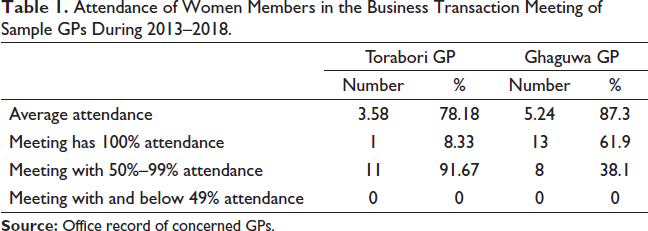
Based on the analysis of the field data, this study came up with the fact that many factors such as the composition of the institutions, political and community affiliation and regular functioning of the GP were mainly responsible for this. Women members felt it more convenient to work under a woman rather than a man president. According to them, the woman president was more sensitive to women issues and acted according to consensus or majority opinion, which was a significant aspect of the functioning of Ghaguwa GP. In contrast, in Torabori GP, according to women members, the president acted according to his own will or will of other men members of the GP.
The entire six women members, including the president of Ghaguwa GP, belonged to Tiwa, whereas the Torabori GP has a mixed women group belonging to Nath, Muslim and Tiwa, representing three different communities. Moreover, excluding the woman president of Ghaguwa GP, the entire five women members belonged to one political party. On the other hand, in the case of Torabori GP, women members represented three different political parties. Therefore, the nature of the composition of these two GPs has directly impacted the attendance of their women members as each party and community has their specific set agendas and objectives. However, except for the president, all the entire women members of Ghaguwa GP belong to the same party. Accordingly, women members of Ghaguwa GP felt more bonding among themselves than that of women members of Torabori GP. Moreover, it was also observed that the community affiliation among the women members of Ghaguwa GP was so strong that every Monday, the entire women members continued to assemble at the GP office irrespective of any meeting or not to discuss their issues.
Another major factor that directly relates to the attendance of women members of local self-governing institutions was the regular functioning of these institutions. Analysis of data shows that the attendance of women members was high in Ghaguwa GP as it regularly conducted different meetings of GP. For example, out of 33 scheduled transactions business meetings of GP, during 2013–2018, Ghaguwa GP organised 21 such meetings, whereas Torabori GP organised only 12 such meetings. It may be inferred from the field study that woman-led panchayat is more organised in terms of organising transaction business meetings of GP than man-led panchayat. Similarly, during 2013–2018, out of the scheduled 22 Gaon Sabha, 6 Ghaguwa GP organised 13 meetings, whereas Torabori GP organised only 8 Gaon Sabha.
Raising Issues
To discuss this issue, let me highlight my observation of a Gon Sabha meeting that I attended during the field study in 2018. It was a special Gaon Sabha organised to finalise Pradhan Mantri Awas Yojana-Grameen beneficiaries. Both men and women of different villages under the GP attended this meeting, yet the number of women’s attendance compared to men was very nominal. Only 72 women attended this meeting, while 271 were men, including entire elected men and women representatives and other GP officials. Attendance of general women in this meeting was not only a few, but most of them remained silent throughout the meeting. No women belonging to the general category participated in the discussion except the elected women members, whereas almost all the men who attended the meeting participated in the discussion. Participation of women was less not because they did not want to participate in the discussion, but they were not allowed to do so by their men counterparts by not giving importance to the voices of women who wanted to do so.
Another vital trend that emerged from the meeting was that patriarchy makes a different arrangement to exclude women from participating in decision-making in the public forum. These arrangements are not only institutional, but the patriarchy controls women’s voices by imposing different cultural norms. Although many respondents informed that because of the prevailing cultural notion generally, women do not give their view at the public forum in the presence of older adults, the institutional arrangement of this meeting showed another interesting fact. The seating arrangement for this meeting was differentiated by sex and status. The first raw in front of the general participants was reserved for the president and other elected men members, followed by elected women members. All the general women were sitting at the last raw seats kept for general members. Thus, there was a considerable gap between general women and the elected representatives. Therefore, keeping the women physically outside of the decision-making process, the existing patriarchal set-up checked the voice of women from reaching the authority of the GP.
The reservation of seats has indeed enabled women to enter into local governance, but the reservation cannot alter the patriarchal nature of GP. It should be remembered that only 50% of seats are reserved for women. Rest 50% of seats are kept open, where women can also contest in these seats. However, the field study shows that no women contested in the open seats. Further, majority of office staff are men who also sometimes influence the decision of GP basically by the GP secretary, who is a government appointee and one of the significant stakeholders of GP. Moreover, women not only face domination of men in GP because of its patriarchal nature but sometimes inside the household, her husband also influences her public decision. The situation becomes more critical for those women who entered into GP for the first time because of lack of earlier exposure to public life. As a result, they become victims of exploitation of elected men members and Panchayat officials.
General Women and Their Participation
As per the official data, the cumulative attendance of general women in different Gaon Sabha organised by these two sample GPs during 2013–2018 was comparatively less than the attendance of general men participants. The official records of attendance of general women members in different Gaon Sabhas show that only 25.22% of general women of Ghaguwa GP and 22.12% of Torabori GP’s general women attended the different Gaon Sabha organised by these two GPs during 2013–2018. Lack of proper information dissemination, illiteracy, institutional arrangement of meetings and so on were some of the major factors that have affected the attendance of general women. Almost all the women respondents from the selected villages said that women are the last to get any information regarding the Gaon Sabha. The primary source of information for them was the men members of the family. No public announcement was made in both the panchayats about the organisation of the Gaon Sabha.
Interestingly, there was no proper schedule of the Gaon Sabha meeting, as said by the elected women members of the GP. They generally organised the meeting when they were asked to organise such a meeting by the authority, that is, block office, as there was no prior schedule and public announcement of the meeting, so the information regarding any such meeting did not directly reach women. In such a case, the women attendance becomes less as they could not attend the meeting like other general men at short notice. For instance, majority of general women informed that they were intimated about the meeting late, or sometimes they were not even intimated at all.
A few general elderly women respondents informed that they usually do not attend the Gaon Sabha because they are illiterate. Moreover, they felt that nobody gave importance to their opinion or view in such meetings because of their illiteracy. So, according to them, Gaon Sabha is not for them; instead, it is the meeting of educated people who are more vocal and whose voice is given more importance by others. Moreover, this research also found that many women did not have faith in Gaon Sabha as most of the decisions in these meetings were taken in consultation with men rather than women.
Along with these factors, the institutional arrangement of Gaon Sabha also directly impacted the attendance of the general women in these meetings. In both cases, it was observed that Gaon Sabha was organised on the premises of GP. Therefore, those women who live far from the GP office did not prefer to attend the meeting. Moreover, their mobility was also highly dependent on the decision of the men members. In most cases, women attendance was low as the family gave more importance to men’s attendance than women’s. They considered that one member’s representation from each family is enough to get all the information about the meeting in these meetings. This phenomenon is also assisted by the sexual division of works norms, which assigns all domestic duties to women and all other social productive duties to men.
It was also observed that irrespective of sex, people have less awareness about the GP. The majority of people consider GP as the delivery agency of government aid projects and programmes which they availed in the form of subsidy as most of them do not know the objective of GP. Hence, their attendance in Gaon Sabha was highly dependent on the distribution of benefits of these schemes. During the field study, it was found that a section of people started boycotting Gaon Sabha as they could not fulfil the eligibility criteria for getting benefits from such different schemes. Accordingly, their attendance declines in such a meeting.
Conclusion
The reservation of seats in PRIs has opened up space for women in the public and political domain. With the increase of women representatives, position and roles of women basically, the elected members, have slightly improved within the household and outside the household structure. However, the reservation fails to bring drastic changes to the structure of society within the patriarchy. It has been observed that participation of women as elected representatives fails to provide them access to decision-making, getting an equal position, access to information. Therefore, along with legal changes, there is a need for action that may change the social structure. This can be possible by mobilising women as a group. In such a direction, women’s groups, such as SHGs, can play a vital role where women get ‘space’ to discuss various issues without the influences of patriarchy. Furthermore, this study recognised the importance of ‘critical masses’ of women in local governance.
This article also observed that political participation is not only casting a vote or contesting an election; instead, political participation is beyond this, including decision-making and access to information and knowledge. As Max Kaase and Alan Marsh (1979) rightly said, political participation is the voluntary activities that ‘intended to influence either directly or indirectly political choices at various levels of the political system’ (Kaase & Marsh, 1979, p. 42). However, the reservation policy, as prevails now, fails to mitigate this. It simply reserved the seats for women to enter into the local government, but due to lack of earlier exposure, the dominance of patriarchy both within and outside the household, an elected woman fails to get access to decision-making. Her decision is influenced not only by the other elected men representatives but also by other men officials in office and inside the household. There is a need for transformation of women’s presence into political participation. It is only possible when there will be action to enhance their capacity in terms of skill and knowledge about different provisions of the act and other activities of the local governance. This further will also assist in people understanding the local governance systems. This study found that most members attend the PRIs only to avail the grants or subsidy. Their intention is not to participate in the democratic process of decision-making, instead of getting something as a subsidy. So there is a need for change in the perspective of people about the GP. People must consider PRIs as democratic institutions rather than a delivery agent of Government programmes or Projects. Until people’s perspective towards the PRIs changes, the fundamental objective of PRIs will not be fulfilled, and it will continue to serve the creamy layer of the society only who knows about the system. Moreover, to function appropriately, GP must be empowered to amend the guidelines of different projects and programmes according to the need of the local area so that many more people can be brought under the umbrella of different development schemes. Power of amendment of guidelines or eligibility criteria of different development schemes is essential to mitigate local issues; so the actual beneficiaries can be selected.
Moreover, there is a need for institutional reforms in the GP. For example, the Gaon Sabha should not be organised at office premises; instead, it can be organised in different villages under its jurisdiction rotationally so that the participation of women from the different villages can be ensured. Further, the state functionary must adequately monitor the organisation of scheduled Gaon Sabha and business transaction meetings of the GP according to the different Panchayat acts.
Footnotes
Acknowledgement
The author would like to express his gratitude to the blind reviewers for their careful review and insightful comments and suggestions.
Declaration of Conflicting Interests
The author declared no potential conflicts of interest with respect to the research, authorship and/or publication of this article.
Funding
The author received no financial support for the research, authorship and/or publication of this article.
