



Abstract
This study explores the changes in the portrayal of minor women characters in the Ramayana and the Mahabharata to that of the contemporary fictional narratives of Kavita Kane. Women’s struggle, except in the Vedic period, expresses their endeavor for self-reliance and individuality. It also carries their subsequent efforts to camouflage or appropriate the patriarchal norms to be at peace with society. The struggle of marginalized women in epic stories—whether misrepresented, represented, or silenced—is now being brought to light by reframing their roles as protagonists who assert themselves, fight for their rights, and challenge the pre-determined social and cultural expectations that have caused their oppression in a male-dominated society. These stories prompt us to question gender and class-based discrimination by highlighting female characters’ neglected mental abilities.
Introduction
The Ramayana and the Mahabharata are the seminal Indian “religious” scriptures of Hindus that formulated Indian socio-cultural practices, thoughts, and beliefs. They are normative epics that provide discourses on “religion,” interpersonal values, and human ethics. These epics have deeply influenced Indians from childhood, both consciously and subconsciously. The importance of honesty, integrity, and compassion in human relationships are valuable lessons Indians have learned from these epics. The Ramayana and the Mahabharata narrate the ancient Indian social history through adaptation. Adapting literary texts is a significant endeavor that requires a critical effort to revisit the classics in popular culture. When reworking classics, the dialogues are often changed while the narrative remains consistent. Both cinema and theatre have proven to be effective mediums for communicating meaning across different historical times and cultures, as they help bring the text to life and make it more accessible to a broader audience. It also challenges the popular notion that adapting classics is a niche pursuit for literary professionals rather than something the masses can enjoy (Preet Kaur Simran and Kaur 2018, 1).
The ancient texts have always been a source of mystery and fascination worldwide. The teachings of Indian sages, thinkers, spiritualists, and philosophers have greatly influenced the way of life in India. Theism and atheism (the terms related to “religion”) have coexisted in this land of marvels, where supernatural powers and charismatic sages have left their mark. India’s ancient epics have laid the foundation for Indian culture, reflecting the plurality and complexity of inclusive cultures that have evolved over centuries. India’s constitution defines Indian culture as a composite culture containing elements of hundreds of religious, linguistic, ethnic, and modern social groups. The Indian subcontinent has derived its cultural values from the epic literature written in Sanskrit and other subsequent Indian languages from ancient times (Venkateshwara 2021, 29-33).
The Ramayana is an epic poem composed by the sage Ratnakar Maharishi Valmiki, a brilliant poet who was the first to construct ballads. While writing the epic, Lord Brahma, the god of creation, arrived to bless him and saw Valmika (Ratnakar covered by an anthill of bugs), and gave him the name Valmiki. Valmiki was the first to create a special pattern of prosody for the literary genre of the epic and the first to forge the grand form of the epic in Sanskrit language. Indians refer to Valmiki as “the first Kavi or composer of ornate poetry” or Adikavi (pioneer poet) and Ramayana as “the first ornate poetry” (Adi Kavya) (Debroy 2017, 40). Valmiki’s Ramayana is a 24,000 verse epic poem divided into seven Kanda (Cantos, chapters and these are the subtitles): Bala Kanda, Ayodhya Kanda, Aranya Kanda, Kishkindha Kanda, Sundara Kanda, Yuddha Kanda, and Uttara Kanda, and approximately 500 Sargas (chapters). The Ramayana differs significantly from the Mahabharata in numerous ways. Above all, it is much shorter and of much more uniform. The text has proven itself truly prophetic to the present day. For thousands of years, the poem of Rama has been kept alive in India, and it continues to live in all grades and classes of people. High/low, prince/princess, merchant/artisan, nobleman, peasant, and shepherd are all quite familiar with the characters and stories of the great epic (Winternitz 1959, 6).
The Mahabharata is an epic composed by the sage Krisna Dvaipayana Veda Vyasa, also known as Vyasa. The epic is also known as Shat Sahasra, (one hundred thousand verses, eighteen Sections) and divided into several sections with verses including Jaya (nucleus of Mahabharata 8000), and Bharata (24,000). The Ur or root text was edited by Vishnu Sitaram Sukthankar Bhandarkar at the Oriental Research Institute in Pune, India (Pandurang Kane 1966, 5; Sukthankar 1933, 23-28). The Mahabharata is a fascinating piece of literature that captures the essence of ancient Indian culture and mythology. Its various sections offer a glimpse into the characters’ lives in the epic, their struggles, triumphs, and relationships. Overall, the Mahabharata is a precious piece of history that continues to capture the imagination of readers worldwide. The Mahabharata addresses various aspects of the human condition, such as happiness and sadness, health and sickness, pleasure and pain, and governance and foundation. It also raises philosophical questions about death, purity, truth, violence, and the self/others. As a result, the Mahabharata is not just a piece of literature but it is world literature that imparts knowledge about daily life (Pandurang Kane 1941,7). Authors have reinterpreted and reconstructed the epic several times, inspiring popular fiction. The increasing interest in the Mahabharata reflects the evolving socio-economic situation in India and changing gender norms, which have led to a transformation in the literary, political, and socio-cultural ethos. Both epics are considered the religious, historical, social, traditional, and cultural texts that provide teachings related to the religion. It also provides knowledge about religion and how it works in the context of good and bad things. Both the normative epics have an impact on all aspects of life in India that have been profound, lasting, and continuous, and it is interesting to note how epic poetry has influenced Indian literature in various languages and stages (Chaturvedi 2006, 25).
The Ramayana, the Mahabharata, the Puranas, and the Bhagavad Gita have all influenced the ideas expressed in Indian literature, inspiring writers from all regions of the country. These texts have contributed to a unified cultural and literary foundation for Indian literature. The origin of epics, like all forms of Indian literature, has been traced to the Vedas. There are varying opinions on which portion of the Rig-Veda should be considered the source of the epics. It is interesting to note the significant impact of the Vedas, Upanishads, Ramayana, Mahabharata, and the eighteen Puranas on Indian culture and literature. Ramayana and Mahabharata epics have been particularly influential in uniting Indian life and character for centuries. While the Vedas and Upanishads catered to specific classes, the epics and Puranas became the real Vedas for the masses, molding their lives and characters (Venkateshwara 2021, 29-32).
The epics teach the importance of Hindu religious terms and strongly emphasize the importance in human lives. Dharma is a term with multiple meanings depending on its context. As defined in the Dictionary of Hindu Mythology, it can refer to concepts such as truth, order, law, duty, virtue, and religion. The meaning of dharma can vary depending on the context. Cases refer to a cosmic reality or order that governs the universe, while in others, they pertain to social order and morality. It can also refer to laws that are universal or specific to certain cultures, as well as teachings and duties that are considered virtuous. Dharma can also be associated with religion and spiritual practices. The meaning of dharma is complex and varies based on cultural and philosophical traditions (Johnson 2009, 38).
Adharma (lawlessness, state of “fall” into phenomenality, lack of righteousness or integrity, or moral and spiritual decadence) is the opposite of dharma, representing a state of lawlessness and moral decay. A lack of righteousness and integrity characterizes it and often results in a fall into phenomenality. Adharma stands in contrast to the cosmic truth and order governing the universe and the social order and morality dharma seeks to uphold. It is a concept associated with spiritual decadence and a departure from virtuous teachings and duties (Werner 1994, 21).
Karma (person’s actions, activities, and motions). This concept is central to the theory of the law of Karma, which aims to explain the origins and nature of an individual’s suffering and mortal existence based on their past and present actions. The Dictionary of Hinduism defines Karma as the lynchpin of this theory or doctrine. Ultimately, Karma attempts to account for the relationship between a person’s actions and the suffering they experience in life (Johnson 2009, 65).
Bhava (emotions, state, and attitude) in aesthetic theory is the eight emotions that are felt by a character in a play and evoked through the parts of a drama to produce a corresponding mood (Johnson 2009, 23). Indian culture deeply reflects these values in daily life. Through Indian scriptures, people learn the importance of upholding these values to lead a fulfilling and meaningful life. The Ramayana and the Mahabharata are two such epics that have played a significant role in shaping the Indian ethos. They teach essential lessons on morality, ethics, and interpersonal relationships.
This article investigates the transformation of mythological minor female characters into significant female protagonists in contemporary adaptations of the works of Kavita Kane. The genre of mythical fiction involves reimagining ancient myths in a modern setting. Consequently, it is not unexpected that readers enjoy fabled tales based on these stories. In India’s current scenario, numerous authors have created famous works by retelling myths. The first wave of authors included Ashok Banker, Uday Sankar Krishna, and Chitra Banerjee Divakaruni. The second wave includes Amish Tripathi, Devdutta Pattanaik, Kavita Kane, Ashwin Sanghi, Amruta Patil, Aditya Iyengar, and Karthika Nair.
यत्र नार्यस्तु पूज्यन्ते रमन्ते तत्र देवता:। यत्रैतास्तु न पूज्यन्ते सर्वास्तत्राफला: क्रिया:।। (Manu Smriti Verse 3.56)
Devas (gods) reside where women are respected (worshipped). Where women are disrespected, all actions and dharma come to naught (do not bear fruits).
This article unravels the growth of the ancient minor women characters into central modern women protagonists through the literary adaptation that captures the transformation through retelling and relocating the mythical tales in the contemporary period. Resistant reading is a new form of rewriting, redefining, and reaffirming ancient epics with a unique insight. Revisiting involves questioning, interrogating, investigating, constructing, and deconstructing the original sagas. So many questions have arisen, like: Why must we question/challenge the history of original tales? Do they have an account of discrimination, caste/class conflict, power, and patriarchy? Or does gender inequality exist, or is it a part of our ancient Indian scriptures? Many writers have explored these questions within the context of mythology. Contemporary studies often explore mythology to understand human emotions. These stories have encouraged writers to take a new approach. The vast canvas provided through the epics includes the discourses that reinstate the framework of the cultural, social, political, and traditional contexts. Famous Indian fiction authors, including Ashwin Sanghi, Amish Tripathi, Devdutt Pattnaik, and feminist writer Kavita Kane, have recently explored mythological stories from a female perspective. Their works have earned a special place in readers’ hearts, and they approach their writing through the lenses of deconstruction, feminism, postmodernism, and psychoanalytic theory. Readers are free to interpret the text according to their perspectives. Roland Barthes’s concept of The Death of the Author (1967) suggests that new ideologies and relevance can be established in society by reading or rereading a text. Barthes argues that imposing an author on a text limits its interpretation and that earlier literary analysis focused too much on tracing the author’s scholarly output. Instead, Barthes views writing as a “tissue of signs” that only gains significance when the reader interacts with it. Therefore, the meaning of a text is not determined by the author but rather by its destination—how the reader interprets it.
Kavita Kane is a renowned author, journalist, columnist, and novelist who specializes in mythological fiction writing in India. Her work focuses on the often overlooked and marginalized female characters from ancient Indian epics. By examining the stories of these characters, her novels shed light on the status of women in patriarchal societies. This article will analyze three of her works: The Karna’s Wife: The Outcast Queen (2013) from the Mahabharata, Lanka’s Princess (2016) from the Ramayana, and The Fisher Queen’s Dynasty (2017) from the Mahabharata. Through a critical lens, the study will explore the different perspectives on these female minor characters and their journeys toward becoming integral parts of the story. Feminism isn’t about making women stronger; Women are already strong; it’s about changing the way the world perceives that strength. (Anderson 2015)
Geena Dunne Anderson is an Australian feminist writer and founder of a charity in Australia. Her quote, which went viral on International Women’s Day in 2015 through the Cova Project, highlights the need for a shift in societal perceptions and mindsets towards women. Rather than women needing to be strong, society should provide equality, liberty, and intellectual opportunities while eliminating discrimination based on gender, caste, class, color, and sexual taboos. Feminism is more than just a word or notion; it represents a bitter and hidden truth across countries. Feminist authors from the West, such as Mary Wollstonecraft, Sandra Gilbert, Virginia Woolf, and Susan Gubar, exposed men’s egocentric nature and aggressive behavior towards women.
Similarly, Indian authors Tara Bai Shinde and Krupa Bai Satthianadhan worked to liberate women’s writing from stereotypical portrayals. By revisiting the subalternity of Kane’s novels, it is crucial to rediscover the position of women in contemporary society today and from the tales of the past. Kane uses a gynocentric perspective to review mythic characters and build a woman’s artistic custom, contrasting mainstream writing that presents females as others, defenseless, and inferior to men.
Indian women then and now
The best thermometer to the progress of a nation is its treatment of its women. (Vivekananda 1964, 1)
The progress of a nation is also dependent on women, who, despite being considered a secondary stratum of society, play a crucial role in leading their homes. Anant Sadashiv Altekar argued in The Position of Women in Hindu Civilization: From Prehistoric Times to the Present Day (in Chapter 1 “Childhood and Education”) that ancient Indian history, precisely the period of Rig-Veda from 2000 BC to 1500 BC, gave women more liberty, privilege, and the freedom to choose their partner. In ancient times, using the purdah (veil) system to cover the body was insignificant, and divorce was not allowed for either men or women. This raises the question of whether women in the past played a role or were affected by dominant socio-cultural institutions (Altekar 2014, 1-33). Women were treated as ardhaginis (better halves) and granted unlimited independence in family matters. They were provided the same educational atmosphere as that of boys and went through the brahmacharya (celibacy) discipline, including the upanayana (Sacred thread ritual ceremony) (Jayapalan 2001, 145; Sidram Salawade 2012, 4-7). Women as scholars/savants studied Vedic literature in the same way that men did, and some of them, such as Lopamudra, Romasa, Ghosa, Apala, Juhu, Yami, Indrani, and Sikata-Nivavari are credited as creators of Vedic hymns (Nandal Vikas and Rajnish 2014, 2; Bader 2013, 5-15). Before 300 BC, women from affluent backgrounds had access to education. In the Vedic era, marriage was considered a social and “religious duty” that brought couples together as equals. Women could remain unmarried and choose their life partners after completing their education and reaching puberty. They were allowed to participate in religious ceremonies alongside their husbands, and there were no restrictions on their reading or studying sacred texts. However, the status and position of women began to decline during the later Vedic period, which took place between 1500 BC and 800 BC (Murthy 2006, 2).
Thomas Paul in Indian Women through the Ages of India points out that during the epics period in ancient India, women held a highly respected position within their homes. The ancient Indian history depict women like Sita, Rukmani, Satyabhama, Savitri, and Draupadi exhibiting great perseverance, tenacity, and strong willpower. The Ramayana praises the value of pativrata (the virtuous wife) and idealizes women as one of the most honorable components of our heritage (Paul 1964, 82-90). Additionally, the Mahabharata highlights women’s positive roles in Indian civilization, showcasing instances of women’s leadership as queens who expanded kingdoms and caused the downfall of great monarchies. Some mythological stories attribute the decline of characters like the Kauravas and Ravana to their harmful actions towards women, like Draupadi’s humiliation and Sita’s abduction. However, it is essential to acknowledge that these tales also include instances that perpetuate the idea of women being inferior, such as Sita’s agnipariksha (a practice of walking on the fire by women to prove her chastity) and her exile to the forest in the Ramayana. Even though these events are not actual, they still significantly impact society and culture (Mehta 2021,18).
Geeta Lamba in The Role and Position of Women Ancient Society to Modern Society in India explained that throughout the Dharma Shastras and Puranas, the status of women experienced a significant decline and went through a considerable transition. The Manu Smriti, a Dharma Shastra written well after the Vedic era (200 BCE- 647CE), has been utilized by those seeking to undermine and destroy Hinduism due to its anti-feminine accounts. During the Smritis period, women were considered on par with Shudras and were not permitted to study the Vedas, recite Vedic mantras, or perform Vedic ceremonies. Marriage or domestic life became essential for women, and their primary responsibility was to their husbands. Women were historically denied the same freedoms and formal education as men. They were considered inferior to sons and often had fewer opportunities. Girls were forbidden to study the Vedas or become female students who lived and studied with their guru. Additionally, Sage Svayambhuva Manu, the spiritual son of Brahma and lawgiver of Indian civilization, wrote the most criticized shloka (hymn) for women (Punam and Sharma 2017, 5).
पिता रक्षति कौमारे भर्ता रक्षति यौवने । रक्षन्ति स्थविरे पुत्रा न स्त्री स्वातन्त्र्यमर्हति ॥ ३ ॥ (Manu Smriti Verse 9.3) The father guards her during virginity, the husband guards her in youth, the suns guard her in old age; the woman is never fit for independence.
The role of women in Buddhism is a significant subject as it relates to the religion’s theology history, ethnography, and feminism. During the time of Gautam Buddha, there was a slight improvement in the status of women. Buddha advocated equality and worked to improve women’s cultural, educational, and religious standing. He allowed women to join and contribute to his monastery. However, early Buddhist literature has misogynistic remarks, depicting women as obstacles to men’s spiritual progress and suggesting that their birth is inferior and limits their spiritual advancement. The views of Buddhism on women are complex, as different schools and traditions have different opinions regarding the spiritual growth of women. However, Buddhism acknowledges that men and women are equal in terms of spirituality (Thapar 1978, 23-25). Early Buddhist literature, like the Theravada lineage, Mahayana sutras, and Tantric writings, demonstrates that women and children achieved enlightenment during Buddha’s lifetime. Buddhism does not distinguish between genders because everyone faces the same challenges of aging, illness, and mortality. Therefore, every individual experiences the same suffering and impermanence in life (Mehta 2021, 20).
During the Mughal era, which lasted from 1526 to 1857, women experienced a significant decline in their status. However, some Mughal empresses, like Razia Sultan, were remembered for their noteworthy accomplishments. Unfortunately, men widely oppressed women in the Mughal era, and practices such as polygamy, Harems (if a man, especially a Muslim, had several wives or sexual partners living in his house, they were often referred to as his harem. A harem is a part of a house where a harem lives), Sati (Chaste woman), and Jauhar (mass self-immolation by women) were adopted. In contrast, women in southern India had a relatively better situation. With the arrival of the British in India in the early seventeenth century and the emergence of Indian revolutionaries like Raja Ram Mohan Roy, Jyotiba Rao Phule, and Swami Dayanand Saraswathi, there was a growing advocacy for women’s rights (Altekar 2014, 9).
Methodology
Primary sources include books by and interviews with Kavita Kane and other authors in the field to research the Ramayana and Mahabharata epics. Our research involved analytical and descriptive methods from various fields, including feminism, gender studies, postmodernism, and subaltern studies. This research analyzes the texts’ historical and ideological dimensions to provide a comprehensive analysis. We reviewed existing literature and research papers with theoretical perspectives to support our analysis. For the literature review, we used educational websites and written publications along with searching by keywords such as resistant reading, religion, rereading, adaptation, and comparative study to review and analyze existing knowledge on the subject.
Review of Literature: Revisiting of the mythology in contemporary literary works
Re-vision act of looking back of seeing with fresh eyes of entering an old text from a new critical direction is for women more than a chapter in Cultural History. It is an act of Survival. (Kane 2013, 18)
Revisioning myths in literature has emerged as a widespread practice to recreate, reestablish, and relocate mythological characters to contemporary socio-cultural contexts. Kane endeavored to deeply examine how the female characters liberate themselves from the ill-treatment caused by conventional norms and the conditions women were required to confront (Sasi Archa et al. 2021, 5750-5754). She encouraged and emphasized psychoanalytical lenses, where Surpanakha formulated her self-perception. Her work critically discussed the three Rs: repression, rage, and revenge (Srishti 2021, 204-223). Her fictional books depict the difference between subversive and submissive women and also interprets how these women break the cliche of patrilineal society and represent them in the context of contemporary women (Meenakshi and Kumar 2021, 285-297), (Arekar Madhavi and Doibale 2018, 131-135).
Furthermore, she defends the Meenakshi and discusses how her mother ignored her because of her color. Moreover, she talks about her efforts to break down clever Lanka’s Princess, giving Meenakshi a sense of grief and misery and converting herself into Surpanakha (De 2020, 1-9). Her studies highlighted females who can stand and talk in patrilineal society. So, as we learn standards and morals from the set models of fraternity, we can get a handle on a few ideas from the female characters (Dharmendrabhai Raviya and Malviya 2020, 18-32).
The fictional character Uruvi fights for Karna’s respect and honor and faces doubly marginalized issues throughout her life. Furthermore, she met all the bitterness of society alone (Saha 2020, 797). It also depicts how human social orders deliberately develop their philosophies through folklore. Urmila’s persona in Kavita Kane’s Sita’s Sister is a contrasted figure with the original sagas. Her efforts were previously disregarded and neglected. Contemporary authors perceive the possibilities of representing these epics in a new framework in which they apply subaltern, psychoanalytic, cultural studies, archetypal criticism, and other theories. In Indian literature, numerous female writers have been writing only for women. In the era of computers, women have demonstrated their capability instead of relying upon patrilineal society, and women also played the role of money earner in numerous families (Kalaiselvi 2020, 60-63). The novel and Kane’s studies explores women’s liberation through the voice of the subaltern character Urmila, emphasizing the importance of self-orientation and resisting the notion of gender objectification.
Social Formations and divisions in the society.
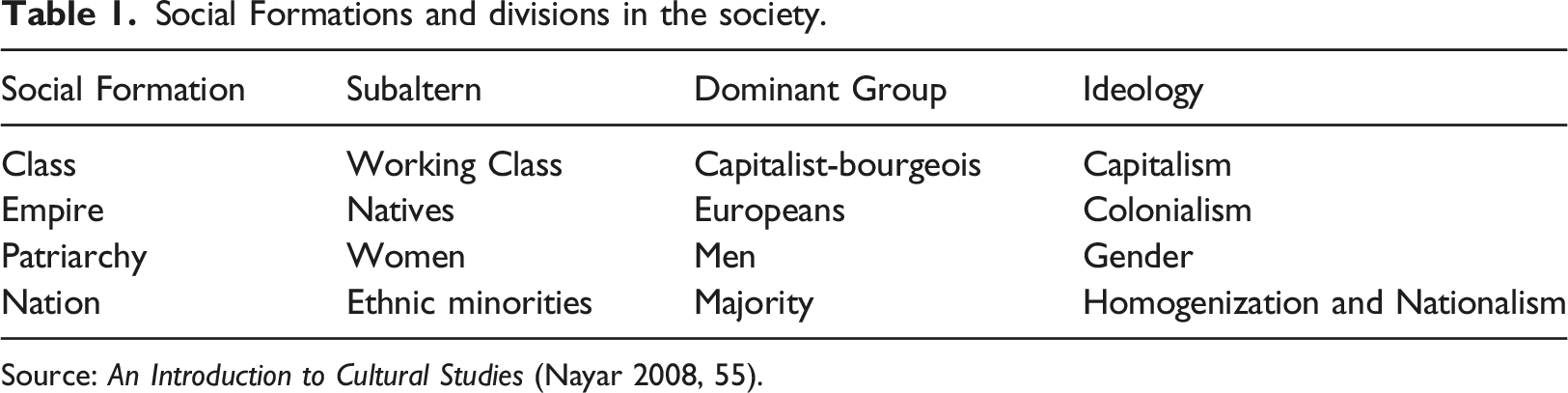
Source: An Introduction to Cultural Studies (Nayar 2008, 55).
Ranajit Guha through this table highlights the persecution, oppression, and subjugation experienced by all social classes, emphasizing the importance of subalterns speaking up. A critical movement in postcolonial studies was the 1980 intervention of the subaltern studies group. Ranajit Guha states that “subaltern” stands as “a name for the general attribute of subordination in South Asian society whether this is expressed in terms of class, caste, age, gender or in any other way” (Guha 1982, 35). Subaltern studies analyze the “binary relationship” of the subaltern and ruling classes and thus studies the interplay of dominance and subordination in colonial systems, most notably India. The methods of the subaltern movement have been extended to other nations, spaces, and historical moments. The overall goal of subaltern studies is to reveal the histories of marginalized or entirely undocumented groups within the colonial and nationalist archives. Turning towards popular accounts of public history and memory to combat what Guha terms “elitism,” the subaltern studies group’s primary focus was to recover, examine, and privilege the agency of the underclass within the networks of capitalism, colonialism, and nationalism.
Kane’s Protagonists: Rereading of Minor Mythological Characters into Major Contemporary Protagonists
बालिका अहं बालिका नव युग जनिता अहं बालिका । नाहमबला दुर्बला आदिशक्ति अहमम्बिका ।। (Pandey 2018, 42) I am a girl, a girl of modern times. I am not feeble or powerless. I am Adi-Shakti, I am Ambika…!!
The Indian community is changing and promoting modern women identifying Adi-Shakti as powerful goddesses. It is essential to acknowledge that women value equality in all aspects of life. Unfortunately, in the past, many ancient Indian epics were written with a male-centric perspective, often disregarding women’s social contributions and sacrifices. Throughout history, patriarchal societies have assigned women various roles and responsibilities. However, Kavita Kane portrays her female characters as individuals rather than objects of societal expectations. Unlike the depiction of women in ancient cultural epics, these female characters experience the phases of maidenhood, womanhood, and motherhood, each with their own unique experiences and challenges (Mishra 2006, 5-20). Kane says, I always believed that mythology can be a huge canvas for contemporary thought. It is not telling us some old tales of gods and goddesses, as so carelessly assumed, but of man and his follies and fallacies. (Expo 43 L229)
Kavita Kane in the interview with The Times of Indian titled “The Kavita Kane Interview: Why Feminism in Indian Mythology Matters Today” in 2017 with Tushar Kaushik shares the glimpse contemporary interpretation of mythology. Through revisionist mythology, Kane delves into the lives of Uruvi, Surpanakha, and Satyavati—characters from the Ramayana and the Mahabharata. Despite being unremarkable in the original epics, these female characters challenge their portrayal as passive objects and assert their intervention. Kane gives them a voice by representing them as titular women, as the original sagas failed to do. “Epics would be lost if not retold: Kavita Kane.” She also said in another interview, “If the Indian epics – the Ramayana and the Mahabharata had not been reimagined and retold multiple times, they wouldn’t have existed today,” at an event called “A Tryst with the Ramayana,” organized by The New Indian Express group in Chennai, Anil Srinivasan.
Karna’s Wife: The Outcast Queen addresses the age-old problem of caste/class conflict and explores how it affects the characters. India is a diverse country with various religions, cultures, rituals, and traditions, but caste/class has been dominant since ancient times. The term “caste” originates from the Spanish and Portuguese word “Casta” and is referred to as Jati or Jana in India, which defines one’s social status based on their occupation (Werner 1994, 50-51). These issues have since expanded to include the subaltern, gender, and majority/minority groups. Princess Uruvi, daughter of Pukhiya’s King Vahusha and Queen Shubhra, challenges society’s cliches and patriarchal norms. The novel reveals that Uruvi faced double marginalization as a female and an outcast after marrying Karna. The book’s protagonist defies the strict social norms of a male-dominated society with remarkable bravery. Kane delves into the timeless topics of caste and gender that have existed in the Vedas, Dharma Shastra, and Puranas for centuries.
In Hinduism, individuals have traditionally been classified into different groups based on their caste or sub-caste as outlined in the sacred text Manu Smriti – Svayambhuva (Manu). The Hindu community is divided into four Varnas: Brahmin (Ecclesiastical), Kshatriya (Military), Vaishya (Industrial), and Shudra (Servile). Sage Manu divided them into different categories and separated society into upper, middle, lower, and no class (Werner 1994, 52). The association and responsibilities of body parts gave birth to caste/class warfare since it demonstrated each caste’s respective status in society as determined by the philosopher Manu. The head is symbolic of Brahmins and has complete rights to read the Vedas and offer speeches on them to the community, while women and Shudra (servile/lower class) are not permitted to touch or read them.
Furthermore, they are upper-caste, and their occupations are priests and teachers. The Kshatriyas are thought to be the body’s shoulders and have the privilege of reading the Vedas but cannot teach them to others; they are upper-middle class and can work as soldiers or combatants. The Vaishyas represent the thigh of the body, and according to Manu, they do not need to read, understand, or teach the Vedas; instead, they can be businessmen. Finally, Shudras, Harijan, and untouchables were assigned the lowest position—the feet. They had no right to read the Vedas or interact with persons of higher classes or castes.
Philosopher Manu said the fourth caste served the three castes above them. Seeking forgiveness for wrongdoing involved serving the Kshatriyas while following all orders of the Brahmins was necessary to reach paradise. Restrictions were placed on Shudras and women over time, preventing them from becoming priests or governing their families as they saw fit. Individuals were often obligated to comply with the decisions made by societal and familial figures.
In the narrative, Uruvi, a strong female character, challenges societal norms and redefines womanhood. Despite the differences in their backgrounds, she maintains friendships with the Pandavas, Kaurava, and Karna. While the Pandavas were among her close friends, she shared a deep bond with Karna, considered to be low caste, as he was the charioteer’s son. However, not many knew that Karna was born with the blessing of God Surya (Sun) to Kunti. Uruvi faces numerous challenges in her love life and questions the rigid thinking of society regarding caste and class. She goes against her family and the norms of society by marrying Karna, breaking down social barriers, and confronting the harsh realities of societal prejudices on her own. Society will not permit me to keep you unmarried, nor will it allow you to marry a charioteer’s son. You cannot marry a half-caste. (Kane 2013,18)
King Vahusha’s lines highlight the sensitive and central nature of marriage and caste strife. Presenting a modern father instead of a rigid patriarchal monarch is essential. Caste is no longer a factor in marriage and education. Despite contemporary society’s disapproval, people still marry regardless of the restrictions set by “religious texts.” Anuloma vivah (hypergamy) is legal and refers to a marriage between a woman of a higher caste and a lower caste man. According to “Hindu religion” pratiloma vivah (hypogamy) is a marriage where a woman from the lower caste marries a man in a higher caste, which is considered unacceptable (Sharma 2022, 1-9). The cognitive pattern remains constant. The Mahabharata portrays the events leading up to the battle of Kurukshetra as a series of gruesome occurrences. Uruvi prepares herself for the inevitable acknowledgment of her role in the divine plan during the war. Even though she is not directly affected, her husband Karna is a victim, and as his wife, she shares the burden of shame he feels. However, she embarks on a path of self-discovery because she is often ignored as a part of Karna’s family and as someone who silently witnesses epic events. Whatever happens to me or whatever I do, I shall never disappoint her. However, I am not good enough for Uruvi. (Kane 2013, 67)
The above conversation demonstrates how, despite Karna having complete faith in Vrushali, his inclination was towards Uruvi. The passive female and his first wife, Vrushali, readily accepted polygamy, which was extremely popular during this period. Vrushali possesses ideal traits for a successful marriage; she is sensible, kind, and adaptable. She was an Adhirath and belonged to the same caste as her husband. Uruvi was Vrushali’s opposite, who decided how she would live her life and stuck with them until the end. To marry her beloved Karna, Uruvi overcame all obstacles, antagonisms, and disgrace. Her marriage was the start of many difficulties. Throughout it, she took responsibility for her actions and stayed authentic to herself. Karna’s battle with his marginalization throughout his life culminated in the battle of Kurukshetra. The marginalized female characters, Uruvi and Vrushali, also engaged in personal conflicts with both society and in their personal lives. Vrushali’s quiet suffering drove her to insanity in response to society’s focus on discrimination, caste inequality, honor, and pride. Uruvi, on the other hand, chose to fight against those responsible for social injustices. Her unwavering compassion for the abused and her support for and opposition to societal wrongs helped sustain Karna’s movement. Throughout the tale, Kane portrays Uruvi as a princess fighting for her rights and championing women’s equality.
The tale of Lanka’s Princess begins with Meenakshi, who struggles against the objectification of gender roles. From a young age, she endured neglect and emotional abuse. The story follows her transformation into Surpanakha, a Rakshasi (demon), as she feels she has no choice. Meenakshi was born to Sage Rishi Vishrava and had three brothers, Ravana, Kumbhakarna, and Vibhishan, whose names carry negative and positive connotations. In the novel, Meenakshi faces discrimination from her mother due to her gender and skin color. She is portrayed as a “monster” due to her mixed heritage of being half human/half demon. Meenakshi inherited the Brahminical qualities from her father and brother Vibhishan, while her mother Kaikesi and brother Ravana contributed to her Asura heritage.
Contrary to the original epic, she is considered the person who demolished the Asura dynasty. However, contemporary Surpanakha has the credentials to raise her voice against the patriarchal norms in which women are considered as “other,” presenting herself as self-reliant. Kane’s novels have one fundamental theme that deals with the exploration of marginality in epics and the revolution of the protagonist. Kane (2016, 1) begins the novel with a convoluted phrase “It is a Girl!” that conveys to the readers a sense of gender inequity, prejudice, and the agony of psychological standards of Surpanakha. One girl was born among the three boys and greeted with phrases conveying the sentiment of an unsought child. Rakshasi Kaikeshi despised her since her complexion was mahogany; she caused her mother anguish, unhappiness, and sadness due to her sex.
“One is not born, but rather becomes, a woman” (Beauvoir Simone 1949, 283). The quote by Simone de Beauvoir applies to Kane and the main characters, who were not naturally inclined to fight but transformed themselves. The story portrays the main character initially as an unloved child but ultimately shows her as a compassionate and forgiving person rather than a monster. Although her mother disapproved, her father, Rishi Vishravas, accepted her. The protagonist was given three names during her journey, each significant to her life. When her father calls her Meenakshi, she feels beautiful because her eyes resemble a fish’s. However, when Kaikeshi refers to her as Chandrankha, which means (black monkey), she feels concerned and dismayed. Finally, when Ravana gives her the name Surpanakha, she feels powerful.
Why don’t you behave like a girl? Always fighting and hitting boys, scratching the eyes out of anyone who provokes you. Surpanakha, that’s the right name for you, you Monster.” She replied immediately, “Yes, I am a monster! If anyone hurts me, I shall hurt them with these!!! I am Surpanakha. (Kane 2016, 9)
Ravana taunts her with the name, calling her a monster for always fighting and hitting boys, but she embraces it and uses it to assert her strength. She finds solace in Taraka her Nani-Maa (Grandmother), who imparts valuable life lessons, boosts her confidence, and endows her with supernatural abilities. Following the death of her pet, she seeks revenge by using her sharp nails to inflict extreme pain on Ravana. Fortunately, with the unwavering love of her husband, Vidyujiva, she can recover from her wounds and sadness. Unfortunately, her life comes to a tragic end when Ravana, with the support of her family, kills Vidyujiva.
Vidyujiva sees her as an enchantress and a tigress who knows how to fight alone. “Meenu, you were ugly, not merely in your looks but your ugly, twisted mind” (Kane 2016, 174). Ravana called Meenakshi ugly because she questioned him after her husband’s murder, causing her to become traumatized and turn into Surpanakha, who wanted Ravana dead. She even plotted to kill her brother and brought Ram and Sita into the conflict to help her. There are variations in Surpanakha’s mutilation in Valmiki’s Ramayana chapter “Aranya Kanda.” In this version, Surpanakha fell in love with Ram’s appearance and proposed to him during his exile in the Dandak Forest. However, Ram rejected her proposal.
अनुजस्तवेष मे भ्राता शीलवान् प्रियदर्शन: |
श्रीमानकृतदारश्र लक्ष्मणो नाम वीर्यवान् || ३ ||
अपुर्वी भार्यया चार्थी तरुण: प्रियदर्शन: |
अनुरूपश्र ते भर्ता रूपस्यास्य भविष्यति || ४ ||
एतां विरूपामसती करालां निर्णतोदरीम् |
भर्यो वृद्धां परित्यज्य त्वामेवैष भजिष्यति || ११ ||
निकृत्तकर्णनासा तु विस्वरं सा विनघ च |
यथागतं प्रदुद्राव घोरा शूर्पणखा वनम् || २२ ||
“I did not want Kumbha to die or his young twin sons too. I don’t want my Meghnad killed as well. It had been Ravana alone who was supposed to die on the battlefield. Nevertheless, he would be the last to die. Before him, all those who I had once loved would be sacrificed (Kane 2016, 254). Surpanakha seeks revenge against Ravana but spares his family. It had been Ravana alone who was supposed to die on the battlefield. When Ravana was murdered, she was joyful and fulfilled, leaving everyone with Kumbha’s words, “Compassion heals everything” (289). Despite being an asura, she never killed anyone and has been represented as “Beyond the Bad and the ugly, the Good human” (255). Kane depicts her as the most potent character, altering not only herself but also Lanka’s history.
The Fisher Queen Dynasty is a novel that tells the story of Kali (Satyavati), a protagonist from the Fish Dynasty, and her experiences in the Mahabharata. Throughout the book, witness her transformation from Matsyagandha (someone who smells like fish) to Yojnagandha (someone who makes plans) and from Naav Chalika (a boat woman) to Rajmata (the mother of the empire) of Hastinapur. Despite societal constraints based on her skin color and social class, Satyavati manages to expand her control over Hastinapur and become its Rajmata. The plot explores the struggle between a woman’s ambition and temptation for power. The conflict in the novel revolves around ability, and the author questions whether our evaluation of characters changes depending on their gender, caste, and creed. Kane’s foremost objective in the book is to represent women from a feminist point of view, exploring their marginality in the epics and defending the history of voiceless women. She contrasts Satyavati with the men in her culture and elevates overlooked characters in a patriarchal and judgmental society. The Mahabharata portrays Satyavati as a leader who has endured a lifetime of bodily exploitation. She has been unfairly labeled an enchantress, crafty lady, and opportunist. The epic highlights patriarchal standards, portraying men as superior to women, with many male characters such as Dhitrashthra, Duryodhana, Dushasana, Kripacharya, and Dronacharya taking center stage. Despite this, Satyavati faced double marginalization due to her gender and race, like Surpanakha. Throughout the story, she displays positive and negative traits despite a life filled with agony since birth.
Dasharaj feels, “Kings need princes, not princesses! If it had been up to him, he would have probably drowned you in the river (Kane 2017, 31). Satyavati was born to King Uparichar Vasu, who did not fully accept her due to her gender, much like how her mother rejected Surpanakha. To solve the problem of having a daughter instead of a son, King Vasu gave Satyavati to the childless Dasharaj, stating that he only needed a male heir. Satyavati’s tireless work led her to achieve the title of Rajmata despite never being acknowledged as a princess. Satyavati took an oath herself that she “would not be the conquest of a man” (59). She never wanted to become an object of passion in the hands of man. This quote implies that she desires power, control, and dominance and intends to be a ruler rather than being ruled by others. Her character can further be explained with the statement by Beauvoir Simone (1949, 149) about strong women, “who would be equal to men and who would think and act like a man and instead of bemoaning her inferiority to men, she would declare herself their equal.” Even though she had a background of coming from Fish dynasty (the lower strata of society). Satyavati accepted the proposal of Shantanu, the king of Hastinapur, when he fell in love with her. She became the queen of the Hastinapur kingdom, except for Kunti, Draupadi, and Subhadra. Satyavati displayed remarkable foresight when she instructed Bhishma Pitamha to swear to celibacy to prevent her descendants from vying for control of the empire. Her actions demonstrate that she was not merely a feminist ahead of her time but also a brilliant and courageous woman who dared to challenge societal conventions.
According to Kane, Satyavati was mistreated due to societal norms. Women should not be objectified but instead be seen as beacons of hope. The author portrays Satyavati as a resolute woman who will stop at nothing to gain power and accomplish her objectives. Ultimately, she was bestowed the prestigious title of Rajmata of Hastinapur. It is worth noting that Kane attributes Satyavati’s mistreatment to societal norms, emphasizing the need to view women as symbols of hope rather than objects of use.
Conclusion
Research on the progress of women’s development indicates that there have been notable advancements in recent years. However, due to deeply rooted cultural inequalities, certain cultures continue to exclude women from participating in economic, social, and political affairs. Ensuring women have equal opportunities to participate in formal and informal economic activities is vital. Sadly, numerous women encounter obstacles in gaining an education and securing a livelihood, hindering their advancement. As a result, their dignity is compromised, and their freedom is limited. Despite the Indian government’s efforts to promote empowerment and recognition of women through National Girl Child Day on January 24th and International Girl Child Day on October 11th, gender-based crimes like acid attacks, cyberbullying, rape, murder, dismemberment, and pornography continue to exist, denying women equal opportunities and safety. To eliminate gender inequality and promote women’s education and empowerment, a collective effort is required. Kane’s depiction of minor female characters from the Ramayana and the Mahabharata as primary protagonists is an excellent example of transformative representation. Reimagining these epics in novel ways is also a step towards women’s empowerment.
The novels mentioned above convey a powerful message that women can take control of their lives and overcome obstacles with determination and bravery. Kavita Kane challenges gender discrimination by highlighting the marginalized characters in ancient Indian epics, raising awareness essential for the evolution of feminist ideology. Modernizing these tales to appeal to contemporary mindsets that challenge gender norms and patriarchal structures is a significant event. The other event emphasizes the original concept and notions of epics that contribute to its universality. These events are possible due to the epical elements Kane chooses to include in her books. This article compares the myths with the epics to examine how the female perspective differs from the male discourse. Indian feminists have emerged from the context and revised mythology that men created. Kavita Kane’s primary objective was to bring the fabled era of the ancient epics into the contemporary world and decode them. She achieved recognition through her immaculate portrayal of the unstated characters who had a significant and silent part in the greatest epics. The discussion has created the impression in the minds of all mythological writers that some minor characters are yet to be measured. They are Gandhari, Ganga, Savitri, Devyani, Kunti, Amba, Ambika, Ambalika, Shikhandini, Shrutakirti, and Mandavi, who played a prominent role in the epics. The task ahead is to examine, highlight, and decode their experience through modern lenses.
