



Abstract
Objective
We aimed to describe and investigate the factors associated with private internet use for health purposes in the post-pandemic era.
Methods
Data were taken from a quota-based online sample (n = 3270, German adult population aged 18 to 74 years; 47 years on average), with data collection took place at the beginning of 2025. Concerning the private use of the internet for health purposes, three areas were explored (presence and, if applicable, hours per week): researching health issues (e.g. treatments or medications), exchanging views or discussing health issues (e.g. in patient forums), and using telemedicine services (e.g. online consultations).
Results
In total, 60.7% of the participants researched health issues, 20.7% of the participants exchanged views or discussed health issues, and 12.0% of the participants used telemedicine services (e.g. online consultations). Among such individuals privately using the internet for health purposes, the average hours per week for such activities were 1.4 h (SD: 2.0; health issues), 1.9 h (SD: 3.0; exchange views), and 1.8 h (SD: 2.7; telemedicine services). Regressions showed that higher odds of using the internet privately for all three health purposes were significantly associated with younger age, living together: married/partnership, a higher frequency of sports activity, a health-conscious diet, a higher number of chronic conditions, and higher loneliness levels. Some other independent variables such as gender or level of urbanization were partly associated with the outcomes.
Conclusion
Our present study extends our current understanding of using the internet privately for health purposes in Germany. Future longitudinal and cross-country studies are recommended.
Keywords
Introduction
More than two out of three individuals worldwide have access to the internet. 1 In Germany, a high-income country, almost no one in the adult population has no access to the internet for financial reasons. 2 Many public institutions (such as libraries) also offer free access to the internet in Germany.
The private use of the internet offers a wide range of possibilities, from online shopping and video streaming to searching for information. Using the internet privately for health purposes is also an important area. For example, individuals could research health issues such as treatments or medications, exchange views or discuss health topics in specific patient forums, or could use telemedicine services such as online consultations (e.g. at their family doctor or psychiatrist). Private research on health topics can also potentially fuel fears among certain users prone to neuroticism (e.g. if individuals research eyelid twitching on the internet and consequently become afraid of having Parkinson's disease). 3 On the other hand, researching health issues may improve health awareness and even health literacy.4,5 Similar consequences would also be conceivable for exchanges on health topics (e.g. in patient forums). 6 In particular, the use of telemedicine services has the potential to relieve pressure on healthcare systems.
In Germany, about 60% researched health issues online in Germany in the past few years.7,8 Moreover, about 10% among those with access to the internet and aged 46 years and over had online consultations with doctors or therapists in Germany in 2020 9 (see also Neumann et al. 10 ). Additionally, some former studies also investigated the factors associated with such online activities.11–13
Thus far, however, there is restricted knowledge regarding the frequency of and the factors associated with using the internet privately for health purposes. More precisely, most of the existing studies focused on data before 14 or during the COVID-19 pandemic.15,16 This means that there is a lack of studies based on more recent data from the post-pandemic era. Moreover, studies are missing that provide the exact amount of time spent on these online activities focused on health per week. Furthermore, studies are lacking dealing with different online activities related to health. Therefore, we aimed to describe and investigate the factors associated with using the internet privately for health purposes in terms of researching health issues, exchanging views or discussing health issues, and using telemedicine services (including the amount of time spent on these activities each week) in the post-pandemic era. An important model in this context is the unified theory of acceptance and use of technology (UTAUT) model, 17 which includes, among other things, factors such as age and gender to predict behavioral intention to use telemedicine services.
Overall, such knowledge can enrich our present understanding of using the internet privately for health purposes in Germany in the post-pandemic era. This in turn is relevant as such behavior may have consequences for health outcomes. 18 Moreover, such knowledge may assist in improving telemedicine usage, which in turn could relieve the burden on healthcare systems.
Methods
Sample
Cross-sectional data were gathered via an online survey (observational study). Data collection occurred in January 2025. Overall, 3270 individuals (varying from 18 to 74 years) participated in the survey. We conducted power calculations for the logistic regressions beforehand. According to the power calculations (e.g. alpha = 0.05, power = 0.80, odds ratio (OR) = 1.5 for sex, frequency of 0.5 for sex, frequency of 0.6 for researched health issues; the estimated sample size should be 800), our study is appropriately powered.
A very established and ISO certified market research company (Bilendi) performed the survey. To secure that the sample accurately reflected the demographic distribution of the adult population in Germany, a quota sampling approach was employed (with cross quotas for age × gender, uncrossed quota for federal state). Two inclusion criteria were applied: 18 to 74 years and residing in Germany. To put it differently, individuals aged 75 years and older and those aged under 18 years were excluded. Moreover, individuals living abroad were excluded. Further exclusion criteria were not applied.
Before starting the survey, all participants gave written informed consent by agreeing to the online consent form. This is a standard procedure for conducting online surveys.
The study was ethically approved by the Local Psychological Ethics Committee (University Medical Center Hamburg-Eppendorf; registration number: LPEK-0849).
Dependent variables
Concerning the private use of the internet for health purposes, three areas were explored. Individuals were asked whether they used the internet for the following three purposes (each case: no or yes):
researching health issues (e.g. treatments or medications), exchanging views or discussing health issues (e.g. in patient forums), and telemedicine services (e.g. online consultations).
If individuals replied with “yes” to any of the three items, they were asked how many hours per week they spent on average using the internet for that purpose.
Independent variables
Building upon prior research9,11,12,19 and inspired by the UTAUT model, 17 the regression analysis included a wide array of independent variables covering sociodemographic, lifestyle, health-related, and psychosocial factors. Sociodemographic factors included: gender (men; women; diverse), age, educational level (classified according to the International Standard Classification of Education (ISCED)-97 20 : primary; secondary; tertiary), employment status (full-time employed; retired; other), marital status (single; divorced; widowed; living separately: married/in partnership; living together: married/in partnership), and level of urbanization (rural; predominantly urban; urban). Lifestyle-related factors included: smoking behavior (daily; occasionally; stopped smoking; never smoked), frequency of alcohol consumption (daily; several times a week; weekly; 1–3 times a month; less often; never), frequency of sports activity (none; less than 1 h per week; regularly, 1–2 h per week; regularly, 2–4 h per week; regularly, more than 4 h per week), and health-conscious diet (very strong; strong; somewhat; not at all). Health-related variables included self-rated health status (assessed via a single-item tool varying from 1 = very poor to 5 = very good) and a list of 15 chronic conditions such as depressive disorder, stroke, or cancer. Moreover, the psychosocial factor loneliness was included in the regression analysis. It was measured using the six-item version of the De Jong Gierveld Loneliness Scale. 21 The resulting score ranges from 0 to 6, whereby higher values denote higher loneliness levels. Cronbach's alpha was 0.78 in our present study.
Statistical analysis
First, characteristics of the sample are described (mean (SD) or n (%), as appropriate). Then, the frequency of using the internet privately for the three health purposes is presented (also stratified according to key subgroups). Potential differences were tested using chi-squared tests. Subsequently, the factors associated with using the internet privately for the three health purposes (in each case: no or yes) were examined using multiple logistic regressions (ORs with 95% confidence intervals (CIs)).
The independent variables (mentioned in the previous section) were entered simultaneously to the regression models. Potential multicollinearity was tested using variance inflation factors (VIFs). However, the mean VIF was very low (1.19; highest VIF: 1.49), indicating that multicollinearity is not a threat. The overall models were significant (with researched health issues as outcome: likelihood ratio (LR) χ2(28) = 371.12, p < 0.001; with exchanged views or discussed health issues as outcome: LR χ2(28) = 406.96, p < 0.001; with using telemedicine services as outcome: LR χ2(28) = 501.66, p < 0.001).
StataNow 19.5 MP-Parallel Edition (Stata Corp., College Station, Texas) was used for statistical analysis. The significance level was determined at p < 0.05.
Results
Sample characteristics and bivariate analysis
Characteristics of the sample are presented in Table 1. In the entire sample, the mean age equaled 47 years (SD: 15 years, ranging from 18 to 74 years) with about 50% of the respondents being female. More details are presented in Table 1.
Sample characteristics (n = 3270).

The frequency of using the internet privately for the three health purposes (also for several subgroups) is presented in Table 2. Overall, 60.7% of the participants researched health issues. Moreover, 20.7% of the participants exchanged views or discussed health issues, and 12.0% of the participants used telemedicine services (e.g. online consultations). Significant associations were present with most independent variables. For example, the frequency of researching health issues varied by subgroups (particularly by health-conscious diet). The frequency of exchanging views or discussing health issues also varied by subgroups (e.g. age group and health-conscious diet). Similarly, the frequency of using telemedicine services varied by subgroups (e.g. age group, level of urbanization, smoking status, frequency of sports activity, and health-conscious diet). Additional details are shown in Table 2. It is worth noting that among individuals privately using the internet for health purposes, the average hours per week for such activities were 1.4 h (SD: 2.0; health issues), 1.9 h (SD: 3.0; exchange views), and 1.8 h (SD: 2.7; telemedicine services).
Frequency of using the internet privately for health purposes (also stratified according to key subgroups).
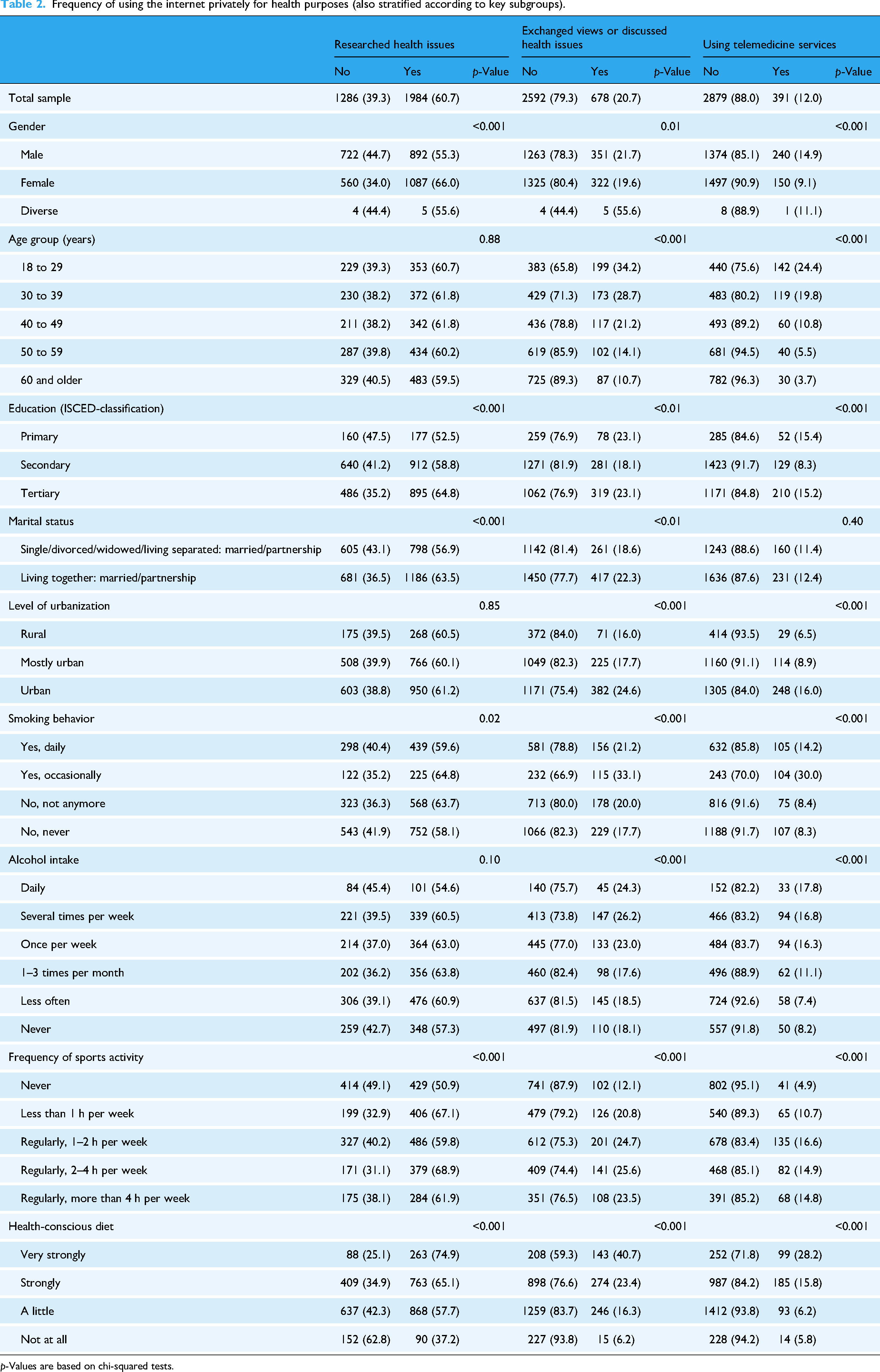
p-Values are based on chi-squared tests.
Regression analysis
Results of logistic regressions are presented in Table 3 (using the internet privately for three health purposes: researching health issues, exchanging views or discussing health issues, and using telemedicine services). Regressions showed that higher odds of using the internet privately for all three health purposes were significantly associated with younger age (e.g. with the outcome researching health issues: OR = .99, 95% CI: 0.99 to 1.00, p < 0.05), living together: married/partnership (e.g. with the outcome researching health issues: OR = 1.44, 95% CI: 1.23 to 1.68, p < 0.001), a higher frequency of sports activity (e.g. regularly 2–4 h per week vs. never; with the outcome exchanging views or discussing health issues: OR = 1.64, 95% CI: 1.19 to 2.26, p < 0.01), a health-conscious diet (e.g. very strongly vs. not at all; with the outcome exchanging views or discussing health issues: OR = 8.02, 95% CI: 4.39 to 14.63, p < 0.001), a higher number of chronic conditions (e.g. with the outcome using telemedicine services: OR = 1.18, 95% CI: 1.09 to 1.27, p < 0.001), and higher loneliness levels (e.g. with the outcome using telemedicine services: OR = 1.15, 95% CI: 1.07 to 1.23, p < 0.001). Some other independent variables were partly associated with the outcomes (for further details, see Table 3).
Factors associated with using the internet privately for health purposes (first outcome: researched health issues: second outcome: exchanged views or discussed health issues; third outcome: using telemedicine services).

Results of logistic regressions. Odds ratios are presented with 95% confidence intervals in parentheses.
Others encompass: single, widowed, divorced, and living separated: married/partnership.
***p < 0.001, **p < 0.01, *p < 0.05, +p < 0.10.
Discussion
In sum, about 61% of the participants researched health issues, almost 21% exchanged views or discussed health issues, and 12% used telemedicine services. Different sociodemographic factors such as younger age, being married, a more health-conscious lifestyle (a health-conscious diet in particular), poor health (in terms of more chronic conditions), and poor psychosocial factors (in terms of loneliness) were associated with higher odds of using the internet privately for all three health issues. Our current study extends our current knowledge (1) by using recent data from the post-pandemic era, (2) by dealing with different online health-related activities, and (3) by adding knowledge about the amount of weekly time spending on such activities.
In comparison to past studies from Germany focusing on middle-aged and older adults during the pandemic,9,10 the use of telemedicine services appears to be declining slightly over time (when comparing only those individuals in these age groups). Previous analyses based on German health insurance data also showed declines in video consultations in recent years (although increases have since been recorded again). 22 In December 2020, a German study focusing on the general adult population showed that 20% of the respondents used telemedicine services. 23 A further study 16 showed that at more than 12 months after the start of the COVID-19 pandemic, 13.3% had replaced physician visits by telemedicine services during the course of the pandemic.
Previous studies from Germany also showed that about 60% researched health issues online in recent years7,8 which matched our present findings. Comparing our results regarding the frequency of exchanging views/discussing health issues with other German studies is difficult due to a lack of comparable findings. Nevertheless, a previous systematic review showed that discussing health topics is a topic of growing interest in the past decade. 24
Our current study revealed that individuals who use the internet for personal health-related purposes dedicate a significant portion of their weekly time to such topics (worth repeating: researching health issues: 1.4 h; exchange views: 1.9 h; telemedicine services: 1.8 h). Given the available time within a week and other activities that could be carried out during this period, we feel that this is a considerable proportion.
In accordance with the bulk of past studies,11,12,25 and in line with the UTAUT model, younger age was positively associated with the outcomes of this study. This can probably be mainly attributed to the high level of technological affinity among younger individuals. 26 Similar to former research (e.g. Narcisse et al. 13 ), being married was associated with the outcomes in our study. We assume that the partner is also concerned about the respondent's health. In this respect, the partner may encourage or gently urge the respondent to seek further information on health issues or to use healthcare services (also in terms of telehealth). 27 Respondents could also look for information about their partner's health.
Previous research also showed an association of physical activity and health-conscious diet with preventive healthcare use or with a more health-conscious lifestyle.28,29 Such higher levels of health awareness and a greater interest in health-related topics may explain why such factors were associated with the outcomes of our present study.
A higher number of chronic conditions was significantly associated with all outcomes of our study. Similar findings were observed in other studies focusing on online health consultations.10,15,19 Our findings may be particularly explained by the greater health needs of individuals with chronic conditions (such as individuals with diabetes). 10 In light of this, it is plausible that individuals with chronic conditions want to learn more about health issues online and may also be looking to exchange thoughts with like-minded individuals. 30
Comparable to previous research (e.g. Neumann et al. 10 ), loneliness was associated with the outcomes (e.g. higher odds of using telemedicine). Such findings can be interpreted in the light of the UTAUT dimension “performance expectancy”: we assume that individuals scoring higher in loneliness used the internet privately for health issues to fulfill their unmet social needs and improve their social connectedness. Discussions on health topics in patient forums can serve as an example of this. The use of telemedicine services may also involve fewer barriers for lonely people than on-site appointments at the doctor's office. 10
We would like to highlight some strengths and shortcomings of our study. First, a main strength is the usage of a quota-based sample, which ensures representativeness in terms of age, gender, and federal state (German adult population). However, it may not be fully representative in terms of other factors such as migration background or religious affiliation. Thus, we recommend future research based on random samples (whenever possible). Three key areas (presence and duration) for using the internet privately for health purposes were explored. However, future research is required to gain further insights into such areas and to explore other areas related to health on the internet. It should be emphasized that this study had a cross-sectional design (with its known limitations, particularly related to directionality). Moreover, an online sample was used. In this respect, individuals with a certain affinity for the internet may be somewhat overrepresented (digital divide bias). Offline random samples may be one way to address this bias in upcoming research. Furthermore, it should be acknowledged that we used self-reported outcomes in this study. We recommend future research based on objective assessments (measured duration of using the internet privately for health purposes).
Conclusions
Our present study extends our current understanding of using the internet privately for health purposes in Germany. For example, this knowledge may help to characterize users of telemedicine services, which in turn may assist in relieving the burden on healthcare systems.
For example, efforts to improve health literacy may lead to a healthier lifestyle (e.g. sports activity and a health-conscious diet). 31 Ultimately, this may lead to an increased use of telemedicine services. Furthermore, strategies to improve digital health literacy (e.g. among older adults) may be beneficial for such outcomes. 32 Additionally, highlighting options such as telemedicine services (both among patients and providers) may be beneficial to increase awareness and ultimately increase their use.33–35 Such measures may contribute to relieving healthcare systems.
Future longitudinal and cross-country studies are recommended. Moreover, upcoming studies could also focus on adolescents and individuals aged 75 years and over. Furthermore, we recommend elucidating the underlying mechanisms in upcoming studies.
Footnotes

Ethical considerations
The Psychological Ethics Committee of the University Medical Center Hamburg-Eppendorf gave its approval for this study (LPEK-0849). The study was conducted in accordance with the Declaration of Helsinki.
Consent to participate
Each individual gave his or her informed consent.
Author contributions
Conceptualization: AH, AN, SP, KP, and H-HK; methodology: AH, AN, SP, KP and H-HK; formal analysis: AH; resources: H-HK; data curation: AH; writing—original draft preparation: AH; writing—review and editing: AH, AN, SP, KP, and H-HK; visualization: AH, AN, SP, KP, and H-HK; supervision: H-HK; project administration: AH and AN. All authors have read and agreed to the published version of the manuscript.
Funding
The authors received no financial support for the research, authorship, and/or publication of this article.
Declaration of conflicting interests
The authors declared no potential conflicts of interest with respect to the research, authorship, and/or publication of this article.
Data availability
The datasets generated and/or analyzed during the current study are not publicly available due to ethical restrictions but are available from the corresponding author on reasonable request.
Statement disclosing the use of any AI tools in the development or editing of the manuscript
We used generative artificial intelligence tools such as Grammarly to improve the manuscript's language. We then reviewed and revised the suggested changes.