




Abstract
The present research has endeavoured to study the well-being and prevalence of depression and anxiety among the urban Indian MSM (men who have sex with men). It has also tried to understand whether any regional variances exist across the different identity categories of MSM. The study was conducted in the urban setting of two states of India, that is, West Bengal and Uttar Pradesh. The participants (N = 700) of this research were the five different categories of MSM identified by the Kothis/Kothmas, a subcultural local identity of Indian MSM. The participants were contacted by using the snowball technique. The present study has adopted mixed method. Ethnography was used to understand the identity issues and problems of MSM as well for providing narratives in support of their anxiety and depression, while quantitative method helped to evaluate the data regarding well-being, depression and anxiety. One-way ANOVA was used for statistical analysis. The qualitative part, data have been analysed by interpretative method. The result of one-way ANOVA confirms the statistically significant differences among different MSM categories in case of well-being, anxiety and depression. The cultural politics of sexual identity (Kothi/Kothma) that excludes the urban Indian MSM themselves cannot avoid the stress generated from their respective sexual practices and life events leading to increased anxiety and depression and a decline well-being. This study intends to create the attention of health planners, policy makers and activists for the welfare and health uplift of MSM in India.
Introduction
In India, MSM or men who have sex with men are highly stigmatised. Homosexuality is considered as an odd phenomenon and it is looked upon as shame for their family who practice MSM behaviour. People believe homosexuality is a negation of masculinity and homosexual men must be effeminate (Connell, 1992). Homophobia is too firmly embedded in countries like India. On the other hand, a man who dresses up like a woman, does everything in a feminine way, seems more vulnerable and stigmatised in Indian culture and society than homosexual practices because the gendered manifestation is more public than their sexuality (more private). Stigma brings discrimination and harassment which are the results of social influence of stereotyping. From 1970s, there has been increased attention to understanding the psychological condition of lesbians, gay men and bisexuals, who suffer stress and stigma. Early researchers have suggested homosexual men are vulnerable to mental health problems and have emotional distress (Cochran & Mays, 2000; King et al., 2003; Warner et al., 2004). The scholars like Cochran et al. (2003), D’Augelli et al. (2001), Luhtanen (2003), Mays and Cochran (2001), Otis and Skinner (1996), Zea et al. (1999) and others have showed that people with same-sex sexuality behaviour is associated with psychiatric morbidity like anxiety, depression and suicidal behaviour. Minority stress model was used in the past few decades by the pathologists to understand mental state or illness, including suicidal tendencies of homosexuals. In contrast, anthropologists and sociologists have provided inclusive effort of interlacing the available complexities of the MSM. They gave a consensus on the meaning, utility and application of the concept, sexual desire, gender role and other issues. Identity politics is a part of modern history and political science as well. The present research is particularly an effort to explore the different MSM identities of two provinces of India (West Bengal and Uttar Pradesh) and their psychological health putting emphasis on the state of well-being and also endeavoured to study the prevalence of depression and anxiety among them. The purpose of selecting two different locations in India is to understand the distinction of the people with MSM practices. In the present day, mental well-being is considered as both the nonexistence of mental illness and the existence of positive psychological resources, such as positive affect and satisfaction with one’s life (Diener, 1984; Sin et al., 2011). From a holistic perspective, the research has included the study of the amplitude of depression and anxiety conversely with well-being of the MSM.
The concept of well-being is derived from positive psychology. Gable and Haidt (2005) defined, ‘Positive psychology is the study of the conditions and processes that contribute to the flourishing or optimal functioning of people, groups, and institutions’ (pp. 104). Positive psychology interventions have intended growing positive (a) feelings, (b) behaviours and (c) positive cognitions that would exaggerate well-being and reduce depressions (Sin & Lyubomirsky, 2009). The term ‘well-being’ is mainly used for a particular array of goodness, for example, life satisfaction, living in a standard quality environment, being able to cope with harsh conditions of life, being worthy for the world, enjoying life etc. (Singh & Shyam, 2007). So, well-being is a complex, multifaceted construct (Singh & Shyam, 2007). On the contrary, anxiety is an aversive emotional and motivational state occurring in threatening circumstances (Eysenck et al., 2007). Spielberger et al. (1983) have emphasised that anxiety can be conceptualised in two ways, as a stable disposition, and as a transient emotional state that everyone experiences from time to time. Both trait and state anxieties have been conceptualised as unitary constructs. State anxiety has been defined as an unpleasant emotional response while coping with threatening or dangerous situations (Spielberger et al. 1983), which includes a cognitive appraisal of a threat as a precursor for its appearance (Lazarus, 1991).
On the other hand, trait anxiety refers to stable individual differences in a tendency to respond with an increase in state anxiety while anticipating a threatening situation. This tendency is consistent across a broad range of situations and is temporarily stable. Spielberger et al. (1999) characterised trait anxiety as a general disposition to experience transient states of anxiety. State anxiety can be a reaction to certain situational demands, whereas trait anxiety is core anxiety. High-trait anxiety individuals can experience more frequent and more intensive anxiety compared to low-trait anxiety individuals; however, they are not anxious all the time (Eysenck & Eysenck, 1980). Depression is often conceptualised as an accumulation of negative moods and negative cognitions (Abramson et al., 1978). By the recuperation of depression psychologists can freeze this negative condition, but it does not mean fixing negative is the alternative of inlaying positive resources (Sin et al., 2011). Negative and positive intuitions are two independent constructs (Watson & Tellegen, 1985). Positive emotions can trigger the greater psychological well-being (Fredrickson & Joiner, 2002). Depression can result from a number of factors, including biological, psychological and social factors (Polders et al., 2008). The present study has not put emphasis on essentialists’ understanding of the biological attribution (inherently linked or not, brain chemical, hormonal) for depression and focused on the socio-cultural stressors that could result in an increased vulnerability to depression. The study has allowed the informants to tell their stories and their narrations that hold the meaning in turn create their experience of the depression. Interpretation of these narrations with detailing help to find out the context that creates stress. It is normal for everyone to experience ups and downs or to feel sad at various phases in life. Sadness may come from the events that happen in a person’s life. But there is a difference between normal experience of sadness and psychological depression, which is a long-term process. According to the WHO (2012) report,
Depression is a common mental disorder that presents with depressed mood, loss of interest or pleasure, decreased energy, feelings of guilt or low self-worth, disturbed sleep or appetite, and poor concentration. Moreover, depression often comes with symptoms of anxiety. These problems can become chronic or recurrent and lead to substantial impairments in an individual’s ability to take care of his or her everyday responsibilities.
DSM-V proposed anxiety symptoms that may indicate that depression is irrational worry, preoccupation with unpleasant worries, trouble relaxing, feeling tense and fear that something awful might happen. This study has explored the state of depression by focusing on particular symptoms. These symptoms include some of the somatic symptoms of depression, such as insomnia, appetite gain or loss, loss of energy and others. Thoughts of suicide were also interpreted as indicative of vulnerability to depression. The Beck Depression Inventory (BDI) scale was used to understand the level of depression of the MSM categories. Early researchers have shown gay men and lesbian women experience stress that is often linked to their membership of a stigmatised social minority (Vincke & Van Heeringen, 2002). Non-disclosure of sexual orientation due to victimisation diminished opportunities for proper support and increased loneliness that also enhanced vulnerability to depression of these MSM people (Buzzella et al., 2003; Oetjen & Rothblum, 2000). Because of being same-sex practitioners, the MSM people experienced violence, discrimination and harassment from the hetero-normative homophobic society in their day-to-day life (Khan, 2004; Thomas et al., 2011). According to Beck’s Negative Cognitive Triad theory, negative thoughts about self even about the world may create depression. Through in-depth interviews of the participants this research could observe whether their life experiences are responsible for creating their negative thoughts about self. This study may also challenge the pathological views of the clinical psychologists who believe same-sex sexuality people are pathologically depressive in nature.
Methodology
The present research has explored the population of MSM in two different locations of India; first one is the state of West Bengal, where the participation in research comes from the urban and adjacent areas of the districts of Mursidabad, Kolkata, Howrah and South 24 Parganas. The other one is the state of Uttar Pradesh, where people from only the district of Varanasi have participated in this study. Apart from the offices of the community-based organisations of the MSM, the fieldwork includes different spaces of the above districts like railway stations, park, open fields, lakesides, cinema halls, restaurants, bus stops, pay toilets area, ghats (riverside) and house of the informants in some cases. This research had been started in 2014 and continued up to 2019.
Majority of the population of West Bengal comprises Bengali-speaking people and in case of Varanasi, they are Hindi speaking. Populations are either from Hindu community or Muslim. Total 700 participants (145 are Ariyal or Veli Kothi/Aariyal Kothma, 165 are Koripese Kothi/Karetal ki Kothma, 96 are Dupli Gupti/Double Decker, 125 are Hijras and 169 are Parikh/Panthis/Purush/Mard/Heterosexual) have been studied in this research. The identifiable terms of self-identity could vary in different states of India.
This research has followed a ‘mixed method’ approach to support the qualitative by quantitative findings and vice-versa. Bernstein (2000) proposed that at present researchers may require to communicate in ‘double speak’ (in specialised languages) to define their ‘fields’ (as opposed to disciplines) and both the interpretation as well as the presentation of the data are essential to increase the importance of a research. The issues of quantitative concern came as a consequence of the qualitative enquiry and were selected to corroborate the qualitative understanding. Volatility of the network, uncertainties regarding responses, risks in the field sites, the flexibility of applying methods and diverse ethical reflexivity were the major problems of any rigid design of this long ‘sensitive’ research on non-hetero-normative subjects. Qualitative method mainly followed ethnography or ‘thick description’. Semi-structured interview and observation were used to understand the underlying meaning or subjective part of the identity issues and problems while the quantitative method is based on structured interviews that have helped generalisation by using statistical inference.
Considering psychological aspects of the MSM, well-being, anxiety and depression were measured by using psychological scales. For this purpose, PGI General Well-being scale (1989), State Trait Anxiety Inventory (A-Trait) scale (1970) and BDI scale (1961) were used. Statistical analysis of these scales had been incorporated to enhance the findings. General well-being has been defined as encompassing people’s cognitive and effective evaluations of their lives (Karatzias et al., 2006). PGI General Well-being scale developed by Verma and Verma (1989) was used to understand the subjective feeling of contentment, happiness and satisfaction with life’s experiences. The scale is binary type and contains 20 items. Number of ticks is counted and constitutes the well-being score of that particular individual at that time. This scale appears to be a reliable and valid tool to measure positive mental health of Indian subjects. In the present study, Cronbach’s alpha of this scale was calculated for the population under consideration and it is 0.76. State Trait Anxiety Inventory (STAI) A-Trait scale developed by Spielberger et al. (1970) consists of 20 questions of which 7 are reversed items. It is a 4-point Likert scale ranging from almost never (1\) to almost always (1\). The high score indicates low anxiety. In the present study, Cronbach’s alpha of this scale was calculated for the population under consideration and it is 0.93. The BDI scale developed by Beck et al. (1961) consists of 21 groups of statements. Score exceeding 18 is considered indicative of significant clinical depression. In the present study, Cronbach’s alpha of this scale was calculated for the population under consideration and it is 0.89.
Quantitative approach has been used to see whether there is any regional variation among the MSM categories in terms of education and income and, on the other hand, to observe whether these categories differ in terms of well-being, trait-anxiety and depression variables. MSM are hard to reach; location-wise available respondent numbers of two categories like Hijra or Dupli were less than one-third of the available respondents of the same categories in different states of India that would seem problematic for a parametric statistical test. So, to avoid the research constraint, in case of psychological analysis, the MSM categories have been compared not by considering regional distinction. This is one of the limitations of the study. The qualitative data have been analysed through interpretative method, while the quantitative data analysed by following chi-square and one-way ANOVA by using SPSS 26.
MSM Categories in India
The present study has explored that the construct of the MSM categories and their practices indicate how the cultural responses to identity and ‘otherness’ culminate in forming and relating the local knowledge of gender and sexuality to the wider web of culture and society. The study has tried to find out regional similarities and the differences on Kothi identified categories and also self-identified categories (some are situational) of MSM networks in two states of India, that is, West Bengal and Uttar Pradesh. Their terms of self-identity varied in these two different states of India. The Kothi/Kothma identified categories are Ariyal Kothi/Kothma, Koripese Kothi/Kothma Dupli/Double Decker, Hijra/Hijra Janani and Parikh/Panthi/Giriya. These categories are also self-identified, but very few Parikh/Panthi can identify themselves with this term. They generally recognised themselves as Purush/Mard/Real-man/heterosexual and rarely as bisexual.
Kothi (in West Bengal) or Kothma (in Varanasi) has been a general usage of term of reference to the self-identity of such males, who are effeminate, prefer MSM behaviour and favour ‘real men’ (Parikh/Giriya, only taking inserter role in sexuality). The Kothis only take the role of receiver at the time of anal and oral penetrative sex. There have been few other distinguishing sub-categories among this category.
The Veli Kothis/Ariyal Kothis of West Bengal or the Ariyal Kothmas of Varanasi prefer loud make-ups in any of their public events and wear feminine dresses. They like flamboyance in their public appearances to attract the ‘real man’ and are always willing to be sexually penetrated by them.
Koripese Kothis of West Bengal or Karetal ki Kothmas of Varanasi do not prefer to use feminine make-ups or to wear feminine dresses, but like other Kothis/Kothmas, they wish to perform feminine roles in sexual acts for the ‘real men’ and to seek pleasure only with the role of insertee.
Within the MSM network, Dupli (in West Bengal) or Double Decker (in Varanasi) is another self-identified category. They like to penetrate and to be penetrated by their partner at the time of sexual act. The role varies depending on the desire of the partner. But there is a variation in the context that in West Bengal, Duplis may have two situational sub-categories, that is, Dupli Kothi and Dupli Gupti. There is no sub-categorical term present in Double Decker in Varanasi, but the features of Double Deckers are like Dupli Guptis.
The Dupli Kothi is such a situational and performative category within the fold of the Kothis as well as Duplis. They like to appear as Veli Kothis, but they possess both the desires to penetrate males and to be penetrated by a ‘real man’. Due to the low visibility of this sub-category, this is not included in the present study for research convenience.
Dupli Guptis/Double Deckers have secret MSM behaviour and appear always ‘straight’ in hetero-normative norms, but act as both inserter and insertee in sexual performances with other men. Generally, they are found to be as married and having children or having girlfriends, so they keep their sexuality as more closeted (Gupti). Majority of this subcategory say that they have the desire to have sex with females and establish family.
Hijra or Hijra Janani is again a certain category within the MSM fold; it is an intentional transformation of Kothis into Hijras through an initiation process. The members of the Hijra group do not call themselves as Hijra, the insiders known to each other with the term Akhua (in West Bengal)/Akhuwe Janani (in Varanasi) and Chhibri (in West Bengal)/Chhibri Janani (in Varanasi). The Akhuas/Akhuwes are the non-castrated members of a group and if they emasculate their genitals they are known to be as Chhibris. On the day of initiation 1 in a Hijra khol (organisation), the fresher Hijra has provided a name by his Guru or elders, they used to attempt to keep his name through a name of an object like Madhu (honey), Rupa (silver), Daliya (name of flower), Hena (type of leaf), Pinky (pinkish colour), Bijli (thunder) etc. which are ambiguous in the sense neither denote masculine or feminine entity and carries a distinctive identity.
The ‘Real man’ (exclusively inserter in sexual performance) is addressed as Parikh (in West Bengal) or Giriya/‘Panthi’ (in Uttar Pradesh) by the insiders of the Kothi/Hijra-identified MSM community. Most of them identified themselves as ‘Purush’/Mard. They believe themselves as ‘straight’ heterosexual as the representative of the hetero-normative society. Generally, they marry a woman and have children. Very few of them who are very accustomed with the Kothi networks identified themselves with the term Parikh/Giriya.
Impact of Identity on Education and Income
Prior research had demonstrated a significant relationship between income inequality and educational attainment (Heckman et al., 2006; Solga, 2014). The current study has shown that feminine men—both the Kothis and Hijras of various regions—have weak academic credentials, much like women, who are still less likely than males to pursue a higher degree (Blackburn & Jarman, 1993, p. 200). Before class nine, the majority of them stopped attending classes. The primary reasons for dropouts from school were familial financial difficulties. Additionally, Kothis/Kothmas dropped out of school due to discriminatory attitudes, a desire to avoid the larger hetero-normative society and severe emotional disturbances. Sushovan, an Ariyal Kothi of 18 years old narrated,
I belong to a needy family, my father is a factory labourer, and I’ve got one elder sister and two younger brothers. Since childhood, I have not been so good at studying. Not being a ‘normal’ son of my father, he often faced charges against me from our surrounding people that your eldest son is a Hijra or ‘meyeli’ (effeminate). When I was in eighth grade, I failed, and my brother, who was in sixth grade, also failed. That day, my father beat me a lot and said, ‘I’ll not spend any more for this worthless log; I’ll spend money for whomever will give me return. But you are not a real man. You are a eunuch. I don’t want to waste my money on you’. But my father did not say anything to my brother.
Comparatively speaking, the Koripese Kothis and Karetal ki Kothmas have relatively more education than the Veli Kothis/Ariyal Kothmas. They can pursue their education alongside people in the general population, despite their attempts to conceal their effeminacy with their straight gestures.
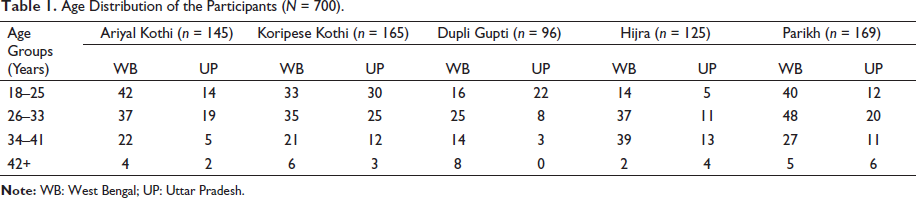
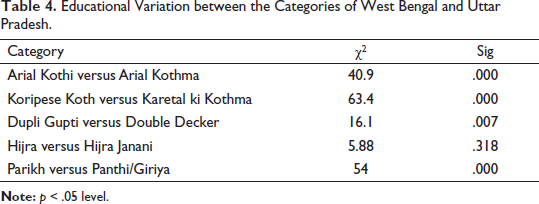
In five categories—Ariyal Kothi, Koripese Kothi, Dupli Gupti, Hijra, and Parikh—of individuals from West Bengal and Uttar Pradesh (to whom psychological scales were applied), Table 1 showed the age distribution of the 700 participants. Tables 2 and 3 show that there are differences in the educational status of the MSM categories by region. Only 5% of Arial Kothmas, 14.28% of Karetal ki Kothmas, 15.15% of Double Deckers, 6.86% of Panthis and none of the Hijra Jananis of Uttar Pradesh have completed class 12 (higher secondary exam), while 26.66% Arial Kothi, 37.9% of Koripese Kothis, 38.09% of Dupli Guptis, 13.04% of Hijras and 32.5% of Parikhs of West Bengal have. The χ
2
result of Table 4 show that the major effects of geography and sexual identity, as well as how they interact, had a significant impact on educational status. The difference values are significant (P < .05) in every case, with the exception of Hijra and Hijra Janani. According to data, the majority of Ariyal Kothis/Ariyal Kothmas who drop out of school early, work as commercial sex workers. They are forced to labour in the public domain due to severe economic hardships, tremendous humiliation and exclusion from alternative employment opportunities. Bubai, 32 years old, reported,
My father once set up a job for me in an office in Kolkata. It was a peon’s job in the office. The pay was 2000 rupees, but how long can I remain anonymous? My effeminate side became apparent. I used to be given cues by a senior official in the office. I remained silent. Later, on a Saturday, he requested me to stay back after office hour. Afterward everyone had left, he took me to the loo in the office, where we had sex. I initially felt uncomfortable, but eventually I began to enjoy the pleasure. He insisted on having sex with me over and over again after this encounter. That rascal spread the rumor that I am gay after I declined. Everyone began mocking me, laughing at me, and even taunting me. Out of humiliation, I stopped going to the office. Tell me, then, how do I make money. I’m not very well educated. No one wanted to put me in any Clark job at their offices for my feminine attitude. My family is impoverished. This condition forced me to become a sex-worker.
Age Distribution of the Participants (N = 700).
Distribution of Formal Education in West Bengal (N = 475).

Distribution of Formal Education in Uttar Pradesh (N = 225).

Educational Variation between the Categories of West Bengal and Uttar Pradesh.
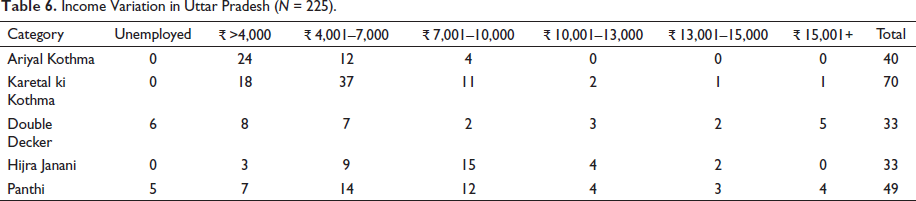
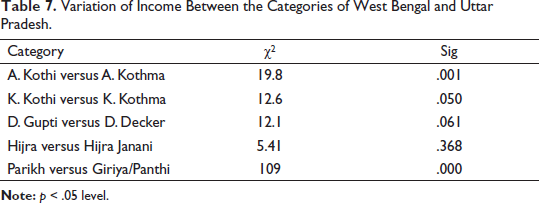
Ariyal Kothis/Ariyal Kothmas have taken on other jobs for their survival as well, sometimes solely, such as dancer (sometimes as launda 2 ), dance/drawing teacher, beautician in salons or parlours and family ceremonies, body masseuse, barber, catering boy, hotel boy, etc. Koripese Kothi/Karetal ki Kothmas can be found working in small-scale businesses to provide services, such as retail workers or salespeople, or those with higher degrees can find employment in private businesses or government agencies or a limited number can be found teaching privately. Several of them have done sex work in addition to their regular jobs. Few people have become purely sex workers to support themselves. They also work as power loom operators, weaver, auto-rickshaw drivers and rickshaw pullers in case of Varanasi. Dupli Guptis and Double Deckers can be found in a wide range of professions, including service, business, and sex trade. The ‘Badhai’ (dance after the birth of a newborn) is the traditional profession of the Hijras and Hijra Jananis. Parikhs, also known as Panthis, work in a variety of fields. The majority of them work as service providers; in addition, some own small business (such as stationery, grocery and mobile phone stores), while others are labourer (such as furniture manufacturers and industrial employees). Tables 5 and 6 show that the majority of Ariyal Kothis (31.42%) earn between ₹ 4,001 and ₹ 7,000 per month, while in Uttar Pradesh, the majority (60.0%) of Arial Kothma earn less than ₹ 4,000 per month. The χ 2 result of Table 7 shows, income levels of the MSM groups vary regionally. Other than Hijra and Dupli Gupti, all of the difference values are significant (P < .05).
Income Variation in West Bengal (N = 475).

Income Variation in Uttar Pradesh (N = 225).
Variation of Income Between the Categories of West Bengal and Uttar Pradesh.
Subjective Well-being of the MSM Categories
Subjectivation due to acquisitions of differentness from the larger social world it may come up with a positive relief in the sense of self-affirmation. Secretiveness, guilt-ridden thoughts and feelings of loneliness might result from self-devaluation. Although self-devaluation has negative aspects, homosexuality develops into a distinct and signified identity (Plummer, 1996, p. 73). In Plummer’s interpretation, whether it is kept as a secret and invisible practice, homosexuality becomes a signifier of the identity and it goes beyond the experience of a homoerotic encounter. A process of isolation both in the way of lacking contact with other same-sex practitioners and lacking support from heterosexual companions comes forward with devaluation of homosexual subjects (Plummer, 1996, pp. 76–77). The case studies and the narratives showed that the majority of MSM are experiencing emotional distress. The majority of them struggle with a contradiction between their thoughts and what they say to friends or strangers. They can express different issues of their life in an unguarded manner. The consequences of those conflicts are manifested in the feelings of (a) guilt, (b) confusion, (c) less confidence, (d) frustration, (e) low self-esteem, (f) uncontrolled behaviour, (g) revenging mind, (h) truth obsession, (i) deep-rooted homophobia and (j) commitment phobia; these all affect their subjective well-being a lot.
Many of the respondents acknowledged that they had attempted to change their orientation and/or attitude in the past to lead a ‘normal’ life, and a small number stated that they would like to change themselves in the future to become ‘straight’ people. They experience emotional confusion as a result of their ingrained homophobia, and their subconscious mind is unable to accept their sexual preferences or behaviours. ‘I used to want to cry and wonder why God made me the way I am’, said Amit, who is 29 years old. He also narrated:
What did I do wrong? What is my fault? Once I started to believe that I had caused my parents such great suffering. Even I made the decision to alter myself and would behave as my mother’s desires. My hair had been cut short like other ‘normal’ boys. At that time, I didn’t go to my Kothi buddies. But I can’t keep it up for very long. I wanted to be happy. I again changed my mind after a few weeks, met my pals, and was ready to live my life according to my own choice.
One is compelled to perform exactly what the dominant hetero-normativity expected of them. Particularly within a wider negative societal climate, it is tough to retrospect gender alternative behaviour. Kothis occasionally sought to change themselves to behave like the ideal man that society expects from a born man with male genitalia. But the subconscious gender expression and sexual preference, dominate the real world around him and make the Kothi prepared to struggle for his existence. Lowlife satisfaction affects their well-being rigorously.
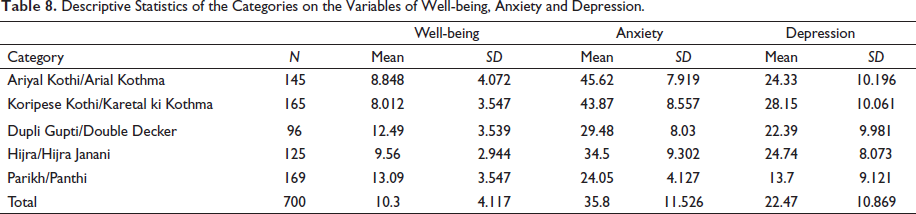
Descriptive statistics of the groups (Ariyal Kothi, Koripese Kothi, Dupli Gupti, Hijra and Parikh of both locations of West Bengal and Uttar Pradesh) on well-being, anxiety and depression variables were calculated and are shown in Table 8. The result demonstrates the variations among those variables (well-being status and anxiety/depression levels) across several MSM categories.
Descriptive Statistics of the Categories on the Variables of Well-being, Anxiety and Depression.
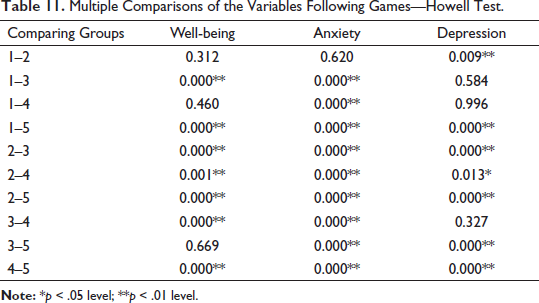
In Table 9, the result of Levene’s test is significant beyond .01 level. So, error variance was therefore not homogeneous or uniform. Table 10 shows that for all of the variables, there was a significant group difference. As a result, there is a significant disparity between the levels of trait anxiety, depression and well-being among these five groups. Since homogeneity of variance has been violated in case of all variables, separate post-hoc tests were chosen. Games–Howell test was used for post-hoc evaluation. It was done for multiple comparisons of the groups.
Levene’s Test of Equality of Error Variances for the Variables (Well-being, Anxiety and Depression).

Analysis of Variance, the Groups Are Compared on Scores of Well-being, Anxiety and Depression.
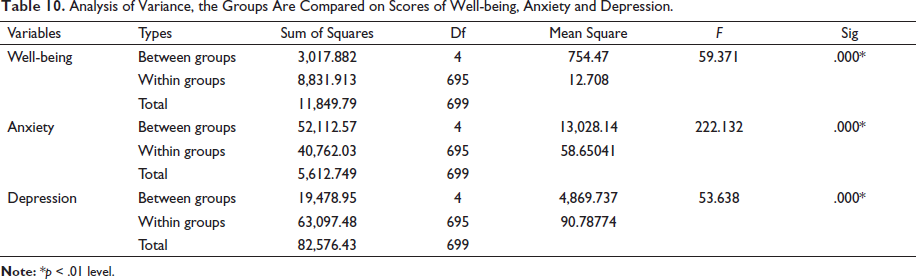
Table 11 revealed there is no significant difference in terms of well-being between Ariyal Kothi and Koripese Kothi, Ariyal Kothi and Hijra and also Dupli and Parikh. Each group has significantly differed from other groups in terms of anxiety, with the exception of Ariyal Kothi and Koripese Kothi. Again, the result also shows there is significant difference between Ariyal Kothi and Koripese Kothi in depression level. However, there is no significant difference in terms of depression between Ariyal Kothi and Dupli Gupti or Hijra. Dupli Guptis have more or less better well-being in comparison to other groups and with the exception of Parikh, they differed from other groups in terms of well-being. The Ariyal Kothis and Koripese Kothis have significant levels of anxiety and depression. The Kothis’ increasing anxiety and depression are a result of stressful events in their lives. Additionally, recent research indicates that stressful life events can worsen anxiety and depression (Mclaughlin & Hatzenbuehler, 2009).
Multiple Comparisons of the Variables Following Games—Howell Test.
Discussion on the Outcomes of Psychological Scales
It is observed in the results that there is a significant psychological difference between the MSM categories. Kothis/Kothmas are the most vulnerable group among all MSM categories. Next to Kothi (both Ariyal and Koripese), Hijras are in second position of poor mental health might be because of their traditional acceptance in Indian culture and society that Kothis do not have. In-depth interviews revealed, in case of Kothi/Kothmas, their experiences of the hard reality from their childhood push them towards anxiety and depression. Environmental bedlam triggers stress and sadness from their early days of socialisation. Continuous rejection from the family members for their feminine attitude and to behave like women creates serious grief from the beginning. Even they fail to gather support from their school or neighbouring friends who used to avoid them for their different behaviour. They could not share their likings or disliking with their friends as their thoughts are different due to hetero-normative influences of the habitus in their life. They usually try to find out satisfaction from their beloved ones but while it fails, they become anguished and gradually start to abhor their selves and existence. There grows the feeling of irrelevance and valuelessness of their life on the earth. They generally avoid relatives and social gatherings for fear of verbal abuse either to them or their family, especially parents. Societal hazards trigger their level of anxiety and depression in a great extent. The Koripese Kothis/Karetal ki Kothmas always suffer the dilemma of what they want to be and what they have to show off. They could not communicate or share about their preferences to family members or the near and dear ones whom they recognise as hetero-normative. Kartik a Koripese Kothi shared:
I’m getting tired of my manly guises. I believe I could be a better daughter or wife than a son or husband. For avoiding stigma, I have to hide MYSELF from ME and for that I was compelled to give ME a complete masculine outlook. I trapped myself in the men’s outfit, kept moustaches and used to walk like a macho. But when I look at mirror, I couldn’t find out myself. It’s not ME; it’s not my reflection. But I’m bound to act like that. I don’t want to push my parents in any societal uneasiness. I used to feel suffocated much of the time. Sometimes thought to leave my family and lost. This stifle makes me down always.
The majority of the Kothis have internal homophobia due to their socialisation in a hetero-normative society. Most of the feminine MSM have that believe that nobody needs them, nobody would understand them and the reinforcements of such feelings sometimes push them to attempt suicide. The Hijras, who are basically the transformation of Kothis by joining Hijra community, have more modest psychological health than the Kothis due to the involvement with an established social recognition. From ancient time, Hijras are lucky for the common people as they believe Hijras are asexual and thus they are pure, unpolluted and benignant to all. In Indian society, sex and sexuality are still hidden phenomena; people see this with awful eyes. Hijras are more empowered than Kothis for this traditional acceptance and for holding a negotiable position with hetero-normativity. But in spite of this, they also bear social disgrace for their ambiguity. Society understands only the binary structures, either this pole or that pole; either male/man or female/woman. Ambiguity is not well accepted in its structural frame and thus Hijras are the excluded one. They have a place in the society but only at the periphery region. Beside this, when the Kothis join a Hijra community, they have already gone through all the negative societal conditions throughout their childhood. Only to enhance economic capital and to get empowerment, they join a Hijra community. Most of the Kothis, after joining Hijra group have left their families and live a separate life with new identity. This also affects their well-being.
The other two categories, that is, Dupli Gupti and Parikhs’ of the Kothis are in better level of well-being. They can enjoy societal dividends easily as they are straight and follow gender norms properly. Gender is more public and sexuality is private phenomena. Until it is disclosed about their same-sex sexuality preference, Dupli Guptis and Parikhs do not face any stigma associated with homosexuality. Moreover, the Parikhs, who act as inserter always, might be recognised as the followers of hetero-normativity. Thus, they enjoy all the benefits of the society for being a real man. Positive societal atmosphere is the main factor for their comparative better psychological health than other MSM categories. Besides this, this study has also observed that poor economic condition also has an impact on the psychological health of the MSM categories.
Concluding Observation
The present study has highlighted the variations across the self-identified subcultural MSM categories in two Indian provinces, as well as varied aspects of well-being and to set forth a predictive position in this regard. In the ‘holy’ city of Varanasi, orthodoxy prevails over public culture where personal issues like sexuality are closely scrutinised against the normative order since postcolonial times (Rai et al., 2009). The Kothmas and Double Deckers of Uttar Pradesh who are surviving explicitly with their identity belong to a low economic and educational group and thus they are comparatively less empowered than the Kothis or Duplis of West Bengal who are members of a middle class with relatively higher socioeconomic and educational status. Since Varanasi has been one of the most religiously devout cities from colonial times, the Hijras are quite powerful there because of their traditional and religious values. In reverse, different districts of West Bengal from where researchers had collected data have been very much influenced by the Western culture since colonial time. This variation of the location of different MSM identities has an opposing impact on their day-to-day life. Despite of locations, the Kothi/Kothma identity suffers the most vulnerable position in contrast to their partners due to its most explicit challenge to hetero-normativity which affects their psychological health rigorously.
Footnotes
Declaration of Conflicting Interests
The authors declared no potential conflicts of interest with respect to the research, authorship and/or publication of this article.
Funding
The authors received no financial support for the research, authorship and/or publication of this article.