




Abstract
Aims and Objectives
Mouthwashes with antibacterial activity inhibit the growth of bacteria in the mouth and teeth. Chlorhexidine is one of the most widely used mouthwashes that inhibits dental plaque and prevents tooth surface decay. Recently, concerns have been raised that alcohol-containing mouthwashes may have carcinogenic properties and may be harmful to children and pregnant and lactating women. The aim of this study was to determine the antibacterial effects of chlorhexidine mouthwashes with and without alcohol on common oral bacteria.
Material and Methods
In this in vitro study, bacterial species were purchased from a research center and were cultured separately in proprietary environments in test tubes. Thereafter, mouthwashes with alcohol, without alcohol, and with salt water (saline) were added to test tubes containing the bacteria grown. The samples were then analyzed using a spectrophotometer to determine viability, growth rate, and bacteria waste. Finally, the data were analyzed using SPSS version 17 through analysis of variance (ANOVA) and Tukey statistical tests.
Results
The obtained results showed that the saline group had the highest antibacterial activity and that the average antibacterial activity of the alcohol and alcohol-free groups did not differ significantly (P > 0.05). Post hoc test results showed that the antibacterial activity of the saline group was significantly different statistically from that of the other two groups.
Conclusion
On the basis of the results, it can be concluded that both alcohol-free chlorhexidine and alcohol-containing chlorhexidine are effective in removing oral microbes. Moreover, by using alcohol-free chlorhexidine, the harmful effects of alcohol can be prevented.
Keywords
Introduction
Oral diseases such as tooth decay, gum disease, and tooth loss may significantly affect a person’s overall health. 1 Some types of oral microorganisms play an important role in pathogenesis infectious diseases of the mouth, jaw, and face, and are even involved in the generation of various infections in other parts of the body. 2 Hence, the reduction of microorganisms in the mouth prior to oral surgery or maxillofacial surgery, which are performed through the mouth, can play an important role in reducing the occurrence of infections after surgery. 3 One of the effective methods for reducing the number of microorganisms in the mouth is to employ antiseptic solutions, used as mouthwashes, often accompanied by other hygiene instructions and sometimes on their own, prior to surgery and in some cases even after surgery and during the wound-healing period. 4 Owing to the extensive use of mouthwashes in different fields of dentistry, a variety of mouthwashes are used today. Among these, chlorhexidine—because of its abundant beneficial effects and few side effects—is used more than other mouthwashes in oral, maxillofacial, and periodontology surgeries.5, 6 For any mouthwash, effective antimicrobial activity with no toxic effects on the periodontal tissue is one of the most important features. 7 The main disadvantage of chlorhexidine is its unpleasant taste and staining of mouth and teeth, removing which is time-consuming and costly. Chemical modification of chlorhexidine in order to reduce its staining leads to decreased plaque inhibition.2, 6
In order to realize solubility of nonpolar compounds, such as essential fats, and to eliminate oral bacteria, which are associated with bad breath and plaque formation, ethanol is added to different mouthwashes. Although deaths from overconsumption or side effects of alcohol-containing mouthwashes are rare, their use by children often leads to dangerous side effects and sometimes leads to non-lethal but toxic reactions. 8 Among the side effects of alcohol-containing mouthwashes, mouth and larynx cancers have received the most attention; however, a review of studies in the field reject this view.9, 10 Owing to the increase in the production of mouthwashes without alcohol, some local companies in Iran are also intent on producing such mouthwashes. Naturally, for comparable antibacterial activity, mouthwashes without alcohol are more desirable than those with alcohol, as the former do not have the side effects of alcohol. Therefore, in this study, the antibacterial effects of alcohol-free chlorhexidine produced in Iran, which is similar to imported ones, on seven species of common oral bacteria were investigated, and the results were compared with those obtained using alcohol-containing mouthwashes on the same samples.
Methodology
This is an experimental and laboratory study. The target population of this study included bacterial species with standard identifiers, which were purchased from the research center of the Pasteur Institute of Iran, Tehran. All experiments were conducted in the microbiology laboratory of Drug Applied Research Center, Tabriz University of Medical Sciences. This research was conducted in full accordance with the World Medical Association Declaration of Helsinki and after getting confirmation from the Ethics Committee of Tabriz University of Medical Sciences with reference number 1395–23654.
All strains were initially cultured in specific media in separate test tubes. Bacteria and fungi were cultured on Müller-Hinton agar (Merck, Germany) and were incubated for 18–24 h. Then, the following three series of seven samples each were extracted from the sterile test tubes:
About 450 mL saline was added to the first series of seven samples (inside each tube). About 450 mL mouthwash without alcohol was added to the second series of seven samples (inside each tube). About 450 mL mouthwash with alcohol was added to the third series of seven samples (inside each tube).
Then, 0.5 McFarland standard was prepared and 50 mL of it was added to each of the tubes of the first, second, and third series. Within 30 s after the addition of the standard, 10 mL was taken from each of the tubes and added to 90 mL of tryptic soy broth (TSB) on microplates; the mixture was incubated for 24 h at 37 °C. 11 After the incubation time at 600 nm (nanometre), concentration and optical density (OD) readings were performed. Finally, the microplates (three for each series: one with normal saline, 3 one with mouthwash containing alcohol, and one with mouthwash without alcohol) were cultured on Müller-Hinton agar . This process was repeated three times, and the average values of the obtained results were recorded. It should be noted that the results were obtained using the control samples containing TSB but without the samples. 12
The studied samples from two series (mouthwashes with alcohol and without alcohol) were each categorized into seven groups (in terms of the bacteria species) as follows:
Group I: Culture medium containing Enterococcus faecalis MMH 594 Group II: Culture medium containing Pseudomonas aeruginosa ATCC 8821 Group III: Culture media containing Candida albicans PTCC 5027 Group IV: Culture medium containing Staphylococcus epidermidis ATCC 1228 Group V: Culture medium containing Enterococcus faecalis ATCC 33186 Group VI: Culture medium containing Staphylococcus aureus ATCC 2921 Group VII: Culture medium containing Lactobacillus acidophilus ATCC 393
Because a study similar to this one could not be found, the sample size in each mouthwash group (saline, with alcohol, and without alcohol) was determined using the results of the present pilot study. Taking the acceptable difference (α) as 0.05 and power as 80%, the volume of the final samples was determined. The viability and growth rate of the bacteria were analyzed using a spectrophotometer (BioTek Instruments Inc, Winooski, USA). Finally, the data were analyzed using SPSS version 17 through analysis of variance (ANOVA) and Tukey statistical tests.
Results
The samples were divided in three groups: in the first group, the desired medium was washed using chlorhexidine; in the second group, the desired medium was washed using chlorhexidine with alcohol; and in the third group, the desired medium was washed using chlorhexidine without alcohol. Moreover, the negative control group included teeth that were sampled and cultured after removing them from the autoclave and without any contamination. The number of colonies obtained in this group equaled zero.
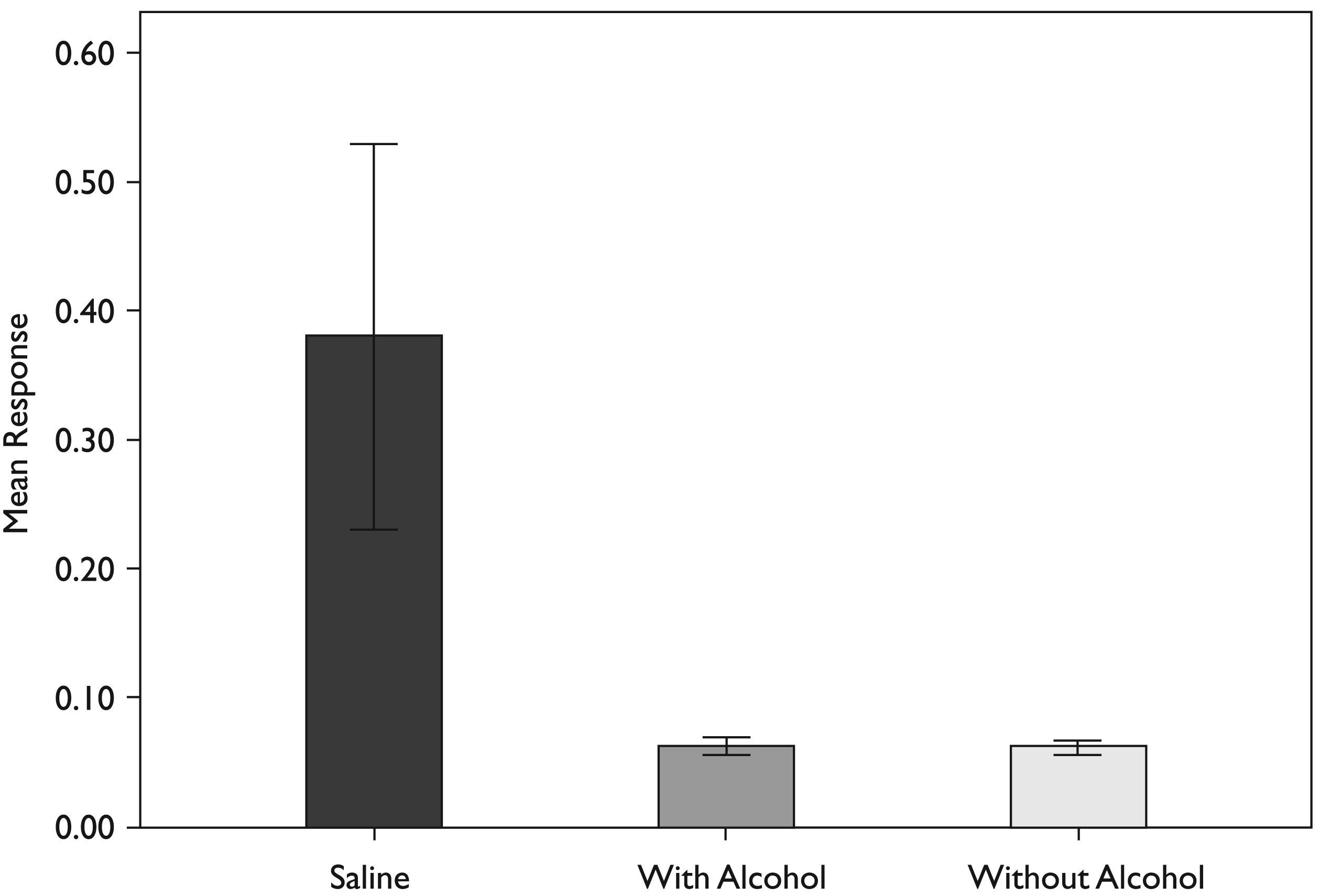
According to Table 1, the highest average value of the antibacterial activity was observed for the saline group (brine) at 0.38 ± 0.18. Further, this value was not significantly different from those for groups with alcohol (0.062 ± 0.008) and without alcohol (0.061 ± 0.005).
Average and Descriptive Indices of Antibacterial Activity of Each Group
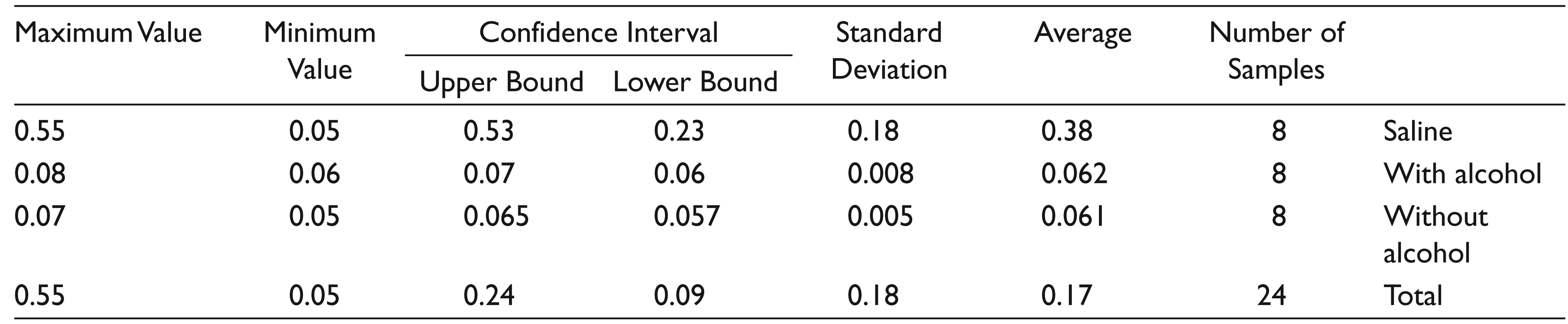
According to Kolmogorov–Smirnov test results, the data for the brine group (P-value = 0.06), group with alcohol (P-value = 0.054), and group without alcohol (P-value = 0.198) were normally distributed. Therefore, single-sided ANOVA was used to compare the antibacterial activities of the three groups. The obtained results showed that the antibacterial activity of the three groups was significantly different statistically (P-value < 0.001).
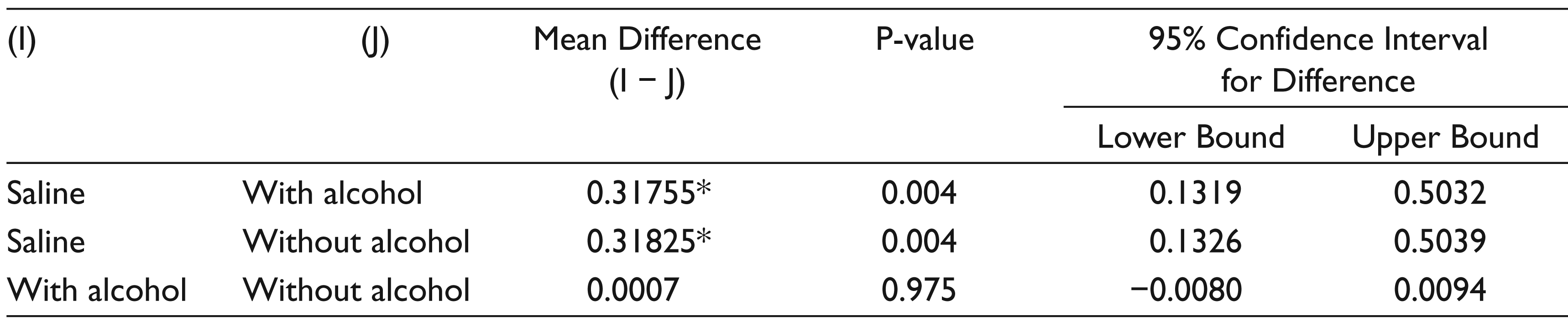
The Games–Howell post hoc test was conducted to compare the antibacterial activity of the three groups. The test results showed no significant difference between the antibacterial activity of the groups with and without alcohol (P-value = 0.975 > 0.05). However, the activity of these two groups was significantly different statistically from that of the brine group (P-value = 0.004 < 0.05) (Table 2 and Figure 1).
Games–Howell Test Results for Pairwise Comparison of Antibacterial Activity of Each Group
Bar Graphs Comparing the Antibacterial Activity of Three Groups: Saline, With Alcohol, and Without Alcohol
Discussion
The obtained results revealed that the average antibacterial activity of the saline group (brine) was greater than that of the other two groups—chlorhexidine with and without alcohol. However, the antibacterial activity of groups with and without alcohol was not significantly different. Most of the previous studies on this topic were designed and implemented in three distinct ways. First, in some studies, the antibacterial activity of chlorhexidine solutions with different concentrations was compared. Second, in some others, the activity of chlorhexidine solutions was compared with that of a placebo. 13 Third, in yet some other studies, the antibacterial activity of chlorhexidine solutions with similar concentrations was compared with the aim of determining the effect of factors such as alcohol presence. 14 A review of the past literature revealed that this is probably the first study in which the effects of the presence or absence of alcohol in mouthwashes in comparison with the effects of saline have been investigated. 15
In addition to the dose and concentration of a mouthwash, its chemical composition can also affect its activity. Different chemical substances such as alcohol, sodium fluoride, and cetylpyridinium chloride are added to mouthwashes. Among these, alcohol is the most widely used and is used as an antimicrobial substance and a solvent. Further, it has been reported that mouthwashes with and without alcohol have the same effectiveness at the same concentration.14, 15 However, some researchers such as Ennibi et al believe that a 0.12% chlorhexidine mouthwash containing alcohol performs better than a 0.1% chlorhexidine mouthwash without alcohol. 16
In 2011, Anyanwu et al compared the antibacterial activity of four different types of mouthwashes, with and without alcohol, on the bacteria Staphylococcus, Salmonella, and Pseudomonas were investigated and compared. The results showed that alcohol-containing mouthwashes had a stronger effect on gram-negative bacteria. These results may be due to the fact that the alcohol contained in mouthwashes affects the outer wall of gram-negative bacteria and destroys it, whereas the alcohol does not affect gram- positive bacteria because they have no external walls. 17
In another study, Todkar et al studied the effects of chlorhexidine mouthwashes with and without alcohol. The obtained results showed that the plaque and gingival indices in both chlorhexidine with alcohol and without alcohol groups reduced significantly in comparison with the placebo group. Moreover, the gingival index showed large clinical changes in the group without alcohol compared to the group with alcohol. Most importantly, it was found that alcohol-free mouthwashes were more effective than alcohol-containing mouthwashes in reducing plaque and inflammation. 15
Notably, chlorhexidine is quite effective at continuous reduction of plaque and can preferably be used when alcohol has to be avoided. In fact, in many studies, alcohol-free mouthwashes have been found to be quite effective in reducing dental plaque accumulation.13,18
The present study was limited in its scope because of the relatively lesser number of strains studied. Moreover, studying the effects of chlorhexidine on more families of bacteria will provide greater clarity on the issue.
Finally, the results of this study are in accordance with those of previous studies in that definitive conclusions in terms of which mouthwash is better cannot be derived from the findings. However, in case of people with hypersensitivity of the mucous membrane or other related diseases, the use of mouthwashes with saline and without alcohol can certainly be recommended.
Declaration of Conflicting Interests
The authors declared no potential conflicts of interest with respect to the research, authorship and/or publication of this article.
Funding
The authors received no financial support for the research, authorship and/or publication of this article.
Footnotes
Acknowledgements
This study was supported by Drug Applied Research Center, Tabriz University of Medical Sciences, Tabriz, Iran.