



Abstract
Point-based hierarchical Markov models for tennis provide transparency and flexibility in predicting the outcome and duration of matches, but have been shown to fall behind in predictive power compared to other methods such as regression. In this paper, a preliminary study is first conducted which highlights the point-based model’s preference for data quantity over quality with respect to time horizons and surface-filtering. Fixing these factors, the main study then ensembles point-based methods in the literature along with two novel methods, (i) using exclusively head-to-head (H2H) data and (ii) point-specific modifications, to significantly boost match outcome prediction accuracy. Consensus model ensembles, in particular, boost average prediction accuracies to around 70%, on par with machine learning models. Progress is also made in duration prediction with point-based models. Point-specific modifications and rudimentary mean duration ensembles show promise in lowering root mean squared error (RMSE), with the latter’s performance strongly correlated with outcome prediction strength for corresponding outcome prediction ensembles. Overall, the positive results speak to the continued relevance of more traditional probabilistic prediction methods and adds to the literature on the considerable potential in ensembling. Studies are conducted with data from professional men’s and women’s matches played during 2011-2022, with the years 2014, 2018, and 2022 set aside for testing.
Keywords
Introduction
Involving only two players and having an exceptional amount of granular data collected on it, singles tennis is a sport that lends itself to modeling. This makes tennis a valuable testing site for new methods and ideas in sports analytics and prediction at large. The topic of tennis match outcome prediction, with potential in enhancing broadcast experiences, has only grown due to the proliferation of sports betting in North America. In addition to sports analytics researchers, broadcasters, viewers, and sports bettors, tennis practitioners are also among the beneficiaries of tennis modeling, as advances in tennis match outcome prediction work towards unlocking insights into the game’s implicit dynamics and patterns of play. A more dire problem in tennis analytics is that of predicting tennis match duration. Even for the most prestigious tennis tournaments, scheduling continues to be an issue, with otherwise high quality matches ending as late as five in the morning (Sten-Ziemons, 2024), harming tennis as a sport and as a product for players and fans alike.
As shall be seen in the subsequent literature review section, procedures employed to predict tennis match outcomes have developed from bookmaker consensus (Leitner et al., 2009) to machine learning methods, where the majority of recent advances are concentrated. The amount of literature is disproportionately lower with regards to tennis match duration prediction, though promising results using stochastic simulation (Kovalchik and Ingram, 2018; Lisi and Grigoletto, 2021) and machine learning (Duen and Peker, 2024) can still be found. Alternatively, prediction of both the outcome and duration of tennis matches can be approached through point-based Markov models for tennis, which emerged in the literature as early as 1970 with Schutz’s seminal work. This method makes use of the hierarchical structure of tennis: a match consists of sets, which consists of games, which consists of points. Therefore, under the assumption that points played in a match are conditionally independent and identically distributed (iid) given which player is serving, a model can be constructed, taking as input the two probabilities of each player winning their service point and outputting the probability a player wins the match.
Methods have been proposed to improve the prediction abilities of the point-based Markov model based on adjusting its input to account for the opponent’s return capability. The opponent-adjusted formula of Barnett and Clarke (2005) diminishes a player’s serve according to their opponent’s return statistics relative to the field, while the common opponent model of Knottenbelt et al. (2012) restricts the data used to only recent matches played against a list of common opponents. Kovalchik (2016) compares these techniques, amongst other point-based Markov model variations, with 2014 men’s tennis data, concluding that the opponent-adjusted formula outperforms the others, whilst highlighting a gap between the point-based models and the best of the regression-based models. Our study proposes and tests two additional methods, before applying ensembling techniques to bridge this gap. We test the performance of directly using head-to-head (H2H) data and also experiment with relaxing the identically distributed part of the model’s iid assumption, using a greedy algorithm to assign a subset of states in the point-to-game Markov model their own state-specific service point win probabilities. We then finally move to ensembling these individual models, including ones in the literature and our own two novel methods, to boost prediction accuracy for point-based Markov models. Several ensembling approaches are explored, but the consensus vote approach yields by far the most significant results, boosting the Markov model to be competitive with the best machine learning predictors. Running parallel to our study on outcome prediction, our work on match duration similarly begins with estimates yielded by the basic Markov model. Effect on duration prediction accuracy of all the individual modifications for outcome are examined, before moving on to ensembling results. Different from outcome prediction, improvements are now measured using root mean squared error (RMSE), with the time unit being minutes.
The improvements this paper makes to the prediction capabilities of the point-based Markov models can be summarized as follows:
Significantly boosts match outcome prediction accuracy through the ensembling of methods in the literature along with two novel methods. In particular, the consensus vote model with (i) common opponents, (ii) opponent-adjusted, (iii) opponent-adjusted common opponents, and (iv) point-specific activation components consistently and significantly outperforms opponent-adjusted models, and numerous ensemble models boost prediction accuracy to the level of the soft 70% ceiling for machine learning models found in Wilkens (2021). Proposes and tests two novel modifications to the point-based Markov model: (i) directly using H2H data, and (ii) point-specific modifications to the model’s point-to-game layer. In particular, we find the former to increase accuracy on par with common opponents models, the latter to reduce duration RMSE on par with opponent-adjusted models, and both requiring more higher quality data for better predictions. Though not spectacular individually, both new models also prove to be important components to some of the best ensemble models. Provides statistical evidence for conventional views on the effect of surface-filtering, time horizons, and change points on point-based models, as well as surface-filtered variations of Knottenbelt et al. (2012) common opponents model hitherto unexplored. Key conclusions from these preliminary studies are summarized in Appendix B, with the main study building on these results.
Through boosting the performance of point-based Markov models, and with further potential highlighted in terms of data granularity and player-specific changes, we aim to demonstrate the continued relevance of these approaches, adjacent to machine learning methods, which provide a high degree of transparency, enabling considerable explainability and customization.
The paper is organized as follows. “Literature Review” overviews the literature with regards to advances in both tennis match outcome and duration prediction. “Hierarchical IID Model” outlines the standard point-based Markov model under iid assumptions and how it is used for the prediction of tennis match outcomes and duration. Some related implementation details are left for Appendix A, along with some immediate results that can be derived from the model. “Data” details the data, how different sources were processed and used for different parts of the study. In “Individual Methods”, we expound on our new approaches, along with a note on variations of the common opponents approach that were not explored previously. “Ensemble Methods” overviews our ensembling methodologies. “Results and Discussion” presents and discusses experimental results for both outcomes and durations. “Concluding Remarks” contains a number of concluding remarks concerning the various studies conducted in the paper, along with potential future directions. Selected additional experimental results are organized in Appendix B, and code used for the entire study along with complete results can be viewed and downloaded at the GitHub repository “c567wang/Point-Based-Tennis-Prediction”.
Literature Review
Methods ranging from more traditional bookmaker consensus (Leitner et al., 2009) to machine learning methods employing regression (Clarke and Dyte, 2000) and neural networks (NNs) (Somboonphokkaphan et al., 2009), are overviewed and tested in studies such as Kovalchik (2016) and Wilkens (2021). The latter study, focusing purely on machine learning models, surveys NNs, logistic regression, random forests, gradient boosting machines, and support vector machines (SVMs), concludes after calibration that model accuracy rounds out at around 70% in the long run, the same accuracy as traditional bookmaker odds. Apart from the study’s experimentation results, this assertion reasons that the betting market already captures most information that can be used for prediction. Furthermore, Wilkens’ study examines the ensembling of the five aforementioned models, ranging from needing agreement from only a pair of models to full consensus, and producing comparatively encouraging betting results. More recent machine learning studies have continued to apply methods encompassed under Wilkens’ survey. Buhamra et al. (2024) focuses on regression models, while a follow-up study (Buhamra et al., 2025) expands the scope to other machine learning methods such as SVMs and XGBoost. Combined with feature engineering and intense calibration via cross-validation, the authors obtain accuracies around 77% for regression models, and accuracies up to 80% for NNs, all on 2022 Grand Slam matches. At the same time, the studies point to the importance of continuously incorporating match data from the Grand Slam closest to the time of prediction, in what they term an “expanding window” approach as opposed to “rolling windows”.
In contrast, Gupta and Assaf (2024) do not measure performance by accuracy, instead highlighting through the area-under-the-curve metric the prediction potential in using in-match statistics as features/predictors, while acknowledging that these would only be known post-match. (We conduct the same demonstration of predictive potential for the point-based models in “Individual methods”.) Jhawar (2022) tackles outcome prediction using k-means clustering, random forests, and multi-output regression on ATP data from 2000 to 2017, with random forests managing to reach 80% accuracy. Yue et al. (2022) explores the use of the Glicko rating system, evolving from the Elo ratings found in chess, for further feature engineering, in conjunction with logistic regression, SVMs, NNs, and gradient boosting. They achieve 70% accuracy on 2019 data and stress the superiority of player rankings as a feature. Though many of these later studies report accuracies over 70%, studies summarized and examined by Wilkens (2021) also reported accuracies exceeding 70% on their respective datasets. An updated survey focusing on the new machine learning models may be necessary to conduct rigorous comparisons and assessments, and it remains to be seen if more recent advances in parameter tuning, feature selection/engineering, and fresher training data closer to the time of prediction can consistently break through the proposed 70% ceiling.
Focusing now on the evolution of the point-based Markov model first introduced by Schutz (1970), there are two mathematically equivalent versions of this approach. The first uses combinatorial reasoning to derive sets of equations to represent the model (Adler and Ross, 2012; Newton and Keller, 2005; O’Donoghue and Simmonds, 2019), while the second models each level of the tennis match using discrete-time Markov chain (DTMC) theory. Winning probabilities and match duration estimates (and their distributions) can then be obtained via matrix inversion. Since it explicitly encapsulates the progression of a tennis match, the latter version lends itself to easier interpretation, examination, and modifications. The DTMC approach’s value in being able to concurrently predict match duration has been demonstrated by Barnett (2016), and was notably used in the 2014 book by Klaassen and Magnus, which consolidates years of the authors’ work on tennis, all based on a Markov chain iid model they named Richard. As described in “Introduction” and detailed further in “Individual methods”, the opponent-adjusted formula of Barnett and Clarke (2005) and the common opponent model of Knottenbelt et al. (2012) have been proposed for the point-based Markov model to account for the opponent’s return capability. Other point-based variations include the low-level point model of Spanias and Knottenbelt (2013) and the Bayesian hierarchical model of Ingram (2019). For our proposed point-specific modifications, a particular version of this has been considered by Carrari et al. (2017), where different parameters are estimated for pre-deuce and post-deuce states, whereas our study examines the entire point-to-game DTMC more systematically. Closely associated to relaxing the iid assumptions are the studies of Klaassen and Magnus (2014) and Sim and Choi (2020). However, these studies focus more on statistical significance while this study directly tests for effect on win prediction accuracy.
The literature is sparser on the side of match duration prediction. Aside from Barnett (2016), Kovalchik and Ingram (2018) and Lisi and Grigoletto (2021) have also examined the topic of match durations. However, these latter two studies fit distributions to match duration data to simulate matches, focusing more towards how rule changes would affect match lengths overall. The work of Duen and Peker (2024) marks an important milestone in duration prediction with the application of multi-linear regression, classification and regression trees (CARTs), support vector regression, and NNs to data from 1993 to 2022. Apart from CARTs, the other three approaches yield similarly admirable results, being off by an average of roughly 17.5 minutes for best-of-3 matches and 26 minutes for best-of-5 matches.
Methods
Hierarchical IID Model
We begin this section with some additional terminology and notation that will be used going forward. The main organizing bodies of professional tennis for men and women are the Association of Tennis Professionals (ATP) and the Women’s Tennis Association (WTA), respectively. We use “level” to refer to the hierarchical components of a tennis match. Specifically, these would be the point-to-game level, the game-to-set level, and the set-to-match level. We consider two tennis players, call them
The model we start with is a complete point-based model with Markov chains at each level much like Richard. Differences arise for the deciding sets of Grand Slam tournaments (Australian Open, French Open, Wimbledon, US Open), owing to rule changes implemented throughout the years. For the transition probability matrix (TPM)
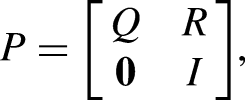
Figure 1 depicts the point-to-game DTMC for when

States of the point-to-game DTMC for a single game in a tennis match, with accompanying transition probabilities.
The other levels of the model all closely follow this approach, with a few notable differences. First of all, all other DTMCs require 2 parameters instead of 1 (not counting
Data
Data used in this study was taken from the excellent GitHub repositories of Sackmann (n.d.). Three repositories were used. First of all, “tennis_atp” and “tennis_wta” include match outcomes for ATP and WTA matches going back to 1968 and 1920, respectively. Alongside these results, aggregate statistics such as the players’ number of service points won and returning points won for the match are available as well. The “tennis_slam_pointbypoint” repository contains more granular data for each individual point, but only for Grand Slam tournaments dating back to 2011 as the collection was done by IBM and Infosys.
In the following experiments, we use this data for training, validation, and testing. For validation and testing, we chose to restrict the range of the datasets to major tournaments (Grand Slams, tour finals, ATP Masters 1000/WTA 1000/WTA Premier). For validation, testing, and estimation of the parameter
Individual Methods
In this section, we overview the three methods in the literature before detailing the two new methods we add to their ranks. Before doing so, we note that though some of the five methods introduce more inputs to the model, none of them make changes to the hierarchical structure of the model nor the state-structure of any of its DTMCs. All changes are ultimately centered around providing better estimates of the service point win probability inputs. How far can changes to only this type of variable take us in terms of accuracy? When the service point win probabilities are taken to be the actual realized service point win proportions of their respective matches, the basic hierarchical model consistently yields accuracies over 90% for the test sets
1
. Of course, the service point win proportions of a match whose outcome we aim to predict are unobtainable prior to the match, but this showcases the potential in increasing prediction accuracy gained solely in working towards better
The most naive method is simply to take a player’s service point win proportion over their matches in the training set. These estimates can vary depending on time horizon length and whether or not the matches have been filtered for only the surface on which we wish to predict. It has previously been mentioned that our preliminary studies in Appendix B examine the effect of shorter time horizons. The effect of surface-filtering is also examined there. Building off of this basic estimate, Barnett and Clarke (2005) incorporate information on opponent return ability. Their opponent-adjusted formula deducts from a player’s
The aforementioned study by Knottenbelt et al. (2012) proposes using common-opponent data to adjust for opponent ability. Training data is restricted to a list of common opponents (CO) that the two players have faced in the given time frame. In their study, win probabilities were obtained with respect to each CO and then aggregated, whereas our approach makes use of all available CO data directly for the estimation of a single value of
Apart from using H2H data, the other new method we employ is the point-specific method, an attempt at relaxing the identically distributed part of the model’s iid assumption at the point-to-game level. Sim and Choi (2020) conducted extensive statistical tests examining the validity of the iid assumptions at the point-to-game level, concluding the identically distributed piece of the assumption as invalid. Klaassen and Magnus also concede this in Analyzing Wimbledon (2014), but reason that the deviation from the points being identically distributed is small enough that the iid models are still quite useful in the analysis. Through the point-specific method, we examine whether relaxing the identically distributed assumption yields a substantial increase in accuracy, and if so, what points having their own
Ensemble Methods
First of all, we note an ensembling method which Knottenbelt et al. (2012) and Kovalchik (2016) both employ, regarding the opponent-adjusted formula and the CO method. Since the former focuses on the opponent’s return ability relative to the field (which is not match-up specific), there is room to combine it with the latter, which aims to use match-up specific information in an indirect way.
A similar application of the opponent-adjusted formula to H2H data does not make as much sense, as the H2H data should already have adjusted for the players’ return ability against the field, as well as how they match up against their opponent. Following from this, we expect the H2H results to be highest in quality (though this may not be the case in practice), followed by the other methods and lastly by the basic estimation. Therefore, our second ensemble method is to prioritize H2H results when a matchup has H2H data, another method’s results if they do not, and use basic estimation for the rest when no other methods apply. We refer to this as the overlay method, since it essentially layers results on top of each other. Furthermore, note that the bottom layer is either from basic estimation or the opponent-adjusted formula, since both have the same coverage (and same imputation method of using field averages). The overlays directly use the model’s binary predictions, but these predictions are taken from the win probabilities the model actually yields. To make use of these probabilities, our next ensemble model makes predictions based on the mean win probabilities of its components. We refer to this third ensemble method as merging.
Taking note that, especially in the context of sports betting, not making a prediction is a valid choice, we also propose two ensemble methods with incomplete coverage of the test matches, much like the CO and H2H methods. The first is a consensus model, which only makes a prediction if all its components are in agreement. The second is a relaxation of the first, needing only a majority to make a prediction.
Finally, on the side of match duration prediction, we also attempt preliminary ensembling. The overlay, consensus, and prediction methods are no longer applicable as they work with binary results, but an ensemble model taking the mean time of its components is examined. For both this model and the aforementioned merging model, there is room for improvement in examining weight distribution beyond a uniform one, but we deem this too large in scope for this particular study.
Results and Discussion
Outcome Prediction
Table 1 presents the experimental results for the individual methods, while Table 2 presents selected results for each ensemble method. In addition to the CO and H2H abbreviations which both tables continue to use, “Basic” refers to the basic results of the point-based hierarchical model, “OAF” refers to the opponent-adjusted formula of Barnett and Clarke (2005), and “PSU” and “PSD” refer to the point-specific method results with one state activated and all-but-one state activated, respectively. (“U” is for “up”, the direction we define where the greedy algorithm starts with no states activated and activates states one-by-one. The reasoning is the plateau shapes which can be seen in Figure 2. “D”, similarly, stands for “down”, using the algorithm that deactivates instead.) “CO(OAF)” refers to the method of applying the opponent-adjusted formula to common opponent data. Furthermore, we use the following notation to differentiate the remaining ensembles. The ensemble’s components are included in its name, with order only making a difference in the overlays – methods that come before being overlaid on ones that come after. Ensembles with “/” connecting its components are overlays, “+” is used for merges, “&” for majorities, and “&&” for consensus.
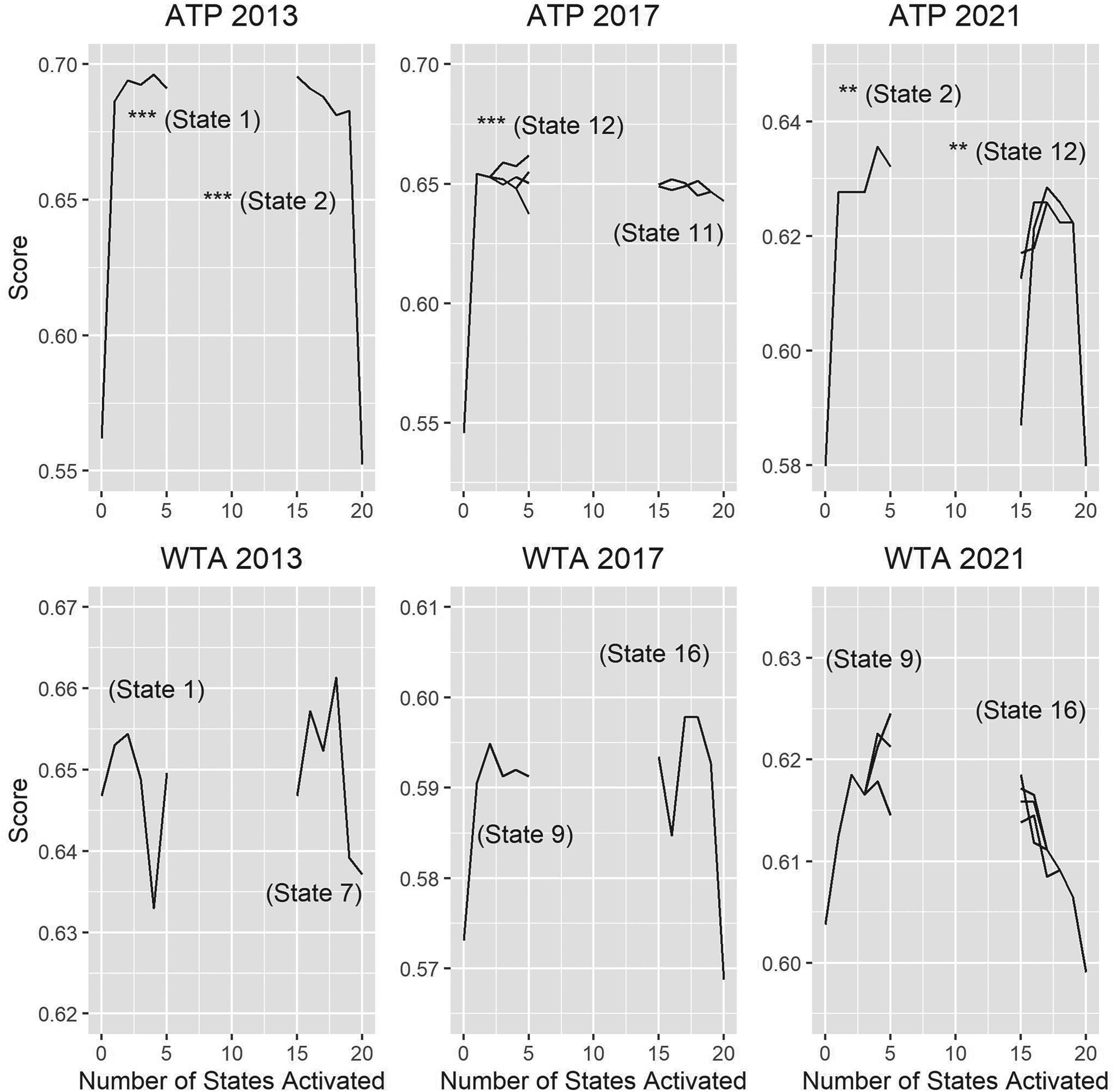
Accuracy score plots corresponding to activations and deactivations of states in the point-to-game DTMC. The first states identified for activation/deactivation are annotated in the plot, along with an indicator for the significance of the jump the activation/deactivation yields (‘***’ - p<0.01, ‘**’ - 0.01<p<0.05, ‘*’ - 0.05<p<0.1, ‘-’ - p>0.95).
Outcome prediction accuracy for individual methods.
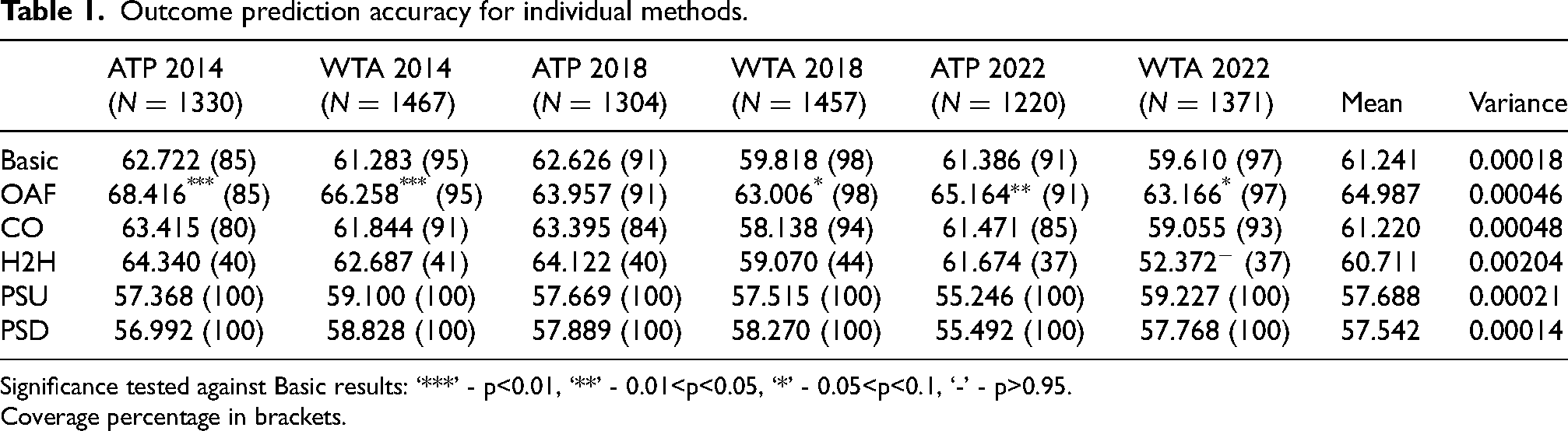
Significance tested against Basic results: ‘***’ - p<0.01, ‘**’ - 0.01<p<0.05, ‘*’ - 0.05<p<0.1, ‘-’ - p>0.95.
Coverage percentage in brackets.
Outcome prediction accuracy for ensemble methods.
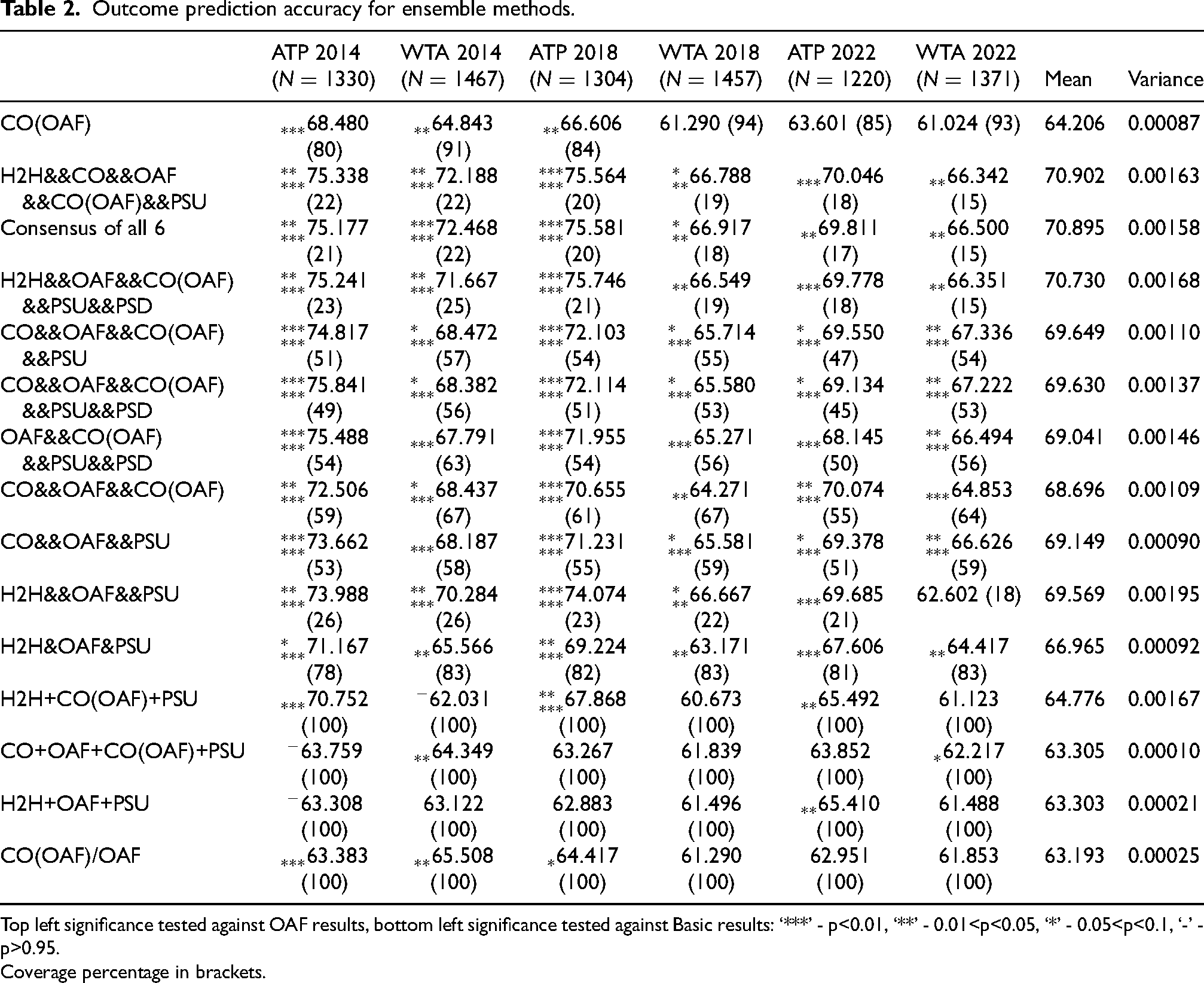
Top left significance tested against OAF results, bottom left significance tested against Basic results: ‘***’ - p<0.01, ‘**’ - 0.01<p<0.05, ‘*’ - 0.05<p<0.1, ‘-’ - p>0.95.
Coverage percentage in brackets.
The tables also include the coverage for each match (i.e., the percentage of matches in the test set for which we have the data necessary to apply a method) in brackets. We can see in Table 1 that the basic model prediction and OAF always share the same coverage, as one player’s service point data is their opponent’s return point data. Even for these two methods which only require service point data, complete coverage is not achievable, with new and improving players continuously being given opportunities in major tournaments. The standard imputation procedure used in previous studies is to use the average service point win probability (and average return point win probability) of the training set. However, taking into account that many of the other methods, in fact, all other methods apart from PSU, PSD, and the overlays, do not have complete coverage, as well as the remark in “Ensemble Methods” on how abstaining from prediction is a valid option in many match prediction contexts, we chose to keep and use the non-imputed Basic and OAF results to make fairer comparisons with the other methods having incomplete coverage. The results with imputation for the Basic and OAF methods were still obtained, with ATP 2014 being the only test set to see a significant (i.e., with p-values of p
Individual Methods
Looking first to the methods established in the literature (i.e., Basic, OAF, and CO), Table 1’s results conform with those in the study of Kovalchik (2016) (performed with 2014 data) with regards to OAF being the most accurate. This is consistent throughout the other two testing years for both ATP and WTA, though p-values are most significant for 2014. Across testing sets, OAF yields a 3.58% increase to the basic baseline results while CO yields moderate, but not significant, increases. H2H comes with a considerable drop in coverage, but only performs slightly better than CO on the testing sets apart from WTA 2022, where it is significantly worse than the basic baseline. The exceptionally low accuracy for WTA 2022 weighs heavily on its variance, which is on another order of magnitude compared to that of the other individual methods. (Since all methods are tested on the same six sets, we take the sample variance of the six scores to roughly compare variability between methods.) Overall, the failure of H2H to significantly boost model performance aligns with the conclusions of the preliminary studies on surface-filtering and time horizons in Appendix B, which stressed the importance of quantity over quality of the data when aiming to boost performance through estimating
This is also the case for the individually unspectacular PSU and PSD results, which are significantly worse than the baseline five times out of twelve. What is worth highlighting first is the plateau phenomenon in Figure 2. More precisely, for all ATP validation sets as well as WTA 2017, there exists a state corresponding to the train-validation dataset pairings, which when activated, yields a significant boost to performance on the validation set. Another state exists for which deactivation yields a similar boost. The way activations and deactivations actually change prediction results is by toggling the model’s perception of how strong a player is. (Note that this perception is not a single value that can be directly compared as in the case of earlier
Ensemble Methods
With OAF as the uncontested standout of the individual methods, it makes sense for it to serve as the benchmark of the ensemble methods, with all significance markers to the top-left of the scores in Table 2 calculated with respect to OAF results. (As noted before in “Individual Methods”, only the overlays are compared to the imputed OAF results.) In view of this, we see that CO(OAF) does not provide a significant boost overall. Though for ATP 2018, CO(OAF) significantly increases accuracy of the basic model while OAF does not, this boost builds on OAF’s incremental boost and is ultimately still not significant enough when calculating significance with respect to OAF.
We finally arrive at the set of models that yield the most promising results, which are the consensus models. The first three ensembles after CO(OAF) in Table 2 are the top three consensus models in terms of accuracy averaged over the six testing sets. All three contain at least five components, and consequently have quite low coverage all hovering around 20%. The relationship between coverage and accuracy is more completely illustrated in Figure 3a, which plots coverage against accuracy for all 57 consensus models. The regression line has a significant negative slope (p =
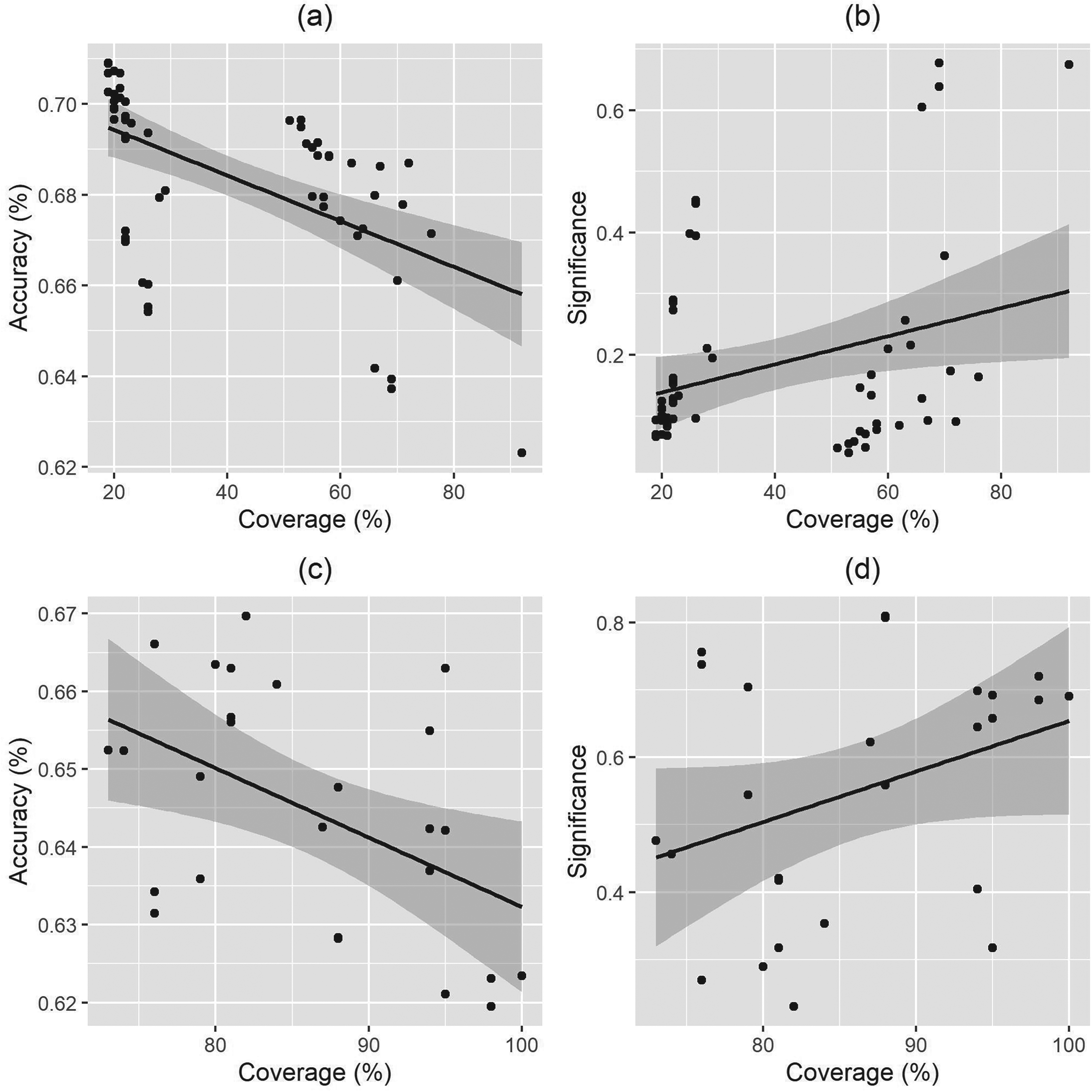
Ensemble coverage against average accuracy and significance for consensus (a, b) and majority (c, d) models.
The majority model highlighted in Table 2 is the top majority model in both accuracy and significance. We cannot conclude definitively that H2H’s boost to accuracy for the majority models does not come with as considerable a reduction to WTA 2022 significance as it did with the consensus models. But this negative effect is evidently dampened, with H2H&OAF&PSU yielding by far the most significant increase for WTA 2022 (p
Table 2 also highlights the best merge model (first in accuracy, second in significance) and the best overlay model (first in accuracy and significance), as well as the merge counterparts to the most significant models identified above. Comparing counterpart performances for the merge models and the lack of significance for the overlay model, we conclude that these latter two methods do not boost performance the way the consensus and majority methods do. This may have been expected for the overlays as soon as the H2H individual results did not outperform OAF, but for the merge method, problems may lie with the equal weights the method assigns to all components that have coverage for a match.
Duration Prediction
All RMSE results from the duration prediction of individual methods are presented in Table 3, along with CO(OAF) and the best mean prediction model (lowest average RMSE, second smallest significance value). Significance was derived using two-sample t-tests (Sheskin, 2000) compared to the basic model results 3 . Unlike in outcome prediction, the applications for duration prediction do not allow the picking and choosing of matches to predict. So, standard imputation is used for both Basic and OAF. We can see duration prediction performance shares some characteristics with outcome prediction results (e.g., relatively strong ATP 2014 performance, relatively strong OAF performance, high variance for H2H, CO(OAF) on par with OAF with no clear improvement). This relationship will be explored further in the next section. Overall, the ability of the point-based hierarchical model to predict match duration seems limited regardless of method. Additionally, not reflected in Table 3 is a clear tendency for all methods apart from H2H to overestimate match duration on average.
Duration prediction RMSE.

Significance tested against Basic results: ‘***’ - p<0.01, ‘**’ - 0.01<p<0.05, ‘*’ - 0.05<p<0.1, ‘-’ - p>0.95.
Coverage percentage in brackets.
For point-specific results, those ending in “A” use the states identified in prior experiments where the greedy algorithm aims to increase outcome prediction accuracy. Those ending in “E” instead have the algorithm choosing the lowest RMSE at every step. The states identified for each experiment are different between the two approaches, apart from WTA 2017 which sees state 16 deactivated for both. Unlike when selecting for accuracy, selecting for lower error fails to yield a valley shape that would correspond to the plateau phenomenon. The lack of valleys is not completely surprising, as the activation of states toggle relative strengths of players, which has a much more direct relationship with match outcome than match duration. That is not to say there is no relationship. Though roughly the same, all “E” RMSE scores are bounded above by their corresponding “A” scores, giving some evidence that the targeting at least has some effect. Perhaps surprisingly, point-specific results are on par with OAF, with PSD.E often even slightly better. The mean duration models are similar in that they make consistent improvements which ultimately remain insignificant. When focusing only on RMSE, all 247 mean duration models improve on the baseline, decreasing the mean RMSE over the five test sets by 2.27% on average, with H2H+OAF+CO(OAF)+PSD.E leading with 3.27%. In view of the potential for improvements in these preliminary point-specific (more data, targeting specific groups, and closer times between train/validation/test) and mean duration methods (moving beyond uniform weights), these two techniques make for promising leads when exploring further match duration prediction with point-based hierarchical models.
Comparison of Outcome and Duration Prediction Results
In this section, we overview some results from the previous two sections with a focus on the joint performance of the various point-based Markov models on both outcome and duration prediction. Table 4 is a representative summary of performance metrics averaged across all five datasets (recall that WTA 2014 data is not available for duration prediction). Table 4’s last two entries, specifying ensemble components, refer to the best performing ensembling methods for each respective prediction problem. These are consensus ensembling methods for outcome prediction and, by default, the mean duration models for duration prediction. Additionally, since PSU.E and PSD.E results are superior to PSU.A and PSD.A results for duration prediction, all models involving PSD in Table 4’s comparisons refer to PSD.E on the duration prediction side. We can see the effect of individual methods are more pronounced for outcome prediction. Similarly, the impact of ensembling is positive for both areas, but we do not see a drop in RMSE commensurate with the jump in outcome prediction accuracy. Nevertheless, higher outcome prediction accuracy does seem to be associated with slightly lower RMSE values at large in the experimental results. This is the case not only when mean duration results are compared against consensus ensembling, but also majority and merge ensembling as well. Looking back to the individual models, this is not as clear, especially in Table 4’s high level summary. CO slightly raises both accuracy and RMSE, H2H only slightly increases accuracy but drastically increases RMSE, and PSD is not good for accuracy but surprisingly, relatively decent for RMSE.
Comparison of outcome and duration prediction results for select models.

This last overall point, on how correlated the outcome and duration performances of the various models are, warrants more systematic and rigorous exploration. To this end, we first normalize all prediction results with respect to their datasets of origin. More specifically, for both accuracy and RMSE, we deduct the mean of the metric over all experimental results from its dataset, and then divide by the standard deviation over the same set of results. This is to account for baseline differences between the datasets, most notably WTA 2022, where the RMSE scores are in the low-thirties rather than the low-fourties like the other four datasets, and the accuracy score under the Basic model is the only one to be under 60%. After normalization, we measure for negative correlation using both Pearson correlation which captures linear association, as well as Kendall’s Tau, which measures ordinal association (Sheskin, 2000). Because of how aligned PSU and PSD results are, only PSD (PSD.E for duration) is used for these correlation calculations to avoid inflating the point-specific method’s influence.
Taken together, or on their own (though this only uses 5 data points per model), the individual methods do not have significant, or even always negative, correlation.
4
On the other hand, the Pearson correlation for mean duration models with consensus ensembling is
Concluding Remarks
Among the experimental results, the consensus models for predicting match outcome are far superior to other models, boosting the accuracy of the point-based approach to be competitive with models using machine learning techniques. In comparison with their consensus counterparts, majority models trade accuracy for coverage, but remain competitive with opponent-adjusted models, which our studies reaffirm to lead prior existing methods in performance. Beyond the implications of these results to anyone looking to speculate on tennis match outcomes, the results add to the literature demonstrating the potential of ensembling methods for researchers in sports analytics and predictive analytics, at large. The positive effects of ensembling are apparent for duration prediction as well, with even rudimentary mean duration models consistently lowering prediction RMSE. More generally, this paper systematically applied variations on the point-based hierarchical Markov model to predicting match duration, finding a tendency to overestimate and identifying the opponent-adjusted formula and point-specific modifications to offer improvements among individual methods. Point-specific modifications play important roles in consensus and majority ensembles, and uncover potential for more predictive power, potential which is partially captured in the plateau phenomenon on the accuracy side (though, perhaps counterintuitively, it is the duration side with better individual performance). Their performance is dampened by their requirements for data higher in volume and denser in time. The same goes for using H2H data, as well as other modifications we attempted which did not yield notable results: decaying service point win probabilities to account for stamina, additional states to capture momentum swings, player-specific (or player-profile-specific) input, and specific return point win probabilities for break points in conjunction with the opponent-adjusted formula.
Further work can be done to build on the strength of the consensus models. More point-based models can be included, such as the low-level point model of Spanias and Knottenbelt (2013) and the Bayesian hierarchical model of Ingram (2019), but the net can be cast even wider to include models which use regression, NNs, etc. While the intuition for consensus models is clear, more interpretability into why they perform so well (while majority models comparatively do not) would be helpful. As for other ensembles, both the merges and the mean duration models aggregate predictions using uniform weights, which after further tuning may yield interesting results. As mentioned in the previous paragraph, as well as “Results and Discussion”, point-specific methods show promise, but would have more to offer if more point-by-point data outside of Grand Slam tournaments were available to target specific players or playing styles closer to the time of prediction. An increase in the amount of point-by-point data would also enable an investigation of relaxing the independence of points assumption for the point-based model (whereas our point-specific model only relaxes the identically distributed assumption). Finally, because of the transparency of the point-based hierarchical Markov models, any method applied for pre-match prediction can just as easily be used for in-match prediction as well, with the only difference being to change the initial state of the DTMCs from 0-0 (at the game, set, and match levels) to reflect the current stage of the match.
Footnotes
Acknowledgments
We would like to thank the anonymous referees and Editor for their helpful comments and suggestions, which have narrowed the focus and improved the presentation of this paper. Thank you to Jeff Sackmann for amassing, maintaining, and sharing the datasets used for this study. We would also like to acknowledge Stephanie Kovalchik for answering our queries on her 2016 study.

Funding Statement
The author(s) disclosed receipt of the following financial support for the research, authorship, and/or publication of this article: Natural Sciences and Engineering Research Council of Canada through its Discovery Grants program [RGPIN-2016-03685].
Declaration of Conflicting Interest
The authors declare no potential conflicts of interest with respect to the research, authorship, and/or publication of this article.