




Abstract
Institutions that are most attuned to university rankings are known as “strivers.” These striving universities chase prestige by altering policies to match league table indicators, while also benchmarking against elite universities within the domestic hierarchy. However, this model has mostly been ascribed to studies in the United States and it has not been considered in non-Western contexts. Through interviews with 48 academics and administrators from Chinese universities, the research explores striving behaviors in China and expands the US-centric model to include global competition with international rankings. The findings show that striving universities in China have placed considerable emphasis on international rankings, but distinctions from the central government have still dominated competition within the domestic hierarchy. Pressures from the various rankings must be balanced between the local and global. These new considerations offer a global outlook on the domestic university striving model.
Introduction
While university rankings have become ubiquitous across the world, not every institution reacts the same way to these performance indicators. O’Meara (2007) labeled universities that are most attuned to rankings as “strivers.” In her striving model, universities chase prestige within the hierarchy of higher education, as measured through league tables. Striving behaviors include changing admission practices, creating steep incentive structures for faculty or staff, and reallocating resources to areas of the university, all with the expectation of boosting institutional ranking (O’Meara, 2007, p. 122). Some of these universities have even attempted to game the system to move up in the league tables, including the use of data fabrication (Kascak, 2017; Kim, 2018a). Striving university behaviors thrive in higher education systems dominated by governance by numbers, in which metrics and indicators such as league tables are overly used as performance and accountability measures, commodifying faculty output (Allen, 2019; Hazelkorn, 2015).
While there has been considerable work on the impact of global rankings (see Cantwell & Taylor, 2013; Hazelkorn, 2015; Marginson, 2017), there has been little research that explicitly connects striving behaviors in non-Western contexts and through a global focus, as striving research has centered on the US (see Kascak, 2017). Other societies have differing government roles in their higher education sectors compared with the United States, which is exceptionally decentralized. Striving behaviors in other, non-Western societies might operate unlike those institutions examined in the US. In recent decades, the impacts of global university rankings have proliferated across the world (Hazelkorn, 2015). With a dramatic rise in foreign student mobility, branch campuses, and global research initiatives, comparisons through international rankings have become more prevalent in recent years (Altbach & Knight, 2007; Zhou et al., 2017). Because of these factors, the striving model should be considered beyond national contexts of domestic ranking and viewed through an additional international lens with global rankings.
In this study, O’Meara’s striving model is theorized with a global perspective through interviews with faculty and staff at Chinese universities, a system that has quickly become one of the most influential globally (Allen, 2017; Rhoads et al., 2014). Chinese higher education provides an ideal setting for the study because the system has been especially attuned to the international standing of its universities, often connected to the government’s ambitious funding projects (Allen, 2019; Mok & Chan, 2008; Song, 2018), but the central government also has a much stronger role in the sector, as universities must align with domestic guidelines (Marginson, 2017). These characteristics of Chinese higher education can provide perspectives and understanding beyond the typical Western experience (Lo, 2016). In theorizing a global striving model, two questions will be examined: (1) How have Chinese universities balanced between global striving ambitions and a dominant central government? (2) To what extent does the elite segment of higher education in China contribute to striving behaviors within a global context?
Striving in higher education
Some universities are more attuned to league tables than others. To categorize these differences, Brewer et al. (2002) identified three types of institutions. First are the prestigious types that already sit atop the national hierarchy. These top domestic universities do not focus on rankings, instead, deriving prestige from history, notoriety, and other local factors. Next, they identify prestige-seeking universities that crave status and are especially attuned to rankings. Finally, they introduced reputation-based institutions, which focus on aspects unrelated to status symbols (p. 35). The very elite and bottom tier institutions are less concerned with rankings compared to their prestige-seeking peers in the middle. Building upon this taxonomy, O’Meara (2007) described these prestige-chasing institutions as “strivers.” In her conception of these universities, she said, “Striving behavior might include campuses amending their admissions process, reward structures, and resource allocation decisions” (O’Meara, 2007, p. 122).
O’Meara and Bloomgarden (2011) argued that university strivers engage in the noted practices in order to rise in the “academic hierarchy” (p. 40), which has been illustrated on Table 1. The scholars specifically contended that “prestige” refers to “external national rankings,” (O’Meara & Bloomgarden, 2011, p. 40). Strivers especially rely on university rankings as benchmarks because they provide tangible evidence of status. These striving behaviors have been found at a variety of universities, but have mostly been studied in the context of the American higher education sector (see Gardner, 2013; Gonzales, 2014; Kim 2018a; O’Meara & Bloomgarden, 2011; 2015; Zerquera, 2018). In the United States, the rankings from U.S. News & World Report have dominated the sector, changing institutional behaviors since the 1980s (Espeland & Sauder, 2008). Yet, scholars have pointed to similar status-seeking through international rankings (Allen, 2019; Gonzales & Núñez, 2014).
Hierarchy of domestic higher education striving.
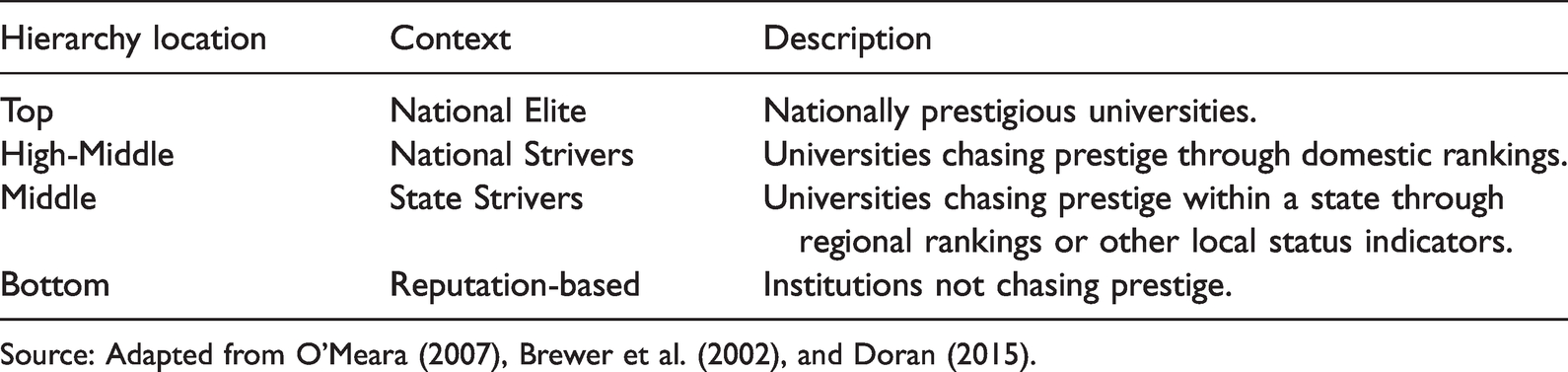
Source: Adapted from O’Meara (2007), Brewer et al. (2002), and Doran (2015).
Although, O’Meara (2007) cautioned that it is difficult to categorize exactly which universities are strivers. She stressed the importance of contexts, “there will be regional differences and ways in which public versus private institutions and institutions that are part of state systems are striving for different levels and kinds of prestige” (O’Meara, 2007, p. 129). In the model, though, institutions with elite ambitions are especially susceptible to striving through rankings in order to gain status.
Stakeholders within striving universities often make comparisons to the elite of the sector through metric benchmarks and best practice emulation (O’Meara, 2007). In the American setting, the Ivy League has represented the top of the domestic hierarchy and these elite universities have been models of standards for strivers. In an examination of the striving model, Kim (2018b) recounted, “with the connotations of elite institutions or Ivy Leagues schools, there have been efforts to systemically determine institutions’ standing” (p. 100). In a study of a striving liberal arts university, O’Meara and Bloomgarden (2011) found that faculty members who pushed for more academic rigor labeled the best students at their institutions as “Ivy League quality” (p. 57). In another study of a selective public university, an administrator told O’Meara (2015), “Ivy League institutions run the ‘game’ and places like [this] would always be playing catch up” (p. 291). However, not all striving universities aim for the Ivies, as these goals are dependent on hierarchical contexts (Doran, 2015; Gonzales, 2014; Zerquera, 2018). This domestic hierarchical divide manifests itself in different ways when considering other domestic contextualization.
The Chinese higher education context
China has been a key player in the global higher education sector for the past few decades through government elite-making efforts for its nation’s universities. In 1995, the Ministry of Education (MoE) first announced an ambitious project to overhaul the top end of the Chinese higher education sector in order for its institutions to meet the “world standard,” called the 211 Project (Ngok & Guo, 2008, p. 546). Eventually, over 100 universities joined this project that came with billions of USD in research funding and status as National Key Universities. In an even more ambitious policy initiative, in 1998, at the centennial anniversary celebration of Peking University (also called Beida), General Secretary Jiang Zemin announced the 985 Project. This new plan was not only geared at meeting a global standard but also elevating institutions to “international advanced level” (as cited by Li, 2004, p. 17). Only 39 institutions were selected for this elite status, with the first nine selected dubbing themselves as the C9 League. The universities in the 985 grouping have gained international acclaim and have seen dramatic rises in their global rankings such as those from Times Higher Education (I) Quacquarelli Symonds (QS), or the Academic Ranking of World Universities (ARWU) (Allen, 2017; Rhoads et al., 2014; Yang & Welch, 2012).
In 2015, the Chinese government announced a new plan that phased out the 211 and 985 Projects. The new replacement project was called ShuangYiLiu (Double First Class), which was officially implemented in 2017 (Peters & Besley, 2018). The new initiative combined the old projects into one entity, but still kept the tiered system with 42 institutions in the top segment 1 and another 95 in the second-tier, according to a report from the People’s Daily. 2 Whereas the previous projects had holistic strategies of creating world-class universities, Double First Class emphasizes individual subjects, disciplines, or departments, especially for second-tier institutions, according to a release from the Ministry of Education, Ministry of Finance, National Development and Reform Commission in late 2017 (Song, 2018). 3 Additionally, with 211 and 985, universities were locked into the funding schemes and there were little mechanisms for oversight built into the awards. Double First Class, however, is now based upon an audit funding mechanism for each level (Peters & Besley, 2018). The striving model has not been considered within this complex environment with a more centrally controlled education system.
Data collection and methods
For the study, qualitative interviews were used with on-the-ground experts within the institutions, namely administrators and professors. The firsthand experiences of the interviewees provide an expert holistic account of the effects brought from the rankings (Blommaert & Dong, 2010). Past studies on Chinese universities and their international ambitions have been limited to singular institutions or smaller case studies (see Jin & Horta, 2018; Rhoads et al., 2014; Yang & Welch, 2012). While these vertical case studies provide in-depth understanding of one university, a wider study of the unified sector can provide valuable insights into larger-scale issues and phenomena system-wide, particularly of those that are on a global scale (Hazelkorn, 2015).
The research relied upon a purposeful sample of professors and administrators to garner the social reality from the 211 Project universities, 985 Project universities, and other universities that are considered either specialized or those with big global aspirations. The change from these old elite-making projects to the new system will be explored in the study. With its wide scope, this study can uncover effects that transcend across institutions in the elite spaces of the sector. Moreover, the role of the academic in Chinese higher education is interlocked with the duties of administrators. Thus, the faculty members provide a sense of the administrations’ thought process on these matters, with an added eye for wider scholarship and field. The design employed snowball sampling, gathering a total of 48 administrators and academics from the Chinese higher education sector, including 12 from the C9 League, 17 from 985, seven from 211, and 12 from the other type. Included in the sample are also a variety of fields: hard sciences, social sciences, and education, along with different positions, from early career to late-career. A detailed description can be seen below on Table 2.
Sample details.
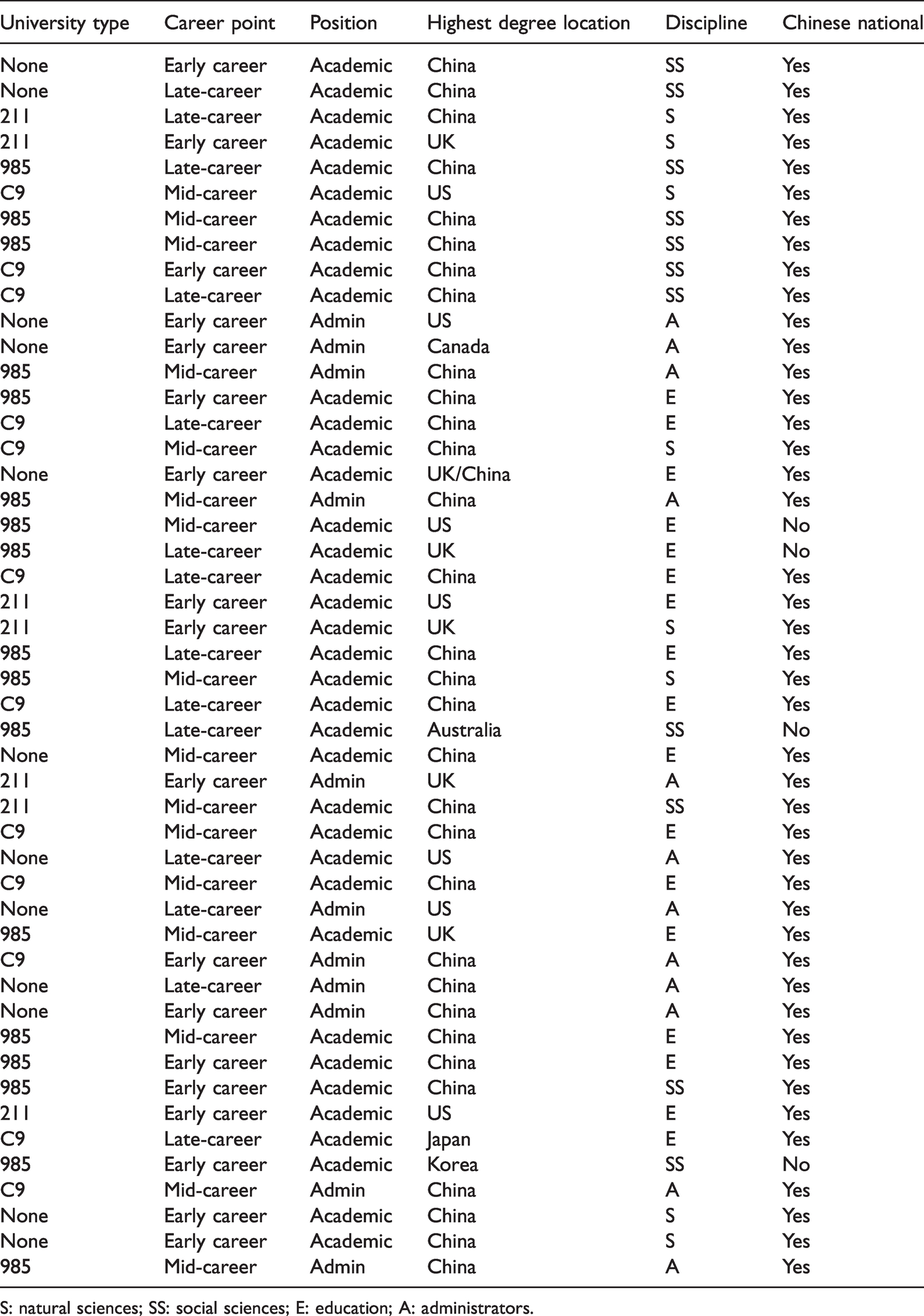
S: natural sciences; SS: social sciences; E: education; A: administrators.
All of the interviews were conducted in a one-on-one phone or live discussion format, except with three email exchange interviews. The interviews were mostly conducted in English, but a student assistant translator was occasionally used for those participants more comfortable speaking in their native language. The interviewees were recorded and provided their explicit permission to participate via guidelines prescribed by the Institutional Review Board. In order to ensure privacy, all of the universities and participants’ exact programs have been anonymized. Every interviewee was well aware of the purpose of this research project. Any material that could be used to trace them has been destroyed.
The interviews averaged approximately 45 minutes, with some ranging from as short as 20 minutes to others as long as 1.5 hours. The design utilized a semi-structured protocol to guide the interviews, but followed the conversations for deep exploration depending on each experience in accordance with the “tree branch style” (Rubin & Rubin, 2011). All of the conversations were transcribed verbatim, along with the help of private transcription contractors via the Fiverr network. In order to ensure accuracy, each transcript was rechecked to ensure that the transcription aligned with the spoken word. Direct quotes have been provided in the findings, but, as they are naturally spoken, they do include some grammatical errors.
Coding
For the data analysis, the interview transcripts were uploaded into the NVivo and systemically coded for trends, which is useful for data organization, quality transcription control, and avoiding coding drift (Rubin & Rubin, 2011). The process first used an open coding method to establish early codes that could be further expounded upon during follow-up readings of the collected nodes of data (Blommaert & Dong, 2010, p. 12). The initial coding sessions followed a deductive method that aligned with the larger themes from the protocol, which were established through literature and pre-testing before the field research.
Coding naturally followed the course of the interviews, rooted in the previous literature, pre-tests, and other preparations, as subjects discussed various topics, they become codes for the analysis (Blommaert & Dong, 2010). In an obvious theme, any descriptions of ranking conceptions went into a “university rankings” code. However, as the coding moved further along in the process, sub-codes were added, such as specific ranking schemes (THE, QS, etc.). Sub-coding is an important part of the process that provides a deeper and more nuanced inspection of the data that interconnect the analysis or narrative. This process yielded larger codes like “Chinese characteristics” and the “world-class university” concept. As it progressed, new sub-codes were created, often under these larger themes: such as “isomorphism,” “elite projects,” “administrative efforts,” and national “hierarchy.” However, even with the thorough literature review and pre-testing, not every emergent code was expected. Finding the unexpected is a natural part of qualitative research (Blommaert & Dong, 2010).
Findings
Striving through global university rankings
In the American striving model, universities use domestic rankings like US News to make sense of their location in the national hierarchy. In the Chinese sector, actors in striving universities also must balance global rankings such as Times or QS with domestic government pressures. The Chinese government has been keen on international standing, and Chinese administrators and academics were burdened with these ambitions. Interviewees reported striving aspirations for their universities related to global rankings. “Yeah, as I said pressure is translating down, is going down all the way to individual faculty, because the university president will have pressure when… the ranking is released, they are all on their feet eager to know the results. And then for each dean, the university will say your ranking has dropped by fifteen places, what is going on?” asked one C9 League professor. The interviewees emphasized that “leaders” of universities put considerable “attention” on global rankings.
Global university rankings promote a single standard for an elite university that is often a reflection of large, expansive research universities of the West (Shahjahan et al., 2017). One scholar at a 211 university complained that her field of sociology is more closely attached to the arts and humanities rather than the social sciences, but the international rankings cannot properly compare across these cultural divides. The respondents reported that it was challenging to accurately capture the disciplines under the exact organizational structure requested by the ranking agencies. The administrators tasked with gathering information complained about the difficulties of the task. “They have the standard template,” said a 985 administrator. “That's a different system. Different methodology. But then the terms have their own definitions, sometimes when you're trying to provide the relevant data then you have to think about it you have to figure out which data should be mapped into their domain. So, this kind of technical issue.”
The interviewee also added that they must specifically look at the rankings to see where they are doing poorly and then invest in those areas. “So, I mean the ranking system for us probably, I think it’s going to make us less special because when… you want to be, the Chinese people, we want to be the best, this is the Chinese way of method. So if we want to be the best then, we have to play the rules, then we have to cut some of our corners to fit into the system,” lamented a non-elite project administrator. Other scholars more focused on local society and community thought it was unfair that schemes often do not capture any homegrown imperatives, and instead focused only on global issues. One administrator from a non-elite project institution heard criticism that her university was just a “local university” because it “does not rank so high as the system.” Throughout the interviews, the respondents believed that the focus on global indicators made local concerns a secondary matter.
Focusing on global rankings at the expense of the local especially came across in reference to teaching institutions, where the direct benefit of global rankings is not always apparent in regards to training the nation’s future teachers. In one explicit example, an elite 985 university, which was more known for hard sciences, explored expanding its school of education in order to become more competitive. The program was already strong, but too small to actually be ranked in any leading discipline rankings. The university even hired some of the most famous international scholars in the field to evaluate the possibility of expansion, whom all counseled against the growth development strategy and advised to instead focus on smaller strengths. Many of the education-focused institutions across China have not heeded this kind of advice and interviewees believed that they have become oversaturated with too many fields.
The domestic government ranking
While the findings do show that actors within Chinese universities are hampered by expectations of global rankings, these domestic varieties are far more impactful. Unlike in the US, these are not rankings produced by private enterprises, but rather the Chinese government has distinctions and rankings that contribute to striving behaviors in the sector. The Chinese Ministry of Education (MoE) is a powerful force for education in China’s top-down governmental environment, with policy and directives trickle downward to subsidiaries. Distinctions and status from the government, such as 211 or 985 Projects, have become important to organizing the national hierarchy of universities.
The MoE employs its own ranking of academic disciplines for Chinese universities called the National Subjects Evaluation (NSE) that is evaluated every four years (Song, 2018). This governmental ranking system is incredibly important to the universities, and overwhelmingly believed to be more crucial for institutions than with global rankings. Global university rankings have only captured the attention of the global strivers, but the Ministry’s ranking has the full attention of every university because it is an official governmental marker. Interviewees believe that, in China, anything “official” has much more of an impact than other outside indicators and, in this case, the global rankings take a back seat to the Ministry in terms of attention; though, the government’s ranking does have some shared characteristics to its global counterparts. One professor from a 985 university said that the Ministry ranking is much closer to the ARWU because it mostly puts emphasis on publications and research output. Although, in 2020, the government announced a move away from some international indicators, such as the Social Science Citation Index (SSCI) (Huang, 2020).
Professors in the sample carried a nervous reverence for the MoE evaluation, while at the same time carry a grumbling aggravation with the outside league tables. In illustration of this concern, one 985 professor offered an example: “[M]uch more important is the Ministry’s own ranking… When QS ratings come out, the president of the university calls the deans of the faculty to his office to explain why [a rival] is higher than [our university]. So you see a response to it, but it’s sort of peripheral. If they lost the status with the Ministry, like that would be devastating for everybody.” Faculty members and administrators all reported considerable stress during the application collection period, where all work and materials that they have been produced over the years were documented to send to the Ministry. Sometimes this work is dumped upon a lower-ranked faculty member or even a post-doctoral researcher because it is tedious and grinding.
The chief reason for the almost universal devotion to the official ranking is because a considerable amount of finances hinges on the results. “If we rank low by the Ministry that means you will have implications on how much funding you will get,” said one C9 professor. While no professors could fully articulate how exactly the funds were allocated based on ranking, the top ordering was of considerable importance. A group of natural science professors from a 211 university said that their institute ranked number one in the most recent Ministry ranking and it allowed them to dramatically expand their operations, including hiring a foreign faculty member and funding a post-doc position, which was filled by a Chinese national who had received a PhD abroad. They even were able to compete with 985 universities of the same discipline, despite being lower in the national university hierarchy.
Not every subject at each university partakes in the MoE discipline ranking, which complicates intra-university department relationship. Some interviewees mentioned that their departments were not even evaluated within this system because of their limited size. Only larger programs with considerable resources were considered, which means that during the evaluation periods, programs move resources around in order to beef up programs that were included. “In the report there was something that’s not so real. I think it’s the same for every university,” said a professor from a 211 university. When followed up on this point, he elaborated on how programs have been gaming the system: “Yeah, you would, kind of rearrange the resources based in the way. Like, this department they have no hope of getting really good spot in the ranking, they would contribute something to the department who has a chance to get a really good chance in the ranking.” He continued, “So, it’s redirecting the resources, basically. So, I think it’s really not necessary. That is just because ranking the first and ranking the second is a big difference.” These instances are similar to reports of universities gaming the system in order to appear more favorable in rankings of other contexts (see Kim, 2018b). The incentives for moving around resources and creating a false narrative far outweighed the consequences of getting caught for striving universities.
Elite-making government projects
While not technically rankings, the 211 and 985 Projects have provided sense-making to the Chinese higher education sector similar to rankings in other sectors. For many professors, when first asked about rankings, they mentioned these government projects. Given the hierarchical nature of the striving model, these government statuses are important to contextualizing O’Meara’s model in the Chinese sector. Further, the updated version of these projects does implement a ranking-like mechanism. Even years after the 211 and 985 Projects have technically been terminated, they have left an imprint on the sector akin to ranking schemes such as US News. Students, administrators, professors, and even employees are intently focused on these stratifications. Many professors revealed that their programs have “unofficial” policies that discriminate against the lower institutions in the hierarchy. For instance, a 985 university would only hire candidates who went to a 985 university, and a 211 university would only hire people from 211 or 985 universities. Similar reactions have been reported in the private business sector. Universities were still strongly emphasizing these distinctions during this fieldwork in spring and summer of 2017, despite the announcement of the new replacement policy, Double First Class, two years prior.
Unlike with movement each year from rankings, elite statuses in the projects had been frozen for universities within each of the segmentations: “Because once you’re 985, you’re 985 forever,” said one professor. The system has been visualized in Figure 1. Along with 211 institutions, there was no real mechanism for movement into these elite statuses; meaning, it created a permanent higher education hierarchy. This permanence did disincentive some striving behavior nationally because the hierarchy was set. However, there was still considerable chasing of prestige, especially on the international stage.
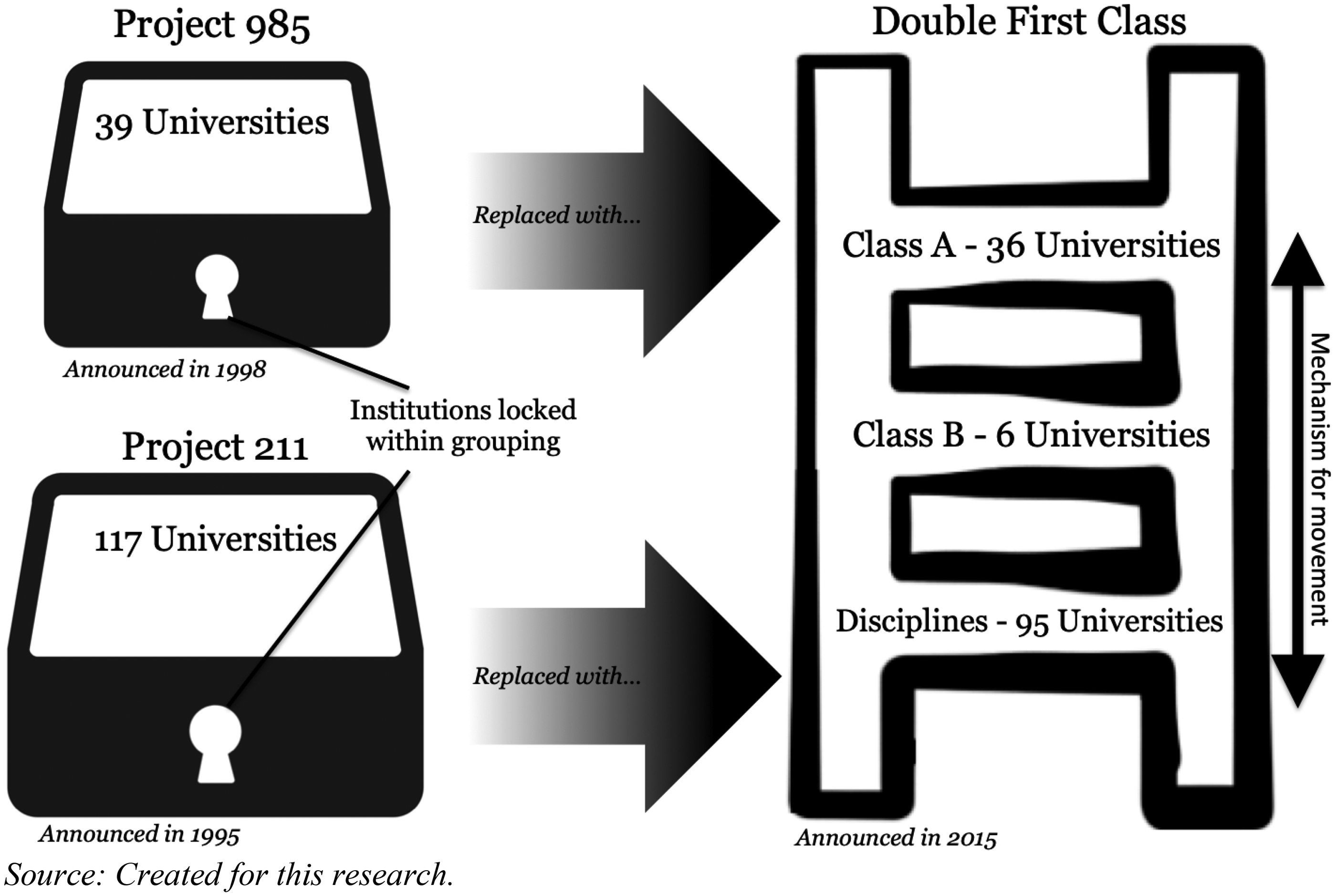
Lock boxes vs. the ladder: representation of elite hierarchy from projects established in the 1990s to the new double first class system.
The Chinese government has recently replaced these old policies with a new elite-making project called Double First Class (ShuangYiLiu), which is geared at alleviating some past drawbacks and has supposedly created opportunity for mobility—operating more akin to ranking schemes, also on Figure 1. The interviewees were keen on replacing the old system that kept universities in specific groupings, to one that had built-in opportunities for program and university progression. Programs that once did not have a chance to gain elite domestic status now had a theoretical chance, which should increase domestic striving behaviors due to the prestige and material resources gained from these statuses. Similar to its predecessor projects, in the ShuangYiLiu universities or disciplines granted higher distinctions would receive more funding opportunities.
However, there was also concern about the consequences that could result in relegation or removal from the funding projects. Because of the possible movement within the new system, national striving behaviors should increase. “[It] will break the entitlement or guarantee status or tenure… And it establish dynamic system to adjust this so that university can go in and out of this 2.0 project. For those who make real mistakes and have no signs of improvement after warning, so basically they will be kicked out,” warned one C9 League professor. During the period when the interviews were conducted, policy details were still murky for the new plan and many participants were unclear about the exact nature of the new system. Sometimes, rumors on WeChat, China’s most popular social media service, filled in the gaps that were not provided by officials. “There were even formulas going around saying that if you discipline is rated by this domestic exercise, you rated below a certain then you will be given so much less, floating around on WeChat, but quickly the Ministry of Education came out denying that,” said one mid-career academic from an elite C9 university. “But if those were any indication, then these discipline rank lower are at greatest risk of being closed down. Because you dragging everything down.” While the MoE discipline rankings already factored into some funding choices, it has been unclear whether they will be used within this system. It is likely that these two operations will merge, using the MoE’s metrics as the movement mechanism for Double First Class distinctions.
Reactions to a new system
The concerns about being shut down due to poor rankings were near-universal and also something already faced by Chinese institutions. “[I]f one subject in [the university] is bad, then the university would have no choice but cancel it. That is what our leaders have told us,” cautioned one 985 university professor. Another C9 professor confirmed, “several important key universities” at “very famous” institutions had “closed their educational schools” because their administrations felt pressure from the changes made from the government programs. Smaller and less prestigious programs are now under fire because they basically have no chance to compete. Larger programs at least have the opportunity, even slim, of making a move in these domestic discipline rankings because they have resources to participate. One administrator from a non-elite project university in a smaller city felt consternation with the entire process, because she believed that it was good policy to have universities focus on their strengths, yet she also thought it concerning that programs and disciplines would actually become restricted, “[we] train the people for the whole region as a public service, is that going to be enough to just offer a couple of disciplines?”
Some professors were sympathetic to the mission of the MoE and their administrators who had to implement these policies. China, after all, is a massive country with the largest education system in the world, they mentioned. With a ballooning population of new academics produced each year, one asked how could all of these people become professors? Space and resources are limited, echoed those encouraged by the new competitive system. A few scholars also lauded the focus on disciplines over the previous models’ holistic university approach. One early career 211 professor explained that his university where he earned his PhD had top programs in education and physics, but the administration has been forced to allocate considerable resources to other areas in which the school had no tradition because of this holistic approach. He believed that the totality attenuates education in all departments and that the ShuangYiLiu would release universities from these burdens. Further, there was some hope, especially from 211 and non-elite universities, that the new program would provide opportunities to move into elite status. It could be a map to positively grow an institution, smartly investing in one program at a time instead of throwing everything against the wall to see what sticks. “They say that they want to become a good uni, so they need to take a discipline first. They need to become the best in that discipline first,” said one foreign-trained, early career 211 university academic. “So they pick that discipline that is the smallest… They spend a lot of money on this small discipline. And then they will become the top uni in this area first, then maybe expand from there.”
Despite some positive spin, overall, most of the interviewees were dubious of any monumental changes happening due to the new project. The announced universities basically mirrored the previous hierarchies and universities are hesitant to give up any position. Universities are not willingly giving up their advantages within the system, many of them argued. When asked if the elite projects will continue to shape institutional perception, another 211 university professor said, “I think yeah, these things will carry on. Because… they wouldn’t throw it away, not voluntarily. We are 211, why not mention it? We should mention it. [laughs].” In the end, the new policy is likely going to increase striving competition in China compared to the previous projects.
Discussion and conclusion
Theorizing a global striving hierarchy
While global rankings are given reverence by stakeholders in top Chinese universities, they have an even greater focus on government distinctions and rankings. Differing from the US with private ranking firms such as US News, striving behaviors at Chinese institutions center on appeasing the Ministry’s discipline ranking or keeping elite project status. The differences between the Chinese and American sectors can help to understand the striving model from a more global perspective. A more complete global striving model has been illustrated on Table 3. Atop the global model sits globally prestigious universities that do not rely on rankings for status, but are nonetheless reflected in global rankings and benchmarked by other institutions. This handful of global elites are emulated by other institutions and sectors across the world. These institutions set global practices and are seen as the industry standard-bearers globally. Tied to historical legacies and national prominence, the so-called “world-class university” can often be ascribed to this class of university (Marginson, 2017).
Global striving model.
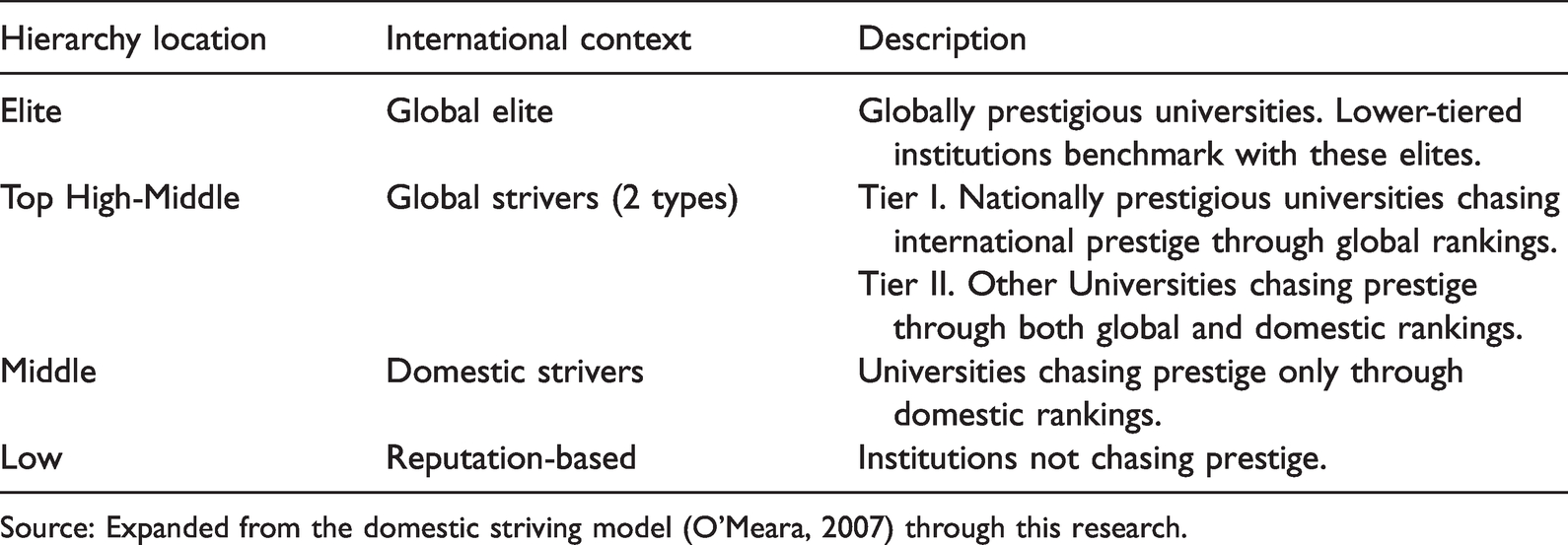
Source: Expanded from the domestic striving model (O’Meara, 2007) through this research.
Within the global striving model, there are also universities that sit comfortably atop their own national hierarchies and are only striving for international prestige, called Tier I global strivers. These Tier I strivers have domestic prestige, but chase the global elite and attempt to emulate or follow their success. Much of the elite Chinese higher education landscape can be defined by these institutions. For instance, the former 985 universities have clear status given the government distinction, but crave recognition from the global community. Just as with domestic strivers, universities around the world have attempted to move up in the global rankings through strategies like funneling funds to research-intensive projects (Horta & Shen, 2020), investing in top faculty from elite universities (Altbach & Yudkevich, 2017), boosting recruitment of international students (Zhou et al., 2017), and creating global partners with other top-ranked universities (Allen, 2019). Similarly, global strivers of the Tier II type seek to build reputation in both the global and domestic sectors. Some of the former 211 universities and other fast-rising Chinese universities have a focus on both their domestic positions along with global connections, sometimes due to regional biases within China that favor the eastern coasts and megacities.
Similar to O’Meara’s (2007) domestic model, there are institutions in the global model that only have national striving expectations, meaning they are looking at domestic rankings while completely ignoring the global sector. These institutions within China likely do not have any government status and may further attempt to move up the hierarchy within the new Double First Class mechanism or other ranking distinctions. Although outside the scope of this study, future research should investigate these efforts to move up within this hierarchical mechanism, as the structures and barriers from the old models should be difficult to penetrate. Likewise, other institutions in this model do not chase prestige through rankings, but rather through local reputations or programs. In China, these institutions are likely new and sometimes private universities that look to offer amenities or possible migration routes. However, this research did not fully engage with these institutions, a consideration for later work.
Implications
In comparative research, contexts always matter. The global striving model theorized through this research can be ascribed more broadly, as it builds upon O’Meara’s work that had formerly been constructed through US higher education structures. The American system is more robust, well established, and quite unique compared to other sectors around the world. First, the system is considerably decentralized, especially compared to various higher education systems around the world, and has seen a trend of defunding in recent decades. The higher education sector in the US has been also more reliant on private institutions, with some of the most elite in the system being private universities such as those in the Ivy League (Kim, 2018b). American institutions are more inward-looking compared to other systems due to historical characteristics and positioning (Hazelkorn, 2015). For example, the private magazine ranking of US News has dominated the American higher education discourse with domestic rankings, rather than with global rankings. Likewise, the US is mostly a recipient nation in terms of international students, without much recent tradition of sending students abroad for full degrees. These odd characteristics of the sector mean that other higher education systems around the world will likely operate differently in terms of striving, aligning with their environmental contexts and national characteristics.
Expanding the striving model with the case of China offers additional domestic considerations that are common around the world. The Chinese higher education system is much more centralized than its counterpart in the US, without the presence of elite private universities, though this is certainly an expanding area of the sector (Buckner, 2017). Further, China’s younger system has been dominated by elite-making ambitions guided by strong investment, especially at the top end of the spectrum, that has helped turn the nation into a destination for international students rather than just a sender. While these initiatives have proven to be successful in gaining international recognition a boost in rankings (Allen, 2017), some have critiqued the tactic as rooting the system with “clay feet” (Altbach, 2016) and overemphasizing STEM over other areas (Horta & Shen, 2020). Policymakers seem to be aware of these concerns, with new efforts to improve other parts of the higher education sector, discipline focus of Double First Class, and the deemphasis on international indicators such as SSCI articles (Huang, 2020). Because the Chinese system is likely more relevant to developing sectors around the world, stakeholders in other societies have looked to China as a place of emulation. There has been a proliferation of elite-making policies and emphases on highly-cited research indicators in developing systems chasing world-class status (Marginson, 2017). The global striving model presented through the case of China can help to understand and predict behaviors in these other parts of the world, as these developing higher education sectors will likely pursue similar paths and policies of educational development, even as the critiques and concerns remain.
Despite the expansion of the model presented in this study, future research on these behaviors should be more diversified. As this was one of the first studies to expand the model to a non-Western context, the work only examined the elite end of the Chinese sector, delimited at the top end of the spectrum. Of course, outliers and other oddities could persist across different systems, such as university branch campus arrangements, that do not align with the striving model. Like in the more robust studies of the US, the lower-tiered universities in this hierarchy should also be considered, such as an exploration of the growing trend in private universities in developing systems. Similarly, other systems around the world deserve attention from scholars thinking about striving behaviors, especially from societies that are rapidly developing and maturating a domestic hierarchy similar to China. Finally, while the US sector has been heavily studied in this model, there have been few studies into global striving through the international rankings. It is sometimes taken for granted that global league tables do not matter in the US, but this notion needs to be further tested. With this global striving model, the intersections between domestic and international rankings can be better understood throughout the world.
Conclusion
The striving model has proved to be a useful analytical tool to understand higher educational sectors, which has only gained more importance as the world emerges from the COVID-19 crisis and systems rebalance their goals. The crisis stemming from COVID-19 is a reminder that the hierarchies considered in this type of research can and do change—helping to understand the motivations of strivers and the hope of reaching a desired status. Under these unprecedented circumstances, the usage of university rankings could be overshadowed by other more material concerns as institutions face the realities of a post-pandemic world. Even pre-crisis, academics and educators have decried the extreme competition surrounding league tables (Shahjahan et al., 2017). For instance, European scholars have attempted to curb these striving behaviors through initiatives such as U-Multirank, which offers personal customizations and bands rather than ordinal rank (Marginson, 2014). But after almost a decade, the initiative has not made much impact in the global higher education sector. Indeed, international competition has only become fiercer in recent years, and it is unclear if the crisis will cause an inward turn to domestic systems from societies around the world. Reactions, in all likelihood, will probably hinge on national characteristics and local histories.
In the case of China, its universities have been stuck in the middle of two powerful forces; one from the outside globalized sector that is pushing university ranking standards onto institutions, and the other from the government’s own distinctions and policies that also promote normalization with constraints to variation. While it is generally known that the global rankings irk academics and other actors in the sector, there is less criticism of the government’s efforts. Though, some did express their frustration at the perceived tight control, arguing that the restrictions have been a “detriment to development”, as one late-career C9 professor complained. In the near future, there will be an increase in striving behaviors across the Chinese higher education sector due to the combination of pressures from domestic resource allocations and continued global ambitions. However, there are signs that the global ambition goals could be easing, as the Chinese higher education sector has gained more confidence on the global stage and the government has officially lowered expectations of international output. In the longer-term future, the sector may turn more inward, resembling the domestic striving model akin to that of the United States, where various sectors around the world benchmark Chinese institutions and strive to join them.
Supplemental Material
sj-pdf-1-cne-10.1177_22125868211006201 - Supplemental material for Adding an international lens to the university striving model: How both global and national indicators influence the Chinese higher education hierarchy
Supplemental material, sj-pdf-1-cne-10.1177_22125868211006201 for Adding an international lens to the university striving model: How both global and national indicators influence the Chinese higher education hierarchy by Ryan M. Allen in International Journal of Chinese Education
Footnotes
Declaration of conflicting interests
The author(s) declared no potential conflicts of interest with respect to the research, authorship, and/or publication of this article.
Funding
The author(s) received no financial support for the research, authorship, and/or publication of this article.
Notes
References
Supplementary Material
Please find the following supplemental material available below.
For Open Access articles published under a Creative Commons License, all supplemental material carries the same license as the article it is associated with.
For non-Open Access articles published, all supplemental material carries a non-exclusive license, and permission requests for re-use of supplemental material or any part of supplemental material shall be sent directly to the copyright owner as specified in the copyright notice associated with the article.
