



Abstract
While digital competence is widely acknowledged as fundamental to educational transformation, the mechanisms impeding its translation into innovative teaching practices remain inadequately understood. This study investigates teachers’ adaptive use of digital tools, characterized by exploratory adaptation and innovative application behaviors. By developing a multiple mediation model incorporating four key constructs: educational contextual norms (ECN), digital tool structure (DTS), technology adoption intention (TAI), and perceived usefulness (PU), this study illuminates the transformation pathway from digital competence to adaptive use. Analysis of data from 9,726 primary and secondary school teachers reveals three transformation pathways: an intrinsically driven pathway relying on internal motivation, an extrinsically driven pathway dependent on external norms, and a multi-driven path demonstrating significant sequential mediation through ECN → DTS → PU. Findings indicate that digital competence facilitates innovation indirectly through a progressive process of interpreting contextual norms, selecting appropriate tools, and developing value recognition, thereby providing insights for fostering teachers’ digital innovation practices in educational settings.
Keywords
Introduction
As educational digital transformation accelerates, teachers’ digital literacy has emerged as a critical factor in improving instructional quality and fostering classroom innovation. Globally, teachers’ digital competence is widely recognized as a cornerstone of educational digitalization, with a growing emphasis shifting from skill acquisition to innovative teaching practices. According to the UNESCO ICT Competency Framework for Teachers (Version 3), teachers should effectively integrate ICT into their lessons and use technology to promote pedagogical innovation and educational change (UNESCO, 2018). The UNESCO AI Competency Framework for Teachers further suggests that teacher competence should evolve from acquisition to deep application and creation in the AI era (UNESCO, 2024). The OECD emphasizes the need for teachers to enhance their ability to integrate digital skills and pedagogies and to be able to align their teaching practices with the digital environment (OECD, 2025). Similarly, UNICEF points out that teachers’ digital competence is an important prerequisite for promoting online teaching improvement and educational innovation (UNICEF Europe and Central Asia, 2022). China’s 2022 industry standard Digital Literacy for Teachers further emphasizes that teachers should possess the ability to utilize digital technology resources to achieve pedagogical innovation (Ministry of Education of the People’s Republic of China, 2023). In July 2025, the General Office of the Ministry of Education of China launched the Digital Empowerment for Teacher Development Action to promote the reform and development of the teaching force (Ministry of Education of the People’s Republic of China, 2025).
Empirical studies suggest that the relationship between teachers’ digital competence and classroom innovation is not a straightforward linear one (Suárez-Rodríguez et al., 2018). Although some teachers possess certain technical competencies, their actual teaching practices are often constrained by specific knowledge, self-efficacy, and cultural factors, resulting in an insufficiently innovative use (Ertmer & Ottenbreit-Leftwich, 2010; Xie et al., 2023). Based on a large-scale survey of Chinese teachers, Chen et al.(2023) noted that teachers still need to strengthen the application of digital knowledge and innovation. International surveys corroborate this phenomenon: multiple OECD reports indicate that teachers’ use of digital tools predominantly remains confined to administrative tasks and replicating traditional methods (OECD, 2019, 2023). Concurrently, TALIS data reveal that on average, approximately 43% of teachers feel inadequately prepared when using ICT in classrooms, and about 18% urgently require relevant professional development (OECD, 2021). These findings collectively demonstrate that merely mastering digital skills is insufficient to ensure innovative classroom applications.
Further research indicates that the gap between digital competence and classroom innovation is constrained by multiple factors. Scholars have pointed out that teachers’ beliefs and readiness, as well as school-level resources, technical support and cultural values influence teachers’ integration of technology in the classroom (Inan & Lowther, 2010; Li et al., 2025; Wang, 2024). In conclusion, the transformation from teachers’ digital competence to innovative teaching is jointly influenced by their internal willingness and the surrounding educational environment. This study focuses on uncovering the mediating pathways through which teachers convert digital competence into innovative instructional practices—a process that narrows the gap between “possessing capability” and “innovative application” and has become a core priority for both academics and policymakers.
This study takes teacher digital competence (DC) as the starting point and introduces variables such as technology adoption intention (TAI), educational contextual norms (ECN), digital tool structure (DTS), and perceived usefulness (PU) to construct a multiple mediation model. This model explores how teachers’ digital competence translates into adaptive use (AU) through multiple mechanisms. To explain this process, the study draws on the Information Systems Success Model, the Adaptive Structuration Theory, and the Technology Acceptance Model. Specifically, the Information Systems Success Model is used to assess the effectiveness of the digital tool structure; the Adaptive Structuration Theory emphasizes that technology value depends on users’ adaptive choices within their socio-technical contexts, helping reveal key interactive mechanisms in technology application; and the Technology Acceptance Model highlights the mediating role of perceived usefulness and adoption intention in technology adoption. The integration of these three frameworks not only deepens understanding of the transformation mechanisms of teachers’ digital competence but also responds to domestic and international calls for enhancing teachers’ digital literacy and innovative teaching. It provides empirical support for optimizing teacher training and educational digitalization policies.
Theoretical Foundations
Adaptive Structuration Theory
DeSanctis and Poole proposed the Adaptive Structuration Theory (AST) based on group decision support systems in 1994 (DeSanctis & Poole, 1994), emphasizing that the ultimate value of technology is not directly determined by its functional design but rather emerges as a result of continuous reconstruction through the interaction between social structures and technological structures. Norms, expectations, and behavioral patterns within social structures guide users in how they understand and approach technology. Meanwhile, the inherent structures and resources within technology are selected, interpreted, and reconfigured in practice, thereby shaping actual usage patterns.
Existing research indicates that high levels of digital competence do not automatically translate into extensible or innovative applications in the classroom; rather, it often relies on the adaptive selection and restructuring of structural rules and resources. This study proposes that the process by which teachers transform digital competence into innovative classroom applications is activated by Educational Contextual Norms (ECN). ECN encompass official policy recommendations and peer group usage models. These norms alone do not directly alter teacher behavior. Only when teachers possess sufficient digital competence can they effectively interpret external norms like official recommendations and peer practices, transforming them into executable and innovative technology applications. In other words, DC is the prerequisite for ECN to exert influence.
This study operationalizes the “Appropriation” concept from AST as “Adaptive Use” (AU). Its core lies not in whether teachers use technology, but in how they proactively select, combine, and innovate functions between technological structures and instructional needs. Specifically, adaptive use exhibits three characteristics: (1) Structural Selection: Teachers make alternative choices among multiple digital tools or similar functionalities; (2) Structural Reconfiguration: Teachers recombine multiple functions to achieve instructional objectives based on teaching tasks; (3) Structural Innovation: Teachers apply existing tool functions to novel teaching activities beyond their intended purposes. Accordingly, this study defines AU as the degree to which teachers flexibly select, extend, and innovatively utilize digital tools based on their functional understanding.
Information System Success Model
The Information System Success Model (ISSM) posits that information quality, systems quality, and service quality individually or collectively influence willingness to use and user satisfaction, which in turn affect net benefits through their mutual interaction (DeLone & McLean, 2003).
In this study, digital tools refer to instruments that utilize digital technology to collect, acquire, retrieve, transmit, store, and process multimedia resources. These include, but are not limited to, interactive software, online platforms, various applications, and internet services. The quality of the instructional resources produced by these tools constitutes the information quality that teachers prioritize. Meanwhile, the stability of system operation, the interactivity of the interface, the alignment with instructional needs, and functional coherence collectively form the systems quality and service quality of digital tools. Therefore, this study treats the digital tools teachers routinely use as information systems, evaluating their structural characteristics and effectiveness in education through three variables: systems quality, resource quality, and functional coherence. This research posits that the DTS —encompassing the above three variables—influence teachers’ willingness to use digital tools and their perceived value, which in turn affects the active selection and innovative application of these technological tools.
Technology Acceptance Model
Davis proposed the Technology Acceptance Model (TAM) in 1989, which comprises four core elements: perceived usefulness, perceived ease of use, behavioral intention, and actual usage. Perceived usefulness (PU) refers to the extent to which an individual believes using a specific system can enhance their performance. Perceived ease of use (PEOU) denotes the degree to which an individual perceives the system enables unconscious operation. Existing research indicates that PEOU not only directly influences PU but also indirectly affects behavioral intention through attitudes (Unal & Uzun, 2021). TAM emphasizes that individuals’ adoption of information technology is mediated by psychological cognitive variables such as PU, PEOU, and behavioral intention, while social norms serve as external variables directly influencing PU/PEOU.
This study views digital tools structure as an extension of PEOU, positing that whether teachers can interpret norms as actionable teaching strategies depends on DC. Therefore, ECN is not treated as an external variable but incorporated into the mediation model as an “interpretable norm” requiring activation by DC. In other words, teachers can only transform high-level digital competence into exploratory and innovative use when they perceive the technology’s usefulness and ease of use; this perception of usefulness depends on the support and guidance provided by ECN. This study positions ECN between DC and tool perception to emphasize that teachers’ understanding and implementation of norms do not occur automatically but depend on their technical ability to “decode” norms. Therefore, compared to traditional models treating social norms as external variables, the proposed sequence (DC→ECN→DTS, PU→AU) more accurately reflects the psychological mechanisms through which teachers transform norms into practical strategies within educational contexts. Specifically, this sequence highlights that DC is a prerequisite for ECN to function, clarifying the logical relationship between individual competence and contextual norms in driving adaptive use.
Research Hypotheses
TAM consistently highlights the central role of utilization intention in explaining actual technology adoption among individuals. The correlation between behavioral intention and actual use behavior was significant and robust, and this association was particularly significant in the teacher population (Scherer et al., 2019). Additionally, empirical research on the individual distinctions of teachers suggests that teachers’ attitudes toward using technology have an impact on their adoption of new technologies in the classroom (Avci, 2022; Holzmann et al., 2020). Based on this, this study proposes Hypothesis:
TAI positively influences AU. Teachers’ adoption of technology and tools is driven not only by individual cognition but also significantly influenced by social contexts and normative factors. Peer influence and recommendations from officials proved to be important factors in driving teachers’ use of digital resources and technology tools (Baddar & Khan, 2023; Hazzan-Bishara et al., 2025). Larger-scale studies focused on subject-specific teaching further indicate that social influence is a key predictor of whether teachers introduce innovative technologies into their classrooms (Weinhandl et al., 2025). Therefore, this study defines educational contextual norms as peer influence and official recommendations and proposes hypothesis:
ECN have a positive impact on AU. The Information System Success Model and related research indicate that the structural quality of a system influences user behavior. In educational settings, this means that systems stability, resource integrity, and functional coherence are critical factors determining whether teachers can and will integrate digital tools into classroom instruction. Specifically, technology compatibility is an important factor in driving teachers’ adoption of technology in teaching and learning (Lawrence & Tar, 2018); the ease of use of the tool significantly affects the behavioral intention towards the teachers’ application of AI (Al Darayseh, 2023). Therefore, this study proposes Hypothesis:
DTS has a positive influence on AU. PU has been extensively validated as a key factor in predicting users’ adoption intention (Davis & Venkatesh, 1996). Existing research indicates that when teachers decide whether to use technology, they often base their perceptions on whether the technology can help achieve instructional goals (Abel et al., 2022). In educational practice, performance expectancy serves as a key determinant influencing teachers’ continued use of 3D modeling (Branko et al., 2023). Therefore, this study proposes:
PU positively influences AU. Perceived technological competence is a critical factor influencing the use of instructional and application software by teachers (Dogan et al., 2021). Teachers’ digital competence can both drive technology adoption by increasing intention to use and indirectly influence usage behavior via interactions with the social environment. Mediated by their intentions to use, the higher the level of teachers’ digital competence, the better the quality of online teaching behaviors (Li et al., 2021). When teachers possess adequate technical competence, they are more likely to recognize and adopt recommendations from colleagues and schools, as they can evaluate the value of suggested tools based on instructional needs. Conversely, when technical competence is lacking, teachers may disregard or reject recommendations due to low confidence, even when they exist. Subjective norms can promote technology adoption intention and actual usage by influencing individuals’ attitudes and perceptions (Liu, 2025; Mayantao & Tantiado, 2024). Concurrently, peer collaboration can also have a catalytic effect on teachers’ integration and consistent use of tools in the classroom (Chiu, 2022). AST posits that teachers’ technology use stems from structural choices and innovation. ECN provides teachers with rules to follow and practical examples to emulate. Teachers’ digital competence influences their ability to understand, decode these norms, and translate them into actionable strategies. Thus, ECN mediates between teachers’ digital competence and adaptive use. Based on the above research, this study proposes Hypotheses:
TAI positively mediates the relationship between DC and AU.
ECN positively mediates the relationship between DC and AU. This study defines the essence of educational contextual norms as peer influence and official recommendations. Compared to the traditional concept of “social influence,” such contextual norms can directly promote teachers’ adaptive use of digital tools at the practical level without requiring the psychological mediating variable of “intention”. Teachers’ digital literacy not only influences their usage intentions but also shapes their recognition and understanding of contextual norms, thereby further affecting their perceptions of digital tool structures. Existing research indicates that under group norm guidance, teachers tend to evaluate the structural advantages of tools more positively. Meanwhile, tool structures (interface quality, technical compatibility, etc.) play a crucial role in promoting teachers’ technology adoption (Weinhandl et al., 2025). High DC enables teachers to more accurately interpret the pedagogical value embedded in ECN, leading to more positive judgments about tool utility and thereby enhancing their PU of digital tools. The TAM model posits that PU is the core cognitive factor driving technology adoption. Related research also indicates that digital competence beliefs enhance teachers’ perceptions of the ease and usefulness of technology (Antonietti et al., 2022) and indirectly increase usage frequency by enhancing perceptions of the usefulness of tools (Cattaneo et al., 2025). Simultaneously, subjective norms can indirectly promote teachers’ behavioral intentions by elevating individual perceived usefulness (Teo, 2011). Based on this, the following hypotheses are proposed:
DC exerts a positive indirect effect on AU through the chained mediating effects of ECN and DTS.
DC exerts a positive indirect effect on AU through the chained mediating effects of ECN and PU. Building upon the aforementioned assumptions, this study further proposes a more complex chained mediation hypothesis to explore how competence transforms into adaptive usage behavior through multiple pathways. As a crucial contextual social influence variable, ECN not only affect teachers’ behavioral intentions but may also enhance their evaluation of tool value through group identification and peer interaction, thereby indirectly influencing their perceptions of platform structure and resources (Chiu, 2022). Existing research indicates that information quality and system characteristics significantly predict extended use and exploratory use through PU (Saeed & Abdinnour-Helm, 2008). Fathema et al. also note that systems quality, perceived self-efficacy, and facilitating conditions as critical predictors of teachers’ attitudes toward LMS (Fathema et al., 2015), while teachers’ beliefs and attitudes influence their intentions and actual behaviors in using LMS. Teachers with higher DC are better equipped to recognize and interpret ECN, thereby focusing on structural characteristics of digital tools such as systems quality, resource quality, and functional coherence. AST posits that understanding technological structural features influences users’ structured choices and innovative practices. Consequently, positive perceptions of tool structure enhance both teachers’ PU and their intention to adopt new technologies—both psychological mechanisms serving as key predictors of adaptive use. Therefore, this study proposes:
DC exerts a positive indirect effect on AU through the chained mediating effects of ECN, DTS, and PU.
DC exerts a positive indirect effect on AU through the chained mediating effects of ECN, DTS, and TAI. Based on these hypotheses, this study constructs a structural equation model as depicted in Figure 1.

Model
Methodology
Participants
This study conducted a questionnaire survey among in-service teachers in China. A total of 11,260 questionnaires were collected. After excluding 1,534 invalid responses—those showing widespread uniformity in answers or exhibiting regular responses—9,726 valid questionnaires remained, yielding an effective utilization rate of 86.4%. Among them, male teachers accounted for 25.8%, while female teachers made up 74.2%. These teachers came from various disciplines including Chinese language, mathematics, history, and art.
Instrument
Measurement Items

Results
Common Method Bias
Common Method Bias Analysis

Descriptive Statistics and Correlation Analysis
Descriptive Statistics and Correlation Analysis

Reliability and Validity
Construct Reliability and Validity

KMO and Bartlett’s Test

HTMT - Confidence Intervals

Hypotheses Testing
In this study, the partial least squares (PLS) method based on the analysis of principal components was used to construct a structural model to validate the hypothesized paths to the mechanism of action that transforms teachers’ digital competence into adaptive use (Figure 2). The measurement model with path coefficients
Discussion
Direct Effects: Perceived Usefulness is the Strongest Driver of Teachers’ Adaptive Use
Direct Variable Relationships

Empirical results indicate that TAI exerts a significant positive influence on AU (β = 0.164, p < .001), supporting Hypothesis H1. This finding indicates that teachers’ intention to actively experiment with new technologies serves as a crucial endogenous driver for their innovative teaching practices. Consistent with existing research emphasizing the pivotal role of behavioral intentions in technology adoption, this result further validates the central position of intention in teachers’ technology adoption processes. ECN exerted a significant positive effect on AU (β = 0.160, p < .001), validating Hypothesis H2. This indicates that recommendations and influences from peers, schools, and educational authorities directly promote teachers’ adaptive use.
Furthermore, DTS exhibited a significant positive influence on AU (β = 0.176, p < .001), validating Hypothesis H3. This research suggests that tool usability, functional completeness, and resource availability are necessary prerequisites for instructors to effectively integrate technology into classroom education. This conclusion aligns with Rahimi, who found that richer teaching resources available to teachers increase the likelihood of upgrading problem-solving methods and engaging in high-level innovative practices in the classroom (Rahimi, 2024). Similarly, Wu et al. discovered that accessing school-related resources significantly enhances teachers’ digital competence (Wu et al., 2022), further underscoring the critical role of resources and tool quality in AU.
Among all variables, PU showed the strongest direct effect (β = 0.476, p < .001), validating Hypothesis H4. This indicates that teachers’ perceptions and recognition of digital tools’ potential to enhance teaching effectiveness and work efficiency are key drivers of adaptive use. This finding aligns with existing research conclusions. Perceptions about the usefulness and compatibility of technology integration significantly play a role in their application intentions and behaviors (Alshalawi, 2019); perceived usefulness significantly predicted teachers’ actual use of emerging technologies across diverse educational contexts (Akiry, 2021; Gumbi et al., 2024; Sudaryanto et al., 2023).
Direct Mediation: Digital Competence Indirectly Promotes Adaptive Use through Technology Adoption Intention and Educational Contextual Norms
Indirect Variable Relationships

Empirical results indicate that DC exerts a significant positive effect on AU through the mediating role of TAI (β = 0.019, p < .001), confirming Hypothesis H5. This finding aligns with conclusions from existing literature. Rahimi and Tafazoli found that teachers’ digital competence is significantly correlated with positive attitudes toward technology integration (Rahimi & Tafazoli, 2022). Nikou et al. state that digital literacy directly affects the intention and efficiency of using digital technology (Nikou & Aavakare, 2021). This result further supports the notion that teachers’ use of technology depends on their existing attitudes and beliefs about technology and their current level of knowledge and competence (Ertmer et al., 2012). Our findings indicate that stronger digital competence among teachers can stimulate their intrinsic motivation and exploratory desire, leading to greater proactivity and persistence in adaptive use rather than relying solely on external directives or pressure.
The results demonstrate that DC exerts a significant positive influence on AU via the mediating role of ECN (β = 0.017, p < .001), thereby confirming Hypothesis H6. This outcome corresponds with established research. Petko et al. showed that educational technology integration is influenced by individual teacher readiness, including teachers’ perceptions of the usefulness of the technology and confidence in their skills for teaching and learning, which, in turn, is influenced by the school’s overall readiness (Petko et al., 2018). This finding suggests that the more digitally competent a teacher is, the more likely he or she is to perceive and respond to normative expectations from the school organization and professional community, and thus exhibit higher levels of technology use behaviors. This study further reveals the mechanism of digital competence, indicating that teachers’ digital competence may affect their perception of educational contextual norms, thus strengthening the internalization of technology usage norms within the educational environment.
Chain Mediation: Educational Contextual Norms Exert Dominant Influence through Digital Tool Structure and Perceived Usefulness
This finding validates the innovation of our model based on Adaptive Structuration Theory, namely that teachers’ digital competence (DC) serves as the prerequisite for activating educational contextual norms (ECN). Only when teachers possess high levels of DC can they effectively ‘decode’ ECN, which subsequently influences their perception of the tool structure (DTS) and perceived usefulness (PU). Specifically, DC impacts ECN and indirectly influences AU via two different chain mediation pathways. First, DC affects DTS through ECN, promoting adaptive use behavior among teachers and supporting Hypothesis H7. Second, DC enhances teachers’ PU via ECN, indirectly enhancing AU and supporting Hypothesis H8. This suggests that teachers with higher levels of digital competence are more likely to recognize and respond to social expectations from their peers and educational authorities, making it easier to select a digital tool with greater ease of use or perceive its value in their teaching practice, resulting in greater levels of adaptive use. This finding aligns with existing research. Teachers’ digital skills play a crucial role in integrating digital resources (Guillén-Gámez et al., 2023); their competence beliefs and value beliefs are significantly related to their perceived teaching competence and integration (Cheng et al., 2021; Song & Zhou, 2021). Further, Zhang et al. revealed that the social environment indirectly influenced technology application behavior through teacher efficacy and outcome expectations (Zhang et al., 2021). Concurrently, the ease of use of digital tools influences teachers’ intention to adopt technologies and, consequently, actual use (Gumbi et al., 2024).
However, although the indirect effects of the chained mediating paths were statistically significant (β = 0.014, p < .001), the overall effect sizes were small. This suggests that the digital tool structure has limited influence in promoting adaptive use and may require synergistic or interactive effects from other latent variables to generate stronger driving forces. Further analysis revealed that after digital competence significantly influenced the structural quality and functional coupling of digital tools via educational contextual norms, its effect pathways diverged into two mediating mechanisms: first, DTS indirectly promoted AU by enhancing PU (β = 0.020, p < .001); second, DTS enhances TAI, thereby further driving AU (β = 0.006, p < .001). Hypotheses H9 and H10 are supported. This finding is consistent with previous findings. Teacher attitudes, self-efficacy, digital competencies, and digital tools have an impact on their ICT integration, either directly or indirectly (Peng et al., 2023). Related studies also indicate that teacher education can enhance teachers’ recognition of technology value and attitude through role models, thereby boosting their self-efficacy in TPACK application (Baran et al., 2019; Tondeur et al., 2017). Preservice teachers’ TPACK level is closely linked to their perceptions of the usefulness of instructional technology (Joo et al., 2018). Concurrently, technological knowledge reserves and institutional support emerge as crucial mediating variables predicting the alignment between TPACK and ISTE standards (Nelson et al., 2019).
Notably, the effect sizes of the two mediating pathways differ significantly: the indirect effect via the “Technology adoption intention” pathway is only 30% of that via the “Perceived usefulness” pathway (0.006/0.020). This implies that the primary role of educational contextual norms lies in guiding and facilitating teachers’ exposure to high-quality digital tools. Once exposed, the direct recognition of practical value derived from the tools’ inherent quality features and user experience (perceived usefulness) becomes the more central and direct psychological mechanism driving teachers’ adaptive use.
Main Effect: Teachers’ Digital Competence Primarily Influences Adaptive Use through Indirect Mechanisms
This study reveals the underlying mechanisms through which teachers’ digital competence impacts their adaptive use. Findings indicate that teachers’ adaptive use is driven by a composite mechanism involving digital tool structure, educational contextual norms, perceived usefulness, and technology adoption intention. Among these, the chained mediating pathway, “ECN → DTS → PU” (β = 0.020), emerges as the dominant mechanism with the strongest effect. This implies that teachers with high digital competence are more acutely adept at identifying and responding to external social recommendations, thereby accessing high-quality tools. The tools’ inherent ease of use and functional performance directly trigger “perceived usefulness,” which significantly promotes their innovative application in teaching practices. All indirect effects were statistically significant (p <.001), and bootstrap sample means showed high consistency with original values, indicating the robustness and reliability of multiple mediating pathways within the model. This further supports the validity of the study’s conclusions.
Transformation Pathway Analysis and Implications
This study, through structural equation modeling analysis, reveals three typical pathways for the transformation of teachers’ digital competence into adaptive use. Among them, the intrinsically driven pathway highlights the pivotal role of teachers’ internal motivation and intention to adopt competency conversion; the extrinsically driven pathway emphasizes the external forces of educational contextual norms and external support in promoting competency application; while the multi-driven pathway reveals the chain mechanism formed by the interaction of multiple factors, as illustrated in Figure 3. Conversion pathways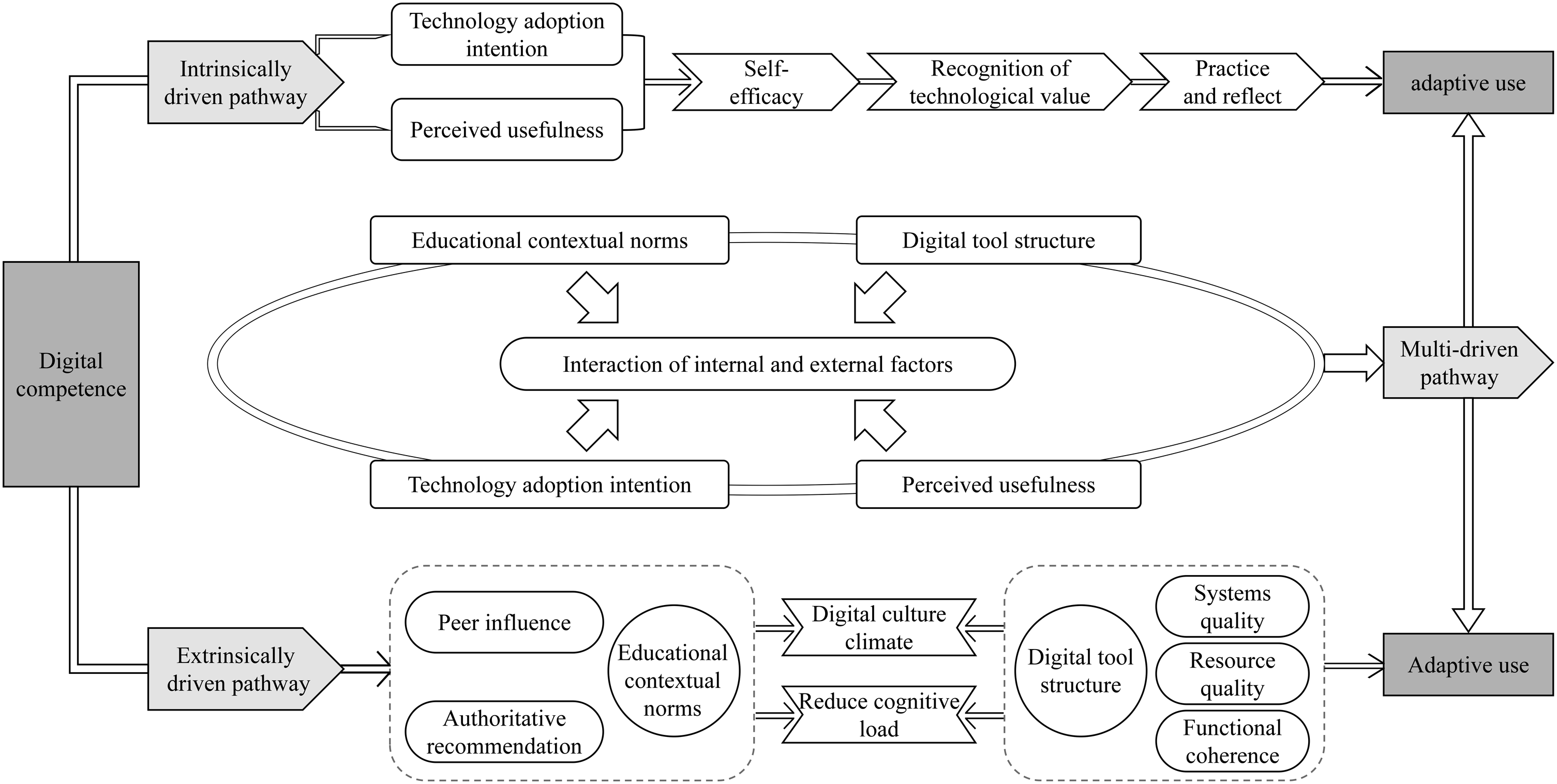
Intrinsically Driven Pathway: Competence Transformation Driven by Intrinsic Motivation
This study reveals a typical intrinsically driven pathway for the transformation of teachers’ digital competence into adaptive use. This pathway follows a mediation model of “digital competence -> technology adoption intention/perceived usefulness -> adaptive use” highlighting the central role of the intrinsic motivation system in the competence transformation process. Specifically, teachers’ digital competence stimulates their proactive willingness to explore new technologies while reinforcing their recognition of the pedagogical value of tools, thereby promoting innovative applications in the classroom.
This finding strongly aligns with conclusions from existing research. Studies by Chien et al. (2014) and Habibi et al. (2023) both indicate that teachers’ technological beliefs and usage intentions are better predictors of their classroom integration behaviors than technical knowledge alone. Meanwhile, Chiriacescu et al. (2023) confirm that perceived usefulness and enjoyment are crucial psychological mechanisms linking teacher competence to usage attitudes. Mumtaz (2000) also pointed out that teachers often need to confirm the practical utility of technology before genuinely integrating it into their teaching practice.
Based on the characteristics of this pathway, it is recommended that relevant departments and schools establish a professional development system centered on value recognition for teachers. Specifically, through case-based teaching, reflective practice, and workshops, efforts should focus on enhancing teachers’ self-efficacy, deepening their understanding of the educational value of technology, and providing ongoing practical opportunities in real classroom scenarios, thereby constructing a transformation chain from competence to practice. Student feedback and classroom observations should also serve as crucial positive feedback mechanisms, providing teachers with grounds for continuous improvement. As Durak (2021) noted, in teacher education aimed at effective technology integration, explicitly encouraging teachers’ own beliefs and focusing on developing their confidence in technology integration practices may prove beneficial.
Extrinsically Driven Pathway: Behavior Transformation Guided by External Support
The study also identifies a significant extrinsically driven pathway, revealing that teachers’ digital competence is effectively transformed into adaptive use through external factors such as educational contextual norms, digital tool structure, and organizational support. This pathway underscores the crucial role of the external environment in facilitating competence transformation.
The transformation of teachers’ digital competence into extended classroom practice and innovative application depends not only on individual intention but is significantly influenced by peer experience sharing and recommendations from administrators and educational authorities. When colleagues reduce uncertainty about tool usage through classroom demonstrations or experience sharing, teachers demonstrate greater propensity for imitation and experimentation. Similarly, when school administrators or authoritative bodies promote tools through training or policy documents, this top-down normative influence further reinforces teachers’ adoption intentions, thereby driving the transformation of digital competence toward adaptive use. Furthermore, school leadership support and organizational culture development prove equally critical within the externally driven pathway. Principals’ technological leadership can indirectly enhance teachers’ professional digital competence by cultivating a school-wide digital culture (Rasdiana et al., 2024). Organizational cultural environments—encompassing organizational atmosphere, institutional culture, leadership style, and human-machine relationships—also exert substantial influence on teachers’ behavioral patterns (Lv et al., 2022).
Consequently, schools and educational departments should enhance guidance mechanisms through peer demonstrations and authoritative recommendations while promoting observation exchanges and developing professional learning communities. Simultaneously, sustained institutional and training support should be provided to foster a stable, positive educational ecosystem, thereby facilitating teachers’ successful transition from digital competence mastery to educational practice innovation.
Multi-Driven Pathway: Multi-Layered Chain-Based Integration and Transformation
Transcending single-driver models, this study also identifies a more complex multi-driven pathway. This pathway exhibits typical chain reaction characteristics: digital competence first increases sensitivity to contextual norms, then enhances the perception of tool ease of use, subsequently strengthens perceived usefulness and adoption intention, and ultimately leads to deep adaptive use.
Existing research similarly substantiates this multi-factor driving mechanism. Teachers’ technology integration is influenced by four dimensions: school, students, teachers, and technology (Martin et al., 2025). Raygan and Moradkhani similarly found through empirical research that EFL teachers’ technology integration depends not only on their TPACK and attitudes but also on the indirect influence of school climate (Raygan & Moradkhani, 2022). School climate further promotes technology integration by affecting teacher attitudes. This indicates that internal and external factors at different levels often interact to jointly shape teachers’ technology use behaviors.
Based on the characteristics of the multi-driven pathway, it is recommended to establish an institutional and organizational collaborative framework. On one hand, an adaptive use-oriented teacher evaluation system should be developed, incorporating innovative applications of digital technology into assessment indicators. This system should include evaluation criteria covering the breadth of tool usage, depth of teaching integration, and dimensions of innovative practice, linked to professional promotion and performance reward mechanisms. On the other hand, regional digital education resource sharing platforms should be established to provide certified high-quality tool resources and serve as support hubs for teacher case exchange and professional development, thereby forming a virtuous cycle of evaluation, resources, and development.
Conclusions
This study systematically reveals the transformation mechanism of teachers’ digital competence into adaptive use by constructing a multiple-chain mediation model that includes educational contextual norms, digital tool structure, and perceived usefulness. The research identifies three typical transformation pathways: the intrinsically driven pathway highlights the core role of internal motivation, the extrinsically driven pathway emphasizes the crucial influence of the external environment, and the multi-driven pathway demonstrates the chain reaction characteristics of multiple elements. Empirical results indicate that teachers, influenced by peer and authoritative recommendations, are more inclined to adopt digital tools with well-designed structures and high-quality resources. This process enhances their recognition of the tools’ pedagogical value and the perceived usefulness of the technology, ultimately promoting exploration and innovation in teaching practice.
This study extends traditional technology acceptance models by demonstrating that educational contextual norms function as mediating variables activated through teachers’ digital competence. These findings suggest that effective digital transformation in schools requires developing comprehensive support systems-including tool recommendation mechanisms, professional learning communities, and institutional incentives-to create environments where technological integration can flourish. However, this study has several limitations that should be acknowledged. First, as the research sample was primarily drawn from China, the cross-cultural generalizability of the findings requires further verification. Second, the cross-sectional research design presents challenges in fully elucidating the dynamic causal relationships among variables. Additionally, the measurement of digital tool structure relied mainly on teachers’ subjective perceptions; future research could benefit from incorporating objective technical indicators to enable more comprehensive evaluation.
Footnotes

Funding
The authors disclosed receipt of the following financial support for the research, authorship, and/or publication of this article: This study was supported by the National Natural Science Foundation of China [grant number 62277020, 62307018], the Industry-University Cooperation and Collaborative Education Program of the Ministry of Education of China [grant number 241202377042256], and the Fundamental Research Funds for the Central Universities [grant number CCNU25JCPT024].
Declaration of Conflicting Interests
The authors declared no potential conflicts of interest with respect to the research, authorship, and/or publication of this article.
Data Availability Statement
Data will be made available on reasonable request.