



Abstract
The research examined school leaders’ opinions, attitudes, and performative actions toward teacher absenteeism. Existing research has primarily focused on interventions implemented by the Teachers’ Service Commission to curb teacher absenteeism, and yet since leaders are the main agents and their actions are context bound, their actual actions and insights should be accounted for when addressing absenteeism. Our study finds that though teacher absenteeism has been reduced, disheartening challenges persist. The authors recommend continuous monitoring and establishing a mentoring system.
Introduction
When teachers miss school, quality education is compromised. Teacher absenteeism (TA) may drain school resources, increase administrative time spent on replacing classroom instructors, and ultimately, result in management challenges. Moreover, the phenomenon has widespread consequences for students, schools, society, and teachers alike. This article concentrates on outlining school leaders’ attitudes, opinions, and actions toward TA in private and public primary and secondary schools in Nairobi, Kenya, and the surrounding counties of Kitui, Machakos, Muranga, and Kiambu. The broader aim of the study is to find appropriate interventions that, if implemented, can provide fodder for further studies and contribute to the body of successful interventions on how to mitigate absenteeism. In this article, a leader refers to any educational leader involved in school management, namely a head-teacher, principal, and school director. Based on recent reports, TA is a serious problem in low-income and middle-income countries, including Kenya (e.g., Bold et al., 2017; Guerrero et al., 2012; Lee et al., 2015; Muasya, 2016; Reinikka et al., 2018; The World Bank, 2018). The phenomenon is also present in developed countries (e.g., Griffith, 2017; Miller et al., 2007). TA is still an acute phenomenon in Kenyan schools, even though some attempts have been made to minimize it. The Kenya Teachers Service Commission (TSC) has made efforts at reducing it. In 2015, it released a series of monitoring and reporting procedures for schools to follow. The detrimental effect of TA on students, schools, and teachers suggests a need to understand the causes of low teacher attendance and to identify systemic solutions for mitigating it.
Much of the research on TA in Kenya has focused on what types of interventions the TSC and the Ministry of Education have and should put into place and on how well teachers have been implementing such measures, which include requesting a leave of absence from school, the monitoring of classes (TSC, 2015), community monitoring (Glewwe et al., 2010), and teacher accountability measures (UNESCO, 2017, p. 4). Principals and head-teachers are critical pillars in addressing TA, and they are the main implementation agents. It is therefore imperative to investigate their attitudes and approaches to TA in addition to the measures recommended by the TSC and Ministry of Education.
The main research question therefore is as follows:
The corresponding subquestions are thus:
What are school leaders’ opinions and attitude toward teachers’ absenteeism?
What means can leaders adopt to address TA?
How can leaders motivate teachers to remain in class and engage with students?
The approach we will use to answer the main research question is to present the definition of TA in the Kenyan context, and thereafter, explore school leaders’ attitudes and actions and the performative aspects of managing the problem. The performative aspects provide real insights into the situation on the ground when studied together with tangible interventions applied to resolve the issue.
Teacher Absenteeism
The issue of employee absence is difficult for organizations. The situation is more complex in education institutions. Some definitions of absenteeism proposed by scholars and that can be used here include the following: “any failure of an employee to report for or to remain at work as scheduled, regardless of the reason” (Cascio, 2010, p. 49; also see Bowers, 2001) and any “chronical absence of teacher from school” (Griffith, 2017). Moreover, Obeng-Denteh et al. (2011) have defined absenteeism as the persistent absence from work or some other place without a good reason. It can be culpable or nonculpable in nature, meaning that it can either be involuntary or voluntary. Voluntary absenteeism refers to factors that are under the control of an individual, while involuntary absenteeism refers to factors beyond the control of the individual (Gaziel, 2004; Ramsey et al., 2008). Hence, TA can be due to religious observances, personal necessity, maternity leave, union business, unpaid leave, health screening, a death in the family, short-term personal illness, attending professional conferences, or a court appearance.
Excessive absences affect school costs, since “additional fiscal resources must be expended to compensate needed substitutes,” but absenteeism “has other educational consequences as well” (Jacobson, 1989). National averages on TA in developing countries range from 3% to 27%, and absenteeism is more of a problem in poorer, more isolated schools, contributing to unequal educational opportunities (Guerrero et al., 2012). Research evidence indicates that TA translates into lower student achievement levels (Clotfelter et al., 2009; Muasya, 2016). Statistics show that primary school teachers were absent from school 27% of the time in Uganda, 25% of the time in India, 14% of the time in Ecuador, and 11% of the time in Peru (Chaudhury, 2006). A recent review of Kenya, Mozambique, Nigeria, Senegal, Togo, and the United Republic of Tanzania found that 44% of teachers were either absent or at school but not in class much of the time (Bold et al., 2017). It is also important to mention that teacher presence in schools does not necessarily translate into effective teaching. Chaudhury (2006) has provided an example from India where 75% of teachers were reported to be in school on a given day, but enumerators found that only half were actually teaching in a classroom. A study by Guerrero et al. (2012) on developing countries shows that direct interventions in which monitoring systems are coupled with rewards have a positive and statistically significant effect on teacher attendance, but no effect on student achievement. In addition, they found that indirect interventions which involve the community in students’ education and provide incentive schemes for students had a positive and significant effect on teacher attendance, but neither strategy had an effect on student achievement. Kremer et al. (2009) and Jiménez and Sawada (2014) similarly indicate that TA can be reduced through programs oriented to give students scholarships. Raegen et al. (2007) have observed that strong evidence of a causal relationship between teacher absence and student achievement may be misleading. According to them, providing financial incentives for good teacher attendance may yield better results in terms of students’ achievement scores in schools where the background rate of absence is extremely high (Raegen et al., 2007). Based on the aforementioned studies, three types of TA can be deduced: school absenteeism, classroom absenteeism, and absenteeism related to effective teaching. In this article, TA refers to all three types of absenteeism and takes a general perspective on the issue. Teachers ought to be good instructors and facilitators for learning, which clearly requires their presence in schools (McKinsey & Company, 2007; UNESCO 2017). After conducting a series of multicultural investigations, The World Bank (2018, p. 71) recently declared a learning crisis, and accordingly, a teaching crisis, which has a direct link to TA (see also Reinikka et al., 2018, p. 15).
Teacher Absenteeism in Kenya
The World Bank (Martin, 2013) has stated that the absence rate of teachers in Kenya is currently 16%. In addition, for every 100 public school teachers in Kenya, 55 were in class teaching, while 27 were at school but not teaching on any given day. TA in Kenya is one of the key problems that needs improving in the education sector (see also Lee et al., 2015; The World Bank, 2018, p. 15). Fundamentally, TA is not only a problem of teachers or school management but also a far-reaching phenomenon that may affect students’ insufficient learning outcomes (Guerrero et al., 2012; Muasya, 2016; Reinikka et al., 2018; The World Bank, 2018). Together with low competence and self-esteem among teachers, TA hinders students’ possibilities to obtain quality learning experiences. The TSC has tried many types of interventions to address the problem. In one intervention, it offered merit-based scholarships to the top-scoring 15% of sixth-grade girls in Kenyan primary schools (the Girls Scholarship Program). These scholarships consisted of grants (to schools) that covered school fees, grants to parents for school supplies, and recognition in an awards ceremony. After introducing the program, the average student test scores improved by 0.12 standard deviation points in the test schools, with spillover benefits for boys and for girls at the bottom end of the achievement distribution results (whose chances of winning the scholarships were small). Teacher attendance in the schools increased by 4.8 percentage points from a baseline attendance rate of 84%, which implies a 30% decrease in absenteeism. However, teacher behavior in the classroom did not change. In another separate intervention, teacher bonuses were linked to student performance. Teachers modified their behavior in ways that raised scores on the tests used to allocate the bonuses, but the experiment did not improve teacher attendance. Although students had higher test scores on the tests tied to teachers’ bonus incentives while the program was in effect, similar increases did not occur on tests not linked to the incentives, and a year after the program had ended the gains in student achievement on the tests linked to the bonus incentives had completely dissipated. A research by Muralidharan and Sundararaman (2008) indicate that in a similar situation, teachers performance bonus payments did not change student absence and it remained at 25%, even though it improved teachers’ preparation and in some case increased student learning and performance (Figlio & Winicki, 2002). As an alternative approach to improving teacher incentives, some experts then suggested making changes in the lines of authority so that teachers are subject to community monitoring and have local control over hiring, or else a system where schools must compete for students (Glewwe et al., 2010).
The TSC, which is the body that employs teachers in the country, issued new guidelines in 2015. The main issues for addressing absenteeism include requiring from teachers written permission to be absent from school and mandating that teachers can only attend conferences on weekends. The guidelines also require that the heads of primary schools obtain written permission for any absences from TSC subcounty directors, while all principals in secondary institutions must be granted the same by the TSC county directors (TSC, 2015).
Methodology and Data
The study used descriptive survey research together with explanatory information (see Cohen et al., 2007, pp. 205-206) to assess school leaders’ current attitudes and actions and the performative aspects of managing the problem of TA in Kenyan private and public schools. Descriptive studies such as the one by Cohen et al. (2007, p. 205) have looked at, for example, individuals, groups, institutions, and means to describe, compare, contrast, classify, analyze and interpret the entities and the events that create their various fields of inquiry. An open-ended approach combined with descriptive survey research provides insights into TA by focusing on school leaders’ opinions, attitudes, and actions toward TA, and thereafter, their suggestions for further actions and interventions.
The data set is both quantitative and qualitative. In the first round of data collection, we invited a purposive sample (Cohen et al., 2007; cf. Krippendorff, 2004) of school leaders to respond to the questionnaire. The sample was drawn from school leaders who had attended an Art of Leadership Program at a Kenyan university. The school leaders are experts in running the day-to-day affairs of the school, and their knowledge and opinions on the absence of teachers in the classroom and school provide important insights on the problem and how to manage it. Ninety (N = 90) leaders responded to the questionnaire. The number of respondents was determined by the saturation point. The information provided from leaders was aggregated to ensure anonymity. The questionnaires (soft and hard copies) were distributed in convenient ways to the leaders willing to participate. The questionnaire was semistructured with background information about the schools, teachers, and administrators. In addition, it included open-ended questions about the leaders’ opinions on TA and how they motivate teachers to remain engaged. The survey was completed with a group interview (e.g., Cohen et al., 2007, p. 373) of five voluntary school leaders; it consisted of in-depth, follow-up questions based on their responses from the questionnaire. The entire research protocol passed an ethical review.
Data Analysis
The open-ended questions sections were analyzed using qualitative thematic analysis with structural coding and categorizing (Cohen et al., 2007; Krippendorff, 2004). First, a search was conducted of different expressions and contradictions to obtain a general idea about the TA phenomenon based on leaders’ opinions, attitudes, and actions. Second, the expressions were categorized via a three-step process: (1) coding of subcategories (open coding), (2) coding of main categories (axial coding), and (3) coding of primary categories (selective coding; Cohen et al., 2007; Shapira-Lishchinsky, 2020). This structural coding system, originally developed by Glaser and Strauss (1967) and further expanded on by Strauss and Corbin (1994), allows for logical procedure with intention when deconstructing the data into manageable units to better understand the phenomenon in question (Cohen et al., 2007, p. 493). Some categories may overlap with other categories. Even though Glaser, Straus, and Corbin created the method to ground a new theory, the present project makes use of the system to analyze data on the issues that educational leaders in Kenya are most concerned with and address how such issues may result in further research actions taken by authors. The coding procedure (open, axial, and selective coding) provides a clear structural path for analysis. The system of coding and clustering is represented below and in Figure 1.
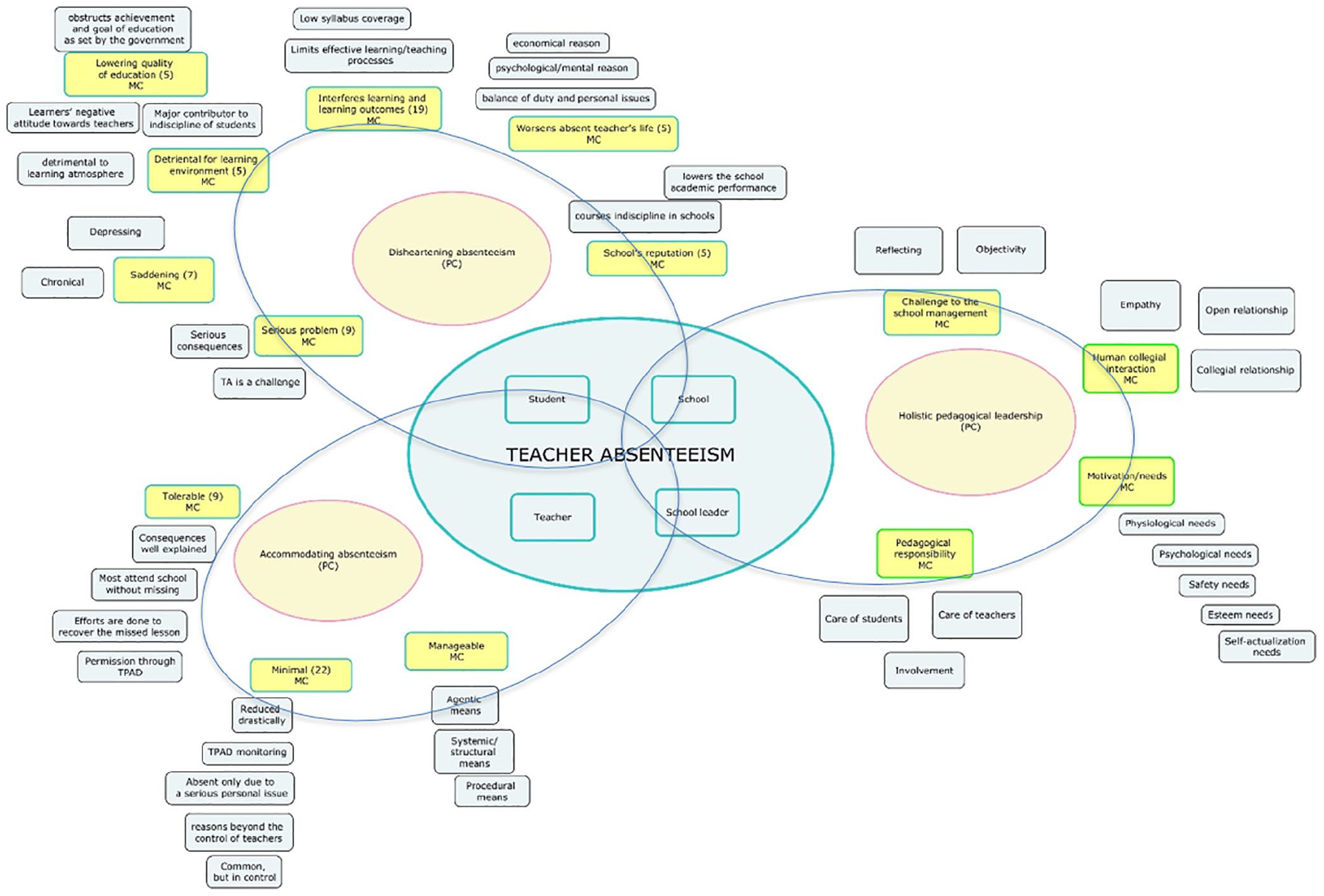
Multidimensional framework of teacher absenteeism.
Coding of Subcategories (SC)
This is a process of breaking down the data into separate units of meaning by the authors. For example, the subcategory “reduced drastically” emerged based on different phrases like “It [TA] has been reduced with the introduction of Teachers’ Performance Appraisal and Development (TPAD)” or it “can still be reduced if a mechanism for detecting genuine cases is introduced.” Another example, the subcategory “procedural/policy issues,” relates to policies and contractual agreements and the application of code of regulations, as demonstrated by the following comment from one leader: “It is critical to regulate leave of absence through proper organization.”
Coding of Main Categories (MC)
This process refers to instances when all subcategories are connected to a main category. For example, the main category “serious problem” is linked to the subcategories “a vice which needs to be minimized,” “serious consequences,” “should be avoided,” and “TA is a challenge.” Altogether, 13 main categories were identified.
Coding of Primary Categories (PC)
In this section, the number of categories were clustered together into larger, more comprehensive categories, called primary categories. As a result, three primary categories were identified that explain the opinions, attitudes, and management actions toward TA. The primary categories were as follows: “accommodating absenteeism,” “disheartening absenteeism,” and “holistic pedagogical leadership.” The findings section has been structured around descriptive data based on the participants’ background information and leaders’ opinions, attitudes, and actions regarding TA. Figure 1 illustrates the structure of the TA phenomenon. The frequency of cases is given in brackets, for example “mentoring and counselling teachers” (14).
Findings
Descriptive Statistics of Background Information
The total number of respondents was 90: 31 females and 57 males. Many of the respondents were principals (72) or head-teachers (13). Five individuals were school directors. Forty-one respondents had between 6 and 11 years of experience, while 11 had between 11 and 15 years of experience and 10 had more than 20 years of experience. The rest (22) had 5 years or less of experience. The school leaders mainly came from two counties, Muranga (47) and Kitui (35). These school leaders were mainly from mixed schools (65), but also from girls-only schools (13) and boys-only schools (11). The schools had an almost even number of day (43) and boarding sections (42). Most of the schools were public schools (74), followed by a lesser number of private schools (14). Most of the findings relate to secondary schools (71), but they apply also to primary schools (13). Few schools had both secondary and primary sections (4).
Accommodating Absenteeism
What Are School Leaders’ Opinions and Attitudes Toward TA?
The opinions of leaders on TA varied, with some giving possible causes and effects for it. The main opinions regarding TA were that it was minimal (MC; 22) and tolerable (MC; 9). For example, one leader mentioned that “it is minimal and allowed only when there is a genuine reason,” while another stated that “it is not common in my school; permission is granted, though the teacher is cognizant of its detrimental effect on the learner.” The main reasons that the leaders chose to make accommodations for TA was that it was deemed beyond the control of teachers (SC; 7), whereas some had successfully completed the Teachers’ TPAD tool (SC; 7), and therefore, could only be absent in serious cases. Some of their comments on the self-assessment and appraisal tool included as follows: “TA has been reduced with the introduction of TPAD, but can still be reduced [further] if a mechanism for detecting genuine cases is introduced,” and “it is rare due to TPAD monitoring.” Some of these leaders (2) felt that this could be affected by the presence or absence of teachers. However, one school leader noted that, “Almost 80% of teachers attend school without missing [work], and the few that are absent, do so when they see [that] the head-teacher or leader is absent.” The dominant findings here are that TA is minimal (MC) and has been reduced due to TPAD monitoring (SC).
What Means Can Leaders Adopt to Address TA?
The third main category addressing how school leaders make accommodations for absenteeism found that TA is Manageable (MC). This implies that schools and school leaders have created ways to deal with the problem. The solutions can be classified as follows: agentic issues (psychological support and motivation; SC), systemic/structural issues (SC), and procedural/policy issues (SC).
Agentic issues (SC; 47): We identified many agentic issues. The main aspects of the psychological support and motivation category included having approachable leaders (14), mentoring and counselling teachers (14), offering incentives to discourage teachers from missing school (4), sensitizing teachers to their duties (4), presenting leaders as role models (7), and encouraging teachers to participate in TPAD (2). Comments indicating such agentic issues include, for example, instances where an administrator pointed out that the role of leaders is “first and foremost [to be] role models to those with the problem of absenteeism,” while another said that “there is a need to guide and counsel teachers engaged in the vice of alcoholism and a need to support teachers facing family challenges” and still another that “a leader should talk to teachers and advise them on the dangers of absenteeism.” In general, the respondents reported that the most important agentic issue is that teachers be approachable.
Systemic issues (SC; 41) include discussions about leave of absence as agenda items (1), having a clear induction process (2), supervising and monitoring teachers through duty/lesson attendance registers (e.g., student registers), having a system to clock in and out (16), creating a good work environment (1), issuing warning letters (3), communicating a system for how to request a leave of absence (8), having a system for substitute and assistant teachers (3), and holding teachers accountable (2). Comments related to systemic issues included, for example, “there is a need to put in a mechanism to monitor attendance, such as a biometric system,” or “it is crucial to monitor teachers’ absenteeism and ensure that in cases of absenteeism, the lessons are covered.” In addition, one leader mentioned that there is a necessity to “use floating teachers or a number of assistant teachers to stand in.” Of the aforementioned systemic solutions, the dominant strategies used by educational leaders are a system for clocking in and clocking out and a clear-cut leave application system.
Procedural/policy issues (SC; 10) include formulating policies and contractual agreements (2) and applying a regulation code (8). In A comment illustrative of such policy issues, one leader mentioned that “it is critical to regulate leaves of absence through proper organization.” The dominant policy here is the code of regulation.
Overall, school leaders reported that the most effective system for minimizing TA is the TPAD monitoring system launched by the TSC in 2015, especially when combined with various agentic means to deal with the issue. The most dominant agentic feature was the presence of leaders in school, which implies that they are available whenever teachers need consultations. This can serve as a strong support mechanism for mentoring and counseling teachers about the effects of absence. Counselling is an effective means carried out especially by head-teachers. Positioned between teachers at the more general level and education leaders, head-teachers have an effective working relationship with both the board of management/TSC and teachers. The main systemic strategy used in schools is system for clocking in and clocking out, while leaders also strongly agreed on the need to create clear systems for leaves of absence. A good code of regulations is central to managing TA.
Based on the above findings, school leaders believe TA in the studied county schools is mainly under control. This tends to contradict the general understanding of TA presented earlier. Nevertheless, it is also important to present comments made by few teachers on the disheartening aspects of TA.
Disheartening Absenteeism
Some leaders described the situation of TA as either saddening (MC; 7) or a serious problem (MC; 9). The saddening or serious nature of the issue can be grouped into the broad primary category disheartening absenteeism (PC). Four leaders described the issue of TA as chronic (SC) in their schools, mainly stemming from alcoholism (2), illness, or stress or as a result of gross misconduct. Other reasons included lack of job satisfaction, apathy toward teaching, and burnout. As one leader illustrated, some teachers even desire missing class. A leader from a boarding school mentioned that there are many chronic cases especially on Mondays and Fridays.
According to the leaders, absenteeism has an adverse effect on many educational sections, not to mention the students, the school’s reputation, the school management, and the absent teachers themselves. The leaders do understand the reality of TA in schools, they know its serious consequences (SC), and they are well aware of how important it is to have teachers in school carrying out their daily school duties. In a word, they summarized the phenomenon of TA as a challenge (SC), or even more as “a vice, which needs to be minimized” or, in words of a principal, one that “should be avoided.”
In school environments, TA has the following effects on students: it interferes with learning and learning outcomes (MC; 19) and it is detrimental for learning environments (MC; 5). The effects of such a disheartening situation on students is that it limits effective teaching and learning time (SC); it also means the syllabus cannot be fully covered (SC). Many leaders in fact mentioned the inability to adequately cover the syllabus (8). Other negative effects include a decline in academic performance (7), the inability to acquire requisite knowledge within stipulated timelines (3), and students failing their exams (1). One leader who highlighted the effect on syllabus coverage had the following to say: “It adversely affects learners’ performance. It limits learner contact hours and leads to poor syllabus coverage.” Another leader said, “it is grounds for gross misconduct as it affects acquisition of knowledge within stipulated timelines.”
TA’s effects on the learning environment are detrimental (MC). School leaders commented as follows on the problem: “Learners form a negative attitude toward teachers,” “it is detrimental to [the] learning atmosphere,” and “indiscipline of students increases.” Another leader mentioned that “it will also make the learners lack responsibility in [the] future.” A school’s reputation (MC; 5) might also suffer due to TA. It lowers the quality of education (MC; 5) and may “hinder achievement and [the] goals of education as set by the government.” Just as a substantial number of absences hinders students’ learning, it also harms the absent teacher and worsens the absent teacher’s quality of life (MC): “A teacher can lose his or her job.” Some other leaders said in a succinct manner that “if no change is observed, the teacher should be asked to retire” or “denied pay.”
In summary, TA is detrimental to learning outcomes (interferes with learning outcomes, MC) and hinders the provision of a quality education to students (lowers the quality of education, MC). For all of the aforementioned reasons, TA is still a challenge for school management (MC), one which “needs to be addressed holistically.” The next section focuses on the aspect of pedagogical leadership (PC), the third primary category.
Holistic Pedagogical Leadership
How Can Leaders Motivate Teachers to Remain in Class and Engage Students?
The leaders identified the different motivational needs (MC) of teachers, which correlate strongly with the whole spectrum of Maslow’s (1943) hierarchy of needs. Even though the needs proposed by Maslow (1943) date back to the WWII period, some aspects proved relevant for this study, including physiological needs, psychological needs, safety needs, esteem needs, and self-actualization needs. The main needs identified as motivators for teachers were physiological needs (SC) and psychological needs (SC). Physiological needs include proper remuneration (28), fewer teaching lessons (2), and providing good meals, especially in the case of boarding schools (3). Comments supporting this observation included the following: “there is need to award teachers who are always in school” and “there is need to provide them with lunch and 4 pm tea.” The psychological needs identified were relevant feedback about the teaching process (2), providing counseling and staff-building activities (7), giving positive comments to teachers (1), and principals acting as good role models (8). Opinions demonstrating the necessity for addressing psychological needs included the following: “there is need to obtain feedback about the teaching process, the strengths and weaknesses of a teacher” and “there is need for a principal to empathize with a teacher, especially in cases where the issue of absenteeism could not be avoided.” Safety needs (SC) include hygiene factors (1), creating proper policies that clarify the procedure for seeking a leave of absence (8), creating a good working environment in schools (3), and having a succinct disciplinary process (1). Several views relating to safety needs were as follows: “there is need to make the school a good place of work” and there is a “need to prevent loopholes in the lengthy disciplinary process, where the administration has become a lawyer to have a water-tight case against a teacher.” Esteem needs (SC) include a need to celebrate teachers (2), writing recommendation letters for teachers (2) and instructing new teachers on a proper work-life balance (2). With respect to celebrating teachers, one leader mentioned that “there is need to celebrate teachers and treat them with decency.” Another suggestion was to “reward those who are always at school and recommend them for promotion.” The aspect of self-actualization (SC) includes the themes of autonomy (1) and a need for teachers to maintain self-discipline (2). One critical comment regarding the need for self-discipline emerged when a leader mentioned that “Teachers need to be encouraged to work without supervision.”
Human Collegial Interaction
Leaders are role models for teachers (8), whatever their attitude toward TA, and they ought to perform supervisory duties (5). Leaders are leaders, but they are still “colleagues with teachers, despite being in charge,” as one leader mentioned. Two other leaders said that “one should practice active listening and confront [someone] where necessary” and that “being human and leveling oneself as the manager of teachers makes them feel important, and they feel that they could do more. It is human nature.” These are examples of how to create and maintain a collegial relationship (SC). In addition to a collegial relationship (SC), empathy (SC), and an open relationship (SC) are essential to human collegial interaction (MC).
When inquiring about school leaders’ thoughts on the importance of empathy in addressing the issue of TA and whether they view using a Likert-type scale as very important, important, or not important, 45% (32/71) reported that empathy is very important, 44% (31/71) that it is important, and 11% (8/71) that it is not important. Leaders listed several positive aspects of empathy (SC): for example, it “invites teachers to be in school and positive” (2). Others mentioned that empathizing with teachers helps teachers better express the challenges facing them and voice their feelings (8). A principal emphasized that “a leader must be empathetic, but not sympathetic in all cases, especially in cases of sickness or bereavement.” Even though the leaders clearly feel that empathy is important, a proper balance needs to be struck between duty and personal issues (2). A leader should also lead by example (1).
Those leaders who responded that empathy is very important see it as fostering an open relationship (SC; 22). The following phrase highlights its importance: “empathy is a very important human element in maintaining open relationships, and a greater motivator than money.” Moreover, empathy makes teachers feel understood, valued, and important (18): “If a leader gives a listening ear, teachers open up and share what is driving them away” (4).
Even though many leaders reportedly have a positive view on empathy, some leaders noted that it is unimportant for them. They specified that “it may encourage absenteeism” and that “a leader should be careful that teachers do not take advantage of their situation.” More opinions on the negative effects of empathy are highlighted in phrases like “it will make a teacher not value the seriousness of the duty they have” or “it will consequently make learners lack future responsibility.” In addition, as another leader expressed it, “absenteeism is sometimes caused by laxity, and showing empathy will make the naughty behavior worse.”
Pedagogical Responsibility
Pedagogical responsibility (MC) refers to care of teachers and students (SC), their involvement and their welfare. “Children and teachers come first, before parents,” one leader emphasized. A leader should be sensitive to the needs of teachers and address them accordingly (1); the leader should provide them with “time to explain their absenteeism” (3). In relation to pedagogical leadership, leaders should nurture and motivate teachers as collegial leaders: “Teachers are leaders in their classrooms, and thus, should be treated as leaders in their own capacity, and management should ensure [that] all leaders grow together.” Another leader noted the following: “teamwork is a two-way affair, there is an expectation to work well in order to achieve results” and “that brings out a greater engagement in the teacher.” Pedagogical responsibility refers to care of students (SC) as well, for instance “when a teacher has students’ concerns at heart, absenteeism reduces[sic].” An important aspect of responsibility is caring about syllabus coverage when a teacher is absent. Solutions for syllabus coverage may include substitute teachers. Creating a good and motivating learning environment engages teachers in pedagogical responsibility, which is a crucial motivational incentive.
Challenge to School Management
Even though few leaders mentioned that TA presents a challenge to the school management (MC), “it needs to be addressed holistically” and “requires understanding by the parties involved.” These opinions indicate the need for objectivity (SC). A leader is in a decisive position in giving permission for a teacher’s absence and that requires objectivity. A principal indicated that “not all cases of teachers seeking permission deserve permission.” Another leader explained that “you can only condemn what you have seen; you cannot give direction if you have no direction, [meaning] a leader should give convincing reasons if permission is denied.” These phrases represent objectivity and emphasize the need for self-reflection by leaders, which relates to the subcategory of reflecting (SC).
Holistic pedagogical leadership is a broad primary category, one which consists of teachers’ motivational needs (MC), human collegial interaction (MC), pedagogical responsibility (MC), and school management (MC). The most dominant motivational need mentioned is proper remuneration for teachers, followed by the need to provide counseling and staff-building activities for teachers and create proper policies, which clarify the procedure for seeking a leave of absence. The school leaders noted that empathy is an important element in maintaining strong human collegial interactions, as it brings to light the challenges facing teachers. Empathy creates open relationships between a leader and teachers, and it makes teachers feel understood, valued, and important. Pedagogical responsibility refers to care of teachers and students’ pedagogical welfare. That implies that leaders have a responsibility to create a good teaching and learning environment and to engage teachers in school activities and teamwork. TA is a challenge for school management. However, many positive steps are being taken to minimize it. Leaders’ objectivity and reflectivity are good examples of profitable TA management.
Discussion
This article has examined school leaders’ current attitudes toward TA by inquiring about their opinions and thoughts on the problem and several recent interventions initiated by principals in a few counties in Kenya. The study employed thematic analysis to identify three primary categories that describe the current state of TA in the country: accommodating absenteeism, disheartening absenteeism, and holistic pedagogical leadership. By accommodating TA, a school and its leaders are acknowledging that TA is minimal, tolerable, and manageable. The results indicate that such schools have reduced TA, which contradicts earlier accounts by The World Bank (2018, p. 136), at least in the surveyed counties. Some level of progress has been made in reducing TA due to: (a) the establishment of the TPAD tool in 2015 by the TSC; (b) mentoring and guidance given by principals to teachers; and (c) school leaders empathizing with teachers’ situations and creating a sense of actual concern for a learner. Even though TA has thus been reduced to some extent, some disheartening challenges still exist for schools, challenges that need to be addressed holistically. Many studies already indicate that TA is detrimental to learning outcomes and hinders the distribution of quality education to students (Clotfelter et al., 2009; Muasya, 2016; Reinikka et al., 2018; The World Bank, 2018).
The primary task of every school is to contribute to student learning and student achievement. The presence of teachers in the classrooms is crucial. Pedagogical leadership, in its narrowest definition, holds that teachers and school leaders are accountable for school results, which leads to expectations that leaders will work to enhance student learning and improve learning outcomes (e.g., Ärlestig & Törnsen, 2014; Leithwood et al., 2006; Male & Palaiologou, 2017; Reinikka et al., 2018). Leadership is about direction and influence and about providing support to people to move in those directions (Leithwood et al., 2006). Being accountable for student learning and school results requires from leaders an active focus not only on the core processes of teaching and learning, but also on dynamic human collegial interaction and teachers’ motivational needs and well-being. In addition, the research indicates that investing in counseling and staff-building activities and providing proper remuneration and a good working and learning environment may improve the motivation of teachers to be engaged in school duties. Teachers are leaders in their classrooms, and they should feel valued and appreciated.
The authors recommend a continuous monitoring and evaluation of the TPAD tool, with involvement of stakeholders, and establishing a mentoring system of teachers within each school. School leaders need to understand teachers’ situations before they can implement the required solutions. In addressing TA, a leader should focus on two essential perspectives: (a) being accountable for student learning and school results, which requires an active focus on creating an inspiring teaching and learning environment and providing capacity building activities for teachers, and (b) improving teachers’ motivation to stay in school and in the classroom and engage in teaching. This requires human collegial interaction, setting clear directions together with teachers, expressing high expectations for teachers, encouraging them to meet such expectations, creating prerequisites for collaboration on teacher activities, and providing ways to be jointly accountable for achieving them. Even though school leaders are mainly positive and understanding about TA, few empirical works exist on how they can actually manage TA. Future research needs to focus on interventions and studies that would not only help leaders efficiently manage TA but would also increase teachers’ presence in the classroom and improve their competency.
Footnotes
Declaration of Conflicting Interests
The author(s) declared no potential conflicts of interest with respect to the research, authorship, and/or publication of this article.
Funding
The author(s) received no financial support for the research, authorship, and/or publication of this article.
