



Abstract
A well-considered pedagogical design can significantly enhance the implementation of playful learning in school settings. Teachers’ beliefs, attitudes, and instructional practices play a decisive role in the success of innovative pedagogical approaches. This study explores Chinese primary school teachers’ perspectives on the design and implementation of playful learning pedagogy in the context of English as a Foreign Language (EFL) learning. Eight teachers participated in a 1.5-month playful learning project that included workshops and a two-week classroom implementation period. In the workshops, the teachers were familiarised with the concept of playful learning and a preliminary Pedagogical Design Model. They then implemented playful learning pedagogy in their classrooms, involving a total of 320 students. Post-implementation interview data were collected and analysed using thematic analysis. The findings indicate that teachers perceived the pedagogical design of playful learning as a valuable yet somewhat ambiguous process, viewing it as an important tool for enhancing students’ EFL learning. Although the teachers provided generally positive feedback, they also expressed concerns about the systematic design of the playful learning process. The study provides valuable insights into the use of playful learning pedagogy in the Chinese primary school context.
Keywords
Introduction
A growing body of research highlights play and playfulness as an indispensable part of learning, underscoring its importance for developing skills like problem-solving, collaboration, creativity, and multiliteracy (Ollonen & Kangas, 2025; Yogman et al., 2018). Playful learning involves a range of playful activities grounded in play, playfulness, and physical engagement, characterised by children’s active participation, joyful and creative exploration, and interaction with the environment (Heljakka, 2024; Kangas, 2010; Mardell et al., 2023). Despite its potential in primary education (Hyvönen, 2011; Kangas, 2010; Qvortrup et al., 2022), there is still a limited amount of research on playful learning from the teacher’s perspective, particularly in the Chinese school context.
Playful learning and playful teaching have been defined as overlapping and complementary concepts, with playful learning referring to learners’ activities, and playful teaching referring to teachers’ activities. Playful learning can be defined as a set of playful characteristics that can be integrated into instructional design to enhance learning and collaboration, encouraging learners to be active participants and explorers in their learning process (Kangas et al., 2017; Tang & Vezzani, 2017). Playful teaching, or playful pedagogy, requires teachers to focus on playful pedagogical expertise, the quality of children’s play, and the affordances of playful environments (Siklander et al., 2025). According to Hyvonen (2011), playful teaching comprises some key elements: the teacher’s adaptive role; the intentional design of play processes across contexts; and the promotion of children’s creative agency. The design and implementation of playful learning require playful pedagogy. Playful learning, integrated with pedagogical design, is pivotal for children’s learning, development, and wellbeing, as it effectively engages them through multisensory, interactive, and hands-on experiences, providing a dynamic alternative to traditional lecturing (Kangas, 2010; Li et al., 2023; Magnusson & Pramling, 2018).
Teachers’ pedagogical thinking is key in using their practical and theoretical knowledge, performance, and reflective practices. Pedagogical knowledge integrates teachers’ actions and thinking, including ethical and moral considerations. Pedagogical thinking guides teachers in deliberately implementing curricula goals (Kansanen, 1995). Previous research has highlighted diverse approaches to implementing playful pedagogy in schools. For example, teachers have adapted games and play-based activities in curriculum-aligned learning environments (Bourgonjon & Hanghøj, 2011; Mardell et al., 2023).
Educational practices are inherently contextual and shaped by national and local curricula. While playful learning is a key pedagogical approach in early childhood education in many countries, it can also be a relevant method in primary education, as exemplified in Finland (Finnish National Board of Education, 2014). Contrary to historical perceptions of play as antithetical to learning, playful learning has recently gained traction in China, with parents and educators increasingly valuing its role in fostering active engagement and joyful learning experiences (Li et al., 2023; Under China’s 2022 education reforms, schools are required to cap teaching hours, reduce homework, and limit daily tests, while adopting experience-focused curricula such as game-like engagement, collaborative exploration, and authentic experience instead of traditional discipline-based approaches (Hernández-Romero & Sun, 2021). Chinese education, grounded in Confucian philosophy, promotes a pedagogical model that emphasises personalised, practice-integrated learning rather than mere knowledge acquisition (Niu et al., 2024).
Playful activities have more recently been studied and integrated with learning in the context of language teaching (e.g. Heidari-Shahreza, 2024; Mao et al., 2022), The playful pedagogical approach is particularly relevant in the context of the Chinese EFL classroom, which represents a departure from traditional methodologies towards more interactive and engaging educational practices (Qu & Policarpio, 2025). The Compulsory Education English Curriculum Standards (2022 Edition) recommends English instruction starting from Primary Three, though urban schools typically start in Primary One. Despite its official status as a core subject, English receives fewer teaching hours than Chinese and math in primary schools, creating a contradictory situation in which equal exam weighting contrasts with its marginalised classroom presence (Qi, 2016). EFL teaching prioritises communicative competence and interactive learning, requiring teachers to navigate challenges such as integrating traditional and innovative teaching methods while addressing diverse student needs (Namanyane & Shaoan, 2025).
Previous research has indicated that inconsistencies in the definitions of play and differing perspectives on the purpose of play in educational settings make it challenging for teachers to determine how to meaningfully integrate playful pedagogy in classrooms (Mao et al., 2022; Pyle & Bigelow, 2015). For example, teachers’ understanding of the significance and role of play, as well as their pedagogical knowledge of how to promote learning through play, can be inadequate (Bubikova-Moan et al., 2019). Teachers’ perceptions regarding the purpose of play and structural obstacles hinder its implementation (Pyle & Bigelow, 2015). Teachers’ own playfulness in creating and implementing playful learning pedagogy has been recognised as a critical aspect of their pedagogical expertise (Hurme et al., 2023; Siklander et al., 2025). Together, these findings reveal that teachers’ pedagogical activities, roles, engagement in pedagogy, and scaffolding practices are of great importance in implementing playful approaches to teaching (Kangas et al., 2017; Hyvonen, 2008; Ollonen & Kangas, 2025). Teachers’ perspectives on a playful approach are therefore crucial, as their beliefs, attitudes, and classroom practices significantly influence the effectiveness of instructional strategies (Qu & Policarpio, 2025).
Meanwhile, the practical classroom implementation of playful learning pedagogy often lacks effective empirical studies. In China, playful learning in primary schools is often approached more as a conceptual or philosophical idea than through practical implementation (Chen et al., 2022). The effectiveness of playful learning is shaped by stakeholder (e.g. students, teachers, parents) involvement, environmental resources (both online and offline), and cultural context –with culture being the most influential factor, as it encompasses educational concepts, motivations, preferences, and policymaking through traditions, language, and social structures (Li et al., 2023). The definitions, implementation methods, and challenges associated with integrating playful learning into classrooms can vary considerably (Johnstone, 2022). Enthusiasm for playful teaching often clashes with the difficulty of its integration into traditional academic objectives. This gap underscores the need for professional development and strategies that balance playful approaches with measurable learning outcomes (Qu & Policarpio, 2025).
Playful learning requires teachers to use guidance and various scaffolding strategies (Ollonen & Kangas, 2025). Teachers need to know how to design educational and meaningful play but also how to guide learners in the process. Dubbels (2016) emphasises that play requires proficient instructional communication, which includes a positive teacher attitude, a focus on the process, and flexibility in assessment and content. Teachers play a central role in planning activities, facilitating and guiding students’ learning, sparking intellectual curiosity, and assessing learning progress (Kangas et al., 2017; Li & Kangas, 2024).
A pedagogical design model, used in instructional design, provides a conceptual tool for visualising and determining the creation of a playful learning process by aligning the creative process with an ideal design scenario. It also provides an efficient framework for instructional design research (Branch & Kopcha, 2014). Carefully predetermined learning goals and activities are crucial when designing playful learning processes, as pedagogical design provides the blueprint for instructional activities that aim to motivate and promote students’ learning (Kangas, 2010). Golinkoff et al. (2006) suggest that the purposes and conditions under which play is an optimal pedagogical strategy should be discerned. For example, in their research, Zhang et al. (2010) combine learning activities, tangible object manipulation, and physical activity to engage students in playful learning. Rapeepisarn et al. (2006) and Heljakka (2024) propose the adaptation of traditional games, toys, and digital tools in supporting playful learning. Mao et al. (2022) state that play activities can be classified in three categories: playful activities facilitated by realia; competitive play; and roleplay. In conclusion, pedagogical design involves an iterative approach to planning, selecting strategies and activities, incorporating technologies or media, and assessing learning outcomes, with a focus on clearly defined learning objectives and effective playful activities.
This research develops a pedagogical model, Pedagogical Design Model for Playful Learning (see Figure 1) to visualise and guide the playful learning process, serving as an efficient framework for instructional design research (see also Branch & Kopcha, 2014). In the model, four distinct phases of playful pedagogical activities in primary education are identified: planning; orientation; playing; and elaboration (Kangas, 2010; Li & Kangas, 2024). Teachers play an important role in planning activities, facilitating and supervising students’ learning, sparking their intellectual curiosity, and assessing their progress. However, designing and implementing playful learning pedagogy in the classroom is not necessarily easy for teachers, especially when they have not reflected on the meaning and role of play in learning (e.g. Kangas et al., 2017), and when it represents a new approach in the education system. A Pedagogical design model for playful learning (applied from Li & Kangas, 2024; Kangas, 2010)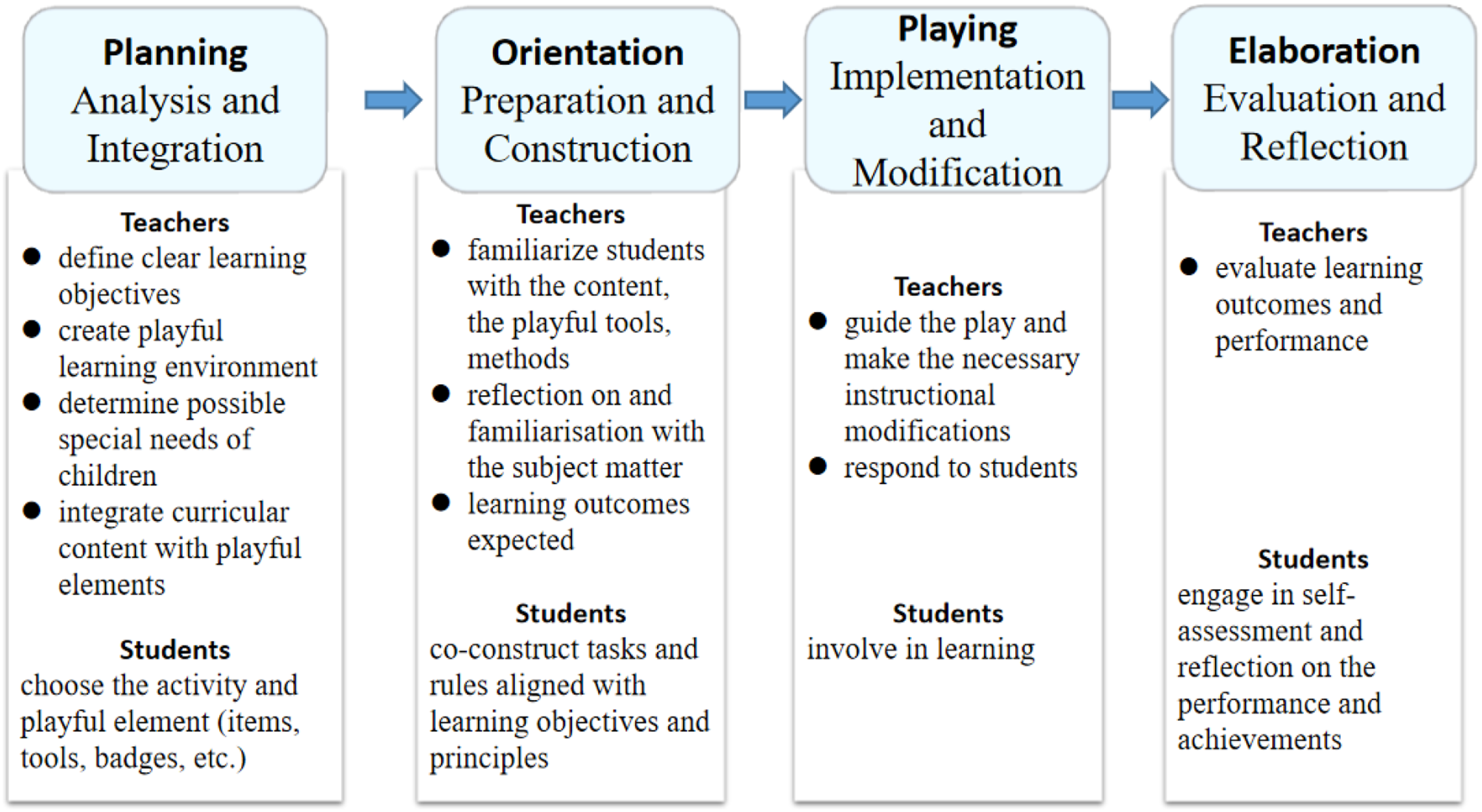
Given that children are key agents in classroom play contexts, the model incorporates students’ active involvement throughout the process. When working with young children, teachers should strive to understand their developmental and conceptual starting points before engaging in design activities (Borum et al., 2015). The introduction of a playful frame in the classroom, with students’ shift from learners to players, redefines the learning situation and provides them with new modes of interaction (Cruaud, 2018). McInnes et al. (2013) argue that traditional views of play, based on adults perceptions of observable behaviour, differ from children’s own perceptions of play. In playful learning, students are active participants, players, and content creators (Kangas et al., 2017). The pedagogical design therefore also emphasises children’s agency.
The planning stage is crucial for implementing playful learning in curriculum-based learning, for which it aims to create a pedagogical framework. Teachers need to define clear learning objectives, create a learning environment that allows playful exploration, identify any special needs of children (cf. Ilgaz et al., 2018), and analyse how to integrate curricular content with playful elements (Kangas, 2010). To promote children’s active participation and agency, teachers give students autonomy to choose play activities and components such as topics, stories, tools, and badges. The orientation stage involves preparation and knowledge construction. It aims to share learning goals and create an initial knowledge base (Li & Kangas, 2024). Teachers introduce the learning topic and provide the background information needed for upcoming play activities. With the teacher’s guidance, students co-construct tasks and rules aligned with the learning objectives and pedagogical principles.
The playing stage primarily involves implementation and ongoing modification. It serves as a guiding and scaffolding stage (Li & Kangas, 2024). During this stage, teachers support and scaffold students’ learning and have the flexibility to make instructional modifications as students engage in various playful learning activities. Teachers also respond to students’ questions and ask follow-up questions (Ollonen & Kangas, 2025). They should be prepared to modify learning tasks when necessary – for example, by simplifying tasks that students find too challenging. Elaboration focuses on evaluation and reflection. Both teachers and students engage in individual and collaborative reflection on and assessment of the learning process. Cojocariu and Boghian (2014) note that one of the key challenges in implementing playful learning in classrooms lies in evaluation. Teachers may struggle to accurately assess students’ learning outcomes through play, while without proper evaluation, students may follow diverse paths and reach non-standard pieces of information. A procedure for evaluation and reflection should therefore be incorporated into the design model to enable teachers to assess students’ learning outcomes and performance.
Building on Mao et al.’s (2022) empirical research on play in Chinese education, which highlights two key themes, teachers’ perceptions of play and their teaching practices, this study has a dual focus. First, it examines teachers’ perceptions and considerations of playful learning pedagogy after participating in a 1.5-month project, during which they were familiarised with and implemented playful learning pedagogy in their classrooms. Second, the study employed a Pedagogical Design Model for playful learning as an elicitation tool for identifying the planning, orientation, playing, and elaboration phases of playful learning in the implementations and exploring teachers’ perspectives on the model. Based on the theoretical framework, the research question is as follows: How do Chinese teachers perceive the design and implementation of playful learning pedagogy in English as Foreign Language Learning?
Methodology
Participants and Research Context
The empirical research was implemented in the context of Grade 3–4 English teaching at a suburban primary school in Beijing. As a suburb of Beijing, its education level lags significantly behind the city’s core districts, with relatively underdeveloped educational resources. At this school, English instruction begins in Grade 1 with two classes per week. The Compulsory Education English Curriculum Standards (2022 Edition) defines three proficiency levels, with Level 1 corresponding to Grades 3–4. During this foundational stage, teachers are expected to design multisensory cognitively appropriate activities that promote engagement through thematic exploration, aiming to facilitate meaningful language acquisition while fostering enjoyment of English learning.
The Participant Teachers
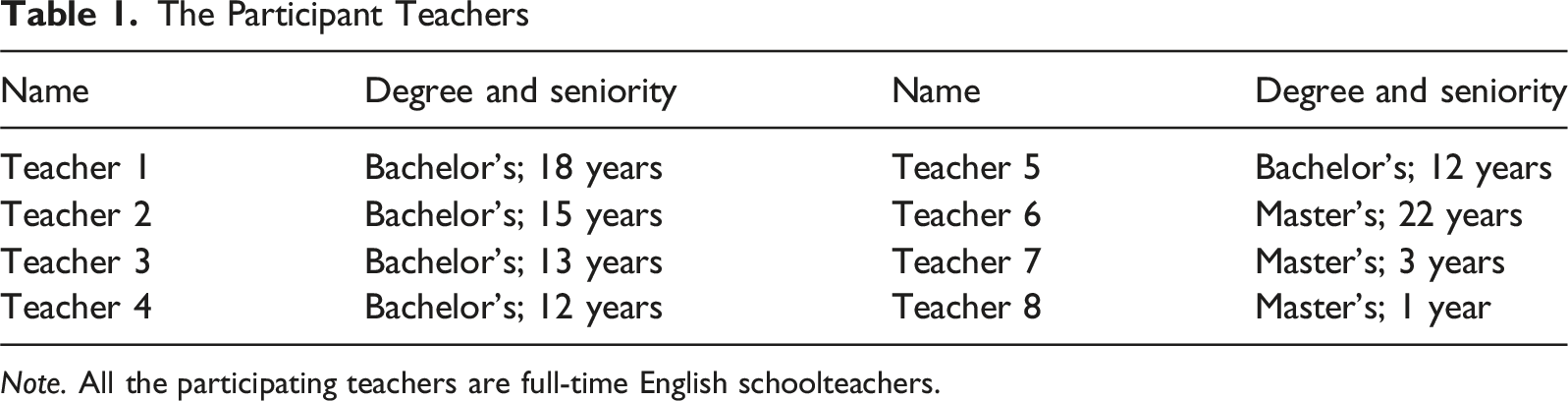
Note. All the participating teachers are full-time English schoolteachers.
Five teachers held a bachelor’s degree in English teaching; three held a master’s degree. Six of the eight teachers were considered experienced teachers, with more than ten years of teaching experience, while two were early-career teachers with a maximum of three years of teaching experience. In China, teachers have a grade-based lesson preparation system to ensure that teachers in the same grade teach similar content and at a similar pace. This means that students in the same grade receive the same level of English knowledge. All eight teachers gave their informed consent to participate in the study. The study followed the ethical guidelines for scientific research set by the Finnish National Board on Research Integrity (https://www.tenk.fi), complied with the Data Protection Act, and respected the principles outlined in the Convention. All the participants’ anonymity and privacy were respected in all the research phases.
The project comprised a workshop and weekly online and in-person meetings during which the teachers were provided an opportunity to learn about and discuss playful learning. The teachers were motivated in learning about playful learning pedagogy and to implement it in their own English-language classrooms. The teachers were also familiarised with the Pedagogical Design Model for playful learning, which they implemented in their classrooms over a two-week period, involving a total of 320 students from grades 3–4 (aged 9–10). The workshop focused on the application of playful learning pedagogy in primary school English classrooms. During the first month of the theoretical study period, the teachers participated in weekly online sessions that included literature reviews of playful learning, discussions of practical challenges encountered in teaching, and the formulation of implementation plans, which subsequently aimed to lead to the development of a model for playful pedagogy. In the following two weeks, the teachers implemented the playful learning approach in their English classrooms. Each teacher conducted four 45-min lessons, resulting in a total of 32 lessons. During this period, the teachers observed one another’s classes and participated in lesson evaluation sessions, where they exchanged views and suggestions regarding classroom-based playful pedagogy. After the implementations, post-implementation interviews were conducted to evaluate the outcomes.
Data Collection
Post-implementation semi-structured interviews were chosen for their versatility and flexibility, allowing both individual and group interview formats and enabling researchers to access participants’ inner world to gain a deeper understanding of their perspectives (Kallio et al., 2016; Patton, 1987). The interview began with a clearly defined purpose that was grounded in the study’s problem statement. The interviews involved active listening and probing, using both guiding questions and participant responses. The interviews’ structure was adjusted based on the study purpose and research questions (deMarrais & Lapan, 2003).
The framework presented by Kallio et al. (2016) provided a practice-based tool to support rigorous data collection and enhance the study’s trustworthiness. A five-phase framework guided the development of a semi-structured interview: (1) Identifying prerequisites: In this stage, the teachers identified and defined the prerequisites necessary for conducting the interviews, including an assessment of the model. (2) Retrieving and applying prior knowledge: The researcher retrieved and applied relevant theoretical and empirical knowledge to inform the interview structure and content. For example, Johnstone (2022) conducted interviews that addressed the benefits, characteristics, challenges, and supports related to implementing playful learning for primary students. (3) Formulating the interview guide: The main themes and follow-up questions were carefully crafted to elicit detailed and nuanced responses. (4) Pilot testing to refine the interview guide: In this stage, two teachers were invited to participate in pilot testing to ensure its clarity, relevance, and practical feasibility. (5) Finally, the completed guide was presented in a user-friendly format and was ready for use in the actual interview process.
The data consisted of eight teacher interviews, five conducted in person and three online. Each interview lasted approximately 20 minutes. Guided by a semi-structured interview protocol, the questions explored teachers’ interpretations of playful learning pedagogy and the pedagogical design model, focusing on their perceptions, perceived barriers and challenges, and reflective insights. Example questions included: What do you think of integrating playful learning into teaching? and Which parts of the model do you think need improvement? All the interviews were transcribed, resulting in a total of 16 pages of written text (formatted using 12-point font and 1.5 line spacing).
Data Analysis
An Example of Data Analysis Process

Note. The data analysis followed a six-step analysis (Braun & Clarke, 2006). Based on questions about perception, implementation, and considerations of pedagogy, two specific themes were identified.
Based on questions about the perception, implementation, and considerations of the pedagogy and design model, two key themes were identified: the additional values and considerable challenges of playful learning pedagogy; and the need for a systematically designed playful learning process. The analysis involved cycles of posing questions and identifying relevant descriptions and ideas, using extracted quotations as units of analysis.
Results
In relation to the research question about teachers’ perception of playful learning and pedagogy, the findings indicated that teachers recognised both the values and challenges of playful learning pedagogy. In addition, a systematically designed playful learning process was perceived as necessary and essential.
Additional Values and Considerable Challenges of Playful Learning Pedagogy
All the teachers acknowledged the value of playful learning pedagogy, emphasising that playful learning was not just play for entertainment. Instead, it was viewed as an effective approach to learning and enhancing students’ motivation. The goal of playful learning activities was to spark students’ interest in learning, involving the mastery and practice of knowledge. According to the teachers, the acquisition and practical application of knowledge constituted the core purpose of playful learning. They agreed that playful learning activities could increase students’ interest, boost their enthusiasm, and deepen their understanding of the learning content. According to the teachers, introducing playful learning pedagogy to the classroom could reduce students’ frustration and enhance their self-regulation in learning. At the same time, the teachers reported that student engagement and a positive learning atmosphere emerged naturally within the classroom. The following quotations highlight the teachers’ perceptions of the value of playful learning. My students know that learning through play is fun and helps them increase their interest in learning. They think it helps them learn better in a playful way that is quite creative and different from their normal class. [Teacher 8] As an experienced teacher, I can feel how students are engaged in playful activities in the classroom. Playful learning should happen naturally. The students and teachers all enjoy play and learning. [Teacher 1]
In the first quotation, the teacher stated that students perceived playful learning as an important motivator and a source of joy in learning. The second quotation highlights the teacher’s recognition of the connection between playful learning and student engagement. The enjoyment of learning is also emphasised in the quotation, and play is understood as a valuable form of learning.
However, the teachers were ambivalent about playful learning and saw some challenges in its implementation in the classroom. I’m wondering how often we can have playful learning in classroom teaching. Can it be normal teaching? [Teacher 3] This teaching mode is new and interesting, but I am a little worried about failing to finish the teaching task. [Teacher 2]
Teacher 3 actively addressed her views on the implementation of the pedagogy, including the frequency of incorporating playful learning and the use of various forms of playful activities. She felt that time management and the selection of playful activities were critical. There was a concern that if play became too dominant, the activities might lose their appeal for the children. This can be interpreted as a challenge in creating space for playful learning as part of curriculum-based learning. Teacher 2 was concerned that if the play was not aligned with the teaching objectives, it might hinder the overall learning process.
The teachers also emphasised that students’ knowledge levels and attitudes towards playful learning should be considered. They expressed concerns about the suitability of the teaching materials and their understanding of students’ progress. They believed that the students’ level of knowledge directly affected the effectiveness of play as an educational tool. In China, a primary school class typically consists of nearly 40 students. What kind of knowledge is suitable for playful learning? Is it necessary to use playful learning to study in every class? This is a question worth thinking about in future teaching. [Teacher 7] Play is very popular among the young generation. If it can be integrated well into the classroom, I think it can shorten the distance between teachers and students. [Teacher 6] I think my students need to undergo more playful learning training and know more about playful learning, which will be helpful for their independent learning in the future. [Teacher 5] The imbalanced ability of students and the large class capacity make it very difficult to carry out play activities. [Teacher 3]
Several other views were expressed. Teacher 7 raised critical questions about the scope and necessity of playful learning. In contrast, Teacher 6 emphasised its role in fostering teacher–student connections through student-centred engagement. Teacher 5 emphasised the importance of further professional development in playful learning pedagogy to enhance students’ self-directed learning capacities, whereas Teacher 3 highlighted structural barriers such as ability disparities and overcrowded classrooms as key obstacles to effective implementation.
Need for a Systematically Designed Playful Learning Process
All the teachers shared positive experiences of incorporating the Pedagogical Design Model for playful learning in their classrooms. They pointed out that teachers’ design skills and professional instructional strategies were critical for successful implementation. I think many teachers are unfamiliar with playful learning. They need more guidance on how to implement it in classroom teaching. [Teacher 4] I think we should have a deeper discussion in the workshop about the pedagogical model, which can be a useful scaffold to support classroom teaching. [Teacher 7]
Although most were experienced teachers, they were motivated to explore this pedagogy and required guidance to implement it effectively in their classrooms. Teachers 4 and 7 both advocated a systematically designed process of playful learning and the development of additional pedagogical models to deliberately incorporate playful learning strategies in the classroom.
Based on their playful learning implementations, they made suggestions for refining the model, emphasising that creating rules was a key step in the orientation phase of the playful learning process. We should help students build a solid foundation for playful learning and provide proper guidance in the orientation stage. [Teacher 4] The classroom becomes chaotic without clear rules. Frankly speaking, some students are a little distracted in game learning, and they pay more attention to how the game is played instead of what they are actually learning. [Teacher 5]
Teacher 5 also emphasised the importance of establishing clear rules that encompassed various aspects such as discipline, competition, and appropriate classroom behaviour during play. Within pedagogical design, questions of how to behave, cooperate, and co-create knowledge are considered as essential as determining the focus of learning, defining learning objectives, and selecting appropriate tools (see Kangas et al., 2017; Li & Kangas, 2024). Teacher 4 further highlighted the significance of providing appropriate guidance throughout the process to promote students’ playful learning.
The interview data also highlighted additional dimensions for systematically designing playful learning in education. These included clearly defined learning goals aligned with knowledge acquisition and strategically designed activities involving intentional student grouping, optimised game frequency, and the use of diverse formats. The teachers also emphasised the importance of multimodal engagement, integrating physical activities with traditional, digital, pop-cultural, and social games. An enjoyable learning climate, supported by low-pressure fair evaluation systems combining tangible rewards, teacher feedback, and peer-based democratic assessments (e.g. voting), was also seen as critical. All the carefully selected quotations illustrate that playful learning was regarded as a promising pedagogical approach with significant potential to enhance educational experiences. However, it required systematically designed playful pedagogy to be effectively implemented.
Discussion
Previous studies emphasise the role of the teacher and the importance of pedagogical design in playful pedagogy (e.g. Kangas et al., 2017; Hyvonen, 2008; Li & Kangas, 2024; Ollonen & Kangas, 2025; Wu, 2019). Playful teachers are cognitively, socially, and physically spontaneous in making decisions and constructing situations in which they can perform or interact playfully or use children’s interaction as a source of playfulness. They integrate playfulness and play with pedagogical decisions. Mao et al. (2022) emphasised that teachers actively participate in playful learning as guides, supervisors, teammates, or onlookers. When considering play in the school context, teachers can adopt various roles such as leaders, allowers, and afforders (Hyvonen, 2011) and draw on their own playfulness in implementing playful learning pedagogy (Hurme et al., 2023). However, teachers need playful pedagogical competencies and strategies for designing and implementing playful learning.
The study also sheds light on students’ involvement in developing playful learning practices in primary education. Essentially, pedagogical design is a systematic process, and integrating playful learning within this framework is a continuous effort that relies on the ongoing development and exploration of educational practices. As key educational stakeholders in classroom learning, students’ views of playful learning should be understood. When working with younger children, it is important to understand their perspectives and conceptual frameworks before engaging in design activities (Borum et al., 2015). Teachers and children build playfulness in interaction and relationships with other people, animals, environments, and situations (Hyvonen, 2008). As a core dimension of children’s physical, mental, emotional, and social development (e.g. Rapeepisarn et al., 2006; Yogman et al., 2018), playfulness challenges traditional ways of teaching and learning.
Although the use of actual play in education has shown several encouraging results and attracted many enthusiasts, it also presents challenges in terms of time, cost, and pedagogy (Pavlou, 2020). Play may threaten the teacher’s control, disrupt lesson plans, challenge established and shared values, and raise concerns about potential risks (Leather et al., 2021). It is noted that it is important to consider many factors: the element of fun; interactivity; interest; class size; students’ proficiency level; cultural context; timing; the learning topic; and classroom settings (Masri & Najar, 2014).
Meanwhile, it is noteworthy that play and playfulness possess multifaceted and evolving meanings across diverse contexts and cultures. Institutional and environmental factors such as resource availability, classroom design, administrative backing, and parent opinions heavily influence whether playful pedagogy is adopted (Qu & Policarpio, 2025). Mao et al. (2022) explore Chinese teachers’ understanding of and concerns about the use of play in supporting young children’s English learning. They emphasise that playful learning is teacher-designed and teacher-directed, requiring careful pedagogical design. Although Chinese teachers are critical to fostering young learners’ English acquisition through their self-efficacy, pedagogical beliefs, and classroom environment, a persistent gap remains between their understanding of effective teaching methods and their confidence in implementing them (Song et al., 2025). Effective implementation of play in Chinese classrooms requires a careful consideration of the country’s unique educational context.
Limitations and Future Research, Ethical Considerations, and Implications
It should be acknowledged that this empirical study has some limitations. The study’s findings are limited by its data’s geographical scope, as they are primarily sourced from suburban teachers and students. The development of education in China is uneven across different regions, with significant disparities between urban centres, suburbs, and remote areas. Given China’s significant urban–rural disparities in education resources, pedagogical practices, and socioeconomic contexts, future research should prioritise multiregional data collection. Furthermore, the sample size of eight teachers and the two-week implementation period contribute to the limited quantity of data. Mao et al. (2022) highlight that a significant gap remains in understanding the interplay between playful learning and the curriculum, particularly regarding how structured play can be effectively supported in EFL contexts. Future studies should therefore aim to address this gap by conducting teaching experiments with larger and more diverse samples, representing a wider range of primary school classrooms.
Another limitation concerns the reliance on self-reported data. Researcher triangulation was applied in the analysis of the data using consistent frameworks, and the researchers endeavoured to discuss and interpret the findings as objectively as possible. However, self-reported data always have limitations. Yet the one-month familiarisation period with playful learning prior to implementation may have enabled more reliable data collection, as it allowed the teachers to acquaint themselves with playful learning and the Pedagogical Design Model and discuss related issues with the researcher. This process may have reduced potential misunderstandings concerning pedagogy. To enhance the findings’ objectivity and reliability, future studies could integrate quantitative methods, expand the sample size, and employ multisource data collection (e.g. student performance, classroom observations) to provide a more comprehensive and balanced perspective. Building on the current findings, it would be useful to further refine and empirically test the Pedagogical Design Model for playful learning beyond EFL contexts in diverse educational settings in future research.
Conclusion
The study indicated that the interviewed Chinese teachers generally viewed playful learning pedagogical design positively. It also provided valuable insights into how to better implement pedagogical activities aligned with playful learning in EFL classroom settings. The findings support the need for the further development of the Pedagogical Design Model for playful learning to provide a tool and a practical framework for integrating playful learning into formal education. Based on the findings, the Pedagogical Design Model could be further developed by incorporating the following insights. In the planning process, it is vital to set learning objectives carefully and to define rules in collaboration. For the successful implementation of playful learning, it is important to consider factors such as students’ development and knowledge levels and their attitudes towards playful learning, and teachers’ pedagogical understanding of playful learning. Teachers’ knowledge and understanding of digital and game-based possibilities, alongside the availability of technological equipment, can shape their approaches, expectations, and concerns regarding the integration of playful activities into teaching.
During the orientation phase, it is imperative to determine learning objectives while considering students’ development and knowledge levels and their dispositions towards playful learning. Teachers’ scaffolding strategies to motivate students is also important, including connecting new information with prior experiences, fostering exploration, asking relevant questions, encouraging, listening, and supporting the creation of social interaction (Ollonen & Kangas, 2025). Based on the findings, it can be seen that Chinese teachers believe the disparities in students’ abilities and large class sizes require particular attention during the orientation phase to ensure that all students can engage in play activities at their skill levels, and that they have equal opportunities for participation and learning.
In the playing stage, it is imperative to prioritise student engagement and cultivate a favourable learning environment. Teachers play a crucial role in establishing an emotionally safe and communal learning space for children (Hyvonen, 2008; Melasalmi et al., 2023). However, in large classes, managing time effectively during the play process can be challenging for teachers. Moreover, when digital games are used, this can become a particular challenge because such environments are often designed to sustain learners’ engagement and immersion (see Nguyen-Viet & Nguyen-Viet, 2025).
During the elaboration process, it is crucial to assess learning outcomes and its alignment with learning objectives. A pedagogical design model that adeptly addresses learning and teaching challenges can be deemed effective, as it enhances students’ motivation and overall learning experience (Isman, 2011). The immediate post-lesson evaluations conducted by Chinese teachers after observing classes, along with students’ feedback, are instrumental in identifying more issues during this stage.
Footnotes

Author Contributions
Xiaoyan Li: Idea construction, data collection, data analysis, writing—original draft preparation and editing.
Marjaana Kangas: Data analysis, writing—reviewing and editing.
Signe Siklander: Writing—reviewing and editing.
Heli Ruokamo: Writing—reviewing and editing.
Funding
The authors received no financial support for the research, authorship, and/or publication of this article.
Declaration of Conflicting Interests
The authors declared no potential conflicts of interest with respect to the research, authorship, and/or publication of this article.