



Abstract
This study examines university teachers’ beliefs and practices related to task-based language teaching while teaching English as a foreign language. Task-based language teaching (TBLT) has become a prominent topic for researchers and practitioners in recent decades. It is also advocated by the Chinese Ministry of Education for college English teaching. However, few studies have investigated local EFL (English as a foreign language) teachers’ perceptions of and difficulties in implementing TBLT. This study aims to fill this gap. Data were collected via 12 semi-structured interviews, and the results revealed that the Chinese EFL teachers employed a weak version of the approach, i.e. the task-supported language teaching approach. They tended towards a student-centred teacher–student relationship. These findings suggest that the role of traditional Chinese values in influencing the implementation of TBLT has been overemphasized. Implications for the sustainable development of teaching pedagogy and professional learning are discussed.
Keywords
I Introduction
Task-based language teaching (TBLT) has been widely adopted in English language curricula (Butler, 2011; Carless, 2012; East, 2019; Long, 2015), and in many countries it has also been applied to teaching other foreign languages, for example Chinese (Du et al., 2017; Sun, Wei & Young, 2020). Policies also advocate and encourage teachers and institutions to employ TBLT in their curricula (Newton & Bui, 2018; Nunan, 2003). In particular, Nunan (2003) highlights the importance of TBLT based on a study of curriculum guidelines and syllabi in Asia-Pacific countries including Japan, Vietnam, China, Korea and Malaysia. For example, in China’s Guidelines on College English Teaching (CET), the latest guiding document on CET reform issued at the government level by the Chinese Ministry of Education (also known as the 2015 Guidelines) requires the adoption of a task-based teaching approach for CET in Chinese universities (Ministry of Education, 2015).
In contrast, previous studies have indicated that TBLT is not a one-size-fits-all method, but interacts with various local contextual factors in its application (Bao and Du, 2015). In addition to its benefits, some challenges also exist in the implementation of TBLT in foreign language teaching. However, to date few studies have been conducted to explore local teachers’ knowledge about and perceptions of these reforms in their specific contexts (Barnard and Nguyen, 2010). As East (2017, p. 421) maintains, there is a need to ‘acknowledge the genuineness of teacher perspectives on TBLT in practice’. Except for Zheng and Borg’s (2014) case study of Chinese secondary school teachers, little is known about EFL (English as a foreign language) teachers’ perceptions of TBLT in their teaching practice in China.
On the other hand, empirical investigations have observed conflicts between contemporary Western language pedagogical approaches such as TBLT and local beliefs in the importance of and preference for grammar instruction (e.g. Hu, 2002; Carless, 2012). These conflicts are often perceived as being caused by particular socio-cultural resistance such as perceptions of the role of teachers and of ways of learning and teaching (Hu, 2002). For example, in Chinese traditional culture education is teacher-centred and the teacher–student relation is hierarchical (Hu, 2013). Thus, traditionally Chinese education values the transmission of knowledge rather than questioning, criticizing, debating and persuading. Teachers are the authority and the expert in class; students are supposed to receive knowledge from and respect the wisdom of their teachers (Hu, 2013; Nisbett, 2003). Consequently, a traditional Chinese view of language pedagogy focuses on grammar-translation approaches, and the memorization of grammatical rules and vocabulary by doing drills, exercises and translation (Du et al., 2017). Chinese students perceive teachers as valued professionals as a result of the traditional teacher-centred and exam-oriented educational policies, and the imbalanced power relations between teachers and students (Chen and Yu, 2019). In contrast, TBLT, developed within the Western pedagogical tradition, discards the perception that knowledge is transmitted from teacher to learner, instead promoting learner-centredness and communicative activities that encourage student participation and interaction (Long, 2015). Therefore, the TBLT method seems to be in conflict with the traditional learning culture in China. As observed by Ellis (2009, p. 222), Chinese teachers ‘are likely to adhere to a philosophy of teaching that is radically different to that underlying TBLT’. This study aims to explore the extent to which possible conflicts of teaching philosophy influence Chinese EFL teachers’ perceptions of TBLT, and the factors that may impede the implementation of TBLT in Chinese college EFL teaching.
The rest of the article is organized as follows. First, the research gaps in literature and also between policy and practice in the Chinese college EFL context are identified. Second, methods of data collection and analysis are presented. Next, the findings are presented and discussed, followed by some implications for future instruction. Finally, the article concludes with limitations and suggestions.
II Literature review
1 The theoretical foundation of TBLT
TBLT is in essence a goal-oriented activity, in which learners work toward the achievement of an outcome while communicating in the target language. As the use of TBLT has developed, different ways to implement it have emerged. Ellis (2003, 2017, 2019) distinguishes between a strong form and a weak form of TBLT, referred to as task-based and task-supported language teaching, respectively. Task-based language teaching is an approach ‘employing task as the unit of analysis at all stages in programme design, implementation, and evaluation’ (Long, 2015, p. 3); task-supported language teaching, on the other hand, simply incorporates tasks into traditional language-based approaches to teaching (Ellis, 2017). Tasks in task-supported language teaching are used in the practice stage of a traditional present-practice-produce (PPP) methodology (Ellis, 2003), usually to ‘practice items in an overt or covert, pre-set linguistic syllabus’ (Long, 2015, p. 3).
It is worth remembering that TBLT is rooted in early 20th century educational philosophies such as social constructivism. Social constructivism perceives knowledge as constructed by the individual within social contexts. TBLT also reflects shifts in Western pedagogy toward experiential learning (e.g. Kolb, 1984) and learner autonomy. The teacher acts as a monitor and an advisor during task performance, and only returns to the centre for the language debriefing session that concludes the traditional TBLT cycle. This student-centred, teacher-facilitated teaching model has been observed to conflict with the Chinese Confucian-heritage tradition, which emphasizes hierarchical relations between teachers and students (Chen & Yu, 2019; Hu, 2013). Littlewood (2007) also raises concerns about the conflict between the implementation of TBLT and the educational values and traditions in East Asian contexts.
2 Implementing TBLT in China
The National English Curriculum Standards (NECS) in China encourage ‘the adoption of task-based teaching method’ and promote ‘the teacher-led and student-centred teaching philosophy’ (Ministry of Education, 2015, p. 15). Previous studies have investigated the implementation of TBLT in Chinese classrooms, with a particular focus on the context of primary and secondary education (Chen & Clare, 2017; Zheng & Borg, 2014), documenting the main obstacles for teachers in adopting a task-based approach, such as large class size, mixed ability groups and time pressure to follow curriculum guidelines. For example, Zheng and Borg (2014) explored teachers’ understanding of TBLT and the implementation of TBLT in their lessons, focusing on Chinese EFL in the secondary context. The findings indicate that teachers’ understanding of tasks seemed narrow and was strongly associated with communicative activities. Factors that shaped the teachers’ implementation of TBLT were also examined by Zheng and Borg (2014), including the curriculum materials, teachers’ beliefs about aspects of language teaching and learning (such as the importance of grammar or speaking), and contextual factors (such as large class size, low proficiency or mixed ability students, time pressure, and examinations).
Few studies have explored teachers’ perceptions of the challenges encountered in shifting to TBLT in the Chinese EFL context at tertiary level. As one of the few investigations, Liu, Mishan and Chambers (2018) carried out a questionnaire survey among Chinese EFL university teachers. The findings showed that most of the Chinese ELT teachers surveyed held positive views about TBLT implementation, despite the fact that the majority of the participants were not confident in their understanding of TBLT. Major factors hampering the implementation of TBLT are discussed, including resource constraints, constraints from administrative systems, and constraints related to students and teachers. Among all these constraints, the public examination system was seen as one of the key factors impeding the implementation of TBLT (Liu et al., 2018). Compared with quantitative research, however, qualitative investigations can uncover subtle meanings and provide more insights into individual variation, which is normally eliminated in quantitative research (Dörnyei, 2007). In order to explore the complexities of local university teachers’ perceptions and experiences, more in-depth investigations are needed.
Therefore, this study aims to fill the gap between researchers and policy makers on the one side, and the perceptions of local university teachers on the other. The following research questions guided the present study:
What are Chinese university EFL teachers’ perceptions of the roles of teacher and student in class?
What are Chinese university EFL teachers’ perceptions of the implementation of TBLT?
What difficulties do Chinese university EFL teachers face when implementing TBLT in class?
III Methodology
1 Participants
The participants were EFL teachers for non-English majors in Chinese universities. To recruit the participants, invitations were sent by email to Chinese EFL teachers using contact information listed on the official websites of Chinese colleges and universities. The goal of the study and the procedures were explained in the email, and a consent form approved by the Research Ethics Committee was included.
A total of 12 teachers agreed to participate in the study, from different universities and colleges in three areas including Beijing, Zhejiang and Chongqing. Most respondents had long-term English language teaching (ELT) experience, of whom 41.6% (5 out of 12) had more than ten years’ ELT experience. Only two respondents had less than five years’ ELT experience. Nearly all the respondents had a Master’s degree in English, except for one who had a Bachelor’s degree but who was pursuing her Master’s degree in English and Education. All the teachers interviewed were teaching College English to first- and second-year college students.
2 Instruments
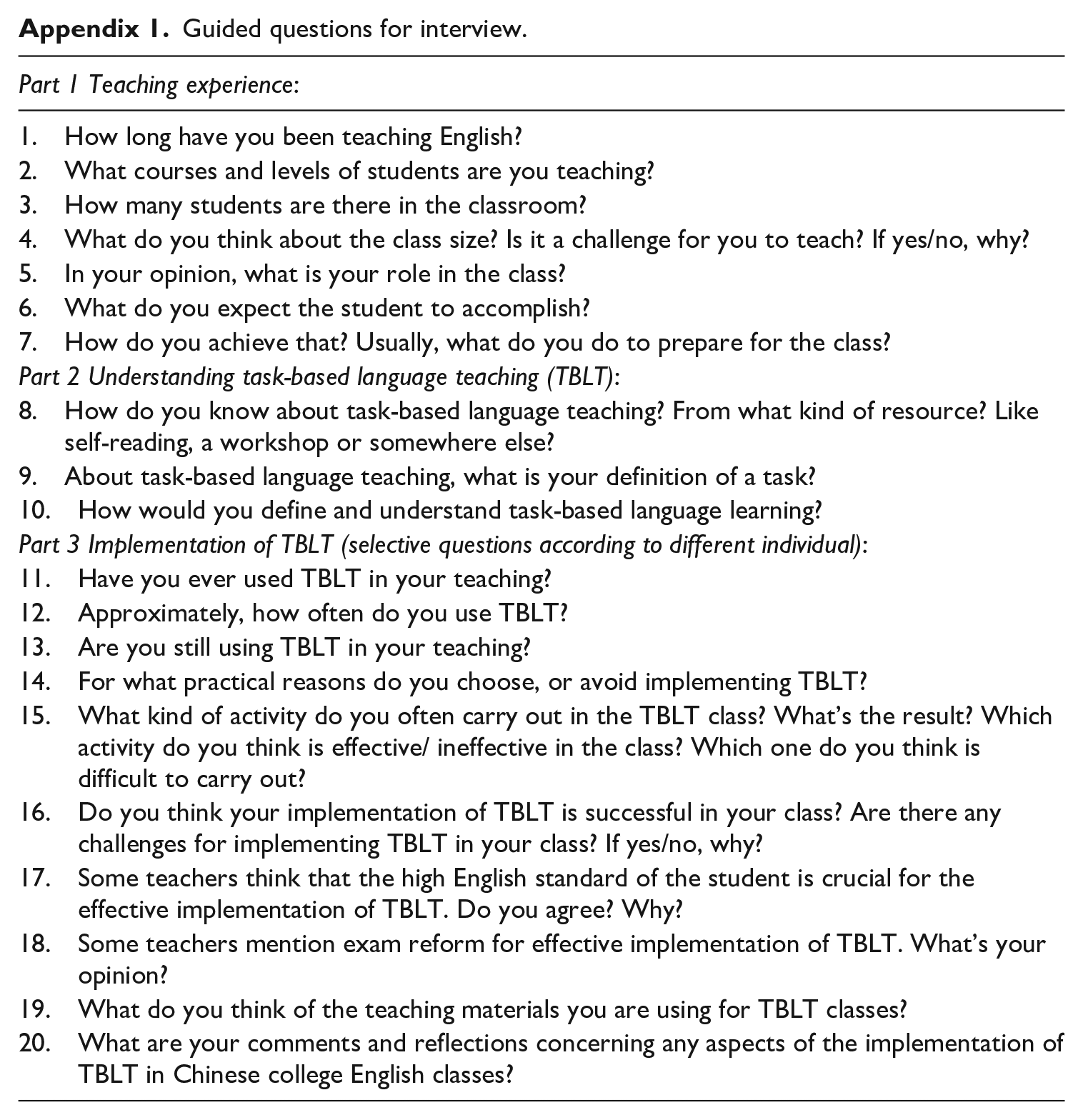
Semi-structured interviews were employed to investigate the complexities of the participants’ in-depth thoughts and experiences related to the implementation of TBLT. In total, 20 questions were developed as guided questions for the interview (see Appendix 1), which was carried out on a one-to-one basis in Chinese. All the interviews were audio-recorded and transcribed.
3 Data analysis
Data collected from the interviews were translated from Chinese to English and the translations were verified by another researcher. The data were then coded using NVivo 10 and analysed under the thematic analysis framework, which is a method for ‘identifying, analysing and reporting patterns or themes within the data set’ (Braun and Clark, 2006, p. 35) through familiarization with the data, generating initial codes, and extracting themes and sub-themes. The themes emerging from the data are presented and discussed in the following section.
IV Results and discussion
This study examined a group of Chinese university EFL teachers’ perceptions of teacher–student relationships, and their perceptions of and difficulties related to implementing TBLT. The following section presents and discusses the findings related to each research question.
1 Teacher–student relationships in Chinese EFL classrooms
The Chinese EFL teachers’ interview data indicated that they were leaning toward a ‘Westernized’ teacher–student relationship in class, rather than the traditional Chinese teacher-centred relationship. The teachers conceived of themselves as facilitators, guides, task organizers and audience in the classroom, instead of as simple knowledge transmitters.
a Teachers’ role
During the interview, we asked about the teachers’ perceptions of their teaching aims and the roles they play in class. Except for one teacher (Respondent 6) who described her role in class as a ‘transmitter’, the majority of the Chinese EFL university teachers (11 out of the 12 interviewees) reported that they did not consider themselves to be the authorities and experts in class. This indicated that the Chinese EFL university teachers’ views of their roles in class were in line with those of TBLT researchers (Van den Branden, 2006; Willis, 1996), rather than the teacher-centred Chinese tradition.
Six sub-themes emerged from the analysis of responses: conventional role, facilitator, guide, task organizer, audience, and ‘depends on situation’. Thus, the Chinese teachers’ perceived roles are similar to the Van den Branden’s (2006, p. 217) statement that the teacher should present themselves as a ‘guide’, a ‘counsellor’ and a ‘coach’ in TBLT. For example, four teachers described themselves as a ‘facilitator’ in class, as indicated in the following excerpt: I think I am more like a facilitator to help them learn English. I will help them solve their problems and give them some tasks and they have to do the tasks themselves. (Respondent 5)
From the above extract, it can be inferred that this teacher perceived him/herself as a facilitator and the students as problem-solvers and task completers. This echoes the findings of Liu et al. (2018), in which the majority of Chinese EFL teachers acknowledged the importance of learners’ collaborative and interactive learning skills, learners’ interest and learner autonomy. Therefore, the Chinese university EFL teachers in the present study support Willis’ (1996) conception of the teacher as a facilitator in TBLT lessons. Willis (1996) proposed that facilitating learning should balance the amount of exposure and the use of language.
The teachers also conceived of themselves as ‘task organizers’. One addressed the teacher’s role as ‘guide’. Moreover, one teacher built very innovative learner-centred interactional patterns with their students by considering themselves as an audience: ‘If there are things that the students have to share with me, then I am an audience’ (Respondent 7). This is in line with the concept of the TBLT teacher’s role as a ‘co-communicator’ with the students, as proposed by Littlewood (1981, p. 92). The finding thus illustrates an attitude change among Chinese college ELT teachers, moving away from the teacher-centred tradition towards a more Westernized teacher–student relationship in class that highlights learner participation and autonomy.
In addition, two teachers believed that their roles in class were not static, instead depending on the particular subject they were teaching. For example, Respondent 7 described themselves as the centre of the class when teaching grammar and language forms, but as an audience and a task facilitator when the lesson focused on speaking. This view is in line with Willis’ (1996) and Ellis’ (2009) proposals that teachers’ roles in TBLT are not limited to those of task manager or facilitator, and TBLT can be both learner- and teacher-centred depending on different task phases.
b Students’ role
The teachers believed that students were moving away from the traditional passive learning model towards a more active learning culture. Ten teachers acknowledged the importance of student participation and cooperation and were content with their students’ in-class involvement. Only two teachers mentioned that some students were not very creative and flexible in their learning, which affected their participation in tasks. These teachers perceived their students as being solely extrinsically motivated, and they attributed this to the exam-focused education environment. Littlewood (2007) also argued that Asian students were not passive learners; instead, their passive classroom attitudes more likely resulted from the educational context.
In addition, two teachers explicitly addressed that students were more willing to communicate now than in the past: I think students nowadays are getting better and their willingness to communicate increases with the influence of Western culture and globalization, for example, communicating with foreigners and studying abroad. (Respondent 5)
It is interesting to see that this teacher (Respondent 5) noted the growing interest and demand for students’ communicative competence due to the increasing cross-cultural communication. The teachers’ interview data illustrated changes in the views and expectations of Chinese college students under the influence of globalization. The present study thus supports previous studies on Chinese student classroom behaviours (Shi, 2006). For example, Shi (2006) documented the declining influence of Confucianism on the Chinese culture of learning, in which the students showed many characteristics in common with their ‘Western’ contemporaries, such as being active, interactive and critical. As Liu et al. (2018) suggest, Chinese students’ limited understanding of TBLT, the passive learning environment and the exam-focused evaluation system all impede their active participation and cooperation in task-based learning. It is possible that ‘once exposed to task-based teaching’, they can ‘adjust their preferences for learning’ (Adams and Newton, 2009, p. 9), which may in turn motivate their teachers to implement TBLT in class. This is indeed what was reported by two teachers in this study.
In summary, these findings represent a significant attitude change among Chinese college ELT teachers, moving away from the teacher-centred tradition to the Westernized teacher–student relationship in class that promotes student participation and autonomy. This finding provides support for previous claims (Butler, 2011; Shi, 2006) that the role of traditional Confucian values in shaping Asian classroom practices has been overemphasized.
2 Perceptions and implementation of TBLT
a Understanding of TBLT
Various criteria for defining tasks have been proposed (e.g. Ellis, 2003, 2017; Willis & Willis, 2007), including task authenticity, primarily focusing on meaning and student-centredness. Most of the criteria were noted by the Chinese EFL teachers. For example, nearly half of them emphasized that the concepts of ‘goal’ and ‘outcome’ were important in defining a task, which are core features of the concept of ‘task’ (Ellis, 2003; Fortune, 2009; Willis & Willis, 2007). Four teachers highlighted situational authenticity and interactional authenticity.
The interview further probed the teachers’ understanding of TBLT by examining the employment of specific activities, teaching techniques and classroom management skills. The interview data indicated that the teachers employed a variety of tasks, including role play, debates, discussions, problem-solving, reports, speeches, presentations, drama, video performances, poster-making, singing and dubbing a movie. Among these tasks, role play, debates and discussions were the most frequently mentioned tasks by the respondents. However, for most teachers (n = 8) tasks were mainly used to activate students’ existing knowledge of English by developing fluency, rather than to acquire new knowledge or restructure their interlanguages. One teacher commented: ‘I seldom use TBLT in language knowledge learning. I will ask the students to carry out interactions and the performance after we learn the textbook’ (Respondent 5). As illustrated by the participant, tasks are only employed as ways for practice language knowledge taught previously in class. That is, tasks were perceived as tools for activating language rather than acquiring new linguistic skills. Therefore, the teachers could be considered to be adopting a weak version of TBLT.
For task design, the teachers realized the potential that the internet could offer for designing TBLT materials. They reported that the resources they used for designing tasks were mainly from the internet and movie clips. It is widely accepted that the emergence of Web 2.0 tools has facilitated an online interactive, collaborative and learner-centred environment for TBLT (Thomas and Reinders, 2010). However, the internet was used by the teachers simply as a source of materials and information in task design. The interactive and collaborative environment that the internet could offer appeared to be neglected.
Furthermore, the interview revealed that misconceptions of TBLT existed among the teachers, corroborating the self-evaluation of their familiarity with TBLT reported by Liu et al. (2018). Most of the teachers in Liu et al. (2018) self-reported a low level of understanding of TBLT. The interview carried out in the present study provides us with more detailed insights of the Chinese teachers’ understanding of TBLT. Three teachers reported that TBLT focused mainly on speaking and listening, reflecting one of the most common misunderstandings of TBLT noted by Ellis (2009). It is worth noting that the teachers in Zheng and Borg’s (2014) research perceived tasks as speaking in pairs or groups. However, tasks do not always require speaking, and may involve all the four skills (listening, speaking, reading and writing). As an example, Hill and Laufer (2014) demonstrated the effectiveness of two form-oriented reading tasks in enhancing vocabulary learning and reading competency, namely form-oriented production tasks and form-oriented comprehension tasks.
In addition, two teachers misconstrued TBLT as not focusing on form, as shown in the following excerpt: TBLT is more practical if the teaching focuses on comprehensive ability. But if the teacher aims to explain the theory clearly, it would be more practical to use the traditional teaching approach, in which teachers can explain explicitly. (Respondent 1)
The above interview extract indicates that the teacher failed to realize that language forms can be focused on by integrating content input as part of the teaching phrases in TBLT. Task-based learning attempts to address the dilemma of how to ‘confront the need to engage naturalistic learning processes’ while simultaneously ‘allow[ing] the pedagogic process to be managed in a systematic manner’ (Skehan, 1996, p. 58). Form-focused instruction or content input can be incorporated into different phases of the task-based approach, to lessen the cognitive and linguistic burden without detracting from a primary focus on meaning (Gilabert, 2007). Moreover, Ellis (2003) describes techniques for focusing on form during a task that can be used by the task participants either implicitly or explicitly. These techniques potentially enhance the acquisition value of a task by inducing noticing of linguistic forms (Ellis, 2003, 2017). The findings from the present study reveal that the Chinese EFL teachers were not familiar with these techniques for focusing on form in TBLT. The teachers’ lack of familiarity with TBLT may be associated with the lack of appropriate and efficient TBLT training in the Chinese EFL context.
b Task-supported language teaching
The interview revealed that all the Chinese EFL teachers in the study employed a weak version of TBLT tasks, i.e. the task-supported language teaching approach. As discussed earlier, tasks in the weak version of TBLT are normally used as ‘supplementary activities before or after the form-focused instruction’ (Zhang, 2007, p. 74). All the teachers in this study claimed that their lesson plans were primarily based on the textbook, the teaching outline, and the schedule regulated by the university, as shown below: The teaching outline and schedule is designed and regulated by the school. So we have to prepare the class based on that. However, any point that is relevant to the text in the book can be extended. Based on the text, you can design and distribute some tasks. All the materials relevant to the themes in the text, such as the video clips and the materials online, can be developed and adapted. (Respondent 12) Basically, I prepare the class according to the teaching outline. But based on that, I will add some other interesting new materials and tasks, for example the headline news. (Respondent 6)
As shown in these extracts, although teachers had to prepare the class based on teaching outlines and schedules mandated by the university, they tried to add supplementary materials to their teaching. In this situation, tasks in the classroom were normally treated as extension activities or add-ons. Therefore, for the Chinese EFL teachers, it was impossible for them to use tasks as the basis for their entire curriculum due to the administrative system, including pressure to fulfil teaching assignments and limited teaching hours. Respondent 7 commented: ‘I do not have enough time to carry out very specific integrated TBLT within the teaching hours. I can only adopt some parts of TBLT.’ As noted by Ellis (2019), in an instructional context where ‘pure’ task-based teaching is constrained by local contextual factors, task-supported language teaching will also be needed.
Despite these obstacles (which will be investigated in detail in the next section), the teachers also illustrated the benefits of TBLT. The collaborative and interactional nature of TBLT and its motivational potential for students were acknowledged by the teachers. They maintained that TBLT helped them to create a collaborative learning environment. Furthermore, the teachers also emphasized that TBLT promoted students’ motivation, initiative and learning interest in their classroom. This is in line with Liu et al.’s (2018) finding that most teachers choose to use TBLT because it creates a collaborative learning environment; ‘TBLT improves learners’ interactive skills’ was the second most commonly selected reason why teachers choose to use TBLT.
These findings echo Butler (2011) and Carless (2012) in that the use of a task-supported approach demonstrates the teachers’ efforts in finding an appropriate and adequate option for TBLT under the constraints of their local contexts, such as the pressure to fulfil teaching assignments and the limited teaching hours discussed above. As emphasized by East (2019), eclecticism in practice is influenced by contextual factors such as school-imposed expectations and high-stakes assessment requirements. Therefore, a weak version of TBLT should be considered as a localized adaptation of TBLT, rather than as a poor implementation of the strategy.
3 Difficulties in adopting TBLT
Recognizing obstacles in the implementation of TBLT in the Chinese EFL context will contribute to the development of localized TBLT. Researchers, for example Carless (2012), advocate contextual adaptations to TBLT, and address the need to consider possible changes in local educational traditions in order to enhance language learning. Therefore, this section explores the Chinese EFL teachers’ difficulties in adopting TBLT.
a Lack of task-based textbooks
The fact that existing textbooks were not suitable for TBLT was one of the main reasons for the teachers avoiding implementing TBLT. As mentioned above, Chinese EFL teachers were required to use textbooks mandated by their institution or by the education ministry. All the respondents commented that their textbooks were not very conducive to TBLT, as they were not designed based on the principles of TBLT. For example, the content was form-focused and ‘there is limited design for speaking’ (Respondent 10). The teachers also noticed the lack of authenticity in their textbooks. They criticized the textbooks as irrelevant to students’ lives and ‘the topics are quite out of date’ (Respondent 12).
According to Widdowson (1978), authenticity has to do with appropriate response and learner engagement. Authenticity of task depends on whether learners are engaged by the task – that is, they should be interested in the topics, and understand the relevance (Guariento and Morley, 2001). However, the teachers reported that the existing textbooks failed to provide students with linguistic choices that enabled them to communicate appropriately in various contexts. As one teacher commented, ‘the students have to learn all the speaking from the textbooks. But sometimes, the English in the textbooks is too formal for daily language’ (Respondent 8). Analysing the oral English textbooks in China, Ren and Han (2016) found that pragmatic knowledge was still under-represented in most textbooks, and the ways of presenting pragmatic knowledge in the textbooks seemed to be based on the writers’ intuition.
On the other hand, however, half of the teachers thought they could adapt the content in their textbook into tasks to implement TBLT. For example: The textbook is mandatory and you cannot change it. So for most of us, we make changes to the textbook by ourselves. It is not rewriting or totally using another textbook. It is the adjustment of the textbook during the class. I think every teaching textbook needs to be adjusted and changed. (Respondent 11)
As stated by this participant, teachers should be able to tailor the mandatory textbook for their own teaching (Ren & Han, 2016). This teacher believes that it is necessary to adjust the textbook to be more suitable for their own teaching context. The comments are in line with Mishan (2011; also see Mishan and Timmis, 2015), who maintains that teachers are material developers as they have to continually evaluate, adapt and/or produce materials to suit their own teaching contexts. Willis and Willis (2007) also offer a range of solutions to allow teachers to integrate tasks, even if the coursebook is not designed for TBLT. Therefore, the Chinese EFL teachers have the option to supplement or adapt their textbooks to fit the principles and procedures of TBLT. However, half of the respondents reported challenges when designing tasks, in terms of how to make the tasks interesting, how to group students, clear instructions and directions for students, and the appropriate amount of input in the pre-task cycle. We will examine these next.
b Limited knowledge of TBLT and training opportunities
The teachers reported that they need to give students clear instructions and directions: ‘Students must know very clearly the instructions and tasks to do in every step which is challenging for teachers’ (Respondent 11). In addition, one respondent expressed a different concern: ‘Teachers should consider how much input before the tasks is enough for students to carry out the tasks successfully’ (Respondent 1). Apart from the difficulty of designing tasks, two teachers also stressed the difficulty of evaluating students’ task performance. This is consistent with previous studies reporting that local EFL teachers had difficulty in assessing learners’ task-based performance, which is also one of the reasons why they avoid using TBLT (Liu, Mishan and Chambers, 2018).
Although efforts have been made to increase the training opportunities for teacher professional development in TBLT in China, the findings exposed a number of areas that should be further addressed. The study emphasized the need to focus on appropriate task design, efficient task assessment and evaluation. To ensure the implementation of TBLT as required by the 2015 Guidelines (Ministry of Education, 2015), the promotion of teacher training and further development will require greater support at all levels (Xu and Fan, 2017).
c Large class size
The majority of the Chinese EFL teachers (nine out of the 12 interviewees) commented that their English classes were too large, and considered this an obstacle to implementing TBLT. The teachers reported that the large class sizes hindered TBLT in various ways, including limited interaction, difficult class management, students’ limited participation and engagement, assessment, and the physical and mental challenge for teachers.
A teacher described employing TBLT in a class with over 60 students as ‘quite exhausting’ (Respondent 1). Findings in the present study verified the difficulties of implementing TBLT in a large class (Hayes, 1997; Mulryan-Kyne, 2010).
d Curricular constraints
Limited instructional time and the pressure to fulfil the demands of a form-focused curriculum were also emphasized by the teachers. Teaching hours for carrying out TBLT were limited, and the teachers recognized that TBLT was time-consuming. When faced with limited instructional time and pressures to fulfil the demands of the curriculum, the teachers had limited time to complete tasks in class. Respondent 5 commented: ‘To finish the teaching outline and schedule, teachers have no time to study and research on TBLT. So it would be better if teachers had more free time’. This excerpt suggests that the Chinese teachers are too busy with their teaching workloads to further develop their professional skills. Lack of sufficient instructional time was also documented in Zhang’s (2007) observation of ELT in Guangdong in China, and Bao and Du’s (2015) examination of TBLT in learning Chinese in Denmark.
The contextual factors highlighted in this study have also emerged in several other studies of curriculum implementation (e.g. Carless, 2007; Zheng & Borg, 2014). It is interesting to note that the contextual factors (such as large class size, low proficiency or mixed ability students, time pressures, and examinations) were also raised by Zheng and Borg (2014) in the implementation of TBLT at the secondary level in China, and by Ren and Han (2016) in the context of incorporating more pragmatics instruction in EFL teaching in China.
V Implications
The findings indicated a lack of theoretical knowledge of TBLT among Chinese EFL teachers, exposing a major problem in teacher education in China, namely the lack of adequate and appropriate in-service teacher training (Gao & Ma, 2011; Zhou, 2014). Zheng and Borg (2014) also highlighted the importance of deepening teachers’ understandings of what TBLT means, both as implied in the curriculum and in the literature more generally. The interview respondents in this study seemed to understand most of the key features of tasks, including goals and being outcome-oriented, task authenticity, a primary focus on form and student-centredness, except for the following two criteria: 1) a task engages cognitive process (Ellis, 2003), and b) completion is a priority (Willis and Willis, 2007). Thus, we suspect that the Chinese teachers may not be aware of these two crucial features of tasks.
Furthermore, this study also found that there were misunderstandings about some aspects of TBLT among some Chinese ELT teachers. As revealed in their interview data, some teachers thought that TBLT focuses mainly on speaking and listening. However, tasks do not always require speaking; they can involve all the four skills (listening, speaking, reading and writing). In addition, the findings from the present study reveal that the teachers sometimes misconstrued TBLT as not focusing on form. However, it appeared that techniques for focusing on form during a task, which may be used by task participants either implicitly or explicitly (e.g. Ellis, 2003), were unfamiliar to the teachers. Their lack of techniques and skills for appropriate task design, efficient task assessment and evaluation were also emphasized by the interviewed teachers. Various challenges were identified by the interview respondents when designing tasks, in terms of how to make the tasks interesting, how to group students, clear instructions and directions for students, and the appropriate amount of input in the pre-task cycle. Further, it is widely accepted that the emergence of Web 2.0 tools has provided an online interactive, collaborative and learner-centred environment for TBLT (Thomas and Reinders, 2010). Although most of the teachers recognized the importance of online resources in task design, they had not fully explored the potential of collaborative computer-assisted teaching.
The findings in this study shed light on the need for teacher training in TBLT in the Chinese context. Regarding the approach to teacher training in the Chinese EFL context, Zheng and Borg (2014) recommended data-based teacher development (Borg, 1998), which emphasizes reflective analyses of their own teaching (i.e. transcripts of lessons and teachers’ commentaries on their work) and of the influencing factors that shape it. Sun et al. (2020) highlight that teachers have a crucial role in curriculum reform, as their beliefs about and attitudes towards English language teaching pedagogies influence their practices. This kind of participant-centred in-service teacher education can increase teachers’ self-awareness of how their own beliefs and contextual factors influence their instructional choices.
With a dedicated focus on innovation in theory and practice, the importance of the initial teacher educational (ITE) programme in helping teachers to promote and implement TBLT is emphasized by East (2019), who concludes that the sustainable implementation of TBLT ‘requires ITE initiatives to be maintained and more established teachers to up-skill’ (p. 113). As a teaching approach advocated by the Chinese government, TBLT continues to be promoted in college English teaching. It is thus necessary to develop a support system for the professional development of Chinese EFL teachers, to enable them to respond to the ongoing top down reforms of ELT. While it is not possible to generalize about all Chinese EFL university teachers on the basis of our small sample, this study can shed light on research on TBLT in Chinese and other EFL contexts.
The issue of large class sizes has often been raised by the Chinese EFL teachers as a problem in relation to the implementation of TBLT; the same is true of foreign language teaching in other countries (Bao and Du, 2015). However, this difficulty may remain particularly salient for Chinese ELT, and for foreign language teaching in other countries as well. Tomlinson (2016) argues that a large size class can allow some students to ‘hide’ in comfort, which can relieve their negative anxiety and stress. Tomlinson (2016) proposes that a whole class approach in large classes has the potential to facilitate students’ language acquisition, stating that whole class activities such as performances of drama, dialogues, and storytelling can stimulate more interaction between students and teachers in large classes. Future research is encouraged to explore whether carrying out tasks using a whole-class approach rather than in pair/group discussion can help the implementation of TBLT in large classes.
In China, the centralized education system is a challenge for the implementation of TBLT, since unified teaching materials and evaluation forms are mandatory for all teachers and students. Chinese teachers often feel powerless in the control and management of their classroom teaching, as the top-down curriculum implementation system confines their freedom in classroom teaching, such as teaching materials and evaluation. Therefore, de-centralizing the administrative system to empower local institutions and teachers in terms of curriculum design and evaluation seems to be crucial, particularly taking into account the fact that China is massive with considerable diversity in needs across the country. Meanwhile, as Tomlinson (2013) suggests, every teacher needs to be a material developer. Chinese EFL teachers need to be capable of adapting their coursebooks and producing materials in order to ensure that teaching materials are suitable for the TBLT approach, as well as relevant to their learners’ interests. In addition, as mentioned earlier, the internet is being used simply as a resource for materials and information in task design. It is important to provide training to EFL teachers with respect to exploiting the interactive and collaborative environment of Web 2.0.
VI Conclusions
This study investigated Chinese university EFL teachers’ perceptions of TBLT. The findings showed that Chinese EFL teachers were leaning toward a student-centred learning culture in class. However, the study also indicated a lack of knowledge of TBLT among the teachers, who usually adopted a weak version of the task-based approach. Major obstacles to the implementation of TBLT in the Chinese university ELT were identified. Nevertheless, opportunities also exist; the adoption of task-supported approaches revealed the teachers’ efforts to seek an appropriate and adequate TBLT approach in the local context.
It must be noted that there are some aspects in this study that could be strengthened in future research. First, the size of the participant group was rather small, particularly considering the complexity of the Chinese EFL context. Unbalanced regional development may influence the teaching quality in different universities. Further studies may need to include a large number of EFL teachers from different regions. Moreover, the study focused mainly on teachers’ perspectives and opinions in the process of curriculum development. Further studies could explore students’ perspectives, as well as those of other stakeholders such as publishers and administrative officers.
Footnotes
Appendix
Guided questions for interview.
| Part 1 Teaching experience: |
|---|
| 1. How long have you been teaching English? |
| 2. What courses and levels of students are you teaching? |
| 3. How many students are there in the classroom? |
| 4. What do you think about the class size? Is it a challenge for you to teach? If yes/no, why? |
| 5. In your opinion, what is your role in the class? |
| 6. What do you expect the student to accomplish? |
| 7. How do you achieve that? Usually, what do you do to prepare for the class? |
| Part 2 Understanding task-based language teaching (TBLT): |
| 8. How do you know about task-based language teaching? From what kind of resource? Like self-reading, a workshop or somewhere else? |
| 9. About task-based language teaching, what is your definition of a task? |
| 10. How would you define and understand task-based language learning? |
| Part 3 Implementation of TBLT (selective questions according to different individual): |
| 11. Have you ever used TBLT in your teaching? |
| 12. Approximately, how often do you use TBLT? |
| 13. Are you still using TBLT in your teaching? |
| 14. For what practical reasons do you choose, or avoid implementing TBLT? |
| 15. What kind of activity do you often carry out in the TBLT class? What’s the result? Which activity do you think is effective/ ineffective in the class? Which one do you think is difficult to carry out? |
| 16. Do you think your implementation of TBLT is successful in your class? Are there any challenges for implementing TBLT in your class? If yes/no, why? |
| 17. Some teachers think that the high English standard of the student is crucial for the effective implementation of TBLT. Do you agree? Why? |
| 18. Some teachers mention exam reform for effective implementation of TBLT. What’s your opinion? |
| 19. What do you think of the teaching materials you are using for TBLT classes? |
| 20. What are your comments and reflections concerning any aspects of the implementation of TBLT in Chinese college English classes? |
Funding
The author(s) received no financial support for the research, authorship, and/or publication of this article.
