




Abstract
Early childhood education and care is a current interest in many countries. Many international studies have highlighted the importance of high-quality early education environments where learning and play are integrated. Studies show that these types of learning environments have a positive impact on children’s future prospects and overall development. Critical curriculum steering documents from Finland and Brazil form the basis of this study and can similarly be shown to define the quality of these environments, as well as providing definitions of playful learning in these differing cultural contexts. A content analysis explores patterns of the cultural and pedagogical difference of definition. This descriptive comparison permitted similarities and differences between the countries with regard to play to emerge. In this article, the authors explore what these different cultural and pedagogical definitions of play and playful learning are and what they might mean. The article thus makes a methodological contribution to a broader discussion of comparative studies of national curricula in early childhood education with specific regard to children’s engagement, learning and development in and through play. The theoretical conclusions are, however, more tentative, but the authors suggest some innovative ways to conceptualise cultural and pedagogical differences in play by making an analogy with Wittgenstein’s analysis of games in his Philosophical Investigations.
Introduction
In recent years, the Organisation for Economic Co-operation and Development (OECD) has taken the initiative to explore the contrasts and complexities of different national policies and approaches to early childhood education and care (see Directorate for Education and Skills, 2018). In this examination, Bennett (2005) has identified two broad categories in national settings, which are particularly visible in Europe: the pre-primary tradition (e.g. Belgium, France, Ireland, the UK and the USA), focusing on cognitive goals and ‘readiness for school’ as important aims, and the social pedagogic tradition (e.g. Nordic countries and many parts of Central Europe), focusing more on children’s play and social development with an emphasis on children’s agency. The latter approach defines developmental aims more broadly, enabling staff to tailor early childhood education and care programmes to local settings and base their assessments on more varied objectives, rather than set results. As such, these approaches are directly linked to different perceptions of childhood. This kind of holistic curriculum approach is familiar in Nordic countries, where education is seen through child-initiated, interactive and playful activities instead of set questions (see Kangas and Harju-Luukkainen, 2020). Further, the OECD has expressed concerns about the risk of too much emphasis on formal teaching and other ‘schoolification’. Referring to the United Nations’ (1989) Convention on the Rights of the Child, the OECD advocates an understanding of the curriculum in which children should have a high degree of initiative; stresses the reinforcement of ‘those aspects of curriculum that contribute to the well-being and involvement of the child’ (Bennett, 2005: 7); and recognises children as active meaning-makers in educational processes and practices (Kangas and Reunamo, 2019). In all this, the playful learning approach has been a focal point in educational policy discussions internationally (Kangas et al., 2019; Kumpulainen, 2018; Sefton-Green et al., 2015). How playful learning is defined and viewed in policy documents gives us an insight into the deeper structures of early childhood education and the cultural construct of play and learning in different countries. For example, the National Council for Curriculum and Assessment (2009) and Van Hoorn et al. (2014) suggest that scaffolded (i.e. guided) play should be part of the daily practices of early childhood education. This type of definition provides us with a window onto cultural differences, attitudes, and values of children and play in early childhood. Further, in a cross-national study by Harju-Luukkainen et al. (2019), the early childhood educators viewed free play differently, making much about play and its definition culturally bonded.
From these premises, we have formulated the following research question: How are ‘play’ and ‘playful learning’ described in Finnish and Brazilian curriculum guidelines for early childhood education? As data we use official documents from the respective countries, and we explore the textual data with the help of structural content analysis. By contrasting two very different social and educational contexts where curriculum documents have emerged, we can expose some of the values and attitudes towards playful learning which are of importance with regard to children’s agency in early childhood.
Definitions of ‘play’ and ‘playful learning’
The Oxford English Dictionary defines ‘play’ as engagement in an activity for enjoyment and recreation rather than a serious or practical purpose. In educational research, this description, with its focus on children’s experiences, has often been the definition of play. Bondioli (2001: 111) states that the problem with the definition of play in developmental psychology is that the motive for play is generally overlooked because play is often considered ‘a spontaneous and self-motivated activity’. Yet in his Philosophical Investigations, Wittgenstein (2009) delineates a problem with the definition of ‘games’ as a general category that can be applied to all games. The nature and rules of games can, in other words, be easily defined – there are sets of rules – but finding a definition of ‘games’ that applies to all games is problematic. Wittgenstein uses this problem of defining games as the basis for a philosophical notion of language games – the idea that we understand cultures and people through insights into the contingent conditions of specific time and place. This Wittgensteinian notion describes more widely the context of education. Instead of a certain list of goals set by the more advanced members of society, education can be viewed through its broader, multimodal and dynamic goals for empowering children through participation and belonging to support them to navigate and experience agency in an uncertain world (see Directorate for Education and Skills, 2018; Kangas, 2016; Van Oers, 2008). However, play and playful learning will have multidimensional and dynamic definitions located in different contexts and cultures. The OECD’s Education 2030 project states that education should embrace three further categories of competencies: creating new value; reconciling tensions and dilemmas; and taking responsibility (Directorate for Education and Skills, 2018). One solution in addressing these ‘transformative competencies’ to support children to be innovative, responsible and aware is to consider education through the notion that (all) play is learning (Pramling Samuelsson and Asplund Carlsson, 2008; Schöning and Witcomb, 2017). Furthermore, playful learning would be identified practices and routines related to supporting children’s play and learning in early childhood education and care (Kangas et al., 2019). The key element is a development and revision of the cultural practices and structures in early childhood education and care which view play as part of children’s learning (Venninen and Leinonen, 2013).
However, for research-based knowledge, these wide political notions are not accepted as such. Following Wittgenstein (2009), an understanding of one set of language games is not always or easily translated into another. For example, in Russia, Vygotsky (1967) separated play from other childhood activities and concluded that only in playful learning do children create meaning through imagination. Similarly, for the French sociologist Cailloins (1958), the requirement for play is that those taking part are involved in an illusion of a fictional world. In the UK educational context, Whitebread et al. (2009) support the idea of simplifying play to serve only the development of metacognitive skills and intentional (in other words, academic) learning.
Many traditional pieces of research on playful learning focus on creating knowledge regarding the learning and development processes in the minds of the children participating in the play. Vygotsky (1967) relates play to the development of self-control and self-regulation in children, together with the development of language and symbolic representation, which creates meanings for communication and belonging in society (see also Kangas et al., 2015). How playful activities and free play are viewed is also context-bound (Harju-Luukkainen et al., 2019). However, play has been shown to have a role in the development of children’s different skills. Skills such as enactment in learning activities through creativity and exploration, or goal-setting for learning through independent initiatives and choice-making have been shown to develop in the context of a playful learning environment with a participatory teaching approach (Kangas, 2016). Moreover, Piispanen and Meriläinen (2015: 233) show how play in class ‘gives pupils freedom to play individually and creatively but still along the lines of the goals’. Researchers have found that social competence is also a requirement for successful play because, in play, the negotiations and agreements between fact and fiction are done within the play. Therefore, playful learning can be seen as a dynamic and dialogical process in an imaginary environment (Møller, 2015; see also Harris, 2000).
These statements have strongly influenced a research culture where children’s inner speech, together with memory skills, language development and cognitive learning, has been followed in the context of play (see Berk, 2006; Hitch et al., 1991). Bodrova (2008) warns against this trend of defining play only through cognitive learning. In her research, she states that mature play can be defined as the leading activity of children. This kind of playful learning, however, does not take place in many early childhood education settings because the time and space for children to become freely involved in play is restricted (Bodrova, 2008).
Research on the role of playful learning in early development and education emphasises the role of adult mediation in the development of children’s skills and motives for play to become playful learning (Kangas et al., 2019; Karpov, 2005; Vygotsky, 1967). According to Wood (2010), playful learning refers to the use of play in early childhood education to promote the learning of young children. McInnes et al. (2011) have shown that, in early childhood education, playful learning can be understood as dynamic and adaptive activities without the strict pedagogical actions of the teachers. Here, playful learning, as part of a dialogical environment as Vygotsky (1967) would recognise it, is also part of the cultural, social and, indeed, political environment. However, Karpov (2005) raises awareness about children’s developing motivation and skills in play, and claims that adults’ participation in children’s play increases children’s interest in playful learning. Researchers have suggested that teachers should practise pedagogy that facilitates playful learning, and that there are discrepancies around play and how it should be implemented in educational practices (McInnes et al., 2011; Moyles et al., 2001).
Method and data
Documents provide a rich, though often underused, source of data for educational research. Documentary research holds a critical position in the foundational development of social science, where, for example, we see Marx, Durkheim and Weber working primarily from archival and documentary sources. Research on documentary sources has particular applicability in educational sciences, as educational systems consistently produce excessive amounts of documentary data (Punch and Oancea, 2014).
In the early childhood education and care setting, this includes, for example, national, municipal, unit and child-specific curricula, and the documenting of children’s progress and other day-to-day evaluation in the operational environment. In the field of curriculum research, critical theory has held an influential role. Cohen et al. (2011: 35) write that ‘[i]t has been argued for many years that the most satisfactory account of the curriculum is given by a modernist, positivist reading of the development of education and society’. As the curricular expression of this, they refer to Tyler’s (1949) influential rationale for a curriculum, which includes four questions:
(1) What educational purposes should the school [here, early childhood education and care] seek to attain? (2) What educational experiences can be provided that are likely to attain these purposes? (3) How can these educational experiences be effectively organized? (4) How can we determine whether these purposes are being attained? (Cohen et al., 2017)
In line with this, Flinders and Thornton (2004: xi) ask in their introduction to The Curriculum Studies Reader: ‘What do schools teach, what should they teach, and who should decide?’ – as well as wondering what beliefs, values and attitudes are learned from the way classrooms are, as in ‘what lessons are taught but not planned, acquired but taken for granted’. After all, policy documents and their day-to-day implementation may not always coincide in the way that policymakers intended.
In this study, the national curriculum guidelines for early childhood education in Finland and Brazil were selected as the data. In both countries, the focus of educational policy in the past few years has been on concluding a new curriculum for the first stage of education, thus new national curricula were published in 2016. In both countries, these new curriculum guidelines consider learning and educational services for children from birth to five (Finnish National Agency for Education, 2016; Ministério da Educação, 2016). Both curricula also emphasise play and playful learning. For example, Agência Brasil made the statement that ‘the new Base Curriculum includes play in early childhood education’ (Martins, 2017 ).
The curriculum documents were analysed through qualitative content analysis. Cohen et al. (2011: 564–569) describe the process of content analysis thoroughly by defining the elements of an 11-step process. They summarise the content analysis process by saying that it involves coding; categorising, as in ‘creating meaningful categories into which the units of analysis – words, phrases, sentences, etc – can be placed’ (564); comparisons and making links between these categories; and, finally, drawing theoretical conclusions from the texts. According to Patton (2015), it is essential that the content analysis process identifies meanings and consistencies through patterns, themes and categories. The national curriculum guidelines were read through, and challenging issues such as ‘meanings’ considering play, playfulness and play-based learning were identified and categorised.
When it comes to curriculum studies, it is also necessary to question the extent to which these document-level guidelines become a practical-level reality in early childhood education settings in each of these national – and, even more so, local – contexts. Yang and Li (2018) have examined cultural ideology matters in early childhood education curricula across cultural settings by utilising Adamson and Morris’s (2014) three-level model, which includes (1) the intended curriculum; (2) the implemented curriculum; and (3) the curriculum ideology. Although the present study does not involve observation of practical-level implementation in the national settings, it is important to keep in mind that the policy document level naturally necessitates practical-level implementation, which relies on the practitioners’ input, as well as being embedded in particular societal and cultural structures.
Although international comparisons in research designs are not unproblematic and may often produce simplifying generalisations and categorisations (e.g. Kettunen and Petersen, 2011), keeping in mind the complexities that such examinations entail, they can also offer valuable knowledge for the further development of national educational systems, such as the policy documents analysed here, as well as how these are interpreted and implemented by educational practitioners.
Findings
In this section, we describe our findings from several perspectives. First, we describe how playful learning and play are defined in both the Finnish and Brazilian curricula from two perspectives: (1) how many times ‘play’ is mentioned and in what types of context and (2) how ‘play’ is defined in the respective countries. This is done to provide readers with some context of the respective country’s document. Following this introduction to the context of the data, we contrast the findings on two levels: (1) an overall curriculum-context level and (2) an operational-context level. This is done in order to answer the research question: How are ‘play’ and ‘playful learning’ described in Finnish and Brazilian curriculum guidelines for early childhood education?
‘Play’ in the Finnish early childhood education curriculum
In the Finnish ‘National core curriculum for early childhood education and care’ (Finnish National Agency for Education, 2016), the word ‘play’ occurs 55 times, but only twice as a chapter heading. The Finnish word for ‘play’ is leikki, with word forms such as leikillinen, which means ‘playful’ (e.g. ‘Lapsella on oikeus leikkiä’ means ‘Children have the right to play’). Also, the word pelata (originating from peli, meaning ‘game’) is related to the play vocabulary, meaning playing games/a game (e.g. ‘pelata jalkapalloa’ means ‘to play football’). The concept of play is mentioned twice at the heading level of the core curriculum: in chapter 3.1, where an action-culture definition is required with ‘the supportive community for play and interaction’, and chapter 4.1, where ‘play’ is defined as a method for ‘development, learning and well-being’. In total, 25 out of the 55 mentions of ‘play’ are in chapter 4.1.
The conception of play in the national core curriculum is that play creates joy and pleasure, and is thus a motivating activity and not a tool to achieve learning goals. With regard to the main concept of learning, the curriculum states:
The concept of learning is based on the conception of a child as an active agent of their own learning. Play is meaningful for the learning of children. The concept of learning is based on a holistic approach and learning happens when children play, explore, moving around, taking care of the learning environment, through self-expression and creativity. (Finnish National Agency for Education, 2016: 20)
A child learns through play (play is named as a key path to learning), but in play the child is not learning through cognitive assignments but more through a way of being, living and perceiving the world. The elements that are combined through play are enthusiasm, cooperation, and challenging personal skills and competencies. Play itself is motivating and a joyful action, where children learn different skills and knowledge. Children are naturally curious and willing to learn (Finnish National Agency for Education, 2016: 14).
The role of play is emphasised in the part of the curriculum that considers the learning community in early childhood education. With nine mentions of play, it can be said that playful learning plays a crucial role in the chapter 4.1:
An operational culture that encourages children to play recognises the significance of play for a child’s well-being and learning. The staff recognise factors that set limits to play and develop approaches and learning environments that promote playing. The children and staff have the opportunity to experience the joy of doing things together and playing together . . . Room, time and peaceful settings are given to children’s initiatives for playing, experiments and experiences. Playing children and adults are given an opportunity to concentrate on play. (Finnish National Agency for Education, 2016: 48)
Finally, in the chapter 4.4 on the concept of learning, the core curriculum emphasises that play alone has an intrinsic value for children, but it has an even more essential role in pedagogies that support learning, well-being and development. Kangas et al. (2015) have identified from the Finnish core curriculum for the early years that the guiding principles of autonomy, exploration, social competence, self-expression, self-control and participation emerge through play and action. Play has a space and place to be visible and audible. Children’s initiatives to play, to try out and to experience are supported by providing space and time and allowing them to play in peace. Children and adults who are playing are given the opportunity to focus on their play.
‘Play’ in the Brazilian early childhood education curriculum
In the Brazilian ‘Base Nacional Comum Curricular’ (‘National Common Curriculum Baseline’ or BNCC), there are 31 mentions of words that are related to brincar (brinc), which means ‘play’ (‘playful’) (e.g. ‘As crianças brincam na areia’ means ‘Children are playing in the sandbox’). There are five mentions of words that are related to jogar (jog), which means ‘playing games’ (e.g. ‘jogar futebol’ means ‘to play football’). In the BNCC document, ‘play’ is mentioned as one of the six rights of the child to ensure learning and development. In the first stage of basic education (i.e. from birth to five), there are six learning and development rights: to live, to play, to participate, to explore, to express and to learn to know yourself (Ministério da Educação, 2016: 36). However, at the level of explicit headings, the concept of play does not appear. In other words, if we may extrapolate some meaning from this, play is not explicitly recognised as being critical to these learning and development rights.
In early childhood education, play means ‘to play daily in different ways, in different spaces and times, with different partners (children and adults), expanding and diversifying their access to cultural productions’ (Ministério da Educação, 2016: 35). This statement is expressed as originating from the previous early childhood education curriculum. The Diretrizes Curriculares Nacionais para a Educação Infantil (2009), in its Article 4, defines a child as a ‘[h]istorical subject with rights who experiences and builds, through the interaction, relationships and daily practices, their personal and collective identity . . . plays, imagines, fantasy, wishes, learns, observes, experiences, narrates, questions, and constructs meanings about nature and society, producing culture’ .
Play as a pedagogical practice is mentioned as aiming towards appropriate learning (Ministério da Educação, 2016: 8). Also, according to the Diretrizes Curriculares Nacionais para a Educação Infantil (2009), the structure of pedagogical practices comprises interactions and play, experiences in which children can build and appropriate knowledge through their actions and interactions with peers and adults, which enables learning, development and socialisation. Overall, play is viewed to be a way of natural development for children from birth to five. However, it is described vaguely that this development consists of aspects of children’s knowledge, imagination, creativity, and emotional, corporeal and sensorial experiences, and also their overall cognitive, social and relational experiences.
Comparison of playful learning contexts in the curricula
The role of playful learning in the context of educational activities in the Brazilian BNCC is small. Considered with regard to the rights of learning and development, the curriculum establishes five areas of experience in which children can learn and develop:
The self, the other and society;
Body, gestures and movements;
Traits, sounds, colours and shapes;
Listening, speaking, thinking and imagination;
Spaces, times, quantities, relations and transformations. Ministério da Educação, 2016: 43–50
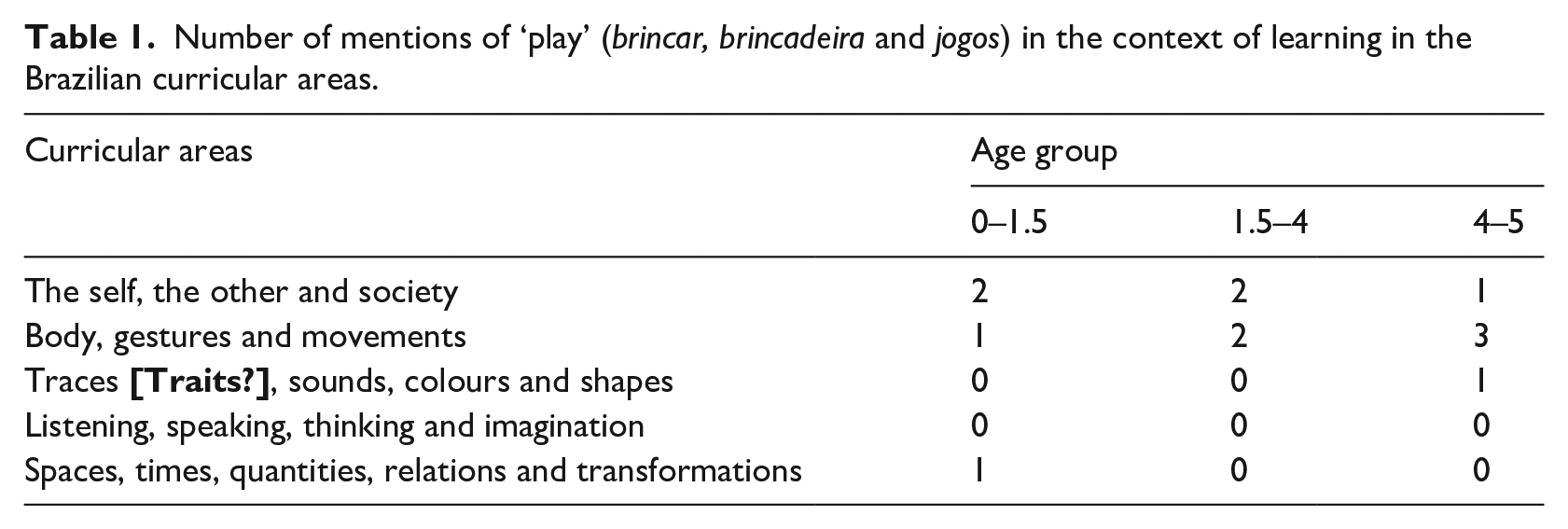
Play is mentioned as a method for learning in the context of ‘The self, the other and society’ and in the context of the ‘Body, gestures and movements’. Both content areas have five or six mentions of play across the different age groups in the Brazilian BNCC (Ministério da Educação, 2016: 43–50; see Table 1).
Number of mentions of ‘play’ (brincar, brincadeira and jogos) in the context of learning in the Brazilian curricular areas.
In Finland, the ‘National core curriculum for early childhood education and care’ also names five key objectives and areas of content for pedagogical activities (Finnish National Agency for Education, 2016, 19-22):
Me and our community;
I grow, move and develop;
Diverse forms of expression;
The rich world of languages;
Exploring and interacting with my environment.
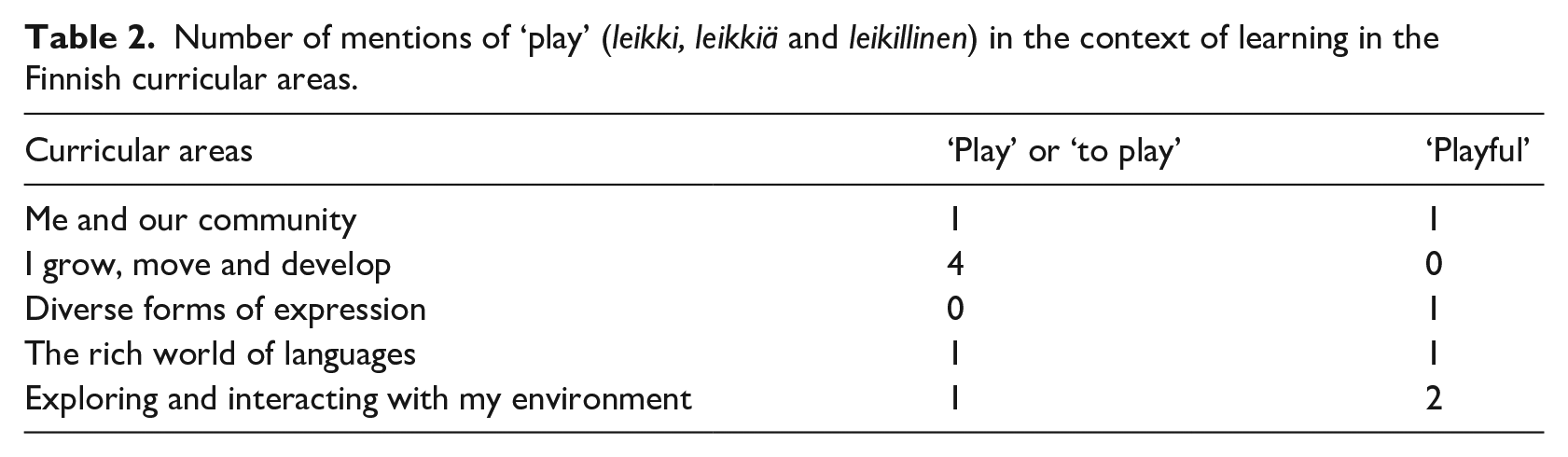
The Finnish curriculum does not give specific learning goals for different age groups but, in general, playful learning is mentioned within the learning area ‘I grow, move and develop’ in the context of physical play and health education. Also, in the learning area of ‘Exploring and interacting with my environment’, play has a total of three mentions, two of which are related to media education (see Table 2).
Number of mentions of ‘play’ (leikki, leikkiä and leikillinen) in the context of learning in the Finnish curricular areas.
Both curricula strongly emphasise the role of play, but in the context of learning – learning areas in the Finnish curriculum and areas of experience in the Brazilian curriculum – do not emphasise or define ‘play’.
Comparison of the operational context of play and playful learning in Finland and Brazil
When implementing the Finnish national core curriculum (Finnish National Agency for Education, 2016), teachers must ensure that children’s initiatives and actions are considered. Playful learning is an important way of working in early childhood education, but this requires the teaching staff to understand the role of play for the child and the pedagogical role of play for children’s learning, development and well-being. Teachers’ commitment to this learning situation creates sensitivity to children’s feelings and personal well-being. This requires that teachers know how to include pedagogical knowledge, cross-disciplinary information and pedagogical expertise in daily educational practices (Finnish National Agency for Education, 2016: 53). A zone of proximal development (see Vygotsky, 1967) is strongly underlined in the curriculum; it states that, through play, children learn new skills and knowledge from a more skilled member of the group (child or adult). Thus, play is a social event of shared learning.
Teachers are encouraged to support and guide children to become conscious of their own learning and to perceive that they can influence their own success in learning. In Finland, a warm and personal relationship between teachers and children creates the basis for learning. Both children and staff have an opportunity to experience the joy of playing and mutual action and togetherness (Finnish National Agency for Education, 2016: 20). Teachers are encouraged to use play as a teaching and interaction method to support children in expressing themselves verbally and bodily. Play can be used in versatile ways in the teaching of various fields of knowledge and the arts: mathematics can be explored in a playful way and imaginary play and play worlds can be developed through drama and children’s literature (Finnish National Agency for Education, 2016: 39).
The Brazilian BNCC (Ministério da Educação, 2016) emphasises that the interaction between teaching staff and children during play characterises the daily life of children, bringing with it many learning opportunities for the holistic development of the child. By joining in play, the teacher has an opportunity to identify children’s emotions and thus support their motivation towards learning. By observing the interactions and playfulness between children, teachers can identify the expression of affection, the mediation of frustration, the cause of conflicts and the regulation of emotions.
The BNCC (Ministério da Educação, 2016) sets the focus on the teaching intentions of teachers to be long-lasting pedagogical relations. This intentionality includes the organisation of teaching and offering of learning experiences that make it possible for children to know themselves and others. Through pedagogy, children learn to know and understand their relations with nature, culture and science, which translates into the practices of care, playing, exploring with varied pedagogical materials, approaching literature and meeting people.
Discussion
In this study our aim was to define more closely how playful learning is described in the Finnish and Brazilian curriculum guidelines for early childhood education. As data, we used the official curriculum documents of the respective countries, and we explored the textual data with the help of structural content analysis. We were able to outline different views on playful learning in early childhood education in the two countries and to detect different approaches and policy orientations towards play and playful learning. However, similarities also emerged, which is discussed further.
In their review of the archaeological, historical, anthropological and sociological research on play, Whitebread et al. (2012) suggest two identifiable features of play: first, its ubiquity among all human cultures, a universality that is ‘consistently supported by adults in all societies and cultures’, and second, its multivariant forms in different societies. In both cases, ‘these variations appear to arise from differing attitudes concerning the nature of childhood and the value of play’ (Whitebread and Basilio, 2013: 78). To start with, it is important to note that the new curricula for early childhood education in both Finland and Brazil interpret that children are viewed to have competencies to transform our society and shape the future. However, in order to take on this active role in society, they will need skills to navigate a variety of contexts in social spaces (the family, community, region and nation, digital contents and the world) (Directorate for Education and Skills, 2018).
In each country, the curriculum documents emphasise the quality of early childhood education through their steering documents, focusing on the playful and holistic approach of learning as an adaptation process to culture and society. However, in an educational system that acknowledges the importance of play in the child’s holistic well-being, learning and development, the pedagogy can be based on factors that restrict opportunities for play and simultaneously strive to develop play-friendly practices and learning environments (see McInnes et al., 2011; Moyles et al., 2001). According to our results, playful learning practices remain vague and are not clearly defined. This can lead to differences in interpretation at the operational level (e.g. Harju-Luukkainen et al., 2019). In an attempt to open up some explanatory possibilities, we turned to Wittgenstein (2009) – perhaps on the surface an unusual choice – to resolve a definitional problem in early childhood education and care. Tentatively exploring the analogical parallel here, we sought to examine the relationship between problems in the definition of play and a playful curriculum (Kangas et al., 2019), contextualised within major reviews of the literature on playful learning (Lester and Russell, 2010; Møller, 2015; Sefton-Green et al., 2015; Whitebread et al., 2012). Wittgensteinian theories of the ‘language game’ and ‘form of life’, we suggest, are evidently comparable to the difficulty of consistent definitions of playful learning.
Our identified factors influenced by value-system construction through binary notions of agency versus education (e.g. Teddlie et al., 2008). Something similar seems to be evident in this study of playful learning in the curricular documentation. Again, in tentative terms following Wittgenstein (2009), we suggest that something very important is being initiated as children are introduced into different cultural and socially defined notions of playful learning, controlled and defined by educational steering documents in different national contexts. These different definitions of play, and thus also learning through play and playful pedagogy, seem to have their roots in cultural and national definitions – and the evidence we have accumulated here unambiguously supports this (Harju-Luukkainen et al., 2019; Kuusisto and Gearon, 2017).
The steering documents, together with the theories, have shown that the definition of play even within one document is not necessarily contextualised and unambiguous. On the basis of our analysis, we argue that variant definitions of play and playful learning can and indeed seem to provide insights into the cultural language games of people, which are divergent in sociopolitical and historical contexts. It hints at something significant which links our Vygotskian notion of societal influence on the curriculum to a wider literature. The importance of such a hypothesis opens up, we suggest, possibilities for new directions in multidisciplinary educational research on playful learning not only in the early years but also across all stages of what we define as the life trajectory. We suggest, tentatively at this stage, that the differing cultural and pedagogical standpoints uncovered in this study show not only different approaches to pedagogy in early childhood education, but also different attitudes to the child in the process of enculturation. The construct, definition, and cultural and pedagogical determination of playful learning are important factors, we hypothesise, in the pathways of this life trajectory. This would seem, based on our initial analysis, to suggest that play in early childhood education is a sort of induction into a societal path for a child. This would be in line with Wittgenstein’s (2009) notion that even the nature of play can not be easily defined; there is no universal definition of playful learning because the concept is always linked with culture and political values in each nation. As we have claimed above, play and playful learning will have multidimensional and dynamic definitions located in contexts and cultures.
Footnotes
Funding
The authors received no financial support for the research, authorship and/or publication of this article.
