



Abstract
In linguistics, Chinese oral communication is important for maintaining and enhancing the utilization and innovation of Chinese language in China. However, traditional Chinese language teaching focuses more on writing and reading than on oral skills. Based on China’s historical milestone, Chinese oral communication is taught according to its characteristics. This century-old historical progression of Chinese oral communication teachings can be divided into five stages: the foundational period dedicated to unifying both spoken and written language, the awakening period focusing on the emergence of the spoken language education, the exploratory period focusing on unidirectional pragmatics, the transitional period inclining towards multi-interactive pragmatics, and the transformational period expanding the context of pragmatics. Therefore, it proposes new requirements Chinese oral communication education should practice in order to cultivate positive communicators with “expressive power” in this new era.
Introduction
The Chinese spoken language is the most commonly used, convenient, and important form of communication for the survival and development of Chinese people. Oral communication is a crucial social skill people need for various forms of interpersonal interactions in our society and daily life, such as education, culture, economy, and politics. The presence of both parties in a conversation plays a natural role in determining the essence of a spoken language. Although oral communication education is one of the main components responsible for achieving what is considered as a successful pragmatics education, it has been neglected by the Chinese language education community. This may be due to the imbalance of Chinese language teaching which resulted in a Chinese saying of “hemiplegia” as mentioned by Lv Shuxiang (吕叔湘) (1992, p. 308). Nonetheless, there are highly insightful individuals who would occasionally try to promote and give recognition to the education of oral communication which lies within the ‘gap’ between reading-oriented and writing-oriented education. However, there are very few research and studies done on oral communication education in China as compared to the reading and writing education. Therefore, this paper provides a developmental reference by reviewing relevant research literature on Chinese oral communication education in China over the past century.
Stages of evolution
Foundational period: Dedicated to unifying both “spoken” and “written” chinese language (1902-1918)
In the late Qing Dynasty and early Republican period, Western democratic and liberal ideas entered China forcibly, challenging stagnant feudal concepts. However, majority of the dialects and obscure classical Chinese literatures were insufficient for disseminating these novel ideas. In response, the government issued a series of curriculum standards, which included criteria for spoken language training and assessment. For example, promoting the use of common spoken language and approaching written language forms that were closer to the spoken language in order to alleviate these contradictions through educational reform measures. Thus, popularizing a national language and unifying both “spoken” (common spoken language) and “written” (common written language) formats have become the top priority in language education.
In 1902, the Qing government formulated the “Regulations for the Designated Enlightenment Schools” (钦定蒙学堂章程) and the “Regulations for Designated Elementary Schools” (钦定小学堂章程). Based on these regulations, it is evident that spoken language was part of the composition section. Oral dictation was used as a form of oral practice and evaluation, and students were required to write a few sentences of dialogues in oral communication as a form of practice (Curriculum and Textbook Research Institute, 1999, p. 4). In 1904, the “Regulations of the Imperial Academy” (奏定学堂章程) promulgated by the Qing government, established “Chinese literature” as an independent subject for the first time. According to the objectives of “learning the official language” and “unifying the national language”, students were required to read texts aloud and practice oral communication regularly which reflected the Qing government’s efforts to unify the commonly used language of “speech” and “writing”. This practice continued as observed in the implementation of the “Regulations and Curriculum for Elementary Schools” (小学校教则及课程表) (1912) and the “Detailed Rules for the Implementation of the National School Regulations” (国民学校令施行细则) (1916) in the early Republican period where both mentioned that students should “practice language” (i.e., the common spoken language).
At that time, forward-thinking educators unanimously advocated the promotion of vernacular Chinese language and the standardization of the national language, aiming to bridge the gap between written and spoken language and to restore the original essence of thought. The pioneer of the vernacular movement, Chen Zibao (陈子褒), authored the earliest vernacular textbook in China, known as the “Three-Character Classic for Women and Children” (妇孺三字书). In his work titled “On the Necessity of Teaching Children to Understand Characters First and Speak First” (论训蒙宜先解字), he put forth an insightful idea that children should first grasp character comprehension, which serves as a foundation for oral communication. Following this, the increasing prevalence of preliminary discussions and practical efforts centered around the “National Language” curriculum suggested that educators are more aware of the importance of teaching spoken language. Chen Duxiu (陈独秀) took the lead in composing the article “National Language Education” in a popular, understandable, witty, and humorous style, advocating the use of vernacular written language. In the article, the term “National Language” refers to a common language, encompassing both written and spoken forms. Chen (2014, p. 36) suggested that national language education should incorporate relatable historical events, exemplary words, and virtuous deeds that children can understand and should be compiled into vernacular textbooks. In 1916, the National Language Research Society was established, and in March of the following year, Cai (1984, p. 257), the president of the National Language Research Society, proposed in the “Constitution” that books should be published under the name of “national language” in adherence to a unified standard. Since then, the overarching design and measures of national language education have been determined on a foundational level, and the unification of spoken and written language is only a matter of time.
During this period, Chinese oral language teaching was still in its infancy stage and educators played a crucial role in both educating the youth and fostering national unity through the promotion of a national spoken language. Their efforts were focused on three main areas: Firstly, there was a significant motivation to unify China’s linguistic landscape with a shared national language as observed in educational reforms, new textbooks, and curricula which emphasized the importance of oral language for national development. Secondly, efforts were made to simplify written language to mirror spoken vernacular, making it more accessible and reflective of oral communication. This was seen as key to bridging the gap between classical Chinese and contemporary thought. Thirdly, the use of vernacular Chinese in classrooms helped spread new ideas and create an intellectual atmosphere among young people. This innovative approach in language education paved the way for the widespread adoption of vernacular Chinese in subsequent years.
Enlightenment period: Focusing on the emergence of the oral language education (1919-1948)
The May Fourth Movement, which is part of the New Culture Movement, played a pivotal role in increasing the Chinese people’s receptiveness to Western progressive ideas. During this period, American pragmatist educator John Dewey embarked on a two-year lecture tour in China. His pedagogical principles, propagated by Chinese disciples such as Hu Shi (胡适), Jiang Menglin (蒋梦麟), and Tao Xingzhi (陶行知), sparked a surge in pragmatic philosophy within the domestic education sector. The May Fourth New Culture Movement marked the onset of the vernacular movement, advocating for the widespread use of vernacular Chinese language to ensure linguistic consistency between written and spoken language. The teaching of “national language” education shifted its focus from emphasizing only its “linguistic” aspect to also focusing on its “oral” aspects. Moreover, the introduction of phonetic symbols to unify diverse local dialects, established a robust foundation for effective oral communication and the dissemination of ideas.
In January 1920, the Ministry of Education of the National Government issued official documents to amend the “National School Regulations” (国民学校令) and the “Detailed Implementation Rules of the National School Regulations” (国民学校令施行细则). These documents mandated the replacement of the term “Guowen” (国文, Chinese Literature) with “Guoyu” (国语, Chinese Language) in all schools across the country. Consequently, primary school textbooks in “Guoyu” underwent a comprehensive revision to adopt a form of vernacular Chinese language that closely resembled spoken language. With the establishment of separating the designations for “Guowen” and “Guoyu”, their respective focuses became clear with “Guowen” primarily emphasizing on literature, while “Guoyu” emphasizes on language. This distinction marked the independent establishment of the “Guoyu” subject, thereby formalizing the teaching of oral Chinese within Chinese language education. In August 1920, the Sixth National Education Conference took place in Shanghai, where the Ministry of Education passed a resolution to adopt the Beijing pronunciation as the national standard pronunciation in the “Guoyin Dictionary” (国音字典). In December of the same year, the Ministry of Education officially promulgated the “Guoyin Dictionary.” Subsequently, the Ministry of Education established a “Guoyu” training institute in Beijing and encouraged national normal universities, provincial education departments, and other educational research and management institutions to open training institutes aimed at promoting “Guoyu” education, with a primary focus on vernacular Chinese language. In March 1921, the Ministry of Education issued official documents instructing all provinces and normal colleges to judiciously reduce the number of hours dedicated to “Guowen” classes and the introduction of “Guoyu” classes. Zhejiang Normal University, led by Principal Jing Hengyi (经亨颐), became the center of The May Fourth Movement in the Jiangnan region. Jing Hengyi spearheaded a series of reforms in support of the vernacular Chinese movement, including the establishment of “Guoyu” classes, the training of “Guoyu” teachers, the compilation of vernacular language textbooks, and the vigorous promotion of vernacular Chinese language usage. His leadership in using vernacular Chinese language, as evident in his response to student Cao Juren, contributed significantly to the promotion of vernacular language. In 1923, the National Government drafted the “Outline of Primary School Chinese Curriculum in the New Education System” (新学制课程标准纲要小学国语课程纲要), based on revisions proposed by Li Jinxi (黎锦熙) and Shen Yi (沈颐). The outline emphasized on the prioritization of teaching phonetic symbols and the further development of technical aspects of language expression. It explicitly outlined a progressive curriculum that included conversation, storytelling, general speeches, debates, and performances (Curriculum and Textbook Research Institute, 1999, p. 14). This balanced the immediate and interactive nature of oral language as a tool for communication and expression. The emphasis on oral language requirements in the outline reflects the National Government’s attention to oral language teaching. This emphasis is further evident in the “Provisional Standards for Primary School Curriculum in the New Education System” (小学课程暂行标准小学国语) issued in 1929, which designated “oral communication” as an independent assessment module with allocated class hours. It is worth noting that during this period, the “Curriculum Outline of Junior High School Chinese Curriculum in the New Education System” (新学制课程标准纲要初级中学国语课程纲要) drafted by Ye Shaojun (叶圣陶) and Hu Shi, stipulated that speeches and debates accounted for 30% of the total marks for composition (Curriculum and Textbook Research Institute, 1999, p. 275). However, in the subsequent “Outline of Senior High School Compulsory Chinese Curriculum in the New Education System” (新学制课程标准纲要高级中学公共必修课的国语课程纲要), there were no longer any specific provisions for oral communication. This suggested that people generally regarded spoken language as relatively simple, and therefore, believed that oral communication teaching only involved daily conversational language, rather than encompassing advanced social scenarios such as speeches, debates, or negotiations. Consequently, oral communication teaching remained in its early stages.
During this period, there was a brief decline in the teaching of oral communication, as evident by the revisions done to the curriculum standards by the Ministry of Education in 1932, 1936, and 1941. The allotted class hours for the “oral communication” module within the “Guoyu” subject gradually decreased over the years, with the ratios of 1/12, 1/13, and 1/14, respectively. In the 1940 curriculum standards for secondary school Chinese, there was no longer any dedicated class time or assessment requirements for oral communication. In July 1947, the introductory outline for the preparatory meeting of the First Basic Education Research Conference held by the Ministry of Education emphasized the importance of having a unified language pronunciation throughout all levels of education together with the collection and statistical analysis of basic vocabulary from the spoken language of children and the general public. In 1948, the Ministry of Education promulgated the “Curriculum Standards of Chinese Language” (国语课程标准) which retained the “oral communication” module for primary schools and provided detailed objectives for developing oral communication skills. However, these standards were not put into practice. These significant initiatives by the Ministry of Education in the Republic of China contributed to the promotion of Chinese Language as a subject which emphasized oral communication.
Hu Shi strongly criticized the emphasis on ancient literary style in the teaching of Chinese literature, which hindered freedom of thought expressions, in his works “The Teaching of Chinese Literature in Secondary School” (中学国文的教授) and “Revisiting the Teaching of Chinese Literature in Secondary Schools” (再论中学的国文教学). He advocated for the promotion of vernacular Chinese language and suggested the inclusion of subjects like national language, public speaking, and debates (Hu, 1924, p. 246). In the later period of the Republic of China, education gradually became more widespread, resulting in an increase in student enrollment but also, a shortage of qualified teachers. Educators focused on the research of teaching materials and methods for oral communication, aiming to both promote the development of basic education and provide resources for teacher training. During this period. The development in oral communication teaching methods and textbooks gained momentum. In the field of oral communication teaching methods research, Li Jinxi’s “New Methods of Teaching Chinese Language” (新著国语教学法) was the first to discuss the teaching methods for oral communication, known as “Hua Fa” (话法) (Li, 2007, p. 14). Li emphasized the importance of listening and speaking skills as key indicators of proficiency in the national language. According to the works of He Zhongying (何仲英) (a writer), Zhao Yuren (赵裕仁) (then an inspector at the Zhejiang Provincial Education Department and an editor at the Commercial Press), Yin Jingshu (阴景曙) (an educator and principal of basic education and teacher training schools), and Wang Guoyuan (王国元) (an educator), the education community during this time highlighted the importance of synchronizing training in both oral and written expression (He, 1927; Wang, 1936; Yin, 1934; Zhao, 1927). They emphasized the simultaneous training of speaking and writing skills and demonstrated awareness of the era, advocating for the importance of including oral language teaching to keep up with the times. These significant works marked the beginning of independent research in China’s education sector focusing on the “oral language teaching methods.” In the development of oral language teaching materials, figures like Chen Heqin (陈鹤琴) (a children’s educator), Ye Shengtao (an educator), Qi Tiehen (齐铁恨) (a modern linguist), and Shen Baiying (沈百英) (a literary figure) successively published textbooks on the topic, each being a representative for their respective eras (Chen & Sheng, 1931; Qi & He, 1934; Shen, 1948; Ye, 1934). Professor Shen Baiying’s work, “Teaching Materials and Methods for Elementary School Oral Communication” (小学说话科教材和教法) is particularly noteworthy. His work discussed the reasons and significance of establishing “oral communication” as an independent subject whereby its teaching content includes topics such as daily expressions, evolving language materials, daily conversations, short stories, general speeches, and simple debates. This book holds a representative significance in contributing to the century-long history of oral communication teaching.
During China’s Republican era, the nation endured the devastating Sino-Japanese War and a decade-long civil war, causing its people to live in challenging conditions. However, this period also witnessed the rise of numerous educators who benefited from the awakening of the Chinese nation and the unwavering education policies by the Republican government during wartime. The characteristics of oral communication teaching during this era can be summarized as follows: firstly, it had a prominent practical emphasis. John Dewey’s pragmatic educational philosophy acted like a storm, tearing down the already -weakened conservative ideological barriers of old China. It timely satisfied and nurtured the Chinese people’s desire for new ideas, providing a theoretical foundation that aligned with the era for the promotion of the vernacular Chinese language; secondly, the “speaking” module consistently held an independent status and had designated class hours within the teaching of “national language.” The term “speaking” suggested a focus on verbal expression, and the inclusion of independent content for oral communication teaching reflected the Republican government’s commitment to the communicative purpose of oral language teaching; lastly, there were specific assessment requirements for “speaking”. Through the efforts of educationalists, the effects of nationwide language standardization gradually became apparent. Interpersonal communication among the people increased, and new ideas spread across China in vernacular form. The ideals of freedom and democracy became deeply rooted in people’s hearts. This extraordinary surge of attention to “speaking”, “dialogue”, “communication”, and related fields in the realm of “national language” education signified the awakening of Chinese oral communication teaching and research. However, upon examining the curriculum standards for primary and secondary schools during that time, the once “hot” focus on oral communication education was predominantly limited to only the primary school stage, an approach aimed at developing students’ fundamental survival skills.
Exploratory period: Focusing on unidirectional pragmatics (1949-1966)
The establishment of the People’s Republic of China marked the end of a decade-long civil war and the transition of political power. The reconstruction of the education system was a top priority at the beginning of the new People’s Republic of China. During this period, Chinese language education was still in its experimental phase, and oral communication teaching did not receive the same level of attention as it had during the Republican era. This was partly because the government lacked experience in running educational institutions and mainly adopted the education system from the Former Soviet Union, which placed greater emphasis on reading and downplayed the importance of oral communication in Chinese language education. Additionally, due to the high illiteracy rate and extremely poor educational conditions, the public had a stronger desire and willingness to learn written language as compared to oral communication. Consequently, the curriculum standards of this period considered oral practice merely as a preliminary step towards writing exercises.
In August 1950, the Ministry of Education formulated the “Interim Curriculum Standards for Chinese Language in Primary Schools (Draft)” [小学语文课程暂行标准(草案)] using “Yuwen” (语文, Chinese Language and Literature) as the subject name. Ye Shengtao, the Vice Minister of Education at the time, explained that “Yu” (语) referred to oral language and “Wen” (文) referred to written language. While this explanation had its limitations, it was progressive as it reflected a conscious awareness at the national level regarding the equal importance of oral and written language teaching. The documents explicitly outlined the requirements for progressive language development, storytelling, reporting, conversation, public speaking, debate, and stage plays throughout the primary school years. They also emphasized the need for research to improve and enhance students’ oral abilities, particularly in the higher grades. However, all the requirements for speaking were included within the “writing” module as preparatory exercises. In September 1954, under the leadership of Ye Shengtao, the Ministry of Education discussed and adopted the “Preliminary Opinions on Enhancing the Teaching of Chinese Language in Primary Schools” (改进小学语文教学的初步意见). Drawing on the former Soviet Union’s emphasis on mother tongue education and the cultivation of students’ “expressive abilities” (Curriculum and Textbook Research Institute, 1999, p. 73). In 1956, after a year of trial implementation of the initial version, the Ministry of Education officially promulgated the “Draft Outline of Chinese Language Teaching in Primary Schools” (小学语文教学大纲草案). Although it listed Chinese language and literature as a separate course, it solely focused on phonetics, vocabulary, characters, grammar, and punctuation. It only briefly mentioned that students should engage in “language communication with people around them in daily life, learning, and play” (Curriculum and Textbook Research Institute, 1999, p. 81). Among the prescribed 408 total teaching hours, only the preparatory lessons in the first grade included speaking exercises which only totaled up to 12 teaching hours. Under the influence of these curriculum standards, oral communication teaching tended towards prioritizing unidirectional speech output while neglecting interaction and dialogue. In May 1963, the Central Committee of the Communist Party of China officially released the “Outline of Chinese Language Teaching in Full-time Primary Schools (Draft)” [全日制小学语文教学大纲(草案)]. This document underscored the utilitarian aspect of the Chinese language curriculum, placing a strong emphasis on literacy, reading, and writing. The guidelines for reading requirements included “accurate and fluent reading of texts” and “expression of one’s personal feelings”. Similarly, the writing requirements included tasks such as “reporting one’s personal observations” and “articulating individual opinions”, featuring a monologue-style oral expression (Curriculum and Textbook Research Institute, 1999, p. 155). This essentially relegated oral teaching to a supplementary role within the broader framework of reading and writing instruction.
Li (1996, p. 36) astutely observed the deviation between the current state of education and its fundamental essence and put forth the insightful argument that language learning is a prerequisite for studying literature. He believed that extracurricular oral practice was only a natural individual development, and schools needed to systematically plan for a unified guideline. Neglected and impractical oral training should be integrated into lecturing and reading instruction to enable young people to acquire essential oral skills (Li, 1952, p. 72). This marked the emergence of an early awareness of oral “communication” courses in the history of New China (since 1949). In 1951, Ye (1994, p. 405) discussed the distinction between speaking and writing in the journal “New Observation” (新观察), stating that an article is essentially more refined than ordinary conversation. Subsequently, some Chinese language and literature educators achieved significant research results focusing on the study of “speaking,” including the relationship between “speaking” and “writing”, techniques for effective “speaking,” and strategies for guiding “speaking” instruction. For instance, Wang (1952) proposed that writing should be practiced through speaking, shedding light on the starting point for oral language teaching. Liu & Wei (1953) summarized a teaching method that combined oral “communication” instruction with writing instruction, and they also emphasized the value of group discussions — an early pedagogical concept involving cooperative learning through small group activities for oral “communication” education. It is possible that teachers recognized the crucial role of oral knowledge in written language (Zhu, 1959), and frontline primary school teachers, represented by the reputable educator Si (1957), endeavored to address the question of how to teach oral “communication” through their teaching experiences. However, despite calls from educators like Xu (1961) for schools to provide targeted training for students’ oral skills, there was actually very little focus on improving students’ oral abilities in Chinese language classes at that time. Unsurprisingly, the prevailing notion of “writing like speaking” faced some criticism. For example, British linguist and educator Halliday (2015, p. 47), who believed that connecting oral experiences with written language experiences in the early stages of children’s writing can be helpful. However, the purpose of writing is usually not to represent realistic spoken language, and hence, once past the initial stage, it is unnecessary to overly emphasize the link between oral writing practice.
The significance of oral language training is a perspective consistently advocated by two Chinese language educators, Zhang Zhigong (张志公) and Lv Shuxiang. In articles such as “Exploring the Relationship Between ‘Thinking’, ‘Speaking’, and ‘Writing’” (从”想”“说”“写”的关系谈起) and “An Initial Exploration of Traditional Chinese Language Education” (传统语文教育初探), Zhang Zhigong repeatedly emphasized the importance of oral teaching in Chinese language education and argued for the relationship between oral language and cognitive processes. Conversely, Lv (1992, p. 50) directly described the substantial neglect of oral teaching in Chinese language education as a “hemiplegia” condition. In his work “Discussions on Language Learning and Teaching” (谈语言的学习和教学), he proposed dedicating a specific portion of Chinese language courses class time to oral teaching (Lv, 1992, p. 309).
Under the influence of educators like Vygotsky and Ushinsky from the former Soviet Union, the education system in this period exhibited a tendency towards “Sovietization”, placing emphasis on the research of teaching methods, education for teachers and the logical structure of instructional content. The characteristics of oral “communication” teaching during this time can be summarized as follows: firstly, there was an emphasis on “oral language” rather than “communication.” This emphasis on “oral language” was a response to the overall neglect of oral “communication” teaching in Chinese language education, prioritizing on a unidirectional speech output while overlooking the interactive and practical aspects of oral communication. During this time, linguistics have emerged as an independent discipline from philosophy while undergoing robust development. Influenced by linguistic research, oral “communication” teaching gradually became more refined, placing greater importance on detailed analysis of language; secondly, oral language teaching was seen as a tool for the purpose of reading and writing, treating oral language training as a preparation for written composition. It appeared as though the sole justification for oral “communication” teaching was its role in preparing students for writing, causing oral “communication” teaching to lose its inherent independence and autonomy. Hence, leading to a situation where the meaning and scope of oral “communication” teaching were “blended” without consensus, making it more challenging to be correctly understood. Therefore, rather than being seen as a genuine emphasis, it could be characterized more as a subtle form of undervaluation; thirdly, there was a growing awareness of developing dialogue skills through activities such as conversations, speeches, debates, and stage plays, despite facing societal constraints. This emerging trend in oral “communication” teaching indicates a positive development, which reflected the inherent demand for oral instruction and marked a significant advancement.
Transitional period: Inclining towards multi-interactive pragmatics (1977-2000)
From 1966 to 1976 was the period of the “Cultural Revolution”, during which cultural activities came to a halt. Just as the emerging and promising oral “communication” teaching in Chinese language and literature education was gaining momentum, it was abruptly suspended. During this period, people were afraid of being punished for saying the wrong things. Following the end of the “Cultural Revolution”, the issue of oral “communication” teaching in Chinese language and literature education entered a new round of discussion. Both the government and educators acknowledged the complexity of pragmatics, recognizing that focusing solely on one-way speech output was inadequate to meet the diverse pragmatic requirements. There was a growing consensus during this period on the equal importance of listening, speaking, reading, and writing, as students needed to receive and comprehend complex information while engaging in interactive communication with others.
In 1978, the Ministry of Education issued the “Full-time Ten-Year Compulsory Education Primary School Chinese Language and Literature Teaching Syllabus (Trial Draft)” [全日制十年制学校小学语文教学大纲 (试行草案)], along with its 1980 revised version, both of which maintained the requirement for oral skills as outlined in the 1963 syllabus. However, the perspective on Chinese language and literature education shifted from a purely “utilitarian” approach to emphasizing the “unity of language and culture”, highlighting the dialectical unity of ideology and language instruction. It wasn’t until 1986 that the “Full-time Primary School Chinese Language and Literature Teaching Outline” (全日制小学语文教学大纲) for the first time started emphasizing the importance of listening and speaking instruction as a way to improve Chinese language and literature education in primary schools. The specific teaching requirements for each grade became more detailed and specific in terms of listening and speaking skills. For instance, the sixth-grade teaching requirements included the ability to orally articulate observations in an organized manner, express personal opinions, and communicate politely (Curriculum and Textbook Research Institute, 1999, p. 477). The issuance of the “Nine-Year Compulsory Education Full-time Primary School Chinese Language and Literature Teaching Syllabus (First Draft)” [九年制义务教育全日制小学语文教学大纲 (初审稿)] in 1988 marked a significant breakthrough in oral instruction since the establishment of the People’s Republic of China. For the first time, the syllabus independently introduced modules on “listening and speaking” as well as “extracurricular activities,” and set forth teaching requirements for these areas. In 1992, the “Nine-Year Compulsory Education Full-time Primary School Chinese Language and Literature Teaching Syllabus (Trial Version)” [九年义务教育全日制小学语文教学大纲 (试用)] began to emphasize the interconnectedness of listening, speaking, reading, and writing, promoting the mutual reinforcement between oral and written language. It is noteworthy that the “Full-time Regular Senior High School Chinese Language and Literature Teaching Syllabus (For Experimental Use)” [全日制普通高级中学语文教学大纲 (供试验用)] in 1996 included statements such as “being agile in language communication” and “appropriately communicating, speaking, and debating in different situations” in the teaching requirements for the listening and speaking module (Curriculum and Textbook Research Institute, 1999, p. 535). This emphasized the significance of oral communication teaching at the high school level and reflected the nation’s attention to advance complex oral communication. It marked a trend in the transformation of Chinese oral language teaching from unidirectional pragmatic output to multidimensional interactive pragmatics.
The attitudes of educators towards oral “communication” teaching and their theoretical achievements serve as the basis for driving educational reforms. Zhang (1981, p. 23) argued that the term “Yuwen” implies the need for comprehensive language training, encompassing both oral and written language. This viewpoint aligned with Ye Shengtao’s interpretation of the term which emphasizing the importance of a balanced development in listening, speaking, reading, and writing skills. Zhang further emphasized the multi-level and multidimensional significance of valuing oral language, particularly in maintaining human social relationships and adapting to the development of modern technology. He proposed that it is necessary for students to receive training in both “reception” and “expression” and provided specific standards to evaluate oral expression: correctness, fluency, and proficiency (Zhang, 1981, p. 219). In his 1981 speech titled “Several Issues Regarding Secondary School Chinese Language Teaching”, Liu Guozheng (刘国正) highlighted the relevance of listening and oral abilities to societal development and emphasized the necessity of incorporating them into teaching. As one would expect, scholars also suggested various methods for oral practice. Chen (1980) believed that “expression” is more challenging and crucial than “comprehension” and asserted that speaking serves to be the basis for writing. Consequently, he proposed that oral composition is the best way to develop speaking skills. Hong (2008, p. 53) recommended cultivating students’ oral expression abilities through activities such as reading aloud, recitation, retelling, and questioning.
Influenced by the rise of Western pragmatics research, the teaching of oral skills (listening and speaking) during this period underwent a significant transformation. It shifted from a simplistic and one-sided approach to a more comprehensive and nuanced one. The decision to separate the “listening and speaking” module in the curriculum reflected the Ministry of Education’s recognition of the importance of developing students’ listening and oral abilities. This emphasis on communicative skills was evident in the 1996 version of the teaching syllabus, which included descriptors like “being adept in language communication.” However, the field of Chinese language and literature education did not fully comprehend the importance of interpersonal dynamics in oral communication, nor did it adequately appreciate the significance of contextual factors in pragmatics. Consequently, there was a lack of relevant research on the relationship between context and the teaching of oral communication. Despite educators consistently emphasizing the importance of oral communication instruction, practical challenges such as teaching conditions and assessment complexities, led to the absence of specific class hours and evaluation requirements for oral skills. To address this, educators and practitioners integrated Chinese oral communication training into reading, writing instruction, and everyday learning activities. The focus shifted towards cultivating students’ ability to engage in oral communication in real-life situations. As a result, rather than being a standalone course, oral communication training became an integral part of developing everyday communication skills.
Transformational period: Expanding the context of pragmatics (2000-Present)
In the 21st century, there has been an unprecedented surge in information exchange and a high frequency of interpersonal communication. Taking these developments into consideration, the European Union formally recognized the significance of mother tongue oral communication skills as a key competence (Pei & Liu, 2013). This marked the official transition of Chinese oral language to oral communication. Moreover, pragmatics highlights the role of “context” in language usage, underscoring its crucial influence on the meaning conveyed by speakers. Drawing insights from pragmatics, oral communication teaching gradually acknowledges the pivotal role of “context” as a limiting factor. Educators have thus begun to place more emphasis on the concept of “creating contexts” within oral communication instruction.
In March 2000, the Ministry of Education introduced the “Nine-Year Compulsory Education Full-time Primary School Chinese Language and Literature Teaching Outline (Trial Revised Edition)” [九年义务教育全日制小学语文教学大纲 (试用修订版)] which included the concept of “oral communication”. However, the requirements and teaching process for the “oral communication” module were relatively vague, with phrases like “willingness to engage in oral communication with others, having a generous and polite attitude”, lacking practical teaching guidance. The guidelines emphasized the importance of “interactive language practice” for oral communication, utilizing various teaching activities and creating communicative contexts both inside and outside the classroom, and practice in daily life. In 2001, the “Full-time Compulsory Education Chinese Language and Literature Curriculum Standards (Draft)” [全日制义务教育语文课程标准(实验稿)] divided primary education into three stages, each clarifying the objectives and content of the oral communication teaching module, along with teaching and assessment recommendations. However, oral communication and writing were still intertwined with textbooks, and there was no separate allocation of time for oral communication instruction. In the “Compulsory Education Chinese Language and Literature Curriculum Standards” (义务教育语文课程标准) issued by the Ministry of Education in 2011, the assessment recommendations for oral communication teaching became more specific. It identified key assessment items such as narration, response, retelling, paraphrasing, impromptu speeches, themed speeches, and problem discussions. It suggested that different aspects of students’ oral communication skills should be emphasized in different stages. For example, the first stage should focus on evaluating students’ attitudes and habits in oral expression, while the second and third stages should emphasize assessing their basic abilities in daily oral communication. In 2022, the Ministry of Education released the “Compulsory Education Chinese Language and Literature Curriculum Standards” (义务教育语文课程标准), highlighting keywords such as “pragmatics,” “practice,” “context” (equivalent to the term “context” in pragmatics), “expression,” and “communication.” It provided specific requirements for teaching and assessment in the domain of “expression and communication” at each stage. The curriculum standards offered more concrete and practical descriptions of oral communication teaching, with assessment items clearly reflecting the contextual and pragmatic orientation of the new curriculum standards as the emphasis on context in oral communication teaching is essential for students to adapt to future societal demands.
The recognition of oral communication as an independent curriculum has gradually become clearer, and there was a lively debate on its teaching models. Influenced by pragmatic theories like Grice’s “Theory of Implicature” and Austin’s “Speech Act Theory”, most scholars focused on the communicative aspect of oral communication teaching and acknowledged the importance of pragmatics within the contextual framework. The emphasis on pragmatics within the context of oral communication teaching was primarily reflected in the understanding of teaching situations, with the belief that the creation of authentic contexts is essential (Liu, 2021). In 2005, the ninth issue of “Bulletin of Chinese Language Teaching” initiated a discussion on “what to teach in oral communication teaching”. Wang (2005) proposed the topic of curriculum-level research on oral communication, focusing on issues related to the orientation of listening and speaking and identifying key elements in oral communication. A Chinese education researcher (Pan, 2004) argued for three major goals in oral communication teaching, including static knowledge, dynamic abilities, and communicative competence, with a strong emphasis on communicative competence. With a goal-oriented approach that prioritizes the development of students’ “expressive power” as the core of Chinese language teaching, the basic teaching approach based on situational creation was explored from a teaching methodology perspective, ushering in a new era of “Positive Pragmatics” in Chinese language and literature education. Huang Wei’s (黄伟) doctoral dissertation conducted thorough empirical research to examine dynamic dialogue teaching in authentic contexts (Huang, 2008, pp. 166–171). Through detailed descriptive research, classroom teaching dialogues were reconstructed, providing methodological support for evaluating oral communication teaching. Despite the prevailing trend in the shift towards a focus on “communication” in oral communication teaching, there are still occasional instances of adherence to the traditional view of Chinese oral communication teaching that prioritizes on static language structures (Tian, 2006, p. 178). The relationship between oral expression and written expression has been a longstanding research topic in Chinese language education. Examples include the series “Basic Training in Elementary School Composition: Oral Communication and Composition” edited by She Tongsheng (佘同生) and research on integrating oral communication classes and writing instruction in lower primary grades published by Zhejiang Normal University. Reviewing the history of “speaking and writing” in Chinese language and literature education from ancient times to modern days, as summarized by Pan Xinhe (潘新和) (Pan, 2015, p. 77), shows a shift from an emphasis on integrating speaking and writing to a balanced approach. The concept of the relationship between speaking and writing in Chinese language and literature teaching has always been a crucial factor that cannot be ignored in the effectiveness of Chinese language and literature instruction. Scholars have attempted to explore the relationship between oral communication teaching and writing instruction, aiming to integrate the two. However, this effort has resulted in the confusion of concepts and the weakening of curriculum awareness between the two. The emphasis on reading instruction dominates the primary battleground of language teaching, leading to an imbalance where input-based teaching overweighs output-based teaching. Therefore, this situation is not conducive to the cultivation of students’ expressive abilities.
During this period, research in oral communication teaching exhibited the following characteristics: firstly, there was a distinct emphasis on “communication” in oral communication teaching. Scholars advocating a “communication-oriented” approach argued from the core values of Chinese language teaching, highlighting the importance of “communication” in language learning from various perspectives. This significantly challenged the traditional “static language structure-oriented” approach. Secondly, there was a focus on pragmatic teaching within the context. Educators recognized the relationship between complex relationship between pragmatics and context, attempting to create relatively authentic and reasonable situations using modern teaching aids. The aim was to achieve the goals of oral communication teaching through the integration of contexts and immersive experiential learning. Thirdly, oral communication teaching is still on the periphery of Chinese language and literature teaching. Education and curriculum reforms seem to rarely address this overlooked crisis. When comparing the number and ranking of relevant literature on reading instruction, writing instruction, and oral communication teaching, a search on the CNKI platform using the topic “口语交际” (oral communication) revealed a total of 4246 relevant papers in fields related to language, literature, linguistics, and more. Among these, 275 were supported by funding, and 246 have been published in core journals. In comparison, the topic of “阅读” (reading) has 523,293 papers, with 14,118 supported by funding, and 8693 published in core journals. As for the topic of “写作” (writing), there were 336,938 papers, with 4745 supported by funding, and 2247 published in core journals. Funded projects related to oral communication accounted for only 1.4% of the total funded projects in these three topics, and papers published in core journals on oral communication accounted for only 2.2% of the total papers published in core journals. This suggests a significant imbalance. Based on the curriculum arrangements and classroom observations in primary and secondary schools, it is evident that ensuring a consistent weekly teaching hours for oral communication instruction poses a challenge. Additionally, classrooms often featured meaningless Q&A and “pseudo-interactions” that mimic dialogues. The root of various practical problems lied in our unclear understanding of the goals of Chinese oral communication teaching, specifically in terms of the type of individuals we aim to cultivate.
Prospects of advancement
Looking at the hundred-year history of Chinese oral communication teaching, we can observe a progression from emphasizing on “language” to focusing more on “pragmatics”. The shift has moved from a one-dimensional “simple pragmatics” to a multi-dimensional interactive “complex pragmatics” (Figure 1). Furthermore, there has been a growing attention on the role of pragmatics within the context. Examining the development of oral communication teaching and research over the past century, we can identify a trend towards enhancing the quality of expressive pragmatics as the primary teaching content, employing authentic situational contexts as a teaching approach, and striving to cultivate students’ “expressive power” as the ultimate teaching goal. Hundred-year history of Chinese oral communication teaching.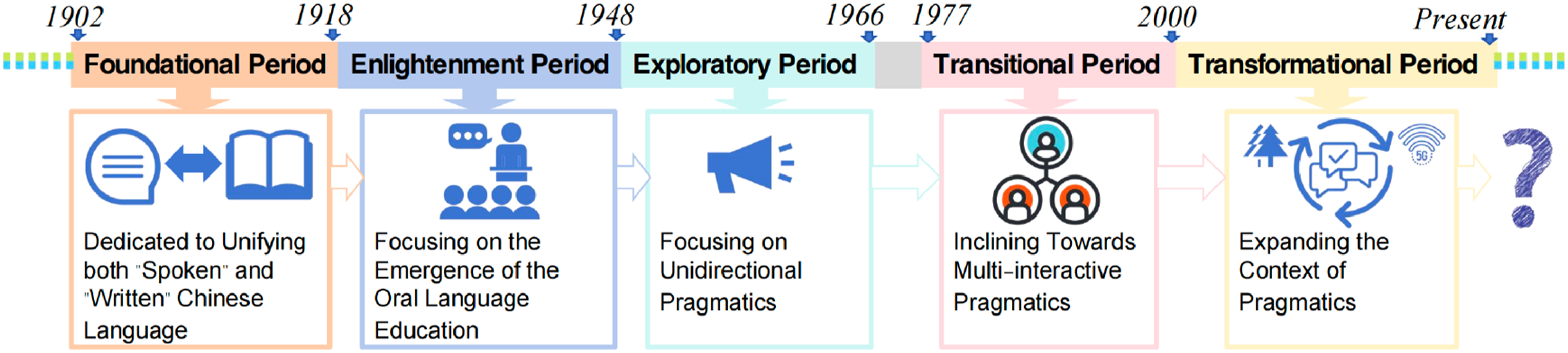
Firstly, enhancing the quality of “expressive pragmatics” is a fundamental aspect of teaching oral communication. The quality of expressive pragmatics encompasses both the formats and attitudes of language use. Regarding pragmatic forms, oral communication during crucial events and significant occasions, which aims to shape situations, differs from everyday casual conversations. It involves the clash of ideas, logical debates, and the pursuit of discursive influence. Therefore, placing excessive emphasis on everyday oral communication may be inappropriate in oral communication teaching. Regarding pragmatic attitudes, the modern era necessitates the cultivation of positive communicators. Positive communicators should possess a sense of agency, enabling them to express their thoughts freely and authentically. They should demonstrate unique and creative thinking abilities, capable of generating distinctive discourse. Moreover, they should exhibit accurate pragmatic judgment, eliciting consensus relevant to the context. Only communicators with a positive attitude can actively integrate existing language resources, creating high-quality discourse. This not only enables a country to break through and excel in the fiercely competitive international environment saturated with capital, but also serves as a powerful tool for elevating the relative value of China’s distinctive cultural capital to an advantageous position.
Secondly, creating authentic situational contexts represents a groundbreaking approach in oral communication teaching. Authentic situational contexts are essential for enhancing teaching efficiency. These contexts can be established through various means, including teacher-led oral scenarios, multimedia teaching tools, and artificial intelligence simulations. The improvement in educational science and technology offers opportunities for students to experience genuine environments. The scope of context creation has extended from a singular focus on synchronic pragmatic patterns and applications to the combination of diachronic and synchronic pragmatic patterns and applications. By analyzing communicative contexts from specific historical periods using a diachronic perspective and applying synchronic pragmatic patterns, this approach broadens the concept of authentic situational contexts. It opens avenues for drawing insights from historical and cultural communicative experiences and applying them to modern communicative contexts. The current demands of the era urge the Chinese people to transition from being “consumers” of language to becoming “producers” of language. The teaching and development of Chinese oral communication should be addressed with deep consideration from a national strategy perspective. China has entered a new era of “building a strong education nation” (Liu & Yuan, 2021), and is on the brink of enriching authentic oral communication teaching with the true essence of education.
Finally, the pursuit of “expressive power” is the fundamental goal of oral communication teaching. The effectiveness of expressive pragmatics, or “expressive power”, depends on various factors, such as the alignment of expression with the context, the speaker’s intellectual, emotional, persuasive power, as well as other comprehensive elements (Pan, 2020). It is crucial not only to focus on the outward “expressive behavior” of the speaker but also on the positive impact that such behavior generates in specific contexts, such as inspiring and captivating the audience. This kind of expressive proficiency represents a valuable form of “cultural capital” for the nation. Expressive pragmatics encompasses the effectiveness of “expressive behavior,” particularly in contexts requiring high standards of oral communication, such as speeches and debates. Without sufficient proficiency, it becomes challenging to elicit resonant and positive responses. The primary objective of oral communication teaching is to nurture learners who can actively, appropriately, and proficiently express new concepts and ideas in specific contexts. By fostering the development of expressive abilities, oral communication teaching plays a pivotal role in empowering new citizens to actively engage in reconstructing the global “new social contract” (UNESCO, 2021, p. 1). However, evaluating “expressive power” as part of the teaching process is multifaceted and is far more complex than merely assessing the ability to inspire and engage. This complexity necessitates the meticulous establishment of comprehensive and scientifically grounded evaluation criteria to support teachers in their instructional practices.
Conclusions
In summary, oral communication teaching plays a vital role in fostering comprehensive language literacy. Linguistic scholars strongly encourage the five million Chinese language teachers in China to draw advancements in language application assessment and take on the significant mission of developing citizens’ language proficiency by actively promoting the teaching of oral communication and expression (Li & Zhu, 2020). Reflecting on the dynamic evolution of Chinese oral communication teaching and its academic history, the field is currently transitioning towards an interactive listening and expression within specific contexts, emphasizing a reciprocal exchange between receiving and producing language. “Expressive power” remains the central focus of instruction, centered on the effective conveyance of ideas. Within the broader framework of Chinese language and literature teaching, it is essential for the “three pillars” — oral communication teaching, reading instruction, and writing instruction — to complement each other. Only through this integrated approach can the existing imbalance in language education, which often prioritize “writing” while overlooking the essential “speaking” aspect, be effectively addressed.
Footnotes
Declaration of conflicting interests
The author(s) declared no potential conflicts of interest with respect to the research, authorship, and/or publication of this article.
Funding
The author(s) disclosed receipt of the following financial support for the research, authorship, and/or publication of this article: This study is supported by the Zhejiang Province’s Graduate Education Reform Project for the 14th Five-Year Plan (No. ZXWB[2023]-1-371) and Special Cultivation Program for Rural Education Projects in Lishui University (No. [2023]18-04) to Y.D.L. The funding agency had no role in the study design; collection, analysis, and interpretation of data; writing of the report; and the decision to submit the article for publication.
