



Abstract
Learning to read Chinese has been the main focus of Chinese heritage language education. The frequency of exposure to orthography–phonology and orthography–semantics correspondences and radical awareness play a significant role in character learning. However, limited exposure to characters in Chinese textbooks and the lack of explicit instruction on phonetic radicals have been proposed as limitations of conventional instruction methods used with Chinese heritage language learners. The current study assessed the efficacy of providing frequent character exposure in group reading activities for Chinese heritage children in their early learning to read Mandarin Chinese through a teaching method called Progressive Character Reading. The effectiveness of the teaching method on Chinese character acquisition and Chinese reading comprehension was examined through a quasi-experimental framework that compared a group of children undergoing the new teaching method (experimental group, n = 20) with a group of learners experiencing the traditional textbook-based instruction (control group, n = 20). Significant differences in gains between these two groups were found in measures of Chinese character reading, character–picture matching and Chinese sentence comprehension. These results suggest that group reading activities with frequent character exposure can increase learning for Chinese heritage language learners over that associated with conventional textbook-based instruction.
I Introduction
In English-speaking countries, a heritage language is a language other than English that has personal and family relevance (Fishman, 2001). Chinese heritage language learners, therefore, are raised in Chinese-speaking families and can speak, or at least understand, the Chinese language (He, 2008). Research on children and adults who are Chinese heritage language learners (Y. Xiao, 2006; Yu, 2015) has found that these learners can master Chinese speaking and listening skills but face more challenges with acquiring reading and writing skills. To some extent, Chinese heritage language learners are bilingual but not bi-literate. They do not have the same literacy proficiency in Chinese that they do with the dominant language within the country in which they are living (Dai & Zhang, 2008; Koda, Zhang, & Yang, 2008).
The development and maintenance of Chinese heritage language learners’ Chinese literacy are traditionally considered in teaching and learning Chinese characters (the Chinese language script). A Chinese character corresponds to a morpheme (i.e. the smallest unit of meaning in a language) and a syllable rather than phonemes (i.e. the smallest unit of sound in a language) (Tong, McBride-Chang, et al., 2017). The pronunciation of Chinese characters can be denoted via Pinyin (a Romanization system for Mandarin Chinese 1 ). The smallest graphical unit within a character is a stroke. For example, the character 十 (pronounced shí, referring to the number ‘ten’) is formed of basic strokes 一 and 丨. Individual strokes do not represent meaning or sound, but stroke patterns, called radicals, can provide hints of the meaning or pronunciation of the character. Semantic radicals imply the character’s meaning, and phonetic radicals imply the character’s pronunciation. For instance, a character 妈 (mā ‘mother’) has a semantic radical 女 which denotes female and a phonetic radical 马, which represents the sound mǎ.
There are two types of characters: simple and compound. Simple characters are composed of strokes and do not have radicals, such as 土 /tǔ/ (‘soil’) and 头 /tóu/ (‘the head’). The mapping from the form (orthography) to the meaning (semantics) of a simple character and from the form (orthography) to the pronunciation (phonology) is not systematic. Orthographically similar characters usually do not share semantic properties, such as 人 /rén/ (‘a person’), 大 /dà/ (‘big’), and 天 /tiān/ (‘sky’). Orthographically different characters may have similar meanings, such as 干 /gān/ (‘dry’) and 水 /shuǐ/ (‘water’). In contrast, orthographically similar characters are often pronounced in different ways, for example, 口 /kǒu/ (‘the mouth’), 日 /rì/ (‘the sun’) and 田 /tián/ (‘the field’).
Compound characters have two or more orthographic units (e.g. having two radicals or having one radical and some strokes). Most compound characters are phono-semantic compound characters of one semantic radical and one phonetic radical. For example, a phono-semantic compound character 草 /cǎo/ (‘grass’) has a semantic radical 艹 that denotes plants and a phonetic radical 早 /zǎo/ that provides the clue of the pronunciation /cǎo/. It is reported that over 80% of Chinese characters are phono-semantic compound characters (Tong, McBride-Chang, et al., 2017; Tzeng, 2002). This type of character accounts for 55% of characters in the textbooks for Chinese heritage children (Koda, Lü, & Zhang, 2008) and 72% of characters in Chinese language textbooks at the primary school for Chinese native children (referring to children who learn Chinese as the first language) (Shu et al., 2003).
Chinese heritage children share some similarities with Chinese native children regarding Chinese character learning, such as having developed Chinese listening and speaking skills before learning characters. However, Chinese heritage children are likely to experience less language input than Chinese native children because heritage language acquisition happens in a bilingual environment (Montrul, 2010). Learning motivation also influences successful Chinese language learning for Chinese heritage children (Comanaru & Noels, 2009). Despite their differences, Chinese heritage children have been taught a similar approach to Chinese native children in conventional Chinese lessons (Cao, 2014). It has been argued that Chinese heritage children would benefit from learning characters via reading and in contexts (e.g. J. Li, 2006; Lü, 2017).
II Literature review
1 Lexical constituency model
The Lexical Constituency Model has been used to conceptualize Chinese character recognition (Perfetti & Tan, 1998, 1999; Perfetti et al., 2005). This model assumes that a word is represented by its orthography, phonology and semantics (Perfetti & Tan, 1998). Written word recognition entails retrieving phonological and semantic representations from their orthographic representation (Perfetti et al., 2005). Difficulties in developing word recognition skills are due to the reader’s incomplete word knowledge in their mental lexicon (Perfetti & Hart, 2002).
There are four separate subsystems in the memory of the Chinese reader, and each subsystem consists of a set of representation units of Chinese characters (Perfetti & Tan, 1999). The four separate subsystems are the character orthographic subsystems containing characters and radicals that are stand-alone characters, the noncharacter orthographic subsystem that contains radicals that are not characters by themselves, the phonological subsystem and the meaning system.
When reading Chinese characters, the basic features of Chinese characters (i.e. strokes and radicals) are analysed once visual input is received (Perfetti & Tan, 1999). The detected radicals prompt activation of the orthographic units in the character orthographic subsystem and the noncharacter orthographic subsystem in memory. A semantic radical or a phonetic radical input activates all Chinese characters that contain the radical in the same position and the radical itself if it is a stand-alone character in the character orthographic system. The activations happen in a threshold style, and the related units will be activated once reaching the threshold. The threshold of orthographic units in the character orthographic subsystem and the non-character orthographic subsystem relies on the frequency of encounters with printed characters and noncharacter radicals. After the orthographic units are activated, it simultaneously sends activation to the corresponding units in the phonological subsystem and meaning subsystem. The threshold of phonological units or meanings is determined by the frequency of previous successful activations of the phonology or the meaning associated with the character.
The threshold style differs from the cascaded manner assumed in dual-route models (e.g. Coltheart, 1985, 2006), which assumes that the word-level phonology in an alphabetic system can be activated before a complete spelling of the word. The threshold style means that a Chinese character’s phonology is not activated before the character’s orthography is fully activated.
2 Factors related to character learning for Chinese heritage children
Radical awareness and the frequency of exposure to characters affect character learning based on the Lexical Constituency Model (Perfetti & Tan, 1998). When reading a Chinese character, the character is decomposed into radicals, and the input of radicals activates related characters in the reader’s mental lexicon (Perfetti & Tan, 1999). Previous research has reported positive effects of radical awareness on Chinese native children’s character acquisition (Anderson et al., 2003; C.S.-H. Ho, Ng, & Ng, 2003; Shu & Anderson, 1997; Tong, Tong, & McBride, 2017). However, few studies have investigated Chinese heritage language learners’ radical awareness and its impact on Chinese character learning. Koda, Lü and Zhang (2008) found that Chinese heritage children’s semantic radical awareness was underdeveloped and remained at the basic level throughout the primary school years.
The frequency of exposure to a Chinese character determines the threshold of phonological, orthographic and semantic units (Perfetti & Tan, 1998). The frequency of character encounters has positively affected learners’ performance for Chinese lexical decision and character naming tasks in previous research (Liu et al., 2007; Sze et al., 2015). Research also found that frequent exposure to characters in independent reading activities positively affected Chinese character acquisition (W.-M. Ho, 2014; L.Q. Xiao, 2013). Chinese second graders could self-teach orthographic representations of Chinese characters after only six exposures to the characters (Liu & Shiu, 2011, as cited in W.-M. Ho, 2014). Compared to Chinese native children, Chinese heritage children have more limited exposure to Chinese characters in their daily lives. For example, they are not exposed to Chinese characters, such as those on billboards and on the label of products in the supermarket, as often as Chinese native children. Most character exposure occurs through Chinese lessons or Chinese literacy activities at home, such as reading Chinese books or watching movies with Chinese subtitles. There is little research that analyses Chinese heritage children’s exposure to characters. Koda, Lü, and Zhang (2008) compared textbooks used by Chinese native and Chinese heritage children. They found that Chinese heritage children were only exposed to 36% of characters taught to Chinese native speakers in textbooks. They argued that the restricted exposure to Chinese characters in the early grades was insufficient to develop the radical awareness required for learning compound characters in the later grades (Koda, Lü, & Zhang, 2008).
Teaching methods in Chinese community schools also affect character learning because most Chinese heritage language learning activities are conducted in Chinese community schools (Chang, 1998). Conventionally, Chinese heritage language learners have been taught based on methodologies for teaching native Chinese children (Cao, 2014), which are teacher-centred and textbook-based (S.K. Tse et al., 2007). Teaching procedures generally follow a bottom-up model of learning that begins with learning how to write Chinese characters, comprehending sentences, paragraphs, and finally, whole passages (Curdt-Christiansen, 2006; S.K. Tse et al., 2007; Pu, 2010).
Research has identified several limitations to the conventional teaching method in developing Chinese language skills in Chinese Heritage Learners. Teachers usually teach the meaning of semantic radicals (C.S.-H. Ho, Yau, & Au, 2003; Wu et al., 1999); however, they do not teach how characters can be separated into semantic and phonetic radicals, the function of semantic radicals systematically, or the sound of phonetic radicals (Wu et al., 1999). Textbooks in Chinese community schools typically have limited or no information about phonetic radicals, although semantic radicals are covered (Lin & Collins, 2012). Such textbooks also provide infrequent exposures to orthographic, phonological, and semantic representations of new characters. The lack of explicit instruction on radicals and the limited exposure to Chinese characters means that it may take longer for Chinese heritage children, compared to Chinese native children, to develop radical awareness, which is fundamental to Chinese character learning.
Conventional teaching practices focus on coding/decoding activities, repetitive drills and rote memorization. Research suggests that these practices can negatively affect students’ motivation causing students to resist attending Chinese schools (Curdt-Christiansen, 2006; Jiang, 2010; M. Li, 2005; Y. Xiao, 2008). In English-speaking countries, Chinese heritage children experience a different learning approach in public English-medium primary schools. Reading activities (such as shared reading, guided reading, and independent reading) are critical components of teaching English literacy (Chamberlain & Forkert, 2019). Chinese heritage children may find the learning experience of conventional Chinese teaching methods less enjoyable, leading to less engagement and poorer learning outcomes: The dominant language of the surrounding community may become the preferred language partly because of different learning experiences. Therefore, researchers have argued that Chinese heritage children would benefit from teaching methods where characters are learned via reading and in contexts (e.g. J. Li, 2006; Lü, 2017).
Radical awareness and the frequency of exposure to characters affect character learning; however, conventional Chinese lessons for Chinese heritage children, has paid insufficient attention to developing children’s radical awareness, especially phonetic radicals, and the frequency of exposure to Chinese characters in the lessons. Teaching methods, including reading activities similar to the instruction in the schools children attend, may be more suitable for Chinese heritage language learners (Y. Chen, 2018; J. Li, 2006; Lü, 2017). Research is required to investigate the potential effectiveness of such teaching methods for these children.
We aimed to explore this issue by examining the efficacy of a teaching method for Chinese heritage children at the early stages of learning to read characters called Progressive Character Reading (PCR). PCR combines character learning activities with group reading activities. Three features of the PCR method are progressive scaffolding of character learning, frequent exposure to Chinese characters through texts, and explicit instruction about phonetic and semantic radicals. The study reported in this article assessed the impact of the frequency of exposure to characters on character learning. The study also assessed the effect of the PCR method on Chinese reading comprehension.
In the present study, two research questions were addressed.
• Research question 1: Compared to the textbook-based instruction, does the PCR method show more significant improvements in Chinese heritage children’s knowledge of orthographic, phonological, and semantic representations of characters?
• Research question 2: Does the PCR method show more significant improvements in Chinese heritage children’s Chinese reading comprehension?
III Methodology
1 Participants
The current study was part of a wider research project carried out in a Chinese Community School (referred to as ‘the School’) in a large urban city in Aotearoa New Zealand, from 2019 to 2020 (see M. Cheng, 2022). In Aotearoa New Zealand, Chinese heritage language learners primarily learn to read and write Chinese in Chinese community schools on weekends or after school (A.-H. Ho & Wang, 2016; J. Li, 2006). Most children enrolled in New Zealand Chinese community schools began attending such schools at the age of five years, the same age as they typically start mainstream primary school (A.-H. Ho & Wang, 2016). However, the class level of children at the School depended on their Chinese language level rather than their age meaning that classes could consist of children of varied ages.
A total of 40 students (26 girls and 14 boys) from Year 1 Chinese classes at the School participated in the study. Most of students in the School were Chinese heritage language learners raised in a Chinese-speaking family who understood spoken Chinese language. The School provided 1.5-hour lessons on Saturdays for students to learn Mandarin Chinese and simplified Chinese characters using conventional textbook-based instructions. Students were required to learn Pinyin before admittance into the Chinese classes.
Students’ parents self-selected placement in the experimental or control group to meet the ethical requirements of the research and the need to separate children between classes. The experimental group was taught by a researcher (the first author) using the PCR method. The control group was taught by a teacher from the School using conventional textbook-based instruction. There were 20 students in the experimental group (12 girls and 8 boys; mean age 7.05 years [SD = 1.23]; age range 5.5–9.83 years) and 20 students in the control group (14 girls and 6 boys; mean age 7.85 years [SD = 1.36]; age range 5.75–10 years).
In the experimental group, 55% of participants only spoke Chinese at home, and 45% spoke Chinese and English at home. In the control group, half of the participants only spoke Chinese at home, and the other half spoke Chinese and English at home. The study met the requirements of the ethics committee of the hosting university.
2 Measures
Participants’ Chinese character knowledge and reading comprehension were assessed by a series of measures administered pre- and post-instruction programme. Chinese character knowledge examined in this study comprised the knowledge of orthography–phonology correspondences and orthography–semantic correspondences. Chinese reading comprehension was assessed by tasks requiring reading individual sentences and short passages. Chinese vocabulary and English word recognition ability were assessed only prior to the teaching classes to control for any differences between the two groups in the study. Research has indicated that Chinese oral vocabulary knowledge is closely related to Chinese character recognition (McBride, 2016; Pan et al., 2011; Zhang & Koda, 2018), and English literacy ability may be associated with Chinese literacy ability (He, 2008; Wang et al., 2009).
a Character listening task
The visual–auditory discrimination subscale in the Preschool and Primary Chinese Literacy Scale (H. Li, 2015) was used to assess the knowledge of orthography–phonology correspondence of Chinese characters. The task comprised one practice item and 20 test items. The test was administrated individually. For each item, the assessor read aloud a Chinese character and verbally presented a word which contained the Chinese character. The given word was used to help participants distinguish the test character from homophones that occur regularly in Chinese due to opaque orthography–phonology correspondences. Each item included four alternatives, which were shown to the student: the correct character, a character that sounded similar to the correct character, a character that looked similar to the correct character, and a character that could form a compound word with the correct character.
For example, the test item 天(tiān ‘sky’). Responses: 天(tiān ‘sky’), 田 (tián), which has the same pronunciation as 天 (tiān) but a different tone, 人 (rén), which looks similar to 天 (tiān), and 上 (shàng) which can be combined with 天 (tiān) to form a compound word 天上 (tiān shàng ‘in the sky’).
Participants were asked to point to the Chinese character they thought was the correct character the assessor spoke. One mark was given for each correct answer, with the maximum score for this task being 20. The internal consistency of this task was Cronbach’s α=.65. This was considered acceptable given that several measures of Chinese character recognition were used in the study.
b Character reading task
This task comprised 50 items (Chinese characters), including 30 items from the Preschool and Primary Chinese Literacy Scale (H. Li, 2015) and an additional 20 items chosen from the level 1 Chinese character list of the Huawen Shuiping Ceshi (HSC). The HSC test is a Chinese proficiency test for Chinese heritage language learners (see H.W. Wang & Liu, 2019; Zhen, 2019). The 50 items in the Character Reading Task were presented on paper in sets of 10 and graded in order of difficulty from simple characters to more complex compound characters (i.e. from characters having fewer strokes and radicals to characters having more strokes and radicals).
Participants were tested individually and were required to read aloud the characters one by one from the top of the list and from left to right. They were told they could skip those characters they did not know how to read. The test was not timed, and self-corrections were allowed. One point was given for each item read correctly, with scores ranging from zero to 50. The internal consistency reliability of this task was Cronbach’s α = .72.
c Chinese-picture matching task
There were 35 items in this task, including 25 items from the Preschool and Primary Chinese Literacy Scale (H. Li, 2015) and 10 items from the level 1 Chinese character list of the HSC Test. Each item comprised a Chinese character and four pictures. The four pictures included a correct answer, a picture that did not relate to the correct answer, and two pictures that were related to the correct answer.
For example, for a test item 天 (tiān), which means ‘the sky’. Correct response: ‘sky’. The other three responses included mountains, trees and listening to music. The mountains and trees pictures are related to the sky because they all belong to nature, whereas the picture of listening to music represents a human activity that is not semantically related to the sky.
This task was presented on paper. The participant read each test character and then selected the picture representing the Chinese character’s meaning. Each correct answer was given one mark, with the maximum score being 35. This measure yielded a Cronbach’s alpha of .79.
d Chinese sentence comprehension task
This task was developed for the current study using a sentence–picture matching task in a multiple-choice format. The 10 items comprised a sentence in Chinese and four pictures. Chinese characters in the 10 sentences were chosen from the level 1 Chinese character list of the HSC Test. Each sentence ranged from 7 to 15 characters and was short narratives describing common activities children encounter in daily life (such as the weather, family members and running in a park). Of the four pictures presented with each sentence, only one picture represented the meaning of the given sentence. The other three pictures included two pictures that partially represented the meaning of the sentence and one picture that did not relate to the sentence.
For example, for the test sentence 下雨了,天气很冷, which means ‘it is raining and cold’, the three alternatives other than the correct answer were a picture that represented snowing rather than raining, a picture that represented hot weather, and a picture that represented a boy playing basketball.
The task was administrated individually, with all items presented on paper. Each participant read sentences by themselves and circled the picture which they thought represented the meaning of the given sentence. The assessor did not provide any help with reading sentences and told participants that they could skip the sentences which they could not read. A correct answer was given a point, with the maximum score being 10. The task produced a Cronbach’s alpha score of .56 in the pre-teaching test, potentially consistent with the relative complexity of the task for inexperienced readers. After 10 teaching sessions, the task yielded a Cronbach’s alpha score of .65 for the experimental and .67 for the control groups.
e Chinese passage comprehension task
A Chinese Passage Comprehension Task was developed for the current research to measure participants’ reading comprehension at the passage level. This task consisted of four short passages and 20 open-ended questions based on two scales from the Progress in International Reading Literacy Study (Mullis & Martin, 2016); retrieval and straightforward inferencing, and interpreting, integrating and evaluating. The four short passages comprised between 29 and 45 words. Chinese characters in all passages were chosen from the level 1 Chinese characters list for the HSC Test. The 20 open-ended questions presented with the four passages included 11 retrieval and straightforward inferencing questions, and 9 interpreting, integrating, and evaluating questions.
Participants were tested individually. Participants were asked to read passages and to answer questions orally presented. One point was given when the answer was pertinent, with the total for the task ranging from zero to 20. The task yielded a Cronbach’s alpha score of .63 for the experimental group and .41 for the control group in the post-teaching phase, suggesting that with teaching, the experimental group were more consistent in their performance. (Calculations could not be performed pre-teaching as all participants scored zero on this measure at the start of the study.)
f English word reading task
English word recognition ability was assessed using the Burt Word Reading Test (New Zealand Revised) (Gilmore et al., 1981), which is the only New Zealand standardized norm-referenced word reading test for 6–13 years old children (L. Tse & Nicholson, 2014). The test comprised 110 stimulus words presented on paper. These were divided into groups of 10 words that increased in complexity. The task was administered individually, and each participant was asked to read out loud the stimulus words from the top of the word list and from left to right. The task was not timed, and self-corrections were allowed. The test ended when 10 consecutive words were misread. The assessor showed the remaining words and asked participants if they could recognize any other words. The maximum score for the test was 110, and it produced a Cronbach’s alpha of .99 with these students.
g Chinese vocabulary task
The Peabody Picture Vocabulary Test (Fourth Edition) (Dunn & Dunn, 2007) was used as a basis to develop a test to assess the participants’ Chinese vocabulary levels in this research. Items from Set 1 (for 2-year-old learners) to Set 15 (for young adults who are over 19 years old) were used as the basis to produce Mandarin Chinese items in this study. There were sets of 12 Chinese words across 15 sets (180 words in total). For each item, four pictures were given, including a picture which represented the meaning of the given word and three pictures that did not represent the meaning of the given word.
Participants were tested individually, and each participant listened to a word spoken by the assessor and then selected one of four pictures that best described the word’s meaning. The score was the total number of items out of a maximum of 180. The test produced a high internal consistency value (Cronbach’s α = .95).
3 Procedure
Pre-teaching tests were administered towards the beginning of a semester at the School. Each measure was conducted individually by the first author and four trained research assistants. The pre-teaching tests took approximately 60 minutes to complete and were administered over three sessions of 20 minutes each. Immediately following the 10 teaching sessions, the post-teaching tests were administered. These took less than 60 minutes to complete over two sessions.
4 Teaching sessions
Ten sessions were conducted as a part of the normal lessons in the Chinese Saturday program of the School in 2019. Each session lasted 1.5 hours.
a Experimental group
The PCR method in the experimental group provided progressive scaffolding of character learning and frequent exposure to Chinese characters through texts. These features are demonstrated in the reading materials and teaching procedure described below.
The reading materials for PCR were based on carefully designed narratives and differed from the format of reading materials used in conventional Chinese textbooks. In traditional textbooks, ‘new’ characters are typically presented with their Pinyin version placed on top of the characters. The rationale is that the more alphabetic/syllabic form of Pinyin will allow the child to decode the Pinyin character string and then learn to associate this pronunciation, and its oral vocabulary entry, with the Chinese character form. Although this may be a useful tool for the initial learning of a character, it may inhibit character learning in text. In the PCR method texts, target characters to be learnt in the text and characters taught in previous texts were presented without accompanying Pinyin, while all other words were presented in Pinyin without characters. Placing phonological aids (Pinyin) alongside Chinese characters may not contribute to learning Chinese characters as attention will be diverted from analysing the Chinese character orthographic representation (W.-M. Ho, 2014). In contrast, unknown characters are taught using teacher-led and group reading activities so that the teacher models the reading of the characters within the text for the learner to follow.
Apart from the targeted Chinese characters, texts comprised words with which the learner should be familiar. This ensured that the target characters were likely to be the only new information beyond the learner’s current knowledge of Chinese. According to Vygotsky (1978), learners acquire a language when they are given appropriate input within a Zone of Proximal Development, which refers to the distance between the actual development level (determined by independent problem-solving) and the potential development level (determined by problem-solving under adult guidance or collaborating with more capable peers) (Vygotsky, 1978). In the current context, students may not be able to read these texts on their own. Still, they are likely to be able to work it out with support from the teacher and accomplish the same task on their own the next time. This shows the progressive scaffolding of character learning in the PCR method.
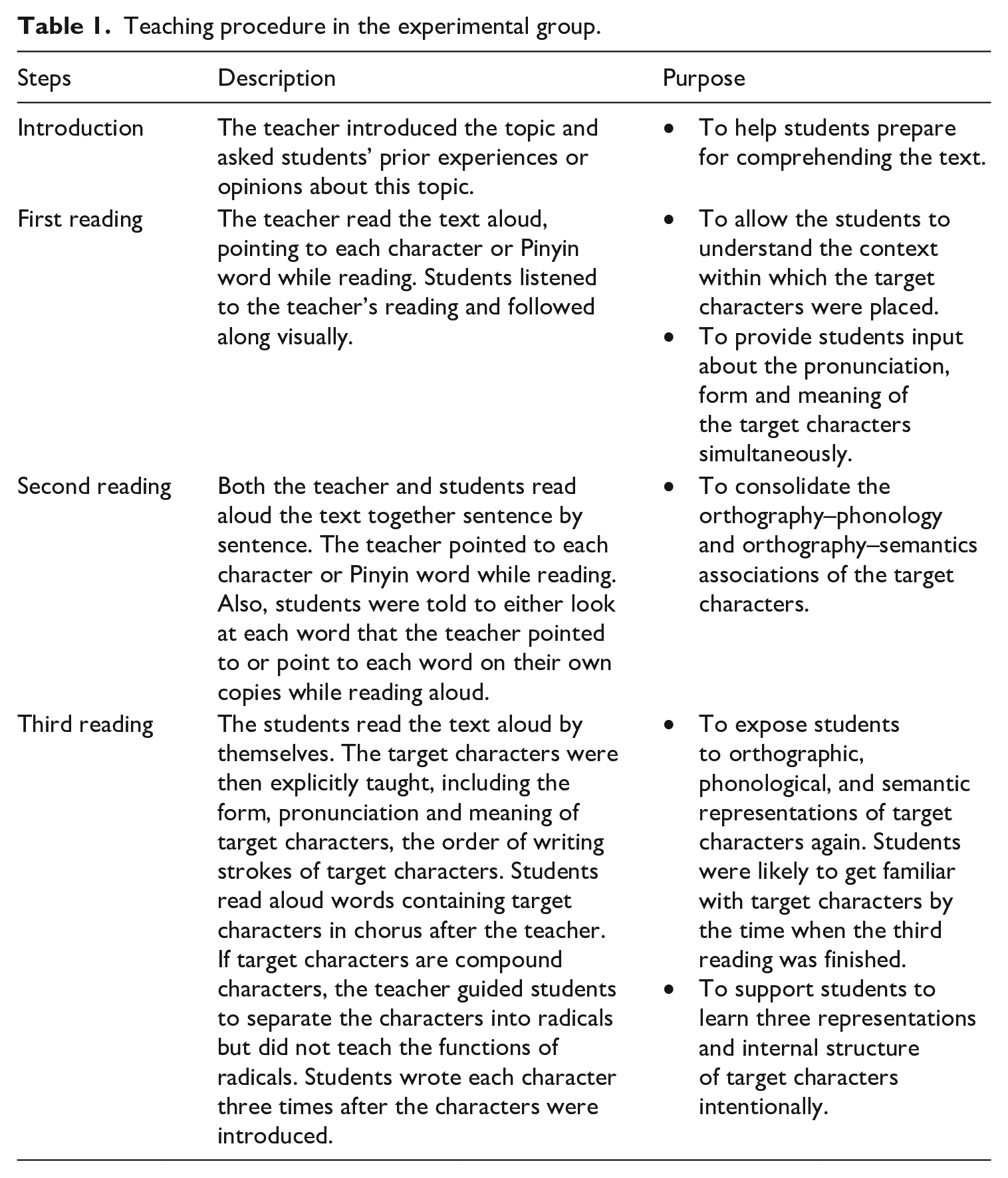
The reading materials provided repetitive inputs of target characters to increase the frequency of exposure to characters, which has been shown to positively affect Chinese character recognition (Liu et al., 2007). Research has suggested that learners can acquire simplified Chinese characters after being exposed to these characters around six times (Liu & Shiu, 2011). Therefore, target characters are repeated six times in every reading material. Repeated teacher-led group readings of materials are used to model text reading, after which the target characters were explicitly taught. The teaching procedure is presented in Table 1.
Teaching procedure in the experimental group.
Target characters for the experimental group were chosen from the level 1 Chinese character list of the HSC Test (see Table 2). Stories were displayed on a big screen via PowerPoint in front of the whole class. Chinese characters in the stories were shown in 45 Kaiti font, and Pinyin words were in 45 Songti font, respectively. Pinyin words in black font and Chinese characters highlighted in other colours. There were two or three sentences on each PowerPoint slide. Every student had one copy of the story. After each session, students were asked to read the story and do an A4 size double-sided worksheet at home. The worksheet included character writing practices (e.g. tracing characters, filling in the blanks in sentences), character recognition practices (e.g. multiple choices) and reading comprehension practices (e.g. drawing a picture based on a sentence in Chinese).
Reading materials: Experimental group.
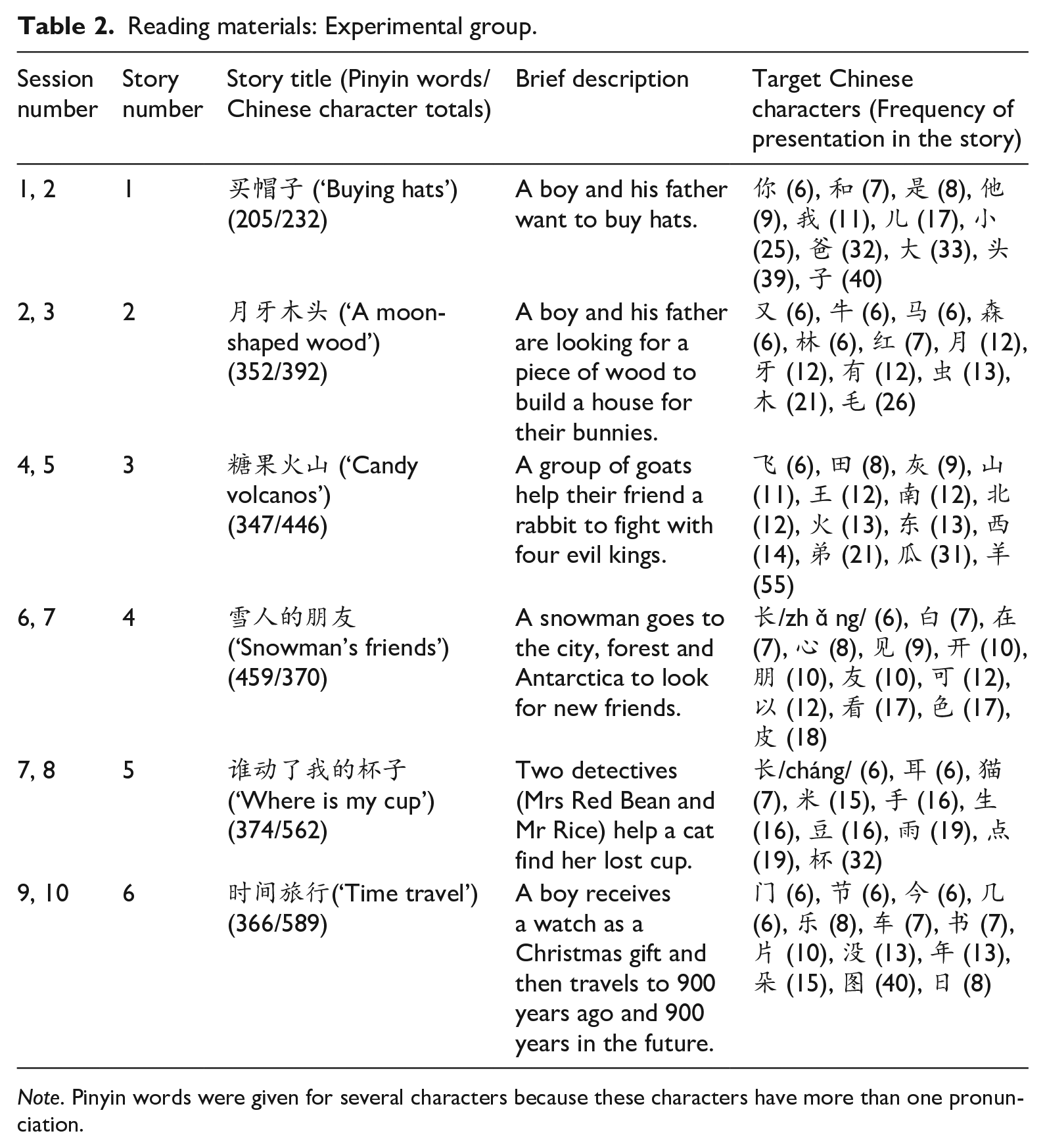
Note. Pinyin words were given for several characters because these characters have more than one pronunciation.
b Control group
The Teacher was informed about the current research and understood that participants joining the control group would join her class. In this class, the Zhongwen Textbook (Year 1) would be the primary teaching material, following the curriculum in the School. The Teacher was asked to deliver the lessons the way the Teacher usually did and was informed that the teaching would not be affected by the current research. After the 10 teaching sessions, the teacher provided the details of the taught characters and teaching procedures to the researcher. The 10 teaching sessions covered Lesson 2 to Lesson 6 in the textbook. Each lesson included, on average, 14 target characters and a 32-character-long text (see Table 3).
Teaching materials: Control group.
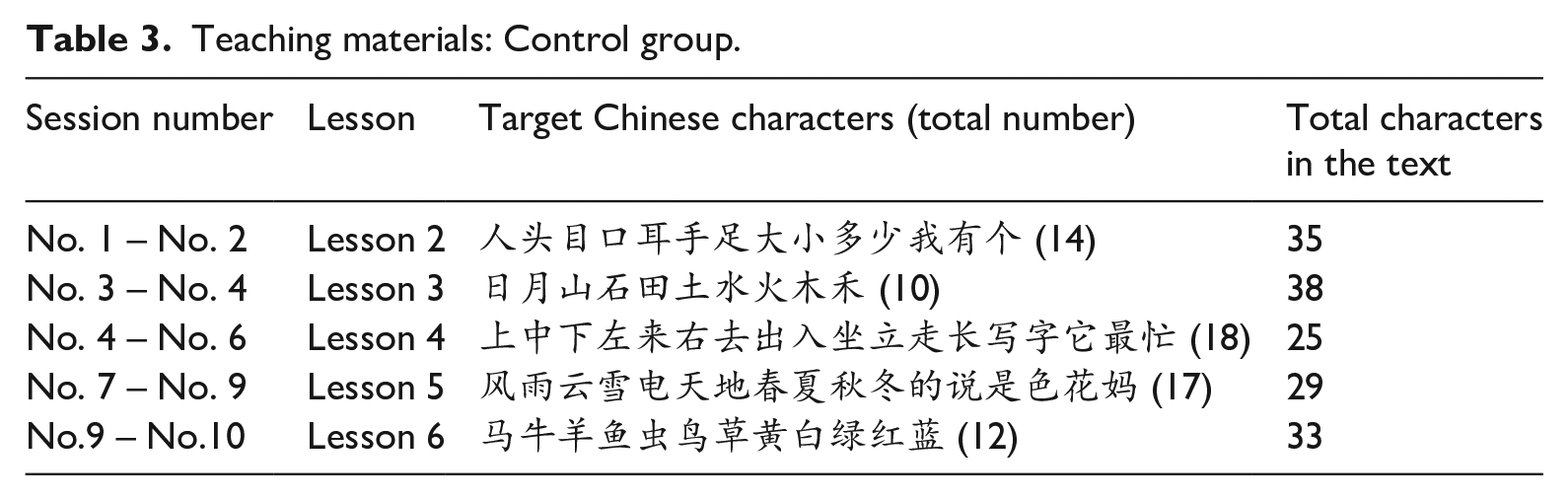
In total, 71 target Chinese characters were taught during the 10 teaching sessions. In the first six lessons of the Zhongwen Textbook for Year 1 students, most target characters were simple characters and had related meanings; for example, the target characters in Lesson 2 were about body parts. However, not all of the target characters were included in the text used in the lesson because the first six lessons focused more on recognizing individual characters rather than comprehending text. In the subsequent six lessons in the textbook, all target characters were included in the texts, which were relatively longer than those used in the first six lessons. In addition, all reading texts in the Zhongwen Textbook were annotated with Pinyin words, although some reading or writing tasks in the textbook questions were only presented in Chinese characters.
Each lesson was taught over 2–3 sessions using the following procedure. First, target characters’ form, pronunciation and meaning were taught, and character recognition practices were conducted, such as students looking at and reading these characters aloud. Students then learned how to write the target characters and practised writing, such as counting stroke numbers and remembering each character’s writing strokes. Students were then guided to read and comprehend the text in the lesson, with the read-aloud practice facilitated by Pinyin words. Finally, students practised using the target characters in the Zhongwen Workbook (Year 1), which matched with the Zhongwen Textbook (Year 1). After each session, practice in the Zhongwen Workbook (Year 1) was assigned as homework, and students were asked to memorize how to write target characters at home. In the following session, the Teacher read aloud all characters taught in the last week, and students wrote the characters in their notebooks by memory without looking at the textbook.
c The similarities and differences
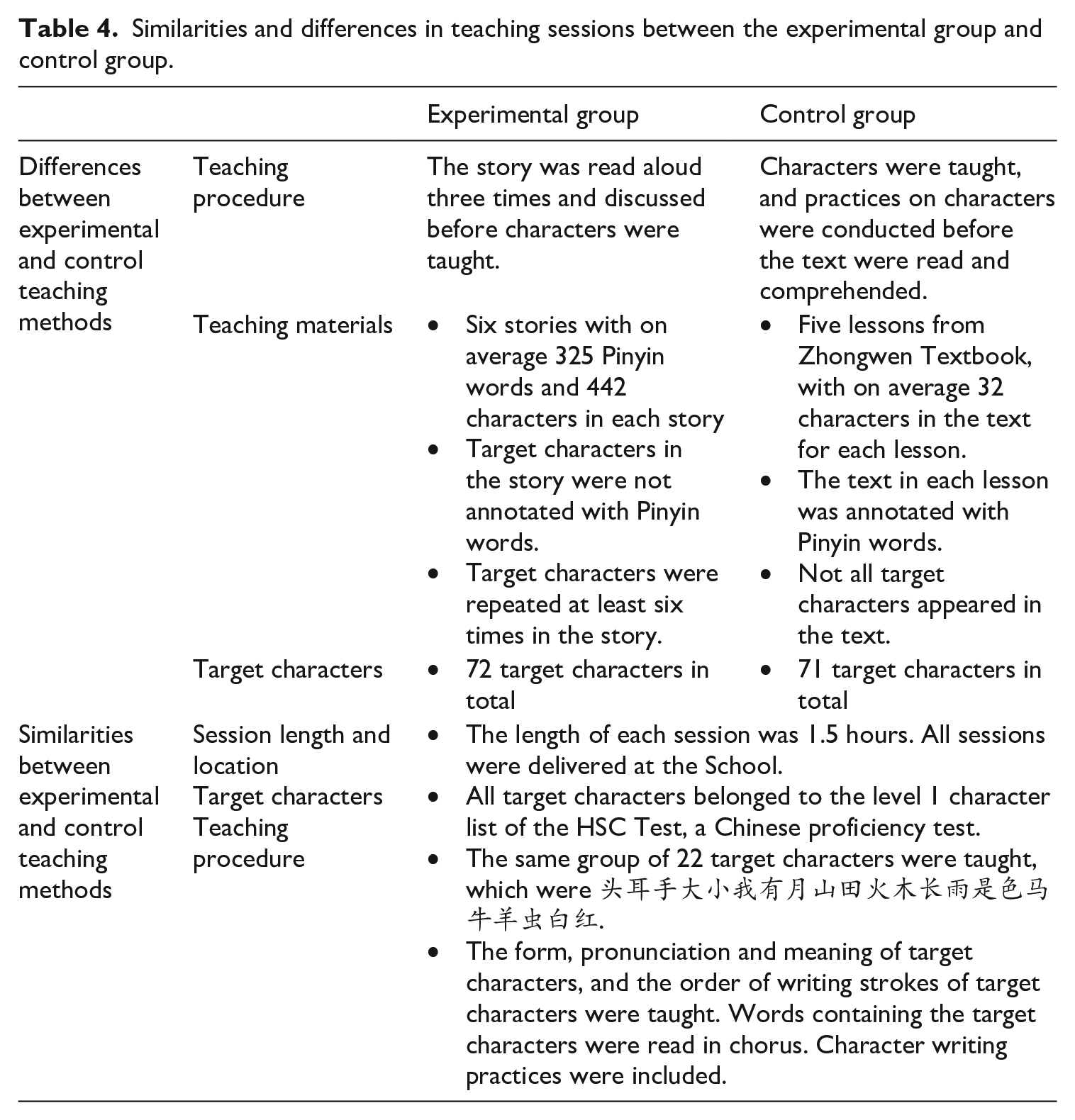
There were two main differences in teaching sessions between the experimental and control groups, based on the materials and the time spent reading (see Table 4). The reading materials for the experimental group were longer and provided more exposure to target characters than the texts for the control group. The group reading activities took the majority of session time for the experimental group. In contrast, learning and practising target characters were the control group’s main part of each session. These differences were implemented to answer the research questions for this study.
Similarities and differences in teaching sessions between the experimental group and control group.
IV Results
Pre-test data were initially analysed to investigate whether significant differences existed between the two groups prior to the 10 teaching sessions. Subsequent analyses were performed to determine if students in the experimental group showed more significant improvements in Chinese character knowledge and reading comprehension measures than their counterparts in the control group over the 10 teaching sessions. Data were analysed using IBM SPSS (Statistics 25).
Descriptive statistics for both groups are presented in Table 5. Any potential difference between the two groups in demographic variables was examined. Results from Chi-square tests indicated that there were no significant differences between the experimental group and the control group in terms of gender, χ2 (1, N = 40) = .44, p = .51) and home language, χ2 (1, N = 40) = .40, p = .53). An independent samples t-test showed that the difference between the two groups in age did not reach significance, t (38) = 1.97, p = .06.
Pre- and post-test scores for all measures.
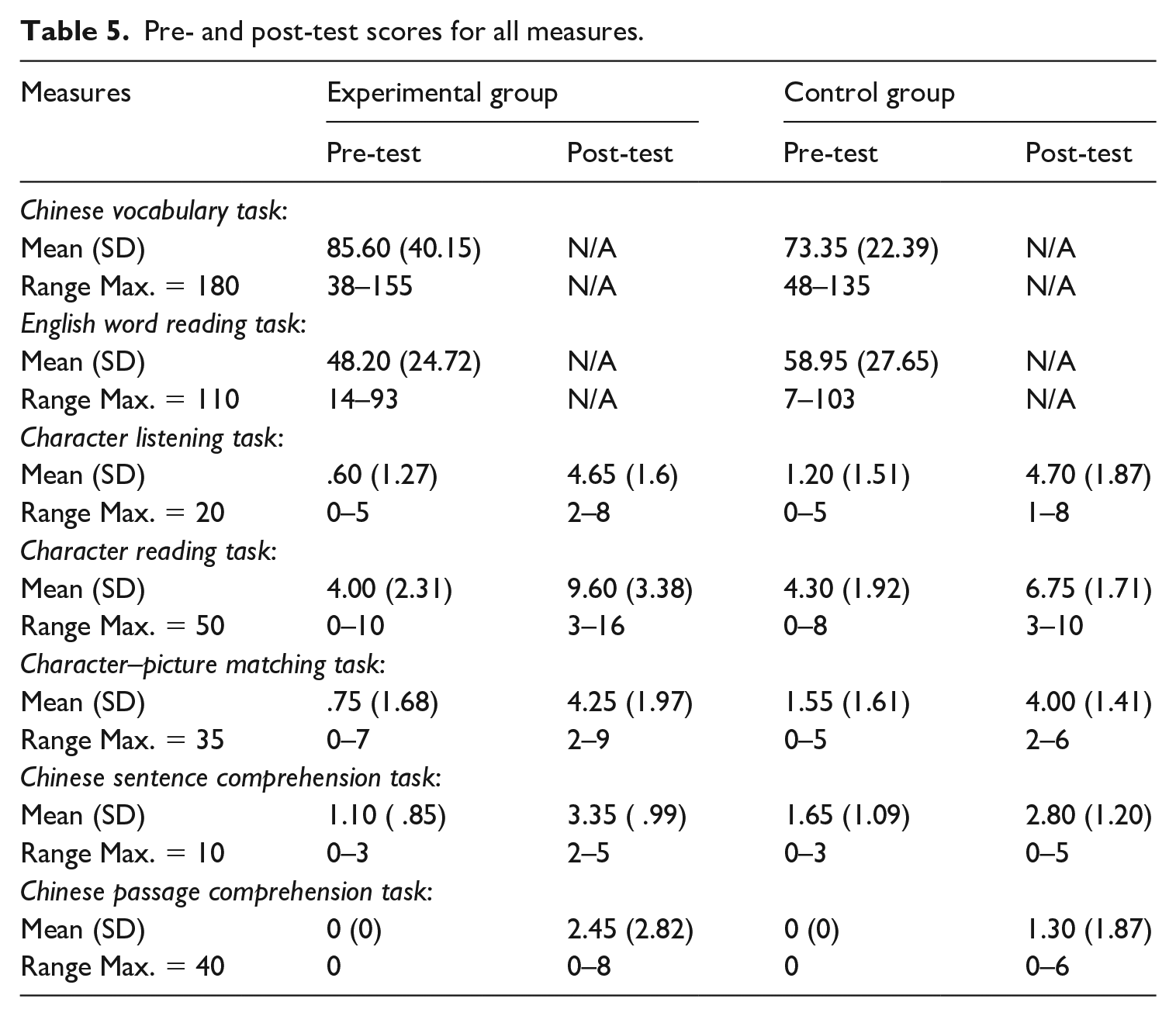
Independent samples t-tests were used to detect significant differences between the two groups in the pre-test measures. No significant difference was found in the Chinese Vocabulary Task (t = −1.19, df = 29.77, p = .24)2 or in the English Word Reading Task (t = 1.30, df = 38, p = .20). These results suggest that any differences between the participants in Chinese receptive listening vocabulary and English word reading skills were not significantly large compared to variability between individuals. As for other pre-test measures, no significant differences were found for the Character Listening Task (t = 1.36, df = 38, p = .13), the Character Reading Task (t = .45, df = 38, p = .66), the Character–Picture Matching Task (t = 1.54, df = 38, p = .13) and the Chinese Sentence Comprehension Task (t = 1.78, df = 38, p = .08).
Mixed (one between and one within participants) analyses of variance were carried out to contrast the gains produced by the experimental and control groups. Overall, there was no main effect between groups. There was a significant main effect of time for the Character Reading Task (F (1, 38) = 122.06, p < .001, ηp2 = .76) and a significant interaction between group and pre/post scores (F (1, 38) = 18.69, p < .001, ηp2 = .33). The increase over time was higher for the experimental group than for the control group, suggesting the experimental group improved to a larger extent in reading characters. There was a significant main effect for time (F (1, 38) = 249.36, p < .001, ηp2 = .87) for the Character–Picture Matching Task. The interaction between groups and pre/post scores for the Character–Picture Matching Task was also significant (F (1, 38) = 7.77, p = .01, ηp2 = .17). The experimental group demonstrated larger improvements in their knowledge of orthography–semantics correspondence than the control group. Performance in the Character Listening Task did not show a significant interaction between group and pre/post measures (F (1, 38) = 1.34, p = .26, ηp2 = .03) although the task showed a significant main effect of time (F (1, 38) = 252.02, p < .001, ηp2 = .87).
The analyses indicated a significant main effect of time (F (1, 38) = 128.07, p < .001, ηp2 = .77) and a significant interaction between group and pre/post scores (F (1, 38) = 13.41, p = .00, ηp2 = .26) on the Chinese Sentence Comprehension Task. The increase over time was larger for the experimental group than for the control group. For the Chinese Passage Comprehension Task, an independent samples t-test was used to compare the two groups’ post-test scores (all students produced zero scores in the pre-test measure). This analysis indicated a non-significant difference between two groups (t = −1.52, df = 32.98, p = .14).3
V Discussion
This study aimed to explore the effectiveness of the PCR method on promoting Chinese character acquisition and reading comprehension for Chinese heritage children. The results suggested that students who were taught using the PCR method improved significantly on Chinese character reading, character–picture matching and Chinese sentence comprehension compared to their counterparts who were taught using conventional textbook-based instruction.
Three vital components of a Chinese character are its orthographic representation (form), phonological representation (pronunciation) and semantic representation (meaning) of characters. Learning to read Chinese characters aims to improve students’ knowledge of the correspondence between orthographic and phonological representations and between orthographic and semantic representations. Both teaching methods in this study facilitated the learning of orthography–phonology and orthography–semantic correspondences. However, the greater improvements demonstrated in the Character Reading Task and the larger improvements demonstrated in orthography–semantic associations from the Character–Picture Matching Task suggest that participants in the PCR method may have developed a more solid knowledge of orthography–phonology correspondence. More frequent exposure to Chinese characters provided by the PCR method may be one reason for these enhanced performances. According to the Lexical Constituency Model, the frequency of previous successful activations of the orthography–phonology correspondence or the orthography–meaning correspondence determines the threshold of activating the phonological or semantic representation when reading a character (Perfetti & Tan, 1999). For Chinese heritage children who were likely to have less exposure to Chinese characters in their daily lives compared to Chinese native children, increasing the frequency of experiencing characters within text shows evidence of supporting the development of character recognition processes.
Decoding plays a vital role in reading comprehension (Gough & Tunmer, 1986), suggesting that improvements in Chinese character recognition skills should lead to improved Chinese reading comprehension. Improved knowledge of orthography–semantic correspondences should lead to a better understanding of the text. However, in the current study, more robust character knowledge may have led to better reading comprehension, primarily at the sentence level, for the students in the PCR method group, given their better performance in the Chinese Sentence Comprehension Task. Results indicated limited development of more complex comprehension processes in both groups in the Chinese Passage Comprehension Task. This may be due to participants not having acquired an understanding of enough Chinese characters to be able to process the passages fully, or it may be that character recognition processes still require most of the processing capacity of these relatively inexperienced learners, leading to fewer resources left for processes needed to connect information across individual sentences.
Despite the positive results, the findings should be interpreted taking into account the limitations of this study. In such an intensive teaching study over a significant period of initial learning for young students, there are practical limitations in sample size and the ability to assign children to teaching conditions randomly. However, the current research is consistent with findings using similar teaching developments with other groups of Chinese learners (e.g. Anderson et al., 2002; Shum & Liu, 2014; S.K. Tse et al., 2007), suggesting that the current work can inform the development of further research and teaching practice for Chinese heritage language learners as well as those learning Chinese as the first language in China.
The need for more measures specifically developed for such a population was also an issue. Most of the measures used to assess gains in performance were adapted from other measures to fit the requirements of the current study and the population of learners targeted. Further work on developing measures for Chinese heritage learners would be useful, for example, including a standardized measure of Pinyin reading. Pinyin reading ability was not assessed formally before the intervention, but instead, School assessments were used to ensure that students had reached a certain level of Pinyin reading, rather than a measure that could assess variability in performance. Pinyin reading ability might affect the participants’ performance because Pinyin words were used in both classes to support reading. The specific effects of Pinyin words on the development of Chinese character reading are worthy of further investigation (see also W.-M. Ho, 2014).
Furthermore, the experimental and the control groups did not learn the same group of characters, which may have led to learning differences. Most of the target Chinese characters (62 out of 78) for the experimental group were simple characters consisting of strokes but not radicals. This was consistent with the participants learning to read Chinese characters at a beginner level.
The results suggest that the PCR method can be applied in Chinese community schools providing a method by which to engage students and potentially increase their learning of Chinese characters. Reading materials will need to be created that fit with the aims of the class and the focus of the teacher, or could be produced as part of curriculum books. To create the reading materials for the PCR method, a teacher could first make a list of target characters suitable to students’ Chinese language level for the whole semester and then choose target characters from the list for each lesson. It can be easier to brainstorm a storyline where the target characters repeat six times if the teacher first lists some two-character phrases that include the target characters. The teacher then could adjust the text format so that target characters, and previously learnt characters, are presented without Pinyin, and all other words are presented in Pinyin without characters. This could be accomplished prior to the start of teaching and, once completed, could be used for additional years given that the target characters remain relevant to the aims of teaching and continue to be engaging to students. The teaching procedure could then follow the introduction, the 1st reading, the 2nd reading, and the 3rd reading, as described in Table 1. As well as reading texts, methods for supporting the learning of individual characters could be considered so as to provide a basis for learning character formats/elements, such as the use of semantic and phonetic radicals. Additional material, including examples of the use of radicals across different words and varying text contexts, is recommended. Again, the additional material could be developed prior to the start of teaching, or as part of a curriculum textbook, to provide practices for the teacher to implement alongside the PCR methods. Further studies are required to explore more ways to introduce common phonetic and semantic radicals in the PCR methods. It will be interesting to see if any educational technology can be used to facilitate teachers to design reading materials for the PCR method.
VI Conclusions
The current study is one of the few studies investigating ways to improve Chinese character learning amongst Chinese heritage language learners. The study explored the idea of providing frequent exposure to Chinese characters for Chinese heritage children in group reading activities and assessed the PCR method. The results indicated that the PCR method could lead to significant gains in Chinese character reading, character–picture matching and Chinese sentence comprehension compared to conventional textbook-based practices for Chinese heritage children at the early stages of Chinese literacy learning. Group reading activities that provide frequent exposure to novel characters’ orthography, phonology, and semantics to Chinese heritage children could support character acquisition. Additional research is needed to find more ways to provide frequent exposure to characters for Chinese heritage children.
