



Abstract
The paper provides an overview of geopolitical developments and tensions in universities and science, and the impact in social space-making and relations of power. Innovations in space-making in higher education combine pre-given materiality with the ideas and interpretations of agents, and the social practices they develop, some of which become part of the ongoing materiality of the sector. One example of global space-making is the Academic Ranking of World Universities (the ‘Shanghai Ranking’), an early example of China ‘going out’ in higher education to transform global university relations. Global evolution in universities and science has passed through three historical layers, all of which enter into current practice: 1) the beginnings of post-coloniality and the 1945 UN Charter and its sovereign international order; (2) from 1990 onwards the strengthening of neo-coloniality in Pax Americana and U.S.-led processes of accelerated globalization; (3) in the last 15 years the partial fragmentation of the neo-colonial order amid growing multi-polarity and the rise of China. The paper expands on present issues and tensions, including the advent of AI in education and research (which should be the subject of international cooperation but is not), and the U.S.-driven closure of relations with China in science and technology. It argues that the decoupling strategy is ill-conceived, and while it has been disruptive it is unlikely to achieve its goals. Despite the geopolitics universities need to find ways of nurturing and developing a cooperative global space based on mutual respect.
Keywords
Introduction
The worldwide higher education sector is changing rapidly in ways not always of its own choosing. We are seeing more assertive forms of nationalism in many countries, and heightened global competition and tensions. Processes of global openness, convergence and integration are more in question than before; and the support for pan-national organisations such as the agencies of the United Nations is more uncertain. In the Anglophone nation-states, the rationale of cross-border regulation has shifted from economic accumulation to considerations of power, politics and national security, in general and in higher education. Disruptions of people mobility in higher education are increasingly frequent. The shift of the United States (U.S.) from engagement with China to strategies to contain China has multiple impacts in higher education and science. There are fractures in global collaboration in science and between universities. In the midst of these troublesome developments the growing impact of Artificial Intelligence (AI) suggests the world has entered the largest technological transformation since the advent of the internet. This ought to be the focus of international deliberation and cooperation, but it looks more likely that AI has become another medium for national contestation and geopolitical fracture.
This paper provides a global overview of the times in universities, including the tensions in the changing global landscape and their implications for universities and science. It focuses especially on institutional and national activity and relations in the global scale itself. The theoretical foundations of the paper are threefold (Marginson, 2022a). First, an ontology in which reality is not fixed but continually emerging. Both the actual and the possible are part of reality, but this does not mean that anything can happen: the possible is conditioned by history, by inherited materiality (Sayer, 2000). Second, an understanding of space making and the global scale developed in human geography (Lefevre, 1991; Massey, 2005). Third, an understanding of the present global circumstances as combining three successive historical layers (Sakwa, 2023), all of which continue to condition the global higher space and the potentials of national and university agents within it: (1) the beginnings of post-coloniality and the 1945 UN Charter and its sovereign international order; (2) from 1990 onwards the strengthening of neo-coloniality in Pax Americana and U.S.-led processes of accelerated globalisation; (3) in the last 15 years the partial fragmentation of the neo-colonial order amid growing multi-polarity and the rise of China.
This complex historical inheritance means that while the future is always open, now is a time of time of more than usual uncertainty and multiple possible evolutions in global higher education and science. After discussing global space and space making in higher education, and reviewing each of the three historical layers and the issues currently facing universities, including the rise of AI, the paper poses key questions about the future.
Geography: Global space and space making
In human geography space is understood differently to space in physics. Space is understood as social space. Constantly evolving, its relational coordinates are determined where human imagining and action meet pre-given materiality and social structures.
Social spaces are not pre-given structures lined up and waiting to be populated, like a row of empty aircraft hangers. Spaces are created and populated by people and institutions. Space ‘is the social dimension … in the sense of engagement within a multiplicity’ (Massey, 2005, p. 61). Social spaces are constellations of relations that people make for themselves. Social space and time are heterogeneous and intersect. Social time is the history of the human agents, their ‘narratives’ or ‘trajectories’, their life journeys. Social space is where the multiple agentic trajectories intersect: accidentally and deliberately, individually and collectively. In space human agents encounter coexistent others which also have their own distinctive trajectories. ‘If time unfolds as change then space unfolds as interaction’ (p. 61). Space is ‘the sphere of relations, negotiations, practices of engagement, power in all its forms’ (p. 99). Social space is also irreducibly diverse. It embodies what Massey (2003) calls ‘the possibility of the existence of plurality, of co-existence of difference’. (p. 3)
Social space takes many forms: markets, networks, villages, cities, multi-site organizations, and geographical scales like the global, national, regional and local. All are constructed by human effort. Take national space. The physical territory pre-dates the nation. It is the claim to the territory, and the organisations, infrastructures, ideologies, narratives, rules and habits supporting the claim, all that work, that make the nation. Massey emphasises that local relations, just like global relations, are continually being created. They are equally open, equally dynamic, they are just made on different scales.
Scales of action
National, institutional and individual agents continually shape social-spatial relations in higher education. They make space in the different geo-cognitive scales. Scales are recognized geographical meta-spaces that vary on the basis of scope and proximity. Marston and Smith (2001) state that ‘scale is a produced societal metric that differentiates space’ (p. 615; see also Sheppard and McMaster 2004). Scales are multiple (Marginson & Rhoades, 2002; Marginson, 2022a). Higher education is not always or inevitably ‘national’ or ‘global’. It is both, and also more, because it is always local in terms of both institutions and professional disciplinary communities, and in Europe the regional scale of the European Research Area and the Bologna agreement are highly generative of capacity and activity.
Individual and institutional agents have open possibilities: they move between scales, they combine activity in different scales, for example using global research links to build local and national research capability. Causation in higher education can flow from activity in any scale: there are no fixed patterns of determination (Marginson, 2022a). Sometimes global connections and models are decisive in shaping university development; sometimes national ideas and agendas shape distinctive approaches; sometimes it is a combination, as in the evolution of science in China, which has been a ‘national-global synergy’ managed by the nation-state (Marginson, 2018). How agents understand scale affects behaviour. Their shared recognition of scale tends to institutionalise what they do, normalising and reproducing the scales in apparently stable ways, so that scale becomes seen as timeless and inevitable. People think globally, act locally, feel national, see as a state, and so on.
Because space and scale in higher education and elsewhere are social phenomena that human agents construct, they are also phenomena that humans can change. Space can always be different, and it is changing all the time. It is product of both deliberative human collaboration and action and also accidental collisions and spontaneous responses. By making new kinds of space in higher education, whole nations, universities and individuals change what is possible, what they can do. While the national scale in higher education is well established, being primarily shaped by states, much of the global scale in higher education is a product of the internet era and has been shaped partly from the bottom up by individual universities and scientific researchers.
Space making in higher education
Following Lefebvre (1991), space making in higher education can be understood as a three-way relation between space as material, space as imaginative, and space as social practices and social relations. This three-relation is modelled in Figure 1. The material domain 1 includes pre-given structures such as economic resources, institutions and systems of institutions, communications networks, laws, regulations, policies, and languages of use. The lower two domains 2 and 3 especially embody individual, group and organisational agency. Perhaps the pivotal point is the agentic imagination in domain 2. In domain 3 agents rework the material resources from domain 1, using ideas and interpretations from domain 2, to build new activities, programmes and organisations in higher education: ‘embedded material practices’ as Massey says, that ultimately become reproduced in domain 1. Geo-cognitive space in higher education as materiality, imagining and social practices. Source: author (Marginson, 2022a).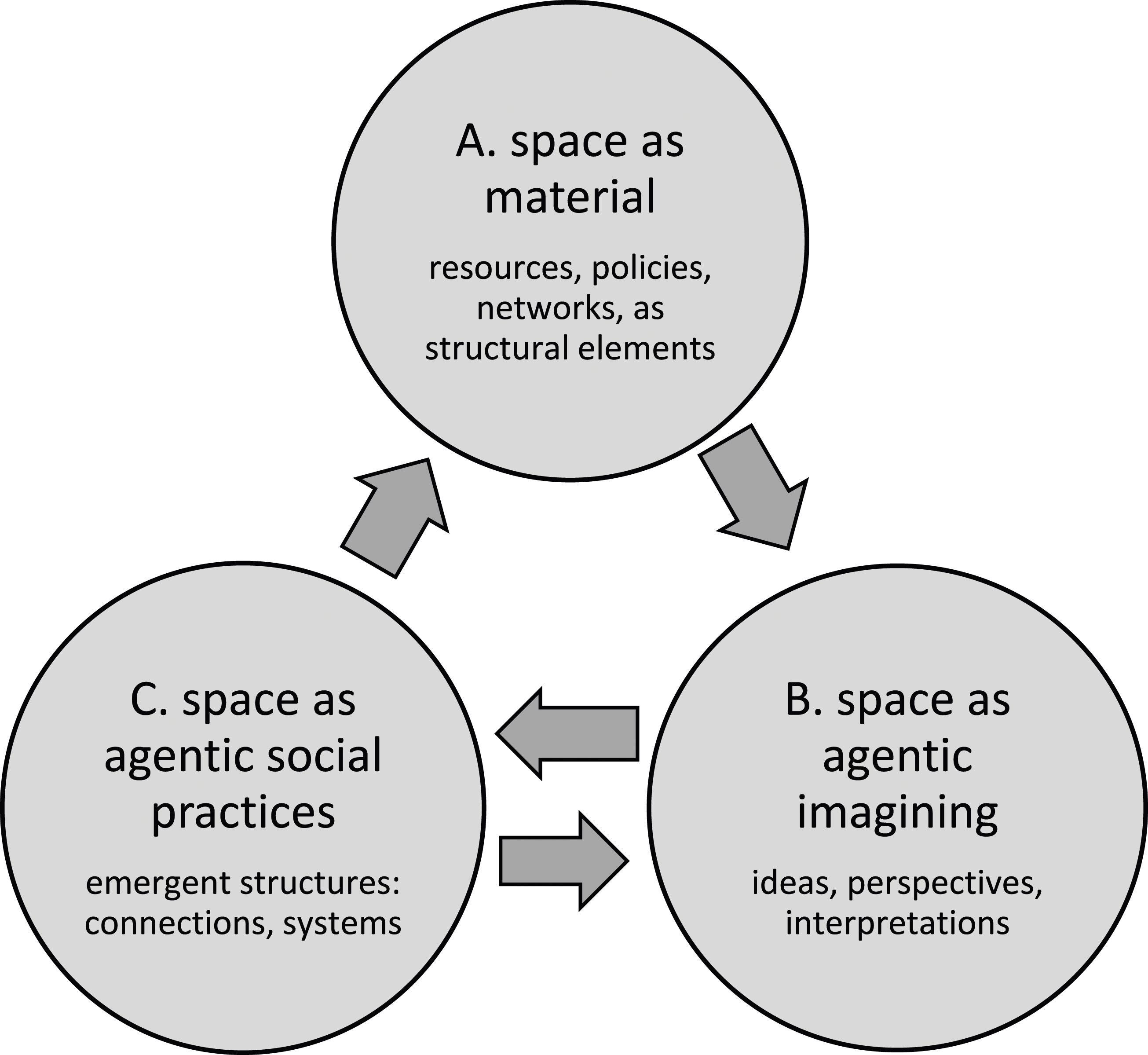
There are numerous examples of space making in higher education. Local institutions work together on community projects in which the whole is greater than the sum of the parts. National governments build layers of world-class universities that augment industrial innovation and network around the world. ASEAN countries establish mobility and recognition protocols the facilitate student development. Universities sign agreements, make alliances and create joint degrees across borders. Western universities set up branch campuses in East and Southeast Asia and India. Faculty reach into each other’s national systems, collaborating in research projects and academic writing. Millions of students apply for foreign university places, fill out visa forms, buy plane tickets, and cross the border for education. All are making space in higher education.
While most activity in higher education is imitative of what has gone before, there is always potential for new models, especially in the global scale, and some of them have succeeded. Consider the Singapore global schoolhouse strategy, NYU’s global model of one year of the degree in two of three countries, and the first MOOCs created at Stanford.
The example of the Shanghai ranking
It has been argued that the imagining process is pivotal. Take the case of the ARWU, the Academic Ranking of World Universities, also known as the Shanghai ranking. In domain 2, the university planner Liu Niancai at Shanghai Jiao Tong University imagined that he could assemble a data picture of worldwide research strength as measured on a proxy basis by performance data. He wanted to compare the performance of his university to other science universities, especially in the U.S. which was the world leader. Liu Niancai collected objective bibliometric data on publication and citations and Nobel Prizes. This provided an unquestionable calibration of performance that lent itself to standardised comparisons both across the world, so that all universities appeared as equivalent regardless of context, and strategies of improvement could be calculated and monitored. The ARWU ranking became a real-world fact in domain 3. It shaped research science as a single global space, consistent with the bibliometric collections on which ARWU was partly based, materialising the imagining of a single worldwide ‘world-class university’ (WCU) sector. The WCU terminology also originated in Liu’s work. These moves facilitated the globalisation of higher education and science. The ARWU ranking and the WCU imaginary directly triggered competitive relations between universities across borders, and hence between countries. The ranking also provided data that facilitated cooperation between universities.
The ARWU and the popularisation of the WCU idea helped to shape not one but two kinds of space in higher education – the global science system, connected to but also above and beyond the nation-states (Marginson, 2022b); and global higher education as a network of interconnected research-intensive universities, again partly disembedded from nations, though less so than in the case of global science. The second imaginary was reinforced by the commercial global rankings, focused on competition in the global student market, that were developed by Times Higher Education in the wake of ARWU (Marginson, 2014).
Arguably, also, the ARWU ranking fundamentally shifted the emphasis of research policy. In the 1990s there had been a growing focus on commercialisation of research, encouraged by the Mode 1/Mode 2 discourse (Gibbons et al., 1994). In the 2000s, after the advent of the ARWU with its powerful metrics and ordering on the basis of tangible outputs, the focus swung to basic science, constituting a different kind of science space. The policy focus has stayed there since. Most governments measure the comparative position of their nation’s R&D capability at least partly in terms of performance in science publication and citation. This has had immense consequences for practice. Governments have focused on funding investment in basic science in universities and government laboratories, building capacity in R&D without attempting to programme it directly. Universities and researchers have not had to wait for business and industry to drive the growth of basic research. There has been less of the Mode 1/Mode 2 talk designed to deconstruct the academic disciplines and potentially, undermine the Humboldtian/American form of the research university. Arguably, Liu Niancai’s imagining and practice of the world in terms of a rank order grounded in published science has had more impact than any other single act of global space making in higher education since the foundation of the internet. It also constitutes an early example of China ‘going out’ that has reshaped global higher education and science.
Global evolution since 1945: The three layers
Space making is agentic with much scope for innovation, as shown in the rapid and diverse evolution of universities and science in the last three decades, and the surprising new initiatives that have emerged. Yet, as Karl Marx states in the 18th Brumaire of Louis Bonaparte (Marx, 1969/1852, p. 398), while people make their own history they do so under material and discursive conditions inherited from the past. They also make their own history amid ever-evolving geopolitics, economic events and technological transformation. Today’s national higher education systems, individual universities and people within them operate with an ever-moving global configuration permeated by three primary historical layers. Richard Sakwa provides an account of the evolving geopolitics in The lost peace (2023).
Layer 1: Post-coloniality and sovereign internationalism
In the first wave of globalisation, the guns-and-bible competitive European colonisation and exploitation of the world between the late 15th century and world war 1 in 1914, at some point European powers and their U.S. offshoot ruled, controlled or strongly influenced (as in the case of China) 95% of the land area of the earth. This was underpinned by the Euro-American powers’ assumption of racial and cultural superiority and a self-defined moral right to lead if not to rule, attitudes which as still deeply felt in much of the West.
The starting point for contemporary geopolitics, in general and in higher education, was the United Nations charter at the end of world war 2 in San Francisco in 1945. This was American-led, in that the U.S. was the strongest single nation following the war and the Manhattan project, and American officials played the largest role in the negotiation of the charter. However, the process was genuinely plural, in that Chinese, Soviet Russian and other non-American agents were significant voices, and it coincided with worldwide political decolonisation whereby erstwhile European and American-controlled territories were becoming formally independent. The United States supported political decolonisation, though it went on to foster continuing neo-colonial economic and political dependence. The actuality and limitations of decolonisation shaped the subsequent period.
In world war 2 the U.S had been allied to the Soviet Union which had a different political system. In 1945 the Cold War had not yet begun and spirit of the charter negotiations was optimistic, cosmopolitan, inclusive and tolerant of difference. The U.N. ‘Charter International System’ (Sakwa, 2023) constructed the world as a plural space with heterogeneous internal political regimes. The principle was sovereign internationalism, entailing tolerance of civilisational differences and diversity of political systems, and respect for the sovereignty of all countries, including non-interference in their political affairs, consistent with the post-colonial premise that each society should determine its own path, providing that states abided by shared charter values such as the U.N. conventions.
As noted the U.S. led the Charter process but as time went on it became apparent that this nation retained the strategic option of selectively moving out of multilateral space, and the obligation to conform to the Charter International System, in pursuit of its own agendas and interests. It refused to sign up to certain U.N. agreements and institutions as these emerged. Looking back it is apparent that U.S. policy was divided between two different global spatialities, grounded in varying notions of the global role of the U.S. This division reflected longer standing differences within the U.S. elite. One camp supported sovereign internationalism, including tolerance of differing political systems, and the principle of non interference. The other camp held a liberal anti-pluralist position grounded in American exceptionalism. It was intolerant of non-liberal regimes (though less so if the state was allied to the U.S.). Sakwa (2023) calls this ‘radical liberal internationalism’ or ‘democratic internationalism’. This was later presented in Anglophone circles as the ‘rules based order’, but these rules were (and are) culturally specific, not shared, and were not agreed when the Charter International System was created. From the 1950s onwards, with the Cold War defined in the U.S. as an epochal civilisational struggle between communism and capitalist democracy, the U.S. demonstrated an increasing willingness to intervene in other polities.
Layer 2: U.S. Neo-colonial hegemony and ‘the end of history’
The Cold War ended on the initiative of the Soviet Union, and to the surprise of almost all, the Soviet Union itself dissolved at the end of 1991 (Zubok, 2021). With the most prominent civilisational other removed, many in the U.S. saw no obstacle to world Americanisation. Francis Fukuyama (1992) captured the moment in his book The end of history and the last man, which proclaimed ‘the universalisation of Western liberal democracy as the final form of human government’. In the internal American debate, the balance between sovereign internationalism and anti-pluralist liberal internationalism, the ‘rules based order’, shifted to the latter. With significant support elsewhere in the Euro-American West, the Bush and Clinton governments in the U.S. felt free to pursue American political, economic and cultural hegemony. Post-1990 globalisation, carried by capitalist economics, communicative convergence and more intensive and extensive people mobility, had multiple strands and potentials and fostered heterogeneity as well as global commonality, but in the first two decades it was a reassertion of neo-imperial and neo-colonial politics in the global scale.
Radical liberal internationalism was pursued through free trade policies presided over by the World Trade Organisation (WTO), with strong Anglophone support, and through the tutelage of Pax Americana in foreign policy and military affairs. Nations that positioned themselves outside U.S. political leadership came under pressure. Global Americanisation was also powerfully advanced by the communicative convergence enabled by the emergence of the internet; the continuing export of U.S. media, film and television; and by American ideas and templates, and American engagement, in universities and science.
Radical liberal internationalism was intolerant of civilisational diversity and different political systems. It claimed a superior modernity in the economy, and moral superiority in politics and society. Routinely assessing other societies against Western norms, it supported interventionalist strategies based on humanitarian objectives and regime change. The emphasis on civilizational values and crusading liberalism recalls the self-positioning of 19th century British imperialism, which claimed world primacy as its right on the basis of self-defined civilisational standards. That innate sense of superiority is very persistent. Recent interviews in UK universities on internationalisation of higher education reveal a common global space making imaginary, in which interviewees typically saw the world from the UK looking out, and also from above, as a place where they felt free to intervene anywhere (Marginson et al., 2024). This is the classical imperial spatial vision, which in the higher education sector in England has persisted beyond the eclipse of British imperial power.
After 1990 the ‘rules-based order’ was implemented militarily with varying success, for example in the Balkans, Libya, Iraq and Afghanistan. It was more successful in higher education and science. There American universities presented as inherently superior: both the arbiters of quality-based comparison, and the winners when such comparisons were made. This stance was easier to sustain because U.S. universities were massive material concentrations of science, welcomed scientists the world over, carried great prestige, and for two decades were much stronger than universities elsewhere.
From the mid 1990s onwards, in most countries aside from the poorest, growth surged in participation in tertiary education (Cantwell et al., 2018; UNESCO, 2024); and as a time went on more than 70 countries established their own science systems, joined to the common global science system, as evidenced by the volumes of global scientific papers, collaborative cross-border authorship, and state funding of research universities. The worldwide spread of educational participation and science capacity was stimulated by global convergence but it was not fostered by Americanisation as such. It reflected rising aspirations, in populations and nation-states, as well as the growing public and private economic capacity to support universities in many countries. It also acquired an economic rationale. From the late 1990s onwards policy economists saw higher education and research as moving parts in an imagined global knowledge economy (Olssen & Peters, 2005; Dale 2005). Universities often welcomed this positioning in the policy mainstream. Some in the West also developed themselves as corporate actors, quasi-businesses in their own right. The commercial form of cross-border education grew rapidly in Anglophone countries outside the U.S., transferring capital out of emerging countries and quickening the brain drain of talent, in continuity with the colonial years.
Meanwhile science was evolving in a form that was both more global and more U.S. dominated than was the case with the world economy, culture or politics. Many of the early adopters of the internet were located in American universities. The great growth of global science after 1990 was led initially by American scientists working across borders in free association with other researchers, largely unregulated by national government and with newcomers free to associate with any other researchers in the network (Marginson, 2022b). Embodying the open potentials of the internet, the emerging global science evolved partly independently of nation-states. At the same time, this generous regime of collaboration also facilitated Euro-American power. Global science was dominated by U.S. scientists, underpinned by national science funding and the inherited resources and the legitimacy of the leading universities. Up to the early 2000s, global science continued largely as a Euro-American duopoly. North America was the leading component of the duopoly. Euro-American norms and institutions, and the English language, regulated inclusion in global science: epistemic content and scientific norms were closed to other cultures and languages, including endogenous knowledge from the global South. The emerging global science space encouraged universal participation in a closed agenda. Both the openness in organisation, and the closure regulated by the hegemonic cultural forms, facilitated U.S. leadership. Massey (2005) states that in space making ‘what is at issue is the nature of the relations of interconnection – the map of power of openness’ (p. 171).
Layer 3: Transition from hegemony to multi-polarity
Globalisation, history and geopolitics oscillate between homogeneity and heterogeneity, between sameness and difference. Diversified post-colonial geo-politics in layer 1 gave way to the homogenising assertion of neo-coloniality and uni-polarity in layer 2. Not surprisingly, the next development was the reassertion of difference in the form of multi-polarity in layer 3. The emergence of multi-polarity had two aspects: the rise of new global powers, and the part-withdrawal of the hegemonic U.S. project. The U.S. abandoned the strategy of universal inclusion and attempted homogenisation, and moved to a strategy of selective closure, division and othering that was designed to constrain the independent potentials of the rising powers.
Hegemonic American globalisation, in general and in higher education, had sustained its momentum for at least two decades. But it was evident that global Americanisation had not been achieved. The pay-offs for the American West had begun to diminish, and it became apparent that the vast global space making project was slipping from control. That project was sustained longer in higher education and science than in political economy, but in universities, too, it eventually gave way to an American straategy of division, othering and closure.
Soon after the financial crisis in 2008–2010 it was evident that the growth of global trade was slowing, the economic role of multinationals was reducing, supply chains were no longer lengthening and the offshoring of production had begun to reverse (The Economist, 2019). Notably, the receding commitment to economic globalisation was a Western phenomenon. It did not include China, the rising middle countries and the newly emerging states. China continued to express a strong pro-globalisation stance (The Economist, 2016). However, in the U.S. there was mounting industrial opposition to open trade (Rodrik, 2018). After Trump was elected in 2016 the American commitment to globalisation reversed spectacularly in the triggering of trade wars with China and Europe. But it was not only Trump. It soon became evident that the shift away from global economic openness was bipartisan and it deepened under Biden (The Economist, 2023a).
This was also true of the American change of position in relation to economic engagement with China. Both sides of American politics judged that the economic benefits to the U.S. were not only less than previously expected, but China had gained more than the U.S. from the open trading environment. The specific U.S. criticism of China was that China did not conform to liberal expectations of the ‘rules based order’ in which the state was separate from the market economy. The U.S. argued that the routine state subsidisation in China was illegitimate, a source of unfair advantage. This turned on a classical civilisational difference. In China the state and the economy have never been positioned as separate and opposing in the manner of the West. Sovereign internationalism could accept the variation in political economic systems, but the rules based order could not. Ironically, the American response, which was the reassertion of protectionism and state subsidies for selected industries, also violated liberal norms. Arguably, though, the trade dispute in itself was not the main cause of tension.
The deeper problem in American eyes was the emerging political multi-polarity in the global scale, with the rise of independent powers outside the West such as the BRICS, Iran and Indonesia - the economic gravity has shifted from the G7 to the G20 - and especially the rise of China, which had confounded the American self-image of inherent superiority and global control. China was becoming as strong as the U.S. in the economy and technology., and the U.S. knew that in the longer run this was bound to have global financial and political implications as well. While stated U.S. policy has never acknowledged multi-polarity, or resiled from the claim to U.S. global military and political dominance in all regions, the emerging multi-polarity has shaped the evolution of a more defensive U.S. strategy.
Multi-polarity in universities and science
The transition from American hegemony to a more multi-polar world is uneven and incomplete by sector. It took longer for multi-polarity in universities and science to become evident, compared to political economy; and the Western (and especially American) cultural hegemony continues in relation to the models, forms and protocols of higher education and science. Yet China’s scientific output in STEM fields has come to outstrip that of the U.S.; and as in the economy, the U.S. strategy has moved from engagement to conflict.
Top Universities in STEM Research, Leiden Ranking. Papers in Top 5% by Citation Rate, 2018–2021, in (1) Physical Sciences and Engineering, (2) Mathematics and Computing, (3) Biomedial and Health Sciences, (4) Life and Earth Sciences.
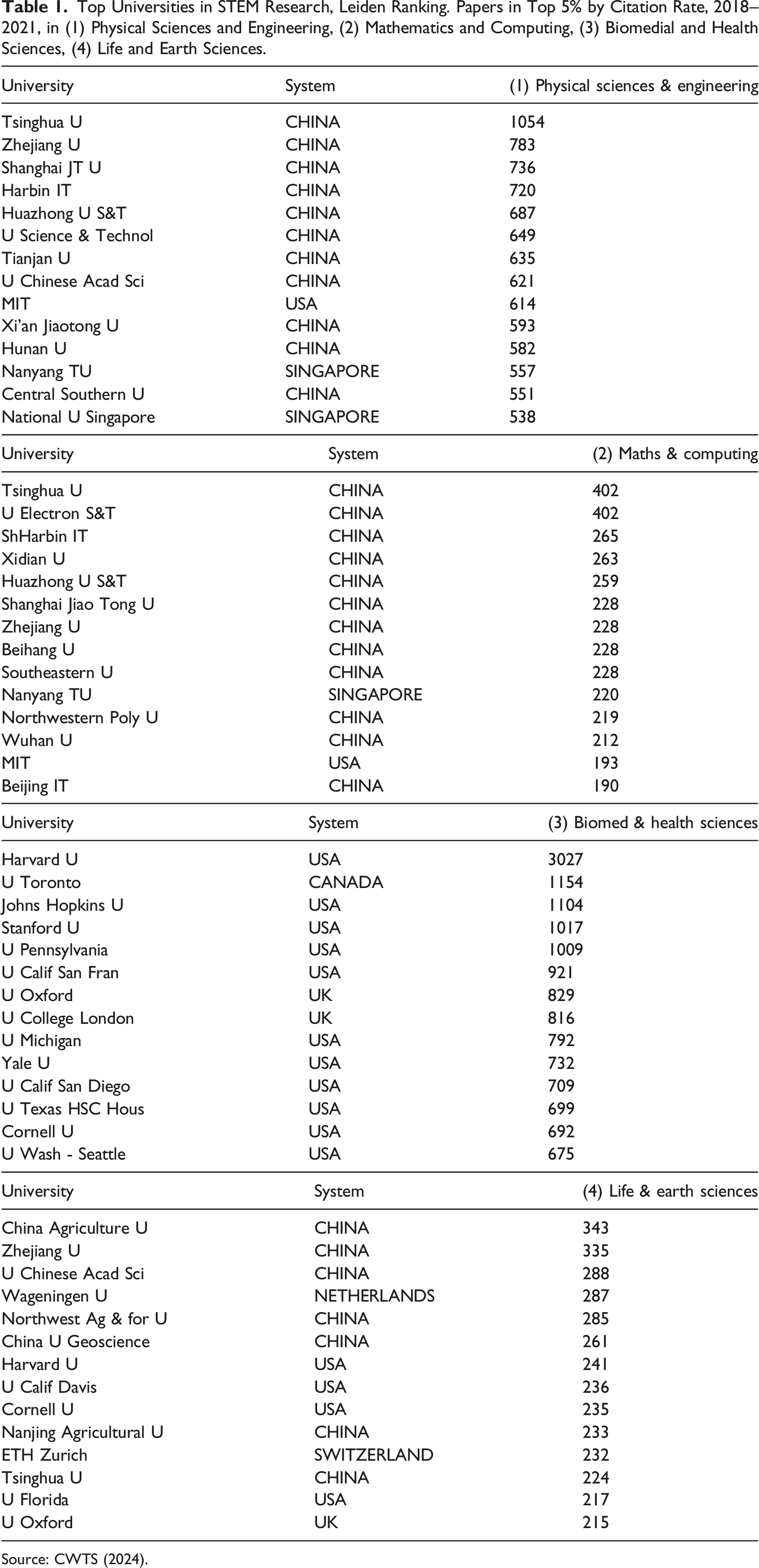
Source: CWTS (2024).
Muti-polarity in political economy, universities and science is not just about China. India is now the third largest producer of science papers, well ahead of Germany, the UK and Japan. Other rising middle countries in science include Iran, Indonesia and Brazil. State building in the global South is generating a more distributed pattern of national agency in science and destabilising the U.S. led neocolonial international relations framework inherited from layer 2. In Europe research organisation has lifted the leading universities as well as distributing capacity more broadly across the region. Global multi-polarity is not an ideology. It is a fact, though the Anglophone countries, particularly, have yet to fully grasp it.
Contemporary geopolitics of higher education
Today’s geopolitics in higher education combines the conditions created by all three historical layers. In the non Euro-American world the powerful global momentum away from coloniality that was evident in layer 1 continues, and this is one of the drivers of agency-heavy multi-polarity in global relations of power. Non-Western countries generally hold to the internationally-agreed 1945 principles of sovereign internationalism, systemic diversity, national self-determination and non-interference; while the U.S. holds to its own creation of the liberal rules-based order and its Western allies general follow. The neo-colonial era in higher education and science that climaxed in layer 2 continues in some respects – for example, in the forms of global science and the operations of the commercial market in international education - despite the multi-polarity in university capacity. Yet layer 3’s multipolarity is destabilising the inherited order.
In the West, as noted, the layer 3 era of growing global multi-polarity is also the era of disillusionment with global engagement. This has rapidly accumulated since the 2016-2020 Trump government and the 2016 Brexit decision in the United Kingdom (UK). Widespread anti-globalisation and bounded nationalism in Euro-American societies is especially evident in national opposition to migration. Western nativism can be partly explained by Western anxieties about the rise of the non-White non West, which is inverting half a millenium of colonial and neo-colonial relations (Marginson, 2024a). Yet there is also a worldwide tendency - one that reaches well beyond the core of the West to encompass Russia, India, and other countries - to national self-sufficiency in political economy and self-referenced national determination in politics. Arguably, this is an inevitable outcome of the faltering of post-1990 global convergence. No new kind of global convergence has yet developed to replace the American-led processes of economic, cultural and political globalisation.
This turning away from the global scale, in general and to a degree also in higher education policy, does not bode well for higher education and science, which are more globalised than most sectors; nor for global action on climate, much of which is sustained in cross-border cooperation between universities (Witte, 2023). More aggressive nation-states are reining in the autonomy of universities and to a degree that of science. There is the reassertion of the single scale vision, methodological nationalism, ‘the belief that the nation/state/society is the natural social and political form of the modern world’ (Wimmer and Schiller, 2003, 2003; see also Shahjahan and Kezar, 2013). In this vision global space and global activity, such as global science, can only be explained as outgrowths of one or another nation. Methodological nationalism occludes or marginalises phenomena beyond the nation-state. It blocks the fuller space making possibilities in universities and science.
In the West the wide support for global convergence in higher education, whereby ‘internationalisation’ was normed as always positive, has given way to a fractured politics. There continues to be support in universities and science (how strong is as yet untested) for the maintenance and if necessary, restoration, of practices of openness and cosmopolitan cooperation (though no evident appetite for rethinking the Western domination of content and processes in science). Yet nativist politics is disrupting student and academic mobility, as governments respond to anti-migration currents. The liberal polities of Denmark and the Netherlands were first to restrict their international student numbers under nativist pressure. In 2023 even Australia, Canada and the UK, which draw large scale revenues from international students, introduced visa restrictions designed to cap numbers. There were varying rationales for these decisions but the common driver was anti-migration politics. Despite the general reassertion of the nation-state, outside the West there has not been the same fracture of cross-border links in higher education. e.g., universities in East Asia remain as open to cross-border relations as they were a decade ago. One exception is Russia. The Ukraine-Russia war has triggered large-scale forced mobility of scholars and students out of both countries, and the loss of cross-border cooperation between Russian universities and most of the West. In Russia, all critics of the government in universities are labelled as ‘foreign agents’, indicating that global relations are now a source of stigma.
The most important change in the geopolitics of universities has been U.S.-triggered decoupling with China and the reduction of the very large U.S.-China scientific cooperation to policies of bordered national interest. This has partly remade the global science space.
The American decoupling
As noted, the hegemonic system of science that evolved after 1990 combined openness of organisational form, that of the worldwide network, with cultural closure. The structure of bounded openness in science up to 2018 strengthened U.S. global agency. It was key to American science power, fostering both the dissemination of American science outward and the recruitment of worldwide talent inward, including talent from China. However, because all social space is relational, and multiplicity tends to increase over time, no closure can be complete or timeless. ‘The closed geographical imagination of openness, just as much as that of closure, is irretrievably unstable’, says Massey (2005, p. 175). As Lefebvre (1991) states, over time every space ‘escapes in part from those who make use of it’ (p. 26). Thus it was with U.S.-led globalisation and the U.S. domination of global science and technology.
Between the early 1980s and the mid 2010s the American government and universities provided generous support to the evolution of higher education and science in China. It is now apparent that this carried the expectation, on the American side, that with the global opening up of the economy, culture, universities and other sectors China would converge with the West in the mode of state and the forms of politics. This thinking was based on the Anglophone assumption that the political system is essentially determined by the economic system. That has never been the case in China. In that regard alone the U.S. expectation was always unrealistic. When that expectation turned there was bitterness on the American side, a sense the U.S. had been misled and exploited. Nevertheless, it can be argued that China’s ultimate fault in American eyes, in science, technology and higher education as in the economy, was not that it failed to become American, but that it became strong, an equal, breaking open the self-reassuring Western domination of science. The balance of power in science, like the balance of power in political economy, had not stayed still. The growing multipolarity meant that the global science space – perhaps the global higher education space – had partly ‘escaped’ Euro-American domination, to use Lefebvre’s term.
This in turn triggered the official shift in US space making strategy in science, from unregulated open connections, to partial decoupling and a more complete form of closure, designed to slow the change in the balance of power and if possible to reverse it and restore the old hierarchy that characterised historical layer 2, the American-led world of the 1990s. Strategies of closure set out build agency by means other than open engagement, fostering capacity behind protective walls, and partitioning space to block other agents from common systems or from dealing with each other. For Massey (2005) what matters is not openness or closure in themselves, but ‘the social relations through which the spaces, and openness and closure, are conducted’ (p. 166).
The changes generated by the decoupling have been dramatic. The 2018 China Initiative and associated policies, such as the war on Huawei throughout the West, much to the benefit of the U.S. tech sector; the pressure on Confucius Institutes and CSC funding; the non-renewal of student exchange agreements; have together reshaped the global higher education space. For example, prior to the China Initiative U.S. university presidents were frequent visitors to Chinese universities. That traffic suddenly stopped in 2018, showing that nominally independent U.S. university presidents could be disciplined by their government as readily as their counterparts in China: the U.S. university sector is also nested in the nation-state.
From 2016 onwards the number of student visas for Chinese students entering the U.S. dropped to less than half of the previous level and it was lower under Biden than under Trump (The Economist, 2023b). In research, the decoupling has extended well beyond fields of science with clearcut military and security applications. Some Chinese doctoral students and faculty in other fields have been denied entry to the U.S. In some cases the stated reason for refusing the visa is that the applicant is associated with a research university with links to the military, or with links to a government with a military. All governments have militaries. There are cases of researchers, holding valid visas and returning to the U.S. after short breaks, who have been blocked at the border and forced to travel back to China (Sharma, 2024). Under the U.S. China Initiative about 150 scientists with dual China/U.S. appointments or projects have been investigated (The Economist, 2023b). There have been few convictions, but others have suffered career damage, and a climate of fear has been fostered, triggering self-censorship. Lee and Li (2021) found that 20% of American citizen scientist of Chinese descent, and 12% of all scientists, did not engage with China after 2018. From 2020 to 2022 the number of China-U.S. co-authored papers fell by 4500 (NSB, 2024).
The U.S. government has also placed sustained political pressure on its Western allies to subject all scientific relations in China to Cold War national security policy. This typically takes the form of blanket risk-management regimes whereby all Chinese researchers in any field, even education or the humanities, are seen as potentially untrustworthy. This not only prohibits or discourages collaborative projects, it reduces university autonomy and academic freedom in the West. Unregulated bottom-up cross-border relationships are being rendered less free to shape global science. The potentials of both kinds of global space making, the shared science system and the network of university-to-university partnerships and agreements, have each been diminished by the U.S. decoupling strategy.
Arguably, though, decoupling is a space making strategy of doubtful practicality. It rests on an inaccurate understanding of the balance of forces and the dynamics of science. First, it is grounded in a mistaken assumption, based on notions of American cultural superiority, that the rise of China’s science must have been essentially sourced in American know-how or American intellectual property and would be slowed or stopped if the U.S. cut the supply of new ideas and returning talent. Hence the decoupling strategy has especially focused on all forms of movement from the U.S. to China: the transfer of knowledge and the policing of intellectual property, joint appointments and projects, Chinese doctoral students likely to enter U.S. and return, and China’s One Thousand Talents policy, which particularly earned the ire of the 2016-2020 Trump government. Arguably, the focus on blocking U.S. to China passage underestimates the extent to which China generates its own science, the nation’s creative capacity. Second, decoupling misunderstands the extent to which global science flows can be bottled up and national and global science in either country can be separated.
The Economist (2024) concludes that decoupling in science ‘overestimates America’s ability to constrain the whole of Chinese science. Even Huawei has prospered despite foreign sanctions’. The same issue of the magazine carries data showing that China was ahead of both the U.S. and the European union in the production of top 1% science papers in eight out of fourteen science fields. It urges U.S. science to maximise its engagement with science in China while returning to global openness in building itself.
The technological challenge
In the midst of these fractured geopolitics the world is confronted with the challenge of a new technology, possibly as transformative as the internet, but carrying dangers as well as positive potentials. Key developments in Artificial Intelligence (AI) including large language models are controlled by the American tech companies, not states. In the U.S. AI might be seen as an opportunity for renewed global hegemony but it is unlikely to remain Western dominated for long. However, given the potential of AI in self-governing technical systems and its military applications the potential loss of political control is alarming. The tech companies are concerned with revenues, market share and their own social power, not the global common good. The evolution of AI should be a matter for international management.
Collaboration would also be beneficial in higher education, where AI is potentially transformative. The potentials in administration are momentous and in education it is unlikely that some of the present forms of written assessment will survive. There may be greater use of assessment based on interactive verbal communication, and more emphasis on the application of learning rather than retrieval. Arguably, however, the potentials of AI in scholarship and culturally-based research are especially significant. Whereas the internet established a connected world community, large language models provide almost instantaneous access to the whole corpus of texts and images in the data base. AI models knowledge (or at least its particular holdings of texts and images) as a single global space open to free interrogation with an inexhaustible multiplicity of questions. It is an extraordinary tool for not just information retrieval but reflexive cultural development, gifting agents from anywhere with the scope to explore anything, but it is not optimally designed for academic purposes. Its potentials depend not only on the questions asked but also on the content of the data base.
Present data bases are both too inclusive, in that they include fake news and other rubbish, and also exclusive, in that they are biased in favour of dominant languages (efforts to create a Chinese version of ChatGPT have so far been unsuccessful). When will there be a cleaner set of scientific knowledge for reflexive intellectual inquiry? What can agents in higher education do about validation and eliminating hallucinations? Agreed cross-border scientific protocols are needed. This should not be left to tech companies and publishers.
Conclusion: Questions for universities
So universities and their leaders face problems and questions. The following are pressing: 1. The U.S. tech sector determines the future of AI: how can states gain control, and how can universities gain control over the academic applications of AI? 2. Specifically, how will more plural large language models be developed, including national-cultural variations, specialist models focused on academic knowledge, and models that address validation issues and eliminate errors in the academic use of AI? 3. What are viable new forms of assessment that incorporate not oppose large language models, and how can AI be most effectively mobilised in pedagogy? 4. How to de-securitise science and restore open, mutually respectful, trusting and productive academic relations between China and the Euro-American West? 5. How to create and implement norms conducive to reciprocal and inclusive academic cooperation, including protocols that normalise open scientific exchange (with exceptions for national interest) and manage academic and student mobility?
The final two questions are the most important. While historical layer 3, the multi-polar world, is irreversible it is associated with instability deriving from the partial break down of the hegemonic U.S. control established in historical layer 2. There is now continuing tension between American (and to a degree Western) efforts to restore layer 2 and the independent agentic capability of China and the non-Western middle powers. The genie cannot be put back in the bottle, and the way through begins with recognition of the sovereign internationalism of layer 1. That provides a feasible starting point from which to restore, retain and develop a common global space in general, and higher education and science, in which relations become both more diverse and more inclusive over time. The alternative is a world riven between a would-be global uni-polarity and separated national systems.
Achieving sovereign internationalism in universities on a stable basis depends ultimately on cooling the geo-political heat, which is beyond the control of universities and education ministries. However, whether the world moves forward geopolitically or not, it is crucial that universities and scientists keep talking across borders, and people mobility in education and science is protected as well as possible. Universities and their national associations can progress their relations by formalising protocols on openness, collaboration, mutual respect, and management of risk, and also by normalising solidarity with those higher education people who are victimised by being caught in the geopolitical cross-fire.
Formalising a common higher education space would enable universities to more effectively address big shared human problems like the climate nature emergency and AI. If global research universities wait for a benign geopolitical setting before moving forward on their own cooperation, they may never have the opportunity to make their fuller and essential contributions to the global common good (Marginson, 2024b; Tian et al., 2024).
Footnotes
Declaration of Conflicting Interests
The author(s) declared no potential conflicts of interest with respect to the research, authorship, and/or publication of this article.
Funding
The author(s) disclosed receipt of the following financial support for the research, authorship, and/or publication of this article: This work was supported by the ESRC/RE Centre for Global Higher Education, supported by the UK Economic and Social Research Council (awards ES/M010082/1, ES/M010082/2 and ES/T014768/1).
