




Abstract
Faculty (N = 156) at regional public universities (RPUs) in the United States were surveyed for self-reports of their primary academic identity (teacher, researcher) along with alignment of that identity with perceived departmental expectations and how their time is spent. Well-being and job satisfaction were examined as outcome measures of identity and alignment. The results are examined in the context of international concerns about neoliberalism in higher education, particularly with respect to academic identity. Participants were employed by RPUs in Illinois, a state with severe budget challenges, to assess the combined impact of neoliberalism and financial pressures on academic identity at traditionally teaching-focused institutions. Results of MANCOVA and MANOVA analyses suggested that participants who identify as teachers had greater overall well-being and job satisfaction than those who identified as researchers. Greater satisfaction was associated with alignment between identity and how time is spent. Implications and challenges to faculty work and strains on academic identity at RPUs are discussed.
In the United States, publicly funded higher education is rapidly reaching a crossroads. According to data collected by the Center on Budget and Policy Priorities (CBPP, 2016), since 2008, every state in the United States has decreased per pupil funding allotments to state colleges and universities, with a median decrease of 21% across states. Under these conditions, public university administrators are under increasing pressure to decrease costs, increase revenues, and run their institutions more efficiently.
These economic shifts have occurred within the larger global context of neoliberalism (Scott, 2016; Yilmaz, Feiner, & McKenzie, 2017), a paradigm described by some as an attempt to maximize human well-being through free market forces (Harvey, 2007) but understood less generously by others as “predatory capitalism” (Giroux, 2014). Within the field of higher education, neoliberalism has been reflected in the more prominent use of the language of business, greater emphasis on research and grant writing as revenue generators (Archer, 2008a; Saunders, 2014), and national initiatives reflecting these values such as the Research Assessment Exercise (RAE) in the United Kingdom (Archer, 2008a, 2008b; Henkel, 2005; Winter, 2009). As Yilmaz and colleagues (2017) summarize, “We are witness to a global project designed to reduce/distil our universities down to private business units that define all academic functions in terms of contributions to economic value” (p. 2). While it is beyond the scope of this article to argue that international neoliberal trends have been a primary cause of the growing economic crisis in public higher education within the United States, it is undeniable the neoliberal rhetoric of universities as economic enterprises dovetails nicely with budgetary necessities of the moment at the state level.
These pressures are particularly keen at American regional public universities (RPUs), also known as comprehensive universities. These are institutions that are funded at the state level but are generally less prestigious than the flagship universities in each state. RPUs traditionally have had few PhD programs, held moderately selective admissions requirements, put greater emphasis on teaching rather than research, and served larger proportions of economically marginalized populations, including first-generation and racial/ethnic minority students (Shavit, Arum, Gamoran, & Menaham, 2007). Budget cuts may be slowly eroding the promise of an affordable university education for these students—since 2008, the average tuition at state universities has increased in every state, with a median increase across states of $2,154 (2015 dollars, adjusted for inflation; CBPP, 2016). At the same time, neoliberal ideology has been linked with the phenomenon of institutional striving, wherein faculty at institutions traditionally focused on teaching (primarily liberal arts colleges and RPUs) have been encouraged to devote greater time and resources to grant writing and research productivity to increase institutional prestige (Gonzales, Martinez, & Ordu, 2014; O’Meara & Bloomgarden, 2011). In fact, attitudes at RPUs have shifted in recent decades, with fewer faculty considering teaching effectiveness as a primary criterion for promotion and a negative correlation developing between faculty salaries and time spent teaching (Youn & Price, 2009).
Our research project approaches the challenges encountered by RPUs through the lens of academic identity. Specifically, we explore the question of how faculty at RPUs in the United States navigate their competing identities as teachers and researchers in the current economic climate. We chose this focus for a number of reasons. First, faculty are arguably the primary conduit through which students experience the larger social and economic forces impacting RPUs. Thus, the ways in which faculty members construct their desired academic identities and negotiate these identities in the face of budgetary and prestige pressures has implications for the kind—and quality—of education being provided to students at RPUs. Second, whether or not one endorses the tenets of neoliberalism, RPUs are inarguably going through significant long-term changes, and failure to account for faculty identity concerns limits the success of institutional change initiatives (Gizir, 2014; Shaw, Chapman, & Rumyantseva, 2013). Third, as tenure-track faculty members at a RPU in the state of Illinois, the authors have repeatedly found ourselves in meetings at the department, college, and university levels centered on discussions of program prioritization, strategic planning, and “mission critical” functions—concerns all rooted in neoliberalism and budgetary constraints. The tenor of these discussions has been so contentious and worrisome that it led one of the authors to liken them to feral dogs fighting over ever-dwindling scraps of meat. When this metaphor has been shared with other faculty, there has been widespread agreement that (1) the comparison is apt and (2) this is not how faculty had previously envisioned their work. Thus, our own struggle to make sense of our academic identities and the long-term implications for RPUs led to the current exploration of how faculty more broadly are dealing with these challenges.
To study these issues, tenured and tenure-track faculty at RPUs across the state of Illinois were administered a survey to answer the following research questions:
Research Question 1: Is there a significant difference in well-being and job satisfaction between faculty at RPUs who primarily identify as teachers and faculty who primarily identify as researchers?
Research Question 2: Is there a significant difference in well-being and job satisfaction between faculty at RPUs whose primary identity aligns with perceptions of department expectations and faculty whose primary identity is not aligned with perceptions of department expectations?
Research Question 3: Is there a significant difference in well-being and job satisfaction between faculty at RPUs whose primary identity aligns with how their time is spent and faculty whose primary identity does not align with how their time is spent?
While previous research has examined the impact of neoliberal forces on faculty (e.g., Archer, 2008a; Giroux, 2014; Gonzales et al., 2014), the current research adds to this work in a few key ways. First, by framing this research in terms of identity, the focus has been kept sharply on individual, micro-level effects, namely, how individual faculty members are forming their professional identities in the context of larger institutional and cultural pressures. Second, the use of a survey approach allows for a broader snapshot than has been afforded by qualitative methods that have been used in much of the research on institutional striving and faculty identity (e.g., Alleman, 2012; Archer, 2008a, 2008b; Chesler & Young, 2007; Gizir, 2014). Finally, and perhaps most significantly, the state of Illinois is an apt site for research as it represents something of a canary in the coal mine for the future of publicly funded higher education in the United States. Illinois has decreased per student funding in higher education by 54% since 2008, the second largest decrease across all states over the same time period (CBPP, 2016). Illinois did not have a state budget from July 2015 to July 2017, and at least two RPUs in the state faced closure during that period (Myers, 2017). While the neoliberal rhetoric of increased efficiency and research production has continued unabated, the goal appears to have shifted from institutional striving to institutional survival. Hence, the experiences of faculty in this context may represent not only an extreme case of neoliberal ideas and budgetary challenges but the leading edge of a looming fiscal crisis in higher education.
Literature Review
Evolving Expectations of the Professoriate in the United States
The tension between teaching and research responsibilities of faculty has a long history in American higher education. From the founding of Harvard in 1636 until the early 19th century, teaching was seen as the central and sacred function of the professor (Boyer, 1994). In the 1800s, technological advances in transportation, engineering, and agriculture shifted the focus of college education and in turn, faculty responsibilities. The German research university became the model of a center for scientific innovation, and research began to surpass teaching as an institutional priority. At the turn of the 20th century, then-Princeton President Woodrow Wilson reflected this shift in his praise of Johns Hopkins University as “the first university in America where the discovery of knowledge was judged superior to mere teaching” (Boyer, 1994, p. 14).
Since the Second World War, the mission of the academy has shifted again, from advancing understanding for its own sake to discovering and creating useful products and processes (Nisbet, 1971). One outcome of this shift has been for professors to become increasingly identified as practitioners of their disciplines rather than as members of their academic institution (e.g., Finnegan & Gamson, 1996; Morphew & Huisman, 2002), resulting in a diminished sense of shared culture within academic institutions. Dill (1982) noted that faculty members are more likely now than a generation ago to identify with their field of scholarly research rather than the institution at which they teach.
Although traditionally populated by faculty focused on teaching rather than research, RPUs were influenced by this trend starting in the 1960s, when they began to adopt the tenure and promotion policies of more prestigious colleges and universities. Whereas previously the criteria for tenure were rather ambiguous, giving weight to factors such as popularity with students and colleagues, criteria began to be more carefully articulated to be consistent with neoliberal values by disproportionately favoring research productivity (Youn & Price, 2009). Over time, the result has been a substantial shift in focus at RPUs. Youn and Price (2009) report that the percentage of faculty at RPUs who agreed that teaching effectiveness should be the primary criterion for promotion declined from 86% in 1969 to 59% in 1997. Moreover, the percentage of faculty at RPUs who had published more than 10 journal articles in their careers doubled between 1975 and 1997, and spending more hours in teaching is now negatively related to increases in faculty salaries at RPUs (Youn & Price, 2009).
The proto-neoliberal shift toward research productivity as a metric for faculty success was accelerated by the economic recession of the 1970s. The resulting loss of federal funding for public universities and student loans put universities in the position of competing for students. They soon looked to corporate culture for guidance on how to survive in this new competitive culture (Dill, 1982). Casting universities in a business mold was not a new idea: several generations earlier, Carnegie and Rockefeller attempted a similar enterprise through conditional donations to universities (Osei-Kofi, 2012). But at the end of the 20th century, this shift took root as part of the paradigm shifts associated with neoliberalism.
Neoliberalism and Higher Education
Harvey (2007) defines neoliberalism as a “theory of political economic practices proposing that human well-being can best be advanced by the maximization of entrepreneurial freedoms within an institutional framework [of] . . . unencumbered markets . . . and free trade” (p. 22). Within the context of higher education, proponents of neoliberalism invoke the language of business—productivity, revenue, accountability, efficiency, and competition (Archer, 2008a; Saunders, 2014)—to reframe universities as enterprises with a mission to create academic “products” that are relevant to the national economy (Davies & Peterson, 2005). Davis (2011) argues, “the academy has largely complied with various neoliberal tenets, to the degree that education has become subordinated to the requirements of capital by ensuring that opportunities exist for businesses to make profits from educational institutions” (p.44).
Neoliberalism now pervades conversations in higher education and shapes faculty identity around the globe. As Giroux (2014) writes: The consequence of such dramatic transformations is the near-death of the university as a democratic public sphere. Many faculties are now demoralized as they increasingly lose rights and power. Moreover, a weak faculty translates into one governed by fear rather than by shared responsibilities, one that is susceptible to labor-bashing tactics such as increased workloads, the casualization of labor, and the growing suppression of dissent. (p. 17)
A Conceptual Framework for Academic Identity
Clearly, the neoliberal turn has significant implications for the academic identity of university faculty. Academic identity is a difficult concept to define (Archer, 2008b; Feather, 2016; Henkel, 2000) both because identity itself has been defined in numerous ways (Beijaard, Meijer, & Verloop, 2004; Fitzmaurice, 2013) and neoliberalism has created significant shifts in the institutional contexts in which these identities are created (Bennett et al., 2016; Elkington & Lawrence, 2012; Winter, 2009). Common among most frameworks for identity is the principle of agency, the idea of identity as an ongoing individual project (Fitzmaurice, 2013). Wenger (1998) described this as a “learning trajectory” with the goal of integrating past experiences and future expectations with present experiences. MacLure (1993) described identity as a “network of personal concerns, values and aspirations against which events are judged and decisions are made” (p. 314), while Beijaard, Verloop, and Vermunt (2000) defined identity as a process of making sense of and (re)interpreting one’s values and experiences through practice. Jenkins (1996) described identity as a synthesis of self-definitions and definitions of oneself offered by others. Tying these varying views together, identity can be broadly conceived as a project of self-definition and self-understanding that acknowledges and incorporates the influence of social institutions and individual relationships (Beijaard et al., 2004; Fitzmaurice, 2013; Giddens, 1991; Henkel, 2005). Thus, identity is subject not only to continuous (re)construction but also continuous negotiation with the social context (Fitzmaurice, 2013; Whitchurch, 2013).
Academic identities are constructed in negotiation with academic institutions and relationships (Henkel, 2005; Winter, 2009). Thus, they are strongly influenced by traditional academic values of institutional autonomy, academic freedom, and the intrinsic public good of higher education (Churchman & King, 2009). However, the influences of neoliberalism have promoted more managerial and corporate values (Bennett et al., 2016; Winter, 2009), making institutions of higher learning much more complex (Elkington & Lawrence, 2012) and ambiguous (Henkel, 2005) than in the past.
These institutional shifts have resulted in increasingly fragmented views of what it means to be an academic (Henkel, 2005). No longer able to ground their identities in a clear set of institutional values, academics are suffering from role conflict (Colbeck, 1998) and a fear that they are losing status through a process of “proletarianization” (Murphy, 2011, p. 509). To be sure, “cherished ideals” (Winter, 2009, p. 123) such as self-regulation and collegial practice are still vigorously defended by academics, yet there is a growing sense that institutional power is being used to pressure academics to construct a professional identity more in line with the corporate values embodied by neoliberalism (Elkington & Lawrence, 2012).
The Importance of Academic Identity
Internationally, much of the research on academic identities has explicitly addressed the effects of neoliberalism by focusing on the impact of national initiatives in higher education. Some examples of this are the RAE in the United Kingdom, wherein higher education institutions nationwide have been allocated funding based on evaluation and ranking of the quality of their research (Archer, 2008a, 2008b; Henkel, 2005; Winter, 2009), and state-level reorganization and consolidation of universities in other nations (McKenna & Boughey, 2014; Ylijoki, 2014). This work is distinct from the U.S. context, where there is no centralized governance of higher education. However, work broadly exploring the rise of audit culture in higher education (Ek, Ideland, Jönsson, & Malmberg, 2013; Leibowitz, Ndebele, & Winberg, 2014; Ruth, 2008; Winter & O’Donohue, 2012) has echoed institutional trends found in the United States.
As in the United States, the institutional privileging of research over teaching is a site of academic identity tension internationally. This tension has been cited in pressures on department chairs to hire faculty with greater research credentials (Ek et al., 2013), unequal distributions of workloads based on research productivity (Elkington & Lawrence, 2012), promotion criteria emphasizing research over teaching (Fitzmaurice, 2013), and senior managers at universities attempting to secure greater institutional status through research productivity (Winter, 2009). This institutional striving has also led to an emphasis on research that is able to attract income and deliver regularly assessable output (Henkel, 2005), in keeping with national initiatives like the RAE.
The focus on research productivity and assessable outputs has a number of deleterious effects for academics. One of these is the need to prove to the institution that one is a legitimate academic (Ruth, 2008). This pressure is experienced particularly by early-career academics (Archer, 2008a, 2008b), who experience it as having “domesticating repercussions” (Smith, 2017, p. 608) of emphasizing the needs of the institution over individual identity concerns. A second effect is a schism between academics who embrace the “new managerialism” as a means to enhance their academic identity and those who oppose it as being in conflict with their desired identity (Tran, Burns, & Ollerhead, 2017; Winter, 2009; Ylijoki, 2014).
Within the United States, the bulk of scholarship on academic identity has focused on the experiences of marginalized groups, including racial, ethnic, and religious minorities (Alleman, 2012; Chesler & Young, 2007; Henry, 2012; Kelly & McCann, 2014; Levin, Walker, Haberler, & Jackson-Boothby, 2013; Morrison, 2010; Thomas & Johnson, 2004); women (Chesler & Young, 2007; Kelly & McCann, 2014; Morrison, 2010); parents (Perry, 2014; Sallee, 2012); untenured and non–tenure track faculty (Anonymous, 2009; Bilia et al., 2011; Levin & Shaker, 2011); and community college faculty (Levin et al., 2013; Outcalt, 2002). This research highlights tensions between academic identities and larger institutional expectations, particularly focusing on experiences of marginalization.
The impact of these tensions often takes the form of challenge to the authenticity of faculty members’ academic identities. This challenge can be external, in the form of young, female, or minority faculty having their expertise more frequently challenged by students (Chesler & Young, 2007), or through explicit and implicit messages from colleagues and administrators. This challenge is often internalized as a feeling of being disingenuous to one’s own self in order to fit in (Henry, 2012) or not being a genuine academic but in fact an impostor (Levin & Shaker, 2011).
This focus on marginality and legitimacy echoes the international research on academic identity and fears about the “proletarianization” of faculty (Murphy, 2011). A handful of studies in the United States have specifically examined the issue of marginalization around the tensions between teaching and research in forming an academic identity. Reybold (2008) found that adult education faculty struggled to balance their roles as practitioners and academics. To adjust to the culture of higher education, many described the need to silence their practitioner voice. Eddy and Hart (2012) presented a similar story of struggle to find the balance of teaching and research at smaller rural institutions. It is probable that similar identity struggles are occurring at RPUs, though little research has been done to explore this population’s experiences.
Consistent with the rise of neoliberalism, it is notable that a number of these articles (e.g., Eddy & Hart, 2012) have been written against the backdrop of a shift toward a greater focus on research productivity in the United States in contexts traditionally seen as more focused on teaching. In these contexts, faculty who would like to focus on teaching describe challenges that parallel the marginalization described in the broader literature on faculty identity. It is also notable that a number of authors have called in various forms for resistance to this marginalization. For example, Outcalt (2002) argued that teaching needs to be a driving force and focus in community college professionalization. Morrill (2012) has called on faculty to give equal emphasis to their teaching identity as to research. Through this study, it is our intent to expand this research by examining identity tensions of faculty at regional public universities in the context of a neoliberal agenda exacerbated by tenuous economic conditions, particularly the ever-increasing emphasis on research productivity at institutions traditionally focused on teaching excellence.
Levin and Aliyeva (2015) have argued that in navigating their professional identity, faculty at regional public universities are the least protected from neoliberal forces since research at these institutions does not generate the same level of funds as at research universities yet faculty are still expected to produce and compete. As previously discussed, Youn and Price (2009) identified an increased focus on research productivity among faculty at RPUs in recent decades. This shift is particularly troubling because these universities have traditionally served larger proportions of economically marginalized and minority groups. These students may apply to schools that they expect to embrace effective teaching, only to discover faculty focused on academic production (Boyer, 1990) in a way that may perpetuate rather than address class inequalities (Ayers, 2005). Thus, while the impact of neoliberalism at RPUs in the United States is clearly different than at research-intensive institutions or in countries with more centralized governance of higher education, a growing impact is almost certainly being felt.
Higher Education Funding in Illinois
The long-term budget crisis in the state of Illinois has exacerbated the challenges of neoliberalism by amplifying the need for institutions to be competitive while simultaneously taking away resources that allow them to compete. Higher education in Illinois, like many states, is in turmoil (Myers, 2017). Illinois is in a particularly troubled position because the state went through a two-year period in which a state budget was not passed. In the most recently passed budget before that gap (FY 2015), a total of $2 billion was appropriated for higher education (Illinois State Board of Education, 2014). However, as of May 2017, the public university system had received only 29% of those funds. The state legislature finally passed a new budget in July 2017, but it represented a 10% decrease in higher education funding compared to FY 2015 funding levels (Seltzer, 2017).
Illinois’s precarious budget situation has led to an exodus of both faculty and students from Illinois universities (Strahler, 2016). Across the state, fall 2016 freshman enrollment numbers were down from 2015. While some state universities experienced enrollment increases during this period, the drops at others were quite severe. Northern Illinois University experienced a 20.2% drop in freshman enrollment, Southern Illinois University-Carbondale had a 23.7% decrease, and Eastern Illinois University had an alarming 25.2% drop (Rhodes & Thayer, 2016). In this climate, the language of research productivity and operational efficiency has taken on much greater urgency as the conversation at RPUs shifts from how to thrive to how to survive.
Job Satisfaction
A substantial body of research exploring the job satisfaction of academics has demonstrated both the increasing demands of this work and growing dissatisfaction among academics with their working life (Fredman & Doughney, 2012; Lester, 2013; Vardi, 2009). Much of this work has linked dissatisfaction with neoliberal emphasis on productivity and “marketization” of the professoriate (Fredman & Dougney, 2012). Shin and Jung (2014) compared higher education systems in 19 countries and found that those with performance-based management cultures focusing on productivity were classified more often as high stress. Countries with higher job satisfaction among academics had higher levels of intrinsic motivation among faculty, while those with high stress showed higher levels of extrinsic motivation, an indication of their focus on productivity.
Another neoliberal theme impacting academic job satisfaction is efficiency, reflected in higher workloads and greater expectations put on academics’ usage of time (Kuntz, 2012). This has been demonstrated in faculty complaints of insufficient staff, increasing general administrative duties, committee work, faculty meetings, time devoted to institution-level change initiatives, technology needs, institutional red tape, and the need to take on additional work such as consulting (Ryan, Healy, & Sullivan, 2012; Vardi, 2009). In qualitative survey data collected from dissatisfied faculty, Fredman and Doughney (2012) recorded frequent complaints of a combination of workload and management factors demonstrating the downside of a focus on efficiency. These included complaints of inadequate resources, too great a focus on money and the bottom line, and faculty being treated as “shop assistants in a retail environment” (p. 54). Ryan et al. (2012) found that a one-unit increase in their measure of faculty productivity concern increased by a factor of 1.6 the odds of faculty leaving for another institution.
These findings reflect a broader tension between faculty and administrators apparent in the research on job satisfaction. Copur (1990) found that decreases in business faculty job satisfaction were connected with challenges to their autonomy by administrators who asserted control over their work. Kuntz (2012), for example, found in an interview study that tenured social science faculty made a distinction between “my work,” meaning scholarship, and “not my work,” meaning administrative and teaching duties. This is consistent with other research that has shown that university faculty are not inherently dissatisfied with the need to be productive but rather with the lack of control over their own work (Fredman & Doughney, 2012).
While these findings are valuable, it must be noted that much of the research on academic job satisfaction has thus far been conducted at research-intensive universities (e.g., Bozeman & Gaughan, 2011; Copur, 1990; Ryan et al., 2012). The experiences of faculty at these institutions may not mirror that of faculty at RPUs, which have very different missions, budgetary constraints, and student bodies. Furthermore, our study is unique in that it moves beyond the conversation of work requirements and examines job satisfaction as an outcome of faculty identity negotiations.
Methodology
The methods used in this study examined the interplay between academic identity and neoliberalism at RPUs in the state of Illinois. The survey protocol was designed to examine tensions between research and teaching by asking faculty both about their own priorities and institutional expectations and pressures with respect to those priorities. This study was framed according to the following research questions:
Research Question 1: Is there a significant difference in self-reported perceptions of well-being and job satisfaction between faculty at RPUs who primarily identify as teachers and faculty who primarily identify as researchers?
Research Question 2: Is there a significant difference in self-reported perceptions of well-being and job satisfaction between faculty at RPUs whose primary identity aligns with perceptions of department expectations and faculty whose primary identity is not aligned with perceptions of department expectations?
Research Question 3: Is there a significant difference in self-reported perceptions of well-being and job satisfaction between faculty at RPUs whose primary identity aligns with how their time is spent and faculty whose primary identity does not align with how their time is spent?
With respect to Research Question 1, it is anticipated that the increasing neoliberal focus on research productivity at RPUs will be experienced as positive for faculty with a research-focused identity and negative for faculty more focused on teaching. Thus, our hypothesis for Research Question 1 is that there will be a significant difference in job satisfaction between these two groups and that research-oriented faculty will have greater job and life satisfaction.
With respect to Research Question 2 and Research Question 3, department expectations and time spent on various activities are being used here as measures of institutional pressure on academic identities. Those faculty whose professional identity aligns with their perceptions of departmental expectations and how they spend their time would be predicted to experience fewer tensions in their academic identity. Thus, it is our hypothesis that those faculty whose identity aligns with department expectations and/or how they spend their time will have significantly higher job and life satisfaction than faculty whose identity is not aligned with these measures.
Participants and Procedure
Tenured and tenure-track faculty of all ranks (assistant, associate, and full professor) from six RPUs in the state of Illinois were invited to participate in an online survey via email using publicly available email addresses provided on university websites. The emails included a link to the survey along with a brief description of the project. The link connected respondents to the Qualtrics online survey platform, where their informed consent was obtained before survey questions were presented. The informed consent indicated the purpose of the study and the approximate amount of time it would take and noted that consent was voluntary and could be withdrawn at any time. Nonrespondents were prompted via email to complete the survey one and two weeks after the initial email. All consent forms, surveys, and related study materials were approved by a university Institutional Review Board.
A summary of the total number of faculty and respondents from each university is provided in Table 1. In total, 240 faculty returned surveys. Of these, 84 could not be analyzed because significant portions of the survey were left blank. This resulted in a final sample size of 156, representing 4.8% of the entire sample surveyed. This response rate is somewhat low but not unexpected given the workload of university faculty. Given response rates in the single digits, however, there may be biases in the sample, so some caution should be exercised in generalizing the findings to larger populations.
Number of Faculty and Respondents at Surveyed Institutions

Source for total faculty at each institution is www.collegefactual.com.
When asked about their racial/ethnic identity, 86% identified as White, 2.6% as Asian/Pacific Islander, 1.9% as Latino, 0.6% as Black, 0.6% as multiracial, 2.6% as other, and 5.7% declined to respond. With respect to gender, 51% identified as male, 45% identified as female, 1% as other, and 2% declined to respond. Assistant professors comprised 35.8% of respondents, 30.4% were associate professors, 26.3% were professors, and 7.5% of the sample did not indicate their rank. Respondents had an average of 11.1 years of experience, with a range from 1 to 43 years of experience. The mean salary among the sample was $75,939. Broken down by rank, the mean salaries were $65,053 for assistants, $75,976 for associates, and $93,696 for full professors. Participants were asked to indicate, broadly, the discipline in which they did the majority of their work. They were provided with six choices and an “other” category. Humanities was indicated by 10.4% of the sample, 23.6% indicated social sciences, 3.8% indicated mathematics/computer sciences, 18.1% indicated professional/applied sciences, 9.9% indicated education, 7.7% indicated visual/performing arts, 12.1% indicated “other,” and 14.3% did not provide a response.
Measures
Satisfaction With Life Scale
The Satisfaction With Life Scale (SWLS; Diener, Emmons, Larsen, & Griffin, 1985) is a five-item scale in which participants are asked to indicate level of agreement with five statements using a 7-point Likert-type scale (1= strongly disagree, 7 = strongly agree). The items include global assessments of life satisfaction such as, “The conditions of my life are excellent” and “So far I have gotten the important things I want in life” (see Appendix A for full instrument). Repeated analysis of the psychometric properties of the scale have demonstrated that it is unidimensional and correlates highly with other measures of well-being for a variety of populations (Arrindell, Heesink, & Feij, 1999; Diener et al., 1985; Pavot & Diener, 1993; Pavot, Diener, Colvin, & Sandvik, 1991).
Job Satisfaction Survey
The Job Satisfaction Survey (JSS; Spector, 1985) measures job satisfaction of employees working within public or not-for-profit sectors (Spector, 1985). The JSS contains 36 items, consisting of 9 subscales of 4 items each (see Appendix B for all items and subscales). Participants are asked to respond to a 6-point Likert-type scale (1 = disagree very much, 6 = agree very much). Table 2 lists the 9 JSS subscales, including definitions and measures of internal reliability for each subscale.
Job Satisfaction Survey Subscales (Spector, 1985)

Identity
To assess faculty identity in terms of their major job responsibilities (teaching, research, securing funding, service), participants were asked to rank these (highest = 1, lowest = 4) in terms of three metrics: (1) “importance to your identity as a faculty member,” (2) “how you spend your time,” and (3) “importance to your department.” The questions were framed in this way to identify the level of fit or mismatch between faculty members’ desired professional identity and the actualities of the job, including scheduling and institutional pressures. Finally, the survey contained two open-ended items related to faculty members’ identity struggles. (These qualitative data are not included in the current analyses.) The entire survey was designed to be completed by respondents within 10 minutes.
Results
Research Question 1: Is there a significant difference in self-reported perceptions of well-being and job satisfaction between faculty at RPUs who primarily identify as teachers and faculty who primarily identify as researchers?
Faculty were asked to rank each of the following in terms of their importance to their identity as a faculty member: teaching, research, service, and securing funding. Among those who provided complete data, 64.7% (N = 101) ranked teaching as most important, 28.8% (N = 45) ranked research as most important, 5.8% (N = 9) ranked service first, and less than 1% (N = 1) chose securing funding as most important (see Figure 1). Because so few participants selected service or funding as most important, those 10 participants were dropped from further analyses for this research question. Further comparative analyses were conducted for the remaining two groups, henceforth referred to as teachers and researchers. Teachers and researchers were compared across all demographic variables. No significant between-group differences were found for gender, race, age, academic discipline, academic rank, or salary.

Primary academic identity of participants.
An additional preliminary analysis was performed to determine if there were differences between teachers and researchers with respect to years of experience. An independent samples t test was conducted with identity (teacher vs. researcher) as the grouping variable and years of experience as the outcome variable. In this case, teachers (M = 11.60, SD = 9.00) had a significantly greater number of years of experience compared to researchers (M = 7.93, SD = 6.11; t[108] = 2.39, p < .01). Consequently, years of experience was controlled for in all further analysis for this research question.
To determine if primary faculty identity (teacher vs. researcher) was a predictor for job and life satisfaction, a MANCOVA test was conducted with primary identity (teacher vs. researcher) as the grouping variable, years of experience as a covariate, and outcome variables of SWLS score and the nine JSS subscale scores. The data met the requirements for assumption of independence of observations and homogeneity of variance and covariance necessary for MANCOVA. Box’s test of equality of covariance matrices, Levene’s test of equality of error variances, and the test of homogeneity of regression slopes were nonsignificant.
There was a significant effect of identity (researcher vs. teacher) on several of the outcome variables after controlling for years of experience, Wilks’s lambda = .840, F(10, 108) = 2.06, p < .05, partial η2 = .160. Univariate follow-up analyses were significant for SWLS, F(1, 120) = 8.70, p < .05, partial η2 = .047; and seven of the nine JSS subscales, including pay, F(1, 120) = 17.11, p < .01, partial η2 = .084; fringe benefits, F(1, 120) = 7.52, p < .01, partial η2 = .066; contingent rewards, F(1, 120) = 8.95, p < .05, partial η2 = .053; coworkers, F(1, 120) = 4.47, p < .05, partial η2 = .037; operating procedures, F(1, 120) = 10.72, p < .01, partial η2 = .078; communication, F(1, 120) = 7.34, p < .01, partial η2 = .058; and nature of work, F(1, 120) = 6.22, p < .01, partial η2 = .064. In every case, teachers reported higher satisfaction levels than researchers. This finding was contrary to our initial hypothesis in that it was anticipated that researchers would have higher life and job satisfaction than teachers. This discrepancy is given further consideration in the Discussion section.
Research Question 2: Is there a significant difference in self-reported perceptions of well-being and job satisfaction between faculty at RPUs whose primary identity aligns with perceptions of department expectations and faculty whose primary identity is not aligned with perceptions of department expectations?
To determine the relationship between alignment of identity with perceived departmental expectations and the outcome variables of life satisfaction and job satisfaction, all participants were assigned a dummy code based on their answers to the questions ranking the “importance to your identity as a faculty member” and “importance to your department” of each of the four job duties. If the identity a participant ranked as number one was identical with the departmental expectation that was ranked number one (e.g., the participant identified themselves as a researcher and they indicated that research is the duty most valued by their department), they were assigned a dummy code of one to indicate alignment. If a participant’s top-ranked identity did not align with the top-ranked department expectation, they were assigned a dummy code of zero. The results from this dummy coding are presented in Figure 2, broken down by respondents’ primary identity.

Alignment between primary identity and department expectations.
A MANOVA test was performed using this alignment dummy code as the grouping variable and using SWLS and the nine JSS subscales as outcome measures. The results for the overall MANOVA test did not show a significant between-group difference, Wilks’s lambda = .936; F(7, 148) = 1.46, p = .187. Due to this lack of a significant finding, univariate follow-up analyses were not conducted.
Research Question 3: Is there a significant difference in self-reported perceptions of well-being and job satisfaction between faculty at RPUs whose primary identity aligns with how their time is spent and faculty whose primary identity does not align with how their time is spent?
A similar MANOVA test was conducted to determine whether a relationship existed between alignment of identity with time spent and the outcome variables of life and job satisfaction. A dummy-coding procedure identical to that conducted for Research Question 2 was completed, this time to indicate the alignment between the “importance to your identity as a faculty member” and “how you spend your time” items. The results of this dummy coding are presented in Figure 3, broken down by respondents’ primary identity.
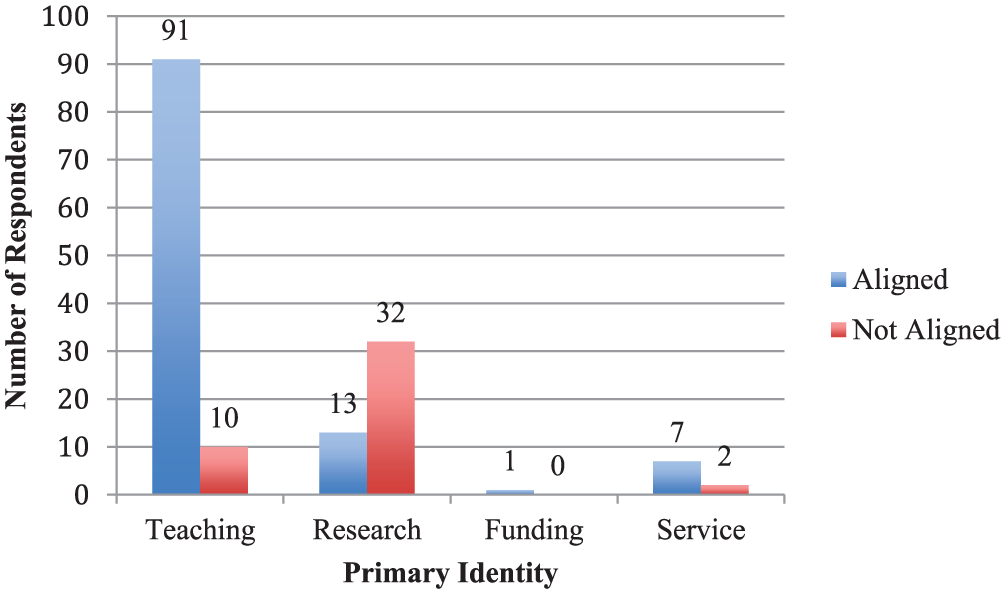
Alignment between primary identity and time spent.
The MANOVA utilized this dummy code as a grouping variable, with SWLS and the JSS subscales as outcome measures. The overall MANOVA demonstrated a significant between-group difference, Wilks’s lambda = .870, F(10, 135) = 2.02, p < .05, partial η2 = .130. Follow-up univariate analyses indicate significant between-group differences on the following outcome measures: SWLS, F(1, 144) = 10.77, p < .01, partial η2 = .049; and six of the nine JSS subscales, including pay, F(1, 144) = 10.65, p < .05, partial η2 = .045; fringe benefits, F(1, 144) = 4.08, p < .05, partial η2 = .030; coworkers, F(1, 144) = 4.53, p < .05, partial η2 = .033; operating procedures, F(1, 144) = 12.89, p < .001, partial η2 = .079; communication, F(1, 144) = 4.97, p < .05, partial η2 = .033; and nature of work, F(1, 144) = 5.31, p < .05, partial η2 = .044. In all cases, the group whose primary faculty identity was aligned with how their time was spent reported a higher level of satisfaction than the group with a mismatch.
Discussion
Our study results indicate several interesting and important findings. First, we found that one’s academic identity matters in terms of job and life satisfaction. In comparison to researchers, teachers reported higher levels of satisfaction on a number of measures, including greater feelings that they were paid a fair amount for the work they do and received adequate fringe benefits, they were appreciated and recognized for their work, they liked their coworkers and got along well with them, their university did not overburden them with red tape or paperwork, their institution communicates its goals clearly, and they took pride in and enjoyed their work. Teachers also reported greater overall life satisfaction than researchers.
On the face of it, the higher satisfaction levels of teachers combined with the finding that a larger proportion of faculty at RPUs identified as teachers would seem to suggest a positive outlook for RPUs. However, this interpretation is problematic due to the additional finding that faculty with fewer years of experience were more likely to identify as researchers than teachers. There are two possible explanations for this relationship: a developmental effect or a cohort effect.
A developmental interpretation would indicate that faculty at RPUs start out identifying more with the research aspects of their jobs and then over time shift from research to teaching as the primary area of importance for their faculty identity. This interpretation would be appealing since it would indicate that over time, faculty at RPUs become more satisfied as they settle into their work as teachers and identify more with what, in past decades, was the primary focus for faculty at these institutions.
A cohort interpretation of this phenomenon would suggest that rather than faculty developing over time into teachers, institutions have evolved such that in recent years, the profiles of newly hired faculty have shifted, with more researchers and fewer teachers being hired at RPUs. This interpretation is considered the more likely of the two for several reasons. First, this is consistent with the research literature on institutional striving (Gonzales et al., 2014; O’Meara & Bloomgarden, 2011) and shifting attitudes of faculty at RPUs (Youn & Price, 2009), both of which have demonstrated an increasing institutional focus at RPUs on research and a decreased emphasis on teaching. Second, while university junior faculty have been found to resent the constant pressure to publish and lament the passing of a “golden age” in which faculty could conduct research at a more leisurely pace, these same faculty still very much identify with their research and see research as the most important aspect of their work (Archer, 2008a). Thus, consistent with larger neoliberal trends emphasizing research productivity, it is possible that graduate students generally are being more strongly socialized to value research over teaching, or that more research-focused individuals are being selected into graduate schools in the first place, leading to a larger proportion of nontenured faculty with the same values. Finally, with the increasingly competitive hiring environment in higher education (Jaschik, 2016), it is possible that a surplus of researchers who would have previously been hired at research-intensive institutions have become available for hire at RPUs, leading to a sort of “trickle-down effect” of neoliberal values. This shift, coupled with neoliberal forces (e.g., institutional striving at RPUs, focus on measurable and marketable research production, increased competition), could certainly account for the relationship between years of experience and primary identity found in this study.
If the cohort interpretation is correct, this finding could be highly problematic for RPUs over the long term, for reasons illuminated by the answer to the third research question in this study. With regard to this research question, it was determined that those faculty who spend the greatest amount of time on the task that they rated as most important to their identity (e.g., teachers who spend the largest proportion of their time teaching) reported greater overall well-being and job satisfaction, including greater feelings that they were fairly compensated and received adequate fringe benefits, they liked and worked well with their coworkers, they were not overburdened with institutional red tape, their institution communicated clear goals and priorities, and they enjoyed and found meaning in their work. This finding parallels previous research that has determined that university faculty job satisfaction is not impacted by excessive workloads alone but rather when they are expected to perform excessive work that is not in line with their own job priorities (Fredman & Doughney, 2012).
In light of the findings for the first research question, this latter finding suggests that the reason for researchers’ greater dissatisfaction may not be their identity per se but rather that there is a mismatch between their priority (research) and how they spend the greater part of their time (teaching). In fact, despite the greater emphasis put on research at RPUs in recent years, faculty at these institutions still have a higher teaching load than faculty at more research-intensive institutions, meaning that they have less time available to devote to research (Katsinas, Ogun, & Bray, 2016). Consequently, researchers at RPUs may be facing a mixed message when they are hired: that our institution values your research but you will not be granted the necessary time to engage in this “valued” work. This interpretation is also consistent with the null finding for the second research question, which suggests that the rhetoric of “department expectations” is less salient for faculty than the concrete reality of how their time is spent.
Taken together, the findings that greater dissatisfaction is being reported by researchers, less experienced faculty more frequently identify as researchers, and one cause of dissatisfaction may be a mismatch between time spent and primary faculty identity could suggest greater troubles on the horizon for RPUs. Students attending these universities, particularly students positioned within the less selective tiers of the postsecondary hierarchy, come from traditionally underserved communities, including large proportions of first-generation students, economically disadvantaged groups, and racial and ethnic minorities (Shavit et al., 2007). These students are most in need of faculty devoted to quality teaching to improve their chances for educational success and future economic prospects. In the face of increasing tuition and decreasing support at the state level, these students may be facing the additional obstacle of faculty who are decreasingly focused on providing quality teaching and, perhaps even more alarming, increasingly dissatisfied with their work as RPU faculty members.
Future research will need to expand on the findings in this study, both in terms of probing faculty experiences at RPUs more deeply and studying RPUs in other states. While the operational definition of identity utilized in this study (essentially, ranking of various academic tasks) was useful as a starting point for exploration, identity will be explored more deeply in future research, including analysis of qualitative data that were collected in the same survey but whose analysis was beyond the scope of the current article. Analysis of qualitative responses from faculty at RPUs will help substantiate and refine the findings presented here. Also, while Illinois is a useful context for this work, given its current budget crisis, it will be valuable in future research to see if faculty have similar attitudes in other states, both those states in similarly difficult financial straits and those who are not in such dire circumstances yet are experiencing the nationwide trend of decreased state support for higher education.
Pervasive neoliberal trends toward competition, efficiency, and “economically related deliverables” like grant-funded research output (Luka et al., 2015) combined with increasing economic pressures at the state level pose significant challenges to RPUs in the United States, their faculty, and their students. If RPUs are to continue to deliver on the promise of an affordable college education for all students, challenges to faculty work and strains on faculty identity will be a vital area for continuing study. It is hoped that the research presented here will be an initial step in this direction.
Footnotes
Appendix A
Appendix B

Authors
DARYL DUGAS is an assistant professor of educational psychology and adult development at Northern Illinois University. His research interests include the identity development of teachers and the impact of the transition to adulthood on teaching practices.
KELLY HODGSON SUMMERS, PhD, is an assistant professor in the Department of Leadership, Educational Psychology, and Foundations at Northern Illinois University. Her research interests include bullying and victimization in middle schools, including the role of bystanders in bullying situations, and how school leaders can better support data-driven decision making in public school settings.
LINDSAY N. HARRIS is an assistant professor of educational psychology and a faculty affiliate of the Center for the Interdisciplinary Study of Language and Literacy at Northern Illinois University. Her research investigates the cognitive processes underlying reading and word learning across writing systems and sensory modalities.
AMY E. STICH is an assistant professor at Northern Illinois University and a 2016 National Academy of Education/Spencer Postdoctoral Fellow. Stich is a sociologist of education and qualitative researcher whose work focuses on social class and inequality of access, opportunity, and outcome at various levels of education.