



Abstract
Investigating the experiences of four new Chinese language teachers from diverse backgrounds in a Midwest state, this study explores their interactions with curriculum during their first year of teaching in U.S. K-12 schools. Using Zeichner and Gore’s interactive perspective of teacher socialization, the study gathered qualitative data from multiple sources and formats. The data underwent coding and analysis in NVivo 8. The findings revealed that these new teachers had limited access to K-12 Chinese curriculum and lacked sufficient knowledge about it. Consequently, they faced challenges in making informed curricular decisions and struggled in their daily instruction. Despite these obstacles, the teachers managed to create their own curricula, implement student-centered teaching, and incorporate both Pinyin and Chinese characters in their instruction. The paper concludes with recommendations for Chinese teacher education.
Introduction
Enrollment in Chinese language programs in U.S. K-12 schools has been on the rise (The College Board, 2006; Kong & Shang, 2020; Rhodes & Pufahl, 2009) following the recognition of Chinese as a “critical language” by the U.S. Secretary of Education (NCOLCTL, nd). Despite challenges arising from recent tensions between the U.S. and China, Chinese language education continues to grow in U.S. K-12 schools (Chen, 2023; Kong & Shang, 2020). Consequently, there is a pressing demand for qualified Chinese language teachers in U.S. K-12 education (Chen, 2023; Ingold & Wang, 2010; The College Board, 2006).
Despite the increasing demand for qualified K-12 Chinese language teachers, there is limited research on how these teachers are prepared for their roles in U.S. schools. While the need for qualified teachers has been acknowledged (Wang, 2009), research specifically focusing on Chinese language teacher education in the K-12 context is scarce (Gong et al., 2020; Wang, 2012). Existing literature highlights challenges faced by K-12 Chinese language teachers, particularly in curriculum development (Chen, 2023; Chen et al., 2017; Liao et al., 2017).
Research in various disciplinary areas emphasizes the pivotal role of a robust curriculum in effective teaching and student learning (Polly, 2016). Curriculum and instructional materials significantly influence how teachers learn and teach (Achinstein et al., 2004; Kardos & Johnson, 2010; Lloyd, 2008; Valencia et al., 2006). Despite the importance of this topic, limited research exists, especially in the context of K-12 Chinese teacher education. This study explores the experiences of new Chinese language teachers with curriculum in K-12 schools, comparing their experiences with teachers from other disciplines.
Literature Review
Curriculum and Influence on Teachers
Curriculum encompasses standards for instruction, learning objectives at district and state levels, as well as materials designed for teacher and student use during instruction (Polly, 2016; Remillard, 2005; Sherin & Drake, 2009). In this study, “curriculum” refers to the comprehensive plan guiding K-12 Chinese language instruction, including learning objectives, thematic units, lesson plans, and assessments over an academic year or semester. A Chinese curriculum ideally outlines topics, relevant vocabulary, grammar, cultural elements, and explicit orthography instruction. Curriculum materials, such as textbooks, teacher’s guides, and workbooks, aligned with the curriculum, facilitate instruction in K-12 Chinese language classrooms. The term “curriculum” can have varied meanings, including standards, learning objectives, and instructional materials, but in this context, it pertains specifically to the structured plan guiding classroom instruction.
The impact of curriculum on teachers’ learning and instruction has been extensively studied in mainstream education. Research has identified both positive and negative aspects of how the curriculum affects teachers (Achinstein et al., 2004; Valencia et al., 2006). Some studies reveal that curriculum and curricular materials can hinder teachers’ creativity and autonomy (Apple & Junck, 1990; McNeil, 1986; Valencia et al., 2006), while others indicate they support and facilitate teachers’ instruction (Lloyd, 2008; Nicol & Crespo, 2006; Polly, 2016; Remillard, 2000; Valencia et al., 2006). When teachers are “unfamiliar or uncomfortable with the subject matter or pedagogical strategies recommended” (Brown & Edelson, 2003, p. 6), curricular resources provide the necessary structure for instructional activities. Additionally, curriculum aids pre-service teachers’ learning. Nicol and Crespo (2006)found that curriculum materials help raise questions that pre-service teachers may not consider on their own, enabling them to elaborate and use the curriculum creatively. Lloyd’s (2008) case study of a math student teacher’s internship demonstrated that concise curricular materials assisted the student teacher in understanding details and big ideas before adapting them to actual instruction. Consequently, scholars advocate for curriculum analysis activities in teacher education programs and emphasize the importance of teachers’ involvement in the design processes to enhance their learning and teaching experiences (Ball & Cohen, 1996; Lloyd, 2008; Remillard & Bryans, 2004).
Novice teachers encounter challenges in using and adapting curriculum to their instruction due to limited knowledge. Some student teachers “mechanically” followed teachers’ guides, lacking a deep understanding of the activities, leading to distortions of lesson objectives (Ball & Feiman-Nemser, 1988, p. 415). Additionally, new teachers often lack teaching experience, affecting their effective use of curriculum. Sherin and Drake (2009) found that new teachers focused on details rather than big ideas in curriculum, lacking evaluation and adaptation skills. The absence of a coherent curriculum can overwhelm new teachers, contributing to attrition from the profession (Kauffman et al., 2002). Consequently, explicit assistance is crucial for inexperienced teachers to enhance their understanding of curriculum and increase their pedagogical knowledge (Kauffman et al., 2002; Lloyd, 2008; Remillard & Bryans, 2004).
Curriculum and Teacher Knowledge
Teachers’ familiarity with curriculum is integral to their overall teacher knowledge (Shulman, 1987; Verloop et al., 2001). Integrating this knowledge with pedagogy, content, student, and contextual understanding is vital for effective teaching (Shulman, 1987; Tsui, 2003). Moreover, teachers’ grasp of curriculum significantly influences their interpretation and application of instructional materials (Kauffman et al., 2002; Lloyd, 2008; Remillard, 2005; Sherin & Drake, 2009).
Recent studies have delved into the early teaching experiences of educators, exploring how they navigate curriculum and contextual factors, leading to a restructuring of their teaching knowledge (Remillard, 2000; Smagorinsky et al., 2002; Valencia et al., 2006). Remillard’s (2000) examination of new mathematics teachers revealed that these educators scrutinized students’ learning, teacher guides, and textbooks before making curricular decisions, fostering the evolution of their teaching expertise. This insight aligns with literature findings, emphasizing that teachers’ adaptation of curriculum to local contexts shapes their knowledge base (Remillard, 2005). Consequently, her proposed research framework underscores the intricate interplay between teachers, curriculum, and various educational constructs.
Teachers require substantial support and guidance in understanding curriculum, especially when their professional knowledge base is limited. Adler (2012) emphasized that weak professional knowledge among teachers led to challenges in effectively incorporating curriculum texts into their classroom practice. To address this issue, scholars have advocated for better-designed curriculum materials and targeted professional development initiatives (Adler, 2012; Kauffman et al., 2002; Remillard, 2000; Valencia et al., 2006). Notably, existing research predominantly focuses on mathematics and English teachers, often comprising experienced educators, underscoring the necessity for similar investigations involving new teachers and those in diverse disciplinary areas.
Curriculum and Second/Foreign Language Teacher Education
Scarcity exists in studies exploring the experiences of second and foreign language teachers with curriculum and curriculum materials. Despite being a domain where “…traditional practices, conventional wisdom, and disciplinary knowledge have dominated” (Freeman, 1996, p. 374), language instruction has historically overlooked teacher education. Existing research has primarily concentrated on curriculum coursework within teacher education programs (Graves, 2009), or reported teachers’ challenges with curriculum (Chen et al., 2017; Liao et al., 2017). Few studies have delved into the learning experiences of novice language teachers in K-12 settings (Farrell, 2009). Consequently, there is a pressing need for research investigating the encounters of second and foreign language teachers with the curriculum.
Tsui’s (2003) study stands among the few examining language teachers’ learning experiences. It redefines teacher knowledge and explores the differences between experienced and novice ESL teachers in Hong Kong, highlighting expert teachers’ ability to interpret and balance teaching forces effectively. In Hong Kong, Richards and Pennington (1998) observed first-year ESL teachers primarily adhering to the prescribed curriculum, while Farrell (2003, 2006) identified conflicts between a novice ESL teacher’s ideal curriculum and the prescribed one. However, these studies were conducted outside the U.S., and comparable research on ESL and foreign language teachers within the U.S., including Chinese language teachers, is scarce. Given the growth of K-12 Chinese education, understanding how Chinese language teachers learn to teach and the influence of curriculum is imperative.
Theoretical Framework
This study, following Zeichner and Gore’s (1990) interactive perspective on teacher socialization, explores unique aspects of K-12 Chinese language teachers’ learning experiences. Traditionally, teacher socialization has been described as “the process whereby the individual becomes a participating member of the society of teachers” (Zeichner & Gore, 1990, p. 329). Existing literature has examined teacher socialization through functionalist, interpretive, and critical lenses. The functionalist approach highlighted commonalities but overlooked diversity, while the interpretive approach focused on individual development, lacking a generalized framework for teachers’ growth.
This study employs Zeichner and Gore’s (1990) interactive perspective, which acknowledges that teacher socialization is a dynamic and reciprocal process. Teachers actively engage in their own learning, exert influence on their environments, and shape their professional development. Viewing socialization as a mutual interaction, teachers simultaneously influence and are influenced by diverse forces (Zeichner & Gore, 1990). This interactive lens guides the exploration of how new Chinese language teachers’ interactions with curricula impact their initial teaching experiences and contribute to their professional development. The study addresses the following research questions: 1. What was the availability and support for Chinese curricula in the schools where the teachers were employed? 2. Did the teachers possess adequate knowledge of curriculum? 3. How did the interplay between curricula and teachers’ curriculum knowledge impact their inaugural year of teaching? 4. What methods did the teachers employ to learn and implement their curricula effectively?
Research Method
This qualitative case study is part of a broader research initiative, employing methodologies rooted in mainstream and language education (Chapelle & Duff, 2003; Duff, 2008; Hatch, 2002; Miles & Huberman, 1994; Richards, 2003; Stake, 2000; Yin, 2006). Focusing on four distinct cases, this study delves into the unique and shared aspects of Chinese language teachers’ integration into the K-12 language teaching profession.
Context
At a Midwestern U.S. university, the Confucius Institute and the university’s teacher education program collaborated to address the shortage of qualified Chinese language teachers. They introduced an Alternative Routes to Certification Program (ACR) where candidates from the U.S., China, and Taiwan, after completing their undergraduate studies, undertake two summer courses. From fall onwards, they teach full-time in K-12 schools for two years in the same state or neighboring states, simultaneously taking professional education courses. Upon completion, they receive provisional teaching certificates. This innovative program blurs the lines between traditional pre-service student teaching and new teacher induction, with candidates assuming both roles concurrently, referred to as “new teachers” in this study.
Participants
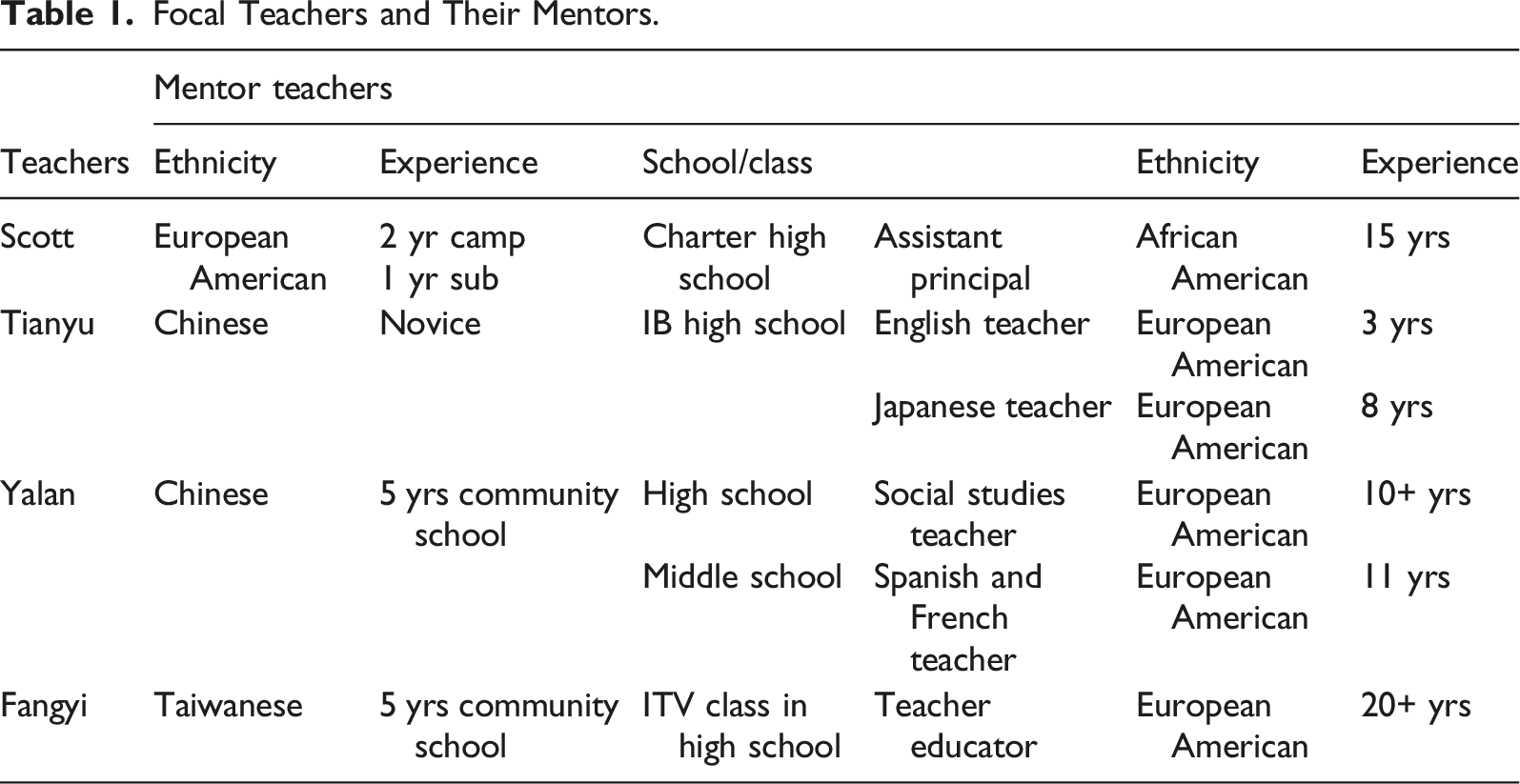
This study focuses on four new teachers enrolled in the alternative certification program at U.S. secondary schools in 2009–2010. The selection of the four focal teachers aimed to encompass diverse teacher candidates’ backgrounds and experiences within the certification program. These teachers represented a variety of linguistic, cultural, ethnic, and educational backgrounds. Additionally, three of them possessed teaching experience in different contexts, showcasing the program’s diversity. This selection seeks to mirror the diverse backgrounds of Chinese language teachers in the U.S., as evidenced by existing sources, although it may not encompass all possible backgrounds. Pseudonyms have been employed for the four teachers involved in this study, which has received IRB approval. Below are brief descriptions of these four teachers.
Scott, an experienced European American translator proficient in Chinese, taught Grades 6–8 at an urban charter school during the study. He had prior experience in a non-profit youth camp and served as a long-term substitute teacher. His mentor, the assistant principal and school consultant, possessed 15 years of teaching experience as a history educator.
Tianyu, a new teacher from China, joined the certification program right after receiving his Bachelor’s degree in 2009. He taught International Baccalaureate Chinese in a high school during his first year. He was mentored by an experienced English substitute teacher in her third year of teaching in the fall and by a veteran Japanese language teacher with eight years of experience in the spring.
Originally from China, Yalan, a U.S. citizen, possessed a Bachelor’s degree from China and a U.S. Child Development Association certificate. Before enrolling in the certification program, she taught Chinese in a local Chinese community school for five years. In her first year of public K-12 teaching, she taught Chinese language and culture in social studies classes in a public high school in the fall, mentored by a social studies teacher. In the spring, she taught Chinese as a foreign language in a public middle school, mentored by a Spanish language teacher with 11 years of experience.
Fangyi, from Taiwan, held a Bachelor’s degree from Taiwan and a U.S. Master’s degree in education from the same university hosting the certification program. Prior to the program, she taught English in Taiwan for three years and Chinese in a U.S. community school for five years. In her first year of the program, she taught Chinese in a distance education program for students from three high schools, mentored by an experienced teacher and administrator. The focal teachers were either native or proficient Chinese speakers.
Focal Teachers and Their Mentors.
Data Collection
Data collection for this year-long study, spanning from fall 2009 to spring 2010, aimed to achieve an “in-depth” understanding of the teachers’ real-life teaching contexts (Yin, 2006, p. 111). Various data formats were employed, including weekly teaching journals, bi-weekly teaching videos, field instructor feedback, and mid-term and final evaluations. In their teaching journals, teachers documented their teaching experiences, described challenges encountered and posed questions. They submitted their journals and videos for review and participated in online meetings with their field instructor.
The field instructor conducted mid-term and final evaluations in collaboration with the teachers’ mentors and/or principals. These evaluations were comprehensive, encompassing eight general standards and detailed sub-standards. These standards covered areas such as teacher knowledge, addressing students’ needs, technology integration, assessment practices, classroom management, parent/community relationships, professionalism in the school environment, and professional development.
Furthermore, each teacher participated in two semi-structured, in-depth interviews— one centered on their backgrounds and the other on their first-year teaching experiences. During the second interviews, the teachers were prompted to recall their first year of teaching using their videos as a stimulus. These interviews, lasting from half to 1 hour each, were conducted in either English or Chinese, according to the teachers’ preference. In the second year, follow-up conversations lasting 5–15 minutes were held to seek clarifications and gather additional information.
Additionally, mentors, policy-makers, instructors, and administrators affiliated with the certification program were interviewed. These interviews, conducted in English, typically lasted around 1 hour. The mentor interviews focused on their perspectives on K-12 Chinese instruction, their interactions with their mentees (the focal teachers), the challenges their mentees encountered, and the guidance and support they offered. All interviews were audio-recorded for accurate documentation. The interview questions can be found in the attached appendix.
Data Analysis
The qualitative data analysis was conducted using NVivo 8, where texts from different data sources were meticulously analyzed line by line in the software’s “free node.” This process allowed detailed themes to naturally emerge from the data, ensuring an unbiased approach (Richards, 2003). The analysis concentrated on teaching journals, videos, interviews, and follow-up discussions. The interviews were translated (if in Chinese) and transcribed. Each teacher’s experiences with curriculum and learning to teach were analyzed individually across multiple rounds and compared across various data sources throughout the academic year. Subsequently, a cross-case analysis was performed to identify significant similarities and differences among the four teachers’ curriculum experiences. The analysis results were compared with findings from peer debriefing and member checking (Brenner, 2006), resolving any discrepancies through discussion and revisiting the data.
Results
In alignment with the research questions, the findings of this study are presented in four sections below: teachers’ curriculum in their initial teaching years, their understanding of curriculum, the impact of curriculum on their teaching, and their process of learning to teach and utilizing the curriculum. Notably, we observed striking parallels in the experiences of the four teachers, despite their diverse backgrounds and teaching tenures. Consequently, our report emphasizes the commonalities across these four themes.
Lack of Curriculum and Limited Assistance
Lack of Curriculum
Although the four teachers were assigned to different school districts within the state, the study revealed that none of them were provided with a specific curriculum or abundant curricular materials for teaching Chinese in public secondary schools. This restricted access to Chinese language curriculum significantly challenged their first year of classroom instruction.
Both Scott and Tianyu faced a similar challenge as neither of them received any curricular materials before the fall semester commenced. At the outset of the semester, Scott was tasked by the principal to develop a curriculum for his Chinese classes. Reflecting on this experience, he stated, “Since I didn’t have a textbook or a kind of curriculum…I was creating the curriculum” (Scott’s second interview). When questioned about the resources at his disposal, Scott replied, “I basically created my own from scratch…I was basically going without any resources at all” (Scott’s second interview).
Tianyu, a novice teacher from China, found himself unprepared for teaching in an IB program. He recalled, “I went there. I just heard about IB, but I had no idea about what it is” (Tianyu’s second interview). It wasn’t until the middle of the second semester that he received an IB syllabus, and even then, it was the only material available to him. He remarked, “I still do not have any IB curriculum. I only have an IB syllabus. That was I think February or March in 2010, so almost in the middle of the second semester” (Tianyu’s second interview). Additionally, Tianyu lamented the lack of resources for Chinese teachers in the IB Mandarin program, stating, “…for IB for Mandarin, they do not have a lot of resources for Chinese teachers” (Tianyu’s second interview). Although he received the textbook “Integrated Chinese” in late September, it was not tailored for Chinese IB programs, forcing him to create his teaching materials from scratch at the beginning of the school year, mirroring Scott’s experience.
“Similar to Scott and Tianyu, Fangyi and Yalan did not receive curricula from their schools or districts. However, they differed in their approach; both Fangyi and Yalan had independently prepared their own curricula before the semester began. Fangyi collaborated with her mentor teacher to develop the curriculum before the school year started. The mentor teacher recalled their efforts, Fangyi has to set her goals based on the standards of the State and the national standards. So when we sat down to outline the expectations for the first year, she really had to set her expectations for her students, and those were the goals for the class. (Fangyi’s mentor interview)
Similar to Tianyu, Fangyi received a textbook from the school, “Learning Chinese with Me,” and used it to plan her lessons. She supplemented her teaching materials by researching online and looking into how other Chinese teachers organized their schedules (Fangyi’s second interview).
Yalan faced a unique situation in her first year, similar to but distinct from the other focal teachers. She collaborated with a social studies teacher to design the curriculum for teaching Chinese language and culture in the social studies classes during the summer. However, this was a new experiment, and they had limited curricular resources. In the spring, Yalan taught Chinese in a middle school without a provided curriculum. Drawing on her experience, she designed her own curriculum. Her mentor teacher confirmed this, stating, “As far as the district-driven curriculum, we don’t have that, because we are just about developing Chinese. So we are kind of allowing our Chinese teachers to develop it as they are creating the courses” (Yalan’s spring mentor interview). Despite these challenges, Yalan utilized interactive PowerPoint presentations to teach vocabulary, a strategy she devised due to limited resources.
Limited Assistance
During their first year, these teachers received varying degrees of assistance in curriculum design and implementation. Scott received minimal assistance, while Tianyu and Fangyu received moderate support. Yalan had mentorship in the fall but lacked it in the spring, creating differing levels of aid among the teachers.
Scott’s mentorship primarily focused on broad program goals, such as conversational skills and cultural topics (Scott’s mentor interview). Apart from these general objectives, Scott received limited curriculum guidance. Discussions with his mentor centered on classroom management due to student behavior concerns (Scott’s second interview). Additionally, Scott’s mentor, being an administrator without a language background, lacked the expertise to assist him in curriculum design (Scott’s second interview). Consequently, Scott independently made all curriculum decisions.
Tianyu sought information about the IB Chinese program from his school, but received only a general booklet that briefly introduced the entire IB program, leaving him unclear about the specifics of the Chinese program. While his fall mentor assisted him in the classroom, and his spring mentor helped him find an IB syllabus, neither mentor actively engaged in curriculum design. Occasionally, they suggested topics for Tianyu, but there was limited direct assistance in shaping the curriculum (Tianyu’s second interview).
Unlike Scott and Tianyu, Fangyi and Yalan received considerable assistance in curriculum design. Fangyi’s mentor and Yalan’s fall mentor collaborated with them to design their curricula before the fall semester. Throughout the fall, they both received feedback from their mentors. However, Yalan did not receive assistance in curriculum design from her spring mentor due to the mentor’s limited scope of guidance, which did not include aspects related to teaching development, lesson plans, or curriculum (Yalan’s spring mentor interview).
Limited Knowledge of Curriculum
The data reveals that the four teachers had insufficient knowledge of curriculum, and their restricted access to Chinese language curriculum impeded their development of teacher knowledge. These limitations posed challenges to their learning to teach, leading to difficulties in their teaching experiences. Scott admitted his limited understanding of curriculum, stating, “I think I’ve learned the most about curriculum from developing it as I taught” (Scott’s follow-up interviews).
Required by his principal to develop a year-long Chinese IB curriculum, Tianyu found himself discouraged and bewildered due to the principal’s unclear expectations. Although Tianyu aimed to let “… learn speaking first, and gradually lead them to reading, writing, listening…” (Tianyu’s follow-up interviews), the principal expected a more comprehensive curriculum specifying content. This discrepancy highlighted Tianyu’s limited understanding of U.S. K-12 foreign language curriculum and related second language acquisition theories. His proposal appeared to be influenced more by his personal experiences, shaped by his previous foreign language education in China, where the four language skills were taught separately (Tianyu’s follow-up interview).
Yalan and Fangyi had designed their curricula before the school year began, yet their grasp of curriculum concepts seemed lacking. In September 2011, over a year after their initial teaching experience, an email from Yalan to the first author revealed potential gaps in her curriculum knowledge, as she inquired: (1) Can a book be considered part of the curriculum? (2) What common elements define all curricula? What makes “a curriculum” what it is? (3) Is the term “curriculum” overused or misused? Do teachers, parents, students, and administrators respond differently to the term based on their connotations?
The email suggests Yalan’s uncertainty about the various interpretations of the term “curriculum” in K-12 contexts, a concern she later confirmed during subsequent conversations.
In a conversation in April 2011, a year after her first year of teaching, Fangyi revealed her lack of understanding about what constitutes a curriculum and how to design a language curriculum. This realization came to her during a language curriculum course in a TESOL program at another university.
Influences on Their Teaching
The teachers’ constrained access to Chinese curriculum hindered their teacher knowledge development, creating challenges such as deciding what to teach, when to teach language skills, and whether to prioritize Pinyin or Chinese characters. These difficulties extended into other teaching areas, intensifying their first-year struggles.
Influences on the Content
Relying on his personal insights into foreign language instruction, Scott chose topics and made curricular decisions. However, he struggled to meet his expectations. Initially, Scott believed his students would share his fascination with Chinese history and culture. He remembered, …I felt there was a lot of Chinese history, culture…that would make the students automatically very interested in learning Chinese, so I was excited, very eager, and also expected that my students were going to be as eager as I was, and learn what I was going to be teaching… (Scott’s first interview)
The quotes reveal that Scott didn’t assess students’ needs or real interests before making his curricular decisions. Consequently, he discovered that students weren’t interested or engaged as he had assumed. Scott noted, “I feel like I was giving them good information, but I found out the students a lot of times didn’t take notes at all, or didn’t study their notes, or lost their notes” (Scott’s second interview). While other factors like students’ long-term academic struggles and misbehavior played a role, the absence of curriculum and support made teaching more challenging for Scott compared to first-year teachers with established curricula and assistance.
After his initial curriculum attempt failed and following feedback from the principal, Tianyu embarked on a redesign. Yet, being a novice teacher from a different cultural and educational background, this task proved daunting. Despite his efforts, he struggled to select appropriate topics, stating, “I would say those topics are all the ones that I can think of…” (Tianyu’s second interview). However, his limited curriculum knowledge made it challenging to sequence these topics logically, resulting in disjointed lessons. He admitted, “So I taught a lot of things, but they are not well-connected…to them, it seemed random” (Tianyu’s second interview). This lack of curriculum design skills compounded his difficulties in planning and instruction. When asked about his initial lesson planning, Tianyu confessed, “I had no idea. All I was trying to do was how to finish the class and have something…” (Tianyu’s second interview). Without a structured curriculum and well-prepared lesson plans, Tianyu often lost track during lessons, leaving students confused. Consequently, students approached the principal seeking clarity on their daily lessons.
Despite having more curricular materials than Scott and Tianyu prior to the school year, Yalan and Fangyi encountered challenges as students lost interest and asked unrelated questions. This suggests a potential lack of understanding of their students’ interests during curriculum preparation, even with mentor assistance. Additionally, since Chinese instruction was new in their schools, few were familiar with students’ needs in learning Chinese. To address this, Yalan and Fangyi conducted surveys to gauge student interests. Consequently, they adjusted their curricula based on survey results. However, both teachers noted that their curriculum experiences significantly contributed to their first-year challenges.
Pinyin and Chinese Characters
Lacking a structured Chinese curriculum, the teachers faced the dilemma of whether to focus on Pinyin or Chinese characters and how to approach these topics. During the initial year, Scott opted for a communicative approach, writing Pinyin on the board and expecting students to follow along and learn the sounds. He avoided overwhelming his students by not teaching Chinese characters or Pinyin systematically (Scott’s second interview). However, by the end of the year, Scott was disappointed to find that the students did not meet his expectations. I remember being frustrated kind of the end of the year where I write something in the board in Pinyin, and I would call on somebody and say, “What is this”? And they read it…what they…and it was totally wrong. (Scott’s second interview)
Scott’s realization came when he noticed students struggling with Pinyin pronunciation, highlighting the importance of systematic instruction. Reflecting on his decisions, he regretted not teaching Chinese characters and acknowledged the impact of limited curriculum support, expressing that having an experienced Chinese teacher assist him would have been invaluable (Scott’s follow-up interviews).
Tianyu, influenced by his background, initially focused on teaching Chinese characters, believing it would engage students. Disagreeing with Yalan, who advocated teaching both Pinyin and characters, Tianyu soon observed students struggling with character pronunciation. Consequently, he adapted his approach, incorporating Pinyin into his instruction, as documented in his journal, Back then I was supporting the negative [other] side, and defending myself by telling them my American students in China all have problems with pinyin and tones even if they speak wonderful Chinese. Ironically, I have changed my previews [previous] lesson plan with adding Pinyin to the first unit. (Tianyu’s journal in the fall)
Without a curriculum or guidance, Tianyu independently incorporated Pinyin into his teaching. However, this self-directed approach potentially impacted students’ learning negatively.
Due to her prior teaching experience, Yalan introduced both Pinyin and Chinese characters at the beginning. However, she struggled with specific curriculum decisions related to stroke order. In her October journal entry, she questioned, “Is the order (笔顺笔画) 1 of characters important? Is it necessary to teach American students 笔顺笔画?” (Yalan’s fall journal), demonstrating her uncertainty about this aspect of the curriculum.
Fangyi initially used Zhuyin Fuhao and traditional Chinese characters in Taiwan but switched to Pinyin and simplified Chinese characters due to the students’ difficulty with the complexity of traditional characters (Fangyi’s follow-up interviews).
Pacing for Their Teaching
Limited access to curriculum posed challenges for the four teachers in determining the appropriate pace for their instruction. Tianyu encountered the most significant challenges, although the other three also faced varying difficulties.
Scott recalled, “I had an ‘idea’ of what I wanted to teach for the semester or year, but I didn’t have any input on it from my mentor, and I had no idea how fast or slow my pacing should be” (Phone communication with Scott). Yalan and Fangyi had to adjust their curricula to match their instruction with students’ interests and pace. Fangyi mentioned, “They didn’t specify how many lessons I had to complete in the semester” (Fangyi’s second interview). While Scott, Yalan, and Fangyi had flexibility in their pacing, Tianyu did not.
Tianyu grappled with pacing his instruction, especially considering the pressure to prepare his students for the IB Chinese test. He recalled, “…after a few months of teaching, I realized that I had only covered a few pages of the textbook” (Tianyu’s second interview). Inadequate teacher knowledge and lack of curriculum and guidance exacerbated his challenges. During the mid-term evaluation, the principal highlighted Tianyu’s struggles, noting, “Learning lacked focus, and lesson planning/unit planning was non-existent” (Tianyu’s principal’s report for the fall mid-term evaluation). This evidence suggested that Tianyu’s teaching was significantly hampered by his difficulties in lesson planning and pacing, with the lack of curriculum and guidance being a crucial factor, as observed by his fall mentor, “Honestly, I think if he had a curriculum, he would be a lot more successful” (Tianyu’s fall mentor interview).
Growth with Knowledge of Curriculum and Improved Instruction
In their first year, the teachers gained curriculum knowledge through mentors, field instruction, and personal experiences. This exposure allowed them to integrate their instruction with students’ lives and teach Pinyin and Chinese characters in a more structured manner.
Connecting Instructional Topics to Students’ Lives and Interests
Scott’s teaching approach was influenced by his past experience in an educational camp, emphasizing the connection between lessons and students’ lives. This perspective was reinforced during field instruction discussions on student-centered teaching. As Scott interacted with his students, he gained a deeper understanding of their backgrounds. This insight prompted him to incorporate themes relevant to students’ lives into his teaching. He set clear goals for his first year, aiming to engage students through meaningful, real-life connections in his lessons, So my goal for the whole year was at the end of the year as much as possible, they could talk about themselves in Mandarin…I want to specifically relate to their lives, and I mean…to communicate with other people in Mandarin... (Scott’s second interview)
Scott’s teaching goals aligned with those set by his mentor and the school. The broad objectives provided some guidance for Scott’s curriculum design. A review of Scott’s teaching videos revealed that he focused on themes closely related to students, including self-introduction, family, drinks, food, and school subjects. Over time, his instruction became more student-centered, emphasizing themes relevant to students’ lives and interests.
In her social studies class, Yalan focused on teaching about Britain, the United States, France, Germany, and Korea, aligning with what the students were learning in their social studies classes. Her inclusion of Korea was based on her desire to relate to the real-life experiences of a Korean student in her class. This decision highlighted her thoughtful approach to curriculum design and her awareness of the principles guiding her choices. Yalan further elaborated on her decision-making process, That’s their purposes of learning a language, I believe. If it is not connected to real life, it would be meaningless…I should say from my experience partially, and partially from your class
2
. Then naturally I thought of this. I remember we talked about it in our class. (Yalan’s second interview).
As their understanding of their students deepened through interactions and mentorship, Scott and Yalan honed their ability to choose engaging topics. Scott, for instance, creatively integrated Chinese culture into his lessons. He devised a game involving chopsticks and fruit snacks, where students practiced picking up numbered or colored snacks with chopsticks, fostering enthusiasm among the students. Scott noted their enthusiasm in his spring journal, attributing it to the enjoyable activity and the treat-like nature of the fruit snacks. This inventive teaching method showcased his evolving ability to connect curricular decisions to students’ lives, enhancing their engagement in the learning process.
In early spring, Yalan capitalised on her students’ interest in the Winter Olympics, leveraging a big poster in the school center about the Medal Count as a teaching tool. Utilising this timely opportunity, she taught her students Chinese vocabulary related to sports and medals. The impact was significant, as she observed her students actively using Chinese in their conversations the next day, highlighting the effectiveness of aligning curriculum with students’ current interests and events: The second day, I saw two students watching the medals count, and said, “美国金牌: 7, 银牌: 7, 铜牌: 10”
3
. I’m very happy and surprised that they remembered it. And another student told me, “I’m learning 花样滑冰 now”. (Yalan’s journal in the spring)
Yalan’s decision to incorporate the Winter Olympics into her lessons was based on her understanding of her students’ interests. With 14 out of 17 students being boys who shared a passion for sports, she tailored her curriculum to align with their preferences (Yalan’s journal in the spring). This insight into her students’ interests enabled Yalan to make more informed curricular choices, resulting in engaging lessons and enhanced learning experiences for her students.
Fangyi, despite having less experience with U.S. students, improved her teaching methods through various sources of knowledge, including her mentor teacher, field instruction, fellow teachers, and direct interactions with students. She recognized that “…if the lesson really links to students’ life, students would be more willing to learn” (Fangyi’s second interview). She organized a field trip to a local Chinese restaurant, encouraging students to converse in Chinese with the waiter. Through surveys, Fangyi confirmed that students enjoyed this interactive experience and felt motivated to use Chinese in practical situations. Additionally, she integrated communication standards from the ACTFL 5C framework into her lessons. By incorporating students’ topics and expressions from their writings, Fangyi made her instruction more relevant, encouraging active participation and interaction in class. This approach, grounded in a deep understanding of curriculum and students, significantly contributed to her teaching development and students’ learning outcomes.
Despite facing significant challenges, Tianyu actively worked on enhancing his understanding of curriculum. The fall mid-term evaluation served as a crucial point where he recognized the necessity of a long-term instructional plan. Realizing the need for a structured approach, he actively sought resources, interacted with his cohort, and carefully studied the IB Chinese syllabus. Tianyu recalled, “Later with the syllabus, I knew which vocabulary was useful to the students and they should learn or which vocabulary would not appear in their tests” (Tianyu’s second interview). This in-depth understanding enabled him to reorganize his instruction effectively. As a result, Tianyu observed a positive shift in his teaching dynamics, with classes proceeding smoothly, transitions becoming seamless, and students successfully grasping the intended content (Tianyu’s spring journal). This adaptation and growth in his curriculum knowledge significantly impacted his instructional effectiveness.
Throughout his teaching journey, Tianyu actively engaged in continuous learning and adaptation. Drawing from methods learned during field instruction and students’ interests, his instruction became increasingly student-centered. By incorporating the IB syllabus and students’ input, he designed a unit on weather, employing various activities and collaborative tasks. The students, highly motivated, enthusiastically presented their weather forecasts, showcasing their fluency in Chinese. Tianyu’s instructional improvements were evident, reflected in successful student presentations and their subsequent upload on YouTube. While Tianyu exhibited growth in his teaching, he faced limitations in aligning his instruction with students’ real-life contexts due to external assessments, distinguishing his approach from that of the other three teachers.
Pinyin and Chinese Characters
As their understanding of curriculum deepened, the four teachers embraced the incorporation of both Pinyin and Chinese characters in their teaching. Initially differing in their approaches, all four educators recognized the necessity of teaching both components. Scott, reflecting on his first-year challenges, integrated both Pinyin and Chinese characters into his curriculum during the second year (Scott’s follow-up interview), leading to notable progress as observed during the author’s classroom visit in spring 2011.
Tianyu initially concentrated solely on teaching Chinese characters, but as his students’ proficiency improved, he introduced Pinyin alongside characters. Realizing the importance of both elements for the IB test, he emphasized characters for reading and writing preparation. After their weather presentations, Tianyu guided students through a reading task about weather in China, enhancing their reading and writing skills relevant to their studies (Tianyu’s spring journal), The letter is from a friend in China that introduced the weathers in four seasons. They are all in Chinese characters, and students are not allowed to use textbook and notes so that they can really practice their reading…a reply letter talking about ××’s
4
weather in four seasons is a good chance to practice the writing. (Tianyu’s journal in the spring)
Yalan, drawing from her previous teaching experience, integrated both Pinyin and Chinese characters in her curriculum from the start, aligning with her community school background. Her learning during the first year further affirmed this approach. Yalan incorporated stroke order teaching techniques and utilized six types of Chinese characters, enhancing students’ character memorization. A classroom visit during her second year demonstrated Yalan’s effective use of stroke orders to support students’ character writing, fostering successful learning outcomes.
Fangyi promptly transitioned to teaching both Pinyin and simplified Chinese characters throughout the academic year. Unfortunately, due to her departure from the certification program, the researchers were unable to observe specific details of Fangyi’s methods in her second year.
Conclusion and Implications
In this study focusing on four novice Chinese language teachers during their first year in U.S. K-12 schools, limited access to curriculum and insufficient knowledge posed significant challenges. The teachers’ struggles stemmed from the absence of comprehensive curricular resources, hindering their ability to make informed instructional decisions, especially regarding the teaching of Pinyin and Chinese characters. This lack impacted their lesson planning and instructional pacing. Despite these challenges, the teachers successfully crafted their curricula, embracing student-centered teaching. Notably, they adapted by incorporating both Pinyin and Chinese characters into their instruction.
The study highlights that the lack of a structured curriculum negatively impacted new Chinese language teachers’ growth and their students’ learning experiences, potentially undermining K-12 Chinese Education. Similar challenges were noted in prior research (e.g., Kauffman et al., 2002), indicating a widespread issue in the education system. The absence of a structured curriculum, along with limited assistance and curricular materials, emerged as significant challenges for the teachers in their first year of teaching. This situation hindered their learning and implementation processes, potentially hindering the development of autonomy and creativity in these new educators (Cohen & Ball, 1999), and compromising students’ learning outcomes. Despite their efforts in designing curricula independently, these novice teachers faced significant challenges due to their limited experience, potentially affecting the quality of education provided (Kauffman et al., 2002).
This struggle with curriculum development not only affected the teachers’ teaching methods but also led to overwhelming situations, leading some teachers, like Scott, to leave their positions after the first year. Teacher retention is a national concern (Olson, 2000), particularly in K-12 Chinese education, where the shortage of qualified teachers has hindered its growth (Arnoldy, 2007; Ingold & Wang, 2010; The College Board, 2006; Zhou, 2012). Addressing these challenges is crucial to the development of K-12 Chinese education. Action needs to be taken to create structured Chinese language curricula and retain teachers effectively.
New Chinese language teachers, like their counterparts in other subjects, require explicit guidance and support in curriculum design and implementation. Despite their proficiency in Chinese, these teachers lacked the automatic understanding of what and how to teach in a K-12 setting due to diverse backgrounds and limited support. Similar to teachers in other disciplines, they required assistance in recognizing students’ needs and crafting appropriate curricula tailored for U.S. K-12 students (Adler, 2012; Kauffman et al., 2002; Remillard, 2000; Valencia et al., 2006). The absence of structured support led to “unrealistic” expectations in their curriculum design efforts during their first year (Scott’s follow-up interview).
Collaborative efforts among stakeholders are pivotal in effectively addressing these challenges and supporting teacher learning and curriculum design. Following the study, the teacher certification program took steps to address teachers’ needs by integrating K-12 language curriculum design into their instruction. However, the teachers’ experiences underscored the absence of established Chinese curricula in schools, highlighting the need for schools to establish mechanisms and provide ongoing support for teachers to develop their own K-12 Chinese curriculum.
Continuous support from schools and districts is essential to facilitate regular curriculum discussions among new Chinese language teachers and their colleagues. Additionally, fostering collaboration between teacher education programs and K-12 schools can ensure ongoing support for new Chinese language teachers, aiding in their curriculum design and overall professional development. Such collaborative efforts are essential for enhancing the quality of Chinese language education and promoting teacher effectiveness in K-12 settings.
Moreover, there is a pressing need for research to explore the content and structure of K-12 Chinese curriculum design. It is noteworthy that the Chinese Language Teachers Association recognized this urgent need and issued a call for proposals on Chinese curriculum for its annual conference in 2013. However, further research is essential to offer guidelines and/or models for K-12 curriculum design in this field. Huang (2022) investigates various curriculum models and explores their potential synthesis and application within the Chinese context. Similar studies are warranted for K-12 Chinese language education to provide educators with valuable insights and frameworks for effective curriculum development.
Supplemental Material
Supplemental Material - New K-12 Chinese teachers’ experiences with curriculum: Flexibilities and difficulties
Supplemental Material for New K-12 Chinese teachers’ experiences with curriculum: Flexibilities and difficulties by Wenxia Wang and Jeff Bale in International Journal of Chinese Education.
Footnotes
Declaration of Conflicting Interests
The author(s) declared no potential conflicts of interest with respect to the research, authorship, and/or publication of this article.
Funding
The author(s) received no financial support for the research, authorship, and/or publication of this article.
Supplemental Material
Supplemental material for this article is available online.
Notes
References
Supplementary Material
Please find the following supplemental material available below.
For Open Access articles published under a Creative Commons License, all supplemental material carries the same license as the article it is associated with.
For non-Open Access articles published, all supplemental material carries a non-exclusive license, and permission requests for re-use of supplemental material or any part of supplemental material shall be sent directly to the copyright owner as specified in the copyright notice associated with the article.
