




Abstract
This study examines the extent to which the Initial English Language Teacher Education (IELTE) program curriculum facilitates the development of the necessary knowledge base to ensure prospective English language teachers’ classroom preparedness. Data were collected through curricular analysis of four IELTE programs and semi-structured interviews with four program directors and 10 early career English teachers to evaluate IELTE program effectiveness to prepare teachers, at least, entry-level teaching. Findings indicate that contextual factors such as rigid national policy documents, teacher educators’ limited competencies and their role in curriculum development and implementation, the status of the IELTE programs within the universities, lack of collaboration between IELTE programs and schools contributed to the inefficiency of IELTE programs to ensure prospective English teachers’ classrooms preparedness. Thus, English teachers were not prepared to carry out their jobs effectively because the knowledge base that prospective teachers acquire and develop through the IELTE program did not correspond to what they need in their classrooms for effective teaching.
Plain Language Summary
This study aimed to examine the extent to which the knowledge base areas for second or foreign language teachers were covered in the initial English language teacher education program curricula in Kyrgyzstan to ensure English teachers’ classroom preparedness. The research employed a combination of document analysis and semi-structured interviews to collect data. The study focused on four IELTE program curricula, involving interviews with four program directors and 10 early career English teachers who were graduates of the selected programs. The analysis of the data revealed that contextual factors such as rigid national policy documents, limited competencies of teacher educators, and their role in curriculum development and implementation, as well as the status of IELTE programs within universities, were identified as contributing factors to the inefficiency of these programs in ensuring the readiness of prospective English teachers for the classroom. Additionally, the lack of collaboration between IELTE programs and schools was identified as another factor hindering the effectiveness of these programs.The findings highlight the significance of teacher education programs as the foundation for continuous teacher development. The study not only provides insights into the existing challenges but also offers valuable recommendations to stakeholders for enhancing the initial English language teacher education curricula in Kyrgyzstan.
Introduction
In recent years, worldwide educational discussions have placed the quality of teaching at the core of the educational agenda to enhance student learning outcomes and overall educational improvement. Therefore, researchers have attempted to identify the components that correlate with effective teaching. Studies have revealed that the quality of teaching depends on a myriad of factors, but the quality of teachers can be identified as one of the most important determinants of student learning outcomes (Darling-Hammond, 2012; Darling-Hammond & Bransford, 2005). Teachers Matter, the report from the Organization for Economic Cooperation and Development (OECD) on policies that contribute to attracting, developing, and retaining effective teachers in schools, states, Of those variables which are potentially open to policy influence, factors involving teachers and teaching are the most important influences on student learning. In particular, the broad consensus is that “teacher quality” is the most critical school variable influencing student achievement. (OECD, 2005, p. 26)
However, despite the consensus on the importance of teachers’ quality in student learning outcomes, researchers have different views on what characteristics of teachers facilitate student achievement and to what extent each characteristic influences teachers’ classroom performance. Various contested views, such as teachers’ academic credentials, knowledge bases, professional dispositions, and teaching experiences are linked to teacher quality. Among these, teachers’ knowledge base has received the most attention as many studies have found the knowledge base to be a vital component of teachers’ professionalism; thus, given the importance of teachers as a key factor for student learning, teachers are required to have a knowledge base repertoire that promotes effective teaching and learning outcomes. Therefore, the role of initial teacher education (ITE) programs becomes crucial as a key entry point where necessary, or at least a prerequisite, a knowledge base is acquired to enter the teaching profession and upon which continuous professional development is built. This study aimed to examine the extent to which the knowledge base areas covered in the Initial English Language Teacher Education (IELTE) program curriculum in Kyrgyzstan ensured English teachers’ classroom preparedness.
The rationale for analyzing IELTE programs is that, in Kyrgyzstan, teacher education, including IELTE, is offered through a concurrent model in which subject disciplines are taught along with pedagogical disciplines for a bachelor’s degree. IELTE graduates are not required to receive subsequent training through a consecutive model, such as the Postgraduate Certificate in Education or Teacher Certification programs, which focus on both general and subject-specific pedagogy to be qualified to teach; that is, in Kyrgyzstan, there are no other requirements for becoming an English teacher except for a 4-year university degree to qualify as an English teacher for secondary schools. Moreover, there are no structured induction programs to support new teachers in their initial years of teaching. Existing induction programs are limited to assigning mentors by pairing a novice teacher with a more experienced one. Thus, the university IELTE program is the only medium through which prospective teachers can acquire the necessary knowledge to become teachers. Therefore, analyzing the IELTE program curriculum is vital to understanding the extent to which the program facilitates the development of the necessary knowledge base for effective teachers.
The following research questions were formulated for the study.
To what extent is the knowledge base required for teaching covered in the IELTE curriculum?
How do IELTE program directors perceive their program curriculum as equipping their graduates with the necessary knowledge base to teach English?
What are novice teachers’ perceptions of the effectiveness of IELTE program coursework in supporting the acquisition of the knowledge base required to teach?
Background Literature and Framework
Teachers’ Knowledge Base
For decades, knowledge bases have been at the core of researchers’ and educators’ work across disciplines. A knowledge base refers to a set of specialized knowledge, skills, and dispositions that teachers need to create an effective teaching and learning environment (Malderez & Wedell, 2007; Shulman, 1987; Sonmark et al., 2017; Verloop et al., 2001). According to Mullock (2006), teacher knowledge base is “… accumulated knowledge about the act of teaching, including goals, procedures, and strategies that form the basis of what teachers do in the classroom” (p. 48). Richards (2008) delineated knowledge base as “a specialized knowledge base obtained through both academic studies and practical experience (p. 160). Verloop et al. (2001) defined a teacher’s knowledge base as “all profession-related insights that are potentially relevant to the teacher’s activities” (p. 443). These multiple views have implications for the knowledge that teacher education curricula should cover to prepare effective teachers. As such, a large body of research has been conducted on teacher education programs in which prospective teachers develop the essential knowledge base required to enter the teaching profession. This study specifically elaborated on research related to what should constitute the core knowledge base of a second- language teacher education (SLTE) program to ensure language teachers’ classroom effectiveness.
SLTE: Knowledge Base and Models
Despite being new to the field of education, SLTE programs have yielded a large body of research of their own. Over the years, this has shifted from a behavioral to a sociocultural perspective of language learning. The behavioral view of language learning is influenced by the theories of Pavlov, Watson, and Skinner, who viewed language teaching as a process of habit formation that can be developed through stimuli, responses, and reinforcement patterns. The sociocultural perspective of language learning is grounded in Vygotsky’s theory, which viewed language learning as a social activity, that is, language is learned through social interactions with others (Farrell, 2018; Freeman, 2016; Johnson & Golombek, 2016). In this research, much attention has been paid to what teachers must know and be able to do effectively in their profession (Nguyen, 2013; Richards, 2016; Tsui, 2003). ESL/EFL teachers develop the necessary knowledge base through various sources such as ITE, in-service teacher training, observation apprenticeship, teachers’ prior educational experience as learners, and classroom teaching experience. However, among these sources, teacher education is crucial in developing teachers’ knowledge bases to prepare them for their jobs effectively. Freeman (2016) stated that teacher education is “a bridge that serves to link what is known in the field with what is done in the classroom, and it does so through the individuals whom we educate as teachers” (p. 9). In addition, teacher education functions as the first step toward teachers’ professional socialization to become “a member of a specific group, the teaching profession” (Farrell, 2001, p. 49). Given the importance of teacher education in the initial stages of the profession, there has been a plethora of research on what constitutes SLTE content (König et al., 2016; Richards, 2016; Tsui, 2003). However, despite a large volume of work in this field, it “remains an unresolved issue” (Richards, 2016, p. 23). The complexity and challenges of delineating the knowledge base that should constitute a language teacher education program can be attributed to various factors. Owing to its historical origin in applied linguistics, SLTE draws from many tributary disciplines which have shifted its focus from language teaching per se (Freeman, 2020). Given the dual role of the target language in classroom teaching, where it is used both as content and as a means of teaching that content, non-native speaker (NNS) teachers are required to attain a certain level of proficiency in the target language and communication skills to conduct classroom tasks and routines (Freeman, 2016; König et al., 2016; Tsui, 2003). In addition, contextual factors influence and determine what should be included in the ESL/EFL program (e.g., the status of English in the context where it is taught and learned, language policy, and national and school tests) (Freeman, 2016).
A body of research on second-language teaching has developed various models of the knowledge base built on Shulman’s (1987) seminal work on teachers’ knowledge base: content knowledge; general pedagogical knowledge; curriculum knowledge; pedagogical content knowledge; knowledge of learners and their characteristics; knowledge of educational contexts and knowledge of educational ends. These knowledge base models delineate particular domains of knowledge for second or foreign language teaching, such as linguistic expertise, general pedagogical knowledge, teaching theories; and curricular, contextual, and pedagogical content knowledge (Akbari et al., 2012; De Oliveira, 2015; Roberts, 1998; Tsui, 2003; Xu, 2015). A summary of some of these second- or foreign-language teacher–knowledge base models is presented in Table 1.
Knowledge Base Models for SLTE.

As seen in Table 1, although all these frameworks use various terms to refer to the same knowledge base, they seem to agree on four key domains: Subject Matter Knowledge (SMK), General Pedagogical Knowledge (GPK), Pedagogical Content Knowledge (PCK), and Context Knowledge (CK).
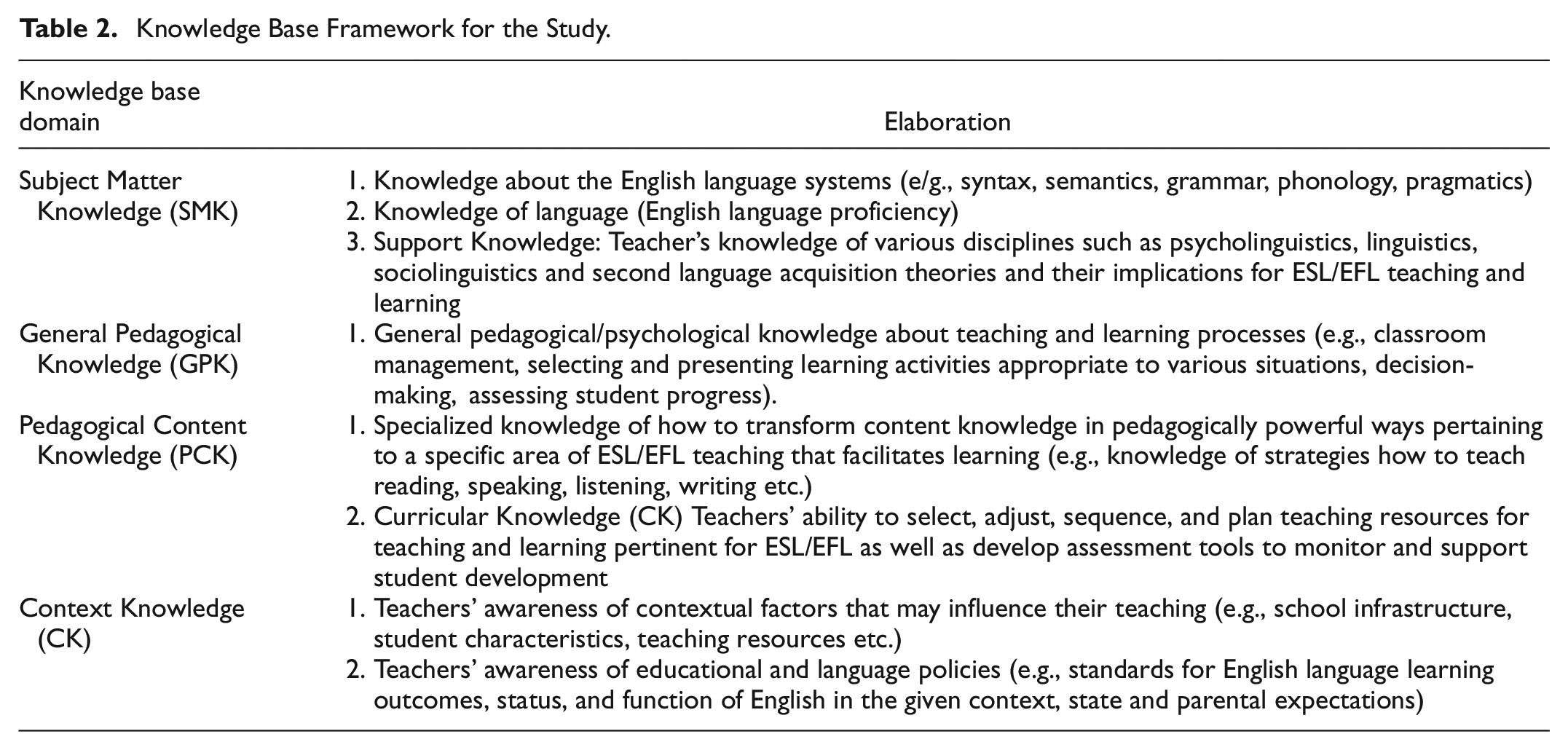
The knowledge base framework consisting of the four aforementioned domains were used in this study. Each knowledge base domain consisted of subdomains pertinent to the context of this study. For example, the SMK domain included English teachers’ language proficiency as a subdomain, which is particularly important in the context of Kyrgyzstan, where English teachers are nonnative speakers of English. This is because teaching English, which Freeman et al. (2015) referred to as “English-for-Teaching” (p. 4) requires a necessary level of command of the English language, which can impact several teaching dimensions, such as teachers’ functionality in class, efficacy, access to resources, and instructional strategies (Faez et al., 2021; Farrell & Richards, 2007; Young et al., 2014). Table 2 elaborates each domain component.
Knowledge Base Framework for the Study.
Research Design
Methodology
This study was a qualitative case study, which focuses “on an issue with the case (individual, multiple individuals, program, or activity) selected to provide insight into the issue … [and] involves a detailed description of the case, [and] the setting of the case within contextual conditions” (Creswell et al., 2007, p. 245). Although case studies are a frequently used research design, it has not gained a “legitimate status” in social sciences (Yazan, 2015, p. 134). Some researchers view case studies as a strategy of inquiry, whereas others view them as a research design or methodology (Chopard & Przybylski, 2021; Creswell, 2007; Stake, 1995; Yin, 2002). Case studies allow researchers to explore single or multiple cases to gain an in-depth understanding of a program, institution, individual, or process in a bounded system (Creswell, 2007; Merriam, 1998). Moreover, context is an important factor in case studies, as researchers “deliberately want to uncover contextual conditions, believing that they might be highly pertinent to your [researcher’s] phenomenon of study” (Yin, 2002, p. 13). Therefore, a qualitative case study was considered relevant for the current study to understand the views of teacher education administrators and English teachers regarding the effectiveness of the IELTE program in preparing teachers for their careers in their bounding contexts.
Data Collection
This study employed document analysis and semi-structured interviews for data collection. Document analysis allows a researcher to evaluate, interpret, and understand a research problem (Corbin & Strauss, 2008; Merriam, 1988). It can be used alone or as a complementary method to triangulate data to ensure the validity of data collected through other methods (Bowen, 2009). Document analysis can also be used as an interview question-generating tool (Goldstein & Reiboldt, 2015). Semi-structured interviews allow in-depth data to be gathered in a guided conversational format, promoting flexibility for interviewees to express their perceptions of the topic as well as for the interviewer to plan, implement, and organize the interview content and questions (Gubrium & Holstein, 2002). Owing to its “conversation with a purpose” (Burgess, 1988) framework, interviewers can ask interviewees “… to elaborate on various issues” during the interview (Dörnyei, 2007, p. 136). In the context of this study, semi-structured interviews provided to access the voice of “the professional community in whose interests they [curricula] have been designed” (Shulman, 1987, p. 5), as well as those who developed and implemented IELTE program curricula.
Research Context
Education in Kyrgyzstan
Kyrgyzstan’s education system has undergone drastic restructuring since the mid-1990s, after it became an independent state following the breakup of the Soviet Union. The transition from a centralized to a market-oriented economy required adjusting educational goals to be in harmony with the knowledge and skills required in the new socioeconomic and political context. Thus, in the period following independence, the education sector underwent several reforms to improve the quality of education by changing the content, approaches, methodologies, INSET, and so on. For example, in 2015, the State Educational Standards for Higher Professional Educational Institutions (SES-HPEIs) outlined a set of competencies for each field of study geared toward developing competencies needed to function effectively in workplaces. In 2009, the government approved the National Framework Curriculum for general secondary schools based on a competency approach. However, irrelevant curricula, a shortage of qualified teachers, outdated teaching resources and practices, school infrastructure, and inadequate financing because of systematic economic crises have contributed to the deterioration of the educational system since independence (DeYoung, 2011; Johnson, 2008; Mertaugh, 2004; Shamatov, 2015; Silova, 2009).
The change in sociocultural, economic, political, and ideological contexts in Kyrgyzstan following the demise of the Soviet Union required a profound transformation of ELT objectives to respond to changing societal needs. Considering characteristics ascribed to English as “a gateway to greater cooperation and understanding between peoples from divergent cultural backgrounds” (Modiano, 1999, p. 26), and “an international lingua franca that is not geographically or historically restricted,”“English as a means of international communication across national and linguistic boundaries” (Jenkins, 2006, p. 160) triggered by the globalization processes made it imperative for Kyrgyzstanis to master English for socioeconomic mobility. Hence, Kyrgyzstanis began learning English for various reasons such as better employment opportunities, international scholarships to study abroad, travel, and business. However, given that Kyrgyzstan was part of the Soviet Union for more than seven decades, it inherited the English language teaching legacy of the Union, including its structure, curriculum, teaching methodology, and approaches. As such, some “lock-in” practices, beliefs, and behaviors, such as rote memorization, fact-checking, and grammar-translation persist in the current English language teaching.
English Language Teacher Education in Kyrgyzstan
In Kyrgyzstan, foreign language departments or institutes of the universities offer IELTE through the concurrent model. Currently, there are more than 15 higher professional education institutions (SES-HPEIs), which offer English language training in the country. In comparison, during the Soviet era, one university and three pedagogical institutes offered subject teacher-training programs, two of which offered IELTE for both universities and secondary schools, in addition to other subjects. However, in the new socioeconomic context, these three main pipelines of IELTE shifted their focus from training English teachers to more “marketable” programs, such as business management, international relations, European civilization studies, translation, cross-cultural communication, and linguistics. Even the two pedagogical universities that had a long history of training English language teachers proclaimed themselves state universities, removing “pedagogical” from their titles. Certainly, this use of consumer-oriented restructuring or “consumerism turn” (Naidoo et al., 2011) to survive in a competitive market-driven economy is unsurprising given the declining status of pedagogical or teaching profession. This decline has been evident in the shortage of teachers, low enrollment in teacher education programs, and an aging teaching cadre, mainly due to inadequate remuneration paid for teaching.
In an attempt to attract applicants to the teacher education programs, the government provided state scholarships for the so-called “budget” scholarship scheme (state-funded) which required the scholarship recipients to sign a three-year service commitment contract. For example, for the 2022 to 2023 academic year, 77% of the state educational grants were allocated to teacher education programs (The Cabinet of Ministers of the Kyrgyz Republic, 2022). However, as previous studies show, most students enrolled in teacher education cannot meet the threshold requirement for their first-choice or the most popular programs, such as law and business management. Therefore, these students transfer to their most desirable programs during their undergraduate studies. In addition, not all teacher candidates who stay in teacher-training programs join the teaching workforce upon completion. In other words, most students use state scholarships as a path to transfer to their first-choice programs. This suggests that from an attitude of having “no other options” or using Initial Teacher Education (ITE) programs as a “path” to transfer to their first-choice programs from the beginning led to the low-quality student intake for ITE (including IELTE) programs coupled with the lower threshold for the teacher training programs compared to other programs. For example, in the last 3 years (2020, 2021, and 2022), the average threshold for ITE was 110, which is the lowest threshold established to qualify for state scholarships, whereas it was higher for computer science, law, and medicine.
English Language Teachers
In Kyrgyzstan, a 4-year university degree is required to qualify as an English teacher for secondary schools, and at least a master’s degree to work at the university level. Most teachers graduated from the Philology or Linguistics Departments of the universities. There are no other requirements for becoming an English teacher, except a university degree, which can negatively affect the quality of teachers joining the teaching profession.
It is interesting to note that even with easy entry requirements, young people try to avoid becoming teachers because teaching as a profession lost its prestige in Kyrgyzstan after the breakup of the Soviet Union owing to the aforementioned factors. Researchers have identified teachers’ salaries as one of the factors that led to a decline in the teaching profession (Brunner & Tillet, 2007; Silova, 2008; Steiner-Khamsi et al., 2008; Steiner-Khamsi et al., 2014).
Sampling and Procedure
Curriculum sampling and participant selection were based on the sampling criterion that “all cases meet some predetermined criterion of importance” (Patton, 2002, p. 238). This strategy is mostly applied when considering quality assurance issues to obtain information-rich data to identify the weaknesses of the system for program or system improvement. The criteria for the selection of the four universities’ programs were as follows: (i) various university locations: two universities from the capital cities and two universities from secondary (regional) cities; (ii) two universities (one from the capital and one from a regional area) both of which have a long-standing history of offering IELTE programs, and two (one from the capital city and one from a regional area) post-independence universities; that is, relatively new in offering IELTE programs.
The participants included four program directors and 10 early-career secondary school English teachers. The criterion set for structured interviews was that the interviewees held an academic administrative position. The rationale for this was that, by virtue of their positions, program directors are accountable, among other things, for overseeing curriculum development, implementation, and assessment procedures to ensure the attainment of the intended academic goals. Program directors can provide valuable insights into IELTE program objectives, structure, and content regarding the efficacy of these programs in ensuring pre-service EFL teachers’ classroom readiness. I used three main questions for program leaders emanating from the curriculum: (1) “What are the core knowledge bases required to be effective English teachers in Kyrgyzstan, and how are they embedded in your program? (Does your program’s curriculum embed the knowledge base required by the National Curriculum Framework for Secondary Schools?)”; (2) “To what extent do the knowledge base areas covered in your program ensure pre-service teachers’ readiness as English teachers?”; and (3) “What principles and theoretical underpinnings do you follow when developing your program’s curriculum?”
The criteria set for the 10 early-career English teachers were that (a) they had earned a bachelor’s degree from each of the four universities included in the study and (b) they had fewer than 5 years of teaching experience at secondary schools. The rationale for the first criterion is that because they were university graduates, they were able to evaluate the program and its influence on their teaching performance. The rationale for the second criterion is that the early years of teaching are the most difficult and critical years that contribute to early-career teachers’ retention or attrition from the profession (Goodwin, 2012; Ingersoll, 2001). Thus, these teachers would have been better at providing insights into the relevance of SLTE courses.
Prior to the interviews, the researcher explained the purpose of the research, procedures, confidentiality, and voluntary nature of participation in the study to the participants. Participants were asked to sign a consent form. The study followed Bryman’s (2004) approach, which included respondent validation and triangulation to ensure the validity of the findings. Interview transcripts and a summary of the findings were sent to the study participants to ensure the accuracy of their accounts of the topic of the study during the interview. Triangulating the data enabled a comprehensive understanding of the research questions, specifically, the effectiveness of English teacher education programs in preparing future teachers for teaching. Additionally, incorporating multiple cases within a single context enhances the validity and reliability of the findings (Merriam, 1998).
Document Analysis
First, the IELTE program curricula were downloaded from the websites of the four universities and obtained directly from the deans, directors, and heads of relevant programs. To protect confidentiality, all four universities were pseudonyms: Regional University 1, Regional University 2, Capital City University 1, and Capital City University 2. Second, the knowledge base covered in IELTE programs was examined and coded according to the study’s framework. The codes that emerged were then placed under an a priori code based on the study framework. For example, the “Theoretical Phonetics” course, which familiarized pre-service teachers with “speech sounds, syllable formation and division, the ways of joining speech sounds, word stress, intonation, and other phonetic phenomena,” was coded under the “Support Knowledge” subdomain, within SMK. Additionally, the percentage of credit hours for each knowledge base was calculated based on the number of credit hours allocated to each course.
Interviews
The sample consisted of four program directors and 10 early-career English teachers. Each candidate was interviewed for 45 to 60 min. The focus of the interview was on the effectiveness of the IELTE program curricula to cover the core knowledge base to ensure classroom preparedness for teaching in the context of Kyrgyzstan. These interviews were designed for early-career English teachers to gain reflective feedback on the strengths and weaknesses of IELTE programs. During the interviews, in-service teachers were given a list of attended IELTE courses and asked to identify and elaborate on the courses that helped them in their classroom teaching. They were then asked what they would change or add to the program, if they could, and why. All interviews with the program directors and pre-service teachers were recorded and transcribed. Following Braun and Clarke’s (2006) approach, I first transcribed and reread each interview transcript to understand the participants’ perceptions of the effectiveness of preparing future teachers. Notes taken during reading of the transcriptions served as preliminary codes. These codes were clustered to form initial themes. Emerging themes or categories were grouped together. The codes that emerged were then placed under an a priori code based on the study framework.
Findings
Document Analysis
Analysis of the curricula revealed that all four IELTE program curricula were homogeneous in terms of structure and content. This can be explained by the fact that universities develop their program curricula based on the SES-HPEIs, which serve as a blueprint for the knowledge base that prospective teachers are expected to acquire before they start teaching. The standards identify six blocks of disciplines which show the credit hour distribution for each block of the IELTE curriculum.
SES-HPEIs prescribe a list of disciplines for the first two main blocks, which are identical for all teacher education programs, irrespective of the major. The professional block comprises disciplines that provide students with opportunities to develop the knowledge, skills, and competencies required for their respective subject specializations. It consists of two parts: main disciplines and variables. The SES-HPEI establishes the main disciplines for the professional block, which includes general disciplines required for teaching, such as psychology, pedagogy, developmental anatomy, and physiology. The variable disciplines consist of relevant subject-specific courses that allow pre-service teacher graduates to gain the in-depth knowledge and skills necessary for professional activities. According to the SES-HPEIs, universities have control over the variable part of the curriculum, which includes the establishment of a list of subjects and curriculum development. However, the list of the main disciplines for the variable part of the “professional” block is established by the relevant Educational and Methodological Department (Uchebno-metodicheskimob’edinenie [UMO]) of the HPEIs. Thus, it can be argued that universities’ control over curricula exists only on paper. The list of disciplines for the professional block was established by the UMO, leaving only elective courses for universities. It is important to point out that the UMO establishes only a list of disciplines; however, curriculum development for the professional block rests with universities (IELTE programs). Figure 1 demonstrates the weightage placed on each knowledge base domain according to the framework across the four IELTE program curricula.

Knowledge base distribution in the IELTE.
This study examined only the professional block component of the curriculum to examine the distribution and coverage of the knowledge base to ensure pre-service English teachers’ classroom readiness.
As illustrated in Figure 1 that SMK comprised approximately 72% of the total 152 credit hours of the professional block disciplines. Because ELTE programs are housed in the philology departments, approximately 31% of the disciplines within SMK comprise disciplines from general linguistics (e.g., Introduction to Linguistics, Discourse Analysis, Literary Analysis, Theoretical Phonetics, Theoretical Grammar, Comparative Typology, and Stylistics, Lexicology. Knowledge about language (English language systems) and language proficiency take approximately 30% of the credit hours dedicated to SMK. Only one course (Practical Course of English) offered over eight semesters, that is, each semester of the 4-year program, is aimed at developing pre-service teachers’ knowledge of English as well as language proficiency.
PCK ranked second, comprising 8% of the total credit hours in the professional block of the curriculum; 12 credit hours were allocated to the delivery of only one discipline (Foreign Language Teaching Approaches). The analysis of the course content revealed that course topics were limited to the description and history of various teaching approaches, such as the grammar-translation method and audio-lingual, and communicative approaches in teaching. Hence, it did not equip prospective teachers with the pedagogical skills required to effectively teach specific aspects of ESL/EFL, such as reading, listening, reading, and writing, or an integrated approach to language teaching and learning.
GPK comprised 6% of the total credit hours in the professional block disciplines. It consisted of two courses (pedagogy and psychology) to develop pre-service teachers’ GPK base. The contents of these two courses included basic theoretical concepts of pedagogy and psychology, along with the theoretical, methodological, and historical development of pedagogy as a science. Thus, generic pedagogical knowledge bases, such as classroom management, diverse instructional strategies, techniques to facilitate student learning, assessment tools to monitor student progression, and various learning abilities and styles were not addressed in these courses. In addition, none of the four IELTE program curricula included a Curriculum Knowledge base within PCK, which could equip prospective teachers with the knowledge and skills to select, plan, and adjust teaching resources to meet the needs of their students and develop assessments to monitor and support student development.
CK base domain comprised approximately 12% of the total 240 credit hours to complete the program. Table 3 illustrates that prospective teachers had 28 hr, consisting of four credit hours for observational practice in the third semester and 24 credit hours for teaching practicum divided between semesters four, five, six, and seven. During the practicum, prospective teachers gained familiarity with school culture, textbooks, and syllabi.
IELTE Structure and Credit Hour Distribution.

Interview Analysis
Program Directors
The analysis of interviews with program directors revealed a consensus in terms of the need to restructure IELTE programs, as they felt that their programs did not include the necessary courses to cover the knowledge base required to teach English in secondary schools. However, the program directors asserted that they did not have flexibility in terms of identifying the subjects that they believed should be part of IELTE programs, as the bulk of the course was structured by the UMO. One of the program directors commented, “I feel that the courses we offer in our program are not enough to adequately address teachers’ needs, but our hands are tied because UMO decides what courses should be taught in the program.” Another program director voiced a similar opinion: “I can’t make any changes to the program to make it more effective because the Ministry and UMO decide what courses should be taught in our program and I can’t dispute this … our curriculum is good for philologists and linguists.” A third program director commented, “They blame us for the poor quality of teachers, but they don’t know that I must teach courses given by the UMO. Our curriculum is for philologists but not for teachers.”
Program directors also complained about insufficient credit hours for the disciplines to develop the knowledge and skills to teach English owing to contextual factors (SES and UMO) that shaped the structure and content of the curriculum: A program director commented, “The subjects identified by UMO are mainly for linguists. I can’t change anything but what I do is that within the subjects identified by UMO, I add some material that I think is important for teachers.” These insights suggest that program directors acknowledged the ineffectiveness of their programs in preparing efficient teachers, but that the top-down approach hindered them from offering courses they viewed as important for effective teachers.
In-Service Teachers
The interviews intended to gain insight into the strengths and weaknesses of various IELTE programs regarding their efficacy in ensuring pre-service English teachers’ classroom readiness. Regarding the strengths, the participants identified a few important disciplines, such as the History and Culture of English-Speaking Countries, English Language History, and Stylistics. For instance, the following comment by a participant resonated with other participants’ opinions regarding these disciplines:
I think English teachers should know cultural, history, and social issues about the English-speaking countries. For instance, Russian teacher should know about the history of Russian culture and literature. The same with us [English teachers]. I use what I learned from courses, “History of English, Culture” and “Literature of English-speaking Countries.” So, it was good. When I had this course, I thought, why I need these courses? Now I changed my mind … it was good that I had this course.”
In addition to the strengths of the IELTE program, the participants identified four areas requiring improvement: language proficiency, material design, assessment, and practicum. The need to improve these areas emanated from the challenges faced in their early careers as English teachers. It also emanated from the challenge of meeting the demands of learning outcomes in light of the current teaching standards in secondary schools. The four areas of improvement mentioned by participants were placed under the study framework.
Areas of Improvement for Language Proficiency Within SMK
The participants did not feel that they had sufficient linguistic competence, even though the curricula analysis demonstrated that SMK was given much weight in IELTE program curricula, considering the credit hours allocated to it. For instance, only one course (Practical Course of English) comprised 50 to 54 credit hours and was taught for eight semesters. The course descriptions suggested that it aimed to develop all four language and communication skills so that students could interact with various sociocultural spheres. However, the course focused on text analysis, translation, and completion of exercises based on speech (structural) patterns through written and oral practice; in other words, the emphasis was on habit formation, imitation, and reinforcement.
Participants’ opinions regarding their language proficiency could be summarized with the following comment made by a participant:
…the courses I have taken were a waste of time. They did not help me in my teaching. Yes, I understand and translate but I can’t speak. I get nervous if someone is coming to observe my lesson because of my English. Some students attend English language courses, and their English is better than mine, and it makes me feel nervous in the classroom.
These comments aligned with research findings that identified teachers’ language proficiency as a crucial factor impacting ESL/EFL teachers’ classroom performance. This is particularly true when teachers are NNS of the language they teach (Andrews, 2003; Freeman, 2017; Richards, 2017) and need sufficient language proficiency to teach effectively. NNS teachers who have sufficient English proficiency are more effective in areas such as accurate content explanation, class management, engaging in meaningful interaction with students, and adapting their teaching to the learners’ needs. By contrast, NNS teachers with limited English proficiency tend to rely more on textbooks, be more prescriptive, are unable to assess content and identify and correct students’ errors, and so on (Farrell & Richards, 2007; Tsui, 2003). Thus, this subdomain of the SMK is particularly important in the context of Kyrgyzstan, where English teachers are NNS of the target language.
Interestingly, out of the four language skills of the SMK domain, participants repeatedly mentioned “writing” as a skill they would like to master. The IELTE curriculum revealed that this area of the knowledge base was not embedded in the curriculum, even though both the SES-HPEIs and the NCF identified writing as a core skill. When questioned about how they taught writing, all participants mentioned that they did not have a writing class in their school curriculum. According to a participant, “I have a textbook that I use, and in that textbook, writing tasks are copying exercises and fill-in-the-gaps exercise.” Another participant commented:
Once, one of my students from Grade 11 was participating in some program, and he asked me to help him with writing Statement of Purpose, but I did not know how to help him because I did not know how to write in English. I felt terrible! Why they [programs] didn’t teach us how to write.
It can be deduced from the comments that the IELTE curriculum was aligned neither with the SES-HPEIs nor with the NCF for secondary schools. For example, in SES-HPEIs, graduates are required to write a thesis as an exit qualification requirement; however, none of the IELTE program curricula had a course introducing generic features of academic writing, or theses or research writing. In addition, according to the NCF for secondary schools, high school graduates should have a B1 level on the CEFR in all four language skills, including writing. The question arises as to how prospective teachers who writing skills do not have can help develop these skills.
Materials Design and Assessment Within the Curriculum Knowledge
When the interview participants were asked what they would like to add to the existing ILETE program, they unanimously agreed that material design and assessment courses should be included. It is not surprising that they mentioned this because teachers’ skills to develop curricula were completely ignored in all four IELTE programs, which is otherwise a core domain in teachers’ knowledge bases.
The general opinion that the participants held regarding these two issues were as follows:
When I started working as a teacher, I did not know how to develop my lesson plans. The head teacher gave me a template that I use; I use a textbook, so I don’t have to develop my own lesson plan; I get my lesson plans from the internet; I just give them grades. A student wanted to know why I gave him [grade] three but I could not explain; I attended a workshop about teaching and the trainer talked about rubrics to assess students’ knowledge. She [trainer] gave us rubrics, but I don’t know how to use them.
In addition, the foreign language teaching methodology course in the PCK was mostly theoretical and based on a rote memorization approach; that is, prospective teachers did not have the opportunity to develop subject-specific pedagogical skills. Participants’ insights regarding their experiences in developing this domain were reflected in the following comments: “During seminars, we repeated what we learned in the lecture. During the term exam, we had exam tickets [a card which contains questions a student must answer], and we explain or tell the history of some teaching methods,” and “During the exam, I retold audio-lingual method and got five [excellent].”
Practicum With the CK Base
Another area of improvement identified by the participants was school practicum. As Table 3 shows, the pre-service teachers had three school practicums (28 of 240 credit hours). As an important aspect of professional socialization, each type of practicum (observational, teaching, and pre-qualification) aims to provide pre-service teachers with the opportunity to apply what they have learned in the ITE programs, including designing, and delivering lesson plans, classroom management, and assessment strategies and criteria.
Participants commented that practicums were very helpful to understand the “status quo” of the educational processes in school, as well as teaching as a profession. Reflecting on their first school practicum, they commented that the practicum provided them with insights into educational practices, the inner workings of schools, and teachers’ responsibilities in schools. The excerpts, taken from pre-service teachers’ perceptions about the school practicum, revealed some commonalities in their perceptions that the insights they gained during their practices were both motivating and demotivating. One of the teachers said,
It helped me to work on my weaknesses. I learnt the “kitchen” [the inner workings] of the school. I learnt what is expected from me as a teacher, etc. After my school practicum, I started studying seriously because I learnt that to be a good teacher, I should know English very well to teach my subject.
At the same time, the participants’ understanding of school practicums revealed a lack of or insufficient support from their mentors in designing lesson plans, classroom management, and assessments.
School teachers were happy because they gave us all their lessons to teach … it was free time for them [teachers];I thought I would learn how to design lesson plans, but school teachers gave us a textbook and we taught all their lessons. [A] school teacher did not observe my classes but at the end of the practicum, she gave us “five” [excellent] because we taught her classes. Our university faculty, she showed up only once a week to see that we are at school; I ended up teaching all her [school mentor] classes.
These comments suggest that both the school and university mentors lacked the knowledge and skills needed to support the perspectives they encountered during their practicums. During the interview sessions, the program directors commented that mentoring school practicums were not included in university mentors’ teaching workload. Therefore, some faculty members mentors for school practicums were based on “goodwill.” Their involvement in the school practicum was limited to reporting the completion of the program based on teachers’ feedback and grades.
Discussion
There is growing recognition that the teacher knowledge base is an influential factor that can facilitate effective teaching and learning outcomes. The knowledge bases teachers require to promote effective teaching, and the importance of teacher education programs in the acquisition of that knowledge base have become the focus of research in recent decades (König et al., 2016; Nguyen, 2013). Consequently, this study aims to evaluate the efficacy of the IELTE programs, which serve as key entry points for pre-service teachers to acquire the necessary foundational knowledge before entering the teaching profession. The focus was on evaluating the effectiveness of the English teacher education program in terms of developing the essential knowledge base required for teaching. The analysis and interpretation of the findings are presented according to the sequence of the research questions posed in the Introduction.
To answer the first research question, the curricula of the four teacher education programs were analyzed to examine the extent to which program content facilitated the necessary knowledge base to ensure pre-service teachers’ classroom readiness as EFL teachers.
An analysis of the four IELTE program curricula demonstrated that structure and content were greatly influenced by contextual factors, which contributed to an imbalanced weighting of knowledge base domains in the IELTE curriculum.
Teacher education programs housed in philology departments was the major contextual factor that contributed to the overrepresentation of general linguistics courses. This is largely because these disciplines are identified by UMO as the main disciplines for students majoring in philology. Credit hours allocated to these disciplines comprised 72% out of 152 total credit hours allocated to the professional block, whereas GPK and PCK together comprised only 14% of the credit hours. This comparison indicates that most disciplines are intended to equip prospective philologists, not language teachers, with the necessary knowledge base. Thus, departments allocated only a small number of credit hours for knowledge bases related to teaching, “just in case” their graduates required it. Conversely, most graduates from linguistics and philology backgrounds become teachers, considering the number of linguists and philologists in a small country such as Kyrgyzstan, with a population of 7 million, would be required. Locating IELTE within the philology department as an additional specialization contradicts government aspirations about the role of education in the country’s overall development. For example, in the Education Development Strategy of the Kyrgyz Republic for 2012–2020, the government envisaged education as “… the main tool for promoting Kyrgyzstan’s social and political development and will ensure its competitiveness in regional and international processes” (Government of the Kyrgyz Republic, 2011, p. 3). To achieve this, the quality of teachers is of paramount importance because a nation’s overall socioeconomic development, competitiveness, and capacity depend on how well its workforce is educated and trained. This, in turn, is contingent on how knowledge and skills are offered at all levels (primary, secondary, or university). As Bright (2013) asserted, “with a few, if any exceptions, the quality of a school, district, or a nation cannot surpass the quality of its teachers” (p. 141).
In fact, as IELTE programs are within philology departments, several key knowledge base domains that are required for teaching were not included in the curriculum. Participants expressed that they felt prepared in areas such as subject-specific teaching strategies, planning and adapting lessons, and assessing student progression. For example, teachers expressed that they did not have the opportunity to develop subject-specific pedagogical knowledge (e.g., how to facilitate students’ communication skills and how to teach reading, speaking, listening, and reading). The findings align with previous research reporting that pre-service teachers with a relatively low understanding of this knowledge base had more difficulties in instructional strategies in teaching a particular topic by adapting the content of the textbook to make it more comprehensible to the students in a particular context (Akbari & Tajik, 2009; De Jong et al., 2005; Mehrpour & Moghaddam, 2018). The results indicate that in the PCK domain, more emphasis was given to generic teaching theories, whereas the curricula did not adequately cover subject-specific teaching approaches. Moreover, the approach adopted to develop the knowledge base led to limited knowledge in this domain. For instance, 12 credit hours allocated to the generic “Methodology of Foreign Language Teaching” focused on the description of various outdated teaching approaches in SLTE. In other words, the domain focused on lecture-based theoretical knowledge rather than on the development of expertise in teaching approaches and strategies to effectively organize subject matter to enhance student learning. In the teacher knowledge base and education literature, PCK has been recognized as the core of teachers’ ability to transform content to enhance their student learning experience (König et al., 2016; Liu, 2013; Shulman, 1987). However, PCK, which was identified by Shulman (1986) as a “missing paradigm” (p. 9) in teacher knowledge base, still seems to be “missing” in IELTE program curricula in Kyrgyzstan.
The Curricular Knowledge domain was another “missing” paradigm in all four curricula. From a sociocultural perspective (Johnson, 2009; Kumaravadivelu, 2012), Curriculum knowledge has a decisive impact on the “what,”“whom,”“how,” and “why” of teaching. Neglecting skills in the curriculum development left prospective teachers without the necessary skills to acquire foundational knowledge to select materials and teaching methodologies from various teaching resources, techniques, and approaches that were congruent with their teaching contexts and students’ needs. Shulman (1986) asserted that not teaching curricular knowledge to the pre-service students makes “us [teacher education programs] more delinquent” than not teaching pedagogical knowledge (p. 10). Limited knowledge in the curricular knowledge domain striped prospective teachers of their ability to make informed choices, which Larsen-Freeman (2000) calls “principled eclecticism,”: selecting and sequencing teaching resources and techniques believed to be appropriate and effective in achieving learning outcomes in a particular context.
Another contextual factor that shaped the curriculum was the dual function of English as content and medium of instruction. Thus, the SMK domain received significant representation in the curricula of all the four IELTE programs, comprising 72% of the total credit hours of the professional block disciplines. Undoubtedly, subject knowledge is conducive to the development of other knowledge-based teaching domains. Research has identified EFL teachers’ subject matter as a key factor influencing their overall performance in the classroom (Freeman, 2017; Richards, 2017; Tsui, 2003). However, despite comprising 72% of the professional block disciplines, disciplines intended to develop the SMK domain did not adequately prepare prospective teachers to function effectively in the classroom and beyond.
Regarding the second research question, the analysis of interviews conducted with program directors indicated unanimous agreement on the need to restructure IELTE programs. Program directors expressed that their current programs lacked the essential courses needed to adequately address the knowledge base necessary for teaching English in secondary schools. They noted that the hierarchical top-down approach restricted their ability to provide courses that they considered crucial for becoming effective teachers. Although the structure of teacher education programs was strongly influenced by the top-down approach (e.g., State and Educational Department-approved curriculum), teacher educators were unable to exercise autonomy and flexibility in designing courses and determining content, assessment methods, and delivery. For example, while State standards establish only a list of disciplines, the responsibility for curriculum development within the professional block lies with the universities offering IELTE programs. The analysis of the curriculum content demonstrated that the IELTE curricula covered most areas of the knowledge base as per the knowledge base framework (at least at the course title level). However, given the themes covered in the courses and the delivery mode used to develop the knowledge base, the extent to which the course content developed the knowledge base was questionable. For example, as per the course description, “Practical Course of English” aimed to develop prospective teachers’ English language awareness and proficiency by focusing on the theoretical level, mainly on the linguistic forms where the teacher explains grammar instead of facilitating communication. Moreover, the analysis of the course content for the professional block also revealed that the elective part, where, according to SES-HPEIs, IELTE programs are given autonomy to choose the course they think to be important in their programs, was not rationally used by the program educators. For example, courses such as Calligraphy, Geography of Kyrgyzstan, and Ancient Languages indicated a lack of expertise and awareness of the knowledge base pre-service teachers must teach. Thus, it can be argued that along with the irrelevance of some courses, how a course was taught and learned also affected the development of the knowledge base that prospective teachers required in classroom practices. In education research, teacher educators are described as “critical stakeholders” (Walsh et al., 2022, p. 159) and “linchpins” (Cochran-Smith, 2003, p. 5) who are accountable for preparing quality and competent teachers teaching force. However, in this study, teacher educators were unable to fulfill their assigned roles successfully.
The third research question was intended to determine how in-service teachers perceived the effectiveness and relevance of IELTE programs in facilitating the acquisition of a knowledge base for teaching.
Participants repeatedly mentioned English language proficiency as a major hurdle to their daily teaching. The challenges they faced in their early teaching careers, as well as their current challenges, were due to their lack of or limited knowledge in this domain. Previous research reports that NNS teacher language is a significant predictor of successful classroom interaction, confidence, self-efficacy, and classroom management, providing meaningful explanations and effective instructional strategies, asking questions, and so on (Chacon, 2005; Eslami & Fatahi, 2008; Richards, 2017; H. Richards et al., 2013; Wang, 2021).
In addition, the IELTE curriculum neglected to incorporate other essential knowledge bases, such as curriculum knowledge and assessment, resulting in teachers relying overly on textbooks and facing difficulties in evaluating students’ progress. For example, Support Knowledge within SMK was not covered in the curriculum. Major second-language learning and acquisition theories that could provide prospective teachers with the foundations of how a foreign or second language is learned, the factors that influence language acquisition, and the rationale behind teaching approaches to guide them in their teaching were not included in this knowledge base domain. Lack of knowledge and skills in this domain resulted in the participant teachers’ overreliance on textbooks, prescribed exercises, activities, and the Internet to download lesson plans. SLTE research emphasizes the importance of language pedagogy theories that guide teachers in providing theoretically and pedagogically sound instructional practices (Farrell, 2018; Johnson & Golombek, 2016; Wright, 2010).
The lack of university–school collaboration in supporting and guiding pre-service teachers during school practicum was another contextual factor that contributed to the ineffectiveness of the IELTE program. Both school and university mentors have limited or no knowledge of their roles and responsibilities as mentors, which include (but are not limited to) acting as instructional models, observing, and providing constructive feedback, guiding, and nurturing. These results are consistent with previous research showing that school practicum had less impact on students’ preparedness for classroom teaching because of the lack of or weak cooperation between school and university, as well as how school and university mentors viewed their roles in providing opportunities to practice teaching (Ingvarson & Rowe, 2007; Körkkö et al., 2016).
Conclusion
This study sought to analyze the extent to which the knowledge bases were covered in the IELTE program in Kyrgyzstan facilitate their development and ensure English language teachers’ classroom readiness. Document analysis and interviews revealed that contextual factors such as rigid national policy documents, teacher educators’ limited competencies and their role in curriculum development and implementation, lack of collaboration between IELTE programs and schools, and the status of IELTE programs within universities were determining factors in structuring IELTE programs. This led to an imbalanced emphasis across various knowledge base domains in the IELTE program curriculum.
As IELTE programs are placed within the philology departments of universities, they lead to the overrepresentation of disciplines from general linguistics and knowledge about language, rather than language teaching per se. Other equally important knowledge bases, such as GPK and PCK, were given less importance to in the curriculum, which negatively affected relatively newer teachers’ classroom teaching experiences. This top-down approach to the pre-established curriculum structure and content has restricted university programs from adjusting their curricula to meet prospective teachers’ needs. Furthermore, the lack of human resources (curriculum developers and faculty) to develop the curriculum and identify delivery modes has affected the development of the knowledge base. In addition, courses intended to focus on the development of content, including language proficiency, were limited to discrete language learning, instead of focusing on developing English teachers’ language competence to function effectively in classrooms and beyond.
In conclusion, teachers were not adequately prepared to perform their jobs effectively because the knowledge bases developed through the IELTE programs did not correspond to what they needed in their classrooms for effective teaching because of (a) rigid national policy documents, (b) teacher educators’ limited competencies and their role in curriculum development and implementation, (c) the status of IELTE programs within universities, and (d) lack of collaboration between IELTE programs and schools.
Implications and Recommendations
Teachers play a crucial role in students’ learning, as their competence significantly influences students’ achievements. Consequently, it is imperative to invest in teacher education, which serves as the initial stage for developing foundational skills. The findings of this study indicate that early-career teachers face classroom challenges primarily because of an inadequate or insufficient knowledge base to effectively perform their daily teaching activities. The findings underscore the significance of teacher education programs as the foundation for continuous teacher development.
Furthermore, the findings of the study offer insights to all stakeholders, including (but not limited to) teacher-training educators, policymakers, curriculum developers, accreditation and licensing agencies, and so on, to improve or strengthen the IELTE curricula in Kyrgyzstan and ensure pre-service teachers’ classroom readiness.
The results of this study also call attention to all educational stakeholders, including teacher education programs, to build synergetic collaborations and better prepare teacher candidates as effective teachers.
Limitations
This study had some limitations that should be addressed in future research. The data collected were based on the perceptions of individuals such as program directors and in-service teachers, who acted as executors. However, the study would gain more strength if the voices of administrators, such as the Ministry of Education or the Educational and Methodological Department, who establish the curricula for teacher education programs, were included to gather their opinions on the inclusion of specific courses and how these courses contribute to better preparation of future teachers.
Footnotes
Declaration of Conflicting Interests
The author declared no potential conflicts of interest with respect to the research, authorship, and/or publication of this article.
Funding
The author received no financial support for the research, authorship, and/or publication of this article.

Data Availability Statement
Data sharing not applicable to this article as no datasets were generated or analyzed during the current study.