



Abstract
With its great contributions to the world’s development, Chinese science education has become a hot issue in the international research community. Science education research trends have already received much attention; however, a few have been down about research trends of science education in China. This study systematically analyzed research articles (n = 56) by science researchers in the Chinese mainland from five journals, Journal of Research in Science teaching, International Journal of Science Education, Research in Science Education, Science Education, and Science & Education, to reveal research trends in terms of authors’ institutions, research types, methods, and research topics from 2017 to 2021. This study found (a) with a slight increase in paper number, collaborating between domestic and international institutions’ researchers contributed mostly to publications in this period while top 10 domestic institutions were mostly normal universities in Tier-1 cities in China; (b) among the most popular articles—empirical articles, studies conducting correlational design were predominant; (c) topics about students’ learning context, assessment, and nature of science were highlighted in this period and variations of authors’ preference on journals existed. Recommendations for future research on local and international science education are suggested.
Introduction
The past decades saw the modernization of Chinese science education to develop students’ scientific literacy with inquiry-based teaching (Zhang et al., 2022). Given its modernize science education system and continuous supply of STEM talents (National Science Board & National Science Foundation, 2022), China has been treated as a crucial factor in spurring and stabilizing the world economy. Undoubtedly, the experience of science education in China is of great interest to the reset of the world (for example, Lederman et al., 2021). Recently, an increasing number of studies have paid attention to science education research trends through literature review (Erduran et al., 2019; Lin et al., 2019). As revealed in the study of Lin et al. (2019) which reviewed all research articles in three high-quality science education journals from 1998 to 2017, examining core journal publications to review science education research trends were critical and beneficial not only to novice researchers to grasp science education’s development, but also to practitioners to make decisions. However, studies on science education trends in China, especially in the Chinese mainland, are limited. As a booming research field, international science education research community benefits from local contributions to diversified research topics and generalize its achievement. Articles written by Chinese scholars made the most contribution to the development of Chinese science education. Thus, conducting a systematic analysis of articles written by science educators inside the Chinese mainland in high-quality journals may not only shed light on the status of science research trends in the Chinese mainland, but also assist science educators in other countries to plan their further research and provide valuable advice to Chinese science education.
Since 1999, several policy documents have been released to meet the growing demand of scientific literacy in China (Zhang et al., 2022). The notable one is the Compulsory Primary School Science Education Curriculum Standards in 2017 (Ministry of Education, 2017), which emphasized science education as a fundamental subject in primary schools and set the start of science learning at Grade 1. To keep up with international trends, some scholars made efforts to introduce Chinese science education to the international community. For example, the special issue in International Journal of Science education, Science Education Research in China: Challenges and Promises, provided a glance about challenges and promises in Chinese science education through a series of papers written by Chinese science educators (Liu et al., 2012). Hu and Shou (2018) proposed that primary science education in China has experienced many changes in curriculum goals, content, teaching, and evaluation, but has not obtained the status as a basic subject. Compared with their counterparts in developed countries, Chinese science research educators have limited participation in globalization to introduce Chinese science education research and have paid little attention to analysis its research trends (Liu et al., 2012; Zhang & Wan, 2017). Thus, it’s critical to examine research trends of science education in the Chinese mainland periodically and systematically for the research community with valuable perspectives. A good summary of science education in China has been provided in Liang et al. (2018), which introduced Chinese science education from the perspectives of policies reform, research and practices. However, as stated in the book of Liang et al. (2018), although their efforts were intended to provide a broader overview of the policies reform, practices, and research of science education in China, most studies just provided some “personal stories” or “snapshot” of science education polices and research practices in China, neglecting studies with international perspectives. And these findings mostly compared Chinese science education with science education in USA, not international community. Therefore, to provide more meaningful insights about science education in the Chinese mainland and increase the visibility and accessibility of findings, it’s necessary to analysis science education trends in terms of high-quality journal publications.
A systematic analytical framework was more beneficial in literature review than automatically-generated technology to categorize research topics comprehensively (Lin et al., 2019). In the last two decades, an analytic framework including authors’ affiliation, research types, research topics was utilized to analysis international science education research papers (Lin et al., 2014; Tsai & Lydia Wen, 2005). Research collaboration has become a widespread phenomenon in education over the past decades (Hu & Fan, 2020; Jung, 2012). Clearly, investigating authors’ institutions and collaboration types would be valuable for further research. As revealed by Maltseva & Batagelj (2022), more articles were written by more than one author (for example, Pei et al., 2020). Author’s collaboration types made a difference on articles’ citations (Asubiaro, 2019). The analysis of papers’ research types and topics bring benefits to figure out research diversity (Jenkins, 2000). Some scholars also investigated types of methods in specific science education topics to exam the variations of methodologies (Mills et al., 2016). Taken together, as China’s economy develops by leaps and bounds, a systematically analysis of science education research trends in the Chinese mainland from the perspectives of authors’ institutions, research types, methods, and research topics is crucially needed to the entire science education community.
High-quality journals provide wonderful platforms for researchers’ discussion and further foster the development of research fields (Lin et al., 2019; Tsai & Lydia Wen, 2005). Thus, it’s critical and meaningful to analysis certain journals’ papers to reveal research trends. In this study, research articles by Chinese mainland researchers from, Journal of Research in Science teaching (JRST), International journal of Science Education (IJSE), Research in Science Education (RSE), Science Education (SE), and Science & Education (S&E), were selected to reveal science education research trends from 2017 to 2021. In this paper, the following questions were addressed: 1. Which collaboration type and institution contributed the most to the Chinese mainland science researchers’ publications in these five journals from 2017 to 2021? 2. How did the research types of the selected articles in these five journals change from 2017 to 2021? 3. What methods were mostly used in the selected empirical articles in these five journals from 2017 to 2021? 4. How did the research topics of the selected articles in these five journals change from 2017 to 2021?
Methodology
To examine science education research trends in the Chinese mainland from 2017 to 2021 in five selected journals—JRST, IJST, RSE, SE, S&E, this study consisted of two parts, namely selection part and analyzing part (Figure 1). Selection part consisted of three major stages. Firstly, 4111 published articles in these five journals from 2017 to 2021 constituted the initial articles pool. Then, “issue information”, “editorials”, “publisher’s note” “commentaries/comments”, “corrections/erratum”, “responses”, “book reviews” (exclusion #1) (n = 279) were excluded. As the first author was the person who mostly contributed to a project which was supervised by the corresponding author(s) (Bhandar et al., 2014), papers of the Chinese mainland researchers were identified from more than three thousand articles by checking the location of first and corresponding authors’ institutions (exclusion #2) (n = 3776). For authors with several institutional affiliations in multiple countries, one institution afflicted to the Chinese mainland was the requirement for inclusion. As a result, the total number of selected papers was 56. Flow chart of paper selection and analysis.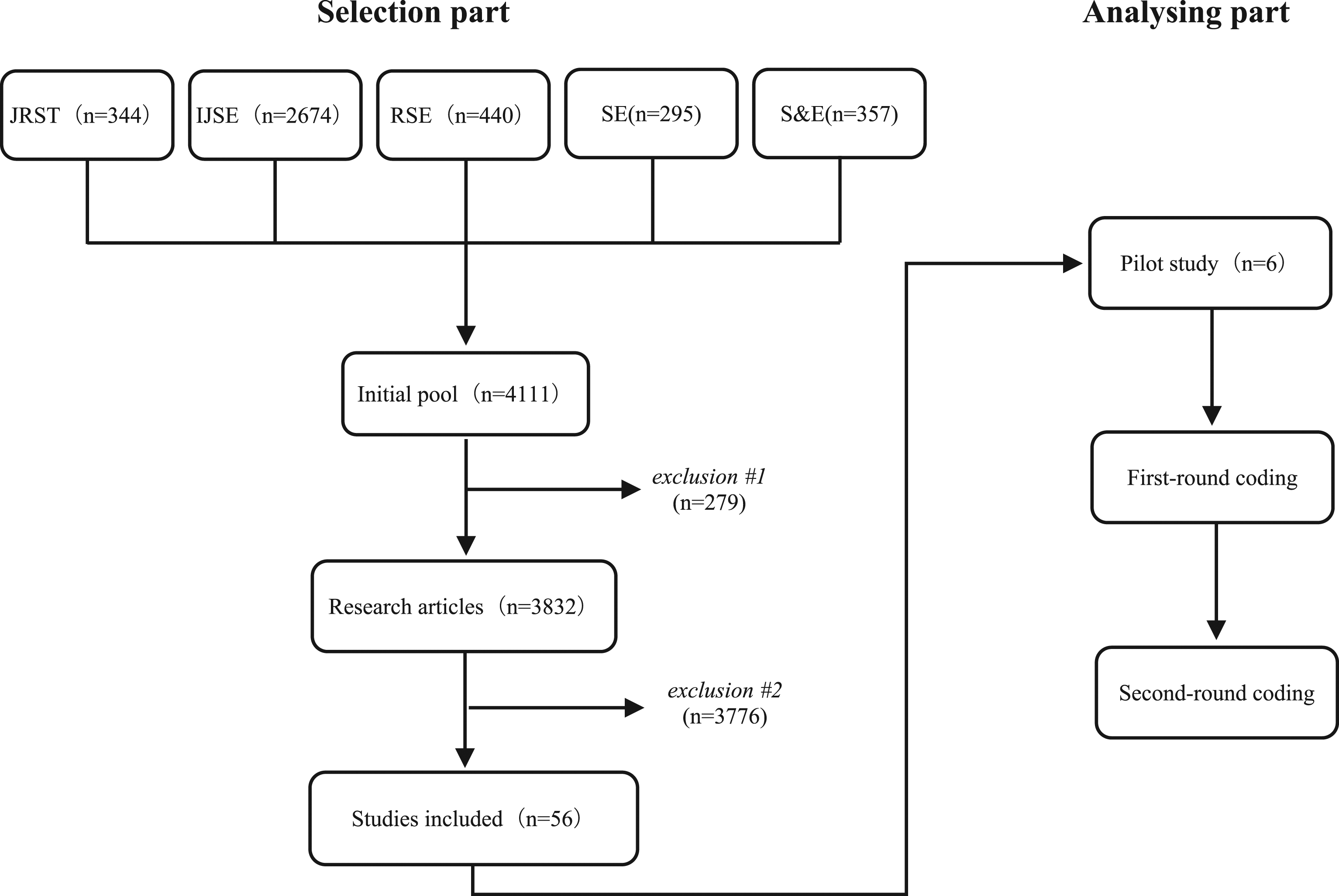
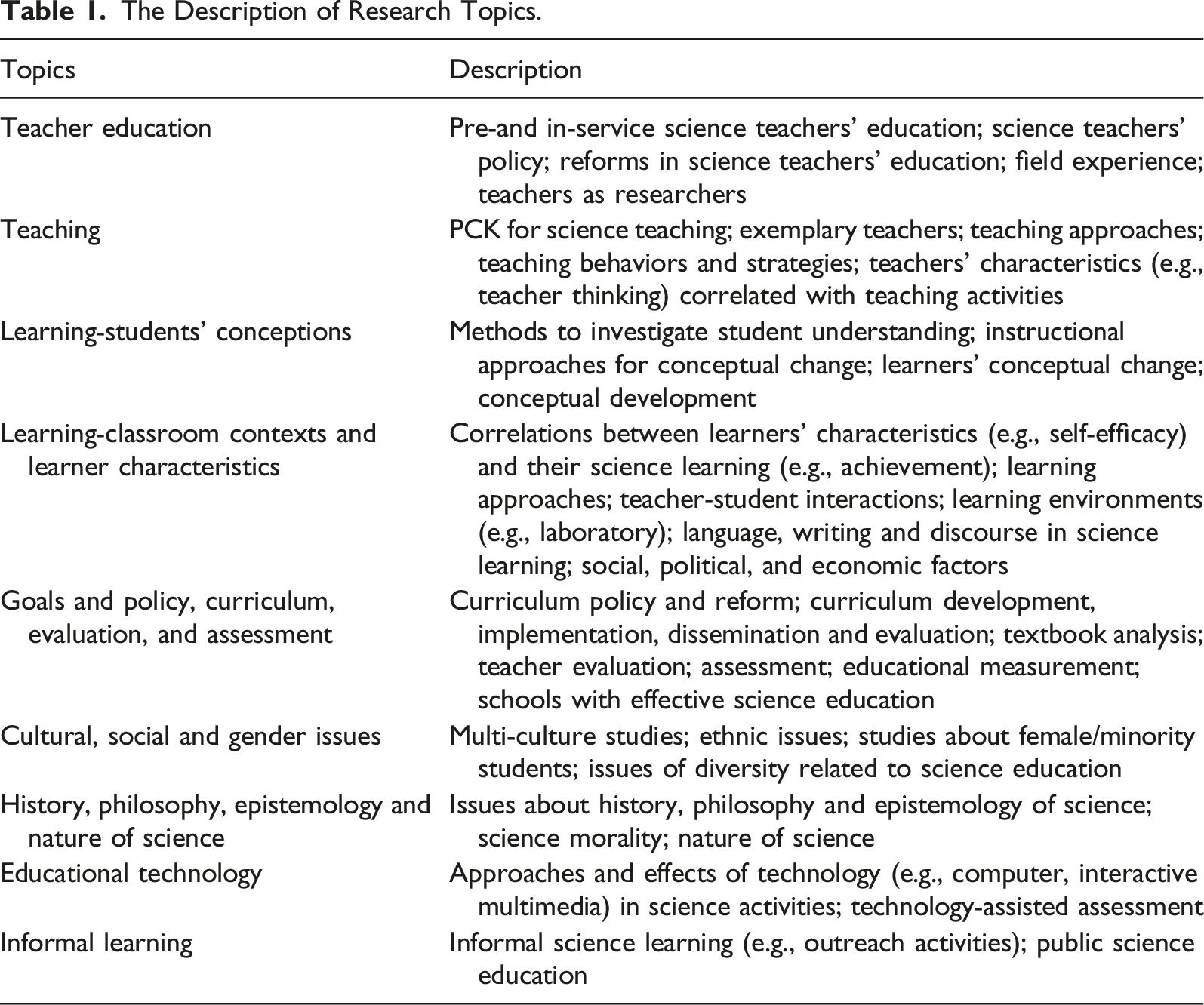
In the analyzing part, coding standards of research types and research topics were adopted from the previous review studies (Lin et al., 2019), because of its strong reliability in studying international science education research trends and feasibility in comparing this study to the previous. The details were following. Firstly, two experienced science education researchers in this study read these standards and examples to get an initial understanding of codes. Secondly, six of targeted papers (more than 10%) were chosen randomly for pilot analyses (Connelly, 2008). Researchers independently categorized the institutions’ collaboration types, methods and coded the research types and topics of them. Papers were read carefully by researchers, especially in title, abstracts, research questions, methods, to choose the best-fit one. Before formal coding process, all researchers discussed the results in pilot together. Then, the first-round coding procedure conducted. The percent of overall agreement for research types reached 0.97, while the consistency of research topics reached 0.85. Researchers met again to deal with the varied opinions. Finally, the inconsistent articles were re-coded and re-categorized in the second-round to reach consensus.
Authors’ Institution
Each author’s contribution to a paper was quantified to calculate institutions’ grades. As Lee et al. (2009) explained, each paper gets one point in the below formula firstly. Then, it neutrally distributes this point to each author based on the number of authors (n) and their orders (i) in the byline. For example, in the study of Wei et al. (2021), these three authors obtained 0.47, 0.32, and 0.21 respectively.
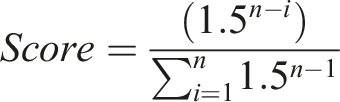
After calculating authors’ score, institutions’ contributions were figured up by summing their scholars’ scores. For example, Wei et al. (2021) gained the score of 0.47, 0.32, and 0.21 for University of Macau, University of Groningen, and Guangxi Normal University respectively. Regarding the collaboration types, one research paper generally has one author (personal) (e.g., Zhu, 2019) or more than one author (e.g., Wei et al., 2021). On the latter, one research paper may the work of authors (a) in same institution (institutional), (b) in same country’s institutions (national), (c) in different countries’ institutions (international), and (d) in different level institutions (interdisciplinary) (e.g., school, university).
Research Type and Method
Investigating research types helps to explain the research diversity and provides valuable information for the growing international science education community. This study adopted the coding schemes of research types in Tsai & Lydia Wen (2005), which has been utilized to review international science education research trends over the past 20 years. The codes include five items, namely “empirical”, “theoretical”, “position”, “review”, and “others”. Take a closer look, “empirical” refer to papers using quantitative, qualitative or mixed-method approaches to address research questions, “theoretical” propose theories or conceptual framework, “position” contains researchers’ views and opinions of some controversial or new topics, “review” analyses the existing papers in specific topics to unveil research status. And papers which cannot be categorized into the previous categories, like interpreting science education standards, will be placed in “others”. As indicated by Lin et al. (2019), empirical studies were the dominated type of publications in international science journals. Therefore, this study further analyzed which methods were mostly used in empirical studies.
Research Topic
The Description of Research Topics.
Results
Section I: Selected Paper by Authors’ Institutions
Selected Papers and Frequency of Collaboration Type.
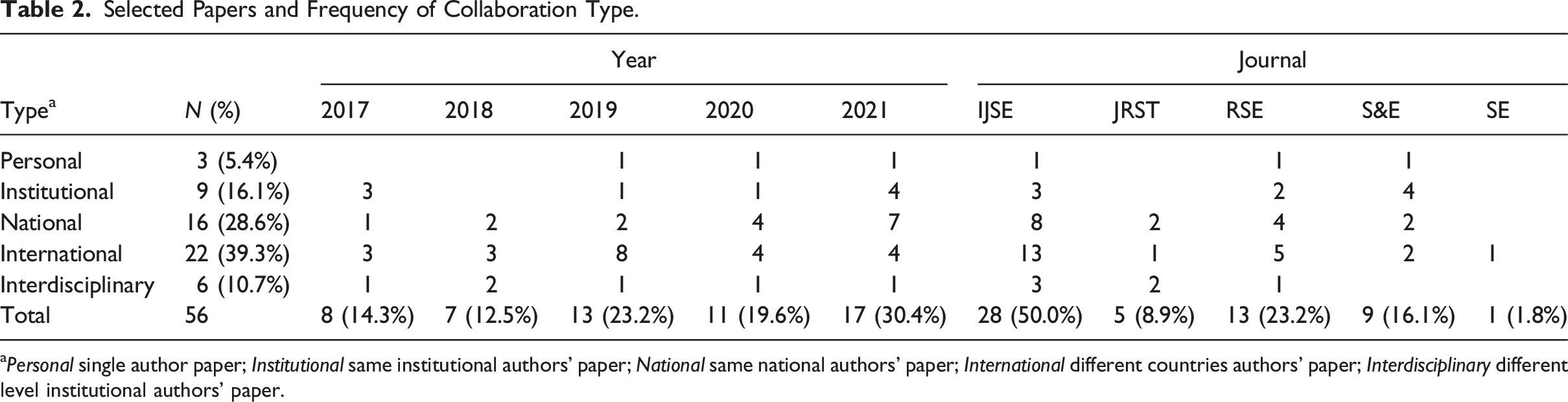
aPersonal single author paper; Institutional same institutional authors’ paper; National same national authors’ paper; International different countries authors’ paper; Interdisciplinary different level institutional authors’ paper.
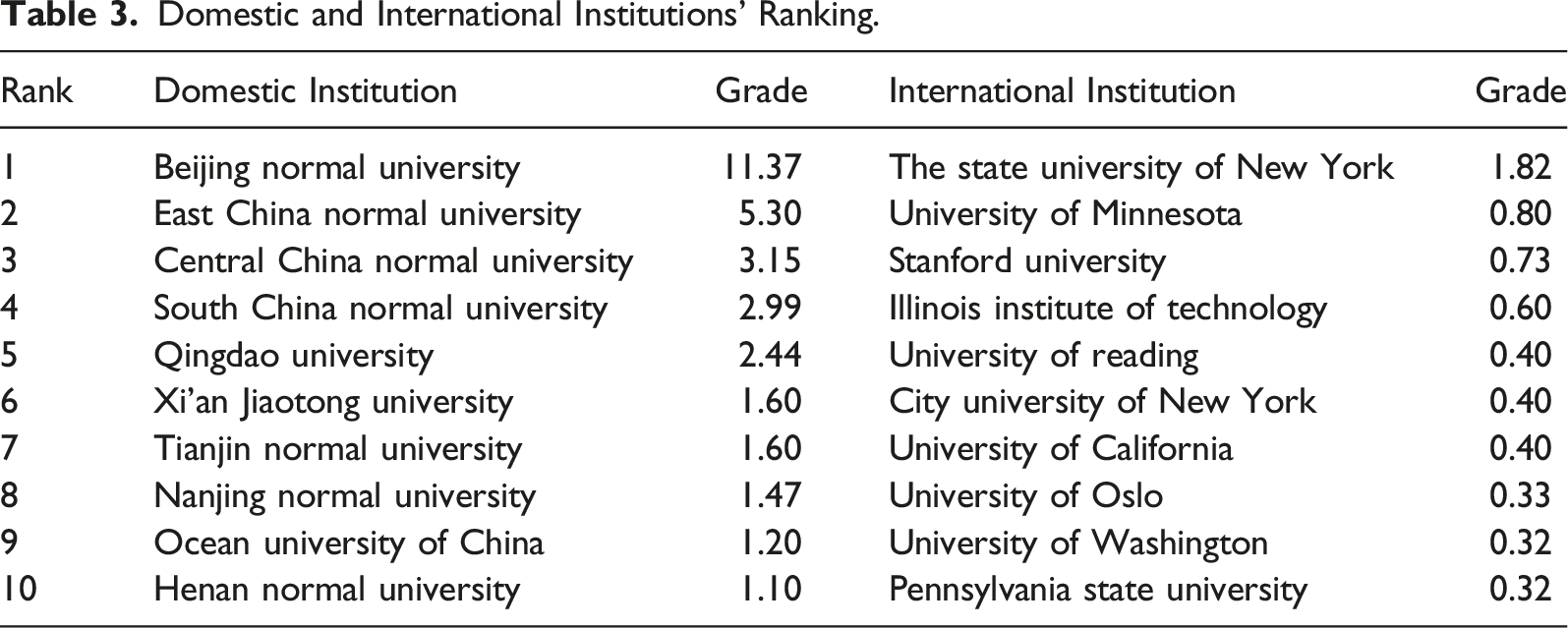
Domestic and International Institutions’ Ranking.
Section II: Selected Papers by Research Type
According to Figure 2, empirical studies (n = 53) accounted for 94.6% from eight in 2017 to 16 in 2021. Nevertheless, literature review (1.8%), position (1.8%) and others type of papers (1.8%) were less published by Chinese science education researchers in this period. There were no theoretical papers in the selected papers. Figure 2 also compares the different research types of papers by journal. That is, the empirical study also dominated the selected papers in all five journals, ranging from 77.8% in S&E to 100% in JRST, RSE and SE. S&E published more types of research papers—position paper (14.3%), review paper (14.3%), by Chinese science education researchers than other journals. Comparisons of frequencies of research types by year and journal.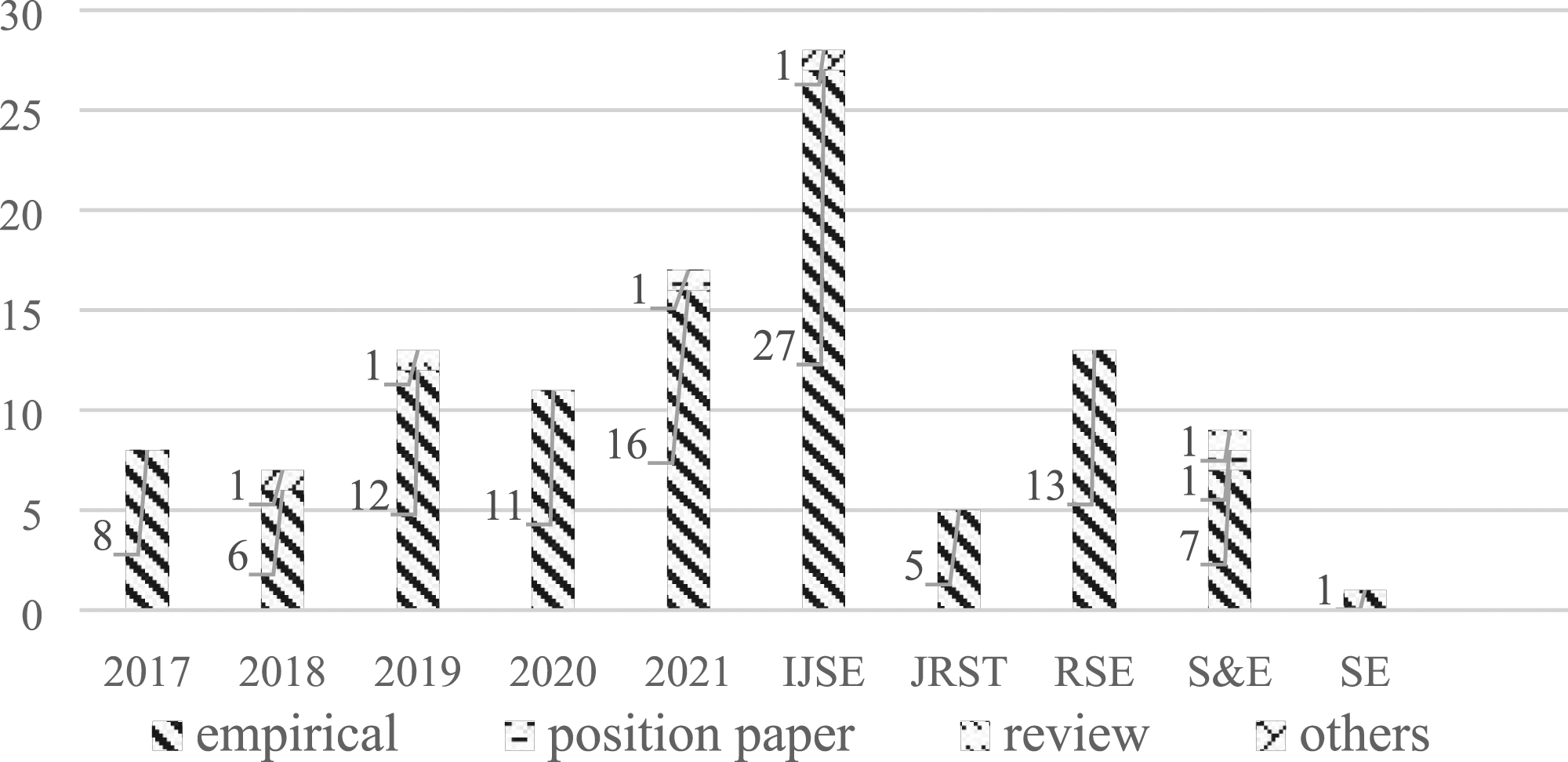
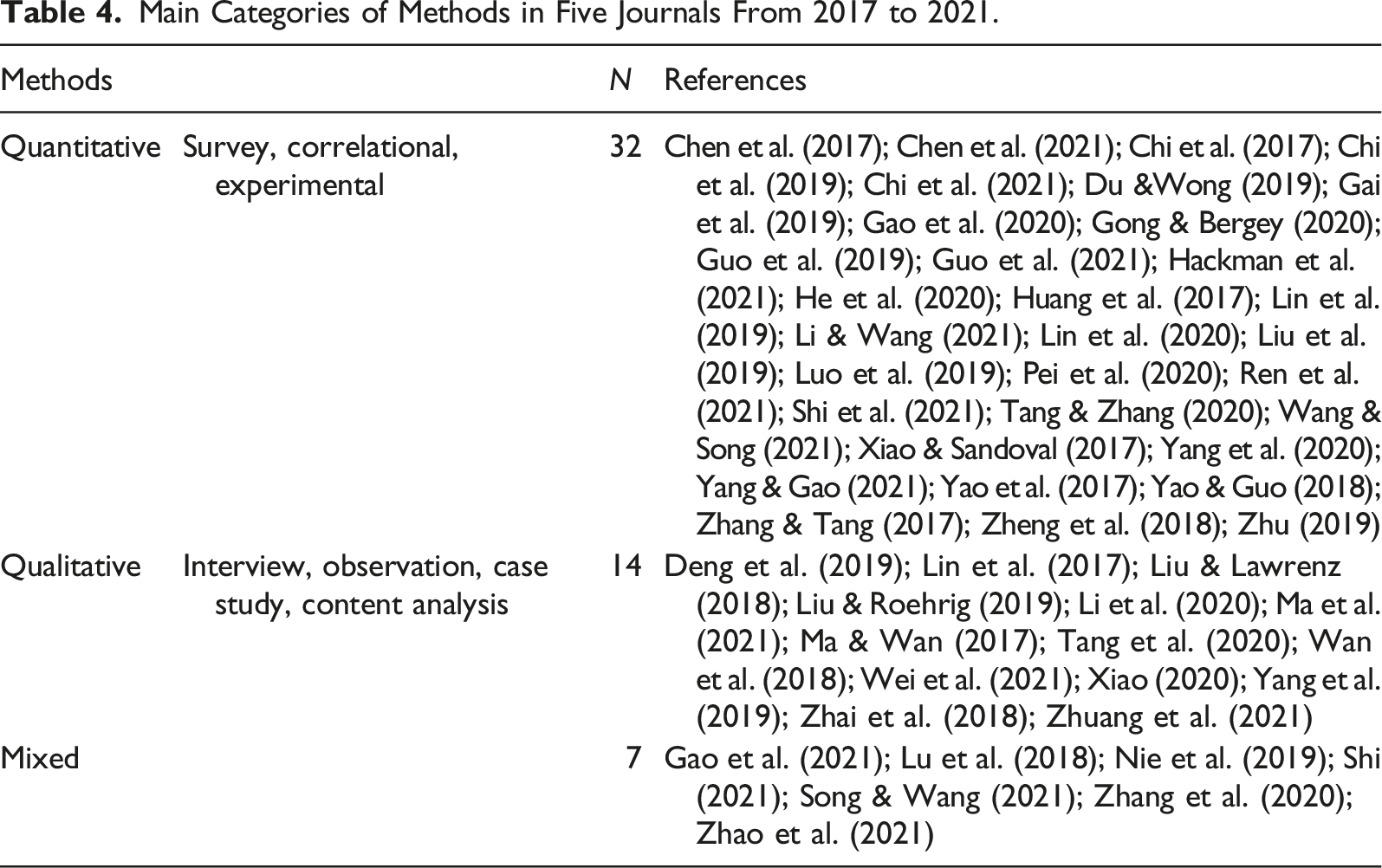
Main Categories of Methods in Five Journals From 2017 to 2021.
Section III: Selected Papers by Research Topic
According to the categories of research topics, selected papers were classified into nine groups. Followed by topics of Goals and Policy, Curriculum, Evaluation, and Assessment (GPCEA) (n = 11, 19.6%), History, Philosophy, Epistemology and Nature of Science (HPE &NOS) (n = 6, 10.7%), and Teaching (n = 6, 10.7%), Learning- Classroom Contexts and Learner Characteristics (L-C&L) was the most popular topic (n = 17, 30.4%) (shown in Figure 3). For example, students’ prior knowledge as one learner characteristics affects knowledge construction while learning approaches would make a difference on students’ argumentation. Liu et al. (2019) investigated the influence of argumentation approach and students’ prior knowledge on students’ scientific concepts learning and argumentation in concept-based topics. Evidently, L-C&L steadily ranked in the first place especially in 2019–2021. Learning-students’ conceptions and Informal learning (L-C) also gained some attention from Chinese science education researchers. On the contrary, Teacher education (TE) (n = 3, 5.7%), Culture, Social and Gender issues (CSG) (n = 2, 3.6%) and Educational Technology (ET) (n = 2, 3.6%) were the least three research topics in this period. Frequencies of research topics from 2017–2021. TE Teacher education; L-C Learning-students’ conceptions; L-C&L Learning-classroom contexts and learner characters; GPCEA Goals and policy, curriculum, evaluation and assessment; CSG Cultural, social and gender issues; HPE & NOS History, philosophy, epistemology and nature of science; ET Educational technology; IL Informal learning.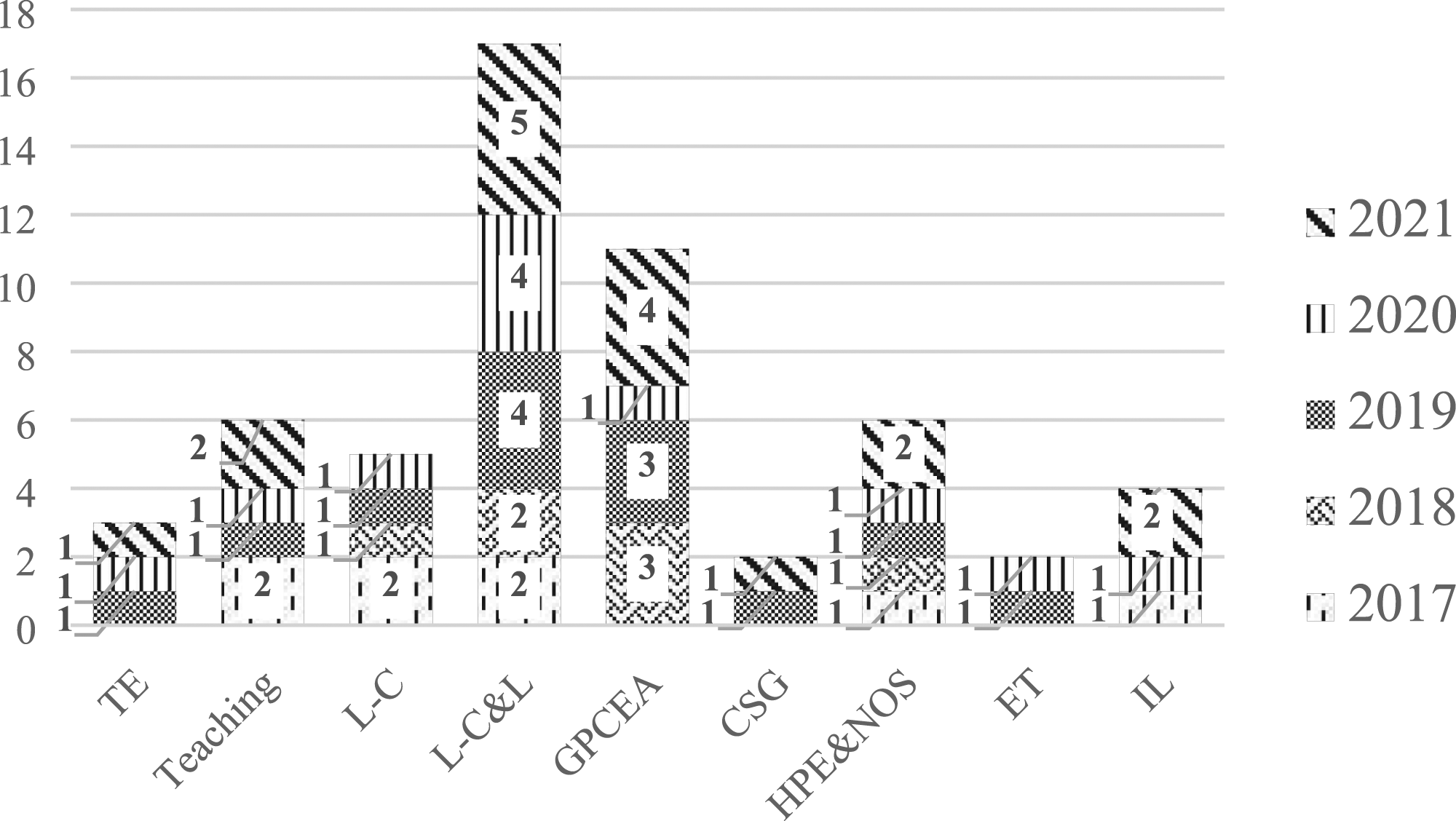
The results of research topics by journal from 2017 to 2021 were provided in Figure 4. Obviously, L-C&L and GPCAE were consistently the two popular topics in five journals. However, different journals took priorities to other topics. Teaching and HPE&NOS ranked in the first place in RSE and S&E, respectively. That implied that more selected papers about science instruction were published in RSE, while Chinese mainland researchers tended to publish their papers about history, philosophy, and nature of science in S&E. Besides, IJSE was the only one journal in which mainland Chinese researchers published papers on the topic of ET. Frequencies of research topics in journals.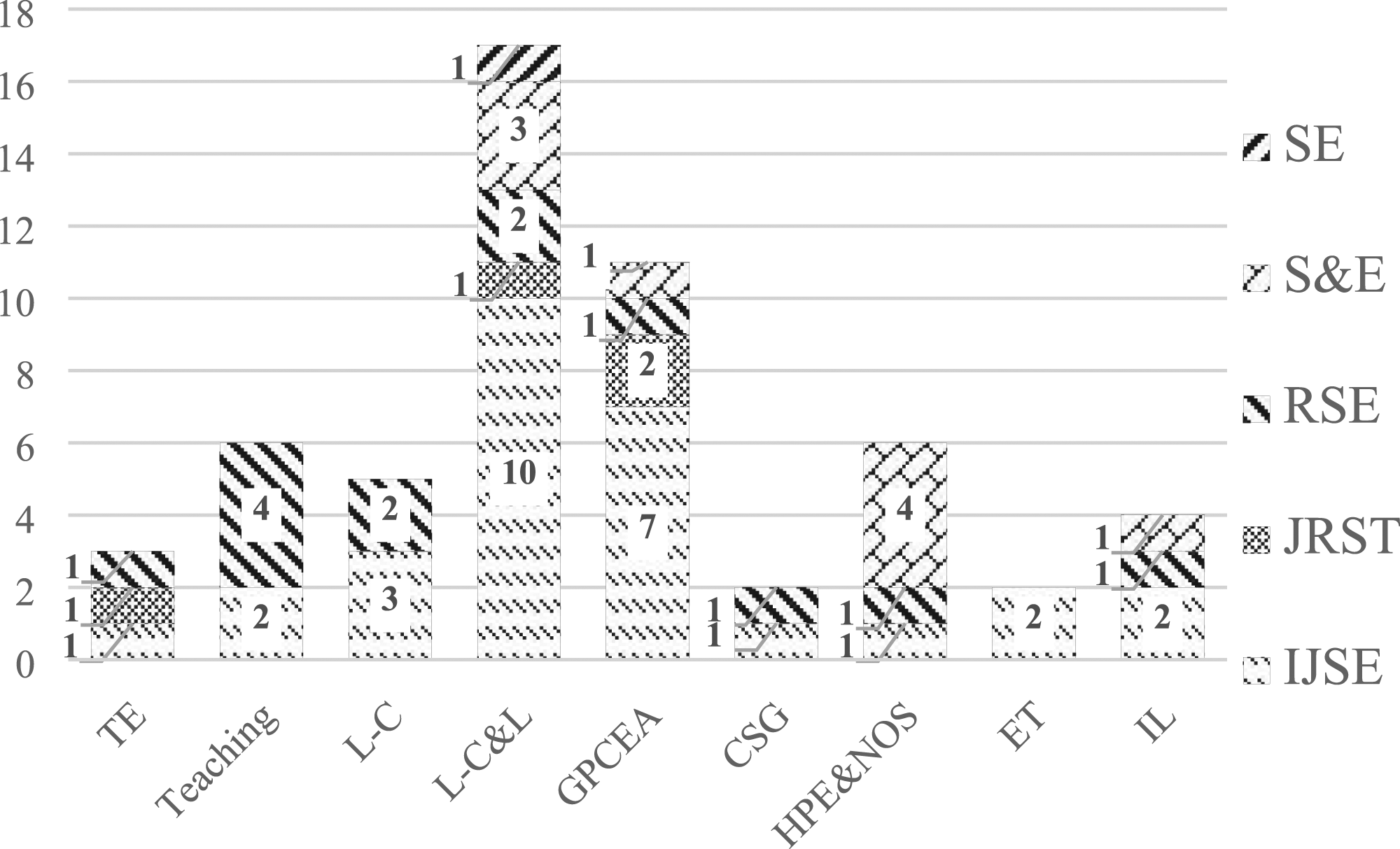
Discussion and Implications
By analyzing the selected publications in JRST, IJSE, RSE, SE, and S&E from 2017 to 2021, this study revealed the research trends of science education in the Chinese mainland. Clearly, Chinese researchers’ participation in the international science education research community remained at a relatively low level, albeit increasing. The possible explanation of this result was the dominated research forms of science education in Chinese local journals was theoretical or pedagogical only, like reflections and position, which were inconsistent with international research characterized by theory-driven empirical studies (Liang et al., 2018). Although researchers received a lot of supports which absolutely varied by region, their attending to international journals was limited partly due to language barriers (Li & Flowerdew, 2007). As proposed by Liang et al. (2018), a few science educators and scholars from the Chinese mainland have shared their findings in English science education journals and books because of differences in language and other reasons. With the support from experienced English researchers, Chinese science educators who are mostly native Chinese speakers were gave opportunities to tell their own stories to the international community. That also indirectly explained why cooperating with researchers from English-speaking countries contributed the most to these reviewed articles. In addition, more researchers tended to collaborate with others from same or different institutions. This may indicate that, with the support of peers, an increasing number of researchers were willing to participate in the international research community (Liang et al., 2018). Thus, for novice researchers, collaborating with others may be a great approach to do their projects and be familiar with popular research design process. Another interesting finding was that the number of papers by international collaboration decreased by year, while it made the greatest contribution in these publications. The plausible explanation may be the accumulation of research experience. For example, Yao and Guo undertook one research project about learning progression in 2017 in collaboration with one international researcher (Yao et al., 2017). Then, in 2018, they banded together to complete another project about learning progression of scientific explanation (Yao & Guo, 2018).
In terms of domestic institutions’ contribution, most of the top-10 institutions were normal universities in Chinese Tier-1 cities. The plausible explanation may relate to the absence of science education researchers and expertise at the start of 21st century in China (Zhang & Wan, 2017). In 2001, most normal universities which mainly prepare preservice teachers were required to set up research centers for curriculum reforms of compulsory education (MOE, 2001). These centers have played a critical role in guiding the research quality and practice of science education in the Chinese mainland. Previous finding (Maneejuk & Yamaka, 2021) about the close relations between higher education and economic development may also explain it. Contributions made by authors from different levels (e.g., teachers) were noteworthy. Teachers’ participation helped them generate a complete picture of the teaching and learning process, ultimately for enhanced students’ learning (Cox-Petersen, 2001). Thus, it’s urgent to emphasis institutions’ collaboration between developed and developing cities and to call all education stakeholders to get involved in science education research. As proposed by Fan et al. (2022), international multilateral collaboration has a great impact on the frequency of citations of publications. What’s else, more papers were published in IJSE, indicating researchers from the Chinese mainland preferred to present their research findings in IJSE. That was consistent the previous findings that more papers from non-English countries were published in IJSE (Lin et al., 2019). It also necessary to take journals’ number of issue and publication frequency into consideration. For researchers from English or non-English countries, it’s necessary to collaborate with local and international science education community to contextualize their research findings.
Consistent with the findings of the international science education trends from 2013–2017 (Lin et al., 2019), almost all selected studies were classified as empirical studies, while there was only one position, review and other types of paper in the reviewed articles. Either position, theoretical, review studies or other type of studies could provide new insights to researchers’ practices. Science education researchers in the Chinese mainland should be encouraged to publish more international articles and consider other types of articles. In the analysis of empirical papers, quantitative data collection took the first place in the methodology. Although each approach has its unique worth, more attention should be paid to diversify research methods. Take the qualitative study of Deng et al. (2019) as an example, pre- and post-intervention data about students’ conceptual and skills changes could provide a broad insight into the impact of intervention.
Research topics about student’s learning (e.g., learning characteristics, nature of science) received more attention from Chinese science education researchers, which was consistent with research trends in international science research community (Lin et al., 2019). This may be explained by the fact that, with the limited efforts on research and the increasingly emphasis on students’ scientific literacy which includes students’ concepts and nature of science (MOE, 2017) in China, students’ development has been given priority. Policies on curriculum would make a great difference on science education research and practices. After the release of Compulsory Primary School Science Education Curriculum Standards in 2017, targeting to cultivate students’ subject matter core knowledge and diverse ways of assessment (Hu & Shou, 2018), how to practice it would be the hot topic. Informal learning, treated as one essential way to support formal education and civic education, also received much attention (e.g., Zhang & Liu, 2021). Less attention on difference in culture, gender and society, educational technology, and topics about teachers also proved it. Clearly, the research of science education depends largely on national priority and investment. As indicated in the study of Medina-Jerez (2018), the prevalence of HPE & NOS in Latin America’s science education research was closely tied with national investment. Furthermore, with the release of “double reduction” policy in 2022 (She et al., 2023), mainly targeting to reduce students’ burden of homework and after-school courses in compulsory education, the inequalities in Chinese education system and students’ welfare have attracted much attention. It appears that a call for further attentions into teachers’ development, individual, social and cultural difference, and approaches to assist individual’s development (e.g., technology-assisted science education), is justified.
Limitation
This study shed light on the research trends of science education in the Chinese mainland. The findings in this report are subject to at least three limitations. First, some research topics and types in the analyzing framework could be subdivided. For example, a closer examination of Learning-classroom contexts and learner characters may yield more meaningful results. Moreover, the articles pool for selecting the reviewed paper in this study could be broaden. These five journals only accounted for a small part of journals database. Articles published in others by the Chinese mainland researchers may enriched the analysis findings. The last limitation may be related to the time span. It’s meaningful to analysis articles in the longer period to get a specific overview of the research trends.
Footnotes
Declaration of Conflicting Interests
The author(s) declared no potential conflicts of interest with respect to the research, authorship, and/or publication of this article.
Funding
The author(s) received no financial support for the research, authorship, and/or publication of this article.
Ethical Approval
This paper was a literature review study which analyzed the published articles in journals. This study didn’t include human participants. So, it didn’t require ethics approval.

Appendix
Selected empirical studies in this review.
Study
Purpose
Main theoretical references
Subject
Sample
Methods
Lin et al. (2017)
To examine science teachers’ meta-strategic knowledge of argumentation teaching
Personal construct psychology
Science
2 science teachers
Qualitative: case study
Zhang & Tang (2017)
To explore the relationship among extracurricular science activities, students’ learning interests, academic self-concept, and science achievement
Social constructive theory and contextual model of learning
Physical, biology, earth and space science
7410 8th grade students
Quantitative: correlational
Zheng et al. (2018)
To investigate the inter-relationships among conceptions of, approaches to, and self-efficacy in learning science in non-Western culture
Cultural anthropology
Science
1049 primary school students
Quantitative: correlational
Zhu (2019)
To examine the effects of students' attitudes on their scientific competencies
Competences and attitude factors
Science
25,658 15-year-old students
Quantitative: correlational
Lin et al. (2019)
To explore the relationships between students’ perceived learning practices and associated self-efficacies regarding mobile-assisted seamless science learning
Self-efficacy
Science
312 primary school students
Quantitative: correlational
Du and Wong (2019)
To examine science capital to understand young people’s science career aspirations in China and UK
Science capital
Science
23,998 15-year-old Chinese and UK students
Quantitative: correlational
Deng et al. (2019)
To examine the effects of reading, peer evaluation, discussion on undergraduates’ scientific writing
Social aspects of scientific writing
Chemistry
22 undergraduates
Qualitative: textual analysis and critical discourse analysis
Chi et al. (2019)
To detect and measure disciplinary context effects on student hands-on performance
Discipline context
Science
251 8th grade students
Quantitative correlational
Tang & Zhang (2020)
To explore the direct and indirect influence of both prior and current informal science learning on science performance
Contextual model of learning
Science
14051 15-year-old students
Quantitative: correlational
Gong & Bergey (2020)
To examine the medication of achievement emotions between the chemistry self-efficacy and classroom engagement
Achievement emotions and control-value theory
Chemistry
103 11th grade high school
Quantitative: correlational
Hackman et al. (2021)
To examine the current attitudes toward STEM education among science teachers and identify the factors that might influence these attitudes
Bronfenbrenner’s bioecological model
STEM
194 in-service science teachers
Quantitative: correlational
Chi et al. (2021)
To examine the moderating effect of teacher feedback on the associations among inquiry-based science teaching and learning practices and students’ science-related attitudes and beliefs
Social constructivist theory
Science
9, 841 15-year-old
Quantitative: correlational
Song & Wang (2021)
To examine the degree to which disciplinary, cognitive and affective factors could explain students’ individual differences in interdisciplinary competence
Interdisciplinary competence and construction
Health, environmental quality, and frontiers of science and technology mixed
385 9th grade students
Mixed: interview and survey
Xiao (2020)
To explore how students use inscriptions as evidence to argue about socioscientific issue
Inscriptions in argumentation
Physical and biology
102 5th- and 6th- grade students
Qualitative: content analysis
Zhang et al. (2020)
To explore the impact of a 9-month-long autonomy-supportive teaching intervention on teacher and students’ perceptions of learning physics
Self-determination theory
Physical
A physics teacher and 147 8th students
Mixed: experimental, interview, observation
Zhao et al. (2021)
To evaluate the impact of quasi-apprenticeship program on students’ perceptions and career intention of becoming a biologist, and to examine the extent to which the impact of the program on students’ career intention
Theory of planned behaviour
Biology
319 7th and 8th students
Mixed: experimental, content analysis
Chen et al. (2021)
To identify the most important contextual characteristics of top performers in scientific literacy
The classic theory of educational productivity
Science
25,181 top-performing students
Quantitative: survey
Wei et al. (2021)
To examine how a beginning science teacher deals with practical work in a physics classroom
Gee’s (2000) conceptualization of identity
Physical
A novice physical teacher
Qualitative: case study
Yang & Gao (2021)
To explore whether there are gender differences in achievement motivation and gender socialization and to determine which factors impact the achievement motivation of male and female college students in STEM majors in China
Gender socialization
STEM
5032 undergraduates
Quantitative: correlational
Gao et al. (2021)
To verify the SSI program’s effect on students’ emotional competence
SSI and emotional competence
Science
26 10th grade students
Mixed: experimental, content analysis
Xiao & Sandoval (2017)
To examine the associations between students’ attitudes towards science and their evaluation of information about a socioscientific issue
Attitudes and evaluation
Science
49 6th students
Quantitative: correlational
He et al. (2020)
To examine how do contextual factors influence the large-scale assessment of students’ epistemic cognition of scientific argument
Suited cognition theory and argumentation
Science
1202 10th −12th students, including 200 in first pilot test, 181 in second pilot test, and 821 in formal test
Quantitative: survey
Ren et al. (2021)
To investigate the impact of personal moral philosophies on the safety practices of students in chemistry and related majors
Forsyth’s four distinct personal moral philosophies
Chemistry
1315 undergraduate students
Quantitative: correlational
Shi (2021)
To examine the effects of explicit teaching of philosophy to promote students’ NOS
POS and NOS
Chemistry and mathematics
132 senior three students; 14 high school students
Mixed: survey, interview
Yao et al. (2017)
To investigate students’ progression in understanding the energy concept
Learning progressions of energy
Physical
4550 junior school students
Quantitative: survey
Luo et al. (2019)
To develop a scale to measure students’ STEM continuing motivation
Continuing motivation
STEM
465 Chinese 7th and 8th graders
Quantitative: survey
Yang et al. (2019)
To assess the design quality of inquiry-based tasks in textbooks
Inquiry-based tacks
Biology
3 high school biology textbooks
Qualitative: content analysis
Gai et al. (2019)
To examine the salient characteristics of the ‘question-answer process’ in senior high school chemistry class
Question-answer process
Chemistry
7 pre-service and 7 in-service chemistry teachers
Quantitative: survey
Wang & Song. (2021)
To present a validated instrument based on our multidimensional construct to explore students’ interdisciplinary competence
Interdisciplinary competence model
Health, environmental quality, and frontiers of science and technology
385 9th graders
Quantitative: survey
Zhuang et al. (2021)
To evaluates the NOS representations in five textbooks approved
Lederman’s theoretical framework of NOS
Physical
5 high school physics textbooks
Qualitative: content analysis
Guo et al. (2021)
To develop an instrument to measure upper-level elementary students’ attitudes towards science
The ABC (affective, behavioural, and cognitive) model
Science
1800 5th grade students
Quantitative: survey
Yao & Guo. (2018)
To examine the validation of the phenomenon theory-data-reasoning framework for scientific explanation and the learning progression
The phenomenon theory-data-reasoning framework
Science
4554 Grades 8–12 students
Quantitative: survey
Shi et al. (2021)
To develop and validate a measurement tool for teachers' modelling-based teaching performance
Modelling-based teaching performance
Chemistry
71 teachers
Quantitative: survey
Chen et al. (2017)
To use a cognitive diagnostic method to investigate whether the hypothesized learning progression for thermochemistry
Learning progressions
Chemistry
694 senior high school students
Quantitative: survey
Li et al. (2020)
To analyse the NOS in junior middle school physical textbooks
Analytical framework of nature of science
Physical
5 physical textbooks
Qualitative: content analysis
Gao et al. (2020)
To verify the cumulative characteristic of conceptual change by developing a learning progression for buoyancy
Learning progression
Science
1036 8th grade students
Quantitative: survey
Ma et al. (2021)
To explore the quality of scientific inquiry in the most popular science textbooks
Scientific inquiry
Science
Nine sets of high school science textbooks (24 books)
Qualitative: content analysis
Ma & Wan. (2017)
To study the history of science (HOS) in science textbooks
HOS in the perspective of developing a culture understanding
Science
19 sets of Chinese science textbooks
Qualitative: content analysis
Wan et al. (2018)
To examines Chinese pre-service teachers views on the nature of science and how Chinese culture influences their views
Nature of science
Physics, chemistry and biology
30 pre-service teachers
Qualitative: interview
Li & Wang. (2021)
To explore the spatial cognitive process among STEM education and its role in STEM education
Human spatial navigation
STEM
172 undergraduate students
Quantitative: correlational
Tang et al. (2020)
To illustrate how instructional practices favour students seeking empirical patterns at the expense of using mechanistic reasoning epistemic activities
Pattern-seeking and mechanistic reasoning
Science
One fourth-grade classroom
Qualitative: observation
Zhai et al. (2018)
To explore the affordances of learning progressions in support of teachers’ formal and informal formative assessment practices
Learning progression-based formative assessment
Physical
2 naive teachers
Qualitative: case study
Lu et al. (2018)
To examine the effects of explanation-driven inquiry on students’ redox conceptual understanding and their misconceptions
Model of explanation
Chemistry
119 10th grade high school students
Mixed: experimental, interview
Liu et al. (2019)
To investigate the influence of argumentation approach and students’ prior knowledge on the learning of scientific concept and argumentation in descriptive and theoretical scientific concept-based topics
Learning of argumentation
Science
138 7th grades
Quantitative: experimental
Nie et al. (2019)
To examine the effectiveness of a knowledge integration instruction in learning force and motion
Conceptual framework model
Physic
208 8th grades for a pilot study; 171 8th grades for the formal study
Mixed: experimental, interview
Lin et al. (2020)
To examine the correlations between perceived technology-assisted teacher support, student hardiness and technology-embedded scientific inquiry
Constructivist-oriented instruction
Technology, science
1566 students (including primary school students and middle school students)
Quantitative: correlational
Pei et al. (2020)
To understand the longitudinal effect of a technology-enhanced learning environment with reflective guidance on sixth-grade students’ learning
Knowledge integration framework
Science, technology
125 sixth-grade students
Quantitative: experimental
Huang et al. (2017)
To analyse students’ questioning behaviour and to enhance students’ question-asking ability
Cognitive disequilibrium
Science
929 7th and 8th students in the survey; 45 8th students in the experiment
Quantitative: survey, experimental
Yang et al. (2020)
To test the validity of and further explore the theoretical model of conceptual framework on effectiveness of professional development
Conceptual framework on effectiveness of PD
Science, engineering
204 teachers; 5581 students from 4th to 12th
Quantitative: correlational
Guo et al. (2017)
To examine the effectiveness of teachers’ different ways of designing multiple examples in helping students learn a physics principle
Variation theory
Physic
315 10th students
Quantitative: experimental
Liu & Lawrenz (2018)
To examine reasoning processes in argumentative contexts
Dual- process theory
Environment science
26 undergraduate students
Qualitative: interview
Liu & Roehrig (2019)
To investigate the nature of in-service science teachers’ argumentation and personal epistemology about global climate change
Epistemology and argumentation
Environment science
20 science teachers
Qualitative: interview, content analysis
Chi et al. (2017)
To investigate associations among attitudes, perceived difficulty of learning science, gender, parents’ occupation and students’ scientific competencies
No
Science
1591 9th students
Quantitative: correlational