



Abstract
Children with severe and multiple disabilities (SMD) becoming out-of-school children (OOSC) is a common issue in developing countries. Researchers have reported that the out-of-school issue results from multiple factors; however, few studies have explored how the interactions of these factors lead to children becoming OOSC. This study aimed to explore the causes of out-of-school issues among children with SMD in China based on game theory. Interview data from six parents of children with SMD who had become OOSC were collected as the primary source of research data, with interview data from school personnel at the six schools that children with SMD in our study had attended or applied to, education policy documents for children with SMD, and relevant news as secondary sources of research data. Narrative inquiry and thematic analysis were combined to investigate the out-of-school experiences of children with SMD and analyze how the strategic interactions of three “players” (i.e., the policy, schools, and families) led to these children becoming OOSC. The findings indicated that the three players successively interacted with each other by adopting different strategies to pursue their respective goals, and the families of children with SMD inferred by reverse induction that no strategy they adopted would change the outcome of their children becoming OOSC if the strategies of the other players were unchanged. Finally, an innovative cooperation model with an emphasis on the interactions of all players is proposed to address the out-of-school crisis.
Introduction
Out-of-school children (OOSC) refer to children who are excluded from school education, including school-aged children who have never been to school, who have started school but dropped out, and who are in school but at risk of dropping out (UNESCO, 2010; UNICEF, 2018). There is a worldwide consensus that having access to school and completing quality basic education is a fundamental way to realize every child’s right to education (UNICEF, 2018). Especially for children with disabilities, quality education not only increases their independence and enables them to reach their full potential but also lays the foundation for their social inclusion (UNESCO, 2015). Therefore, United Nations (2006) adopted the Convention on the Rights of Persons with Disabilities, which aims to promote, protect and ensure the basic rights of all persons with disabilities, such as education, employment, and accessibility, and China also signed this convention in 2007. However, children with disabilities are still one of the most vulnerable populations for becoming OOSC. A survey in 49 countries has noted that the rate of children with disabilities who have never attended school was estimated to be as high as 23% on average (UNESCO Institute of Statistics, 2018). The estimated dropout rates of children with disabilities in these countries were even higher, for example, 26.23% in China (G. Chen et al., 2014) and 57.4% in Cambodia (National Institute of StatisticsDirectorate General for Health, 2014). Compared with children with disabilities in general, children with severe and multiple disabilities (SMD) have more complex support needs, that is, their needs may span multiple domains and/or involve high levels of need in one or more areas (Collings et al., 2016); thus, children with SMD might suffer from more serious out-of-school crises. Therefore, this study aims to investigate the underlying causes of children with SMD becoming OOSC.
Determinants of Out-of-school Issues Among Children With Disabilities
Studies have demonstrated that the determinants of out-of-school issues among children with disabilities include an array of factors related to policies, schools, and families (De Witte et al., 2013; Ware et al., 2016). First, previous studies have explored the role of policy-related factors in alleviating or aggravating the out-of-school crisis among children with disabilities, such as the out-of-school prevention policies in including students in schools (Freeman et al., 2019; Pyle & Wexler, 2015) and the policy imbalance toward children with different levels of disabilities that resulted in children with SMD having little access to school (Kritzer, 2011). Second, school-related factors have been reported to play a direct role in out-of-school issues among children with disabilities, including risk factors such as a lack of necessary academic and behavioral support (Pyle & Wexler, 2015) and school exclusion (Jiménez Asenjo & Gaete Astica, 2013; Zablocki & Krezmien, 2013) and protective factors such as effective instruction (Bost & Riccomini, 2006) and personalized behavioral and social programs (Dynarski et al., 2008). Third, many family factors have been suggested to mitigate or exacerbate out-of-school issues among children with disabilities, such as low socioeconomic status (Zablocki & Krezmien, 2013), parental maltreatment (Morrow & Villodas, 2018), and parental support (Reschly & Christenson, 2006).
In addition, it is increasingly recognized that the out-of-school crisis among children with disabilities may result from systemic flaws caused by the aforementioned factors (De Witte et al., 2013; Ware et al., 2016) rather than a single factor. However, previous literature has not provided an in-depth exploration of how the interactions of these factors lead to children becoming OOSC. Thus, the current study attempts to analyze how the interactions of multiple factors cause children with SMD to become OOSC.
Game Theory and its Applications in Analyzing Issues Caused by the Interaction of Multiple Players
Game theory, a theoretical framework that originated in the field of mathematics in the 1920s, has been further refined to explore socially interactive situations (Colman, 2013). Game theory can provide models to analyze any social interaction (game) with three properties: players (decision-makers), strategies (choices of actions), and goals (payoffs; Myerson, 2013), and it holds that rational players in the game act to maximize the achievement of their “postulated goal” (Colman, 2013). Among many game types, a dynamic game (also called a sequential game) is a useful model for analyzing complex educational issues of long duration and with many interactive rounds, such as measurement of long-term educational benefits (Ding & Xue, 2020), the formation of educational legislation (Law & Pan, 2009), and educational resource dilemma (Chen et al., 2022). In this type of game, players follow the sequence of the game, choosing their strategies one after another, and later players decide their own game strategies based on the strategies chosen by earlier players (Busu, 2018). The current set of strategy choices constitutes a subgame perfect Nash equilibrium if, at any stage in the game, no player can increase his or her expected payoff by changing his or her own strategy when the other players’ strategies remain unchanged (Caruso et al., 2019). Normally, the subgame perfect Nash equilibrium is deduced by backward induction, an iterative process of reasoning backward in time to identify what action would be most optimal at each stage of dynamic games (Bonanno, 2018). The above theoretical foundations can be used to deduce the strategies of players in dynamic games and to analyze the outcomes of the games. For example, Law and Pan (2009) have interpreted the formation of private education legislation in China as a dynamic game in which China’s lawmaking bodies with their own goals interacted with each other by adopting different strategies during the four stages of the legislation, and the subgame perfect Nash equilibrium was reached in each stage of legislation. Eventually, educational legislation was shaped by these strategic interactions. Thus, in the current study, we use game theory as a guiding framework for analyzing how the interactions among the policy, schools, and families lead to children with SMD becoming OOSC.
Education Policies for Children With SMD in China
At present, China has not formulated specialized education policies for children with SMD, but special education policies all focus on improving the enrollment rate and quality of education for all children with disabilities, including children with SMD (Yu & Chen, 2020). On the one hand, education policies clearly state that these children should receive education through three main forms of placement: inclusive education schools (preschools), special education schools (preschools), or home-delivery teaching, and special education classes in child welfare institutions can also be a supplemental form (Ministry of Education of China, 2017). The policy also proposes that children with disabilities can be enrolled according to the “nearby admission” or “cross-region enrollment” policy. In particular, the policy stipulates that schools should implement “zero rejection” for children with disabilities in compulsory education and that once a child with disabilities has dropped out of school, the school should immediately report to the competent department and help the child return to school. On the other hand, policies emphasize the improvement of the quality of special education, such as “improving teaching facilities and curriculum system and reforming teaching methods in special education schools,” “building the support system for inclusive education,” and especially emphasizing the professionalism of the ranks of special education teachers, including entry qualifications as well as postservice training (Yu & Chen, 2020).
However, national surveys have reported that children with disabilities in China are still at high risk of becoming OOSC, with children with SMD likely to be at an even higher risk (China Daily, 2018; China Public Welfare Research Institute, 2020). Therefore, it is imperative to explore the root cause of out-of-school issues among children with SMD.
Research Questions
This study attempts to analyze the root causes of children with SMD becoming OOSC with the theoretical framework of game theory. Specifically, we set out to answer the following research questions: What are the “goals” pursued by the policy, schools, and families of children with SMD? What “strategies” were chosen by three “players” to pursue their “goals”? How do the strategic interactions among the three players lead to children with SMD eventually becoming OOSC?
Method
Research Design
This study applied narrative inquiry and thematic analysis to explore the root causes of out-of-school issues among children with SMD using the theoretical framework of game theory since researchers have stated that an informal narrative of a phenomenon should be combined with the formal analysis of game theory when using a game theory framework to analyze a phenomenon (Grant, 2022). Narrative inquiry is a qualitative method that focuses on participants’ stories and explores the meaning and value behind these stories (Clandinin, 2012), and it is regarded as the most powerful approach to studying human interaction (Freeman, 2007). Thus, this study first adopted narrative inquiry to investigate the out-of-school experiences of children with SMD with a focus on the interactions of policies, schools, and families. Then, thematic analysis based on the narrative stories was utilized to capture the essential elements of the dynamic game, and a game tree was displayed to show the pathways of the interactive game among the policy, schools, and families.
The Positionality and Reflexivity of the Researchers
The positionality of researchers may influence the total research process (Darwin Holmes, 2020). On the one hand, all authors had either research background or teaching experiences about students with SMD, and we aimed to analyze the root causes of children with SMD becoming OOSC and to provide a basis for addressing the OOSC issues. On the other hand, multiple research data, including interviews with parents and school staff and policy documents, were collected with the aim of reducing bias in the findings (Holloway & Freshwater, 2009).
Sampling and Participants
Basic information for participants’ children and their families.
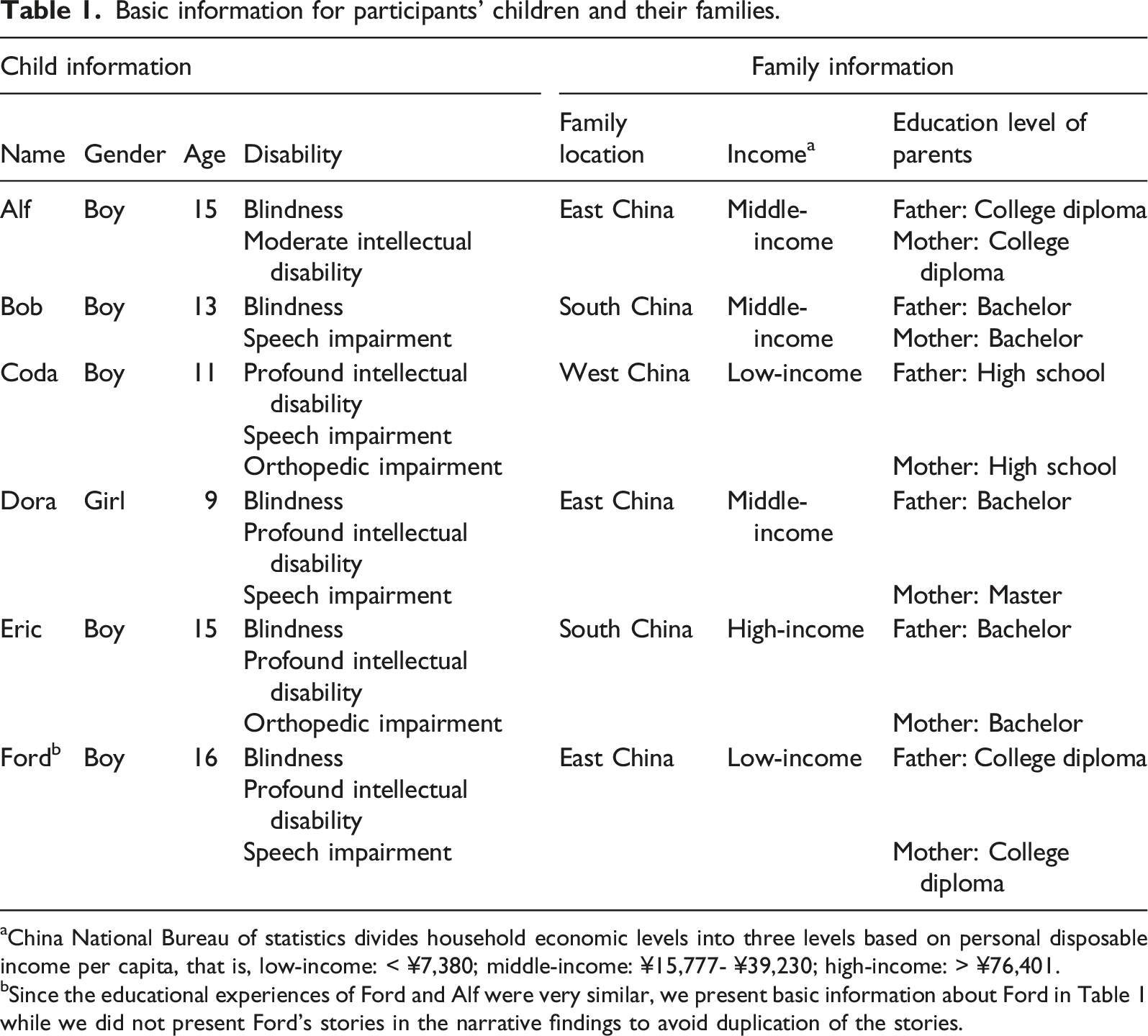
aChina National Bureau of statistics divides household economic levels into three levels based on personal disposable income per capita, that is, low-income: < ¥7,380; middle-income: ¥15,777- ¥39,230; high-income: > ¥76,401.
bSince the educational experiences of Ford and Alf were very similar, we present basic information about Ford in Table 1 while we did not present Ford’s stories in the narrative findings to avoid duplication of the stories.
Information of schools involved in the study.
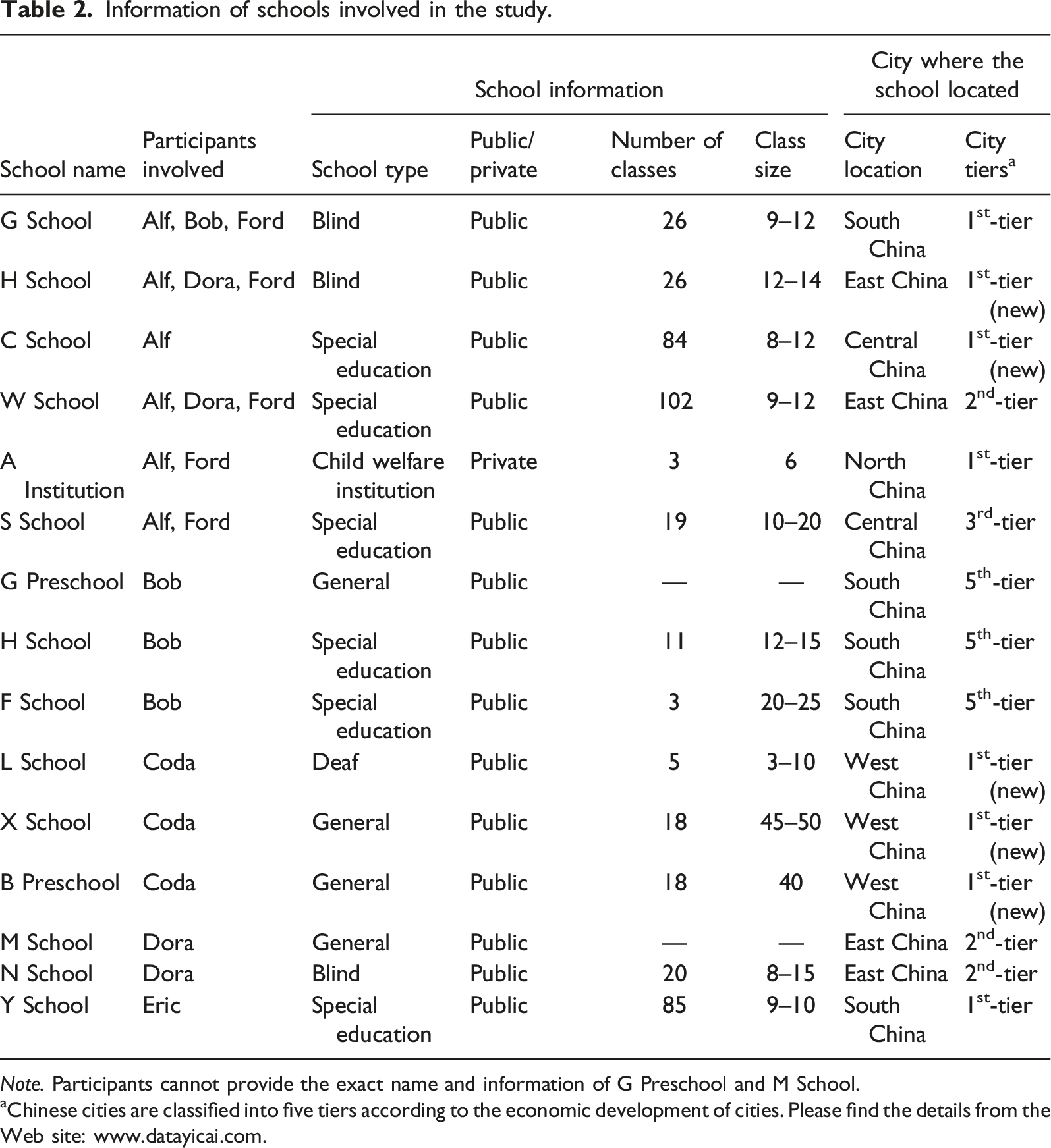
Note. Participants cannot provide the exact name and information of G Preschool and M School.
aChinese cities are classified into five tiers according to the economic development of cities. Please find the details from the Web site: www.datayicai.com.
Information about the teachers and school administrators who participated in the interviews.
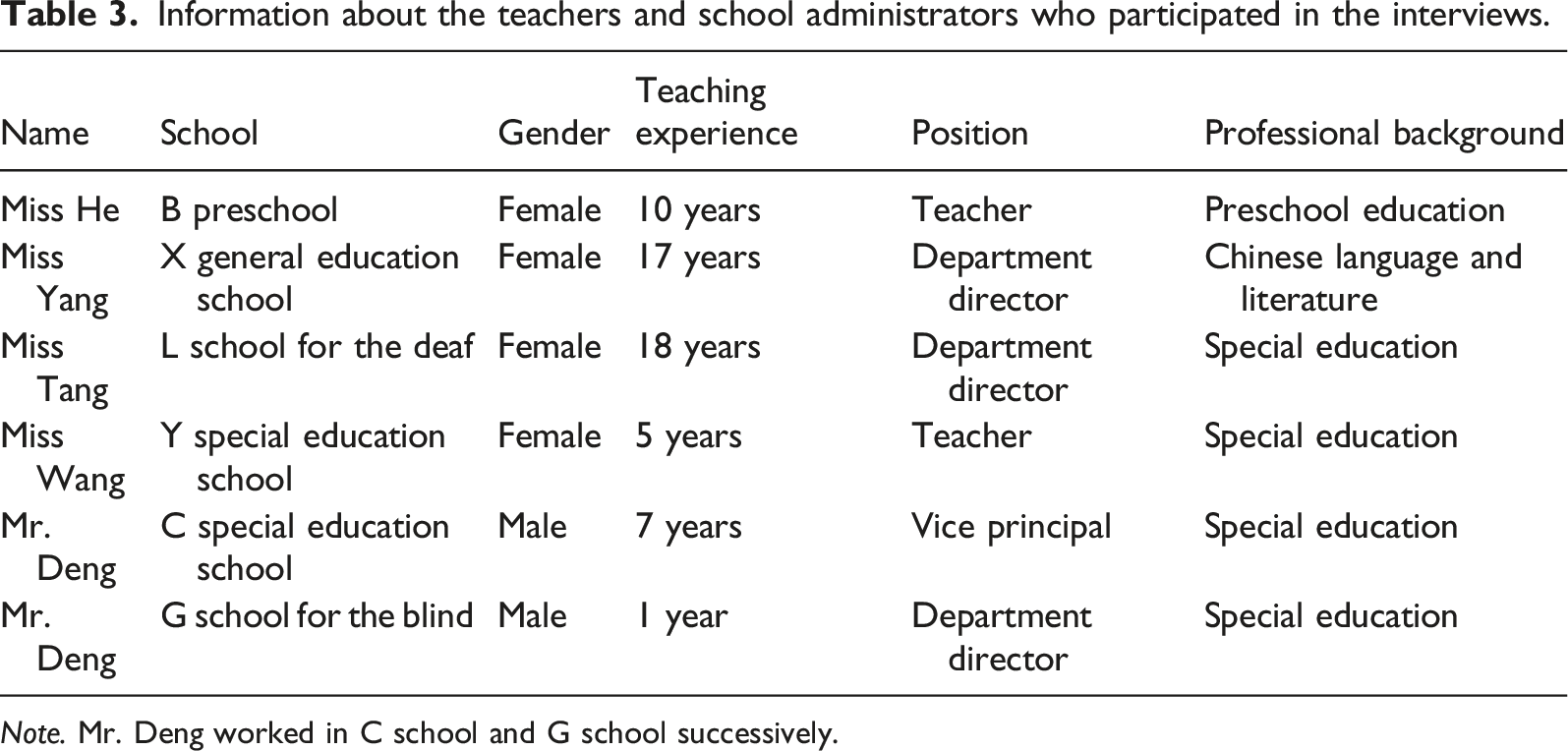
Note. Mr. Deng worked in C school and G school successively.
Data Collection
Different strategies were applied to collect data from policies, schools, and parents. We adopted in-depth, semistructured interviews as the major approach to collecting data from parents and school personnel. First, to explore the out-of-school experiences of children with SMD from parents’ perspectives, we developed the following predetermined interview questions: (1) Why did your child drop out of school (or why was your child not admitted to the target school)? (2) What was your child’s educational experience before dropping out of school? (3) How did you respond to your child’s school dropout? (4) Could you please talk about your views on out-of-school experiences? The interviewees were encouraged to speak freely about the interview questions to allow for flexibility and were asked follow-up questions for interesting answers. Each formal interview lasted 60–90 minutes, and on average, each participant was interviewed two or three times depending on the richness of their out-of-school experiences. In addition, we also requested children’s photos at school and chat history with teachers as additional materials.
Second, since the out-of-school issue among children with SMD is a sensitive topic for school staff, we focused our interview questions on the enrollment regulations and education of SMD children to avoid their refusal to be interviewed. The interview questions were as follows: (1) Please introduce enrollment regulations and implementations for children with SMD at your school; (2) Please introduce the education situations about children with SMD at your school; (3) Please introduce the implementation of home teaching delivery at your school if your school offers this service. All invited school personnel had one online interview that lasted approximately 30–40 minutes.
Third, regarding data from policy, we collected the related education policies using keywords, such as “children with SMD” and “special education,” from the Web site of the Ministry of Education of China as primary sources to analyze the goals and strategies of policy in the out-of-school issue of children with SMD, since Marshall and Rossman (2015) have reported that analyzing such documents can be helpful to understand the setting and portray the values and beliefs of policy. In addition, we searched the news reports related to out-of-school issues among children with SMD through the internet as additional materials for the three players.
Data Analysis
This study combined narrative analysis with thematic analysis to explore the root causes of out-of-school issues among children with SMD using the theoretical framework of game theory. First, narrative analysis, which takes stories as the unit of analysis (Frost, 2021), was conducted according to the following procedure to construct the stories lines: (1) The interview texts transcribed from interviews and other data were read several times by the authors to gain an overview of the data. (2) Each author individually analyzed the data and initially organized the storyline of the out-of-school stories chronologically. Meanwhile, data from schools and policies were used as complementary materials to confirm the veracity of parental narratives. (3) All authors discussed any disagreement on the storylines and reached a consensus in the regular weekly meeting.
Then, the narrative findings were further analyzed through thematic analysis to generate the basic elements of game theory, that is, players’ goals, players’ strategies, and outcomes of the game (Braun & Clarke, 2006). In terms of players’ goals, we captured the goals of different players through different data sources. We extracted the goal of the policy through the documents of the policy, while families’ goals and schools’ goals were extracted through interviews. Regarding players’ strategies, we went through an inductive thematic analysis to thematize players’ strategies by reading the initial narrative findings in the first phase, and then in the second phase, we codified the themes generated in the first stage semantically and latently obtained the revealing extracts (Braun & Clarke, 2006). In terms of outcomes, we captured the initial outcomes in the narrative findings at each stage and then classified the initial outcomes based on the definition of being out of school. The thematic analysis was first conducted by the third and fourth authors independently, and then the first and second authors independently revised them. Finally, all the authors discussed the inconsistent results and reached an agreement.
Saturation in Data Collection and Analysis
Although we had only six parents and staff from six schools participating in the interviews, the parents interviewed in the study came from different socioeconomic statuses, their families were located in different regions in China, their children’s schooling experiences involved all types of educational placements and different learning stages, and the interviewed school personnel came from different school types and education stages, and played different roles in schools, such as teachers, department administrators, and vice presidents. The heterogeneity of the participants provided rich data for our study. In addition, the information provided by our last few parents was similar to that provided by the previous interviewers, and little new information was generated, so we stopped recruiting interviewees, which implies that data saturation had been reached. Furthermore, both narratives and thematic analysis indicated that thematic saturation was reached, as the schooling experiences of the sixth participant were redundant with the other participants’ stories (Saunders et al., 2018).
Rigor
The following four strategies were employed to ensure the credibility and reliability of the findings. (1) Prolonged engagement. Two weeks before the formal interviews, we started informal online chats to obtain basic information about the participants’ families, familiarize the interviewees with the online interviews, and build trust (Korstjens & Moser, 2018). (2) Data triangulation. We gathered multiple forms of data from families, children, and policies, including interviews, policy documents, and news reports, to establish the trustworthiness of the findings (Sarfo & Ofori, 2017). (3) Member checking. All interviews were recorded and then transcribed. Summaries of the interviews were sent to the interviewees to ensure that the descriptions used in the study authentically reflected their experiences (Korstjens & Moser, 2018). (4) The study employed the thick description approach (Creswell & Miller, 2000) by using direct quotations presenting rich and thick descriptions of interviewees’ experiences to render the reported experiences meaningful to an outsider.
Ethical Issues
Ethical approval was issued by the first author’s university Human Ethics Committee, participation was voluntary, and all participants provided informed consent.
Findings
The Story of Alf
Exclusion in Preschool Admission
Although special education policies in China all regard increasing the enrollment rate of children with SMD as one of the key goals, the path to education for children with SMD is still very difficult. 1 The Health Times (2020) reported that China’s gross preschool enrollment rate reached 83.4% by 2019, while the enrollment rate for children with disabilities was less than 1%.
When Alf, a blind boy with moderate intellectual disability, was 4 years old, his family began to seek an appropriate preschool education for him inside and outside their home province. However, he was rejected by several schools because of the unreachable admission standards set by the schools. For example, the H School for the Blind in their home province rejected Alf’s application for admission on the grounds of “self-care ability.” Another school Alf applied to, G School for the Blind in another province of South China, showed a preference for children with disabilities who had outstanding artistic ability, self-care ability, and academic ability. “We looked around for special education schools that had preschool programs, and when we got there, there were always many children applying to these schools. Therefore, these schools formulated a “selective admission standard” to select and admit excellent children with disabilities. Alf was never accepted to these schools because he always failed to meet the admissions criteria.” (Alf’s mother)
The administrator of G School who was interviewed explained that they implemented the selective admission standard because of the limited enrollment quota. “We had only eight places in a class, but there were approximately 20 applicants. Therefore, we set up an admission assessment panel to evaluate their cognitive, communication, motor, and other skills and select the children with higher scores.” (G school administrator)
Neglect of Educational Needs After Enrollment
After being rejected twice, Alf’s family did not give up; they went to other provinces to continue seeking preschool education opportunities for Alf. At that time, C Special Education School in Central China offered Alf an opportunity but required his parent to accompany him all day at school. C School placed children with different types and different severities of disabilities in the same class. Thus, the educational needs of these students were so diverse that teachers could hardly accommodate each student’s educational needs. In addition, his mother’s constant company at school led teachers to unintentionally neglect his educational needs. As a result, Alf made little progress after studying at C School for a semester. Therefore, his mother decided to give up after weighing the cost of living in a city far from home against Alf’s education at C school. “Teachers did interact with Alf in the class, but the interactions, tailored for children with normal vision, were totally ineffective for Alf. Teachers often asked questions such as ‘How many sticks are there?’ ‘What’s this? Since Alf could not see, he had to rely on my assistance; otherwise, he could not participate in the class at all.” (Alf’s mother)
C school’s vice principal explained in the interview that they divided the classes mainly according to the age group of the students, so the needs of each child in the class varied greatly, and the teacher’s expertise was not enough to meet the diverse needs of the children. Thus, the school asked parents to accompany their children and try to support the teachers. Similarly, China Daily (2018) reported that some schools required parents to accompany their children all day, and many parents sacrificed their jobs to accompany their children, only to end up dropping out because the school did not meet their children’s educational needs.
“Zero Rejection” in Name, Emotional Maltreatment in Fact
In 2014, when Alf was 7 years old and had reached the age of compulsory education, he was successfully enrolled in W Special Education School in his hometown because of the “zero rejection” policy. As the family had already experienced many difficulties on Alf’s path to education, his parents cherished this schooling opportunity and tried their best to retain Alf in school. “W School was more than an hour's drive away from our home. Alf's father came home late from work every day and drove us to school early in the morning. Then, I spent the whole day at school with Alf. We worked so hard to get him educated there; however, it did not bring any progress to Alf at all…” (Alf’s mother)
At that time, Alf’s headteacher was not willing to accept Alf because of Alf’s serious emotional disorders, which posed a great challenge to her work. The principal responded that “teachers can’t refuse any child,” so the headteacher had to reluctantly accept Alf. Several teachers and administrators we interviewed admitted that teachers were indeed reluctant to accept children with SMD. “In the class, the headteacher always ignored Alf, and other teachers didn’t care much about him. Maybe Alf didn’t like that atmosphere either. He always lost his temper in class. One day, Alf lost his temper again, screaming and crying. I was afraid that he would affect other children in the class, so I quickly took him out of the classroom. When walking out of the classroom, we heard the headteacher say with a sneer, ‘What a lunatic!’ I was deeply hurt by her words. I didn’t want my son to stay there for a second.” (Alf’s mother)
His parents’ hard work not only failed to produce any progress for Alf but also made him experience negative treatment from teachers. Later, they left W School without any formal withdrawal procedure. “However, no one in W School ever asked why Alf did not go to school anymore, and it seemed common for the school that children suddenly dropped out.” (Alf’s mother)
Although a policy for reporting dropouts and helping children who have dropped out return to school has long been in place, the administrators of C School, G Schools, and X School interviewed confirmed that schools would not keep track of students if they were out of school for a long time.
Bodily Injury due to the Negligence of “Teachers”
After Alf dropped out of W School, Alf’s mother heard that a child welfare institution (A Institution) in North China would admit children with SMD. Thus, at the age of eight, Alf started his study at the institution. After the first 6 months of high-quality services in the institution, internal reform of the institution began, resulting in the departure of a large number of experienced professionals, and many courses had to be canceled in succession. Later, since the reformed institution had no funds to re-employ professionals, the so-called “teachers” were all nannies hired from the rural areas around the institution. These “teachers” had neither academic qualifications nor professional backgrounds, and they were only responsible for taking care of the children.
Although the relevant policies have clearly stipulated that special education professionals of institutions should receive work certificates and prejob training, the institution still employed unqualified teachers. Alf’s mother complained that what was even more disappointing was that these “teachers” showed no sense of responsibility at all. Their dereliction of duty caused many injuries to children, including Alf’s broken arm. “I once happened to see some children in the toilet, without a teacher, and they were all playing with poop like playdough. Later, the teacher told me that Alf broke his arm at school, and we never went to the institution again.” (Alf’s mother)
Authoritative media in China have also reported news of teacher negligence in private institutions resulting in injuries and even deaths of students. For example, People’s Daily Online (2014) reported that teachers at private institutions resorted to violence to address behavior disorders of children with disabilities. Later, Xinhua Network (2016) reported that inappropriate training led to the accidental death of a toddler with disabilities.
Low-Quality Education Becoming “the Last Straw”
After leaving the institution, Alf’s mother continued to look around for schooling opportunities, and later, she took Alf to S Special Education School in Central China. Due to its remote geographical location and underdeveloped teaching facilities, S School had a serious shortage of students, and the principal was happy to admit Alf. However, after Alf had studied in S School for two or 3 days, his mother chose to leave the school because of low-quality education. “For example, the school arranged dormitories for boys and girls on the same floor, which might bring some potential sexual harassment for children with cognitive impairment. I once found boys peeping at girls dressing. In addition, there were more than 20 children with different types of disabilities in Alf’s class, and the teacher could not handle it at all. What I couldn’t accept most was that all courses were taught according to the general education syllabus, and there were no special education services at all.” (Alf’s mother)
Similarly, teachers at Y School and L School mentioned using the textbooks and syllabus of the general education school but teaching at two or three grade levels lower. “We follow the general education syllabus. We have no special education rehabilitation other than movement therapy." (L School administrator)
Alf was 15 years old by the time this study was conducted; he still stayed at home and did not return to school. His mother said that she never dared to think about Alf’s future. She and Alf’s father just wanted to make as much money as possible to guarantee Alf’s future.
The Story of Bob
Bob, a blind boy with speech impairments, was also rejected several times during his education from preschool to primary school and eventually dropped out of school. When Bob was 4 years old, his mother came into contact with a general preschool (G Preschool) in their hometown. However, the director immediately rejected his admission, using the excuse of Bob’s safety at school and the other children’s negative attitudes toward Bob’s disabilities. Later, Bob’s family decided to seek educational opportunities in special education schools.
Buck Passing Between Different Schools
His mother first took Bob to apply to a municipal special education school (H School) because she believed that the teaching facilities and teachers’ professional competence there would be far superior to F Special Education School in their county, which is located in a rural area. However, the director of the municipal school rejected Bob’s admission on the grounds of the “nearby admission” policy, that is, Bob should go to F School in F County nearest to his home. Similarly, both the general and special school teachers interviewed confirmed that the schools prioritized following the nearby admission policy.
Reluctantly, Bob’s family had to go to the local F School. The principal of F School admitted that although the school could not reject Bob’s admission, the school had never enrolled blind children and had no teachers who were competent in teaching these children; thus, they would not be able to provide Bob with professional services. “The principal was very surprised when he heard that Bob wanted to go to school. He said that I was the first parent in F County who required a blind child to go to school! I was also shocked by his words. As far as I know, there were quite a few blind children in F County. Didn’t they go to school?” (Bob’s mother)
The deputy director of the Education and Employment Department of the China Disabled Persons’ Federation has also mentioned a similar situation in a news interview: 84% of the 240,000 children with disabilities who were not enrolled in school in 2014 were in rural households, and 78% were located in the central and western rural areas (China Education Newspaper, 2016).
“Home-Delivery Teaching” in Name, a Show in Fact
Later, the principal of F School told Bob’s mother that the school could provide “home-delivery teaching” for Bob. However, so-called home-delivery teaching was far from what Bob’s mother expected: “The ‘home delivery teaching’ was just a show! Every time they just took photos, without any professional services at all. Once they told us that they would teach Bob to wear clothes; thus, we prepared some clothes for their teaching. However, they just took pictures of Bob holding the clothes, and they did not provide any special education services at all. After that, I refused their home delivery teaching.” (Bob’s mother)
The school administrators interviewed also admitted that home-delivery teaching is a way to send condolences and warmth. It is common for parents to refuse this service. “I think the home delivery teaching is some a sham. We only implement home delivery teaching two or three times a semester.” (X school administrator)
Constant Search for Educational Opportunities
When Bob was 7 years old, his mother took him to G School for the Blind in another province to seek opportunities. Similar to Alf, Bob was also rejected because of the “selective admission standards” of G School. Bob’s mother did not give up, and she tried to find all kinds of rehabilitation training resources to strengthen Bob’s communication skills. Two years later, when Bob was nine and a half years old, his mother took him to G School again, but he was rejected again because he still did not reach the admission standard. Although disappointed, Bob’s mother would continue to seek appropriate education for Bob. However, at the time of this study, Bob was 13 years old, yet he remained at home.
News reports have also reported that many parents of children with disabilities have been moving across the country to find the right school for their children and then repeatedly being rejected (Sina, 2021). Similarly, in 2018, a national survey based on nearly 10,000 questionnaires from parents of children with special needs disabilities reported that school-age children with disabilities had a 45% enrollment rate and a 69% success rate in applying for admission at the compulsory education level (China Daily, 2018).
The Story of Coda
When Coda, a boy with a profound intellectual disability, speech impairment, and orthopedic impairment, was three, his mother began to look for preschool admission opportunities all around the city. However, all these preschools refused to enroll Coda on the grounds of safety concerns or a lack of special education teachers. After she inquired about nearly 100 preschools, Coda was still not admitted. Consistent with Coda’s mother’s statement, the preschool teacher we interviewed also admitted that they did not have special education teachers at any of the four branch campuses in the district, and it was also true that no children with disabilities were enrolled in any of the four branch campuses.
No Special Schools in his Home District that Enroll Children With SMD
When Coda reached the age of six, his mother brought him to the only special education school (L School) in his home district to look for a schooling opportunity. However, L School was a school for the deaf and only admitted deaf students. Since Coda’s family could not afford the high cost of schooling in other districts, Coda’s mother wanted Coda to attend the local school so badly that the only special education school became the family’s last hope. “I almost knelt down and begged him to give us a chance, and he told us to apply to L School when Coda was seven. He also promised us that if Coda's abilities had improved by then, Coda could try to study with deaf students. Thus, we continued to send Coda for rehabilitation in the hope of preparing him for school later. However, by the time Coda turned seven and we applied to L School again, the school had a new principal. The new principal refused us, saying that the school only accepted deaf students.” (Coda’s mother)
The administrator of L School that was interviewed also confirmed that the school had not previously enrolled students other than deaf students. “Our school was originally a school for the deaf, which only enrolled deaf students, and only in the last two or three years have we started enrolling students with intellectual disabilities, autism, and other types of disabilities.” (L School administrator)
Inclusive Education in Name, “Just Sitting in Class” in Fact
Later, a relative in the family who worked in education told Coda’s mom that parents could call the Board of Education to make a complaint if the child was not enrolled in school when they reached school age. Coda’s mother apprehensively dialed the complaint number, not expecting the complaint to work quickly, and Coda’s mom received a call from a nearby elementary school (X School) in the afternoon. The principal informed Coda’s mother that Coda could receive inclusive education in X School, but for safety reasons, a caregiver was required to accompany Coda throughout the school day. Coda’s mother gratefully accepted the invitation to attend X School, and Coda’s grandmother took on the responsibility of accompanying Coda at school. However, after Coda had been at school for less than a month, his mother was completely disappointed and took him out of school. “Coda knew that he should not disturb others during class, so he just sat there staring blankly. His teachers and classmates treated him like air; no one greeted him, talked to him, or played with him, not to mention any special education services. The most inconvenient part was going to the bathroom. Since Coda could not walk to the men’s bathroom independently, his grandmother had to take him to the women’s bathroom. Every time his grandma chose a less crowded time to take Coda there, but still, many female students screamed and even called him a “pervert” when they saw him in the women's bathroom. Although Coda’s oral expression was poor, he could understand the bad words and read others’ expressions of disgust. Therefore, he increasingly rejected going to the bathroom at school and just held his urine or refused to drink water all day. Coda suffered too much in that school and this so-called inclusive education was completely pointless, so we decided to leave the school.” (Coda’s mother)
The administrator at X School interviewed also confirmed that students with disabilities usually need parents to accompany them at school and that it was difficult for these children to make friends at school. “In my class, I did not find bullying of children with disabilities. However, I have to admit that these children usually do not have friends. It is mainly because their expression and thinking level cannot keep up with typically developing children.” (X School administrator)
Similar to Coda’s experiences, China Daily (2018) reported that difficulties encountered by children with disabilities enrolled in general education schools included a lack of professional teachers (69%), experiencing discrimination/harm (17%), rejection and nonacceptance by teachers (14%), complaints by peers or parents (14%), and even being asked to drop out of school (10%).
Later, X School suggested that Coda receive home-delivery teaching. However, similar to other children’s experiences, the so-called home-delivery teaching was nothing more than a once or twice a semester delivery of “warmth.” Coda’s mother said that Coda never learned anything from home-delivery teaching or received any professional special education services. At the time of this study, Coda was 11 years old. He was still at home and never returned to school.
Thematic Analysis of the Dynamic Game Among Three Players
Figure 1 shows the game tree of the dynamic game among the three players. Since policies and schools in China have been playing the role of superiors and subordinates and the role of supporters and the supported (Zhao & Tian, 2012), education policy always plays the leader role in this dynamic game, while having the leader advantage of being the first to act in the game. The schools then developed strategies to respond to the educational policies. Finally, families of children with SMD struggled to adapt their strategies to respond to the policy and the schools’ strategies. The analysis of the respective goals and strategies of policy, schools, and families and how children with SMD became OOSC in this dynamic game is presented below. Game tree of the dynamic game among the policy, schools, and families. Note. The green text represents the parent’s strategies in response to the school rejection, that is, continuing to seek admission or preparing the child for admission; the purple text represents the parents’ strategies in response to the school enrollment, that is, retaining their child in school and ensuring the education quality of their child; the orange text represents that the parents had no strategies in response to the school’s rejection or sacrificing education quality and their child became OOSC.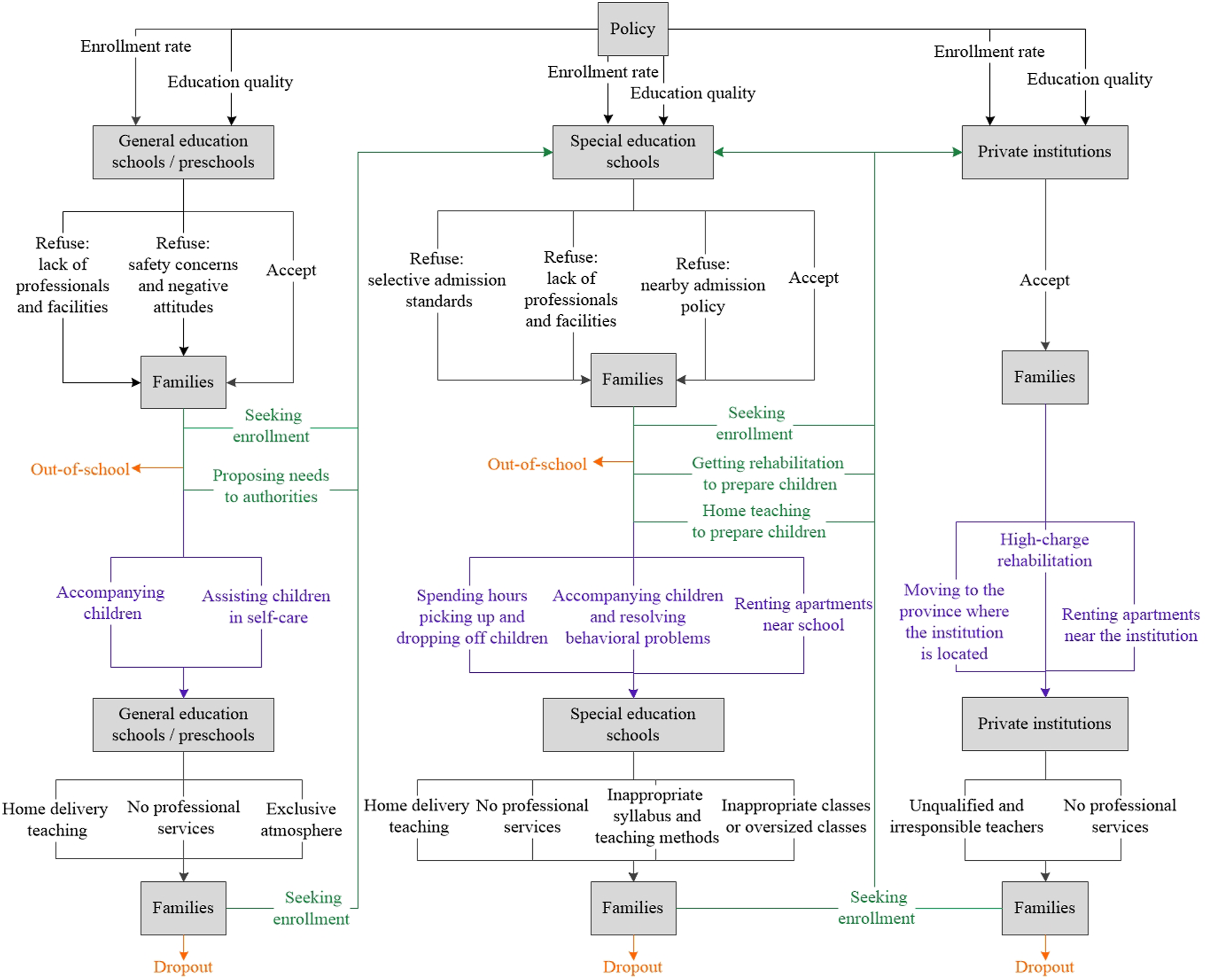
The Goal and Strategies of the Policy
China’s educational policy always considers guaranteeing the educational rights of all children with disabilities as the core goal and is devoted to improving their enrollment rate and education quality (Ministry of Education of China, 2017). Thus, a variety of education policies have been developed as the best response to maximize the achievement of this goal. However, the current special education policies in China are generally characterized by “a focus on macroguidance rather than concrete implementation” and “a focus on enrollment rather than the supervision of the educational process” (Liang et al., 2020). Thus, these policies always lack feasible implementation and monitoring programs. For example, none of them specify the admission criteria and procedures for children with SMD in different special education institutions; none specify how to prevent these children from dropping out and how to return them to school after dropping out; and none specify how to monitor the quality of special education.
The Goal and Strategies of Schools
As a follower in the dynamic game, schools also had the follower advantage, that is, they were able to exploit loopholes of the first mover’s strategy and minimize the burden on schools while implementing policies. Thus, although schools should follow the direction of policies to improve the enrollment rate and education quality of children with SMD, as enrollment expansion inevitably puts pressure on the schools’ resources, instruction, and administration (Wu, 2010), the best response of schools was necessarily strategies that could reduce the pressure caused by enrollment expansion when the pressure exceeded the normal load of the schools. On the one hand, due to the loopholes in current policies for children with SMD, the study found that some schools used various strategies to implicitly refuse enrollment of children with SMD. For example, special education schools developed exclusionary admission criteria to select children with disabilities who have good self-care abilities and special talents. On the other hand, as the current policies lack specific and feasible mechanisms for monitoring and accountability of special education quality, schools did not make it their goal to improve the education quality for children with SMD and even used strategies of sacrificing the education quality to alleviate the pressure of enrollment expansion. For example, Alf’s mother complained that some special education schools placed more than 20 children with different types of disabilities in one class, which far exceeded the abilities of teachers. In addition, no schools provided children with SMD with necessary services, such as behavioral support and speech-language rehabilitation.
The Goal and Strategies of Families and Outcomes of the Dynamic Game
As the last mover in the dynamic game, families of children with SMD in China expected not only that their own children had access to schooling but also that their children could receive a quality education that would enable them to be independent in the future. Therefore, the best response of families was strategies that could guarantee high-quality education for their children. On the one hand, considering the schools’ strategies of denying enrollment to children with SMD, families chose not to give up and continued to seek educational opportunities. For example, some families traveled around China looking for education opportunities for their children and spent a lot of money to have their children receive rehabilitation training so that they could get close to the schools’ enrollment standards. On the other hand, considering the schools’ strategies of sacrificing education quality for children with SMD, families chose to do their best to ensure education quality through their own efforts. For example, in the absence of effective support from school for their children, some parents sacrificed their jobs to accompany their children all day at school and took on the role of paraprofessionals to help their children participate in the classroom and to deal with their children’s emotional behavior disorders themselves.
However, as the dynamic game continued, families found by using backward induction that no matter what strategy they adopted would not change the outcome of their child’s lack of access to quality education if the strategies of the other players were unchanged. Specifically, when families chose to seek enrollment opportunities in other schools, their children were still at great risk of being rejected and becoming OOSC. Even if the school accepted their children and then the families chose to employ various strategies to retain their children in school, they would still fall back into the disappointment of low-quality education, and these children dropped out again. That is, the set of strategy choices constituted a subgame perfect Nash equilibrium, and these children becoming OOSC was the final equilibrium outcome.
Discussion
This study is the first attempt to explore the out-of-school experiences of children with SMD in China, and it makes an important contribution to understanding the causes of the out-of-school issue among children with SMD. With the theoretical framework of game theory, this study revealed how these dynamic and complicated interactions among policies, schools, and families caused children with SMD to become OOSC. Overall, the three players took different strategies to pursue their respective goals in the education process of children with SMD, and these families had been struggling to adapt their strategies in response to the strategies of the policy and schools. Finally, families inferred by reverse induction that no strategy they adopted would change the outcome of their children becoming OOSC.
By collecting and analyzing data from three perspectives, that is, policies, schools, and families, this study confirmed that the out-of-school issue resulted from multiple factors related to policies, schools, and families in a particular sample, children with SMD, which was consistent with findings of prior research (for a review, see Rumberger & Lim, 2008). First, regarding policy-related factors, there were two lines of policies to meet education needs in children with SMD, that is, improving enrollment rate and education quality. However, the lack of supervision and monitoring may result in the policy’s ineffectiveness (Obiweluozor et al., 2013). Second, in terms of school-related factors, we found that most schools did not directly reject children with SMD, but indirectly reject children through distinct causes. The main challenge underlying the school exclusion of children with SMD was a shortage of qualified professionals and facilities (McLoughlin et al., 2005), especially in rural areas (Alduais & Deng, 2022). Third, with regards to family-related factors, in contrast with Alduais and Deng (2022)’s study that suggested parents might prefer girls at home, this study showed huge parental support and effort were involved in the whole schooling process regardless of the child’s gender; however, their child still became OOSC due to the interactive effect between policy-, school-, and family-related factors.
Furthermore, this study first empirically supported the interactive view of multiple factors causing the out-of-school issue (De Witte et al., 2013). Extensive literature suggested potential connections between single factors in out-of-school issues (e.g., Blue & Cook, 2004), but no empirical studies have been conducted to analyze how the interactions among the factors contribute to the out-of-school issues. Combining the narrative stories with thematic analysis using the game tree, this study demonstrated these three determinants (i.e., policy, school, and families) of out-of-school issues, did not independently work; instead, they interacted with each other and caused the out-of-school issue in children with SMD. In addition, this study expanded the view of the interaction effect between two factors proposed by De Witte et al. (2013) to a more complex interaction effect among three factors in a systematic way, and our findings were more approachable to the education reality, that is, numerous factors work together on the OOSC issue (Finn, 1989). It suggested that the effectiveness of the individual effort depends on the collaboration with other potential factors in the children’s out-of-school issue (Okpala et al., 2001).
Implications
In this study, we found that the goals pursued by policy, schools, and families were different and even conflicting. Furthermore, these conflicts were rooted in insufficient resources for special education, which has been a common problem that Chinese society has faced for a long time and is unlikely to be solved in the short term (McLoughlin et al., 2005). Thus, we focus on the dynamic interaction between the three players in the context of limited special education resources in China, and propose an innovative cooperation model based on their dynamic interactions to address out-of-school issues. First, as the leader in the dynamic game, policies should be reformed from slogan-like policies to more concrete and actionable policies, thus avoiding deviations from the school’s implementation and policy orientation (Li et al., 2022). Specifically, uniform, clear, and equitable admission criteria for children with SMD should be formulated to prevent them from being excluded from enrollment; feasible programs to prevent dropouts and back-to-school programs after dropping out should be developed; the monitoring indicators, specific standards, and supervisors of the quality of special education should be clarified; and most importantly, specific and feasible accountability mechanisms for the aforementioned policies should be formulated. Second, while schools follow the policy, schools should be more responsive to the needs of families of children with SMD, place these children in appropriate classes, and provide more specialized services. Clearly, it is necessary to provide the school with adequate resources to implement the aforementioned measures. Furthermore, schools should also consider how to provide all children with a learning environment that is physically and psychologically safe and ensure that all children feel genuinely welcomed and supported (Blazer & Gonzalez Hernandez, 2018). Third, the successful navigation of the special education system also relies on parental advocacy (Goldman et al., 2020). These Chinese stories reveal how much effort families make to educate their children, but there is a lack of parental advocacy during the process. Currently, schools do not track the status of OOSC, and thus schools or policymakers may not be aware of the heartbreaking experiences of these children, such as those who have been out of school for up to 8 years and those who have been denied admission by dozens of preschools. Thus, providing accessible information about education policies to families and encouraging them to speak up to inform policymakers of their needs may also be an important part of this cooperation model (Dynarski et al., 2008).
Limitations
Due to the sensitivity of the out-of-school issue, we avoided interview questions about how children with SMD become OOSC when interviewing school teachers and administrators and instead asked detailed questions about the school’s enrollment and education process for these children to understand the school’s strategies in the dynamic game and to verify the authenticity of parent narratives. However, this roundabout interview may have resulted in some information about the out-of-school issue from the school perspective being lost in this study.
Conclusion
This study reveals how the complex interactions among the policy, schools, and families result in the out-of-school issue of children with SMD based on the theoretical framework of game theory. An innovative cooperation model with an emphasis on the interactions of all players is proposed to address the out-of-school crisis among children with SMD.
Footnotes
Declaration of conflicting interests
The author(s) declared no potential conflicts of interest with respect to the research, authorship, and/or publication of this article.
Funding
The author(s) disclosed receipt of the following financial support for the research, authorship, and/or publication of this article: This work was supported by the Chongqing Social Science Planning project [2021YC027]; Key project of Chongqing Language Committee [grant number yyk22101]; Innovation Research 2035 Pilot Plan of Southwest University [grant number SWUPilotPlan004].
Ethical approval
All procedures performed in studies involving human participants were in accordance with the ethical standards of the institutional and national research committee.
Informed consent
Informed consent was obtained for all individual participants included in the study.
