



Abstract
Sociocognitive theories assume that group membership has a direct impact on social identity. Vulnerable groups can develop different strategies to lessen the psychological discomfort caused by disadvantageous social membership. Some of these mechanisms operate by validating the social order. This article shows how implicit self-stereotypes operate in a group of students who have dropped out of school. The approach is qualitative based on these young people’s discourses on their educational trajectories, their school experiences and their reasons for dropping out. The analysis allows self-stereotypical elements with repercussions at the level of social justification to be identified and is complemented by a brief sociodemographic description to characterize the group in terms of their social disadvantage.
Dropout is viewed as a situation in which a student abandons school. Even though it is considered a complex, multifactor psychosocial phenomenon which encompasses social, structural, individual, family and community factors (Lugo, 2013), it tends to be attributed to individual variables (Abril et al., 2008).
The Organisation for Economic Co-operation and Development (OECD, 2013) states that one of the consequences of young people dropping out of school is social exclusion. In 2016, the OECD’s indicators showed that around 40 million young people — from the countries that belong to this organization — neither studied nor worked nor were undergoing training. Regarding dropout by gender, the prevalence varies country to country, where it depends on the sociocultural differences in the roles ascribed to each gender. In Spain, for example, males have a higher secondary school dropout rate (Organisation for Economic Co-operation and Development [OECD], 2018).
Likewise, not only does school dropout have social consequences, but individually there are several processes associated with social identity and psychological effects which are primarily associated with the concept of the negative stereotype that comes from being associated with a stigmatized group, such as dropouts. These individuals are considered to be in an academically disadvantaged position, to not identify with the process, and later they drop out. These psychological effects have negative consequences on the construction of their identity and self-esteem, so they tend to deploy mechanisms that validate their disadvantage (Woodcock et al., 2012).
This process of social exclusion from the educational context and the definition of self-stereotypes is associated with an array of explanatory frameworks, including the fact that societies are organized on the basis of groups or categories and that they have certain assessments based on their location or position in the social structure (Delgado, 2017).
Within these explanatory frameworks, social identity theory establishes a relationship between a person’s location in the social structure given their group belonging and their self-esteem (Reicher et al., 2010). In other words, belonging to social groups or categories with a high social value has a positive influence on self-esteem; in contrast, belonging to groups with a low social status is problematic and may foster mechanisms to resolve its negative impact on self-image (Blanz et al., 1998).
On the other hand, even though there are a host of approaches and studies associated with school dropout, these perspectives tend to be linked to economic, school or state studies. Therefore, the objective of this article is to perform an analysis from a perspective that has been less explored, namely the process of the shaping of the youths’ social identity with mechanisms to detect the naturalization of school dropout. The research includes theoretical concepts like implicit self-stereotypes, the internalization of the meritocratic ideology in modern educational systems, the myth of free will (or the illusion of choice) and system justification theory.
To do so, we analysed educational, sociodemographic, social vulnerability factors and the discourses of Spanish youths who dropped out of school after the lower level of secondary education.
Theoretical framework
School dropout
School dropout is the endpoint of a process of school failure that is considered part of a culture’s social inequality (Julio-Maturana, 2017). In Spain, the school dropout rate in 2017 was 18.3%, eight percentage points higher than in the rest of the European Union (Romero & Hernández, 2019).
Nonetheless, schooling improves opportunities for employability and long-term earnings, although this depends on different variables: economic, family, the belief system of the academic corpus and group belonging (Carvajal et al., 1993). Therefore, even though the cause of dropout is often attributed to socioeconomic level, research has shown that it is a systemic, intersubjective problem that is complex to analyse (Julio-Maturana, 2017).
One study conducted by Romero and Hernández (2019) states that there are both endogenous and exogenous causes of school dropout. The endogenous ones include personal (abilities and aspirations) and relational dimensions (family, contexts and group belonging). The exogenous ones include structural (work and social milieu) and institutional dimensions (teachers, schools and school policies).
Social identity theory and self-categorization theory
Social identity theory, set forth by Tajfel and Turner (1979) and Gómez and Vázquez (2015), suggests that personal and social identity are not two separate definitions but are closely related and together explain individuals’ behaviours in relation to the groups to which they belong, according to categories based on socio-cognitive mechanisms.
Regarding students’ identity, a study conducted by Eble and Hu (2020) found that this construct was influenced by the teachers’ identity and by society. This process starts in the family before formal school begins, but it later transitions to a broader social group, where the interaction context is more diverse. In turn, these interactions generate a personal self-concept associated with individual learning competences (Julio-Maturana, 2017).
One of the factors found to influence school dropout is the stereotypes of the groups to which a person belongs, that is, the beliefs, behaviours and attitudes of their classmates, teachers and school administrators (Cavaco et al., 2021).
Even though social identity theory is constructed based on self-concept, it can also act to legitimize or justify extreme stances (Gómez & Vázquez, 2015). Thus, one of the ways that social identity works is by validating a social category other than one’s own; that is, the subjects do not validate their own self-concept, do not trust their own abilities and instead legitimize the thoughts of the outgroup, which leads to changes in personal identity and the acceptance of discriminatory treatment or social exclusion (Gómez & Vázquez, 2015).
Stereotypes and implicit stereotypes
Children’s and young people’s beliefs are associated not only with their own abilities but also with the social beliefs to which they are exposed throughout their lives. These beliefs have an impact on their school performance, so they can fall into the concept known as stereotype threat, which, in turn, influences motivation (Eble & Hu, 2020).
However, there are stereotypes that are automatically activated, known as implicit stereotypes, as well as explicit stereotypes, which are commonly expressed by people. Stereotypical associations tend to be rooted in memory and can be activated without the person’s prior explicit knowledge (Arendt, 2013).
There are certain associations (word pairs) between stereotype and the characteristics that are part of the implicit stereotypes transmitted by culture, early experiences and motivational, attentional and cognitive systems (Verhaeghen et al., 2011) and between the minority group and the attribute (Arendt, 2013), which could be exemplified with concepts like ‘school dropouts’ and ‘mediocrity’.
A group’s implicit assessment is based then on the valence, that is, the positivity or negativity of the stereotypes associated with that group. This means that implicit stereotypes are validated not only by the outgroup but also by the ingroup (Phills et al., 2020). Thus, a negative stereotype is viewed as a classification mechanism that leads to judgements and stereotypical treatment of other groups; however, the stereotyped groups tend to consider themselves part of this definition (Steele & Aronson, 1995).
Thus, we see that the effects of stereotypes can influence the subjects’ performance and behaviour, because knowing the negative stereotype of the group puts additional pressure on the individual to mistrust themselves, which has physiological consequences like stress and lower performance in working memory (Doyle & Thompson, 2021; Spencer et al., 2016).
System justification theory or social order justification
Groups’ assessment within the social structure is not coincidental. Because they naturalize, operate, justify and legitimize the system, they have particularly been studied by sociology, which has come up with explanations of how those who hold power construct mechanisms to maintain the social order that best caters to their interests (Greenwald & Banaji, 2017; Moscovici, 1996; Sidanius et al., 2001, 2017). System justification theory posits that stereotypes can operate as justification, that is, on the way defence mechanisms act, seeking to lower psychological discomfort (Jost & Banaji, 1994).
System justification is an expansion of social identity theory and self-categorization theory (Jost & Banaji, 1994; Jost et al., 2015). Both argue that stereotypes allow the social structure to be validated in an implicit, unconscious way and can even make the social order as a whole seem fair.
The relationship between system justification theory and social identity theory lies in the fact that part of self-esteem is associated with belonging to groups or social categories, so the way they are evaluated influences an individual’s self-esteem. From the perspective of the dominant groups, system justification is the way to lower states of psychological discomfort stemming from social functioning due to either structure or dynamics (Jost & Banaji, 1994; Jost et al., 2004).
System justification theory operates at three levels: at the first level of justification of the self, the stereotype allows interpersonal behaviour to be validated. The defence or cognitive dissonance mechanisms to lower psychological discomfort are inherent to this validation (Jost & Banaji, 1994).
The second level of justification seeks to legitimize intergroup behaviours, as in the stereotype and prejudice that allow intergroup actions on characteristics of the other group to be justified (Ramírez et al., 2016). At the intergroup level, negative stereotypes can justify discriminatory behaviours by the ingroup to the others, leading people not to see themselves as ‘discriminatory’ but instead justifying this mistreatment by the others’ characteristics, as noted in labelling theory (Haack & Sieweke, 2018; Rist, 1991).
The last level is societal, which explains intergroup relations as a whole, that is, society’s order that justifies the system. Up to the intergroup level, it is impossible to explain the functioning of self-stereotypes when the situation of a group is structurally disadvantageous in the social order. Examples of this are extremely poor sectors or groups with a low educational level or school dropout, as in this study, so the levels of justification of the self and justification of the system and their dialectical relationship are the focal point of this study (Cavieres & Cheyre, 2016).
In this process of naturalization and legitimization, the idea of ‘false awareness’ is important, in which the entire set of implicit stereotypes justifies the situation of decline. These stereotypes are used as categories for reading and decoding the world, but they cannot be conscious, because if they were they would create an outright conflict with conscious self-perception, which always seeks to be favourable, as noted by socio-cognitive frameworks (Cavieres & Cheyre, 2016).
Ultimately, false consciousness corresponds to the set of negative self-stereotypes that operate unconsciously (implicit stereotypes) in the disadvantaged group, which serves to justify the social order by simply taking it for granted (Berkel et al., 2015; Jost & Banaji, 1994; Jost et al., 2015).
Social exclusion
Social exclusion is a complex, dynamic phenomenon which stems from the structures that validate social disadvantage, like the economic, work, educational, relational and social spheres, leading the individual to leave the circle to which they belong. There is a prevailing idea in groups that people are aware of their own exclusion and accept it. Educational exclusion is one of these spheres and is yet another indicator of social exclusion by limiting opportunities for access to the job market. (Romero & Hernández, 2019).
Based on the above, this research proposal seeks to reveal the social categories that articulate the implicit self-stereotypes that operate as false awareness in the youths’ own reinterpretation of their reasons for dropping out, which harmonize with the myth of free will (or the illusion of choice) and the internalization of the meritocratic discourse (ideology of talent). Both terms are coined in vulnerable collectives or groups at a social disadvantage. Here, there is the assumption that unequal school performance is justified by the ideology of individual talent and the individual’s own abilities and personal effort. Both will serve as mechanisms to adjust to this psychological discomfort (self-delusion), thus perpetuating inequality and social disadvantage.
Methodology
The study used a sample of 16 young men (between the ages of 15 and 16) who were in compulsory secondary education at public or private subsidized schools in Barcelona (Spain), who in semi-structured interviews identified situations of dropout after lower secondary school, which in Spain dovetails with the end of compulsory education. The sampling was intentional in accordance with criteria of accessibility, voluntariness and heterogeneity, which was possible thanks to the general study within which this qualitative analysis is framed.
The general study was conducted via follow-up survey among a representative sample of youths who had studied at public or private schools in an urban context (Barcelona). The total sample consists of 2,056 young people born in 1998, whose consent was requested to be part of the follow-up panel in which they were questioned in the three years after the first survey (in 2014).
To guarantee heterogeneity, three selection variables of the interviewees were established: sex, origin (local or immigrant) and family social status. This latter aspect was constructed based on the father’s and/or mother’s occupation 1 , according to the dominance criteria, that is, the higher of the two. Based on the sociodemographic information collected in the first survey, the subjects in the qualitative sample were chosen and the semi-structured interviews were held either in person or over the phone, according to the interviewees’ preferences.
Conversational technique was the main data collection mechanism. The standardized, unprogrammed interview was applied with a similar script for the interviewees, but the order, priority and interpretation of the questions were left open. The interviews lasted an average of 45 minutes.
The interviews were examined using social discourse analysis, which states that the speakers’ discourses show different positions within a structure, that is, a social place — which in this case corresponds to their position of social disadvantage — revealing that their own conceptions in order to create self-stereotypical elements whose justifying meaning was analysed according to system justification theory (Cottet, 2006).
Social discourse analysis can be viewed within the spectrum of techniques associated with critical discourse analysis. In this particular case, we view their discourse, in both text and speech, as situated, describing something that occurs to a group within the framework of a given social situation (Cavieres, 2010). Individual speech thus represents the ‘social place’ of the group to which the speaker belongs and is the focal point of the analysis (Cottet, 2006).
To collect the youths’ sociodemographic data, a survey was conducted in a stratified two-stage sample based on the selection of 27 secondary schools, both public and private subsidized, which enabled statistical representativeness to be achieved.
Sociodemographic description of the sample
Overall, studies reveal the prevalence of school dropout mostly among youths from low-income families with low educational levels (Espinoza et al., 2012). These social inequality factors may precipitate school dropout, but it is also important to consider the school-specific components (poor marks or poor school experiences), which may lead young people to disaffection and dropout.
The sociodemographic characteristics of the youths who had dropped out of school were explored in the general qualitative study. Table 1 shows a clear relationship between school dropout and the classic sociodemographic variables, namely sex (stronger tendency in males) and low family educational level, among youths primarily from working-class or immigrant families (García & Valls, 2018). The data highlight the higher presence of dropout at highly complex schools, that is, schools with a high concentration of socially vulnerable students.
Relationship between school continuity or dropout; sociodemographic and schooling variables.
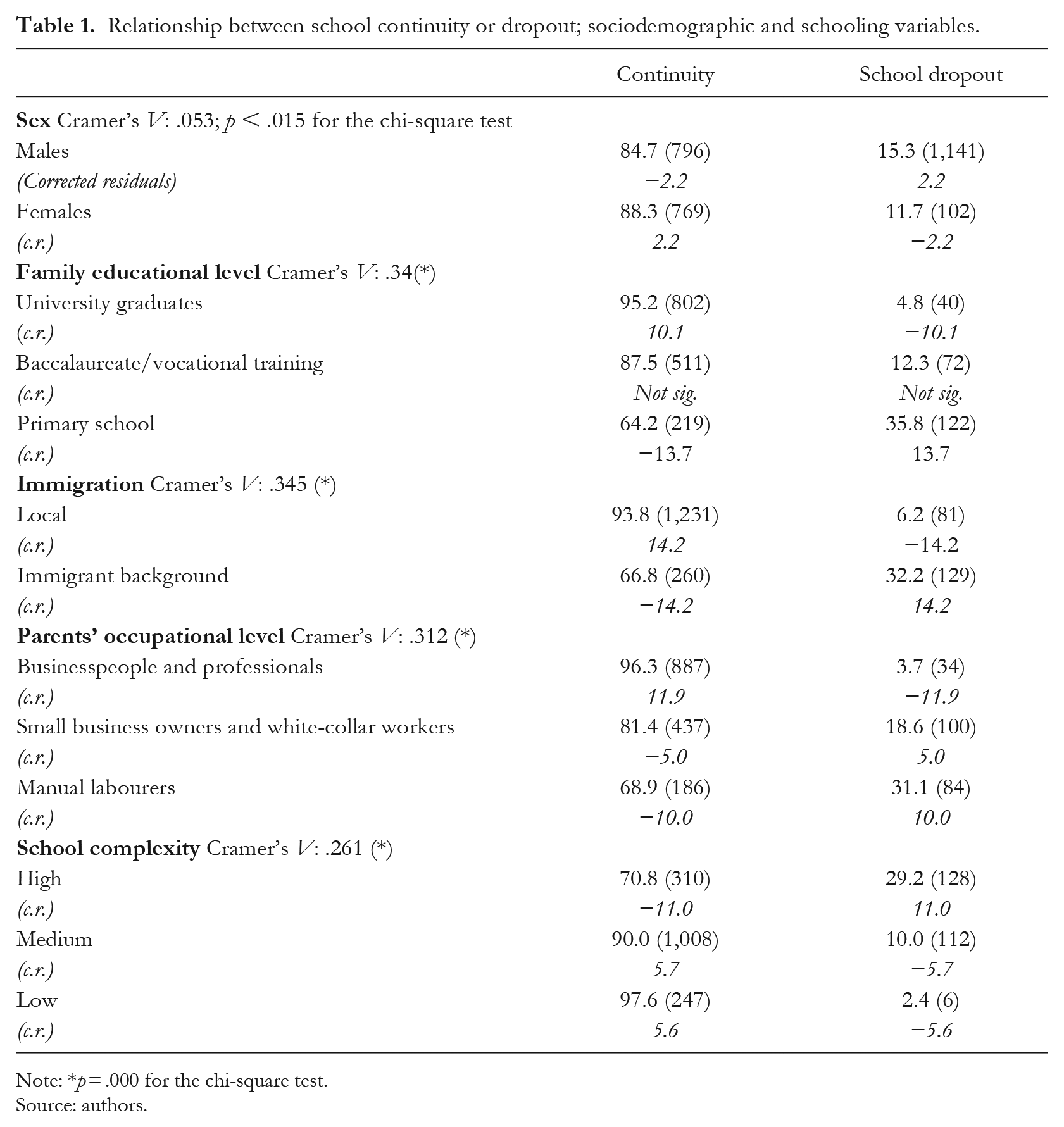
Note: *p = .000 for the chi-square test.
Source: authors.
Categories that articulate implicit self-stereotype
The discourse analysis shows the main self-stereotypical variations that appear in light of the causal explanations for dropout: biographical turning points and the illusion of decision, the lack of academic skills and the internalization of the meritocratic ideology, school as a social place, and studying as a determinant (or not) of economic success.
Biographical turning points and the illusion of decision
Discourses emerged regarding the reason for school dropout that attribute external explanations (with a structural origin: economic problems in the household, for example) as well as contingent explanations (pregnancy, problems with their own health or the health of a close family member). Both explanations sometimes operate together, as in the following quote:
I didn’t finish the middle grade because in the end I had family problems and had to leave because I had to go care for my father because he was ill (60503).
The vast majority of interviewees explained their dropout as the result of external factors that are beyond the individual’s control, regardless of whether they are random or structural. The factors leading to these biographical turning points prominently include migration, which is experienced as a rupture that aggravates social vulnerability in some school trajectories or in adolescence:
Well, a bit of everything, the change in country, because I came right on the verge of adolescence and so you really notice that sudden change. From coming from a stable family nucleus to coming alone with my mother, that affected me a lot (60308).
However, other youths also defended school dropout as a choice conditioned by the academic difficulties they had experienced, as well as by their prediction of difficulties or too much effort, which they are not willing to make, leading to a reinforcement of the implicit self-stereotype:
At first I was convinced that I wanted to do baccalaureate, but when I was in the third year I said, no, I don’t feel like it, because I saw that it was going to be hard so I chose not to do it (60503).
Lack of academic skills and the internalization of the meritocratic ideology
Internalization of the ideology of talent and the meritocratic discourse of the school system are revealed in the interviewees’ discourses, where they operate to justify the system, naturalize educational equality even at the expense of their own self-concept and contribute to reinforcing the negative stereotype of the ‘bad student’. Some of the youths’ explanations for dropping out has to do with their personal capacities and ability to study, while in general schools do not seem to be questioned, even when a great deal of school dropout has to do with the social inequality reproduced at schools (Sepúlveda & Opazo, 2009). Among these youths with a history of dropout, there is a kind of early notion of these difficulties, which in many cases is often confirmed by the teachers.
I could already tell back in primary school, and they noticed it and told me that they were going to give me a different curriculum (60402). I don’t think I’m made for university, or baccalaureate would not be right for me (61720).
The youths’ discourses also contribute to legitimizing the school, which appears as a good place with good experiences, as well as the teachers, whose work they acknowledge. In this sense, some interviewees expressed a kind of gratitude accompanied by a sense of guilt (self-blame) for not having followed their teachers’ ‘instructions’ (a ‘current maturity’ with which they empathize).
I think now that teachers never think badly about the students, but before I thought they did because my teacher told me what I had to do, gave me lots of homework, and now I realize they always did it for our own good. She did everything; if I don’t study she doesn’t care, she still gets paid at the end of the month (61720).
Thus, in the voices of students who have dropped out, teachers are seen as good professionals and collaborators, which positions the student in educational exclusion in their supposed ‘immaturity’, in the role of ‘bad student’.
School as a social place
Generally speaking, positive memories and appraisals of school predominated. It is accepted as a space for different kinds of learning, that is, not only cognitive but also relational, developmental and personal growth:
A school is where you begin to walk before you run. Before you run you have to walk. It’s a place where you are taught, where you leave behind your childhood as you grow and mature (60308).
From this we can glean that dropping out of school or having a history of leaving and going back diminishes educational opportunities. Completing school exceeds the normative conception of something that ‘one should do’, stressing the social appreciation of education and presenting absence as a personal shortcoming before society (Valdez et al., 2008)
I want to study again because studying comes first. Money or fame don’t matter, but people ask you, did you graduate from secondary school? And if you didn’t you feel embarrassed. Money isn’t anything if you don’t have an education, and people say if you have money it doesn’t matter, but the respect you have if you have studied is different (61304).
Studying as a determinant (or not) of economic success
One interesting finding that reveals the operation of mechanisms to defend self-esteem (by lowering cognitive dissonance) is a certain separation between economic success and education. Even though schools are appreciated in terms of their social role, their role as the only way into the job market is more questionable. Education is assumed to be a basic requirement, but it is not the only way to success: the defence of identity in this case is at a more personal level, articulating a stereotype of a kind of epic or overcoming adversity.
Education is often important, but really by now people I’ve seen and known, some even have a master’s and even that doesn’t get them a job. What matters is the experience they have (61304).
Discussion
Different elements stand out that converge in an individualization of the reasons for school dropout, while simultaneously rendering the structural aspects of unequal educational opportunities among the youths interviewed invisible.
On the one hand, the idea of decision in those who do not continue school and the lack of academic competences among those who leave and then go back into the system correspond to internal interpretations in attributional terms: there is no questioning of the system or the elements within their own biographical turning points. The subjects do not accept that they have been overwhelmed by situations and view themselves as having taken a decision, even though they were just children.
The interpretation that education is not a requirement for job success is also a manifestation of individualistic logic: success entails individual competences or even luck, but it is far from appearing in a collective project.
Among those who drop out of school and do not return, all of the above shapes a modern-day epic story, where having lost a relevant space with prominent people (teachers) in a favourable environment (school) enables them to articulate a shortcoming which is resolved with a story where they manage to overcome the loss, which operates as a compensatory mechanism. This story is common in social identity theories: people create strategies to maintain a positive self-image coherent with the notion of individualism.
Regarding the quantitative data, these showed how variables like gender and migration are related to dropout, even though none of the interviewees cited the influence of gender in academic success. Especially when asking them about migration, it was viewed favourably, and they stated that it brings cultural diversity. Therefore, this is yet another mechanism to overcome a negative social identity: redefining attributes.
The above reports on a group that seems to recognize themselves as migrants, and from this category they do not question the new system; instead, they have a grateful attitude towards it, even when the system discriminates against them.
In more extreme cases, the students see themselves as immigrants: a bad student who has also taken bad decisions. This self-image operates within the framework of a positive assessment of the school, with good teachers, so it signals wasting an opportunity. From there, the way they find to offset the loss, the debt, is with effort, perhaps extraordinary effort: the ideas of effort and sacrifice allow people to signify their suffering as an epic, where the effort legitimizes their current precariousness, maintaining the internal locus of control Figure 1.
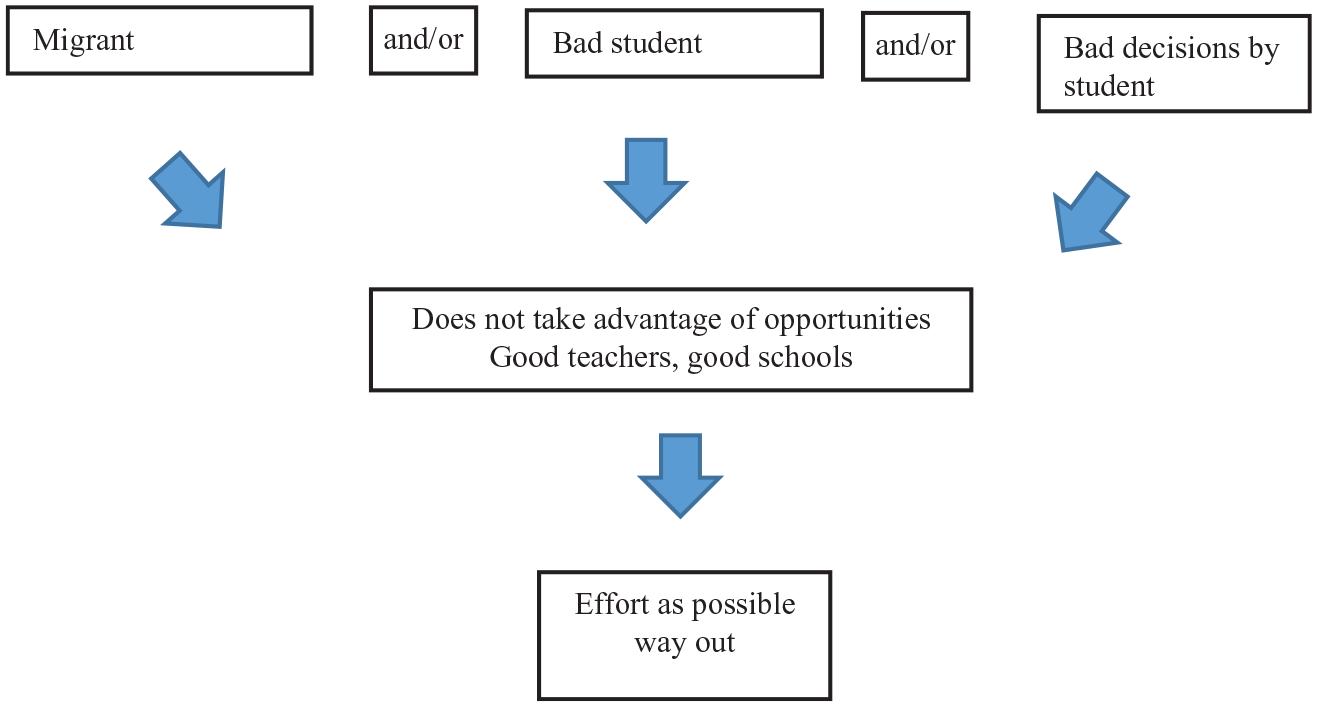
Implicit self-stereotype and its legitimizing nature.
Conclusions
School as a good place
Based on the emerging categories, it is worthwhile to analyse certain differences among the interviewees. Among those who did not continue studying, we can even detect the idealization of school: the teachers are viewed as well-intentioned people who achieved their life goals, as manifested in having studied and working in that field. In contrast, the dropouts who later go back do not have this idealization to the same extent; instead, they describe a school experience always on the verge of failure. In both cases, school is positively assessed, and primary school is generally viewed more positively than secondary, mainly because there is pressure regarding the future in the secondary that is not there in primary.
Reasons for dropout: between contingency, decisions and abilities
There are also differences between those who leave school and do not return and those who return: in the former we can detect some experiences of biographical turning points (stories about the death of family members, illnesses or depression). Even though there is awareness of this turning point, it is interesting to see that at that time the idea of choice prevails; that is, the interviewees end up attributing their dropout to themselves (Becerra & Reidl, 2015).
In the case of those who have experiences of leaving and going back to school, it is impossible to see a biographical turning point but instead a complex academic experience where the attribution is also internal, although here the explanation has to do with capacities or competences that do not accord with academic life.
Studying as a determinant (or not) of economic success
Even though it is assumed that schooling is an important factor which serves as a facilitator in the working world, the discourses analysed showcased work experience as a ‘compensatory’ factor for the absence of educational credentials and the value of vocational training as practical learning, associating success at work with a combination of effort and luck. This enables them to justify their work situation and the precariousness associated with their work histories.
Finally, the importance of school as a social place and source of respect is coherent with the literature available (Vargas & Valadez, 2016), so those who drop out exist with a sense of missing something, of social taint, an issue which is aggravated by viewing dropping out as an option. As Criado (1996) states regarding school dropout:
its consequence has been integration into the lower segment of the work market: minuscule salaries, long workdays, terrible working conditions, zero chances for promotion. All that contributes to producing a discourse of regret for the road taken, a discourse that, dominated by the legitimising theory—society in general—of meritocracy, ends up blaming them for their current condition. If they are being exploited, it is because they did not study (Criado, 1996, p. 250).
Final considerations
In summary, in accordance with Gómez and Vázquez (2015), the results of our study show how the majority of interviewees construct their personal and social identity mistrusting their own capacities, as they accept the meritocratic ideology inherent to the school institution and justify their educational exclusion in terms of choice. Our results thus contribute to identifying the categories that articulate the implicit self-stereotype of the ‘school dropout’, although future studies should further explore the influence exerted by teachers’ interactions with their socially vulnerable students in order to learn more about the construction of the implicit self-stereotype in school dropout, in line with the studies by Eble and Hu (2020). Another line of future research is the effect of the school, either its social composition or the organization of its curriculum. Regarding school composition, it has been found that schools with greater social complexity have a higher dropout rate, so it would be worthwhile to analyse whether discourses on negative self-stereotypes develop equally when peers belong to categories that are higher in the social hierarchy. The organization of the curriculum may also have an influence on the development of negative identities regarding ability in students who are put into less challenging academic pathways (Pamies & Castejón, 2015).
Likewise, we can identify several defence mechanisms or mechanisms to lower cognitive dissonance in the interviewees’ discourses, in accordance with Jost and Banaji (1994), which occur as the outcome of false consciousness.
Thus, in the interviewees’ discourses, individual choice operates as a mechanism to adjust the negative impact of their histories as dropouts due to the lack of academic skills. The emphasis on economic success outside of school in some discourses also contributes to mitigating the dissonance associated with the social value attached to education. In some narratives, we also detect an epic story about resilience or the ability to overcome adversity in the working world, thus disassociating economic success from academic success. Choice or individual decision when faced with adversity thus becomes a mechanism to adjust to the negative impact of school dropout by avoiding damaged self-esteem. These mechanisms also come into play in the consolidation of a discourse of social legitimization, the consolidation of the meritocratic logic of educational systems, according to system justification theory, concealing the close relationship between social inequality and school inequality, as well as the influence of the school environment on students’ educational careers.
The results of the research pose several challenges for guidance practices and devices at schools. The excessively individualistic approach of many of these practices could be modulated with a more structural approach that decodes the ideologies of talent and meritocracy, which could frame individual effort in a context of unequal opportunities and offer other materials for the positive construction of self-esteem.