




Abstract
Students’ well-being in China seems to be insufficiently researched. This article reviews the recent literature on Chinese students' well-being to illustrate the relationship that exists between mental health and education as well as to identify implications for improving well-being. Eighteen articles published between 2012 and 2022 were reviewed and selected according to a systematic protocol. It was found that the reviewed papers focused on 4 areas: analyses of well-being in the context of implications for the study process, analyses of students’ wellbeing in the context of various characteristics yet without direct implications for the study process, studies of well-being conducted among medical students and in relation to Chinese students studying abroad.
Introduction
For several decades now, terms such as “well-being” or “subjective well-being” have been growing in popularity in many scientific disciplines, particularly in the health and social sciences (Ruggeri et al., 2020). Well-being is considered by many researchers to be the basis for creating and maintaining healthy, productive societies (Das et al., 2020). There has been an increasing consideration of the concept in educational policies. There is a growing interest in how schools and universities support students' well-being and what factors affect this process (T. Cheng et al., 2021). According to conducted studies it seems that universities around the world are experiencing a decline in students' well-being (Riva et al., 2020). Entering college is associated with two important changes in a young person’s life - the transition from schooling to independent learning and the stepwise initiation of a more independent life, which can affect health and well-being (Alessandri et al., 2020). A variety of aspects related to learning and teaching at university can influence students' mental health and well-being positively or negatively, and conversely, students' mental health and well-being can influence their learning and teaching experiences (Jones et al., 2021). Research indicates that the mental health and well-being of college students is worse than that of non-students; moreover, mental health deteriorates after starting college compared to before the commencement of studies (Worsley et al., 2022). Requirements, workload, assessment policies and other aspects of studying are therefore important risk factors that can affect students' well-being and increase the risk of mental health problems (Jones et al., 2021). Examination and analysis of the university environment, in the context of teaching and learning, the experiences and relationships among students and between students and staff, and their relationship to students’ well-being, are essential for providing appropriate and timely assistance (Riva et al., 2020). The interest in well-being has also been observed in China, which, along with economic reforms and changes in national policy, has opened up to Western culture, including social research theories and methodology. However, there is concern that concepts and tools developed in the West, which are increasingly being applied to the study of the Chinese population, have limited reliability and relevance (Zhang & Norvilitis, 2002). According to Higgins and Zheng, it is necessary to take into account China’s ancient psychological heritage and traditional Chinese culture when studying and interpreting Chinese psychological phenomena and behaviour (Higgins & Zheng, 2002). Moreover, the use of Western-constructed self-report questionnaires based on the Likert scale in a Chinese cultural context may be doubtful due to differences in the perception of the concepts of “satisfaction” and “happiness” (Zeng & Kern, 2019).
The Concept of Well-Being and Its Dimensions Among Students
The concepts of well-being and subjective well-being derive from positive psychology, which focuses on issues related to human strengths and opportunities to improve them. The growth of interest in studying these phenomena has been particularly evident over the past 20 years, beginning with the establishment of positive psychology as a scientific discipline (Seligman & Csikszentmihalyi, 2000; Snyder & Lopez, 2002). The reason for the growth of interest in individual well-being was also a protest against so-called negative psychology, which dominated throughout the 20th century and focused on pathogenetic approaches, as well as the noticeable deterioration of social indicators in the most economically developed countries.
Although there is no consensus on a clear definition of the concept of well-being, it can incorporate key psychological dimensions, such as the presence of a positive emotional state and a positive attitude (Liddle & Carter, 2015) and the ability to make decisions and take responsibility for one’s own life achievements (Ager et al., 2015; Roscoe, 2009). Therefore, well-being seems to be one of the key constructs of positive psychology, whose basic assumptions, formulated by Seligman (2002), indicate the importance of describing an individual’s good life in terms of his or her strengths and the factors that foster them. In addition, more significant is how a person perceives and reflects on his or her life situation, that is, the subjective judgment of his or her well-being or, in other words, subjective well-being.
A sense of happiness and contentment are considered to be a very important life value by students from different corners of the world (Diener et al., 1995). Studies suggest that many factors influence students' subjective well-being (SWB). Among them are personal relationships, including social support from parents, friends and a life partner (Ratelle et al., 2013; Dixon Rayle & Chung, 2007). Students' satisfaction with university life is also clearly related to their academic performance (Chambel & Curral, 2005). Indeed, it turns out that a favorable work environment promotes satisfaction with studying, and thus influences productivity and improved academic performance (Cotton et al., 2002). Other strong predicators of students' subjective well-being are specific needs, especially those related to the ability to make choices and freely express oneself, to develop one’s passions and interests, to be successful, as well as satisfied needs for security in both the psychological and social aspects (Turkdogan & Duru, 2012). Hence, research reports involving students around the world demonstrate that a high sense of well-being translates positively into academic achievement, relationships with other people and overall health.
Cultural determinants of well-being
It is worth mentioning that any concept of well-being is culturally embedded. However, while well-being and happiness are assumed to be a universal experience, there are differences in their conceptualization between Chinese and Western cultures. According to Lu, in the Confucian tradition, social responsibilities are placed above the well-being of the individual. Historically, the Chinese, unlike Western societies, have been socialized to place the well-being of the community higher than the happiness of the individual (Lu, 2012). Consequently, well-being will be related not to an individual’s attributes, but to social relationships, performing social roles and fulfilling the responsibilities related to those roles. Therefore, socially rewarded attributes will be self-control, conscientiousness and concern for the collective good, rather than personal well-being as in Western societies (Lu & Gilmour, 2006).
Chinese researchers generally view well-being as subjective wellness based on traditional culture and values. They are also less likely to distinguish the term satisfaction from happiness than is the case in Western literature, due to the main philosophical concepts on which Daoism and Buddhism are based. In these concepts, individuals are not encouraged to have active desires or hedonistic emotions, as this would interfere with the achievement of a homeostatic state of life (in contrast to Western societies, which often reduce happiness to the fulfillment of personal needs and desires) (Lau et al., 2005). Furthermore, dialectical balance, i.e. viewing happiness and unhappiness as two sides of a coin, is vital in Chinese culture; a person does not pursue hyper happiness but rather seeks internal balance, which derives min from the Yin-Yang philosophy (Lu & Gilmour, 2006). As indicated by research in China, well-being is additionally associated with mental bliss and a sense of gratitude towards life, and is assumed to be of a more lasting and deeper nature. Additionally, the use of terms such happiness is impeded by the fact that there are a large number of terms and expressions available in Chinese that appear as representations of a single concept (Lau et al., 2005).
Well-Being of Chinese Students
Similar correlations to those described above can be noted for Chinese students, although the well-being of students in China does not seem to be well researched. It is worth noting that any concept of well-being is culturally embedded. Significantly, the word “happiness” has recently entered the Chinese vernacular, with the consequence that Chinese students are less familiar with the concept of happiness than their American peers (Lu, 2012). In addition, research indicates that while Chinese students score higher on international tests, they report lower levels of well-being than in other countries (Ling et al., 2022). One contributing factor is a strong culture of academic achievement. In China, the education received, symbolized by a university degree, particularly one from an elite university, is one of the most vital factors in social stratification, regardless of social background (Gromkowska-Melosik, 2017). As Zhao and co-authors note, academic competition and pressure for academic achievement are the result not only of tradition but of many social and economic factors. Among the most important are the unequal distribution of human and material resources in education, competition among college graduates for positions in white-collar sectors, the lack of a well-functioning social security system, or the vast income disparities associated with education (Zhao et al., 2015). School and academic success is therefore of immense importance to the future of the student and his or her family, resulting in enormous social and psychological pressure. On the other hand, as the authors note, China’s education system that relies on external indicators of academic success educates students who are uncreative and insecure (Zhao et al., 2015).
Aim
The purpose of this article is to review the contemporary literature (covering the years 2012–2022) on the topic of the relationship between subjective well-being and the study process of Chinese students. The review was guided by the following research questions: • What does the research literature suggest about the relationship between subjective well-being and the study process of Chinese students? • Which areas were the articles subjected to qualitative analysis focused on? • What methodological approach was applied to study the relationship between subjective well-being and the study process of Chinese students? • What factors may be predictors of Chinese students' well-being in the study process? • What are effective ways to promote Chinese students' well-being in the study process?
Methodology
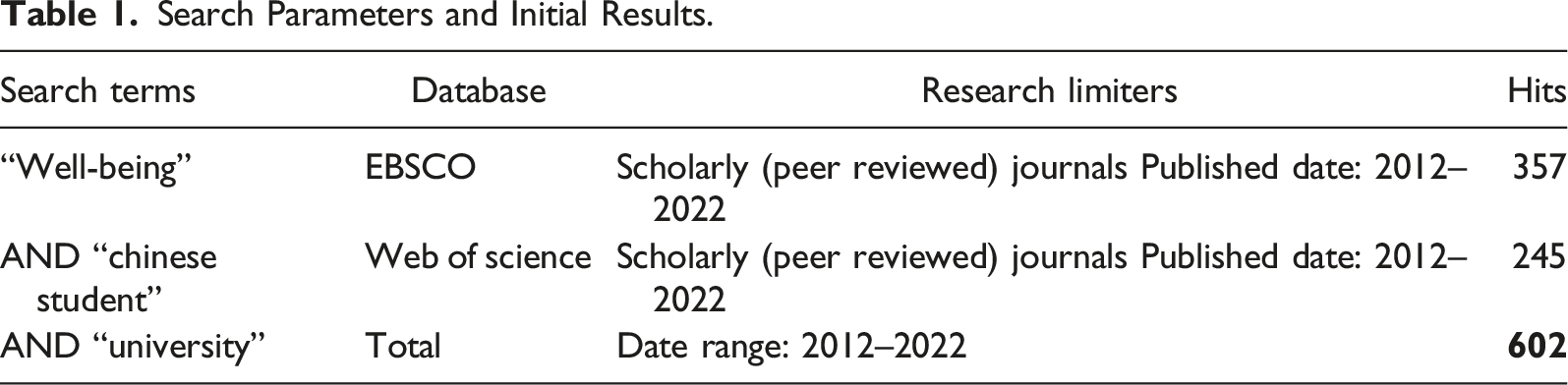
Search Parameters and Initial Results.
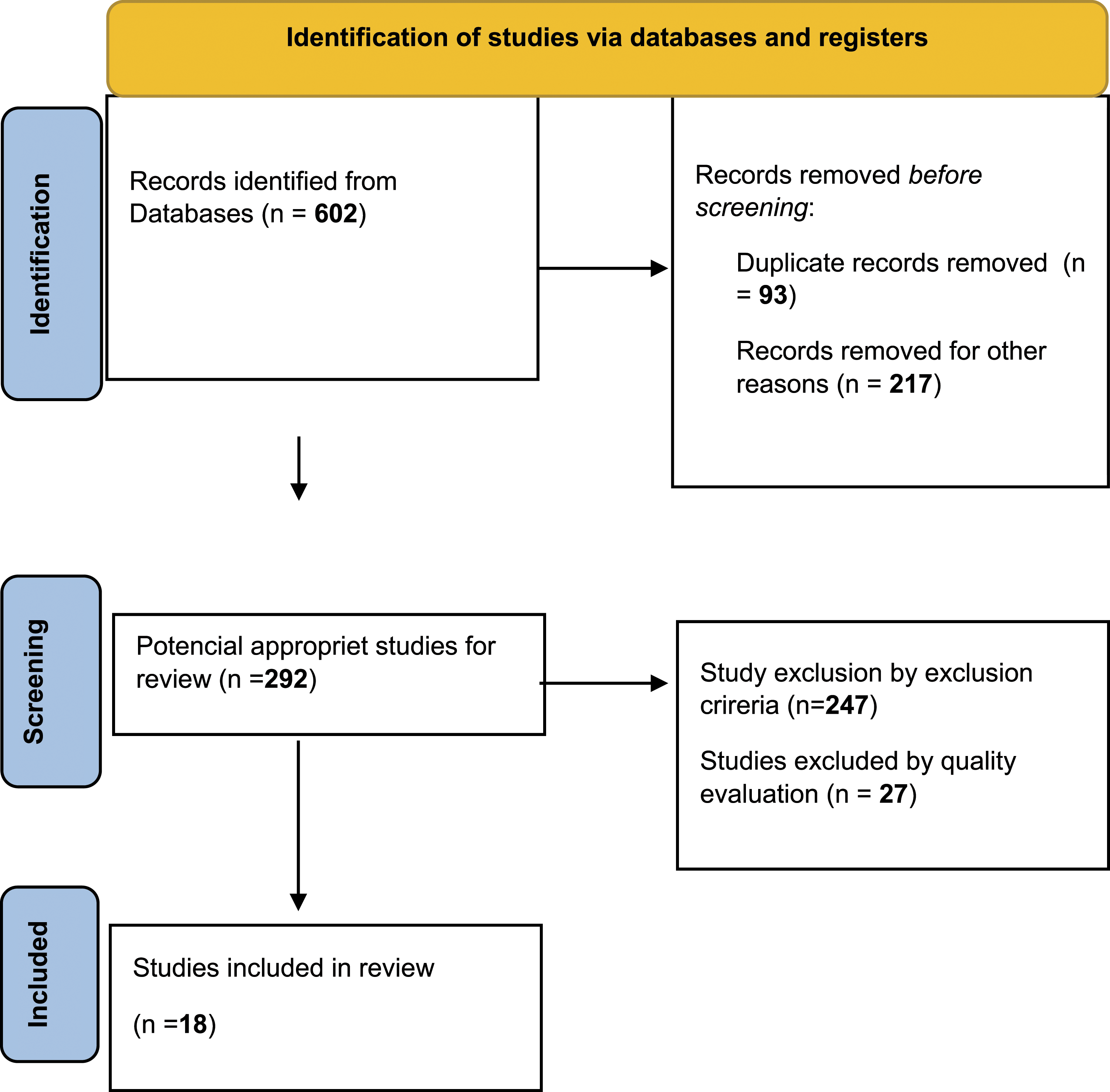
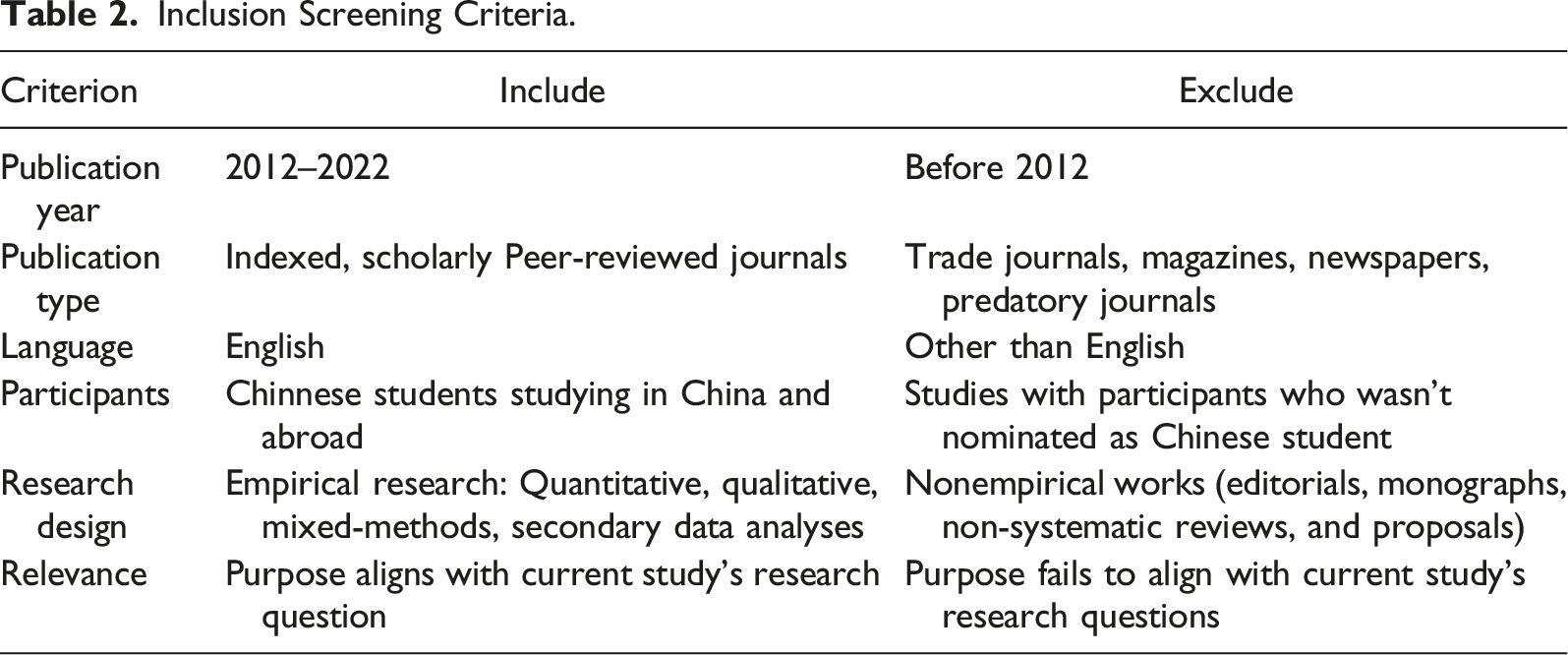
The selection process is shown as a diagram in Figure 1. The screening criteria are shown in Table 2. The targeted selection of articles from the initial list of studies for possible inclusion: 1. Studies published in English between 2012 and 2022 were retained. 2. Papers published in scientific journals were retained; those published in non-indexed or predatory journals, professional journals, and magazines were discarded. 3. Since the current study focuses on Chinese students, studies on Chinese students studying in China and abroad were retained. 4. Only empirical research (qualitative, quantitative and secondary data analysis) was retained. Article selection flow diagram. Inclusion Screening Criteria.
Quality Assessment
In order to assess the quality of the analyzed articles, the quality criteria developed by Muller, Rinn and Kettler (Mullet et al., 2017) were used. Six of the nine criteria proposed by the authors were used for this purpose: I Objective, II Participants, III Methods, IV Results,V Conclusions, VI Relevance. Each criterion was rated on a 4-point scale, where 3 = exemplary, 2 = acceptable, 1 = poor, 0 = unacceptable.
Data Collection and Analysis
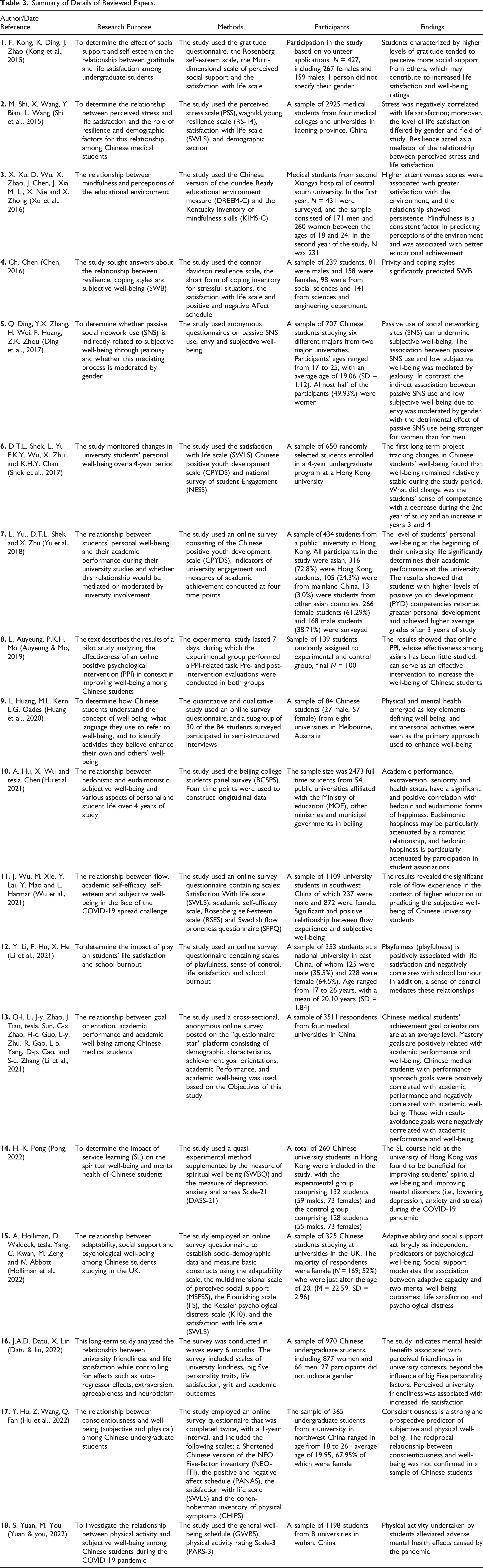
Summary of Details of Reviewed Papers.
Results
Out of 18 articles selected for analysis, 17 were concerned with quantitative research, while one text was of quantitative-qualitative research. It was found that the analyzed papers focused on four areas: analyses of well-being in the context of implications for the study process, analyses of students' well-being in the context of various characteristics but without direct implications for the study process, well-being studies conducted among medical students and in relation to Chinese students studying abroad.
Methodological Approaches Used
Different methodological approaches were used in the analyzed articles - quantitative and mixed methods. In six of the texts analyzed, the researchers presented the results of long-term studies, conducted over a longer period of time, from 2 to 4 years (during the study period of the subjects) (Datu & Lin, 2022; A. Hu et al., 2021; Y. Hu et al., 2022; Shek et al., 2017; Xu et al., 2016; Yu et al., 2018). One text employed experimental research with the aim of evaluating the effectiveness of positive online psychological intervention (PPI) in the context of well-being (Auyeung & Mo, 2019), as well, one text presented the results of research conducted in a quasi-experimental design determining the impact of service learning (SL) on spiritual well-being and mental health (Pong, 2022).
Well-Being in the Context of Implications for the Study Process
The reviewed research suggests that levels of well-being among Chinese students are stable and do not change significantly throughout the study period, despite changes in perceived competence and academic engagement. A decrease in the perceived level of competence is observed in second-year students, which may be related to the numerous changes experienced (educational, social and emotional demands of higher education) during the first year of study, while an increase in competence is noted in the third and fourth years (Shek et al., 2017). In addition, the level of well-being at the beginning of the study positively predicted students' personal development and academic performance in subsequent years (Yu et al., 2018).
In the studies analyzed, the authors sought answers about the relationship between well-being and traits such as resilience, coping styles (Chen, 2016), flow (Wu et al., 2021), playfulness (Y. Li et al., 2021), kindness (Datu & Lin, 2022) or conscientiousness (Y. Hu et al., 2022).
A significant and positive correlation was found between well-being and academic performance, extraversion, seniority and health status (A. Hu et al., 2021). Mental resilience and problem-oriented coping styles can have a direct impact on students' subjective well-being. A task-oriented coping style promotes evaluating a problematic situation without emotional involvement, seeking information in order to best solve it, and the ability to adapt to functioning under changed conditions, so the use of this strategy by students with lower levels of psychological resilience increased life satisfaction (Chen, 2016).
Flow appears to be one form of pursuing happiness through engagement. The experience of flow had a significant positive impact on students’ well-being and together with a higher sense of self-efficacy at university was associated with greater academic progress (Wu et al., 2021). Playfulness and fun, formerly seen as a waste of time, are now considered a positive contributor to the human experience, promoting mental health and well-being. Li and team’s research on the rarely addressed topic of university students’ playfulness showed that it was associated with a higher sense of control, which increased students’ perceived life satisfaction and acted as a protective factor against school burnout (Y. Li et al., 2021). Conscientiousness, on the other hand, is a personality trait responsible for resisting desires and impulses and self-control. It is associated with the process of actively planning, organizing and executing tasks as well as with reliability and a responsible approach to duties. In Hu and team’s study, conscientiousness proved to be a solid and prospective predictor of subjective well-being. Promoting the development of this trait among students with low conscientiousness can help improve physical and mental health (Y. Hu et al., 2022).
The Pong study analyzed the impact of service-learning (SL) on the spiritual well-being and mental health of Chinese students. Service-Learning is a form of teaching and learning that combines social engagement of learners with learning related to various subjects. Learners are then engaged in activities for the common good in a variety of spheres: social, political, environmental or cultural. This form is often implemented in colleges. Participation in SL has been associated with improved spiritual and psychological well-being among Chinese youth and positive changes in students' intrapersonal, interpersonal and social levels (Pong, 2022). Auyeung and team’s study, on the other hand, examined the effectiveness of Positive Psychological Interventions, or activities aimed at improving well-being, focusing on using an individual’s positive emotions and strengths. Although originating in Western countries, PPI proved to be useful for Chinese students. By enhancing well-being, PPI reduced depressive symptoms and caused an increase in positive affect and autonomy (Auyeung & Mo, 2019).
Well-Being of Medical Students
Medical studies are considered one of the most stressful majors, consisting of long study hours, frequent examinations, and high demands and pressure to perform well on exams (Rong et al., 2021). Among the texts analyzed, three of the articles addressed the issue of well-being of medical students (Q. L. Li et al., 2021; Shi et al., 2015; Xu et al., 2016). The study found that students in younger years, women, and students in longer (7-year) curricula were characterized by a higher perceived sense of well-being. The result was attributed to the greater number of stressors faced by older students (seeking a highly competitive job) and men (who face more pressure than women in Chinese culture). High perceived stress was associated with lower mental toughness, contributing to lower levels of life satisfaction (Shi et al., 2015). In addition to demographic factors, the effects of goal orientation and mindfulness on students' well-being were also studied. Goal orientation among medical students reduces feelings of stress and is associated with the use of active learning strategies promoting high achievement. Mastery goal orientation, or ability development, was, in contrast to other types, positively associated with both academic performance and well-being (Q. L. Li et al., 2021). High mindfulness in students was associated with greater satisfaction with the educational environment and this relationship was persistent which plays a crucial role as the climate of the educational environment is linked to academic performance and well-being (Xu et al., 2016).
Well-Being of Chinese Students Studying Abroad
From among the texts analyzed, two papers addressed the issue of well-being of Chinese students studying abroad (Holliman et al., 2022; Huang et al., 2020). Foreign students are more likely than other students to experience low well-being and mental health problems due to cultural differences and language problems. Huang and team’s study focused on Chinese students' understanding of the concept of well-being, as the word well-being does not directly appear in Chinese. Chinese foreign students defined well-being as a category consisting of mental and physical health, safety, social relationships and prosperity, where well-being was viewed through the lens of what a person does (career or hobbies), while low well-being was associated with emotions, what people feel. In addition, Chinese students showed acceptance of pressure as a motivator and negative emotions as an inherent part of human life. In terms of actions to promote well-being, the respondents pointed primarily to intrapersonal rather than interpersonal actions, suggesting that the Chinese view responsibility for maintaining well-being in individual terms (Huang et al., 2020). In the study conducted by Holliman et al. adaptability and social support were useful in protecting against experienced current and future stress, and the relationship between adaptability and perceived psychological well-being was stronger when social support was higher. Programs aimed at supporting international students should therefore focus on developing capacity and building social support networks (Holliman et al., 2022).
Studies on Well-Being in the Context of Various Students’ Characteristics and Activities
Another three of the texts analyzed presented research on the relationship between various characteristics of young people, as represented by students, and well-being (Ding et al., 2017; Kong et al., 2015; Yuan & You, 2022). Yuan and You indicated that physical activity can alleviate the negative psychological effects caused by the Covid-19 pandemic. In their study, students who engaged in physical or athletic activities showed better psychological well-being, higher life satisfaction and better control of emotions and behavior. The authors noted the particular importance of physical activity in alleviating stress for senior students, who face more pressure to graduate and seek employment than other students (Yuan & You, 2022). Kong and team’s study analyzed the relationship between perceived social support, self-esteem and gratitude and life satisfaction in emerging adults represented by undergraduate students. The results showed that subjects with higher gratitude scores perceived the social support they received from others as higher (in comparison to those with lower gratitude scores), which was associated with higher life satisfaction scores. Respondents' self-esteem appeared to be a mediator between social support and life satisfaction. In addition, women were characterized by higher gratitude scores than men (Kong et al., 2015). In contrast, Ding and team’s study sought answers to whether passive use of social networking sites (SNS) is indirectly related to subjective well-being through envy. The study showed that envy was an important mediating factor between passive usage of social networking sites (SNS) and subjective well-being. In addition, this effect was stronger for women, which could be related to greater awareness of interpersonal processes or responding to feelings of envy according to traditional social norms of being tough by men and emotionality in women (Ding et al., 2017).
Discussion
For the past decade or so, there has been an increased interest in studying mental health issues in higher education. Given the importance of well-being in the student population, it has become important to know which factors may be the predicators of well-being and how to design interventions to enhance it. The following were identified among the predictors of Chinese students' well-being in the study process: adaptability, social support, playfulness, experience of flow, physical and mental health, stress resilience, job burnout, mindfulness, coping styles, psychological support, gratitude. Analysis of the relationships between the aforementioned factors and subjective well-being, also revealed effective paths of approach towards promoting the well-being of Chinese students, as will be discussed further.
The first years of study are associated with an accumulation of stressors (Cobo-Rendón et al., 2020) and, as a result, well-being levels need special protection when students enter university (Bewick et al., 2010). The studies cited in the text indicate that universities should implement programs aimed at first-year students to facilitate their adaptation to new conditions and requirements (Shek et al., 2017).
Students' coping strategies and mental resilience examined in the texts analyzed are important for adaptation processes since they are related to appropriate responses in stressful situations, reduce inappropriate emotional reactions, promote positive mood and increase life satisfaction (Lacomba-Trejo et al., 2022). Playfulness has only recently been studied in the context of adults. It is believed to mediate the process of coping with stress because it promotes the reformulation of stressful situations in ways that facilitate flexibility, reduce perceived stress and improve resilience (Clifford et al., 2022). The experience of flow is also associated with student well-being, as many studies conducted on non-Chinese populations have also confirmed. From the perspective of university education, it seems essential that students have the opportunity to experience flow in their studies, as it is a pleasurable state associated with better performance and overall well-being (Olcar et al., 2021). In Chinese culture, conscientiousness is seen as a value. Higher students' conscientiousness is associated with more positive mental health and adaptive coping skills. Research on British and Norwegian students confirms the link between high levels of neuroticism and low conscientiousness and poor mental health (Askell-Williams et al., 2018).
Increased awareness of professional burnout, depression among doctors, and mental health problems beginning during their college years has focused researchers' attention on the mental well-being of medical students (Chatterjee et al., 2022). According to research, medical students are more likely to suffer from mental illness, substance abuse and professional burnout compared to other students (Klein & McCarthy, 2022). Additionally, in China, the observed deteriorating doctor-patient relationship, violent incidents committed by patients in medical facilities, and medical-legal disputes constitute stress factors (Rong et al., 2021). In the studies analyzed, resilience and mindfulness were associated with reduced stress and more positive perceptions of the educational environment which in turn was associated with higher well-being. This information should be used to formulate programs involving the development of these traits in students to improve life satisfaction. In addition, medical students, as a particularly stressed group, should be provided with more psychological support during their study period (Shi et al., 2015).
In recent decades, the demand for Western higher education among Chinese has increased, as it provides a source of accumulating cultural capital, enables one to get into a prestigious university, and increases employment and migration opportunities (M. tesla. Cheng & Agyeiwaah, 2022). However, international students are a high-risk population. Studies indicate that international students of Asian origin are less likely to seek help for low well-being and mental health problems. Cultural factors, including Taoism, are significantly associated with tendencies to keep emotions inside and accept difficulties, as well as to rely on themselves in situations of academic stress (Magnusdottir & Thornicroft, 2022). The findings in the texts reviewed suggest the need to be culturally sensitive when promoting well-being in different populations and in the interventions designed.
Regarding gratitude, many studies have found a relationship between gratitude and a sense of overall well-being, and the importance of gratitude training in improving psychological well-being and feelings of happiness (Behzadipour et al., 2019). One theory explaining this relationship indicates that gratitude may be an emotion related to self-acceptance. Accordingly, gratitude interventions allow people to improve their self-concept (Rash et al., 2011). The gender differences in feeling gratitude demonstrated by Kong, and the team, i.e. the higher scores obtained by women may be related to men’s perception of gratitude in terms of weakness. The resulting gender differences most likely reflect Chinese traditional perceptions of social roles (Kong et al., 2015).
Limitations
It should be noted that only 18 articles were qualified for the review, so generalizing the results obtained to a broader scale must be treated tentatively. The search for papers included only two databases, so it is possible that further research papers published elsewhere were not included. Only papers in English were included, which limited the number of studies reviewed and reduced the possibility of obtaining a truly global perspective. It is worth noting that happiness is constructed very differently in East Asian cultures, and therefore for some of the concepts and tools, the Western vision of well-being and personal happiness is not compatible with the perspective of Asians (Lu & Gilmour, 2006).
Conclusion
This review analyzed 18 papers published in English in peer-reviewed journals between 2012 and 2022. The texts analyzed pointed out the relationship of well-being with traits such as resilience, coping styles, flow, playfulness, friendliness or conscientiousness. The special situation of medical students and students studying abroad was also pointed out. The implications of the various findings for student well-being are described.
Footnotes
Declaration of Conflicting Interests
The author(s) declared no potential conflicts of interest with respect to the research, authorship, and/or publication of this article.
Funding
The author(s) received no financial support for the research, authorship, and/or publication of this article.