




Abstract
Needs analysis for language courses has to be carried out continuously to keep up with global changes and the needs of learners. This mixed-method study aims to describe the subjective and objective needs of the Mandarin learners in Universiti Malaysia Sarawak (UNIMAS), Malaysia, and to check if these needs correspond with each other. Targetting at 120 learners and two instructors, a questionnaire survey was distributed, and complemented by qualitative data derived from focus group interviews. Result shows that learners’ subjective needs correspond with objective needs for motivational orientation, textbook, and cultural exposure. Statistically insignificant differences were found in the expected skills to learn, lecture-activities ratio, and teaching-learning activities. The study concludes that flexibility, student-centeredness and practicality are elements to look into for course improvement. Future research can explore learners’ needs in mastering writing skill, as well as the needs differences among learners across different levels. The study complements the understanding and knowledge of needs analysis in regard to Mandarin learning outside of China.
Background
While America and Europe were suffering from global financial crisis about twelve years ago, China started to emerge gradually as the new world economic centre (Pennycook, 2010), and surpassed Japan to become the world’s second largest economy in 2011, after America (Rose, 2016). As China’s presence has increasingly been seen relevant worldwide, Mandarin Chinese is undoubtedly becoming a language that gains significant attention, with individuals having the language proficiency are highly sought after. Economic globalisation has hence translated into an increase in the teaching and learning of Mandarin (Lam & Kuan, 2019), in which global citizens can witness the language been officially brought into the national education system of 69 countries: more than 2.8 million of people are learning Mandarin in America; more than 5200 and 1700 Mandarin classes are offered in the United Kingdom and Thailand primary and secondary schools, respectively; and the elevation of Mandarin from the third foreign language to the second in countries such as Korea, Australia, dan Indonesia (Xinhuanet, 2019).
The growing interest in the teaching and learning of Mandarin calls for effective instruction of the language. With the field of teaching Mandarin to foreigners in China starting to flourish following its systematic development since 1978 (Li, 2006), it is a common practice for Mandarin-teaching institutions as well as instructors in the overseas to refer to the teaching pedagogies, materials and instructional resources developed in China in carrying out their teaching tasks. However, to ensure effective instruction of the language, one of the stumbling blocks that still haunt overseas instructors are learners’ diversified needs and motivation, since research about Mandarin learners in the overseas are still lacking (Wang, 2018; Zhao, 2016; Zhao & Lin, 2012).
It is important to analyse and study the needs of Mandarin learners to ensure effective instruction of the language. Needs analysis first appeared in the 1920s (West, 1997), and started to gain popularity about fifty years later especially in the area of English for Specific Purpose, and employs approaches such as introspection, interview, observation and questionnaire to obtain insights on the needs of the target being studied (Li, 2014; Ni, 2007). There are a number of definitions given to needs analysis. One early definition by Nunan (1988) is that, needs analysis serves as the starting point for syllabus or curriculum design. His definition was improved by Berwick (1989), with the addition of material selection, assessment, and classroom activities, alongside with the design of curriculum, all of which are crucial for decision planners in designing a course. Brown (1995) perceived needs analysis as the systematic process of all subjective and objective information gathering and analysis, which meet the language learning requirements of learners within a particular institution. It can be observed that needs analysis is learner-oriented because their perspective is prioritised. Taking learners’ needs and perspective in consideration is crucial when designing a course because it can ensure the instructor and learners are on the same “frequency” throughout the teaching and learning process, namely, instructor knows what the learners want and how best to deliver course content, and learners know their needs are properly heard. Given its importance as such, needs analysis are well-received in designing any language course (Dudley-Evans & St John, 1998; Finney, 2002; Seedhouse, 1995).
Needs analysis for language courses has to be continuously done so that the course keeps up with global changes and changing needs of learners. Even a time-honoured course requires an on-going monitoring mechanism to ensure the content is still relevant and responsive to the learners. As such, scholars (for example, Huang; 2014; Li, 2014; White, 1998) generally agree that, if deemed necessary, needs analysis can be performed any time during a language course, or when the course is still being offered. It helps the instructor to have a clearer picture as of what do the learners still need and wish to gain in the later part of the course, besides setting a benchmark to review and re-evaluate the existing course (Li, 2014).
The “needs” in needs analysis can be divided into different classifications, one of which is seeing it as comprised of objective needs (ON) and subjective needs (SN) (Brindley, 1989; Hutchinson & Waters, 1991; Robinson, 1991; Romanowski, 2017). ON, according to Brindley (1989), are those that are observable, and “derived by outsiders such as … Teachers” (Romanowski, 2017, p. 150), such as the learners’ language use and level of proficiency, the learning situation, the perceived language difficulties, how they need to use the language in genuinely communicative contexts etc., whereas SN are not easily observed and appear to be more complicated since they deal with the affective/wishes and cognitive/expectations of learners (termed as “insiders’ perspective” by Romanowski, 2017, p. 150). Examples of SN are the learners’ personality, self-confidence, learning strategies, and self-esteem during the learning process. In a broad sense, “needs” in a learning environment can be viewed from instructor’s perspective on one hand, and learners’ perspective on the other.
Previous studies reveal that learners’ problems can be better catered for if needs analysis were carried out. Gan et al. (2021) looked into how undergraduates in a public institution in Malaysia approached studying Mandarin as a foreign language. The findings showed that, in general students were motivated both integratively and instrumentally, but tended to be more attuned to attitude-based motivation. The students’ sources of attitudinal motivation for learning Mandarin were more likely to be teacher-specific than course- and group-specific. The study provides insights regarding how teachers can boost students confidence. In their study examining Mandarin students’ attitudes and perceptions of learning through video, Ju and Mei (2020) found that students were able to learn Mandarin vocabulary and sentence structures while also improving their speaking and listening abilities by utilising animated videos. The study helps teachers to change their conventional mindset and opens up another alternative in helping students to learn better and easier. In supporting Ireland’s latest strategy for Mandarin language education, Wang et al. (2019) looked into the needs of initial Mandarin learners and their teacher. Even though the communication opportunities for Mandarin are lacking in Ireland, the study identified opportunities for meaningful communication and cultural learning that are helpful for students when they employ digital technology to learn the language. Also aiming at serving students better, a needs analysis study done by Biduri et al. (2018) in exploring the effectiveness of reading materials used in Chinese Language and Culture study program of Darma Persada University reveals that, by incorporating traditional Chinese folklore in their teaching and learning process, students’ learning outcome has been elevated. The context-based reading material in Mandarin has also encouraged the students to be more active during the teaching and learning process. Meanwhile, Zhang (2018) employed questionnaire survey to study on the needs of Chinese and non-Chinese learners. The study shows that as differences exist in terms of learners’ motivation, teaching and learning activities, instructional tools used, teaching materials and instructors’ roles, flexible approaches can be used when facing with learners from different backgrounds. Wang (2019) is another study that, though not directly related to needs analysis, looked at teachers’ and students’ perception on the use of multilanguage in a Mandarin classroom. The results show that there is a need among the students to have their teacher accommodate multilingualism in classroom, in achieving a better and creative learning experience for the students.
Needs analysis is of course inclusive of other languages and disciplines. For example, Poedjiastutie and Oliver (2017) found that despite the English for Specific Purpose program has been taught for 22 years in their target university, students could only master minimal English proficiency. Needs analysis reveals that it was due to the limited opportunities for them to develop oral communication skills. Sung and Tsai (2013) found that roughly fifty percent of their respondents aimed to develop their career in the business field. The results of their needs analysis indicate that the main skills needed to help achieve these goals are listening and speaking skills. Findings as such have convinced scholars and researchers to employ needs analysis as a valuable tool in terms of continuous course development and a linkage between learners’ performance and their future needs.
Research Questions
The 3-level Mandarin proficiency courses in Universiti Malaysia Sarawak (UNIMAS),
Malaysia, are designed to gear towards communicative purpose. Although standard
academic procedures such as continuous quality improvements and curriculum
reviews are conducted regularly, learners and instructors’ voices might
not be fully heard, especially in terms of checking whether the learning needs
are perceived in a similar way by learners (SN) and instructors (ON). As such,
the study was conducted to answer the following research questions: 1. How do the
Mandarin learners and instructors in UNIMAS perceive the learning
needs of Mandarin learners? 2. How do
the learners’ SN and ON correspond to each
other?
Methodology
For the purpose of this article, analyising the needs of learners from the learners’ perspective is SN analysis, while analysing learners’ needs from the perspective of instructor is ON analysis (Arsiyana, 2019). More specifically, the ON analysis in this study focussed more on what the instructor is already implementing in the classroom, instead of what is yet to materialise.
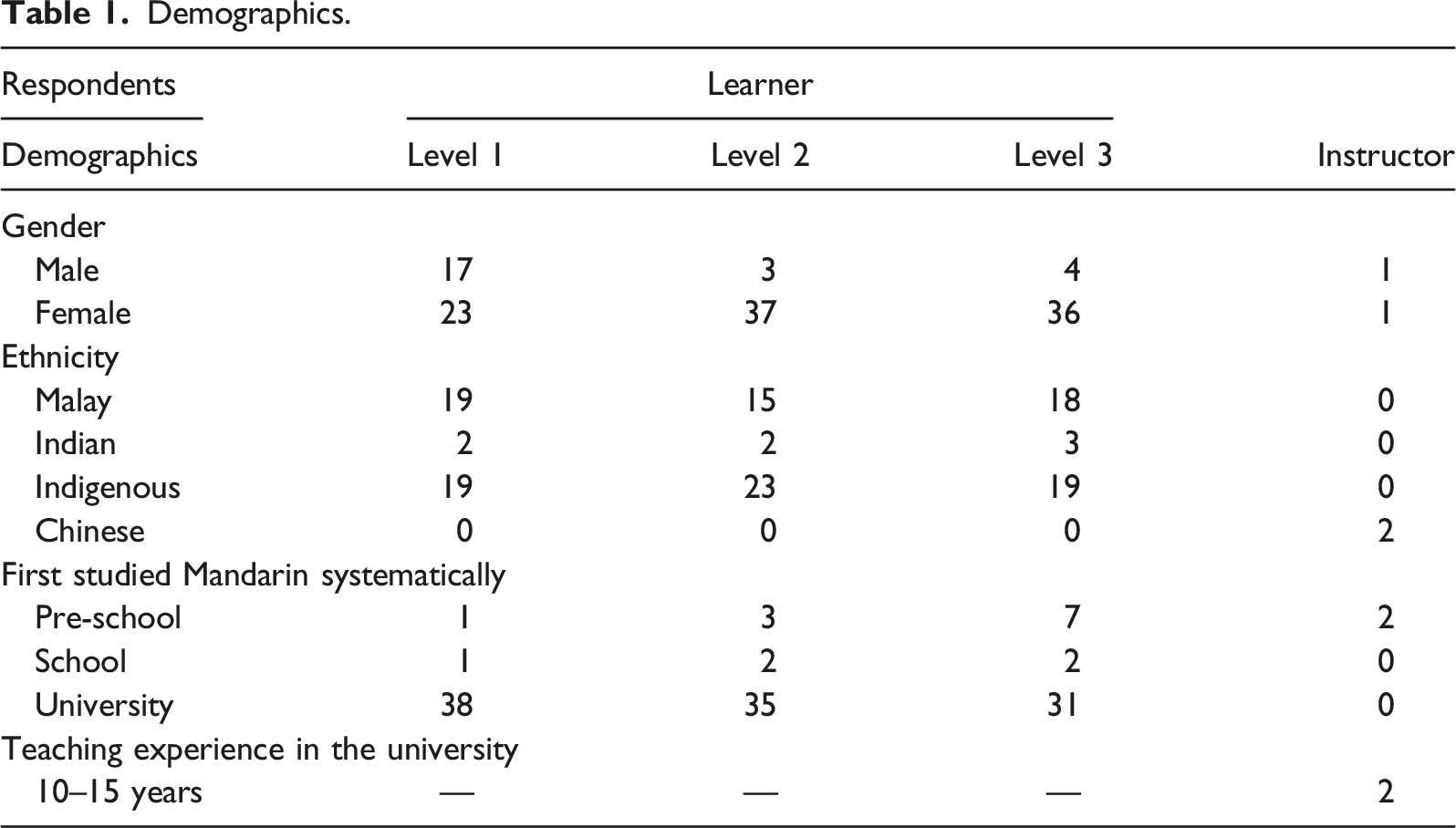
The research was carried out in UNIMAS. A mixed method approach was used, which involved a questionnaire survey (adapted from Wang, 2018; Xu & Moloney, 2014; Zhang, 2014) and series of focus group interviews. Data was collected from 120 Mandarin learners and the only two Mandarin instructors teaching all three levels of the course. The limitation of having only two instructor respondents was overcome by counter-checking their responses with interview feedback.
The questionnaire for learners and instructors shared the same sections (motivational orientation, expected skills to learn, textbook, cultural exposure, and classroom activities), except for the demographics. There were three types of questions in the questionnaire: respondents were either requested to choose from a range of 1–4 (1 for “strongly disagree”, 4 for “strongly agree”), rank the items provided, or provide single response. The results were analysed descriptively and statistically.
Fifteen learners (selected via stratified random sampling; five from each level) and both instructors were then invited to participate in separate focus group interviews. In total, three focus groups for learners were formed according to their level (Level 1, 2 and 3), and another separate group was formed for instructors. Learners of different levels as well as instructors were not grouped together to eliminate the potential influence or conflict of interest among them. Similar questions to the questionnaire (open-ended) were asked in the interviews to enable explicit parallel, deeper exploration of respondents’ perceptions. Each interview lasted for 45–60 minutes. The interviews were recorded and transcribed in regular orthography. Respondents were referred according to their level and number allocated in the interview. For example, S2-3 (learner of Level 2, respondent 3) and T3-1 (instructor of Level 3, respondent 1). The analysis of interview data were guided by Braun and Clarke’s (2013) thematic model, in which the transcribed data were re-read repeatedly for three weeks for familiarisation, followed by inductive coding process, themes identification, themes review, themes defining, and final write up.
Findings
Demographics.
Motivational orientation
Motivational orientation.
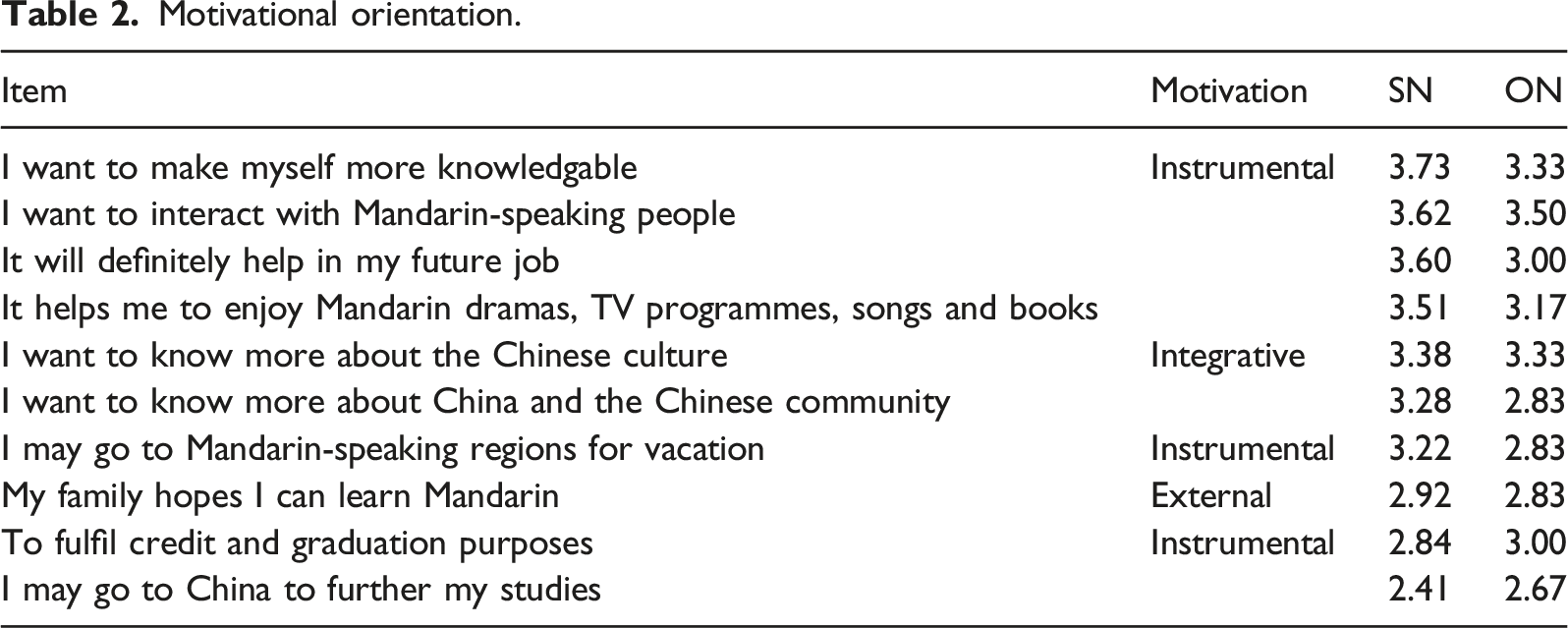
In terms of instrumental motivation, they prioritised on adding own’s
value, communication, job seeking, entertainment, and going for vacation, rather
than study-related purposes – a trend that is also found in
other previous studies (Lanvers, 2018; Li & Diamantidaki, 2021). In the interview, a few learners
clearly exhibited their interests towards entertainment and how Mandarin could
fit in (all excerpts had been slightly edited for fluency; meaning
intact): I prefer to learn through entertainment, because,
like when you do something that you love and enjoy, the learning process
is much easier. So for now, the youngsters like me, we love to watch
Chinese drama or listening to the latest hit Chinese song. So from then
we learn to recognize a few words in Mandarin and then like we are
growing our vocabulary so through entertainment it make me learning the
language. (S1-2) Because I love K-Pop,
the Korean, but they also have Chinese pinyin so I always study the
lyric. They have a Chinese song so I always listen to the song and then
study the lyric… (S3-1)
As for the instructors’ responses, despite not showing obvious difference,
they underestimated learners’ inclination to know about China and the
Chinese community, as well as going to Mandarin-speaking regions for vacation,
while overjudging learners’ decision to take Mandarin to fulfil their
credit requirement. Instructors’ overall responses aligned with the
learners’, though they were more reserved on the statement which claimed
that learning Mandarin would definitely help in learners’ future job. In
this regard, instructors’ feedback in the interview suggested that they
viewed learners’ expectation and the reality in a relatively logical
manner: Students can gain useful language skills in the
class… because it expands to situations revolving their daily
life, such as asking for direction, and describing physical features of
somebody. In terms of job application, the usefulness maybe still
limited because unless students proceed to Level 3, they have not really
learnt how to perform in job application scenario. Most students stop at
Level 1 or 2. They should be able to introduce themselves in basic
sentences, like tell what they like, but not so much on working context.
(T3-1)
The chi-square test of independence performed to examine respondents’ perceptions of learners’ motivational orientation showed that no significant differences were found between learners’ and instructor’s perceptions of motivational orientation, x2 (2, N = 122) = 3.85, p = .25.
Expected skills to learn
Expected skills to learn.
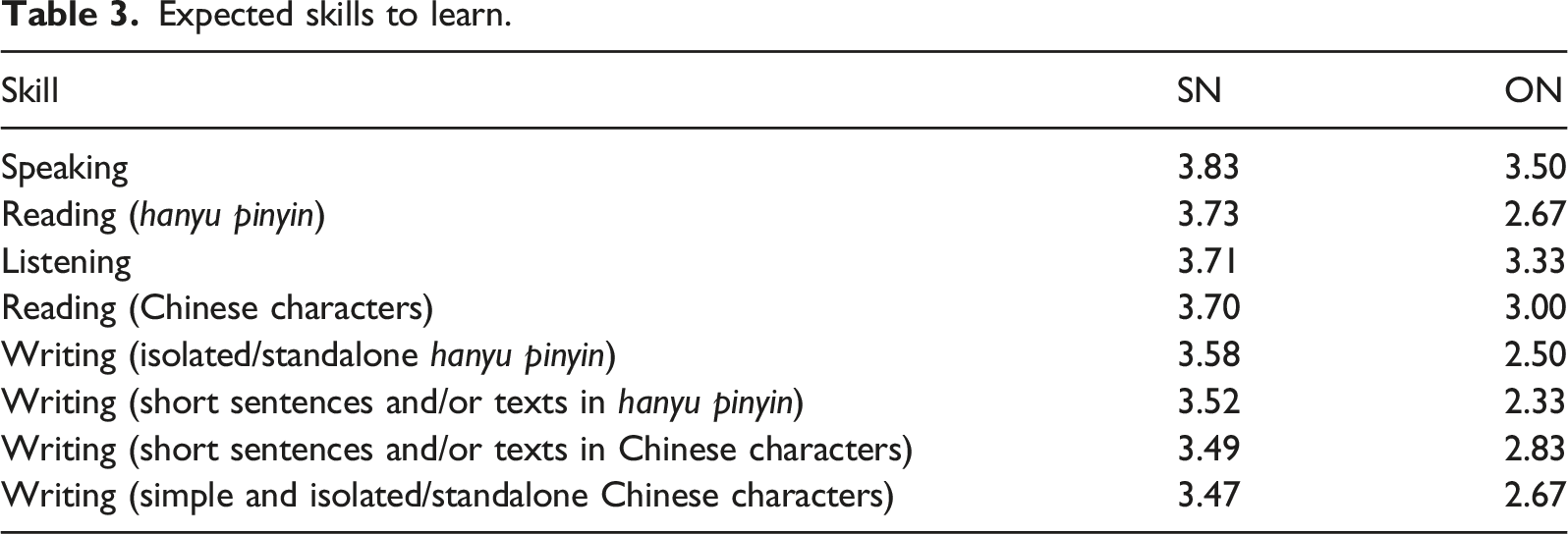
In fact, integrating the four language skills is beneficial in mirroring
authentic day-to-day communication for learners (Richards & Rodgers, 2014). The
relatively-low-but-over-three points received by writing (in Chinese characters,
particularly) suggests that there are some practical considerations by learners
taking place, making them in “dilemma”: I think most
reason why we're learning is to be able to converse, and writing is
less essential for us unless we are studying in China, or we're
taking courses that most of using Mandarin. But I guess most of us only
want to freely, conversing in and interact with other so. That's
why speaking and listening at first.
(S2-1) … should learn Chinese
charactres also because we learn Mandarin if not learn characters it
feel like we lack something. Pinyin is not enough for me. When we see
something in Chinese we don't understand it. So? What do we get
from learning Chinese if we only learn pinyin, so we can only talk and
can only listen to and we can’t understand anything from the
newspaper. (S3-1)
On the other hand, learners’ ON revealed something interesting. Instructors underestimated the needs of their learners, with no skills in exception. This is especially so in skills needing to rely on hanyu pinyin and/or Chinese characters. Instructors presumed learners wanted to learn speaking and listening skills more than reading, while writing was seen as the least important. In short, despite the Mandarin courses in UNIMAS are comprehensive (not skills-specific) (Lam & Hoe, 2013), learners were thought of as more enthusiasted to only master speaking and listening skills.
Table 3 also
shows that learners’ SN and ON differed in the skills that make use of
hanyu pinyin, but not as great in the same skills that
utilise Chinese characters. In other words, instructors thought that exposure to
Chinese characters would do more good to learners. This can be explained by the
Chinese curriculum’s conventional teaching purpose, which emphasises
complicated written literacy (Xu & Moloney, 2014). In this
regard, an instructor shared that hanyu pinyin only served as a
tool to achieve ultimate and genuine Chinese literacy: At
this level [level 3], writing gains more importance
because there will be a lot of characters having the same
pronunciation needing to be made known to students, since it will
benefit their daily encounters. Pinyin is not enough to show the
difference. Students pursuing to level 3 are normally those who are
really interested to learn more about the language, not only
verbally but also in written form.
(T3-1)
Though so, when a chi-square test of independence was performed to examine the expected skills to learn by learners from the respondents’ perspectives, the differences were not significant, x2 (7, N = 122) = 6.24, p = .75. It can hence be concluded that learners’ and instructors’ differences on expected skills were not statistically significant.
Textbook
Textbook.
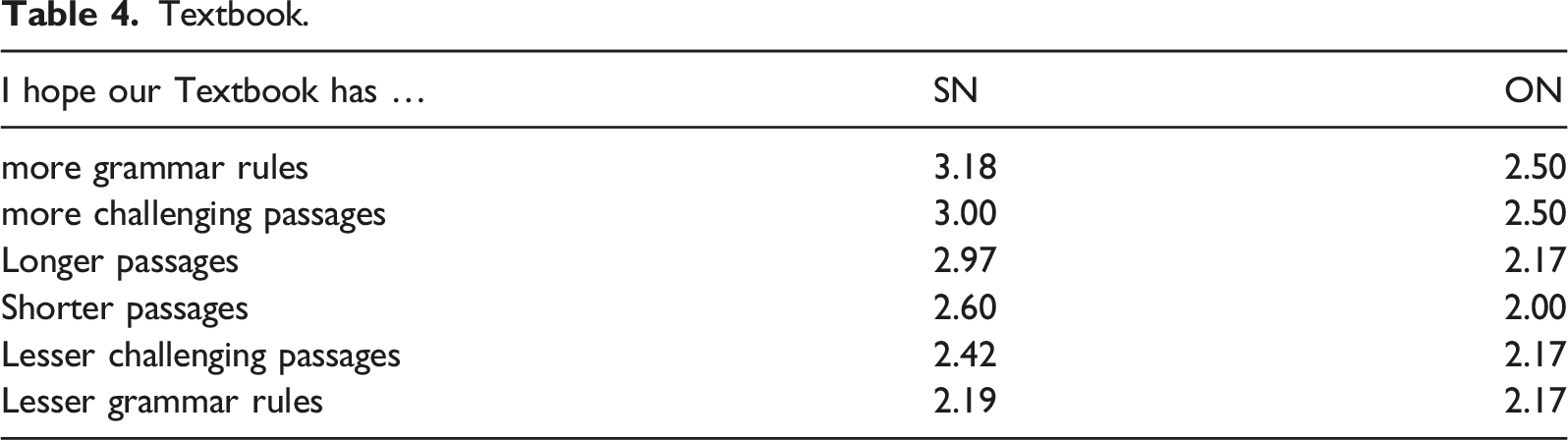
On the other hand, data from learners’ ON (with 2.50 as its maximum)
indicates that their instructors were reluctant for any change to the textbook.
Feedback from instructors’ interview revealed that time constraint and
alignment with the prescribed international standard syllabus were their
concern: Students already lack of drill practices because
I need to cover all the lessons. The dialogues in every lesson also have
new vocabulary which required students to spend more time to remember.
(T1-2) I think the length is just nice.
Some passages are longer to provide contexts to students. Cutting short
makes things a bit too simple… making them longer will cause us
chasing time to finish our teaching.
(T3-1) The length, difficulty and
grammatical items are ok because the selection of grammatical items is
based on the prescribed international syllabus by Hanban. Certain batch
of students learn faster but other batches not… so keeping a
uniform difficulty is important… (T2-1)
In answering whether they were satisfied with their textbook, learners rated 3.69 while instructors rated 3.17. In other words, learners were fairly satisfied with the textbook, though their instructors thought they were not so. Nevertheless, the chi-square test of independence carried out to examine the differences between learners’ and instructors’ views on textbook showed that the differences between these variables were not significant, x2 (2, N = 122) = 0.05, p = .99. This means learners and instructors have similar perceptions of their textbook.
Cultural exposure
Cultural exposure.
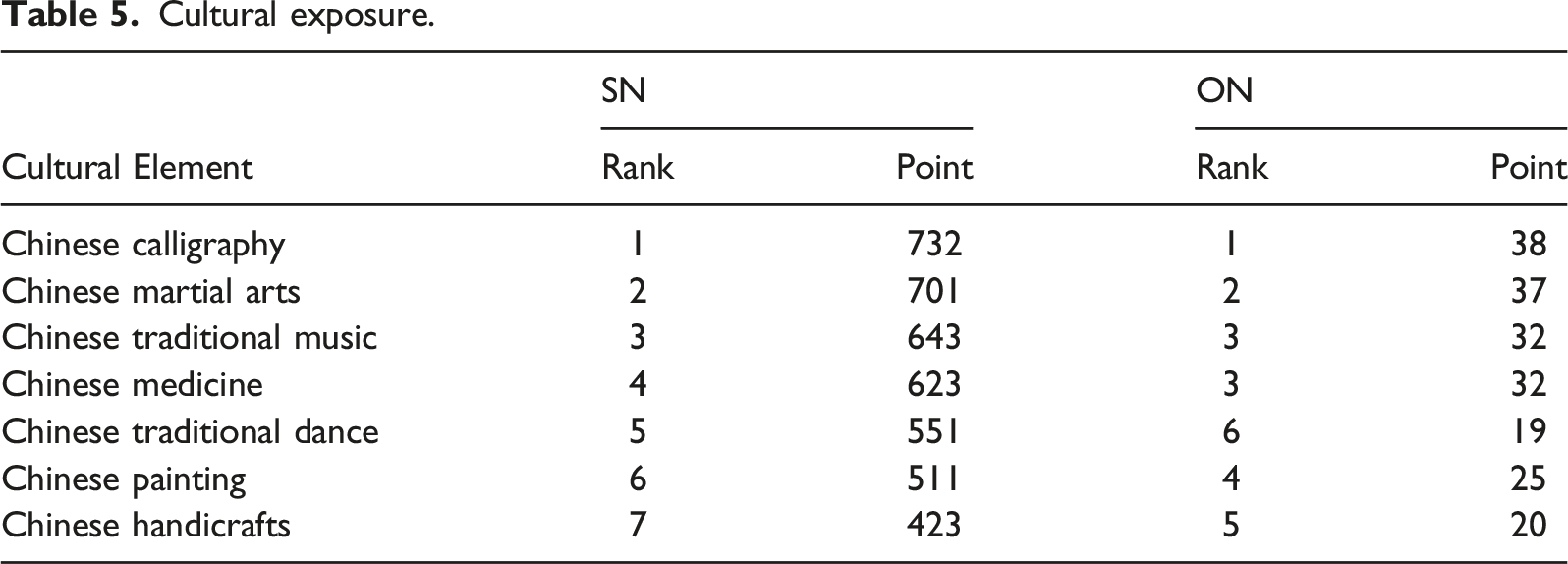
What is less expected, is that Chinese traditional music and medicine are also
well-liked by learners. It is likely that following China’s significant
presence in the international arena, its time-honoured traditions and cultural
heritage are regaining worldwide attention.In addition, music are generally
enjoyable and pleasant to listen to. However, learners’ interest in
Chinese medicine reveals a different reason: the “story-telling”
aspect, and as a tool to understand the Chinese community. I think
it would be better if the medicines can be shared. During the sharing
sessions… we know a bit surface about the medical, like in
Chinese… medicines is not really just the pills or herbs, like
sometimes they use the needles, or the ‘chi’,
‘yang’ kind of things. Yeah, I think that one is more
interesting that they will listen more.
(S3-3) Because i watching kung fu movies,
it’s not only their herbs but also focusing on energy, so…
I think is under the scope medicine. I want to know the reason to eat
this and that herb. I think when we learn about medicine actually it
help us to understand why people do things the way they do… So I
think if we can understand more about why people do things so that we
can understand and prevent misunderstandings.
(S1-4)
On the other hand, it is found that other cultural elements which are more
performing in nature were ranked lower by learners, with Chinese handicrafts
ranked the lowest. Interview feedback from the majority of learners revealed
that they had limited idea when thinking of Chinese handicratfs. A learner even
critically commented on her reason for ranking Chinese handicraft the lowest as
sacrificing her proper class time: I actually love that kind of
things so maybe because we only have like three hours every week to have
our class so I think it is better maybe laoshi can do like some
competitions weekly, and who wants to participate can participate. if
you're going to incorporate into our class time, i think very time
consuming, and then it can take some of the times to add into the
important skill… (S2-2)
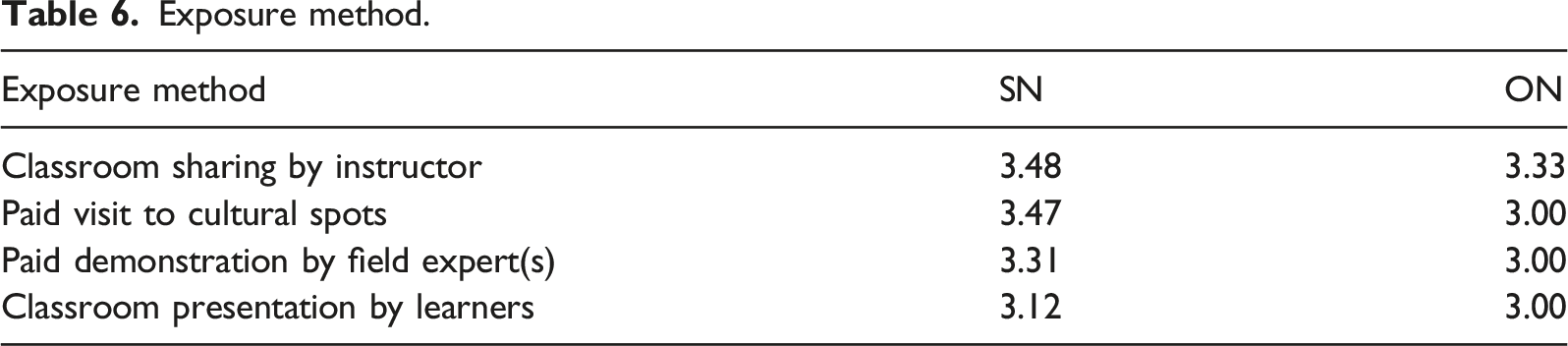
Exposure method.
Classroom activities
Classroom language.
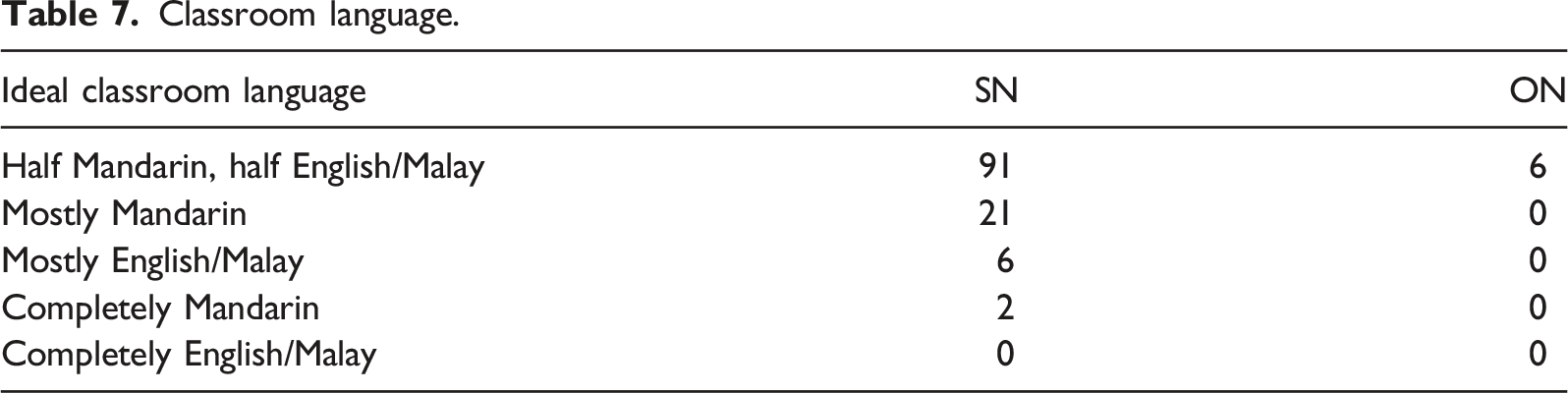
In contrast, all instructors were holding the sole opinion that learners needed a
learning environment which utilises Mandarin and English/Malay in an even
weightage. The practice also frequently involves the use of translation from
Mandarin into English/Malay, in ensuring the accuracy of information received by
learners (Lam et al.,
2017). While it is undeniable that learners of different levels may
have different needs when talking about classroom language, Table 7 suggests
that in overall, learners’ SN and ON in relation to the ideal classroom
language correspond to each other. Though so, the voices of 17.5% learners
hoping that their class can mostly use Mandarin actually reflects the way to go
as they progress from one level to the other. This group of respondents (five
from Level 1, seven from Level 2, nine from Level 3) is a representative of
those who are highly motivated in immersive learning. The result also serves as
an early indication that learners become more confident with the language as
they progress to higher levels. An instructor’s interview feedback below
echoed with these learners: Half Mandarin and half
English/Malay may be still possible for this level [Level
2]… Sometimes certain batch of students are better than
other batches, so teacher can adjust accordingly. But basic
instructions such as nimen du, qing shuo, you wenti ma should be
asked completely in Mandarin. Words introduced more than twice
previously should also be mentioned directly in
Mandarin… to get students get used to them.
(T2-2)
Preferred ratio of lectures to classroom activities.

Although both teaching modes have learners’ support, the finding suggests
that the majority of learners still felt more comfortable to attend a foreign
language class which places equal emphasis on lectures and activities. In this
regard, the current practice resembles the finding by Wang (2007), who reported that the
Mandarin proficiency classes in Harvard University also made learners to speak
up for not less than fifty percent of their class time. On top of this, a
learner’s comment on “student-centeredness” as the focus of
the debate can serve as an enlightenment to the course
provider: [For] Level one, I guess fifty fifty
should be okay but it should increase gradually like 60-40 or 70-30.
Level 2 and 3 should be more on student oriented.
(S2-3)
Table 9 reports
the findings on teaching-learning activities. A chi-square test of independence
was performed to examine the differences between learners’ and
instructors’ views on teaching-learning activities, the differences were
not significant, x2 (2, N = 122) = 0.05, P
= .99 Learners’ SN indicate that they favoured all the activities
listed, despite a clear inclination towards those which better match their
Generation Z characteristics (ie. online and multimedia-related). In the
interview, learners explicitly expressed their feeling towards interactive
learning activities: There is one I like… this one website
where we were given a list of words and we have to pronounce them, and
the website is going to show us a word according to our pronunciation,
and if it's the same with the word given means we pronouncing it
right. For example, how to pronounce mei mei correctly, the computer
tell you right or wrong.... And then it gives you the mark of 10 over
10. (S1-5) I don't really like the
mechanical reading and writing on the spot, I think is very, very no
energy for me. I prefer more oral and more energy to be used in the
class and the one I'm going to participate actively compared to
just sitting down and reading the things I can do privately.
(S2-1) Teaching-learning
activities.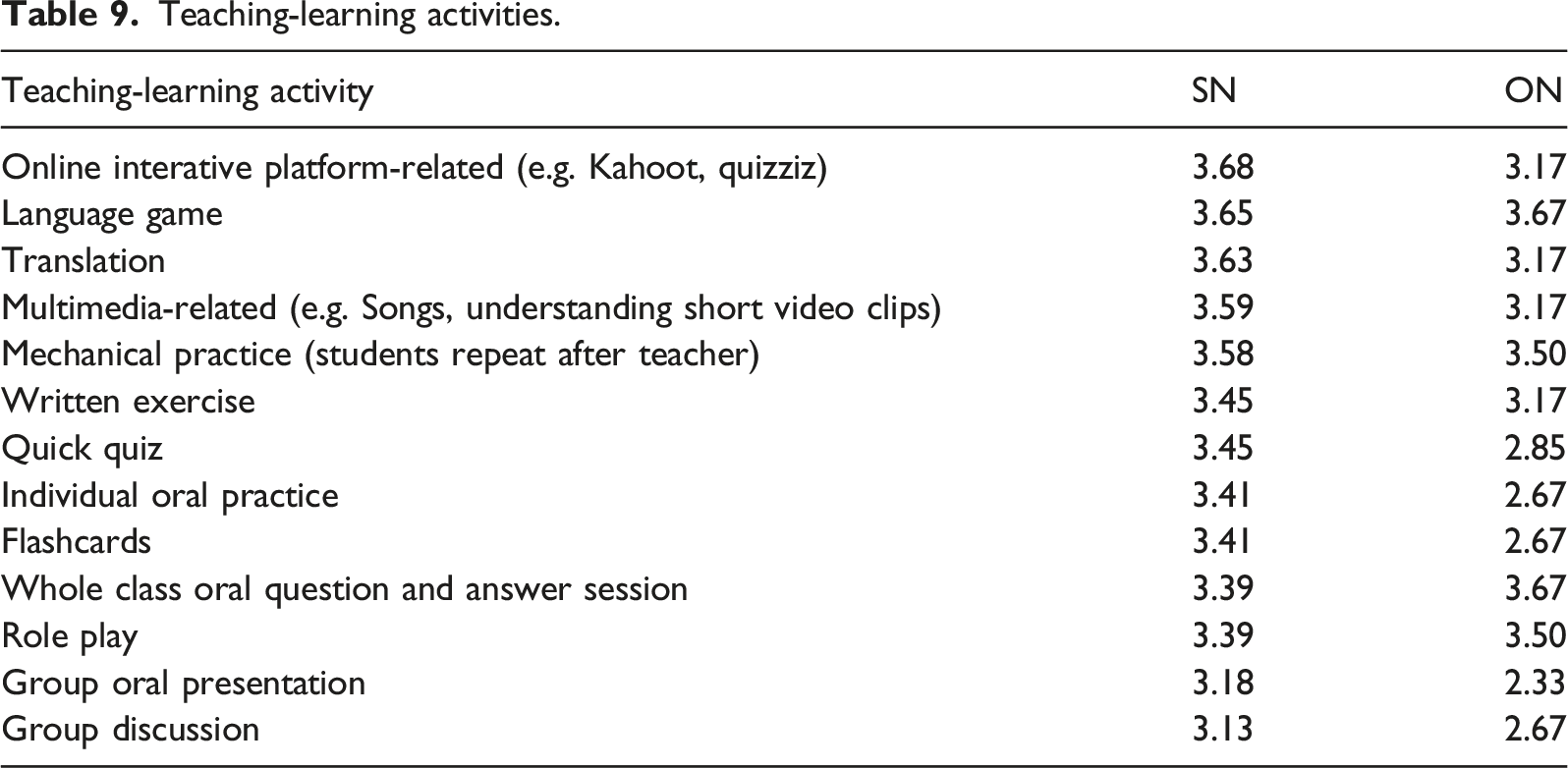
Some traditional activities in a typical language class, such as language game and translation, are also well-liked by the learners. It is worth noting that among these activities, those requiring learners to work together with peers, received relatively low means. During the interview, however, learners responded otherwise. This is perhaps due to peer group pressure (Xu & Moloney, 2014), in which when other respondents felt okay working with peers, the one feeling the opposite just chose to follow the flow.
Responses from instructors suggested that learners needed language game and whole
class questioning and answering session the most, seconded by mechanical
practice and role play. Individual oral practice, flashcards, group oral
presentation, group discussion and quick quiz received means lower than 3 by
instructors. Interview feedback reveals that there are considerations made by
instructors, the obvious ones are time constraint and the issue of
practicality: Mechanical drill is a must because students
… needs to listen to how native speaker speaks. I also always use
whole class QnA because to be frank, is the most time-saving. I have
limited class time to finish my syllabus. I just want to do a quick
check whether students understand. But I know whole class QnA cannot
cater to individual needs. so I also use language games, online quizzes
to make sure I cover the majority of them… In level 1, I seldom
use group presentation because that takes up a lot of time and students
usually either just read from scripts or google answers from the
internet, which I think not too useful. (T1-1)
Discussion
This study investigated the needs of Mandarin learners not only from learners’ perspective (SN), but also complemented with instructors’ perception (ON). The overall result suggests that learners’ SN and ON correspond well with each other for the motivational orientation. It is a good indication to see learners learn Mandarin because of motivations that come within themselves instead of wanting to graduate. This echoes with the findings by other studies, such as Gan et al. (2021) and Nguyen and Hajek (2021); but not with Ventivani et al. (2021), possibly due to differences in the local context. In order to yield better learning result, instructors can incorporate more cultural as well as video/song-based content in teaching. Videos and songs have been reported as effective tools in raising the interest of language learners (Ju & Mei, 2020; Putinatr & Kiattikomol, 2022). In addition, this measure also suits the learners’ need to know more about the Chinese community while not neglecting their Generation Z characteristics, i.e. high sensitivity to technology and communication (Tutgun-Ünal, 2021). In order to help orientate their learning, learners in the beginner’s level can be informed at the very beginning that they will only learn about job-related content in the more advanced level of Mandarin course so that their expectation can be adjusted.
The moderately matched SN and ON of learners in terms of the expected skills to learn confirms their high motivation in learning Mandarin as reported above, while shedding lights to instructors on the possibility of designing a reading cum writing course targetting at learners, or Chinese heritage learners (Xiao, 2006), who have the need. The introduction of such course can complement and enrich the understanding on the reading and writing needs of Mandarin learners outside of China, an area which is still lacking in the existing literature (Feng, 2015; Shi, 2016). The current courses however, still need to continue using hanyu pinyin as a tool to scaffold beginners’ learning (Xiao et al., 2020). Basic Chinese characters can be introduced sparingly and by stages, but always bearing in mind the courses are comprehensive in nature. Fun and creative ways of introducing Chinese characters can be employed (for example, Lam et al., 2018) to kick start learners interest. As for the improvement of textbook for the betterment of learners, additional take-home reading passages or exercises showing more in-depth usage of grammar rules can be added as complement to what they get in their textbook. This measure can benefit the fast and slow learners without giving excessive burden to the latter. The textbook in-use can be reviewed to eliminate unncessary details to ensure smoother delivery by the instructors.
The findings for cultural exposure suggest that generally the learners’ SN and ON correspond well with each other. There are a few pedagogical implications arising from the findings. Firstly, cultural elements can be packaged in the form of cultural sharing sessions as learners love to listen to stories. Secondly, topic on Chinese handicraft is an area worth introducing to learners because this appears as a knowledge gap for them (Cai, 2019). Thirdly, theoretical introduction of cultural elements could be complemented by after-class hands-on activities, visits or even paid demonstration by field experts. It is also crucial for instructors to ensure the cultural elements introduced are practical (as compared to “dead culture”) and close to learners because the courses emphasise on aspects of life surrounding their immediate necessities according to level A1-A2 in Common European Framework of Reference for Languages (Md Nawawi et al., 2021).
The study result on classroom activities helps to conclude that, the current teaching-learning mode (which allocates equal weightage on Mandarin and English/Malay, as well as lectures and activities) is on the right track. Nevertheless, flexibility is important by taking into account learners’ level and student-centredness, as also emphasised by Keiler (2018); Rao (2019) and Tan et al. (2012). In addition, flexibility is equally needed in conducting classroom activities, by prioritising on the use of technological platforms which make learners learning more meaningful. Instructors need to be creative in minimising the constraints they face, one of which is making good use of technology. For example, in order to overcome the problem of time constraint, activities such as educational games (Chua et al., 2021; Ting & Lam, 2021), flashcards and quizes can be conducted online, outside of class time.
Conclusion
The study attempted to present learners’ SN and ON in the Mandarin proficiency courses of UNIMAS. It shows that learners’ SN correspond well with their ON in the aspects of motivational orientation, textbook, and cultural exposure. Slight discrepancies are found in the expected skills to learn, which calls for a possible independent reading/writing course in the future. In terms of classroom activities, learners’ SN and ON correspond well with each other for classroom language use, but fine-tuning would be helpful for lecture-activities ratio and teaching-learning activities. It is suggested that the elements of flexibility, student-centeredness and practicality to be looked into for course improvement while not sacrificing on classtime. The contributions of this study are three-fold: firstly, it provides a point of reference for nationwide Mandarin instructors to better understand their learners with similar level and ethnic composition. Secondly, it yields important information for the instructors to refer to when improving Mandarin proficiency courses. Learners’ needs reflected in the study can provide clearer directions in keeping the course content and delivery up-to-date, besides aligning what is offered in classroom with what the learners want for the betterment of their learning. Thirdly, it complements the understanding and knowledge of needs analysis in regard to Mandarin learning outside of China. Limited number of instructor respondents is the limitation of the study; nevertheless, this small number can make re-alignment of instructional concepts and delivery method easier to monitor. As a continuation of this study, future research can probe into the needs of learners who are interested to master writing skill, and the needs differences among learners across different levels.
Footnotes
Acknowledgments
Special thanks to Associate Professor Dr. Su-Hie Ting for her professional advice and Madam Wee Ling Kuan for helping in data collection.
Declaration of Conflicting Interests
The authors declared no potential conflicts of interest with respect to the research, authorship, and/or publication of this article.
Funding
The author(s) disclosed receipt of the following financial support for the research, authorship, and/or publication of this article: This work was supported by Universiti Malaysia Sarawak Scholarship of Teaching and Learning Grant Scheme [SoTL/FBK/2020(1)/017].
