




Abstract
Soar in the children population following the termination of Mainland China’s three-decade-old one-child policy has aroused attention and concern of the quality of early childhood education, especially the leadership and management approaches of kindergarten principals. However, practical tools for assessing kindergarten principal leadership have not yet been developed in Mainland China. Identity leadership (IL) is a new model in leadership research, and the Identity Leadership Inventory (ILI) facilitates leadership assessment in different contexts with diverse samples. This is the first study to explore principal identity leadership in a Chinese educational context. The Principal-ILI (P-ILI) Chinese version was administered to kindergarten principals and teachers from municipalities and provinces all over Mainland China. A total of 2743 valid responses were collected from 498 kindergartens. Results revealed not only good reliability and validity of P-ILI in the Chinese educational context, but also high perceived IL of most kindergarten principals as well as differences in IL perceived by respondents of different ages, positions, and kindergarten types.
Keywords
Introduction
Following the relaxation of Mainland China’s three-decade-old family planning policy in 2015, millions of additional births were recorded. Yet, to mitigate the declining birth rate in recent years, the universal three-child policy was introduced in 2021. The new change in policy not only pointed out problems of the present population structure but also drew attention to early childhood education quality. Developing an inclusive childcare service system is critical to improving the desire of people to have children (Tatum, 2021). Following the introduction of the three-child policy, parents’ demands for childcare services increased, but the level of socialization of childcare services in China was low. (Liu et al., 2022). Related kindergarten management issues have also aroused extensive concern. For kindergartens in Mainland China, the principal is solely responsible for its management. Hence, continuous research on the leadership of principal is the core of kindergarten management and development. Perceived leadership style of the kindergarten principal has a direct impact on the work performance of kindergarten teachers (Cheng, 2013). However, practical tools for assessing kindergarten principal leadership are currently lacking in Mainland China, thus limiting to a certain extent the scientific development of relevant practical work.
Contemporary leadership literature contains cumulative knowledge on roles and functions, qualities and traits of leaders, as well as types and styles, theories and models of leadership. Two opposing theories emerged when answering the age-old question of whether leaders are born or made. According to the trait theory, leaders are born with leadership skills that are largely innate; while behavioral theories considered leaders made and everybody can learn or be taught to become an effective leader. Despite contrasting, these theories shared a unidimensional perspective focusing mainly on the leader, the core figure of an organization, and on what leaders are and do. With increasing attention paid to the relationship between the leader and the followers, ensuing leadership theories have dual focus, those who lead and those being led. Most obvious is the leader-member exchange theory, which stresses the two-way or dyadic emotional bond between leaders and followers built upon mutual respect and trust (Uhl-Bien & Graen, 1998). Other similar theories include the authentic leadership theory with emphasis on honest relationship between leaders and followers; as well as the transformational leadership theory which highlights leaders’ inspirational motivation, idealized influence, intellectual stimulation and individualized consideration (Judge & Piccolo, 2004) for followers to achieve outstanding or even unexpected performance. Indeed, the evolution in leadership theory from a unidimensional to dualistic perspective is a noteworthy advance; yet, the dynamic relationship between leaders and followers remain bipartite as if leadership operates in a vacuum or in the absence of a context. At the organizational level, leaders and followers are not in binary opposition. Rather, they belong to the same group and have a shared identity. Comparatively, attention to the contextual, group, and overall organizational effects of leadership is lacking in current theories, which is a knowledge gap in research on leadership (Dinh et al., 2014).
With burgeoning academic interest in the importance of context and the role of followers in the dyadic relationship, new leadership theories come into being; one of which is the social identity theory of leadership (Hogg, 2001). This approach to leadership has its basis on the social identity theory (Tajfel & Turner, 1979) and attempts to fill the abovementioned gap by emphasizing group identity and leader-member and member-member processes at the group level. Not only does identity leadership (IL) promise a new model or approach to leadership research, the development of a scale, the Identity Leadership Inventory (ILI) facilitates the assessment of the four dimensions of IL in different contexts with diverse samples (Steffens et al., 2014). Validated by an international project, the ILI-Global Project, with data from all six continents and from more than 20 countries/regions. (Van Dick et al., 2018), the ILI is a useful and reliable assessment tool applicable in different countries/regions and cultural contexts. Moreover, results obtained using the ILI not only enrich the content of leadership theories but also strengthen the theoretical basis for promoting IL, which has shown positive impact on team identification, trust in the leader and well-being of employees (Krug et al., 2020). Although the ILI has been translated into Chinese with Shanghai and Beijing cities in Mainland China as data collection sites of the ILI-Global Project (Van Dick et al., 2018), its applicability to the field of education in a Chinese context has never been validated.
Van Dick et al. (2018) reported significantly greater leadership effectiveness of IL compared with other leadership models such as transformational leadership, and positive impact of IL on job satisfaction, burnout and organizational citizenship behavior. This finding has important implications for the practical development of kindergarten management. Different from that in other educational institutions, the superior-subordinate relationship in a kindergarten is much closer. That is, a kindergarten principal works more closely with the staff and teachers, and is more involved in the day-to-day administration and teaching activities. Haslam (2017) pointed out that the core concern for psychological analysis of group life should be education and learning. Nevertheless, current research on IL on the basis of the social identity theory is scarce. Furthermore, past studies have rarely taken kindergarten teachers as the target sample population.
In view of the above, it would be of both academic interest and practical use to evaluate the applicability of ILI as a kindergarten principal leadership assessment tool in a Chinese context. This study adopts the Chinese version of ILI (Appendix S1 of Van Dick et al., (2018)) and adapts it to the educational context. Findings from empirical data collected from kindergarten principals and teachers in Mainland China serve to validate the applicability ILI not only as an assessment tool in a Chinese educational context, but also as a research tool for educational and identity leadership studies.
Literature Review
Identity Leadership
The word ‘identity’ originates from Latin ‘identitas’, meaning sameness. Its present-day definitions also include the distinguishing character or personality of an individual and the relation established by psychological identification (James, 1890). A shared social identity is the bond between leaders and followers, without which leadership would be impossible. Hence, leaders should actively intervene in creating and redefining identities (Reicher et al., 2005). Leadership processes are enacted in the context of a shared group membership, where leaders, as group members, ask followers, also as group members, to exert themselves on behalf of the collective (Van Knippenberg & Hogg, 2003). Identity leadership (IL) is a leadership model that emphasizes the leader’s need for creating a shared sense of identity for the team to be more effective. Different from other leadership theories that focus on one-to-one leader-follower and follower-follower relationships, IL emphasizes the group identity, group identification and corresponding changes, as well as relationships between the group as a whole and every individual member (Hogg, 2001; Hogg & Adelman, 2013). The leader and the led are no longer in binary opposition; instead, they have a shared identity with common goals and motivation. Though disparate, all members come together in unity, with the leader strengthening the group identity and steering the group toward collective success.
IL has its root in the social identity theory (Tajfel & Turner, 1979). Of note is that previous studies have diverse, if not conflicting, interpretations of what social identity denotes. Some scholars believe that social identity is nothing more than self-categorization according to certain visual differences and involves depersonalization. Once categorized, social identity becomes a relatively static perspective with internal dynamic changes left neglected or ignored for a long time (Ashforth et al., 2008; Deaux & Martin, 2003; Tajfel, 1981). In contrast, some scholars view social identity with a dynamic perspective, highlighting its dependence on social relations and social interaction as well as the emotional linkage resulting from such interaction (Postmes et al., 2005; Rink & Ellemers, 2007). Empirical evidence has shown that emotional sense of belonging bred through participation in team tasks is more persistent than self-categorization purely on the basis of team identity (Ashforth et al., 2008; Postmes et al., 2005). Hence, for better leadership effectiveness, leaders not only should pay attention to team identity but also devote efforts to enhancing interaction and collaboration among team members so as to strengthen their social connection and emotional sense of belonging.
Moreover, IL exerts its influence through social identification. Besides originating from some inherent visual distinctive differences, the psychological process of identification stems also from the emotional connection fostered by interaction and collaboration. Hogg et al. (2012) found that group prototypical leaders are better supported and more trusted. In fact, early social identity theory-based leadership research focused mainly on leaders’ identity prototypicality. However, IL would encompass more than just identity prototypicality. Merely equating the prototypicality of the leader with the collective identity of other group members or the identity of any single member is often biased than fair (Bartel & Wiesenfeld, 2013). The understanding of IL should not stay at the static perspective of guiding followers to self-categorize according to the prototype. Due consideration should be given to the dynamic impact of guiding followers to discern the distinctive collective identity and strengthening their identification.
In sum, IL is defined in this study as leaders actively guiding organizational members in recognizing the shared identity and strengthening their identification; and through such group-level influence leading the entire organization to work together and achieve collective success.
Components of Identity Leadership
According to Ellemers et al. (1999), three components contribute to one’s social identity, namely the cognitive, evaluative and emotional components. Self-categorization is a cognitive component denoting an awareness of one’s membership in a social group; group self-esteem is an evaluative component indicating the positive/negative value connotation attached to this group membership; and affective commitment is an emotional component representing a sense of emotional involvement with the group. Consistent with Ellemers et al. (1999), Bergami and Bagozzi (2000) also examined self-categorization, affective commitment and group self-esteem as distinct aspects of social identity in the organization.
With regard to successful identity entrepreneurship by leaders, Haslam et al. (2011) suggested that leaders need to be artists, impresarios and engineers of identity. As artists of identity, they use language to create a compelling vision of identity and its implications for action; as impresarios of identity, they structure the action of the group to reflect the norms and values of shared social identity; and as engineers of identity, they use energies of the group to reshape the structure of society at large. Steffens et al. (2014) put forward a four-dimensional model of social identity management comprising identity prototypicality, identity advancement, identity entrepreneurship and identity impresarioship. In brief, the focus of identity prototypicality is for the leader to be an exemplary and model member of the group, while that of identity advancement is for the leader to advance and promote core interests of the group. Identity entrepreneurship emphasizes that leaders should bring people together by creating a sense of ‘we’ and ‘us’ within the group while identity impresarioship stresses that leaders should promote structures that facilitate and embed shared understanding, coordination and success.
Identity Leadership Inventory
The Identity Leadership Inventory (ILI) is a leadership assessment scale developed by Steffens et al. (2014). It has been validated by an international project (ILI-Global Project) with data from 20 countries in all six continents. Specifically, the ILI is a 15-item scale categorized under the abovementioned four dimensions. 1. Identity prototypicality (1) This leader embodies what the group stands for. (2) This leader is representative of members of the group. (3) This leader is a model member of the group. (4) This leader exemplifies what it means to be a member of the group. 2. Identity advancement (5) This leader promotes the interest of members of the group. (6) This leader acts as a champion for the group. (7) This leader stands up for the group. (8) When this leader acts, he or she has the group’s interests at heart. 3. Identity entrepreneurship (9) This leader makes people feel as if they are part of the same group. (10) This leader creates a sense of cohesion within the group. (11) This leader develops an understanding of what it means to be a member of the group. (12) This leader shapes members’ perceptions of the group’s values and ideals. 4. Identity impresarioship (13) This leader devises activities that bring the group together. (14) This leader arranges events that help the group function effectively. (15) This leader creates structures that are useful for group members.
Respondents are asked to indicate their agreement to the 15 ILI items using the Likert 7-point scale, with 1 meaning not at all and 7, completely. Results of the ILI-Global Project supported the reliability and cultural appropriateness of the scale. The overall Cronbach’s alpha coefficient was .95, the comparative fit index (CFI) was .94, and the factor loadings for each item ranged from .83 to .96, indicating good reliability and validity.
Research Method
Principal-ILI Development and Pilot Survey
This study developed the Principal-ILI (P-ILI) Chinese version, which was translated from the original ILI. To ensure its validity and applicability to the kindergarten setting in a Chinese context, expert opinion from a panel, comprising scholars in the fields of education and educational management as well as front-line practitioners in kindergarten education, was solicited. Revision to the developed scale was made according to their review. A pilot survey was then conducted on a sample of 62 kindergartens randomly selected from 31 provinces in Mainland China. These 31 provinces included Beijing City, Tianjin City, Hebei, Shanxi City, Neimonggol, Liaoning, Jilin, Heilongjiang, Shanghai City, Jiangsu, Zhejiang, Anhui, Gujian, Jiangxi, Shandong, Henan, Hubei, Hunan, Guangdong, Guangxi, Hainan, Chongqing City, Sichuan, Guizhu, Yunnan, Xizang, Shaanxi, Gansu, Qinghai, Ningxia, and Xinjiang. From each province, one public and one private kindergartens were included in the sample. Invitation for participation in the pilot survey was sent to the kindergartens with the ILI in electronic form attached for principal and teachers to fill. A total of 319 responses were collected, among which 256 returned questionnaires were valid for analysis, giving a valid response rate of 80.25%.
Empirical Study
The target population of this study comprised principals and full-time teachers currently serving in kindergartens of Mainland China selected through cluster sampling and quota sampling. First, for cluster sampling, the total number of kindergartens to be sampled in each municipality and province was determined according to the ratio of the number of kindergartens in each municipality and province to the total number of kindergartens nationwide as listed in the 2018 Educational Statistics Yearbook of China. Then for quota sampling, public and private kindergartens were selected from each municipality and province according to the ratio of 37:63 because private kindergartens accounted for 63% of all kindergartens in the country. There were a total of 254,950 kindergartens in Mainland China (Ministry of Education of China, 2020). In order for the sample size to be representative of the population with 95% confidence level, at least 384 kindergartens need to be sampled (Krejcie & Morgan, 1970). Furthermore, with the possibility of invalid questionnaires taken into consideration and to achieve better representation of the target population, the final sample comprised 498 kindergartens.
Empirical Results
Descriptive Statistics
A total of 4129 responses were collected. After eliminating invalid questionnaires with completely consistent or incomplete responses, 2743 valid questionnaires were analyzed (valid response rate, 66.43%). In brief, the majority of respondents were female (98.25%), aged under 25 years (42.29%), with junior college degree and below (57.34%), 2–5 years of working experience (37.59%), serving as homeroom teachers (42.51%), in private kindergartens.
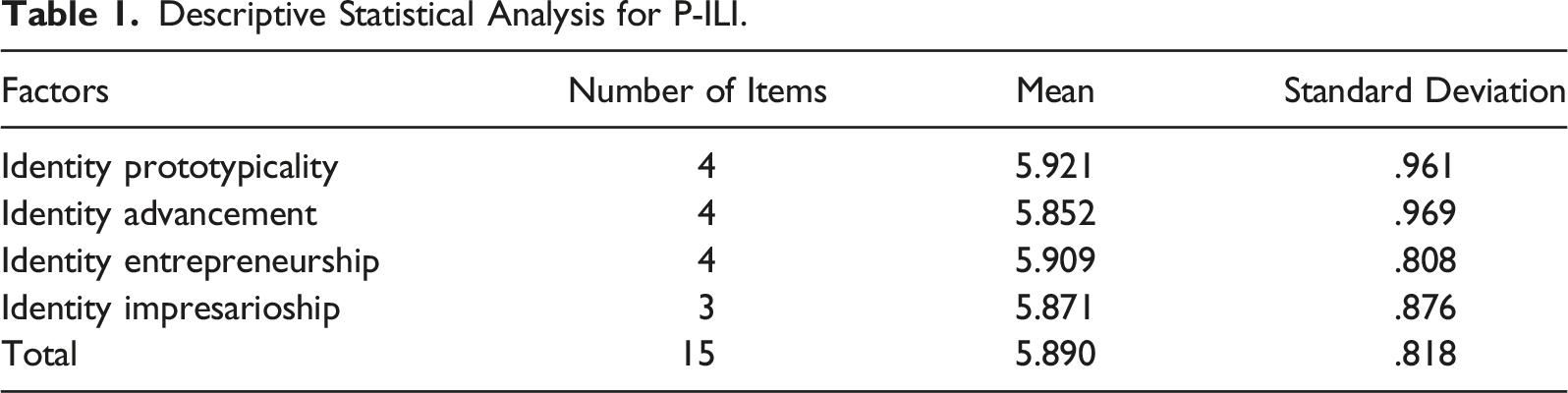
Descriptive Statistical Analysis for P-ILI.
Scale Validity and Reliability
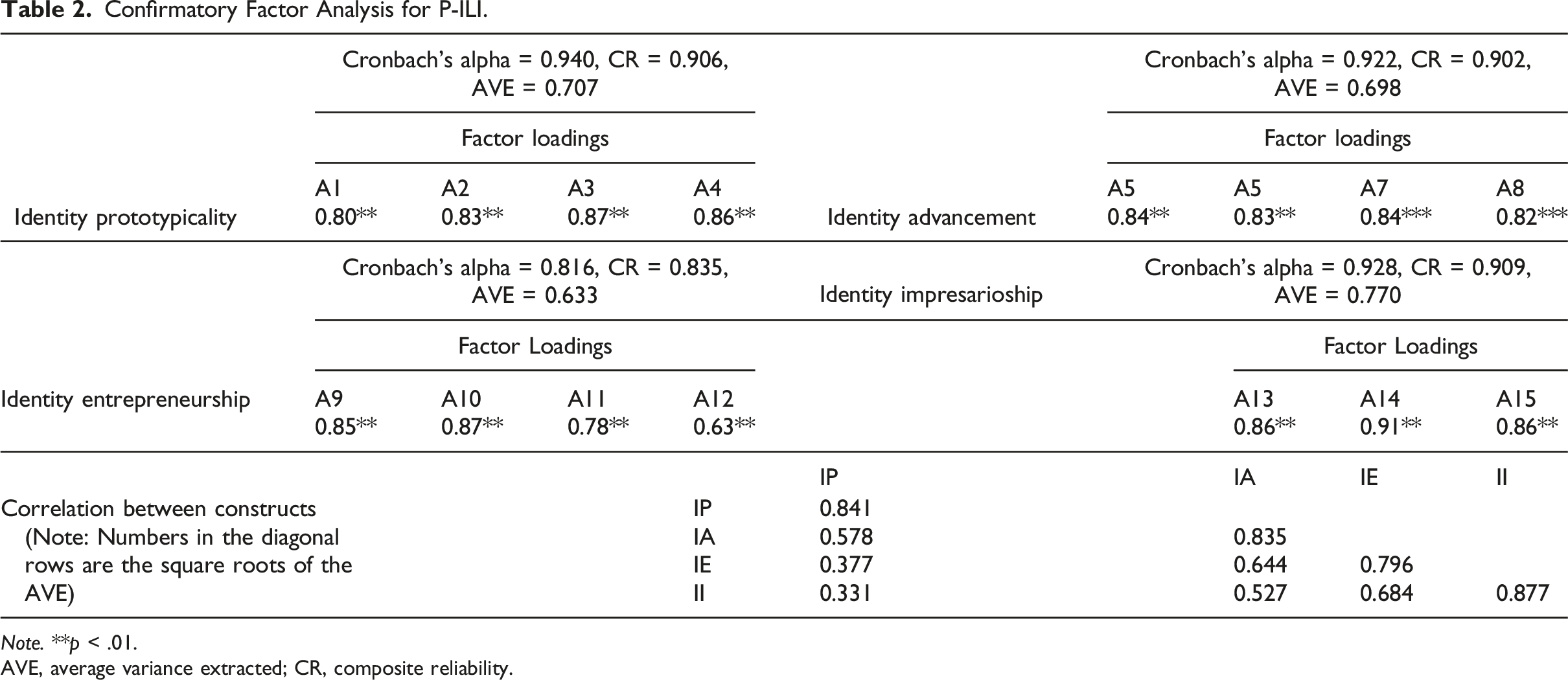
Confirmatory Factor Analysis for P-ILI.
Note. **p < .01.
AVE, average variance extracted; CR, composite reliability.
ANOVA Analysis
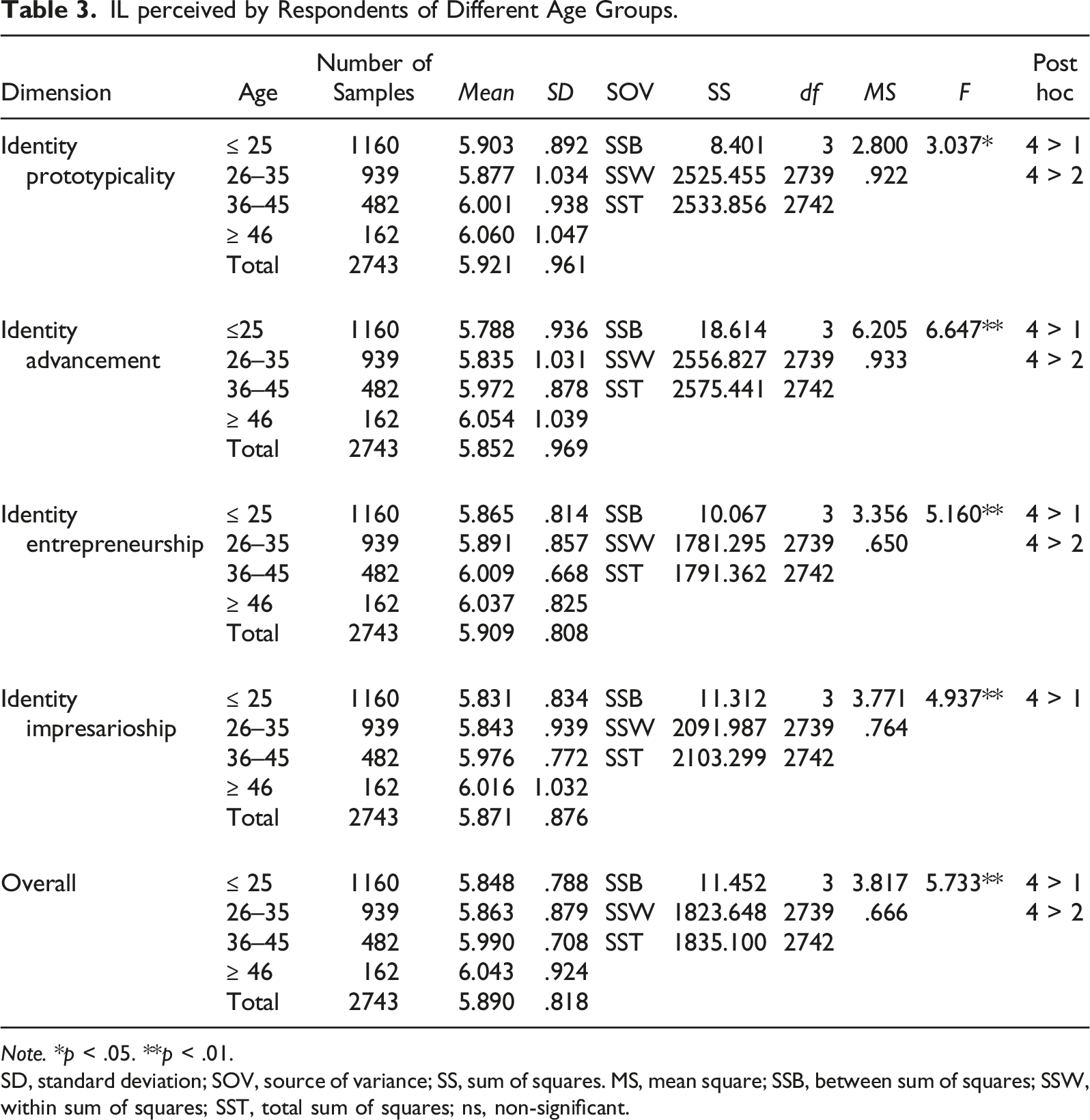
IL perceived by Respondents of Different Age Groups.
Note. *p < .05. **p < .01.
SD, standard deviation; SOV, source of variance; SS, sum of squares. MS, mean square; SSB, between sum of squares; SSW, within sum of squares; SST, total sum of squares; ns, non-significant.
Age
Table 3 shows the IL perceived by different age groups. There seems to be a significant trend of increase in perceived IL with age as evidenced by both the overall mean and the mean of each respective dimension, with the exception of identity prototypicality, in which those aged ≤ 25 had higher perceived IL (5.903) than those aged 26–35 (5.877). That is to say, older respondents tend to give higher recognition of the principal’s IL, probably because they are of the same age as the principal and have better peer understanding. Moreover, respondents aged ≥ 46 may include many principals who tend to have higher perceived IL than the teacher-respondents, resulting in high IL perceived by this age group.
Position
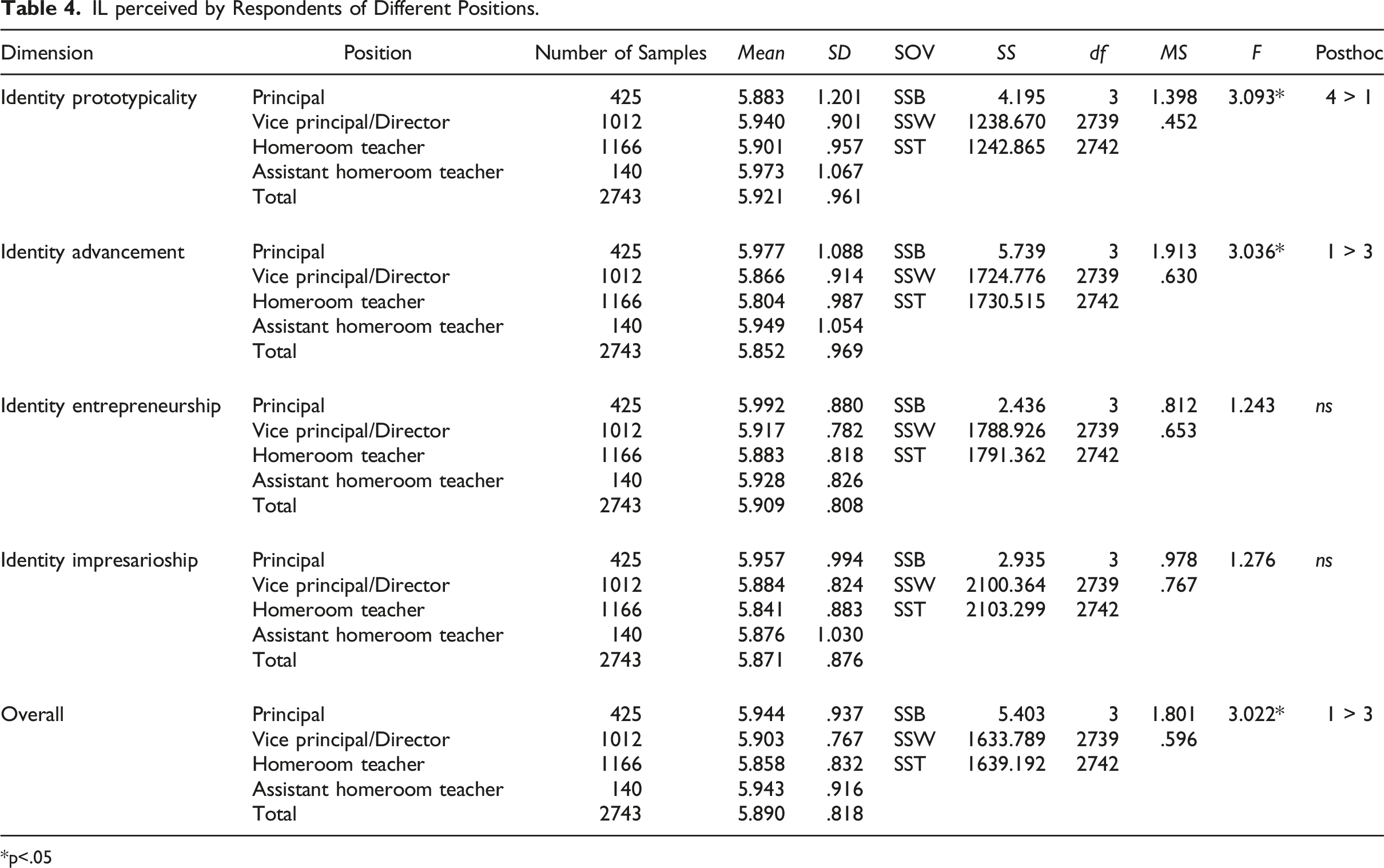
IL perceived by Respondents of Different Positions.
*p<.05
Kindergarten Type
IL perceived in Different Types of Kindergarten.
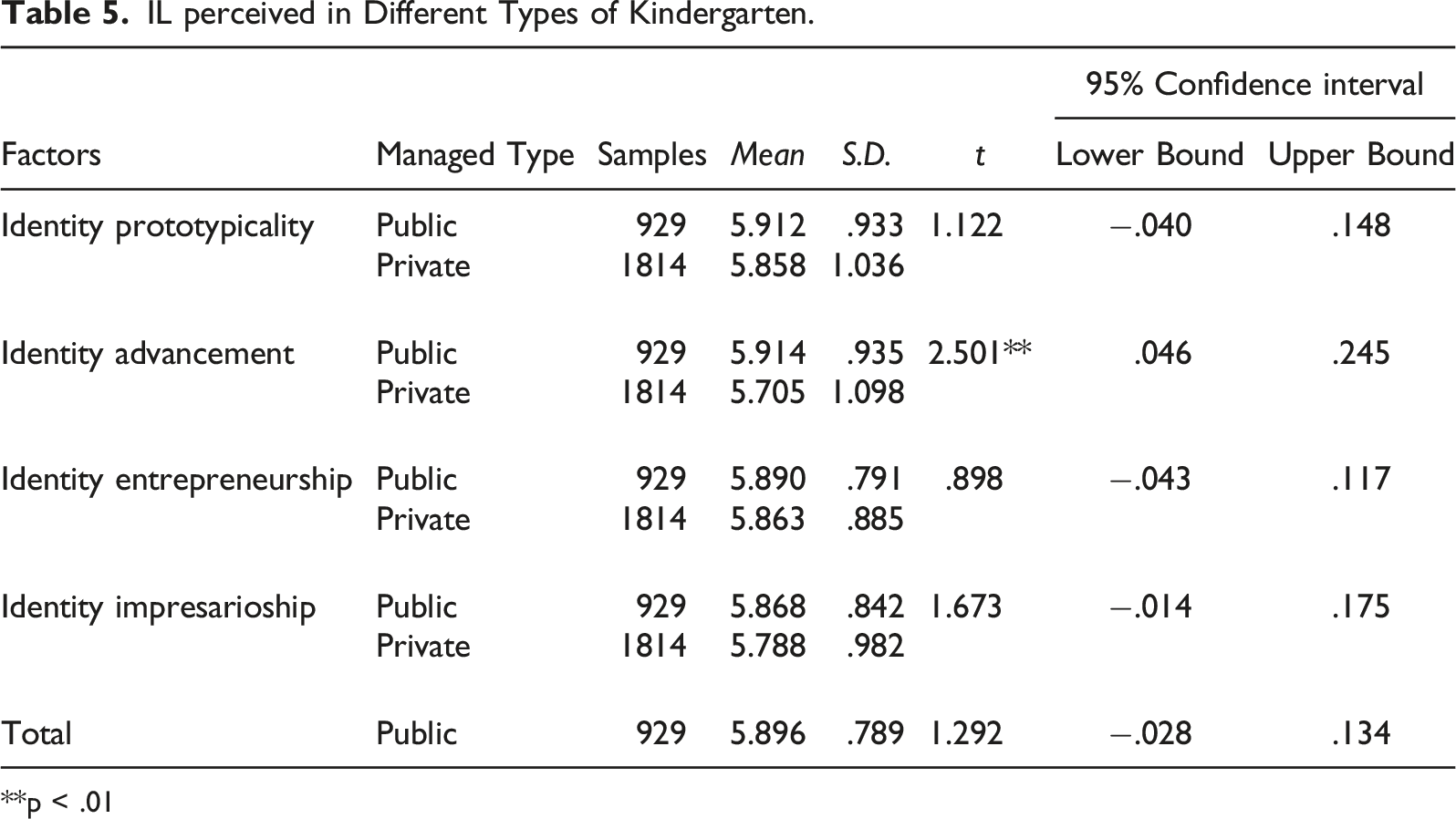
**p < .01
Discussion and Conclusion
Discussion
To the best of our knowledge, this is the first empirical study using an adapted version of the ILI developed by Steffens et al. (2014) to examine IL of principals in Mainland China. The P-ILI (Chinese version) used in this study had good validity and reliability, as illustrated by the results seen in Table 2. The empirical survey data subsequently collected also showed good applicability of this four-dimensional assessment tool to examining IL among kindergarten principals in Mainland China, evidencing P-ILI (Chinese version) as an effective instrument for similar survey studies on IL.
Compared with prior validation results on ILI obtained by Steffens et al. (2014) and Van Dick et al. (2018) using data from members of private and public organizations in Mainland China, the present findings were not only consistent but comparatively more robust. The survey samples in Steffens et al. (2014) and Van Dick et al. (2018) were either from a single organization or a single region with only 338 and 353 responses collected, respectively. In contrast, the 498 kindergartens included in the sample of this study were from municipalities and provinces all over China and a total of 2,743 valid responses were collected. In view of both sample size and regions covered, the present findings were more representative.
Moreover, the analysis results also echo the findings of Van Dick et al. (2018) in supporting the theoretical hypothesis put forward by Haslam et al. (2011) of a shared sense of “we” and “us”. The goodness-of-fit of ILI as a multi-dimensional construct indicated that it is a latent multidimensional construct (Law et al., 1998). In other words, identity leadership can be interpreted as the common factor underlying its dimensions, meaning that leaders with high IL will manifest good leadership in identity prototypicality, identity advancement, identity entrepreneurship, and identity impresarioship.
High IL perceived by employees in Mainland China was also observed by Steffens et al. (2014) and Van Dick et al. (2018) in their empirical surveys. However, no explanation was given for such a high perceived level compared with their counterparts in other countries. Different from the above two studies, the present survey included both teachers and principals as respondents. In other words, the empirical data collected not only reflect what teachers think of their principals but also what principals think of themselves in terms of leadership performance.
On the whole, the high perceived level of the different IL dimensions indicates significant self-confidence among the principals of their contribution in managing the kindergarten, protecting shared interests, promoting solidarity, and enhancing common values. In this regard, greater caution should be taken in future research on whether the high self-perceived leadership performance is attributed to overconfidence. Polivy and Herman (2002) defined overconfidence as an unrealistic belief in one’s ability to succeed. It is a well-established psychological bias that impacts one’s behavior, judgment and decision. A cross-cultural study found Chinese-speaking academic authors exhibiting stronger overconfidence than their English-speaking counterparts (Li et al., 2011). In view of possible differences in IL perception between the leader and the subordinate, separate analysis should be conducted on their respective data.
Practical Implications
Empirical data obtained in this study supported well the validity and reliability of P-ILI, making it an effective and practical assessment instrument for performance appraisal of kindergarten principals. Upward appraisal of the leader’s performance by the subordinates has been found to be a useful and effective means for developing and improving leadership competency (Schultz & Schultz, 2020). In addition to giving the employees a voice or a chance to give the leader and organization feedback, the scale developed helps identify the aspects that need to be strengthened in the management.
Of the four P-ILI dimensions, identity advancement has a consistently lower perceived level than the others, revealing the perception of the principal’s lack of concern for their interests. Hence, there should be greater emphasis on how to strengthen the principal’s performance in paying attention to the needs of teachers and in promoting their welfare. To make the teachers feel valued and their voice being heard, time and channels for upward communication should be provided. For example, there should be a regular and frequent schedule for principal-teacher dialogue; suggestion boxes can be put up with the principal attending and replying to feedback, complaints or advice from the staff; focus groups can be set up to consolidate different demands and to deal with different issues through concerted effort. Whether problems raised can be settled straightaway or require long-term planning, timely responses should be given either to individuals via digital means or made public on the official website.
Limitations and Future Research
This study has some limitations. First, the present findings lack generalizability. In other words, they may not be applicable to kindergarten principals of other countries or other educational contexts. Second, the respondents included only teachers and principals while childcare workers, administrative and menial staff were excluded. However, organizational behavior of these kindergarten employees may also be affected by the perceived IL of the principals. Hence, future studies should consider expanding the sample population to include all members in the organization, other pre-school educational institutions, or other stakeholders with related interests such as parents. Moreover, the region for study can also include neighboring countries in Asia-Pacific with similar cultural backgrounds.
Validated in this study as an effective assessment tool, P-ILI can be applied to related education management studies. Variations in perceived IL of principals between different stakeholders of kindergarten management are worth exploring so as to identify leadership behavior for improvement. Moreover, the impact of IL on team effectiveness (Fransen et al., 2015), workplace health and wellness (Steffens et al., 2017), work engagement (Steffens et al., 2018), and extra-role behavior (Koivisto & Lipponen, 2015) in the kindergarten setting also merits investigation. The empirical research tool developed and validated would provide both exact evaluation and practical guidance to issues of concern and significance to kindergarten management.
The survey in this study was conducted using a self-report questionnaire at a single point in time, which may cause common method variance (CMV). This study performed the Harman’s one-factor test to detect the severity of CMV. The variance of the first variable introduced was 37.61%, which did not exceed 50%, implying that the CMV was not serious (Podsakoff et al., 2003). Moreover, the questionnaire designed in this study is concise and easy to understand, as Podsakoff et al. (2003) suggested. Possible future research can be a longitudinal study to assess constructs at different time points to reduce the impact of CMV.
Finally, IL issues of various levels are worthy of further research. From the perspective of social cognitive schema, Tsai et al. (2015) put forward a model of leader-subordinate relational identity with the related constructs and measurement developed (Tsai & Chou, 2020). With both traditional Chinese culture and contemporary western culture taken into consideration, the leader-subordinate relational identity could be classified into four categories: communal affection relationship, instrumental exchange relationship, care-repay relationship, and authority-obedience relationship. Such classification emphasizes the relational dyadic role, which is more related to the self-concept at the interpersonal level. Future studies can integrate their emphasis on personal level and the focus of IL on organizational level to explore their impact on school management and operation.
Footnotes
Declaration of Conflicting Interests
The author(s) declared no potential conflicts of interest with respect to the research, authorship, and/or publication of this article.
Funding
The author(s) received no financial support for the research, authorship, and/or publication of this article.
