



Abstract
It is well known that nations increasingly struggle to recruit and retain school leaders. A critical clue across different national contexts is the intentions and motivations that draw individuals to principalship. This study examines the engagement, actions, experiences and intentions of principals in Sweden, aiming to explore their identity work in relation to taking the step into principalship and remaining in the role. Although interest in principal identity has increased, studies of principals’ identity, including an organisational perspective, are scarce. This study collects empirical data from two distinct groups: novice and experienced principals, through a qualitative survey. The results show their motifs for taking on and remaining in the principalship include caring for school development in a certain organisational context, finding belonging and pursuing further personal and professional development. That is, self-identity and organisational identity are intertwined and reciprocal. This study highlights an evolving principal identity that thrives on commitment to a particular school rather than on self-identity as a leader. The study result has immediate implications for principal employers, discussing aspects of importance in recruitment of school leaders to build reasonable pathways.
Introduction
It is well known that nations increasingly struggle to recruit school leaders (e.g. Doyle and Locke, 2014; Snodgrass Rangel, 2018; Zepeda et al., 2012). One reason is that ‘crossing over to the principal's office’ represents a difficult shift, as newcomers must take on a multifaceted role (Spillane and Anderson, 2014). Individuals may become principals either by actively seeking a position or by being encouraged into it, leading to somewhat different trajectories (Spillane and Lowenhaupt, 2019). In other words, personal motivation for becoming a principal is important, and support from colleagues often contributes to the decision (e.g. Blanton, 2013; Dyke et al., 2012). Consequently, both self-identity and social identity are activated. Identity, in this sense, is continually constructed through social interactions and layered experiences shaped by both events and their social interpretation (Wenger, 1998). However, individual experiences and intentions in deciding to pursue principalship require further exploration in different contexts (Huber and Hiltmann, 2010; Rammer, 2007; Stevenson, 2006).
It is well recognised that the transition to principal can be fraught with tension and ambivalence, often creating feelings of loneliness in the new role (e.g. Ritacco and Boliviar, 2019; Spillane and Lee, 2014). The transition of novice principals (NPs) can be eased by establishing reasonable conditions; otherwise, their experiences of problems and feelings of ultimate responsibility may be exacerbated (Spillane and Lee, 2014). Organisational identification has been considered a critical construct, influencing both individual satisfaction and organisational effectiveness (e.g. Ashford and Mael, 2024). However, organisational identity researchers have rarely focused on schools and school leadership identity, with a few exceptions (cf. Nolan et al., 2025; van Knippenberg, 2016). Nolan et al. (2025) explore teacher leadership through a social-identity theory lens, including teachers but not formal leaders. Formal school leaders’ organisational identification is an important dimension to investigate in relation to their engagement and action-taking in as well former and future career decisions and is the focus of this study. That is, identity and identity formation focus the individual in a process of development, while identification focus on the individual from a broader social perspective including social structures (Wenger, 1998: 145).
Over time, NPs have been found to modify their expectations of the job and narrow the scope of their role due to sensemaking of external stakeholders’ claims that conflict with their own role understandings (Prado Tuma and Spillane, 2019). Spillane and Lowenhaupt (2019) argue that we must acknowledge the unresolvable trade-offs and conflicting values at play in the core challenges NPs face – such as responsibility, time management and stakeholder demands – in order to explore pragmatic ways of managing these dilemmas through ongoing negotiations. In this sense, NPs’ identities are diverse and fragmented, negotiated within their professional contexts (Bolívar and Moreno, 2006; Jerdborg, 2022; Nordholm et al., 2023). In Sweden, the context of this study, NPs’ socialisation into the role has been found to be diverse, as they orientate themselves differently and engage with their work in varied ways (Jerdborg, 2022; Nordholm et al., 2023). That is, induction requires identity work through organisational and professional socialisation in terms of getting to know principalship in organisational settings and participating in professional principal preparation courses (Crow, 2006; Jerdborg, 2023). A recent study finds that NPs in Sweden develop quite some professional confidence during their induction phase (Sahlin et al., 2025). This qualitative study goes further by taking interest in how individuals decide to pursue principalship, and their intentions in doing so (cf. Jerdborg, 2024). The aim is to explore principals’ identity work in relation to taking the step into principalship and remaining in the role. The aim is addressed by examining novice and experienced principals’ (EPs) engagement, actions, experiences and intentions in processes where they as individuals decide to pursue principalship. The study seeks to answer the following research questions:
What engages individuals to take on and remain in the role of principal? How can principals’ identity work be understood in relation to taking on and remaining in the role of principal?
The study frames two explicit groups: novice and EPs in Sweden. Sweden is of particular interest as a typical decentralised system with relatively unstructured processes for hiring principals, where career movements largely depend on individuals’ motivation and ambition, such as applying for a principal position. This focus has the potential to inform other national contexts about bridging the role of the teacher with that of the principal. The study rests on a social learning theory foundation, with theorising on identity guiding the study and framing the analyses.
Literature review: Shaping an identity as a school leader
Those who become principals usually have a professional teaching career behind them. Becoming a principal, therefore, involves moving from a teacher identity to developing a school leader identity (cf. Jerdborg, 2024; Kreiner and Murphy, 2016). Scribner and Crow (2012) argue that identity provides motivation to take on and enact a role, meaning critical aspects of identity formation that motivate a teacher to take on and enact the role of principal should be considered in research.
Crow et al. (2017) pinpoint principals’ efforts to find appropriate ways to integrate policy changes into the school's value base as part of the professional dimension of a principal's identity. In this sense, principal identity is influenced by experience, values and beliefs (Cruz-González et al., 2019; Nordholm et al., 2023). Understanding the culture of the school and how leadership is shaped by the surrounding community are important aspects of school leaders’ work (e.g. Hallinger, 2018). Leadership identity is therefore not solely individual but also collective, formed through organisational negotiation and socialisation into an organisational identity. This means, a principal's identity is linked to school culture and local conditions, which in turn probably influence commitment (Aas and Vavik, 2015; Crow, 2006; Ritacco and Bolívar, 2019; Wenger, 1998). School leaders’ identities evolve over time, as leading organisations and professionals shape their self-image (Saarukka, 2017; Spillane and Lee, 2014).
Research on NPs shows that awareness of their professional identity is often vague (Kelchtermans et al., 2011; Saarukka, 2017; Spillane et al., 2015; Spillane and Lee, 2014; Spillane and Lowenhaupt, 2019). However, Spillane and Anderson (2014) find that NPs centre their sensemaking on challenges related to organisational legitimacy and integrity. At the same time, they construct multidimensional occupational selves encompassing inconsistencies and contradictions. Saarukka (2017) describes identity work as a process of negotiation, drawing boundaries among principals as part of the work. Nordholm et al. (2020, 2023) build on this by describing a balancing act, in which principals cope with multiple dimensions of identity and role, including during the initial phase of taking on principalship, with preschool principals showing slightly more interest to the surrounding community.
School principals’ professional identities are likely influenced by the national context (Hallinger, 2018). In many countries, school principals combine their role with teaching, whereas in others, principals act primarily as administrators (Pont et al., 2009). Therefore, context and expectations vary, shaping professional identities, an important consideration (cf. Bush, 2013; Jerdborg, 2024; Ritacco and Bolívar, 2019). In Spain, where the principal also functions as a teacher colleague, professional identity transforms as it passes through a provisional trajectory to principal and later returns to the teaching role, creating ambivalence (Ritacco and Bolívar, 2019). In some countries, school leaders are governed by detailed regulations (e.g. England, Ireland and Scotland), whereas in others (e.g. Finland and Sweden) broad regulations apply (Pont et al., 2009).
In Sweden, the context of this study, Nordholm et al. (2020) show that the professional aspect of identity has a greater impact than other aspects. Over time and with age, the personal dimension, however, grows stronger and becomes more prominent. Nordholm et al. (2023) also explored newly appointed principals’ professional identity, examining knowledge, understandings, experiences, values and beliefs in relation to their biographical history – showing that experiences prior to becoming a principal are significant and give meaning to their principal identity. They conclude that building a principal identity requires personal commitment, values and authenticity, and that principals rely heavily on inherent values and beliefs from their teaching career. However, which values and beliefs are influential when making decisions about career movements requires further exploration (cf. Jerdborg, 2024).
The study of identity is vital across several scientific fields (Burke and Stets, 2009). In sociology, identity has been studied for decades (e.g. Giddens 1991; Goffman, 1959; Mead, 1934), and in social psychology, important contributions emerged as early as the 1960s (e.g. Moscovici, 1961). The study of identity from an organisational perspective began in the 1980s (e.g. Albert and Whetten, 1985). Although research interest in school leader identities has increased (Cruz-González et al., 2019), anchoring in the broader knowledge field on identities remains limited (Crow et al., 2017; Cruz-González et al., 2019). However, Crow et al. (2017) contributed by synthesising some literature to develop a theoretical framework of school leaders’ identities, drawing on Giddens and Bourdieu, as well as Wenger (1998). Their framework identifies five identity dimensions: narrative, epistemic, emotional, historical and cultural, and political. While Nordholm et al. (2020) used parts of this framework to explore the emotional dimension of principals’ identity formation in Sweden in a quantitative study – finding variation by gender, age and type of principal – most other empirical studies employ qualitative, in-depth methodologies (Cruz-González et al., 2019).
This study uses traditional organisational identity constructs, focusing on self-identity and social identity in relation to principalship, and views identity construction from a social learning perspective of socialisation. In this view, learning the practice of school leadership involves developing a meaningful identity of competence (Wenger, 1998). The theoretical framework is further developed in the next section.
A theoretical framework on identity work
This study takes its departure from the social theory of learning, in which issues of identity are an integral aspect (e.g. Wenger, 1998: 145). This means that identity is inseparable from issues of practice, community and meaning, even though analytical separation is possible. The main issue is to focus on the individual from a social perspective, while still considering processes of identification and social structure (Wenger, 1998: 145). Alvesson and Robertson (2016) propose a process-, situational- and practice-oriented view of identity, examining how statements relate not only to identity but also to other organisational themes in their critique of organisational identity research. They argue that organisational identity is often treated as a ‘thing’ rather than a process. This study adopts a process-, situational- and practice-oriented perspective by linking the social theory of learning to traditional constructs of organisational identity and connecting it to the organisational and processual theme of career. In Wenger's (1998) sense, learning and identity formation need a place as well as a process to thrive. Career is a concept that describes a process that is on-going during an adult individual's professional life and that can be connected to several (work)places. Within this process of career, identity formation is inherent and affects a person's motivation, forming decisions and taking action.
According to Wenger (1998), identities are temporal, constantly in a state of becoming through engagement in practice. Experiences and the world shape each other through a reciprocal relationship – both individually and socially constructed as a result of socialisation (Wenger, 1998). Identity work refers to the ongoing formation of identity, continuously negotiated both individually and socially over time (cf. Watson, 2016). This includes transitions from one identity to another (Kreiner and Murphy, 2016: 277). Identity thus becomes a pivot between the social and the individual, with the unit of analysis being neither the community nor the person alone, but the process of their mutual constitution (Wenger, 1998). Building a stable yet evolving identity, however, involves multiple dimensions – not only the self and the social, but also relational, organisational, professional and other work-related dimensions – together with the very process of identity work (Ashforth, 2016; Brewer and Gardner, 1996; Watson, 2016; Wenger, 1998).
Identity dimensions
Brewer and Gardner (1996) highlight three identity dimensions: personal identity or self-identity, relational identity and collective identity, that is, social identity. The strength and importance of each dimension change over time and across situations, but self-identity forms the stable core (Brewer and Gardner, 1996; Watson, 2016). Relational identity reflects assimilation to certain significant others (e.g. family members and close friends), while collective identity reflects assimilation to significant social groups, such as those at work. These dimensions coexist and together comprise a person's full identity (Brewer and Gardner, 1996; Wenger, 1998). Self-identity is central for principals (Nordholm, 2020, 2023; Saarukka, 2017) and appears in forms such as self and authentic leadership (Nordholm, 2020). Self-identity can also include experiencing oneself as a leader type (i.e. typically taking the lead in situations), thereby assuming a leadership role at work. Importantly, however, individuals who do not initially identify as leaders can also take on leadership roles and develop a leader identity over time (cf. Haslam et al., 2022).
Leader identities are socially conditioned and include the organisation in which one works and ‘belongs’, in combination with self-identity. This means that, in most cases, individuals do not possess a ‘general leader identity’. Instead, leadership identity needs to rest on a stable organisational identity that functions integratively – that is, as a fusion of organisational, personal and professional identity – to be effective. If leadership identity develops separately, forming a divide between organisational identity and self-identity, identity crises and ineffective leadership practices may emerge. In such cases, leaders tend to dissociate from their organisation and employees, primarily identifying with other leaders (Haslam et al., 2022).
Social identity is collective, relating to the social groups to which one belongs. Social identification involves personally experiencing the successes and failures of these groups. Social identity is negotiated within workplace organisations more broadly, as well as within work groups, departments and occupations (Ashforth and Mael, 2024). At work, social identity can appear as organisational identity, since the organisation constitutes such a group. On the one hand, individuals may identify with the physical workplace and the relationships there (Ashforth and Mael, 2024); on the other hand, they may identify with accomplishing something meaningful together (e.g. within the school), distinguishing their organisation from similar organisations (Haslam et al., 2022). This process creates a sense of belonging, unity and cohesion. Altogether, both leaders and employees identify in relation to the organisation as part of their identity work (cf. Wenger, 1998). In this study, self-identity as a leader is operationalised by indicators of being a ‘leader type’ (i.e. typically taking the lead in situations) who is striving for a leader position at work finding oneself as being a leader ‘in general’, identifying as leader among leaders. Organisational identity leadership is operationalised by indicators of physical workplace and peers, that is, finding it important to accomplishing things together and building a ‘sense of us’ at the school while during this work developing to become a leader. This means to distinguishing the school from other schools and finding identification as a leader within this specific organisation based on (former) teacher and workplace professional identification.
Methodology
This study employed a qualitative design to consider novice (NP) and EP’s recollections of their trajectory to principalship and their reflections of the process of taking on and remaining in the principalship (Flyvberg and Sampson, 2001; Miles et al., 2020). Such reflections were collected from 161 principals. To enable a broad selection of NPs, the site of the 3-year in-service training in the Swedish National Principal Training Program were used to reach this group. As the program is mandatory for all newly appointed principals in Sweden, the site enabled a rich selection of NPs. The group of EPs were approached at a site for further professional development. The principals first participated in a short seminar focused on sustainability in principals’ working lives. Three seminars were attended by NPs, having 1–4 years of experience, while two seminars were attended by EPs. Among the EPs, seven had 5–8 years of experience, 11 had 9–12 years and two had more than 13 years of experience. The participating principals were employed in various curricular school forms (preschool: 53 of NP, five of EP; compulsory- and upper secondary school: 88 of NP, 15 of EP; or adult education: two of NP, zero of EP), with either municipal or independent providers. This means that the selection of principals well represent the variety of principals in Sweden.
Data collection and ethical considerations
Each seminar began with a short presentation of research related to principals’ work–life sustainability, followed by information about this study and an invitation to participate. National ethical laws, regulations and guidelines were followed, and full information regarding voluntary participation and withdrawal was provided both orally and in writing (Swedish Research Council, 2024). Participating principals completed a qualitative survey and subsequently engaged in small-group discussions on the same topic. The survey consisted besides background questions of open-ended questions about work life. These questions were posed to promote recalling, reflection and description and prepared for group discussions. An example of a question is: Think back to your first principal position. Describe how you applied for the position, if you applied for multiple positions, and what job offers you received. The qualitative survey were offered digitally on site – out of practical and pedagogical reasons – being part of the seminar and to function as individual, reflective preparation for group discussions. Participants could choose whether to share the survey data for research or keep it for personal use. Only a few chose to keep it only for personal use. For group discussions, written informed consent was obtained; participants could attend a discussion group without participating in the study if they preferred.
This study is based on data from the qualitative survey (n = 161). The digital survey did not collect user identities, and all survey data are therefore anonymous. All data were collected between March 2023 and December 2024. Nonresponse of questions was low, less than four participants skipped to answer any question used for this study.
Limitations
Some limitations of this study are important to consider. For example, the number of EPs is limited to 20 individuals, which is far fewer than the 141 NPs. Furthermore, the EPs represent a specific selection, as they chose to participate in professional development by attending the seminar where the study was conducted. This selection bias does not apply to the NPs, whose participation occurred in a setting that included a wider range of principals.
Data analyses
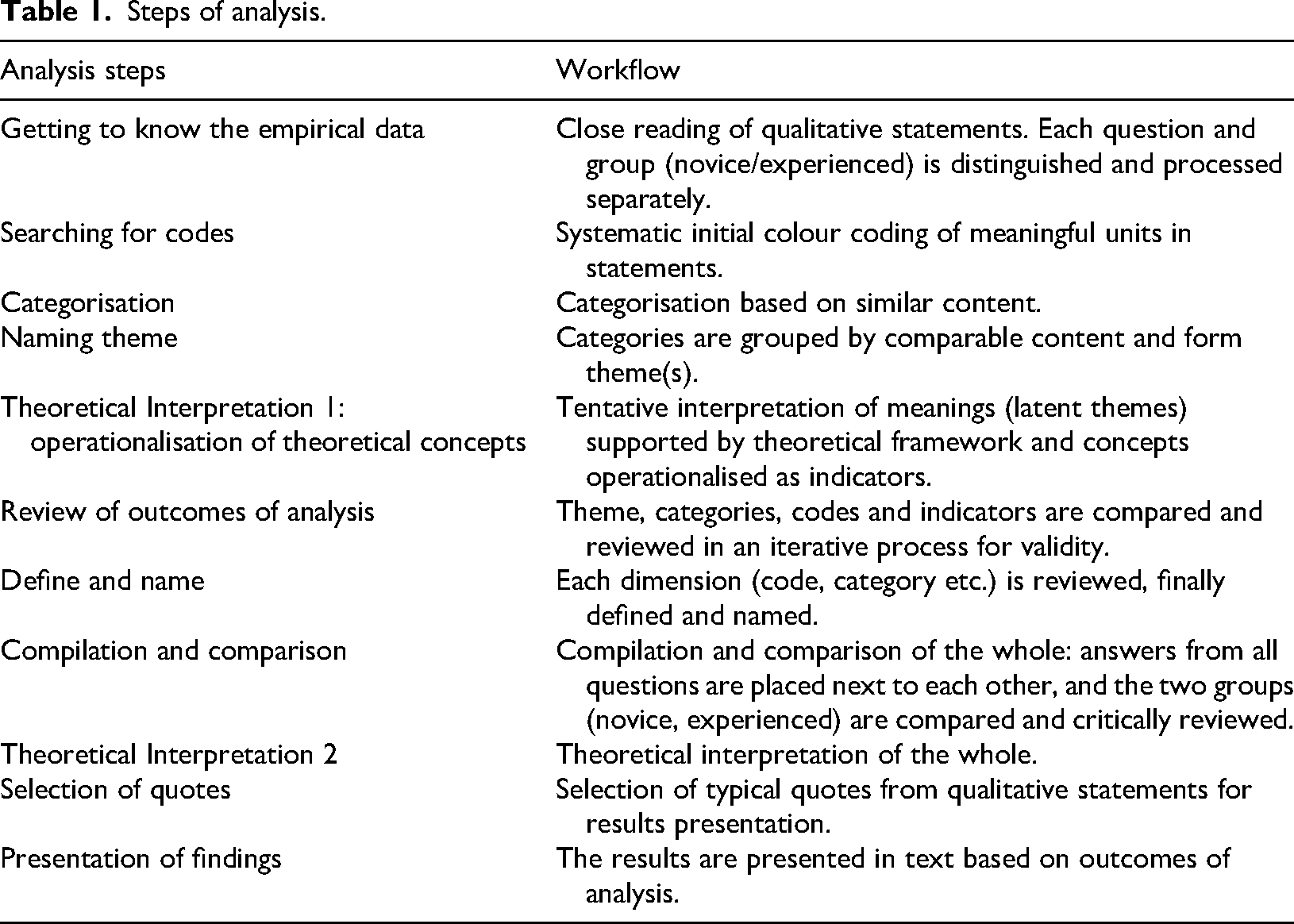
The abductive analysis overall followed the steps of data reduction, data display, conclusion drawing and verification (Levin-Rozalis, 2010; Miles et al., 2020). The specific analysis steps, heavily inspired by Braun and Clarke (2006), are shown in Table 1. In the initial stage, survey data were closely read. Each question and group (novice/experienced) were distinguished and processed separately. Initial colour coding of meaningful units in statements was conducted. Categorisation were conducted based on similar content and together formed a theme of ‘The possibilities and limitations of school leadership’ within the overall aim of the study. Tentative interpretation of meanings (latent themes) supported by theoretical framework and concepts were operationalised as indicators. Thereafter, theme, categories, codes and indicators were compared and reviewed in an iterative process for validity. The theme, categories, codes and indicators are shown in Table 2.
Steps of analysis.
Theme, categories, codes/factors and indicators.
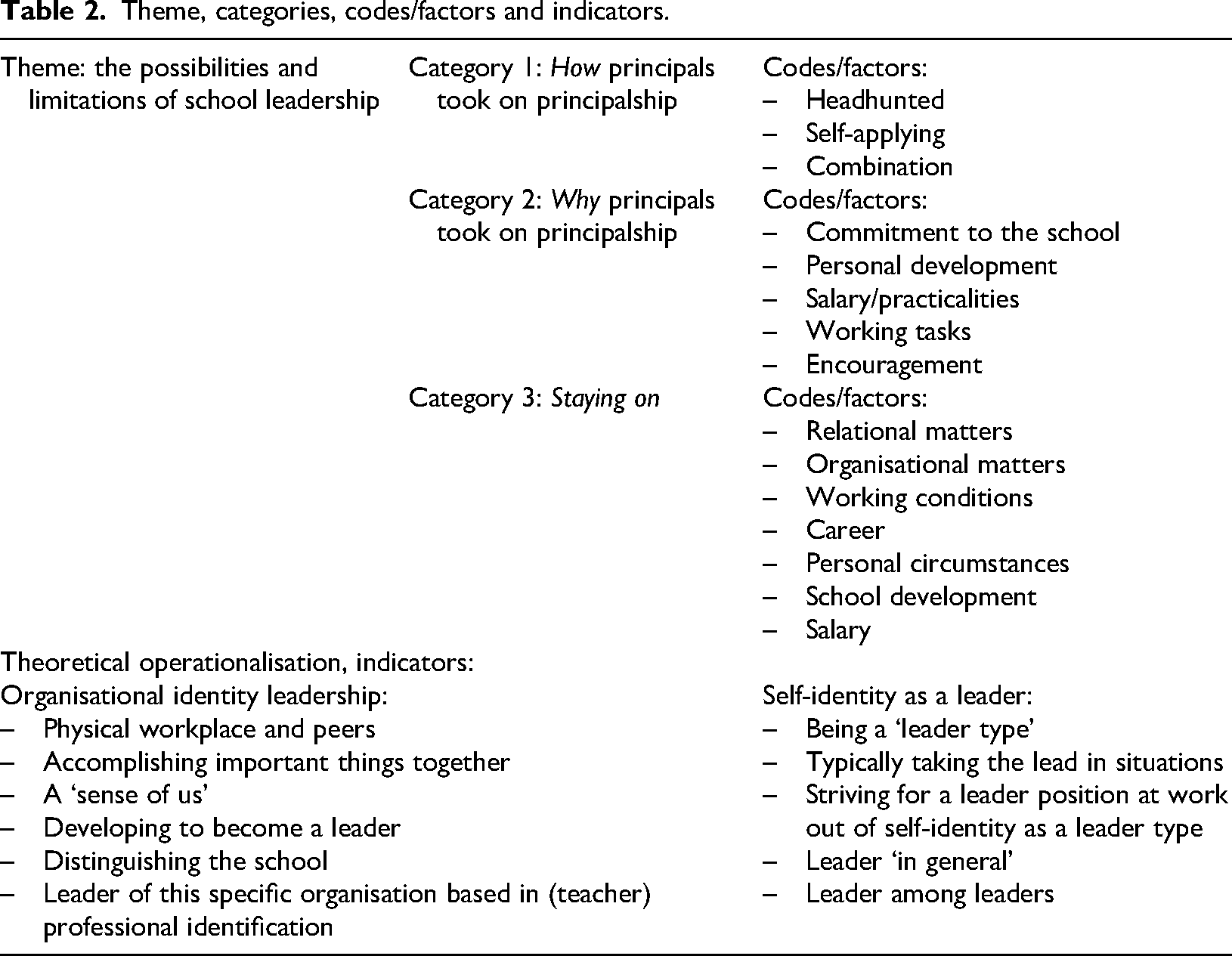
Interpretation of results and conclusion drawing were guided by the theoretical framework, specifically considering professional identity formation (i.e. transition from teacher to principal). The theoretical concept of organisational identity leadership was operationalised by the indicators of: physical workplace and peers; accomplishing important things together; a ‘sense of us’; developing to become a leader; distinguishing the school and identification as a leader of this specific organisation based on (former) professional identification. The theoretical concept of self-identity as a leader was operationalised by the indicators of: being a ‘leader type’ typically taking the lead in situations; striving for a leader position at work out of self-identity as a leader-type; leader ‘in general’; identification as leader among leaders. In all, the methodology and linked analyses made possible to getting close to practice and context; the ‘how’ and ‘why’ of principalship, leading further to values of persons and society (Flyvberg and Sampson, 2001: 129–140).
The findings are presented in the next section by the categories and codes from the analysis – in all framed by the overall theme – possibilities and limitations of school leadership.
Results
This section presents results framed by the overall theme–possibilities and limitations of school leadership – in the processes of identity work while taking on and remaining in the principalship, from 141 novice and 20 EPs, regarding engagement, action taking and experiences. Individual responses could conclude varied codes, while a few (less than four) participants occasionally skipped a question. The results present novice and EPs separately, using the three categories of how principals took on principalship; why principals took on principalship; and staying on in principalship. Factors, appearing as codes, are unpacked, and indicators, operationalising theory, are used to give a detailed picture.
Novice principals
How NPs are taking on principalship
Explicating the how category, it was slightly more common to have been headhunted, that is, personally asked to take on principalship (62) than to self-apply (58) among the NPs in the study. However, some principals reported a combination of these two routes (16) or that they had started their own school (four). These statements provide typical examples: I was offered the position of deputy principal at the school where I was a teacher. I first applied for several principal positions with municipal employers but did not get them. I applied for the one I have and got it. I was asked by the school director of the municipality to apply for the position. I just applied for it and got it.
Why NPs are taking on principalship
Explicating the why category, the NPs’ motives fell into five factors/codes:
Commitment to one's own local school organisation and the education of children and young people (52) Need for personal development or challenge in working life (43) Salary and other benefits, practical or technical conditions (33) Interest in working tasks; budget, responsibility, management and strategic work (24) Encouragement or external pressure (14)
Each of these is further described and analysed below.
NPs’ commitment to their school
The NPs’ motivation for taking on leadership was primarily a wish to contribute to their local school organisation (52). For many, this felt like a natural step in their journey, as they had already taken responsibility and invested their engagement in their school. This formed the basis for a strong organisational identity. In the reflection protocols, the most recurring statements were along these lines: I saw the need for the school management in my school to be supplemented and knew the operations very well. I felt it was time to take a further step. I have always been interested in school development and worked closely with my previous manager. Taking over from her was a natural step, as no one in the staff group saw that we would benefit from bringing in someone from outside. I felt safe in the organisation and the school form; I wanted to contribute to development. Development at the workplace I love and have a heart for! To be able to participate in developing my school unit. To make a difference for the children in our school and to encourage and elevate teachers in their professional roles. I am deeply committed to community engagement; I want to support and improve the local community through a strong educational institution. I enjoy seeing how the school can develop to benefit the children, based on the opportunity a principal has to control their internal organisation. I am motivated by working in a strong team that together shapes and creates the conditions for good educational activities. I want to make a difference for students and teachers and, in that way, contribute to society.
NPs’ wish for personal development
When applying for the role of principal, a wish for personal development or personal challenge was a motivating factor for many individuals (43). This can be interpreted as relating to the self-identity dimension, but it also aligns with an expanding career orientation. Participants stated: I felt accomplished as a teacher and was looking for new challenges. I wanted to develop and learn new things. Challenges, the feeling that I have something to contribute, that my skills can help improve the school. I have always been very interested in school issues and wanted to test the possibility of improving and influencing the school in a different role, a leadership role.
However, when reflecting on the main motivation that engages them to remain in their work, fewer individuals mentioned personal development or challenge (20). This can be interpreted as indicating that the desire for such development was a driving force when seeking a principal appointment, but that this wish had largely been fulfilled once in the role.
These results call for organisational identity leadership because so many NPs emphasises their motivation to be based on their development within their school to become a leader as a ‘natural step’ based in their former (teacher) professional identification.
Salary and benefits combined with interest for working tasks
While searching for their first principal position, practical matters were mentioned as a driving force (33). This included earning a higher salary, gaining greater autonomy regarding working hours and location, enabling better work–life balance and having a shorter commute: My family and I were moving to this municipality. There were no jobs as a special education teacher, but there were jobs as a principal. I applied for such a job instead. The opportunity arose to stay with my employer but in a new position as a principal, and I thought I wanted to give it a chance. The salary increase was also attractive. I had a personal situation, making it beneficial to have more flexible working hours. I also thought it seemed like an interesting job.
Encouragement
Gaining encouragement and support or experiencing social pressure was also mentioned (14) as a reason for initially taking on a principalship. However, no principals cited this as a motivation for remaining in the role. This suggests that taking on a principalship is negotiated within social spaces involving others, linked organisationally to physical workplace and peers.
To stay on as a NP or change jobs
Most NPs stated that they would not change jobs in the next few years (88). They argued that being in the middle of school development work obliged them to ‘harvest’ their efforts. Relational matters were also mentioned as a motivation for staying, as they cared for and felt loyalty to their organisation and its members, including peers, employees and senior management. Some noted that their salary was satisfactory enough to remain in their role. Other reasons cited for staying included good working conditions, a reasonable boss, proximity to a pension or personal circumstances that made changing jobs impractical at the time. If the organisation had recently undergone a reorganisation that improved conditions or created a new role with responsibilities for the individual, this was also mentioned as a reason for staying. A few principals (four) stated that they would not change jobs simply because they had just started: No, hold on and persevere until retirement. No, I enjoy the profession. It is developing and stimulating. No, I get on incredibly well with my principal colleagues and have fantastic working conditions and a good salary. No, I’m happy where I am. I want to see the development of what we’ve started.
Additional reasons included having an unreasonable boss, not receiving fair treatment, unsatisfactory conditions or an overly broad assignment, unsatisfactory salary or reorganisations that had not turned out positively for the individual. Strained working relationships negatively affecting work were another reason given, with some stating that they wanted to try principalship in another school. Only a few said that they would leave because they did not want to work as principals at all. Yes. I feel like I want to move on to new goals and more personal development. I don’t know, I enjoy the assignment I have now, but my superintendent doesn’t make it easy to control my internal organisation, which demotivates me. Today I am an assistant principal, and I think I will apply for full principal positions. Yes, I think elementary school is quite stressful, lacking older students. Yes, the job is overwhelming. Little time to be the present and the pedagogical leader I want to be.
In all, about one-third stated that they had searched for or been offered other principal assignments after their first one, while just as many had not. About 17% had not sought other jobs but had still been invited or offered other principal assignments. A few NPs did not answer this question.
Experienced principals
How EPs are taking on principalship
EPs were divided between having been personally asked to take on principalship (headhunted) and simply applying for the position themselves (self-applying), with some mentioning a combination: I was asked and somewhat ‘persuaded’ to become principal of the school where I worked. I applied through the job bank. I don’t remember if I applied for more positions, but I got the job I applied for. I was an assistant principal but had to take on a temporary assignment as a full principal. I then applied for the position when it was advertised as a permanent position.
Why EPs are taking on principalship
Regarding EPs, the arguments and motives for becoming a principal in the first place were evenly distributed across three main reasons:
Commitment: a will to contribute to the organisation (seven): At that time, I wanted to be involved in developing the school operations and organisation by drawing attention to and identifying certain areas for development. A need for personal development (seven): It was a chance for personal development. Encouragement (or social pressure) as motives for taking on principalship from the start (seven): My principal at the time encouraged me to apply for the principalship as he believed I had the right qualifications. A colleague also encouraged me by saying that I would regret it if I didn’t try.
In addition, some mentioned an interest in specific work assignments, and a few referred to higher salary and other practical matters as important factors in their initial decision to become a principal.
Each of these reasons (factors) is further described and analysed below.
EPs’ commitment to the school, students and staff
Reflecting on what engaged them to remain in principalship, EPs mainly highlighted the will to contribute positively to their organisation. Compared with NPs, however, they expressed this motive in a broader sense (15): School development and relationship building. Want to ensure that students receive the best education and environment possible. To see students and teachers succeed. To see that my leadership makes a difference. Want to feel like I have meaningful work where I can influence and make a difference.
Personal development, practical matters and working tasks as an EP
In descending order, salary and autonomy were mentioned most frequently (five), followed by the need for personal development (three) and interest in the assignment and tasks (three): That I have a lot of freedom and the trust of managers and employees. Development within my field, to constantly develop and learn more. I want to work even more strategically, and I know that my strength lies in seeing organisations from an overall perspective. I want to develop and improve the organisation.
To stay on as an EP or change jobs
Among the EPs, about half (10) stated that they were not planning to change jobs in the next few years, although one had recently done so. Positive working conditions and strong professional relationships were mentioned as key motives for staying on at their school. No. I work at a very well-functioning upper secondary school, with the school director operating at the school with a team of four principals. In addition, I have a very well-functioning work team, and there is a good atmosphere at the school with very nice students. I find it difficult to see a better, or even equivalent, school within commuting distance of where I live. No. I believe that relationships are the key to successful work and that continuity creates the conditions for good relationships. Well, after 10 years as principal in the same school, it is soon time to do something else. However, I have difficulty seeing myself working for another employer. No, I’ve only been in my current job for 1.5 years. I need at least 5 years to deliver school development. Yes, due to personal reasons, moving to another part of the country. Yes. I’m under-stimulated. Curious about career advancement as a superintendent if the opportunity arises. Whether I choose to resign or not, I haven’t decided yet; it depends very much on how the new employer describes their organisation and what role the school principal plays in it.
Discussion
Organisational identity scholars have rarely focused on school leadership (van Knippenberg, 2016). Therefore, the results of this study represent an important contribution to knowledge by presenting a detailed picture of what engages individuals to take on and remain in the role of principal. This study highlights an evolving principal identity that thrives on commitment to a particular school rather than on self-identity as a leader (cf. Haslam et al., 2022). This is so because for both novice and EPs, the primary motivation for assuming school leadership is shown as a desire to contribute to their school organisation. Taking on principalship in an organisation with which one identifies – to pursue ‘development at the workplace I love and have a heart for’, as one principal in this study expressed – is a strong motive, highlighting that local conditions influence commitment. By former research we know this apply in general (Aas and Vavik, 2015; Crow, 2006; Ritacco and Bolívar, 2019). This study contributes by highlighting how organisational commitment apply in the very process of taking on principalship. For many principals in this study, this represented a natural step in an ongoing journey of engagement within their school, forming the basis for a strong organisational identity (Haslam et al., 2022). Accomplishing meaningful goals together in the school – creating belonging, unity and cohesion – supports strong and effective principalship, since leadership identity needs to rest on a stable organisational identity and function integrative across organisational, personal and professional identities (Haslam et al., 2022).
Organisational identification has been considered a critical construct in other fields (e.g. Ashford and Mael, 2024). This study contributes by showing how organisational identification applies in schools and, moreover, promotes evolving school leadership by long-term engagement for a certain school, including the students and teachers there. In former school leadership research, organisational identification has sometimes been anticipated; however, Spillane and Anderson (2014) found that NPs centre their sensemaking on challenges of organisational legitimacy, which calls for identity work on organisational matters. Caring deeply for one's school, students and staff – and striving to make a difference for those one cares about – affects job satisfaction and brings a moral dimension, as one EP in this study expressed: ‘wanting to feel like I have meaningful work where I can influence and make a difference’. This core value is important for principal employers to consider because commitment also brings value to the organisation. Leadership identity is therefore not solely individual but also collective, formed through organisational negotiation and shaped by local conditions that influence commitment (e.g. Aas and Vavik, 2015; Crow, 2006; Ritacco and Bolívar, 2019). The results consequently highlight important critical aspects of identity formation that motivate a teacher to take on and enact the role of principal (Scribner and Crow, 2012).
This study also provides a nuanced picture of identity work and social identity negotiation that principals engage in (Ashforth and Mael, 2024; Wenger, 1998) within processes of becoming and remaining in principalship (Alvesson and Robertson, 2016). That is, principals’ identity work can be understood as a critical aspect of taking on and remaining in the role of principal, specifically considering the organisational identity dimension. The results show that organisational identity plays an important role in the process of becoming a principal, and over time, it develops into an integration of organisational and professional identity (Nordholm et al., 2023), encompassing both a sense of belonging to the organisation and to the principal professional group (Saarukka, 2017). This broader perspective aligns principals’ understanding of the role with societal expectations (cf. Ashforth and Mael, 2024). Motives such as caring for school development (organisational identity), finding belonging within one's school (social identity management), pursing further personal development or challenge (an expanding teacher career) and becoming a full principal (process of career) suggest that principals’ identity work in taking new career steps involves a modulation between self-identity and social (collective) identities (Ashforth, 2016; Kreiner and Murphy, 2016; Watson, 2016; Wenger, 1998). That is, individuals who do not initially see themselves as school leader types can also assume leadership roles and develop a leader identity over time (cf. Haslam et al., 2022).
This study concludes that when identity clashes occur, principals are more likely to resign and seek other workplaces. In this way, the study provides a nuanced description of the tensions and ambivalence that the transition to principalship can involve (Prado Tuma and Spillane, 2019), creating not only a feeling of loneliness but also a sense of non-belonging (Ritacco and Boliviar, 2019; Spillane and Lee, 2014). Moreover, these tensions can lead principals to narrow not only the scope of their role but also the scope of their identity (Wenger, 1998).
Most principals in this study stated that they would not change jobs, as they are committed to conclude school development work. Relational matters were also mentioned as motives for staying, including peers, employees and higher management (Brewer and Gardner, 1996). This reflects a strong loyalty to their organisation, encompassing social, organisational and relational identity (Ashforth, 2016). However, factors such as experiencing an unreasonable boss, not receiving fair treatment, having to cope with unsatisfactory conditions or overly broad assignments, unsatisfactory salary and re-organisations that negatively affected the individual were cited as reasons for leaving the workplace – representing identity clashes that could not be resolved. This is important knowledge as nations increasingly struggle to recruit school leaders (e.g. Doyle and Locke, 2014; Snodgrass Rangel, 2018; Zepeda et al., 2012).
Overall, NPs may have a vague awareness of their professional identity – an identity that can also be fragmented into several dimensions (Bolívar and Moreno, 2006; Jerdborg, 2022; Nordholm et al., 2023; Sarukka, 2017) – but their awareness of their ambition to bring value to an organisation they care deeply about is clear and outspoken. In other words, their organisational identity often precedes their professional identity. When this is not taken into account, ineffective leadership practices can develop, in which leadership identity becomes separated, and leaders dissociate from their organisation and employees. That is, employers can play a role in shaping identity crises and ineffective leadership practices without this intention (Haslam et al., 2022; Rammer, 2007).
Among the novice and EPs in this study, it was slightly more common to have been headhunted, or personally asked, to take on principalship than to self-apply for it (Spillane and Lowenhaupt, 2019). That is, both self-identity and social identity were involved and sometimes intertwined in the step towards principalship (Ashford and Mael, 2024; Wenger, 1998). Both groups shared an organisational commitment and a desire to contribute positively to their organisation as their main motive for continued engagement in work; however, EPs expressed this motive in a slightly broader sense than NPs. Principals were also motivated to principalship by interest for professional development, expanding into broader areas of professional knowledge. That means, important aspects of the school (Hallinger, 2018) need to be considered by principal employers and that the process of taking on principalship as identity work is rather about development and expansion of the teacher career than a shift to a new path (Spillane and Anderson, 2014). In this process, support from (teacher) colleagues plays an important role (Blanton, 2013; Dyke et al., 2012) showing the impact of social relations at work, influencing both individual satisfaction and organisational effectiveness (Ashford and Mael, 2024).
In all, the empirical findings provided new insights on organisational identity matters in principal trajectories. As the overall discussion, in light of previous research show, important knowledge contributions were provided, for example by nuancing and specifying motifs and engagement of principals. Some shortcomings also come to the fore and should be addressed in future studies, for example, relating the societal problem of recruitment deficits to the analytical level of individuals in processes might not be the best procedure as there are also other important factors in play that were not considered by this study.
Methodologically, the study design provided for rich empirical data on principal pathways and motifs. However, future studies should address the methodological shortcomings of this study such as providing a better balance in the number of participants from different groups.
Further, as this study show organisational identity as a strong motif for taking on principalship and a broadened engagement regarding EPs, future studies should preferably consider how organisational engagement of EPs from different school forms might differ. This could be specifically important because in this study there were rather many preschool principals attending (37% of NPs and 25% of EPs) and Nordholm et al. (2020) formerly noticed a slightly higher interest for the surrounding community among preschool principals in relation to other principal groups. Moreover, the group of prospective principal candidates, not yet principals, could provide further insights into these matters and should be in focus in future studies.
Theoretically, the study rest on a sociocultural and organisational identity foundation and uses organisational identity constructs as analytical lenses. This approach is of importance for providing a nuanced picture of identity work in process, and frames in what ways organisational identity matter in processes of becoming and remaining principal; indeed contributing to school leadership identity research by providing a rich theoretical frame. However, there are also limitations such as considering ‘what is left in the shadows when directing light to organisational matters’. That is, future research should direct light to these shadows by using other constructs or operationalise theory differently.
Conclusion
This study contributes to educational research by deepening our understanding of principals’ identity work in relation to taking on principalship and remaining in the role. This identity work shapes an evolving principal identity – thriving on commitment to a particular school rather than on self-identity as a leader – creating a sense of belonging, or non-belonging. This means, principals’ identity work can be understood as a critical clue to taking on and remaining in the role of principal, specifically considering the organisational identity dimension.
The study result has immediate implications for principal employers. To meet the increasingly challenging task of recruiting school leaders, employers need to consider not only self-identity aspects but also relational, organisational, professional and other work-related dimensions, as these are strong motives for both novice and EPs. Moreover, many individuals are driven by a desire to develop, learn new things and take on challenges in relation to their work. This has immediate implications for how to address the challenge of recruiting school leaders. This means, further research is needed on how principal employers actually support and ease the challenges faced by principals, to enhance our understanding of the outcomes of these processes.
Footnotes
Acknowledgment
The author acknowledges and appreciates human English language editing of this article.

Ethical approval and informed consent statements
According to the Swedish Ethical Review Authority guidelines, ethical approval was not required for this study. All procedures adhered to National Institutional Guidelines and ethical standards. All participants were provided written and verbal information about the study including study purpose, sampling and analyses and the voluntary participation including information on how to refrain. They gave their written consent for participation and publication. This is also described in the Methods section.
Funding
The author received no financial support for the research, authorship and/or publication of this article.
Declaration of conflicting interests
The author declared no potential conflicts of interest with respect to the research, authorship and/or publication of this article.
Data availability statement
Supporting data are not available. Sharing supporting data would risk the anonymity due to context-specific circumstances, and participants did not give consent for sharing data in this sense.