




Abstract
This article explores global talent flows in a Chinese context before and immediately after the introduction of Covid-19 measures by focusing on European researchers’ migration experiences as liminal experiences betwixt and between space, institutions, and countries. These experiences are part of a broader understanding of global talent flows in a period where the Chinese economy is transforming from production-based to knowledge-based but simultaneously challenged by a global pandemic. Working with a mixed dataset that includes both semi-structured interviews and survey data, the paper finds that European researchers are under the impression that they are considered a valuable resource by their host institution. The paper explores the value of European researchers in China through the resource-based view and connects it to their ability to connect their Chinese institutions internationally and introduce new publication possibilities. However, by combining bridge decay with liminality, this paper also concludes that the liminal position that European researchers find themselves within is also a significant risk as some of the elements that make them valuable might be challenged by periods of crisis. Finally, China offers an extreme case as a rising science nation that is important to study continuously but even more so during a crisis.
Introduction
This paper discusses recent developments in talent mobility within research and academia related to China. The paper draws attention to international talent as an intangible asset contributing to knowledge creation by bridging relational gaps between Chinese and international academia regarding international networks and publications. It does so at a time when China has established itself as a nation that invests heavily in R&D. According to both UNESCO Institute for Statistics (2020) and the OECD (2021), China is currently the second-largest investor in R&D globally, only superseded by the USA However, China is catching up, and if the trend continues, China will likely become the largest spender on science and technology globally and, therefore, increasingly significant in determining global talent flows beyond the West (Ewers et al., 2021).
The increased spending on science and technology also illustrates a development where China is becoming increasingly attractive as a country destination for researchers (Li et al., 2020); however, foreign researchers in China feature relatively seldom in the academic literature (Han, 2021; Kim, 2015; Larbi & Ashraf, 2020; Wang & Miao, 2019; Wang & Chen, 2020; Xu et al., 2022). Moreover, while the cross-border mobility of talent is challenged in knowledge-based economies both by Brexit and America’s first policies, which emphasise economic and political nationalism (Horak et al., 2019), the Chinese response to the pandemic has likewise been fierce. The Covid-19 pandemic has closed the Chinese borders quickly for foreigners, even for foreign talents, for an extended period (Mouritzen et al., 2020; Nehring & Hu, 2021).
Consequently, this paper asks two questions: why are foreign talent, especially researchers, important to Chinese research institutions? How can we understand the challenges that a prolonged crisis such as the Covid-19 pandemic has on foreign talent in China?
Do you still plan to return, or has this disruption permanently changed your career plans?
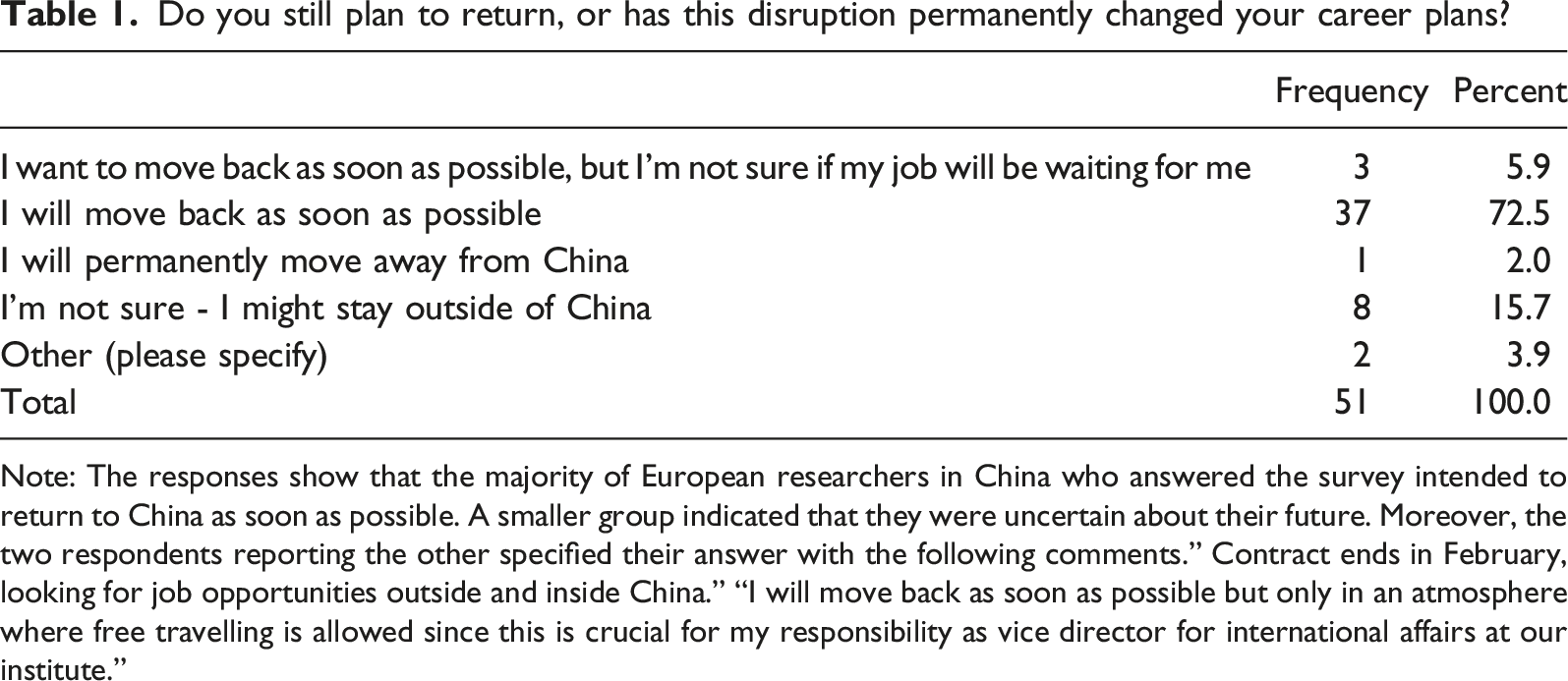
Note: The responses show that the majority of European researchers in China who answered the survey intended to return to China as soon as possible. A smaller group indicated that they were uncertain about their future. Moreover, the two respondents reporting the other specified their answer with the following comments.” Contract ends in February, looking for job opportunities outside and inside China.” “I will move back as soon as possible but only in an atmosphere where free travelling is allowed since this is crucial for my responsibility as vice director for international affairs at our institute.”
Even though the pandemic has blocked foreign researchers in China, this paper is based on the increased interdependence and subsequent easing of mobility, particularly for high-skilled workers (Solimano, 2010), that also seemed to take place in China (Liu & Ahl, 2018; Shachar & Hirschl 2013). Simultaneously, migration has become increasingly formalised so that passports and visas determine mobility opportunities. While different arguments can be made in terms of whether the formalisation of migration promotes mobility or restricts it, Kyle Griffith (2019) points out that labour mobility impacts talents in particular and makes skilled workers move to a more considerable degree, particularly if they possess a “western” skillset. “Western-style managerial experience, as well as Western certifications, remain highly valuable in international labour markets. The ‘global war for talent’ reaffirms the prestige of Western qualifications” (Griffith, 2019:426).
Although he stresses the importance of “western qualifications”, Griffith likewise points out that economies in emerging economies, such as the BRIC countries, have seen a transition towards a knowledge-based economy and information work and are thereby becoming increasingly significant actors in the ever-intensifying ‘global war for talent’ (Griffith, 2019), which resonates with the findings of Ewers et al. (2021). Similar findings highlight that economic growth gradually enables a shift from cheap unskilled labour to knowledge workers, which provides substantial political changes. As a result of this transition, “attracting and retaining talents has become a vital part of China’s competitive strategy in the globalisation process” (Harvey 2014: 3). On these grounds, China has introduced a more straightforward set of rules for foreign talent in multinational corporations, start-ups, and concerning research specialists (Liu & Ahl, 2018; Harvey 2014). While most researchers with a “western skillset”, as defined by Griffith, have been Chinese who returned from overseas, talented foreigners have likewise migrated to China (Wang & Miao 2019).
Methods
The first notable reflection that emerges from selecting this group of people migrating from the global north to the global south is that they are heavily understudied (Wang & Chen, 2020; Xu et al., 2022). Partly, this is because they are a very recent phenomenon and because their opportunities to research in China have only emerged relatively recently (Miao & Wang, 2017; Wang & Chen, 2020). The studies carried out by international researcher in China usually includes a mix of respondents in different disciplines stemming from diverse parts of the world, with a range of 18 and 41 respondents (Farrer, 2019; Kim, 2015; Larbi & Ashraf, 2020; Wang & Chen, 2020).
This study contributes to the emerging literature on foreign researchers in China with a mixed-method approach that applies both an ethnographic data collection, a mixture of unstructured interviews and recorded semi-structured interviews (Stepputat & Larsen, 2015) with 30 respondents and a structured approach to data collection based on survey interviews (Singleton & Straits, 2012) collected in collaboration with Euraxess China (EURAXESS, 2022) an EU mobility organisation working with European researchers globally.
The qualitative data collection was initiated in February 2019 and lasted until August 2019; while supposed to be repeated in February 2020, the emergence of Covid-19 changed the research design. The second round of fieldwork was planned to overlap with the development of the survey. The field work and the work on the survey should have been based from Beijing starting in February 2020, however, became impossible to realise in practice as Covid-19 hit. Instead, the second survey on the state of researchers’ mobility was developed remotely in collaboration with Euraxess and completed in mid-August 2020, while some interviews moved online as well. As the title suggests, Euraxess China completed the first survey on the state of researchers’ mobility the year before, in 2019, and this study draws on material from both surveys. As such, the research design takes on a mixed method or complementary methodological style with two complementary elements in a qualitative quantitative setup (Morse & Niehaus, 2009). Including a structured questionnaire has maintained robustness and rigour that is otherwise difficult to obtain during a crisis and disruption (Gioia et al., 2013). Although mixing the two data sources in this way was somewhat forced upon the study rather than chosen, the combination of qualitative interviews and survey material still works to saturate the field. It allows the project to make substantial claims about the current situation (Saunders et al., 2018), particularly as the survey material is utilised in a descriptive rather than predictive manner. However, the findings in this study should still be considered within a context relating to the Covid-19 pandemic, and they reflect the situation in the early stages of the pandemic.
Researchers as talents
The concept of talent increasingly refers to a diverse skillset (Michaels et al., 2001) as it does for Kerr (2018), who describes talents as a golden gift, which is in many ways similar to the much older definition when the concept referred to a unite of weight and a sum of money.
Focussing on European academic talent in China requires paying attention to the talent concept’s ambiguity and clarifying what kind of talents the article incorporates. In this regard, the talent concept can incorporate various individuals, such as Nobel Prize winners, athletes, high-tech personnel, medical staff, entrepreneurs or individuals holding large fortunes (Kerr, 2018:19–20; Kirk et al., 2017; Shachar, 2006; Shachar & Hirschl 2015; Thorn & Holm-Nielsen, 2008). However, academic or research talents are limited to individuals who work or study at different kinds of research centres or universities dedicated to knowledge production rather than directly involved with commercial development (Bauder, 2015; Bauder, Lujan, and Hannan 2018; Solimano, 2008, 2010).
Talent’s extraordinary mobility derives from their skillsets and value in the destination country. Researchers contributing value are also recognised in China, where both talented Chinese returnees and foreigners are given prominent roles in developing the economy (Cao et al., 2020; Cao et al., 2006; Wang 2011; Wang and Bao 2015). As pointed out by Kyle Griffith (2019), this was particularly the case for researchers with a “western” skillset. Other authors, such as Farrer (2019), have even attributed it to a kind of ethnic capital. Although this is not always the case, and the bodily experience of being a foreigner in China is likewise challenging for some (Wang & Miao, 2019). While legal scholars find that Chinese talent laws are broadly defined within categories of A, B, and C level talents (Liu & Ahl, 2018). For the European researchers included in this study, the attractiveness of talent is reflected by their pervieved value as illustrated in the table below which spans across disciplines.
Academics as a resource but positioned in a liminal time and space
As Chinese institutions perceive international skills and academics as valuable resources (Ewers et al., 2021; Farrer, 2014; Li et al., 2015, 2020; Liu & Ahl, 2018; S. Harvey 2014), we are invited to think about foreign talents in China through the resource-based view (Fang, 2019). The resource-based view is a strategic framework that focuses on all assets controlled by a firm, which enables the firm to implement new strategies that make them more competitive (Barney, 1991, 2001). Within this framework, utilising an organisation’s knowledge and capabilities to achieve a competitive advantage is essential. Knowledge is a core element of the RBV, and exploring new knowledge or finding ways to exploit existing knowledge within the organisation is critical because knowledge shapes the firm or organisation’s activities (van Rijnsoever et al., 2008). It is suggested by Darroch (2005) that knowledge in itself is both a tangible and intangible resource, but moreover, developing knowledge and innovation often requires individuals within a firm or organisation to go beyond their comfort zone.
Griffith (2019) and Fang (2019) indicated that the resource-based view sees talent as human capital that is both valuable and unique, so the value component relates to the organisation’s core functions and the uniqueness concerning the individual talent’s irreplaceability. While they perceive the resource-based view as a predominately western concept, they note that it is becoming increasingly relevant in traditionally eastern countries as these countries have experienced radical economic growth that allows them to compete in the global war for talent. This suggests that there are good reasons to visit European academics based on a resource-based and knowledge-based view.
Complementing these theoretical assumptions, Lynch and Baines (2004) argue that one can utilise the resource-based view in any higher education setting where organisations compete for resources. While focusing on British higher education, they simultaneously conclude that higher education is internationalising and increasingly competes with institutions from multiple countries. Consequently, the analysis of research institutions’ strategic development and resources should be international. Whether or not the resource-based view is the correct tool to analyse strategy developments depends on a global context and the resources available to each institution attempting to build its strategy. Similarly, Van Rijnsoever et al. argue that a university is a professional organisation whose success depends on the work of the researchers working for the university. As an organisation, it can be regarded as a coalition of members who seek to maximise their own and the institution’s goals. Their study of networks at universities suggests viewing these collaborations at the individual level (van Rijnsoever et al., 2008).
However, at the individual level, it is possible to identify a position for foreigners that is betwixt and between Chinese institutions; on the one hand, they at least were considered an essential and valuable resource for their institutions in 2020, but on the other hand, they have been particularly vulnerable to the changing visa regulation that emerged along with Covid-19 (Mouritzen et al., 2020). A helpful concept to think about this position in a fragile transnational limbo (Nehring & Hu, 2021) is liminality (Thomassen, 2014).
While the concept of liminality originated in the study of rituals first established by Arnold Van Gennep and later developed by Victor Turner (Gennep, 2013; Turner, 1991), the concept is also helpful in speaking of other processes of transition, passage, or disruption and have been utilised in various settings both on the macro and the micro-level (Eisenstadt, 1995; Mälksoo, 2018; Stenner, 2018; Thomassen, 2014). Although liminality is a relatively universal concept in contemporary scholars’ usage of the term, as Thomassen writes, “thinking with liminality serves to conceptualise moments where the relationship between structure and agency is not easily resolved or understood” (Thomassen, 2014:1). Within this context, liminality allows us to consider the period of disruption through the emergence of Covid-19 as a transitional moment of separation and reintegration, such as an international researcher being blocked from returning to China.
How are international researchers regarded at Your institution.
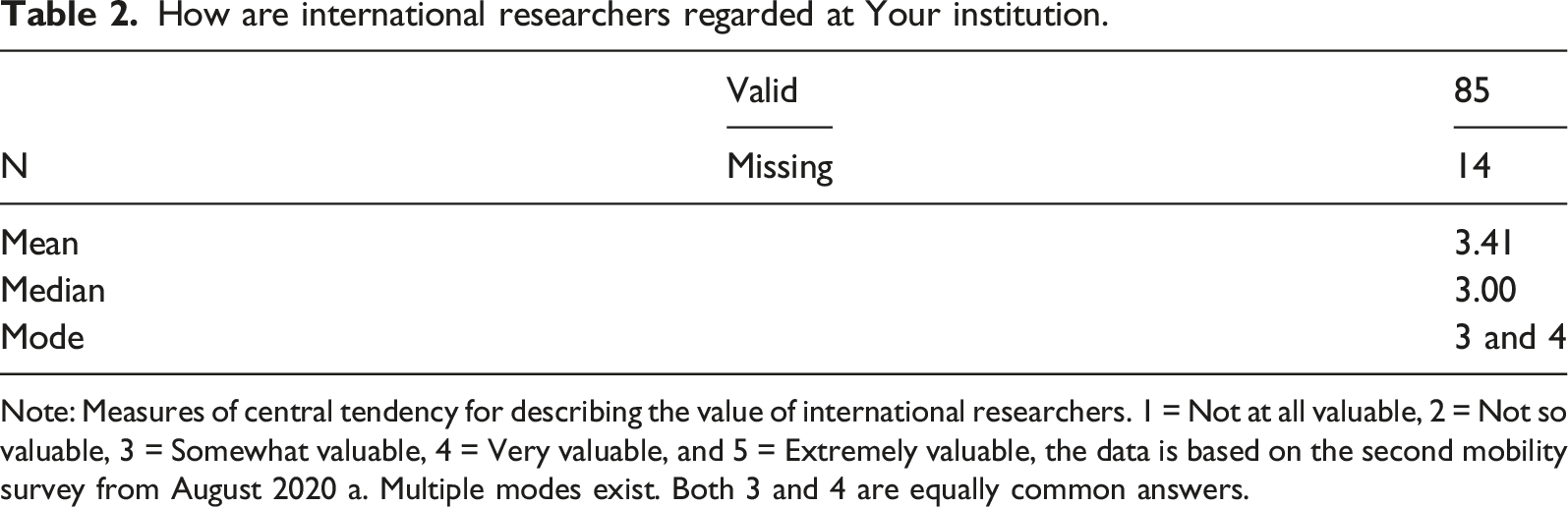
Note: Measures of central tendency for describing the value of international researchers. 1 = Not at all valuable, 2 = Not so valuable, 3 = Somewhat valuable, 4 = Very valuable, and 5 = Extremely valuable, the data is based on the second mobility survey from August 2020 a. Multiple modes exist. Both 3 and 4 are equally common answers.
This study connects the value of networks and researchers’ networks from the resource-based view to the risks associated with a liminal position through Granovetter’s (1973) concept of weak and strong ties but also to the concept of structural wholes as developed by Ronald S. Burt (2002). It does so mainly by focusing on the risks associated with bridge decay. However, as pointed out by Burt, although bridging qualities are of particular value, these networks also decay faster, as he argues: network bridges are critical to the advantage known as social capital, bridges relative to other kinds of relationships shows faster decay rates over time, and the faster decay in bridges has implications for the stability of social capital. … I show that bridge relations are associated with more positive peer reputations and higher compensation, but bridges decay at an alarming rate. Out of 10, 9 bridges this year are gone next year. (Burt, 2002:333)
While this study cannot make the same network analysis as Burt’s, his observations still have crucial theoretical implications. Both because Burt identifies bridging ties as valuable, but even more so because he, as the quote suggests, observes that they decay at an alarming rate. If international researchers are identified as possible bridges between institutions, their liminal position implies that their connection to China can be lost, especially in times of crisis (Table 2).
The liminal characteristics of Chinese academia
Chinese academia has seen significant changes in recent years. These changes include an increase in the funding channelled towards research, as illustrated by the UNESCO Institute for Statistics (2020), which estimates that China is now the second-largest spender in terms of billions of dollars, only surpassed by the USA, spending a total of 372,326.1 M dollars or 2% if the national GDP. It has affected the number of publications where China supposed the USA to produce the most academic articles. In turn, it has affected the number of graduate students and researchers in China, which has considerably increased (Cyranoski, 2020; Viglione, 2020a). Finally, the growth in spending on science and technology in China seems to change migration patterns, first through an increased return migration, but since then, foreign researchers’ emergence in China (Kim, 2015; Li et al., 2020; Wang & Chen, 2020; Zweig et al., 2020). This trend will likely remain as the 14th 5-year plan highly values talents, including foreign talents (Center for Security and Emerging Technology, 2021a, 2021b; Grünberg & Brussee 2021).
As a result of the economic transition, talented individuals and talent management have become increasingly critical components in developing an innovation-based economy in China (Fang, 2019; Harvey 2014). In academia, the new flow of talent towards China has manifested itself through eminent academics who have taken positions in China and become permanent residency holders, such as Bernard Lucas Feringa, winner of the 2016 Nobel Prize in Chemistry; Kurt Wüthrich, winner of the Nobel Prize in Chemistry in 2002; and Robert A. Mundell, laureate of the Nobel Memorial Prize in Economic Sciences in 1999 (Beijin Review, 2019; China Daily, 2018). However, the dominating view is still that China still has a difficult time competing for the most talented individuals, no matter if they are foreigners or Chinese nationals living abroad (Elias & Scotson, 2008; Liu, 2019; Wang et al., 2011; Zweig et al., 2020; Zweig & Wang, 2013).
Part of the explanation can derive from the difficulty in obtaining Visas. An issue that has only increased with Covid-19. Data collected by Euraxess China in 2019 suggested that ‘visa issues’ ranked amongst the most influential factors which affected European researchers’ mobility in China. They point out that this relates both to visa applications, which are often experienced as complicated and the temporal elements of the granted Visas, which often need to be renewed annually and affect the researcher’s mobility internationally. Moreover, green cards and permanent or long-term residence permits are still challenging for those who have not won a Nobel prize. As phased by Euraxess: Most notably, requirements for ‘talent visas’ / green cards remain “prohibitively high”, as one respondent suggested. Inaccessibility to permanent residency does not only mean that one has to go through burdensome annual or bi-annual renewal procedures; it also complicates or even makes it impossible to access other public services, such as registering a vehicle or sending children to public schools in sought after areas in top cities. This ultimately contributes to a very low retention rate. (DEVELOPMENT Solutions Europe, 2019: 10)
Likewise, the Euraxess report notes that visa-related issues extend to spouses, which resonates with this study’s findings regarding foreigners married to foreigners. As phrased by the Euraxess report: Although most talent attraction programs guarantee a full-time job for researchers’ spouses, there rarely is flexibility in case the spouse prefers other alternative types or forms of employment (e.g. self-employment or part-time): one has to either accept the post offered or not work at all, due to constraints with the residence permits. (DEVELOPMENT Solutions Europe, 2019: 10)
However, qualitative interviews and conversations conducted for this project revealed other visa-related issues and marriage approval issues common for transnational couples. These include approving marriages performed outside of China and receiving visas to go abroad when visiting countries abroad; both were particularly dominant for couples where one part was European and the other Chinese. Moreover, foreigners with children are likewise positioned in the in-between, where access to schools and welfare depends on their labour status, university, or spouses’ status. These family-related uncertainties seem to have been enhanced by the Covid-19 crisis, where researchers’ liminal position in China manifested itself to an almost extreme extent.
The Covid-19-related visa issues were highlighted in correspondence with a Euraxess China representative who pointed out that: Everyone whose residence permit expired between March 28 and August 10 lost their opportunity to renew their residence permit and, therefore, couldn´t return in the policy’s first phase. It was not until the end of September that a solution to this was provided, but at that point, it had been too late for many. As a new semester had already started, it meant that some researchers already had other commitments. For others, it meant a considerably shortened timeline to get the necessary visa, resulting in some people not being able to finish the process before the policy got strict again, about 1 month later. (Correspondence with Euraxess China representative)
Were You outside of China when the borders closed on March 28?
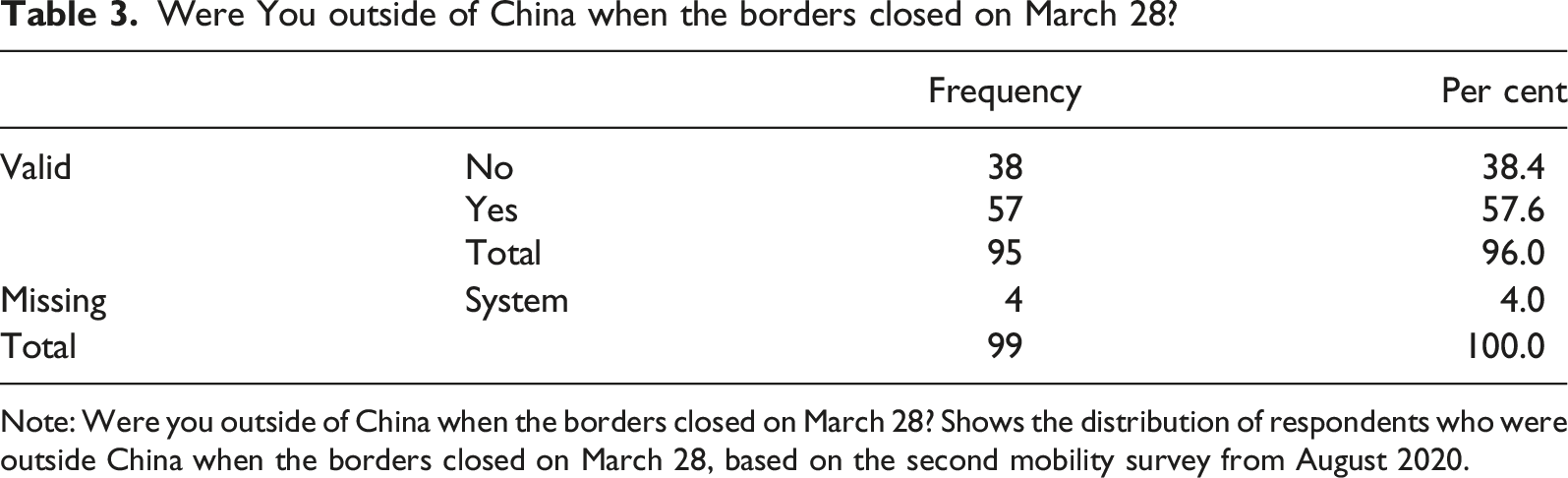
Note: Were you outside of China when the borders closed on March 28? Shows the distribution of respondents who were outside China when the borders closed on March 28, based on the second mobility survey from August 2020.
Of the respondents locked out of China, 51 responded that they could not return to China, while only six replied that they could return to China by mid-August. However, since then, the rules have changed several times, and more respondents might have been able to return to their position in China.
As unfolded in the above quote from Euraxess, many researchers cannot extend their residence permits and return to China; thus, they are barred from accessing their homes and places of work in China. More than anything, the crisis thereby illustrates the limbo that European researchers find themselves within, as their residence permits and contract extensions are challenged by the lack of mobility options available throughout the pandemic. Although it has yet to be seen how academic mobility will recover from the pandemic, both in and outside China, a key aspect has been the extended use of digital tools and platforms allowing for cross-border interaction (Viglione, 2020b; Witze, 2020).
Challenging talent retention and liminal living in China
The restraints on mobility could make it increasingly difficult for China’s institutions to retain top talent connected globally. In the qualitative interviews, the transnational elements and cross-border movement of European researchers in China were often highlighted regarding family, friends, and professional connections. This is likewise clear in the structured interview, where most respondents have emphasised that mobility in their professional and personal lives is critical (Table 4).
A mean, median and mode at 4 suggest that most respondents perceive cross-border mobility as important for their professional lives. In contrast, the mode at 5 and a slightly higher mean regarding the importance of cross-border mobility for respondents’ personal lives can indicate that mobility is even more critical regarding staying connected to family and friends across the globe.
As European researchers and foreigners simultaneously experience being frequently positioned as outsiders in a Chinese research environment (Larbi & Ashraf, 2020), it is not easy to imagine that the personal need for cross-border mobility will be reduced shortly. Professionally the alteration and the move to online participation could potentially alter the need for physically moving across borders. However, foreign researchers face transparency barriers in China. Although some manage to transcend these, others seem to find it a constant struggle to obtain enough funding and time for research (Farrer, 2014). So while there can be traced a perception of China as a new land of opportunities, in which funding for research has been increasing (DEVELOPMENT Solutions Europe, 2016, 2017), this funding or academic life is by no means easy to access and requires the assistance as well as willingness from local stakeholders, which leaves an overwhelming room for developing new talent management strategies. This resounds from a recent publication dealing with western expatriates making a temporary home in China’s emerging global cities. Here the temporal mindset to their time spent is portrayed through the expats’ ideas about their home, and they are, as a group, highlighted as mobile dwellers who are easily capable of either returning to their country of origin or moving forward to the following country and thereby to the next adventure (Cai & Su, 2020).
The finding that academic time in China is temporary resonates well with the qualitative interviews where younger researchers and primarily PhD fellows (all of whom were double degree fellows) tended to pursue career options outside of China once they had finished their degree. To such a degree, not a single PhD fellow responded that they wanted to continue their careers based in China. This finding is not uncommon, and while respondents were generally happy to recommend China to other colleagues, they note that it helps retain contacts and options elsewhere.
These quotes also resonate with the qualitative interviews conducted amongst senior researchers who often stress a positive relationship with their superiors and feel valued at the institution. For the individual researcher considering China as a point of destination, established ties to the Chinese institutions seem to be defining whether they stay or leave, and retention strategies might concern themselves with breaking the relational barriers to working in China either by making the institution more transparent and meritocratic, a point that will be returned to, or through establishing an international network.
Breaking boundaries the liminal position as value-enhancing and bridge decay as risk
Importance of cross-border mobility.
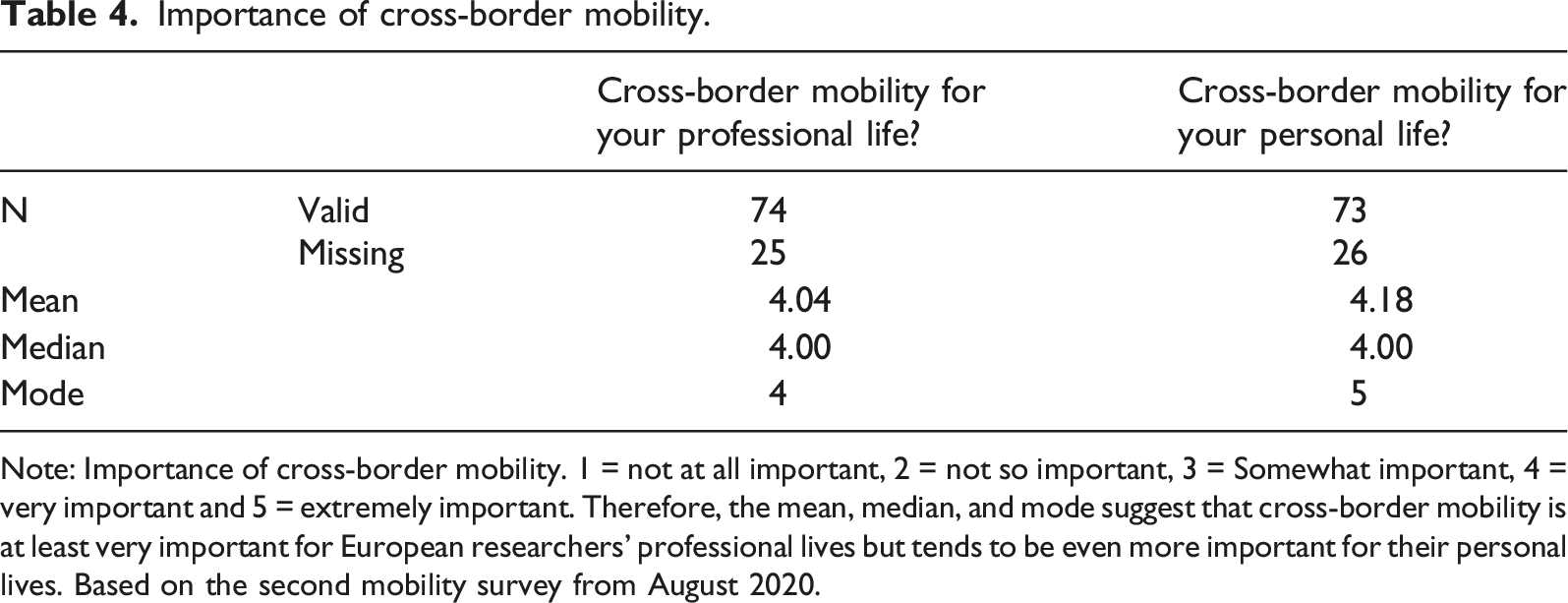
Note: Importance of cross-border mobility. 1 = not at all important, 2 = not so important, 3 = Somewhat important, 4 = very important and 5 = extremely important. Therefore, the mean, median, and mode suggest that cross-border mobility is at least very important for European researchers’ professional lives but tends to be even more important for their personal lives. Based on the second mobility survey from August 2020.
The added value of international researchers.
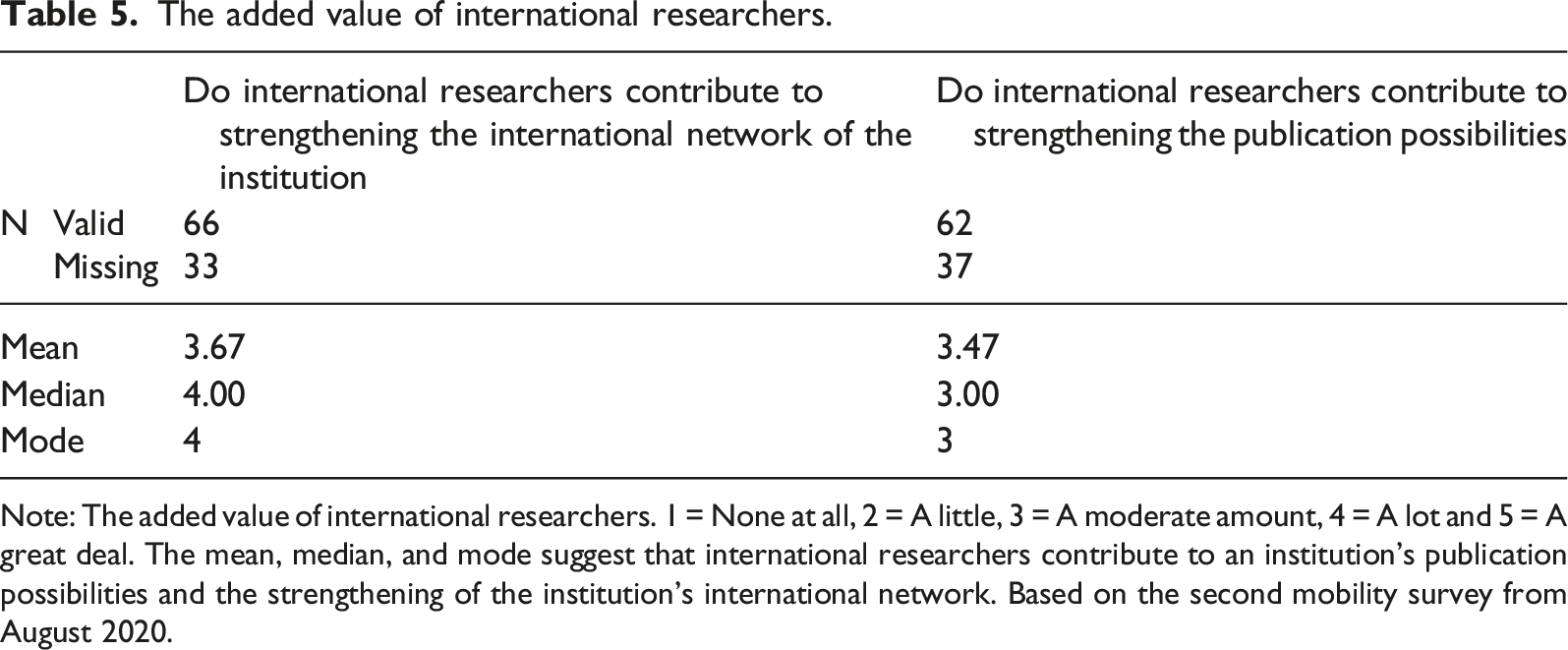
Note: The added value of international researchers. 1 = None at all, 2 = A little, 3 = A moderate amount, 4 = A lot and 5 = A great deal. The mean, median, and mode suggest that international researchers contribute to an institution’s publication possibilities and the strengthening of the institution’s international network. Based on the second mobility survey from August 2020.
While this might be a well-understood finding, which resonates only too well with Granovetter’s (1973) theory of strong and weak ties and the notion of Burt (2004) of structural holes, the ability to bring outsiders seems to be a key to the attractiveness of international researchers in China. When asked about what people he could bring to his department, one respondent gave the following answer: My role is also a role of bringing of bridging, being a bridge, you know. I also think that when the director offered me the job, he also said; with you, we have additional benefits that you can also link and bring people. Maybe I am also more social than other people, so he reckoned that … So if you have some foreigner, somebody from abroad coming people also bring their network and try to expand if they wish, not everybody will do it. But if somebody cares to promote their own career, first of all, it makes sense that you bring people, invite them and try to connect. (STEM researcher interview spring 2019)
This ability to connect the department internationally and bridge across borders seem to be very prominent amongst academics interviewed for the project. One recipient of the prestigious thousand talent program commented on the same question that he had initially asked whether he should learn Chinese or not, to which the director had replied that he would not support that, as he wanted people to speak English here. A goal that our conversation revealed was challenging to reach. In another interview with a thousand talented recipients, the respondent, the only international researcher at the institute, illustrated his role in bringing outsiders through a PowerPoint, which was used to present his experiences as a researcher in China in settings abroad. This presentation included a list of the people he invited for shorter stays during the respondents’ first 18 months at the institution. This list included 12 professors and deans currently based in five distinct countries, some of whom stayed for more than a month and returned the following year. If one recognises the development of soft skills as key to promoting Chinese education, international researchers seem to be pivotal in solving these issues and possess scarce and valuable soft skills.
While the finding that internationals are valuable in terms of bringing outsiders might seem rudimentary, it needs to be perceived in connection to the Chinese context, where much of the literature on Chinese academia stresses guanxi networks as fundamental to understanding the structures of the field (Bian, 2018; Cao, 2008; Yang, 2019). These typically closely-knit ties carry certain advantages and significant drawbacks, much like strong and weak ties present different benefits and disadvantages. As closely tied networks typically define Chinese academia, where Guanxi relations still have a high internal value, the bridging bonds that international researchers bring to their Chinese institutions are likely pivotal in the continued development and internationalisation of Chinese research (Li et al., 2020). When seen in connection to the resource-based view and strategic development, international researchers bridge institutions and organisations and make available external knowledge through their social capital and network. Not only might they possess valuable tacit knowledge, but their networks can cross borders and enable Chinese institutions to establish themselves globally. In a context where research is increasingly performed globally, this ability seems vital for any institution (van Rijnsoever et al., 2008). Finally, they might be capable of teaching soft skills to nationally educated talent; however, whether this is the case or not remain to be seen. When this benefit is considered a stable asset, it is advantageous for academic institutions and entrepreneurial environments relying on these institutions’ talents (Fang, 2019). However, as pointed out by Burt, bridging social ties of high value is at particular risk of decay. Considering this risk in relation to the concept of liminality suggests that the liminal position that European researchers find themselves in is a somewhat dangerous one, to use Thomassen’s (2014) phrasing; because the value they contribute with can quickly be sealed off, and they risk that their possible contribution to Chinese academia becomes irrelevant. For instance, they can no longer function as bridging ties (Burt, 2002) or if China’s publication strategy changes (Li, 2020).
International researchers complement Chinese institutions by extending their publication possibilities within another core academic function. International researchers can connect their Chinese institutions globally; thereby, they are also part of strengthening the organisation’s publication output. That international researcher enhances publication possibilities resonates well with Zweig et al. (2020) findings that Chinese returnees with international experience also enhance publication output. Moreover, this illustrates a point also found in Griffeth’s (2019) work as he stresses the value of western training and education. Even so, the data is not as striking as the material concerning international researchers’ ability to connect different people and institutions. Still, a majority of European researchers respond that internationals at least contribute a moderate amount, with the mean at 3.47, suggesting that part of the explanation is to be found in the significant amount of time for research that many, although not all international researchers have. Notably, those respondents in the STEM sciences who received prestigious reward programs such as the thousand talent program point to the fact that they teach very little and only contribute to administrative tasks to a minuscule extent, and therefore, they are more or less completely free to conduct the research they want. However, respondents also point to their networks as essential factors that make them capable of publishing internationally. Generally, more mobile and less restricted by Chinese and international travel restrictions, international researchers can attend conferences globally to establish connections with collaborators and publishers. Moreover, respondents clarified that they would likely nourish journals’ interest in publishing their work by attending international conferences.
As bridging connections, Europeans are positioned in the in-between and in what can be termed a liminal position. Although filled with opportunities, this position also comes with risks (Thomassen, 2014). European researchers tend to describe Chinese academia as lacking transparency. While the transparency issue seems to go beyond internationals and, for instance, heavily affects returnees (Cao, 2008), international scholars tend to have difficulty manoeuvring the research environment, as illustrated in the table below (Table 6).
How transparent would You say Chinese academia is?
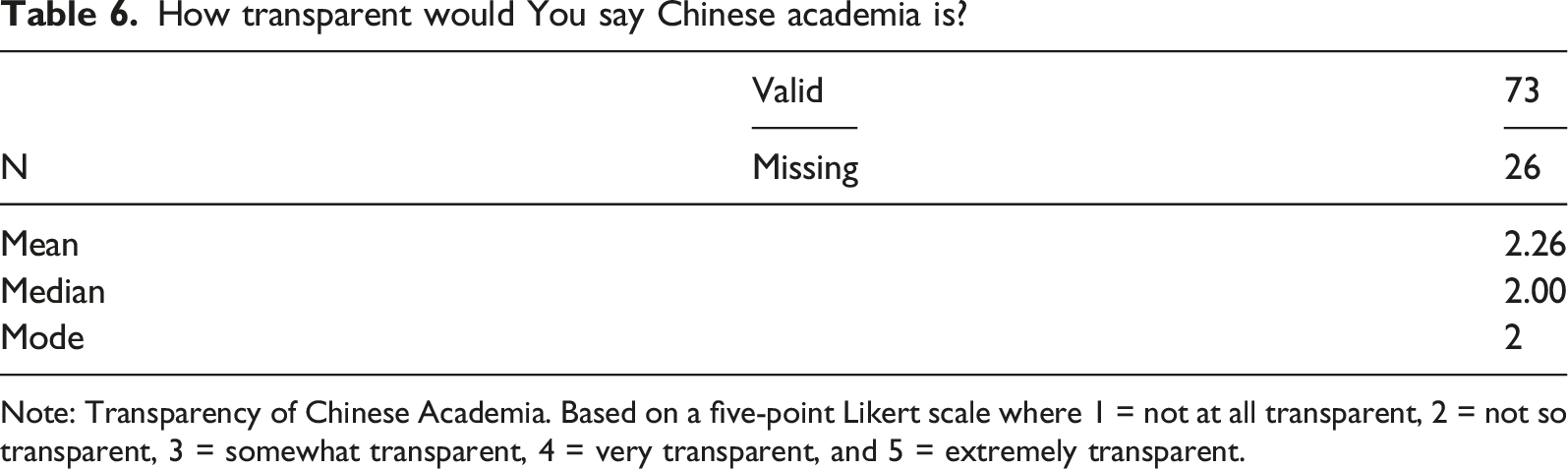
Note: Transparency of Chinese Academia. Based on a five-point Likert scale where 1 = not at all transparent, 2 = not so transparent, 3 = somewhat transparent, 4 = very transparent, and 5 = extremely transparent.
Conclusions
This paper has considered the experiences of European researchers in Chinese academia through the resource-based view. It has done so by perceiving international researchers as a critical asset in developing Chinese academic organisations and external firms’ ability to establish themselves in the global knowledge economy. While the migration of European researchers to China is still tiny compared to global talent migration, it is made possible through China’s increasing demand for and willingness to invest in a talented and specialised workforce. As Chinese academia has consisted of a largely homogeneous group of educated Chinese scholars, this pattern seems to be changing. First and foremost, the literature and the ministry of education reveal that many foreign-educated scholars return to China, taking leading positions at Chinese universities (Li et al., 2020; Zweig et al., 2020).
Additionally, Chinese academia has started including foreign attraction schemes and open access to funding possibilities for foreign scholars (Kim, 2015; Wang & Chen, 2020). While European scholars are still few and far between in China, thereby being considered a rare resource, this study demonstrates that they are perceived to be a valuable resource, which contributes to core academic functions such as increasing the publication output and extending the international network of the university or research institution. Besides giving access to global research communities external to the organisation and increasing publication output, international talent brings other advantages. These advantages include access to a multiplicity of thinking patterns, languages, values, beliefs, and social interactions and, at best, can strengthen Chinese institutions’ ability to train soft skills vital for operating on a global market. Their sheer presence means that international talent is part of globalising China and developing its economy. A core insight that also seems to be recognised by top managers of Chinese universities and research centres (Farrer, 2019; Li et al., 2020). Therefore, Chinese academia still has much to gain from establishing a better research environment for foreigners.
However, European researchers also find themselves in a liminal position where they are betwixt and between a global research environment and local cultural norms and access to information. Most respondents expressed a sense of alienation and distance from Chinese society based on a mixture of linguistic, cultural and network barriers defining their stay and their decisions on whether to stay or leave. Likewise, Europeans perceive Chinese academia as muddy and untransparent, which puts some strain on their flourishing. Qualitative interviews suggest that partnerships and established relations with Chinese partners are essential to surpass this barrier. However, as the survey supporting this study indicate that two-thirds of European researchers were stuck outside China when the country shut its borders for fear of COVID-19, it is likely that bridging bonds and connections established through international researchers are suffering deep wounds, a risk that is particularly grave for bridging connection (Burt, 2002). Therefore, the impact on continued internationalisation in China is essential to study in the coming years, especially considering how mobility restrictions or liberations open for innovation and ideas or close them down.
This paper has illustrated that European researchers seem to contribute to knowledge production in Chinese academia and are even more valuable in establishing bridging connections between Chinese institutions and the international community. It seems unlikely that this will change soon, and the connections established through bridging connections will likely reappear. Nevertheless, China’s reaction to the pandemic and the closing of the Chinese border could significantly impact future mobility patterns. Moreover, the critical role of cross-border mobility in European researchers’ personal lives, in particular, suggests that restrictions, including more extended quarantine periods, would be problematic and pose a risk in terms of retaining talents at Chinese institutions. The concept of liminality (Thomassen, 2014) seems highly relevant to this prolonged crisis and thinking with liminality offers a tool to understand the experience of foreign talent in China. This concept would likely apply to other groups of talented foreigners rather than solely European, although one should be careful with generalising from the sample as different groups of foreigners might also face different risks and challenges. These might stem from political environments or cultural differences. Moreover, Wang and Miao (2019) clearly shows that the bodily experience of being a foreigner changes from individual to individual. In terms of future studies, China presents itself as both an extreme case and a critical one to understand (Flyvbjerg, 2006). As China becomes an even more important actor in global science production, it will likely continue to grow in importance. When or if relatively easy mobility returns to China, this will once again make the study of foreign researchers in China vitally crucial to understand the global talent race (Shachar, 2006; Shachar & Hirschl 2013). In terms of future research, the Chinese case of talent recruitment seems to present itself as one of the most interesting cases to understand in the years to come.
Footnotes
Declaration of conflicting interests
The author(s) declared no potential conflicts of interest with respect to the research, authorship, and/or publication of this article.
Funding
The author(s) received no financial support for the research, authorship, and/or publication of this article.
