




Abstract
Inclusive education has become a new global agenda in educational reform since Salamanca Statement in 1994. However, inclusion in education cannot be realized unless inclusive education teachers enable them to implement inclusive teaching strategies to meet all students’ diverse needs. This study aims to analyze the pupil perspectives of inclusive teaching strategies in Chinese regular primary schools by designing a questionnaire. The questionnaire is developed and validated with satisfactory reliability and validity to collect quantitative data from the 730 students of three regular primary schools in Shenzhen City, one of the largest cities in China. The literature has summarized three dimensions regarding inclusive teaching strategies: ‘values and attitudes,’ ‘management and environment,’ and ‘teaching and instruction’. The results show that these regular primary schools have inclusive values, and students have positive attitudes toward inclusive teaching strategies. Students think that sample schools have inclusive school management and environment concerning inclusive teaching strategies, and some inclusive teaching strategies are used, but others are not so often used in their classrooms. The findings are discussed, and implications for policy and research are presented.
Introduction
Salamanca Statement and Framework for Action on Special Needs Education in 1994 endorsed the idea of inclusive education. It has gradually become a global agenda in educational reform in subsequent years (Ainscow et al., 2019; Hernández-Torrano et al., 2020). To call for more countries to implement inclusive education, international organizations issued numerous official statements and documents to promote equitable quality education for every child. For instance, the Universal Declaration of Human Rights (United Nations, 1948, Article 26) stated that ‘everyone has the right to education.’ Furthermore, the United Nations Convention on the Rights of Persons with Disabilities (CRPD) (UN, 2006, Article 24) indicated that ‘State Parties recognize the right of persons with disabilities to education.’ As one of the state parties, China’s National People’s Congress ratified the CRPD in 2008, with an essential commitment to inclusion for all.
However, there is still a gap between the acceptance of inclusive education by signing the signature of state parties and active inclusive practices in classrooms (Boyle et al., 2020; Qu, 2019). Researchers have great problems in developing more functional studies and successful cases of inclusive education in specific contexts (UNESCO, 2020). One of the biggest challenges is how to implement inclusive education in a specific context as the result of the different understanding of inclusive education (Florian, 2005; Slee, 2006). It specifically includes how to understand, implement and apply inclusive education (Kurniawati, 2021), especially concerning teaching methods or strategies (Farrell, 2000). Similarly, Rouse (2009) argued that the key to implementing inclusive education is to provide teachers opportunities to develop knowledge (knowing), attitudes (believing), and teaching strategies (doing). In order to embrace differences and meet diverse students’ needs, teachers have to develop and use various teaching strategies in inclusive settings. Certain teaching strategies have been identified that are helpful for students with special educational needs in inclusive classrooms: curriculum differentiation, universal design for learning, differentiated instruction, co-teaching, collaborative learning, peer-tutoring, individualized education plans, structured teaching, assessment strategies (Davis et al., 2004; Deng et al., 2016; Mitchell, 2014; National Council for Special Education [NCSE], 2010; Tichá et al., 2018). On the one hand, it is crucial to support teachers in implementing effective inclusive practices for all students learning in the classrooms. On the other hand, research is seldom focused on how teachers apply inclusive teaching strategies in the context of China. Therefore, this study focuses on the use of inclusive teaching strategies in the Chinese regular primary schools.
Background
Inclusive education in China
China has been dedicated to inclusive education development for several decades through national government policies and local practices. To ensure effectively equitable education for disabled children, China has implemented a practical model of inclusive education—LRC (Learning in the Regular Classrooms) initiative since the 1980s. Subsequently, more children and teenagers with disabilities have received compulsory education. In 2018, 666,000 students with disabilities studied on campus, an increase of 298, 000 people or 81% over 2013 (State Council Information Office of the People’s Republic of China, 2019). Poor students with disabilities can receive a 12-year free education covering elementary and secondary schools since the fall semester of 2016 (State Council Information Office of the People’s Republic of China, 2019). In addition, there are substantial local inclusive practices, such as the 1 + 5 + N project: using a three-level resource room system to promote inclusive education, which was initially proposed by the director of the Special Education Center of the Shuangliu district in Sichuan province in the southwest of China (European Agency for Special Needs and Inclusive Education, 2020). This project ultimately gained positive local and national government feedback.
According to Chinese national policies, the main body of the implementation of inclusive education in China is regular schools (State Council of the People’s Republic of China, 2021b). All school-aged children and teenagers who are able to receive regular education must go to local schools to learn (State Council of the People’s Republic of China, 2021a). In order to build a high-quality special and inclusive education system, the main support measures are taken: a. to improve teacher competencies in special and inclusive education through teacher professional development; b. to equip resource classrooms in regular schools that receive students with disabilities; c. to select model schools in inclusive education to lead the development of other schools (State Council of the People’s Republic of China, 2021a). Thus, offering educational opportunities to students with disabilities is the responsibility of regular teachers. However, regular teachers have lower self-efficacy in inclusive education than special education teachers and no confidence in how to meet different students’ needs by using teaching strategies (China Disabled Persons’ Federation, 2019; Zan et al., 2011).
Inclusive teaching strategies
The premise of realizing inclusion is that all teachers are empowered to teach all students (UNESCO, 2020). As Ashman stressed, ‘provision of the most beneficial teaching and learning experiences’ is the basis of inclusive education (Boyle et al., 2020, p. X). Inclusive teaching requires teachers to believe that ‘all children should learn together, wherever possible, regardless of any difficulties or differences they may have’ (UNESCO, 1994, Article 7) and recognize the differences of every student and embrace their diversity (UNESCO, 2020). A qualified inclusive teacher should value learner diversity, support all learners, work with others, and engage in professional development (European Agency for Special Needs and Inclusive Education, 2012). Teacher Education for Inclusion (TE4I) project—a 3-year project at the European level—identified four essential core values and areas of competencies for all teachers to work in inclusive settings. One of the areas of competence is ‘effective teaching approaches in heterogeneous classes’ (European Agency for Special Needs and Inclusive Education, 2012). Inclusive education challenges teachers to develop a large number of teaching strategies. According to the latest statistics, even though 95% of school-aged children (Mixnistry of Education the People’s Republic of China, 2020) can go to local schools to receive education in China, their needs are well accommodated in inclusive settings remains questionable (Deng & Poon-McBrayer, 2012; Pang, 2017; Yang & Zhang, 2018; Yu, 2016). Inclusive teaching strategies play a critical role in inclusive practices by helping teachers cater to all students in an inclusive school. Certain teaching strategies have been identified as effective in meeting diverse students’ needs. Davis et al. (2004) listed a series of teaching strategies and approaches for pupils with special educational needs. National Council for Special Education (NCSE) (2010) summarized seven inclusive teaching strategies to enhance and support inclusive education: differentiated instruction, scaffolded instruction, cooperative learning, peer tutoring, direct instruction, co-teaching, and employment of various teaching styles. This study examines nine inclusive teaching strategies in classrooms to promote student learning in Chinese primary schools.
Students’ voices
In the new era, the educational system must radically change by listening to students’ voices from the policy and practice levels (Bourke & Loveridge, 2018). Pupils are schooling participants whose views should be paid more attention to and valued (Wang, 2016), particularly as critical factors in promoting inclusive education (Messiou, 2019). More researchers justify that listening to students’ voices is crucial to transforming schools. Listening to the pupils’ voices did demonstrate a kind of inclusion (Messiou, 2012). Noyes (2005) concluded that listening to pupil voices may gain positive attainment by emphasizing teaching and learning. Ainscow and Messiou (2018) perceived that considering the student perspectives can facilitate inclusive education in schools. Allowing students to become co-creators can enhance inclusive learning environments in schools (Miranda et al., 2021). Mangiaracina et al. (2021) reviewed the European and international guiding principles documents to emphasize the importance and effect of students’ voices and participation in inclusive education. Messiou (2019) argued that as ‘missing voices’, students’ voices still are largely absent from significant international policies, practices, and research in inclusive education. Listening to students’ views is so critical to implementing inclusive education. Therefore, this study collected students’ perspectives on inclusive teaching strategies in the Chinese context.
The key research question is: What is the current situation on inclusive teaching strategies in primary schools from students’ perspectives? The specific questions are as follows: (1) How are the school values and attitudes toward inclusive teaching strategies from students’ perspectives? (2) How are the school management and environment in relation to inclusive teaching strategies from students’ perspectives? (3) What inclusive teaching strategies do teachers use to support student learning in regular classrooms from students’ perspectives?
To answer research questions, we designed a valid student questionnaire to collect quantitative data on inclusive teaching strategies from three Chinese primary schools.
Methods
Participants
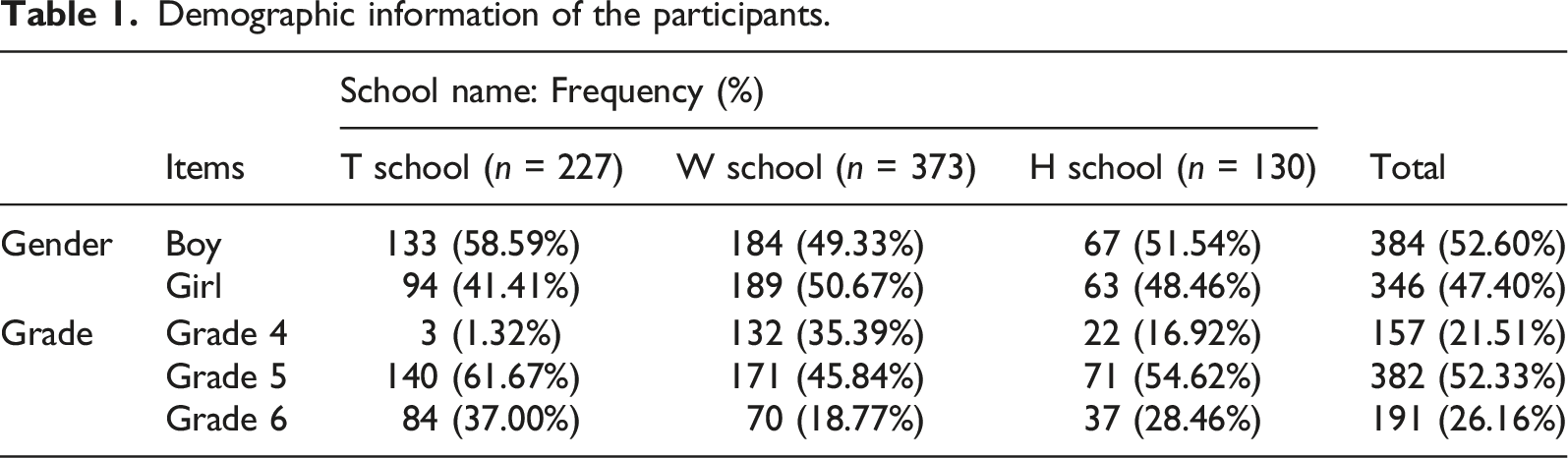
Demographic information of the participants.
Instrument
Wiersma and Jurs (2009) have suggested that survey research is a method that applies to and is appropriate for many educational research situations. Three steps were followed to develop the questionnaire with solid content validity before the validation process. First, the researchers searched relevant literature (such as academic papers, articles and reports) with the keywords ‘inclusive education,’ ‘teacher education,’ ‘teacher training,’ and ‘teaching methods or approaches or strategies’ through electronic databases (e.g., ERIC, Springer), and limited the year of publication from 2011 to 2021. After reviewing the literature, the three dimensions -- values and attitudes, management and environment, and teaching and instruction—were concluded to be related to inclusive teaching strategies. The questionnaire items in dimensions ‘values and attitudes’ and ‘management and environment’ were created from the literature review. Mainly, we referred to two scales: Index for Inclusion (Booth & Ainscow, 2002) and Indicators of Inclusive Schools (Education, 2013). The Index for Inclusion is well known to be a set of materials to guide schools to develop inclusive education in line with their local setting through a dynamic process. The student questionnaire of the Index for Inclusion has been verified as a robust and adequate psychometric instrument to evaluate the school’s inclusive process from students’ views (Fernández-Archilla et al., 2020). The scale of Indicators of Inclusive Schools combines research on inclusion, school improvement, and effective instruction.
Second, the researchers refined or used these items directly for research purposes. For example, in the dimension ‘values and attitudes’, the item in the student questionnaire of the Index for Inclusion is: ‘Staff and students treat one another with respect’. And we revised it for easy understanding to the pupils: ‘My teachers treat everyone friendly in my class’. The item in the student questionnaire of the Indicators of Inclusive Schools is: ‘Everybody works together so that all students feel like they belong’. We refined it to ‘I like to go to school’. The item ‘My teachers expect me to always try my best’ is not changed. In the dimension ‘management and environment’, ‘My teachers like to listen to my ideas’ is from the Index for Inclusion. The item ‘My teachers try to help students who have problems’ comes from Indicators of Inclusive Schools without revision. Yet, we created the items in the dimension ‘teaching and instruction’ following our focus on nine inclusive teaching strategies according to the contextual features.
Reliability of the student questionnaire.

Correlations among questionnaire dimensions.
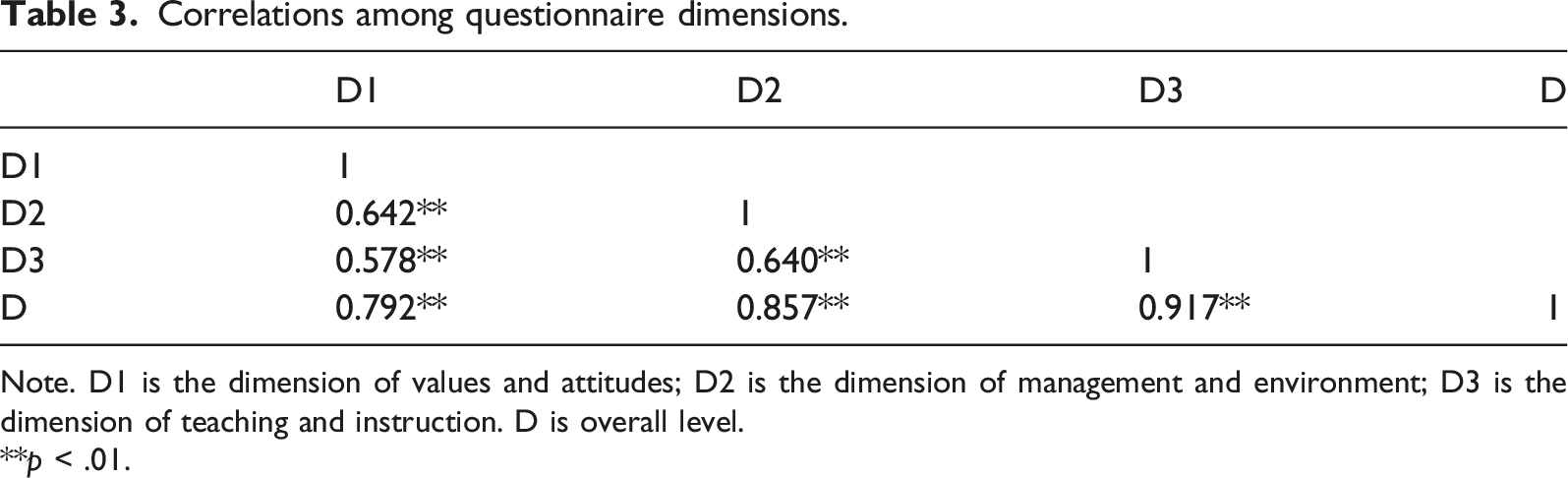
Note. D1 is the dimension of values and attitudes; D2 is the dimension of management and environment; D3 is the dimension of teaching and instruction. D is overall level.
**p < .01.
The questionnaire is composed of three sections. The first section had an instruction describing the study’s purpose, significance, and assurance of confidentiality. The second section questioned the school, gender, and grade of students. The third section was a Likert scale with a four-point scale from 1 (definitely disagree), 2 (slightly disagree), 3 (slightly agree), and 4 (definitely agree).
Procedure
The investigation included three phases. The first one was to develop and validate the student questionnaire after the researchers reviewed the relevant literature, and special and inclusive education professors revised the items, respectively. The second phase was to upload the questionnaire to the Wenjuanxing platform, a free online Chinese questionnaire platform. A link was automatically generated. Using this tool, researchers can quickly and efficiently collect data. The questionnaire was distributed through it. The third phase was that the investigators contacted the local district’s coordinator of the special education center and asked for permission from school principals to carry out the investigation. Then the researchers asked the coordinator to send the questionnaires link to school leaders and tutors of the students. The tutors sent the questionnaire link to the parents of the students. Students can click on the link and fill out the questionnaire over the phone or on the computer after class. Once the students submitted their questionnaires, the researchers could collect their responses. Finally, the researchers analyzed the data using a professional statistical software SPSS 22.0.
Data analysis
Data were coded and entered into the SPSS (22.0) for statistical analysis. No questionnaires were excluded due to the online questionnaire’s advantages. Thus, a total of 730 student questionnaires were analyzed in the SPSS software. The data were first analyzed for reliability and validity in the SPSS. Data analysis includes descriptive statistics, frequencies, percentages, means, and standard deviations. The T-test and ANOVA tests analyzed significant differences between the selected groups.
Results
In this part, the results of the study are presented. They include the means and standard deviations of each dimension and the overall level, the findings of the three dimensions, and significant differences analysis.
Means and standard deviations of each dimension and overall level
Means and standard deviations of each dimension and the overall level.
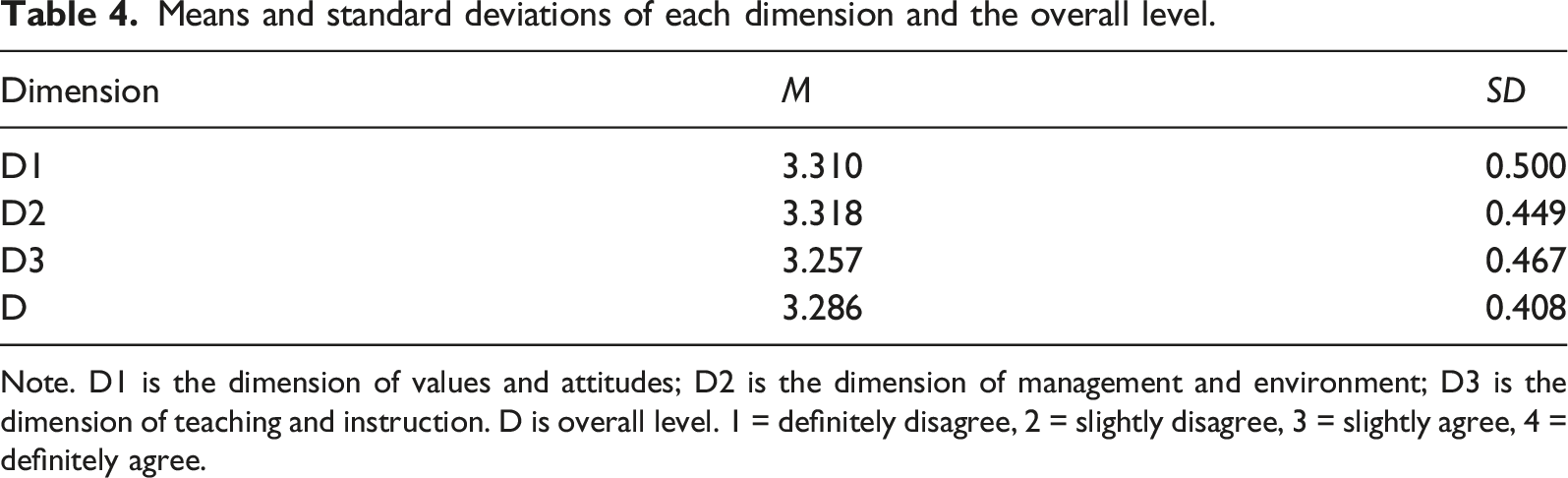
Note. D1 is the dimension of values and attitudes; D2 is the dimension of management and environment; D3 is the dimension of teaching and instruction. D is overall level. 1 = definitely disagree, 2 = slightly disagree, 3 = slightly agree, 4 = definitely agree.
Findings of three dimensions
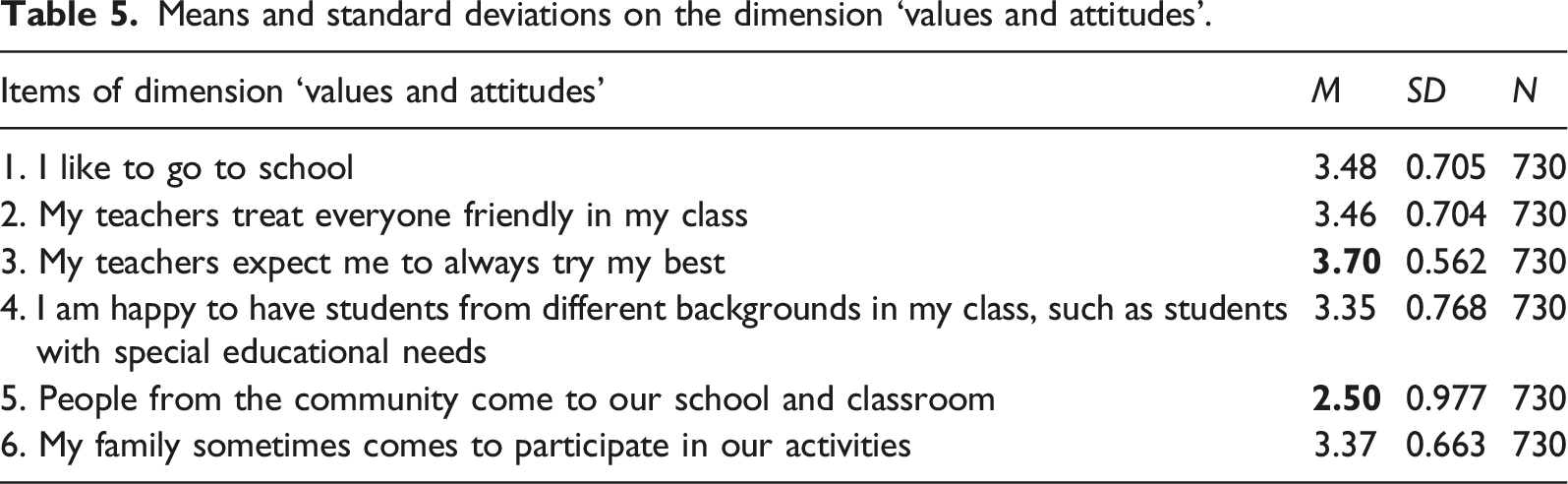
Means and standard deviations on the dimension ‘values and attitudes’.
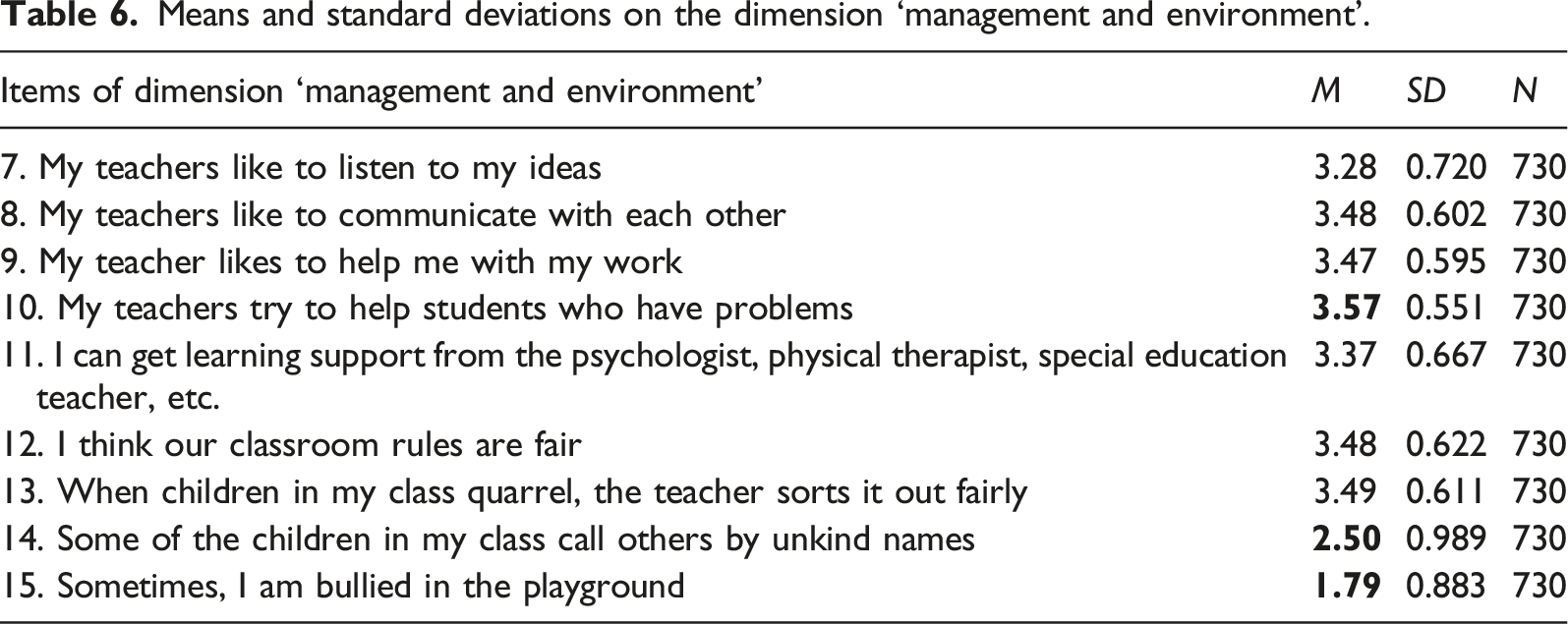
Means and standard deviations on the dimension ‘management and environment’.
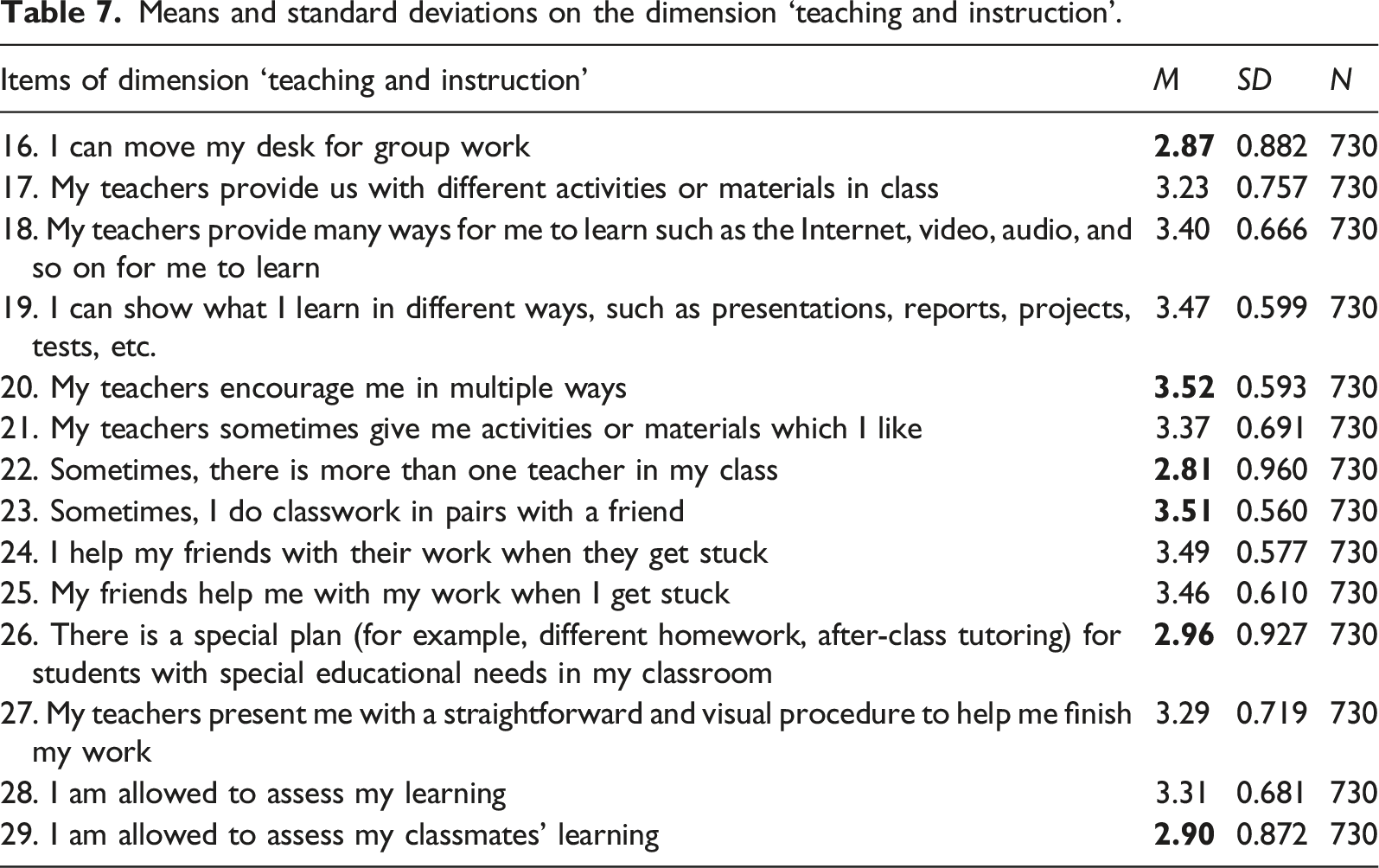
Means and standard deviations on the dimension ‘teaching and instruction’.
Significant differences analysis
Significant differences in three dimensions among different schools.
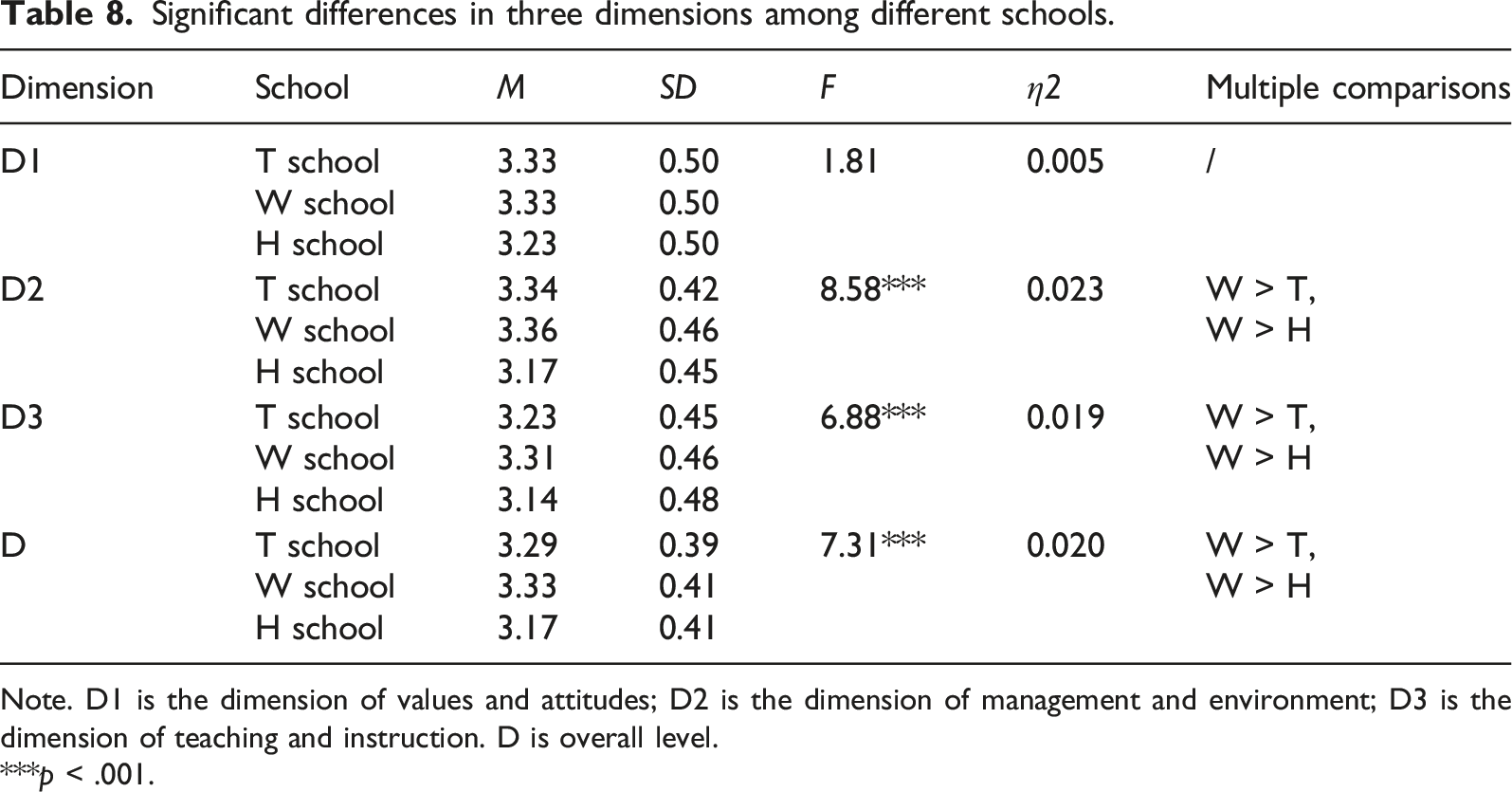
Note. D1 is the dimension of values and attitudes; D2 is the dimension of management and environment; D3 is the dimension of teaching and instruction. D is overall level.
***p < .001.
Significant differences in three dimensions between boys and girls.
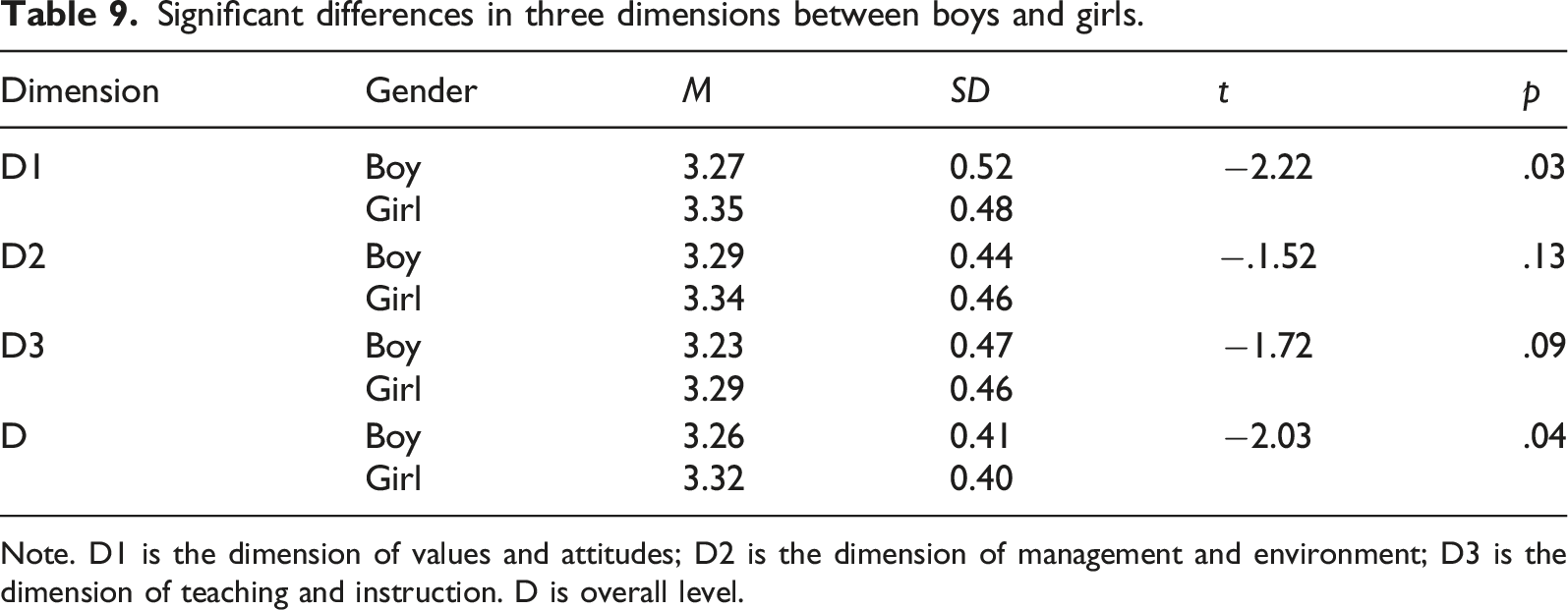
Note. D1 is the dimension of values and attitudes; D2 is the dimension of management and environment; D3 is the dimension of teaching and instruction. D is overall level.
Discussion
The children’s views are valuable (Ainscow & Messiou, 2018; Demetriou, 2019; Messiou, 2019; Wang, 2016). This study collects student perspectives on inclusive teaching strategies through a reliable and valid questionnaire. The results show that schools have inclusive values and students have positive attitudes toward inclusive teaching strategies. As a consequence of international advocacy and domestic practices on inclusive education, more regular schools have been building inclusive values and positive attitudes toward inclusive education in China (Ma & Tan, 2010; Mu et al., 2015). Shenzhen, as one of China’s special economic zones, increased investment in education to develop equitable and high-quality education for all. For example, in 2020, Shenzhen’s education expenditures reached 85.1 billion yuan, an increase of 18.8%, accounting for more than 20% of fiscal expenditure (Shenzhen Finance Bureau, 2021). It ranks first among first-tier cities in China, and the per-student funding standard is among the top in the country. We believe these regular primary schools will have more inclusive values and positive attitudes toward inclusive teaching strategies in subsequent years. In the dimension ‘values and attitudes’, it seems that girls are more favorable than boys to inclusive teaching strategies. It is consistent with Tan’s findings (Tan, 2015). Perhaps girls have more empathy than boys and like to help others. It is needed to explore more in future studies.
Inclusive school management and environment play important roles in inclusive practices. We find that the sample schools have inclusive school management and environment. Through the ANOVA test, we also find that the W school has the most inclusive school management and environment among the three schools because means of the dimension ‘management and environments’ and ‘teaching and instruction’ are significantly higher than the other two schools. We agree with Booth and Ainscow (2011) and Azorín and Ainscow (2018). Inclusion is an unending process, and every school makes its own process by identifying and resolving contextual barriers. The W school is one of the best schools in this district, led by a team of headteachers with inclusive values and attitudes. Everything is student-centered, including the curriculum, school building, teaching activities, etc. The school is well-resourced in inclusive education, with one psychological teacher responsible for managing students with special educational needs.
As for the use of inclusive teaching strategies, the results indicate that inclusive teaching strategies are used in regular primary schools. This study resonates with other research in South Africa (Themane & Thobejane, 2019), Indonesia (Kurniawati, 2021), and the United Kingdom (Pantić & Florian, 2015). Despite the challenges of implementing inclusive education and terrible schooling conditions in South Africa, teachers still make a difference in their classrooms to accommodate all students through planning, presentation and evaluation of their lessons (Themane & Thobejane, 2019). Kurniawati (2021) also found that a small number of teachers used effective inclusive teaching strategies in rural Indonesian primary schools with limited knowledge of strategies and big class sizes. When teachers devote themselves to developing a sense of social justice, they can acquire inclusive pedagogical approaches even if they face harsh conditions (Pantić & Florian, 2015). Specifically, curriculum differentiation, universal design for learning, differentiated instruction, collaborative learning, peer-tutoring, and structured teaching are frequently used. However, co-teaching, individualized education plans and assessment strategies - are not often used in regular classrooms. Due to the international influence of inclusive education (Ainscow et al., 2019), the local government has taken many measures to promote inclusive practices. According to the government action plan, Shenzhen has recently formulated 25 new measures to promote inclusive and special education for equitable and high-quality education for all children (Shenzhen Government Online, 2021). One of the measures is to strengthen research on special and inclusive education to improve teaching methods or strategies in local schools.
As Messiou and Ainscow (2015) emphasized, listening to the view of students, more than anything else, promotes responding to learner diversity. Although the small sample size cannot be generalized to findings relevant to all regular primary schools, the study results likely represent the current situation of inclusive teaching strategies in this district or this city. The researchers will invite more regular schools from other parts of China to participate in this study in the future.
Conclusions
This study analyzes the pupil perspectives of inclusive teaching strategies from three Chinese primary schools by a questionnaire. Based on the analysis and discussion above, we can make the following conclusions:
These regular primary schools have inclusive values, and students have positive attitudes toward inclusive teaching strategies. More girls are more favorable than boys to inclusive teaching strategies. Students think that sample schools have inclusive school management and environment concerning inclusive teaching strategies. The W school has the most inclusive school management and environment among the three schools. Pupils think some inclusive teaching strategies are used, but others are not so often in their classrooms.
The means of dimensions ‘values and attitudes’ and ‘management and environment’ are higher, but the dimension ‘teaching and instruction’ is the lowest. Inclusion has profoundly impacted educational policies and practices world since the Salamanca Statement (Ainscow et al., 2019). More schools in Shenzhen have inclusive values and positive attitudes toward inclusive teaching. Many regular teachers still apply different inclusive teaching strategies or methods to accommodate students’ diverse needs in their classes, such as collaborative learning and peer-tutoring, with the limited and unsound support system in China (Mu et al., 2015).
Specifically, we find that these inclusive teaching strategies-co-teaching, individualized education plans, and assessment strategies - are not often used in classrooms, but curriculum differentiation, universal design for learning, differentiated instruction, collaborative learning, peer-tutoring, and structured teaching are relatively frequently used. As Davis et al. (2004) suggested, a combination of strategies produces more powerful effects than a single strategy. Teachers should employ a variety of inclusive teaching strategies according to students’ characteristics and learning styles.
Our findings provide insights into informing policy concerning inclusive practices in China, especially the use of inclusive teaching strategies. Policymakers should listen to students’ voices and reflect on their policies to promote the implementation of evidence-based teaching strategies in Chinese regular primary schools. The W school can be taken as a good example of developing inclusive practices, and other local primary schools can learn many specific methods to promote inclusive teaching in their schools. The local government and school leaders should pay attention to male students who may need more guidance and support to develop their inclusive values and positive attitudes toward inclusive teaching strategies. Additionally, we are making a contribution to enriching empirical research on inclusive teaching in developing countries. ‘There is no one single model of inclusive education that suits every country’s circumstances’ (Mitchell, 2005, p. 19). More than half of publications and 75% of citations on inclusive education research emerge from developed countries, such as the United States, the United Kingdom, Australia, and Canada (Hernández-Torrano et al., 2020). International researchers should pay attention to the research on inclusive practices in Asian countries and reflect on global developments in inclusive education.
Footnotes
Acknowledgments
The authors would like to thank Dr Li Baowei for his revisions and comments on our article.
Declaration of conflicting interests
The author(s) declared no potential conflicts of interest with respect to the research, authorship, and/or publication of this article.
Funding
The author(s) disclosed receipt of the following financial support for the research, authorship, and/or publication of this article: The first author received financial support from China Scholarship Council (201708310219).
