




Abstract
Student participation in school decision-making and reform processes has taken inspiration from reconceptualisations of childhood. Advocates for student voice argue for the repositioning of children and young people in relation to adults in schools. This article works with data from a multi-sited case study of three primary schools and students’, teachers’ and school leaders’ accounts of their student voice practices. We consider the relationships between students in student voice activities in primary schools, and the possibilities and ambivalences of representative students ‘speaking for’ other students. We integrate recent insights from moves beyond voice in childhood studies, and from the turn to listening in cultural studies, and raise questions for students, teachers and researchers who seek to encourage student voice in primary schooling.
Keywords
The United Nations Convention on the Rights of the Child (UNCRC), ratified by Australia in 1990, has provided a framework for students’ participation in school decision-making and reform processes (Groundwater-Smith, Dockett, & Bottrell, 2015). Article 12 focuses on children and young people’s expression of views: ‘the right to express those views freely in all matters affecting the child, the views of the child being given due weight in accordance with the age and maturity of the child’ (United Nations, 1989). The UNCRC responded to the paternalism of adults ‘speaking for’ children and young people. The new sociology of childhood, emerging at a similar time to the UNCRC, critiqued developmental psychological constructions of children and young people, where children and young people are understood to be in the process of becoming adults. Proponents of a new sociology of childhood argued for a conceptualisation of the status of children as beings (exemplified in James & Prout, 1990), and reconceptualised children and young people as active subjects making sense of and creating their worlds (Alanen & Mayall, 2001).
Student participation in school decision-making and reform processes has taken inspiration from the UNCRC and reconceptualisations of childhood, with advocates arguing for the repositioning of children and young people in relation to adults in schools (Fielding, 2011). This move has been termed ‘student voice’ – the inclusion, influence and active participation of young people in decisions about matters affecting them at school. Advocates for student voice have argued that young people are increasingly responsible, competent and involved in complex relationships outside of school, but schools’ structures and patterns of relationships have remained locked in hierarchical modes of relating that justify the exclusion of students from classroom and school decision making (Bron & Veugelers, 2014). Student voice, in school improvement efforts, has sought to reposition students as agents and actors (Cook-Sather, 2002), with situated knowledge that can contribute important insights to change processes. De-stabilising student and teacher ‘roles’ in student voice encounters are argued to engender ‘restless encounters’ (Fielding & Moss, 2011, p. 79) that enable students and teachers to ‘re-see’ each other as ‘persons, not just as role occupants’ (Fielding, 2011, p. 13). Fielding and Moss (2011) construct a typology for the reconfiguring of students’ roles in schools, describing how the ‘radical democratic school’ encourages ‘fluidity and exploration, not only amongst staff but also between staff and students’ (p. 75). Students may be positioned as: ‘data sources’, ‘active respondents’, ‘co-inquirers’, ‘knowledge creators’ and ‘joint authors’ – and finally, adults and children may collaboratively engage in ‘intergenerational learning as participatory democracy’ (Fielding & Moss, 2011, pp. 75–79).
A range of positive impacts of student voice have been explored in previous research. Participation in school decision-making and reform processes is argued to have personal benefits for students, strengthening their:
Engagement and motivation, self-esteem, confidence and communication skills (e.g. Mitra, 2004) Peer relationships and relationships across year groupings (e.g. Quinn & Owen, 2016) Skills in working with others and ‘accept[ing] other people’s ideas’ (student’s self-report, in Thomson, 2012, p. 99) Leadership and citizenship skills (e.g. Walsh, Black, Zygnier, & Fernandes, 2018).
Other reported benefits of student voice include the strengthening of student/teacher relationships through facilitating dialogue between students and teachers (e.g. Ferguson, Hanreddy, & Draxton, 2011), with the potential for significant professional learning for teachers (e.g. Demetriou & Wilson, 2010). Student voice activities may lead to material and political shifts in schools including ‘[c]hanges to or improvements in facilities and influence on rules, policies and procedures’ (i.e. the physical environment, toilet facilities, playground equipment, food and school uniforms) (Mager & Nowak, 2012, p. 47).
Previous research on student voice has also explored entrenched deficit conceptions of age and relations of power between adults and young people. Drawing on Alcoff’s (1991) The Problem of Speaking for Others, Fielding (2004) makes connections between the paternalistic stance of ‘speaking about’ and ‘speaking for’ marginalised others, and relations between adults and students in schools (p. 302). We summarise four of the concerns that he raises for ‘teachers, teacher-researchers, or researchers’ relating to the dangers of ‘speaking about’ and ‘speaking for’ students, as these will become pertinent to our later discussion of the enactment of student voice in primary schools. Fielding (2004) raises concerns about the ‘presumed homogeneity’ of the ‘student voice’ as sidelining the diversity of intersecting raced, gendered and classed subjectivities amongst students (p. 302). This presumed homogeneity serves the interests of students who are already privileged, rather than those who are ‘least well-served’ by schooling (Silva, 2001, p. 98). Secondly, Fielding (2004) questions the potential for ‘appropriation’ of students’ voices to better control them, asking, ‘Is our current interest in student voice rooted in our fear that they may be rocking the boat?’ (p. 303). Thirdly, he encourages teachers, teacher–researchers and researchers to question their interest in ‘student voice’: ‘Are we sure that our positions of relative power and our own personal and professional interests are not blurring our judgements or shaping our advocacy?’ (p. 303). Fourthly, Fielding (2004) encourages teachers, teacher–researchers and researchers to understand ‘the dangers of unwitting disempowerment’ – that is, that ‘despite our best intentions, our interventions may reinforce existing conceptions of students’ (p. 304).
While Fielding’s concerns centre around adults’ relations to children and young people, other research has observed how children and young people are likewise enmeshed in their own interpersonal relations of power (Schäfer & Yarwood, 2008). There is the tendency for students who are already confident, high achieving, popular, and articulate (which often align with white and middle-class markers of privilege) to be chosen and/or elected for student voice activities (e.g. Whitty & Wisby, 2007). In Cox and Robinson-Pant’s (2006) study, trust between student representatives and the broader student cohort was affected by ‘representative’ students ‘deliberately imposing their own views’ rather than listening to their peers (p. 519). Representative structures may reinforce existing hierarchies of which students’ views are ‘heard’ and which students’ views are marginalised (Messiou & Ainscow, 2015, p. 254). These are foundational issues of ‘the social inequalities of classroom life – about whose voices are actually heard in the ‘acoustic of the school’ (Arnot & Reay, 2004, p. 43).
Previous research has also suggested that children and young people also have their own assumptions about age and institutional change. In their study of student voice in a primary school, Cox and Robinson-Pant (2008) noted how students made recommendations that were relatively ‘safe’ – that is, that are ‘allowable’ within institutional norms around children’s power and within the established practices of the school’ (p. 464): ‘children decided to take some control of the existing reward system, but they did not question the system itself or consider alternatives’ (p. 464). Kehoe (2015) hypothesises that involving students in organisational change processes (like student voice), could be ‘acculturating students to a situation where “doing change” involves offering voice while accepting that the actions to create these changes are only legitimately made by authorities’ (p. 106).
While there have been numerous studies that have explored the notion of student voice across secondary (e.g. Black, 2012; Mayes, 2018; Mitra, 2008; Silva, 2001) and tertiary (e.g. Cook-Sather, Bovill, & Felten, 2014) educational contexts, empirically researched examples of student voice in primary school contexts are less common (Mitra & Serriere, 2012). Of the examples of primary school student voice at a whole school level in the research literature (Bragg, 2007; Mitra & Serriere, 2015; Quinn & Owen, 2016), such efforts tend to engage older primary school aged students (Years 5 and 6 students), with acknowledgement of the challenges of meaningfully engaging younger children in school decision making.
This article analyses data from a multi-sited case study of three primary schools and the accounts of students, teachers and school leaders of their student voice practices, to address the following research question: What are the challenges of enacting ‘student voice’ practices in primary school contexts? In particular, the relationships between students in student voice activities in primary schools are the focus of analysis. While student voice research and practice have been concerned with unsettling and reworking hierarchical relationships between teachers and students, our conversations with students, teachers and school leaders have suggested that further work is needed to explore the relationship between students – between student representatives and students who are not student representatives, and between older students and younger students. Listening to accounts from students, teachers and principals from the case study schools of their practices, we add another type of role to Fielding and Moss’ (2011) typology of the roles that students may take on: Students initiating action, and acting as mediators for other students. While Fielding and Moss’ (2011) roles are ‘radical’ in their redefinition of student/teacher relations, the role that we add suggests a shift in relations amongst students, with implications and ambivalences that we discuss further below. In analysing accounts of students’ ‘voice’ interactions with other students, we return to explorations of issues of power and conceptions of age. In discussing these issues surrounding ‘voice’, we look to the longstanding work of Reggio-Emilia-inspired educators in early education settings and to efforts utilising participatory research to listen to ‘the hundred languages’ of children (Edwards, Gandini, & Forman, 1998). We integrate recent insights from the turn 1 beyond voice in childhood studies (e.g. Davies, 2014; Lewis, 2010; Rautio, 2013), and from the turn to listening in cultural studies (e.g. Bassell, 2017; Dreher & de Souza, 2018), raising questions for students, teachers and researchers who seek to encourage student voice in primary schooling.
Methodology
A qualitative case study approach is often used in educational research and has been used previously to investigate student voice (e.g. Bragg, 2007; Cox & Robinson-Pant, 2006; Quinn & Owen, 2016). Case studies focus on a phenomenon in its real-life contemporary context (Yin, 2009) which is appropriate for the current study as it seeks to investigate how student voice practices are enacted (Ball, Maguire, & Braun, 2012) by schools. ‘Enactment’ involves the complex work of schools when seeking to implement any policy or educational practice, in this instance, by bringing a concept like ‘student voice’ to life in their localised settings.
The broader study, of which the work discussed in this article forms part, was commissioned by the Victorian Student Representative Council (VicSRC) as an evaluation study of VicSRC’s Primary School Engagement (PSE) project. The VicSRC is ‘the peak body representing school aged students in Victoria’, and is ‘a student run, organised and initiated organisation run for the benefit of students’ (VicSRC, 2018, para. 1, 3). The broader evaluation study (see Mayes, Finneran, & Black, 2018) investigated the situated accounts of students, teachers and school leaders of their student voice initiatives, and their participation in the VicSRC’s PSE project, through a close study of the experiences of three case study schools. These three schools (two metropolitan and one regional) were nominated and approached by the VicSRC to be part of this evaluation study, chosen because they were considered to have developed strong student voice practices. Consequently, these schools are not considered to be representative of a broad range of schools’ experiences with the VicSRC or student voice work. Indeed, insights gained from case studies are not generalisable. However, we suggest that if these ‘exemplary’ schools experience challenges in enacting student voice, then there are lessons to be learned for all primary schools.
Participating schools
Pseudonyms are used for the three participating schools, and for the names of students, teachers and school leaders. Demographic information for the three schools can be found in Table 1, sourced from the My School website (Australian Curriculum Assessment and Reporting Authority (ACARA), 2017). Regional (R) is a government sector primary school located in regional Victoria. Metro North (MN) is a government sector primary school located in a suburban residential area in north Melbourne. Metro South (MS) is a Catholic primary school located in a south Melbourne suburb. According to demographic data, MS is the most socioeconomically privileged school of these three schools, with only 8% of students from the lower two socioeconomic quartiles, and 71% of students from the top quartile. MN also is comprised of a large proportion (66%) of students from the two most socioeconomically advantaged quartiles, and also a significant proportion (40%) of students from a Language Background Other than English (LBOTE). Regional is the least advantaged of these three schools, with a majority of students (62%) in the lowest two socioeconomic quartiles, and the smallest percentage (11%) in the top socioeconomic quartile. Notwithstanding these demographic differences, these three schools are all seeking to promote opportunities for their students to ‘have a voice’ at school.
Summary information about the case study schools in the study.
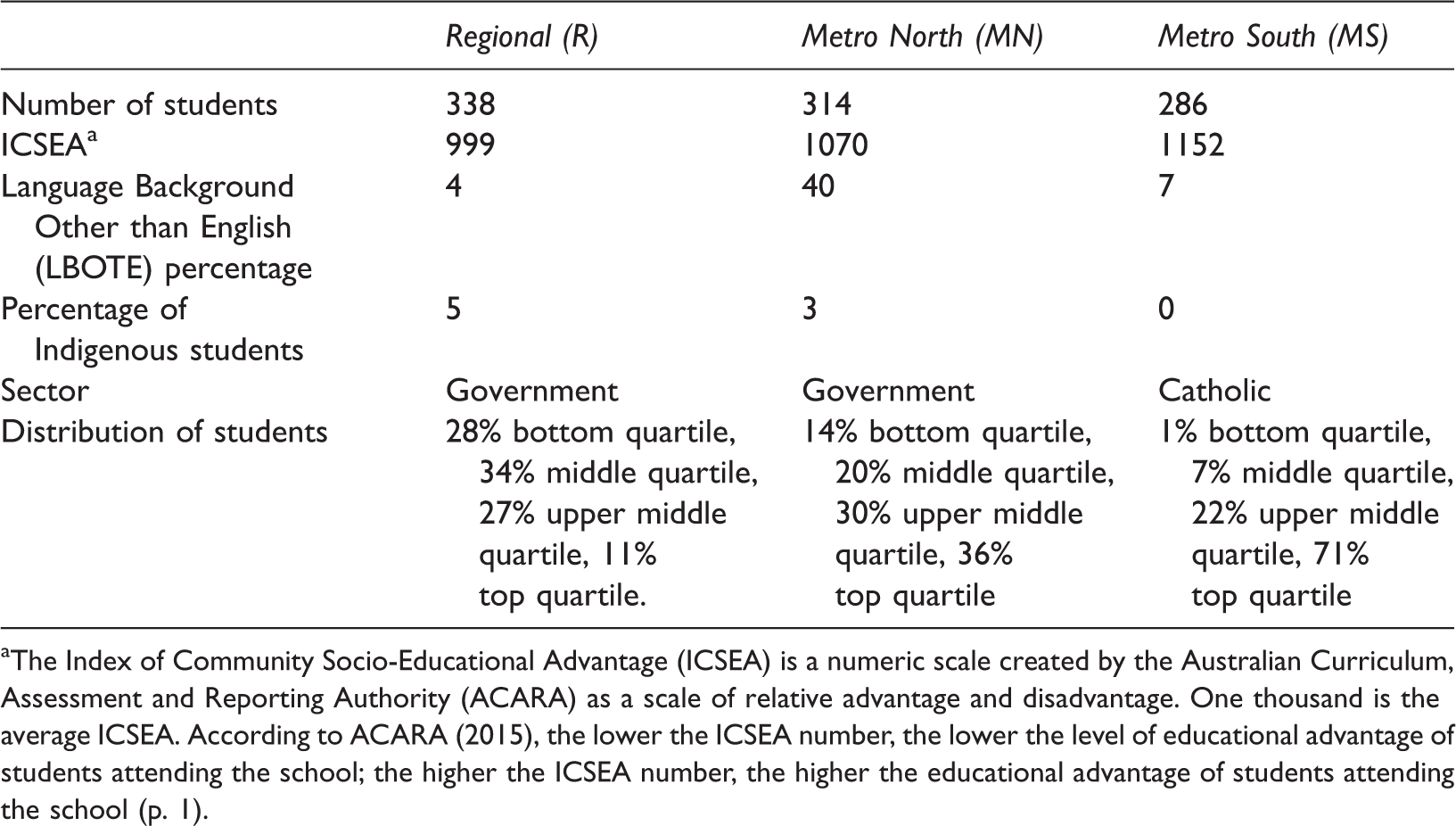
The Index of Community Socio-Educational Advantage (ICSEA) is a numeric scale created by the Australian Curriculum, Assessment and Reporting Authority (ACARA) as a scale of relative advantage and disadvantage. One thousand is the average ICSEA. According to ACARA (2015), the lower the ICSEA number, the lower the level of educational advantage of students attending the school; the higher the ICSEA number, the higher the educational advantage of students attending the school (p. 1).
Data generation
Case studies typically employ a variety of methods that generate data over a duration of time (Yin, 2009). The research engagements of this study occurred over the course of 2018. The research engagements with case study schools included:
A (face-to-face or phone) interview with the school principal and two interviews with the key contact teacher facilitating the school’s Student Representative Council (SRC) (or equivalent).
2
Interview topics included a description of their school, an account of student voice at their school before involvement with the VicSRC, a description of their experiences with the VicSRC, an account of impacts and challenges of student voice at their school, and how their school evaluates the impact of student voice. Quotations from principal interviews are referenced with the abbreviation PI; quotations from teacher interviews are referenced with the abbreviation TI. Two focus groups with students about student voice at their school, at two points of the calendar year. Focus group topics included discussions of the importance of student voice, descriptions of student voice at their school and discussions of impacts and challenges. The students who were part of these focus groups were selected and invited to participate in these evaluation focus groups by the facilitating teacher at their school, on the basis of their prior and ongoing participation in their school’s ‘student voice’ efforts. Of the 23 participating students, 13 of these students were in Year 6 (the final year of primary school) and 21 were in their school’s SRC (or equivalent), with these students ranging in year level from Years 3–6. Of the 23 participating students, there were 16 females and 7 males. Quotations from focus groups are referenced with the abbreviation FG. Participant observation at VicSRC events where teachers and students were engaged with the VicSRC (e.g. a VicSRC student voice workshop). Data from these observations are not discussed in this article. For each school, one of these TIs and student focus groups were conducted on school grounds. During these visits, photographs were also taken of key artifacts relating to the school’s student voice work.
Data analysis
A discourse analysis approach was taken to the reading and interpretation of all interview and focus group transcriptions. Informed by Rogers’ definition of discourse analysis as ‘the analysis of language in use’ (Rogers, 2003, p.5), this analysis involved identifying overt semantic patterns used by our interviewees or focus group participants. These patterns included keywords related to the theoretical frameworks and conceptual discussions of student voice outlined above. They also included repeated terms or phrases which can serve as ‘condensation symbols’ for wider educational discourses, including policy or school discourses about student voice (Troyna, 1994, p. 79). Instead of breaking the transcript down through a word-by-word or line-by-line analysis, however, we focused primarily on whole statements or exchanges. This is a recommended strategy in the case of data that is subject to the influence of multiple discourses and likely to yield multiple interpretations (Charmaz & Mitchell, 2001). Each interview or focus group discussion was first analysed as an independent event, with its own integrity and importance (Eisenhardt, 2002). The data were then combined to construct findings and look for common and contrasting themes.
The findings reported below are synthesised themes relating to accounts of relations between students, the concept of ‘having a voice’, and conceptions of age. While the broader evaluation study explored a broader range of issues, including teacher professional learning and evaluating the impact of student voice initiatives (see Mayes, Finneran & Black, 2018), this article attends to accounts of student voice, representation and age in relation to previous literature. Quotation sources are referenced with the abbreviation for the school (R, MN or MS), combined with the research activity (PI, TI or FG), with a number if there were repeated interviews or focus groups (1 or 2) – for example, MSFG2 (Metro South Focus Group 2).
Findings
Strengthening student relationships
Students and adults spoke about how student voice has strengthened peer relationships and relationships across year groupings. At MS, one student said: ‘I think a positive change has been the way that the students have been treating people, because I think they have been nicer and more kind, and not being bossy and bully[ing] people’ (MSFG2). The MN facilitating teacher also spoke about improved peer relationships in terms of the experiences of students in her own classroom: ‘[I]n my classroom, I have noticed a difference; the level of respect that they have for each other, because they know that they can have a say’ (MNTI2). The principal at MN spoke about how ‘the other kids respect the student leaders; they know that they have got a say and they spend a lot of time engaging with teachers’ (MNPI). These accounts of improved peer relationships accord with previous research about student voice and peer relationships (e.g. Quinn & Owen, 2016).
The challenges of engaging all students
Even while student voice efforts were asserted to have strengthened students’ relationships with each other, students and teachers spoke about the ongoing challenge to engage all students in student voice. Engaging younger children (Foundation, Year 1 and Year 2) in student voice work is a particular challenge. The facilitating teacher at MS explained their experiences: We used to have two students from each class, from Prep [Foundation] through to Year 6, and we also included the four school student leaders on that group. But we were finding our Preps [Foundation] to Year 2s were having a little bit of difficulty just articulating or probably absorbing some of the conversations that would be going on. […] So now, the [SRC] team is really from Years 3 to 6. But when we want whole school input, some of the [SRC] teams will go to those classes and we will ask them questions and gather some information, and then come back with an overall view of what they want to say. So we support them with being able to articulate their ideas and opinions and suggestions. (MSTI1) [One challenge is] the engagement with the younger kids: just that understanding of what student voice and how they can have a say and make changes in the school. I think we are really good at [student voice] in the upper years but it’s trying to help [the younger students] understand what it means to have a voice. (MNTI2) [S]ome of [the younger students], they don’t understand what it [having a voice] means. They just think it’s like someone, when they “speak, speak louder.” Like, they don’t actually know “speak up and share your ideas.” (MNFG1) [Older students] understand why [another student might] think [differently] and they would be respectful why they think that way. But with younger [students], they would just be like, “Oh why do you think that way? I don’t understand. You shouldn’t be thinking that way.” And then they would just try and make them, like, go to this side, even though they have got their own reason for thinking that way. (RFG1)
Strategies for engaging students
Across these three schools, a significant role was taken by student representatives seeking to support, mediate and drive action on behalf of other students. This was frequently spoken about as a desire to ‘give’ other students ‘a voice’ and to not confine student voice to student leadership. In focus groups, students described how they had considered strategies to ‘give a voice’ to younger students at their schools. One strategy was for older student representatives to visit younger ‘mentor’ classes. At Regional, pairs of SRC students are allocated a mentor class (either Foundation, Year 1 or Year 2) who they visit weekly. A student explained: ‘once a week, we go to them and talk about what they want, like, ideas and stuff; and what they think should be changed and stuff like that’ (RFG2).
In Regional and MN, SRC students initiated feedback (see Figure 1) or suggestion boxes, for students to write their ideas, for the SRC students to review and take action on: ‘[W]e got feedback boxes around the school and anyone from anywhere can just grab some [paper] and just put it in there’ (RFG2).
Feedback box (Regional school). [I]n the suggestion box, there was a lot of people saying, “Oh, there’s too much bullying in the school and people more wanting dress-up days.” So we thought, “How can we combine those two together?” (MNFG2) […] we can make students in our school get what they would also want to have around the school. Because there’s not any point in us doing what we want to do when maybe the rest of the school doesn’t want to. (MNFG2)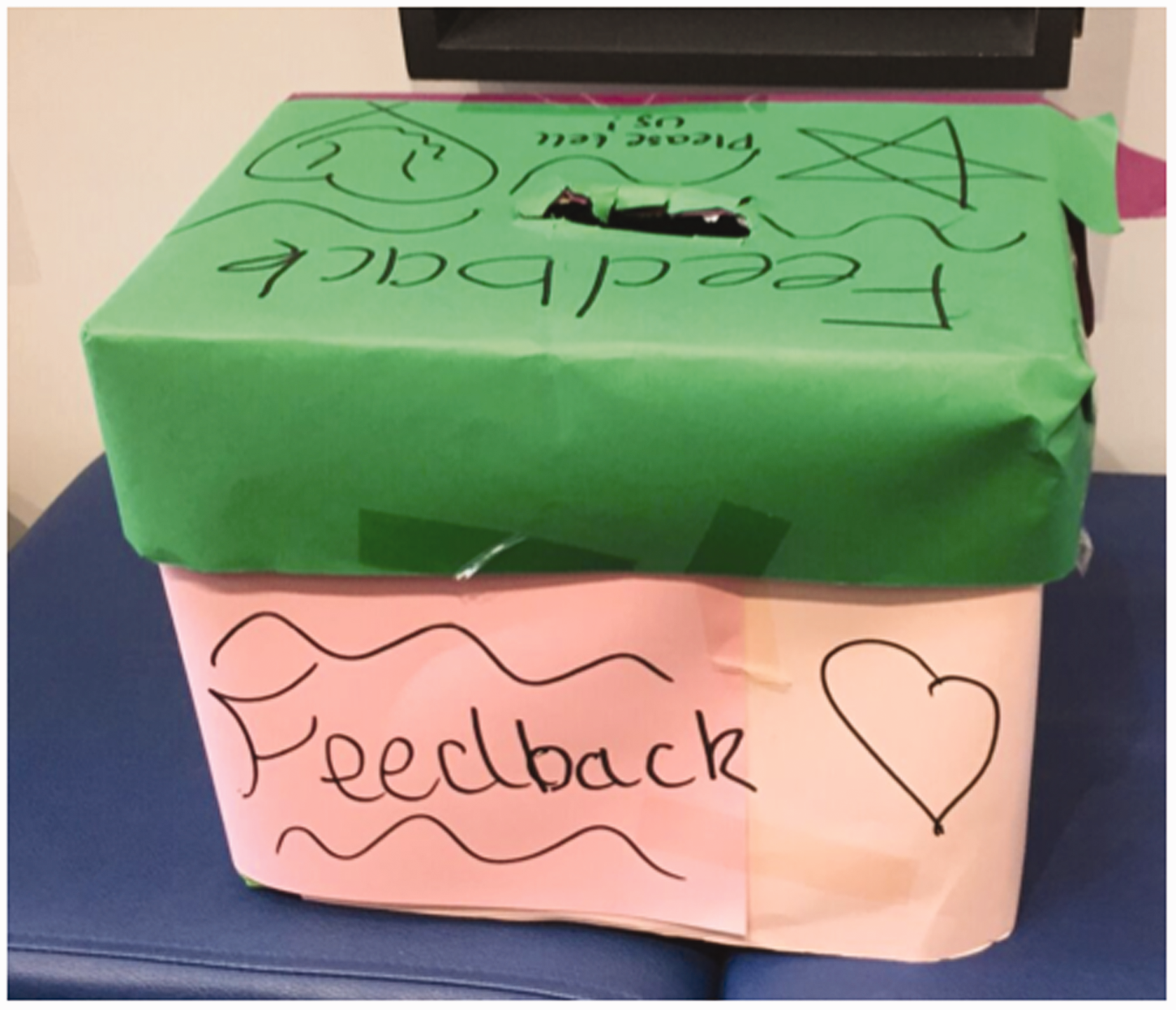
Acknowledged limitations of these strategies
One student acknowledged that strategies for encouraging student voice across the school (e.g. a suggestion box) are well suited for older students, but that younger students need further support to be able to access these opportunities: ‘[P]reps […] can’t write [something] down [for the suggestion box] without making mistakes. […] They can’t write a lot’ (RFG2). The facilitating teacher at MN spoke about how they attempt to support the younger students: [W]e say to the bigger kids to support the younger kids, so they can ask their buddies to help them. But we also kind of have a little bit of expectation from the Prep teachers to tell the Preps about the suggestion box because they are not necessarily going to have an understanding of what it is and what it's for. (MNTI2) I think kids’ perceptions of their voice and agency is still less than what we would have expected it to be. Not because they are not capable, but because I think that they don’t feel confident yet to trust that they can have a say and their say is going to make a difference. […] We feel that our kids still want to do what their teacher wants them to do. (MNPI) I think that we could also change how some students just exclude themselves from the discussion in classes, and the teachers don’t really try and make those students join back in. […] And then the teacher doesn’t really ask them because they kind of have forgotten. (MSFG1) [E]ven if they are misbehaving, they can still have a say; because what if they have something important to say? Like, if you don’t give the naughty kids a chance to speak up, then they might go on misbehaving. (RFG1)
Discussion
The three schools in this case study are already thoughtfully considering and experimenting with facilitating student voice practices across the school body, beyond student representative groups alone, through student-led efforts such as visiting ‘mentor’ classes and suggestion/feedback boxes. It is worth noting that, despite the different demographics of these three schools, similar student voice strategies were adopted across these schools, possibly as suggested by VicSRC facilitators at the student voice workshops that students at these schools attended. The similarity of these strategies suggests a tendency towards a universalising approach to student voice that does not (necessarily) attend to the distinctiveness of particular school contexts and particular student needs.
Across these three schools, these student voice strategies seem to have been taken up by the student body, and student voice efforts were asserted to have strengthened relationships between students. However, the accounts of these students, teachers and principals suggest that more work is to be done to challenge entrenched conceptions of childhood amongst students themselves, and students’ self-imposed boundaries on voice. In some of the students’ observations about student voice, boundaries were set between students who comprehend, take responsibility, behave appropriately and appreciate the school community’s needs, and other students. Such statements suggest the persistence of the interpretation of some students’ voices as ‘too strident, too offensive or too irresponsible’ (Fielding, 2004, p. 303) – not only among adults, but among children and young people themselves.
Student representatives may inadvertently ‘speak for others’ (Alcoff, 1991) and underestimate the capacities of other students, even in attempts to broaden student voice across a school community. Student voice can still be, inadvertently, a ‘dividing practice’ that separates confident, articulate students from those who ‘don’t fit the dominant discourse and academic aspirations of their schools’ (McIntyre, Pedder, & Rudduck, 2005, p. 155) – with student representatives adjudicating the voices of other students. Student voice has been centrally concerned with challenging adults’ conceptions of voice, assumptions about childhood and hierarchical power relations in schools (Robinson, 2014). We contend that student representatives themselves might also be challenged to question their own assumptions about voice, assumptions about childhood and their relative privilege and power in relation to other students. Students and teachers might collectively interrogate the concepts that they use, and that are used in policy documents: such as ‘voice’, ‘agency’ and ‘leadership’ – and consider how these terms may create and reinforce distinctions between students.
Further exploration is also needed into whether it is necessary for students to understand the concept of voice, and whether the concept of student voice relies on a certain expectation of students’ written and oral communication skills. Questions might be raised about why the onus seems to be placed on students to understand the concept of voice, and to articulate their voices in accordance with particular norms. Does a focus on voice need to be complemented with the reflection of older students and teachers on how to ‘listen to learn’ (Groundwater-Smith & Mockler, 2003) – particularly learning to listen to younger students, as well as to students who are less likely to be heard at school? Rather than concentrating on helping students understand the concept of voice, the focus might shift towards how adults and older student representatives might better listen to the ‘hundred languages’ of children – and learn from early childhood educators (e.g. Edwards, Gandini, & Forman, 1998). The Reggio-Emilia-inspired recognition of the ‘one hundred languages’ of childhood is ‘not only a way of crediting children and adults with multiple communicative potentials: “it is a declaration of the equal dignity and importance of all languages, not only writing, reading and counting … for the construction of knowledge”’ (Rinaldi, 2006, p. 175, cited by Davies, 2014, p. 12, original emphasis). Primary schools might find inspiration for multimodal and multisensory modes of engagement (e.g. verbal, visual, tactile, embodied movement) in research generated in other early childhood settings and primary schools (e.g. Adderley, Hope, Hughes, Jones, Messiou, & Shaw, 2015; Emme & Kirova, 2018; Flückiger, Dunn, & Stinson, 2018; Harcourt, 2011; Wall, 2012). The student voice movement might also observe and learn from the turn beyond voice in childhood studies. For example, concerned with the limitations and exclusions of an emphasis on voice alone, scholars in childhood studies have turned attention towards children’s silences (Lewis, 2010) – listening to what cannot or will not be said, and towards broader questions about being and relationality. Ontological questions have been asked about the limitations of focusing on the child alone and their individual voices, separate from the materiality of the school and the world – arguing for emergent engagement with the material conditions of childhood, schooling and voice (e.g. Davies, 2014; Mayes, 2017; Rautio, 2013). Davies (2014) argues for a mode of attuned, emergent listening that is ‘about being open to being affected’, ‘not being bound by what you already know’ and a willingness ‘to let go of’ ‘the status quo’ (pp. 1, 21, original emphasis). In cultural and media studies, there has also been a turn beyond voice alone, to the ‘politics of listening’ (Bassell, 2017). Dreher and de Souza (2018) explain the emphasis of this turn to listening – as an attempt to ‘shift some of the onus and responsibility for change from marginalised voices and on to the relatively more discursively privileged and powerful’ (p. 24). We suggest that resources from these recent turns might be helpfully adapted and taken up in relation to relations of power and privilege in schools. That is, rather than focusing on how to support young people’s expression of voice (alone), attention might shift to the conditions for listening in a school: how adults and young people, together, are reciprocally encouraged to listen, reflect and respond to each other.
We offer a few introductory examples of what a move beyond voice alone and a turn to listening might involve in primary school contexts, and offer a few questions for reflection. In the case of SRC models such as those implemented in these three schools, student representatives might be encouraged to further reflect on their role as mediators of other students’ voices, and the potential of student representatives to close down the voices of other students or speak for other students. Student representatives might collectively deliberate on the following questions:
Whose voices are listened to in the acoustics of our school (cf. Arnot & Reay, 2004, p. 43)? Whose voices are dismissed as immature, rude and/or uninformed (cf. Holdsworth, 2019, p. 19)? Who is expected to speak, listen, and change in my classroom and school? Who do our ‘student voice’ practices and actions benefit? Who misses out? As student ‘representatives’, how are we comparatively privileged in relation to other students? Are our positions of privilege and relative power blurring our judgement (cf. Fielding, 2004, p. 303)? Can students (e.g. student representatives) really be experts about the lives of all other students? Is it possible that we could be, without realising, disempowering others (cf. Fielding, 2004, p. 304)? When student representatives sort through and mediate other students’ suggestions, is it possible that we can ‘dilute’ voices (Bourke & Loveridge, 2018, p. 4)? What might we have to learn from younger students, quiet students, and those who may not be recognised as “good” students? How could we be more attentive and attuned to each other – to listen beyond the verbal and written voice?
Collectively asking these questions may support the cultivation of a pervasive approach to intragenerational and ‘intergenerational reciprocity’ (Fielding & Moss, 2011, p. 75): between students as well as between students and teachers. Such moments of listening and reciprocity may enable the deepening of connections and mutual learning in radically democratic schools.
Footnotes
Acknowledgments
We thank the participating students, teachers and principals at the three case study schools for their time and insights, and we thank the VicSRC staff for their support. We thank the anonymous peer reviewers and the editors for their helpful suggestions.
Declaration of Conflicting Interests
The author(s) declared no potential conflicts of interest with respect to the research, authorship, and/or publication of this article.
Funding
The author(s) disclosed receipt of the following financial support for the research, authorship, and/or publication of this article: This research was conducted as part of a broader evaluation study for the VicSRC, which is funded by the Victorian Department of Education and Training.