



Abstract
This paper takes a North American University’s summer immersion Chinese language program in China as a case to discuss how to engage intermediate-level Chinese language learners in an immersion language learning environment. The study grounds student engagement principles as the theoretical framework for designing and evaluating the course and learning activities. Sixteen Chinese language teachers and fifty-six Chinese language learners participated in the study. The qualitative survey was employed to understand Chinese language learners’ experience of engagement in an immersion program from the perspectives of both teachers and their students. The result shows that students can be deeply engaged in an immersion Chinese language program when the program creates a dynamic environment. In the dynamic environment, the opportunities for diverse interactions (i.e., the interactions among the students, between teachers and students, and between students and the local people) are offered. Students are engaged in developing language skills and abilities when they have the chance to obtain individualized feedback on their language performance and instant assistance when they encounter difficulties. The results also highlight the importance of learning Chinese in authentic communicative contexts, especially for grammar drill activities. At last, implications are generated for future instructional design and practice for Chinese study abroad programs.
Keywords
Introduction
Studying abroad is a great way to prepare students to be global citizens (Isabelli-García et al., 2018). Students benefit culturally and linguistically from learning in a target language country because they are exposed to a community full of language input and cultural practices (Taguchi et al., 2016). Dewey’s (2004) study shows that students enrolled in study abroad grogram improved most on oral fluency and reported more language contact hours than their peers compared to the students who did not.
Several studies emphasize the nature of language learning and teaching as an interactive social practice. Studying foreign languages in a study abroad program is an excellent opportunity for student engagement in language and culture learning and training in high-quality interactive settings (Bown et al., 2015; Isabelli-García et al., 2018). Chinese as a foreign language learning in a study abroad program is mainly addressed from the perspective of linguistic outcomes (Taguchi et al., 2016). To date, no research studies address whether a study abroad program could support student engagement in language learning in language study abroad, and there has been little evaluation of student engagement perceptions in Chinese study abroad programs. Research that addresses student engagement from different perspectives is needed to generate the implications for future study abroad instructional design to enhance student engagement.
This paper takes a North American University’s summer immersion Chinese language program in Beijing, China, to investigate student and teacher engagement perceptions and to discuss how to engage intermediate-level Chinese language learners in their Chinese learning. The design of this program strives for genuine fluency in Chinese and values building a solid foundation through rigorous training in the four language skills (listening, speaking, reading, and writing). To enhance student engagement, the program contains four significant parts: pre-class preparation, in-class teaching, after-class practice, and social activities. For example, there are lecture series, gatherings, movie nights, and weekend trips. Before each lesson, students are offered a study guide in which grammar patterns and expressions of that lesson are presented with examples. They must read through the text and grammar rules in the study guide and try to learn the grammar patterns, expressions, and vocabulary. The program emphasizes the leading role of the teacher in giving feedback, correcting errors, and the pacing of classroom teaching. Corresponding to the idea that “Grammatical competence is an important dimension of language learning, but clearly, not all that is involved in language learning” (Richards & Rodgers, 2001), during class, rigorous drills (i.e., question and answer practices) are used to give students the opportunities to practice the grammar rules and obtain timely feedback. After class, the program offers the students a daily individual session with an instructor during which students respond to the naturally occurred questions and have conversations on topics related to the class of their life. Here, naturally occurring questions refer to inquiries that are not pre-designed but rather questions that come up during interactions. The instructor may ask how the student is doing and follow up with a question depending on the student’s answers. For example, if the student says that (s)he is busy today. The instructor may follow up with questions about the reasons that cause them to be busy. Meanwhile, individual sessions aim to reflect the natural and meaningful use of the Chinese language, focus on achieving communication and expressive language, and offer diverse opportunities for students to interact with local culture and native speakers.
The research questions of the study are: What are student and teachers’ overall engagement perceptions in a Chinese language immersion program in China? What are the students’ and teachers’ perceptions of the engagement elements in the learning activities? How can instructions be designed to engage intermediate level students in Chinese learning in an immersion environment?
Theoretical framework
Designing classroom instruction and using pedagogy built on engagement principles, educators could facilitate learners’ active participation, which in turn could lead to engagement (Egbert & Ernst-Slavit, 2010). This section serves to explore such engagement facilitators from theories.
Defining engagement
Summary of the dimensions of the engagement construct.
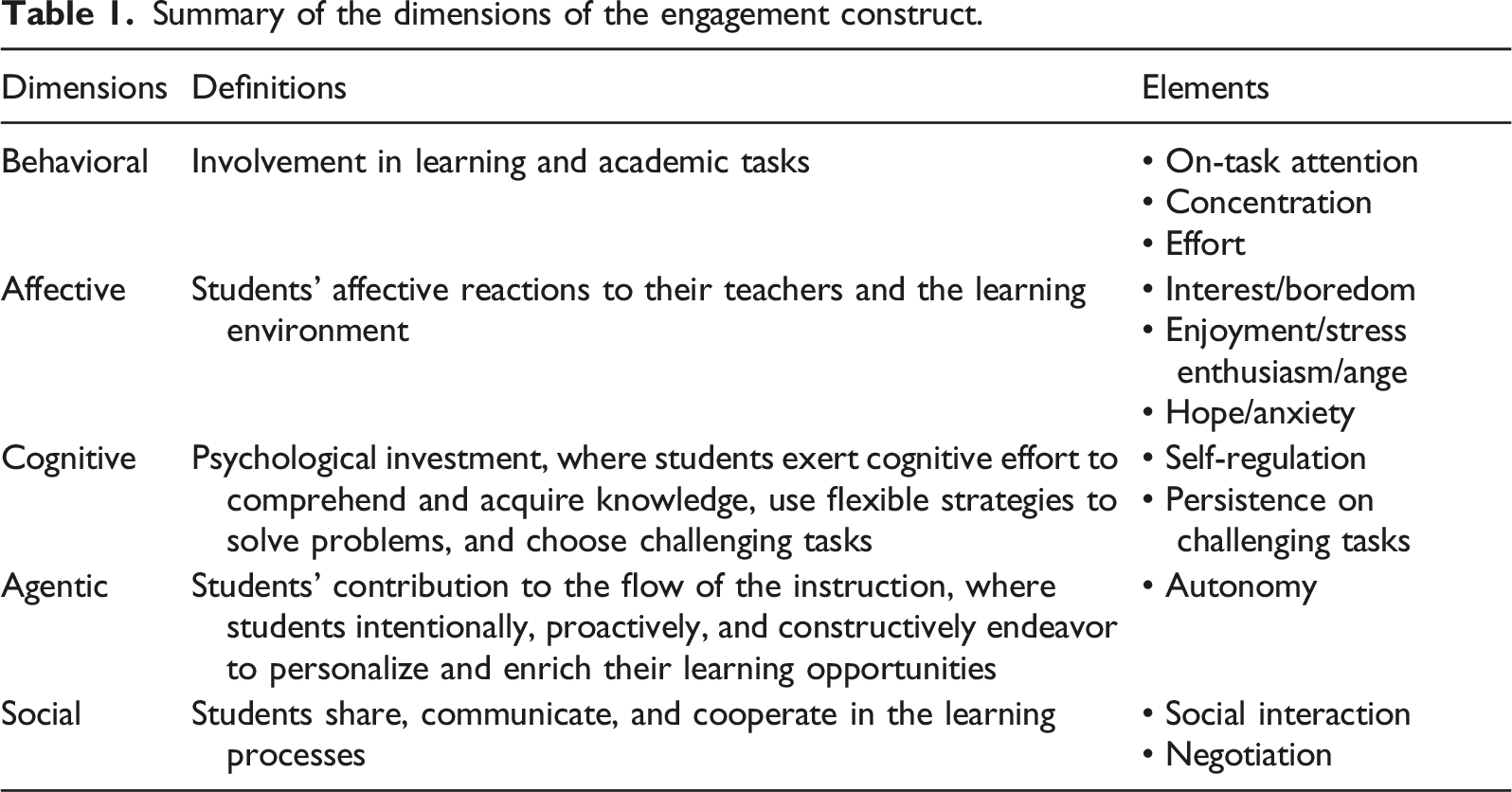
Research with regard to engagement has documented that (a) higher level(s) of engagement can contribute to increasing motivation, self-regulation, and achievement (e.g., Reeve & Lee, 2014; Oga-Baldwin & Nakata, 2017), (b) engagement can mediate the relationship between motivation and learning attainment (e.g., Shernoff et al., 2016), and (c) engagement can be supported at the classroom levels, such as classroom interpersonal relations, instructional environment, and task designs (e.g., Qiu & Lo, 2017; Reeve, 2013; Shernoff et al., 2016; Skinner et al., 2008).
Facilitators of engagement
Understandings of what can facilitate learner engagement and how learners engage in language learning, however, are relatively in its infancy (Mercer, 2019). Two theories that have mostly attempted to address the facilitators of engagement are self-determination theory (Ryan & Deci, 2000) and flow theory (Csikszentmihályi, 1990). According to self-determination theory, there are three psychological antecedents, namely, competence, autonomy, and relatedness, in support of learner engagement. We discuss these three antecedents later in the paper.
To address language learners’ optimal experiences of engagement in the language classrooms, researchers have introduced flow theory into language research (e.g., Czimmermann & Piniel, 2016; Egbert, 2003). According to the theory, students experience “flow” (deeply engaged), they will concentrate on what they are doing; not worry about failures; have self-consciousness evaporate; and experience a distorted sense of time. Flow theory suggests that flow experiences (characterized by a balance between challenge and skills and by a person’s interest, control, and focused attention during a task) can lead to optimal learning.
Therefore, five primary engagement facilitators (discussed below), solicited from theories reviewed above, are used to direct this study for the investigation of learner engagement in Chinese language classrooms.
Competence
Competence refers to learners’ sense of mastery and efficacy, as well as of their future abilities in completing tasks, which includes self-related belief (i.e., self-efficacy and self-concept) and mindset beliefs (Ryan & Deci, 2000). Self-efficacy, central to learner agency, is a key element of the sense of competence. Self-efficacy, defined as people’s belief about their ability to successfully complete a task, is closely related to goal setting, effort investment, and self-regulation (Bandura, 1997). Research indicates that self-efficacy can support engagement (e.g., Mesurado et al., 2016; Walker et al., 2006), probably because self-efficacious learners are apt to fully commit to persisting, overcoming the challenges, and completing the task. This Chinese language immersion program aims to facilitate students’ competence in Chinese language accuracy and proficiency, in terms of listening, speaking, reading, and writing, as well as to gain knowledge and experience of China, pertaining to society, culture, economy, and policy. In this program, students have the opportunity to be fully immersed in China. Their experience is supported by the Chinese language teachers in the classroom and the Chinese native experts in the extracurricular lecturers on the topics of society, culture, economy, and policy. Moreover, the students are encouraged to explore and experience China in their own way during their free time. It can be reasonably assumed that when students gain more knowledge and better develop their language abilities, they would feel more confident and self-efficacious, leading to more effort and engagement in learning.
Autonomy
Autonomy refers to the need for learners to feel in control of and regulate their learning goals, experiences, and actions (Ryan & Deci, 2000). It is characterized by choice and value (Mercer, 2019). Researchers suggested that educators should first develop a good understanding of learning needs to enable learners to have choices in deciding on what, when, where and how to study in their learning tasks (e.g., Csikszentmihályi, 1990; Dörnyei, 2019; Egbert, 2003). Second, learners are expected to be engaged when they understand and appreciate the value (i.e., relevance, importance, purpose, or interest) of their work (Assor et al., 2002; Pintrich & Schunk, 2002; Shernoff, 2013). The design of the program gives students opportunities to exert control over their learning goals, experience, and actions. For example, the program supports learner autonomy by involving students in co-establishing learning objectives/content, encouraging open communication with teachers and peers, and co-constructing learning experiences.
Relatedness
Relatedness refers to the need for learners feeling supportive and socially connected to others (Ryan & Deci, 2000). This highlights the importance of belongingness that learners have in their classroom community and group dynamics. Language learning is inherently relational, which highlights the interpersonal, intrapersonal, contextual communication and collaboration; that is, the social engagement in language use context (Svalberg, 2009). Social interaction allows language learners to engage in the task by sharing, communicating, and collaborating with their peers and teachers, which may in turn facilitate learning (e.g., Edstrom, 2015). This program largely develops students’ sense of relatedness. For example, the lesson topics and activities are designed in congruence with students’ living and learning experience. For example, the first lesson is “到了北京” (i.e., Upon Arrival in Beijing). This lesson covers vocabulary such as “airplane”, “the airport”, “arrival”, “to pick someone up from the airport”, “shuttle bus”, etc. In other words, the linguistic and cultural knowledge, as well as drill practice, in the classroom all serve the purpose of enhancing real-world communication. Additionally, a variety of interaction (e.g., whole-class discussion, peer talk, student-teacher discussion) on such topics are facilitated in the program. For example, in the individual sessions, teachers are required to jot down the errors, discuss these errors to students, and correct the errors.
Challenge
As discussed above, the flow theory postulates that learners’ skill level should match task difficulty to experience flow. This indicates the ratio of challenge and learners’ skills should be carefully taken into consideration when preparing teaching materials, learning activities, and assessment. Previous literature has also identified challenge as a salient factor supporting or weakening student engagement (e.g., Egbert, 2003; Shernoff, 2013; Wang, 2015). As such, this program attempts to optimize students’ learning experience by balancing the difficulty of learning and students’ skill level. For example, after instructing a target grammar in the class, students are required to promptly react to the teacher’s questions verbally. The purpose of this teaching pattern is to set up clear learning goals for students’ improvement and to push students to use the target grammar as much as possible.
Interest
Interest has been widely acknowledged in the literature as a vital facilitator of learner engagement and learning. According to flow theory, “serious play” or “playful work” can direct and concentrate learners’ attention on challenging tasks and experience enjoyment (Csikszentmihalyi & Schneider, 2000). Similarly, Fryer et al. (2016) found challenging tasks can initially interest students; however, such challenges may not support students’ interest over time, suggesting teachers acting as a sustainable source of individual interest. We design our teaching support based on the well-established four-phase model of interest (Hidi & Renninger, 2006). This model describes interest development stages from initial triggering of a situational interest (arising from environmental factors, such as affect, challenge and instant enjoyment), a maintained situational interest (sustained through meaningful tasks), emerging individual interest (incorporating knowledge of situation into individual interest), and finally, to a well-developed individual interest (a relatively enduring predisposition). The program, aiming to maintain students’ interests to actively involve in Chinese language learning, follows such a pattern. For example, a) to trigger students’ situational interest, we invite experts to give talks on Chinese social and economic topics selected by the students; b) to maintain the situational interest, we design relevant learning tasks for students discuss on these topics after the talk; c) to develop students’ emerging individual interest, we organize field trips for students to experience and understand lives of local people; and finally, d) to enhance the well-developed individual interest, we hold Chinese Table during which students eat authentic Chinese food in Chinese restaurants with the teachers for students to freely do any hands-on activities to support authentic communication between students and teachers as well as among students.
Methods
The study employs the qualitative survey research design to explore Chinese language learners' experience of engagement in an immersion program from the accounts of both teachers and their students. Grounded in engagement theory, we attempted to a) identify the critical facilitators of engagement in intermediate-level Chinese language learning and b) examine how engagement is experienced by second-year students and Chinese language teachers in a Chinese language immersion learning environment.
Research context
The research context is the second-year cohort at an eight-week-long Chinese intensive summer immersion program. This program is intensive in that it condenses one academic year of material into 8 weeks. To support the constant use of Chinese, all students must sign a language pledge stating that they will use only Mandarin Chinese for the duration of the program. The objectives of the second year of the language immersion programs are a) Students' language proficiency level can be raised remarkably by rigorous training. b) Students gain a strong understanding of the Chinese language and culture. c) Students commit to continue to learn the Chinese language and to explore the knowledge of Chinese society, economy, and other related fields.
The curriculum structure for the second year is mainly composed of three parts. The first part is a four-hour whole-class language drill session in the mornings of Monday through Thursday; the second is a 50-minute individual session in the afternoon to reinforce what students have learned in the morning. Weekends are dedicated to personal time and social activities. The third component is the weekly oral and written quizzes on Fridays. In the written examinations, students are required to answer questions using the grammar and vocabulary they learned that week and write a composition; in the oral tests, students are asked to select a text randomly and summarize it. Then, they need to answer questions using the grammar patterns learned that week.
This program emphasizes giving each student individual attention. Therefore, the size of each class is kept relatively small (four to six students). The instructors are trained to use carefully designed questions to immerse the students in contexts where the grammar points and vocabulary can be used naturally. Once a modal sentence is produced (either by the instructor or the students), the instructor may ask the whole class to repeat the modal sentence together. Any pronunciation or grammatical mistake will be dealt with during this process. At the same time, the first 2 hours of class in the morning are dedicated to drilling new words and vocabulary, and the second 2 hours of course in the morning focus on using the latest materials in discussions. For example, if the day’s topic is doing laundry (洗衣服). The first 2 hours of class will focus on practicing the pronunciation of the phrases such as “clothes (衣服),” “doing laundry (洗衣服),” etc. The instructor will ask questions that require short answers, such as “Have you done laundry this week? (这个星期, 你洗衣服了吗?)”. However, in the second half of the morning classes, the instructor may ask the students to compare the differences between doing laundry in China and their home country. This type of discussion question requires the students to produce longer utterances compared to the questions given in the first half of the morning classes.
Participants and procedure
The researchers distributed the paper questionnaires to teachers and their students at the end of the program. A total of sixteen Chinese language teachers (all female) and fifty-six students (thirty-six male and twenty female) volunteered to complete the questionnaires, with two students who did not participate. The teachers range from twenty-six to thirty-three years old; fourteen are graduate students majoring in Teaching Chinese as a Foreign Language, and two in-service teachers in American Universities. Before teaching in the summer program, all teachers taught Chinese for at least 1 year. The teachers were selected by their grammar knowledge and teaching ability. Before preparing for the language classes, all teachers received 1-week training organized and supervised by two experienced teachers. The fifty-six Chinese language learners were all college students. Among them, fifty learned Chinese for 1 year, and six learned Chinese for 2 years. Students were placed in the second year based on their performances in the placement test developed by the Chinese instructors of the home American university of the program. The placement test contains two sections: written and oral examinations. The lead instructors recorded students’ placement performances, and then the placement decisions were made by all the lead instructors of the language immersion program.
Data sources
Three data sources were collected from the students and preservice teachers to ensure the study’s trustworthiness. These anonymous surveys were employed to gain students’ and teachers’ perceptions of what makes the language learning tasks engaging and how such engagement takes place in the learning processes.
The student engagement survey
This survey includes three open-ended questions, gathering students’ perceptions of their engagement within the program learning. These questions inquire about whether respondents found the instructional design in and out of the classroom engaging or not (and the reason), activities they found engaging (and the reasons why they were preferred), and exemplifying how one language learning activity helped engage students/themselves in their Chinese learning. There were demographic questions before the survey tapped the respondents’ age and years of learning Chinese.
The Chinese language teacher engagement survey
This survey was composed of three demographic and five open-ended questions. The demographic questions included the respondents’ age, teaching years, and majors. In contrast, the open-ended questions inquired about respondents’ perceptions of their students’ engagement (similar to the student survey), perceived learning outcomes, and suggestions for improvement.
Course and teacher evaluation forms
This data source is used to analyze students' engagement perceptions of learning activities and to explore the reasons for their perceptions. The anonymous evaluation form is used for students to evaluate teachers’ teaching performance and consists of six dimensions on a scale of 1–5 (1 = Unacceptable, 5 = Excellent) and a comment box. The six dimensions corresponding to the program objectives attempt to evaluate preservice teachers’ knowledge of the material, ability to elicit participation, correction of errors, enthusiasm, individual sessions, and overall teaching. The comment box provides the students with detailed feedback to the preservice teachers.
Data analysis
The analysis of the data gathered employed the open coding approach. Initially, as two raters, the researchers independently read and reread the transcriptions to identify emerging patterns and themes and developed their own coding sets to categorize the data. Then the two raters compared and discussed their code sets. The researchers determined the final version of the coding scheme, supported by the theories utilized as guidelines. The scheme involves six categories (e.g., interaction, autonomy, challenge), with sixty-four codes (e.g., interactions with peers, teachers, and others, self-efficacy). The inter-coder reliability was 80%, and then the raters discussed and reconciled to reach the 100% consensus.
Findings and discussions
According to student engagement perception surveys, two-thirds of the students reported that most language learning tasks/activities were engaging, and they were always encouraged to participate. One-third of students noted that a few learning activities were not engaging but forced them to use the language. Notably, the daily in-class oral presentation is the most exciting learning activity, as it is fun and effective in improving their pronunciations. As students discussed, this learning task helped them retain what they had learned and speaking in front of the class made them more aware of tones and pronunciations. Consistent with student comments, ten teachers agreed that inter-peer communication was the most engaging activity in classroom teaching. They pointed out that giving presentations in front of the class and having a discussion with peers could make the students willing to take chances to use the target language and participate in discussions. In addition, teachers offered other examples of peer interaction like classroom debate and inviting peers to take turns to ask and answer questions. They noted that students showed more active attitudes in these activities and were willing to challenge themselves to use new language forms.
Besides, nineteen students noted that the individual sessions (i.e., one-on-one sessions) could create the most comfortable communication environment. They claimed that this learning activity enabled them to ask questions freely and improved pronunciation since the instructor could work with them individually and on their problems. As illustrated by a student, “individual sessions work better for correcting pronunciations and helping me put all the vocabulary learned in the class together. Sometimes, I even feel that it is too short.” Teachers’ responses explained why the students perceived the one-on-one sessions as engaging. They said that in the individual sessions, students felt safe expressing their opinions and were more willing to produce more to invite more corrective feedback from their teachers.
Aligned with students’ opinions, the teachers in their surveys emphasized the importance of generating an authentic communicative context in helping students understand the target language and further engage them to use the target language to express ideas. In addition, fourteen students reported that Chinese Tables (an activity in which the instructors and the students have casual meals together) where they could make authentic conversations were tremendously helpful in practicing speaking without the pressure of a classroom. As illustrated by students, “We discuss more common things and better learn to hold conversations in the Chinese Tables”; “I wish we had more Chinese Tables. They are so fun and help me practice real conversations in Chinese with a Chinese person”.
Interestingly, students’ opinions on the in-class grammar drill are controversial, in which rigorous linguistic training is emphasized. Fourteen students pointed out that the grammar drills helped them understand the materials better. Students said that “Usually, just from reading the textbook, I don’t have a good idea of what’s going on, but the grammar portion sorts it out, so I can see how to use the grammar patterns”; “(the grammar drill) helps me memorize and use the grammar, the teachers telling us to repeat a word is quick but engaging. I have had the most fun in the grammar drill sections.” Six students also mentioned repeatedly reciting longer stories using target grammar and vocabulary, and speaking long paragraphs in class summarizing that day’s lesson offered them opportunities to speak longer and better. However, eleven students mentioned that the course was less engaging when they were asked to repeat the vocabulary and grammar. As one student pointed out, “I learned the most when I have to use the grammar and vocabulary in different ways/situations that make me think more creatively. If the teacher just asks me to repeat, I feel less engaged”. In contrast to student perceptions, teachers held more positive attitudes toward these activities: Five teachers noted that asking students to mimic the correct pronunciations of the teacher individually and answer the questions as a whole class seemed engaging to the students. One teacher added that asking students to answer the questions individually could draw the students’ attention to their linguistic errors and engage them in correcting them.
Competence
Competence refers to learners' sense of mastery and efficacy and their future abilities in completing tasks, including self-related beliefs (i.e., self-efficacy and self-concept) and mindset beliefs (Ryan & Deci, 2000). According to the student comments, they gain a strong sense of efficacy when they have the opportunities to be fully immersed in China, supported by Chinese language teachers in the classroom and by Chinese native experts in the extracurricular presentations. They developed a good understanding in the talks on society, culture, economy, and policy and by exploring and experiencing China in their ways. Besides, students noted that they felt more confident and self-efficacious, leading to more effort and engagement in the program learning when they were free to involve themselves in creative conversations. For instance, the students pointed out that creating stories using patterns and vocabulary facilitated their mastery of linguistic accuracy and fluency.
Some traditional learning activities, although they may seem challenging and stressful, contribute to building students’ linguistic competence, particularly accuracy, such as tasking students to mimic the correct pronunciations of the teacher individually and calling students individually to answer questions. These activities are employed to check the accuracy of their language use, which can draw students’ attention to their linguistic errors, engage them in correcting the mistakes, and further enhance students' sense of achieving linguistic accuracy. Similarly, the teachers agreed that active talks offered students opportunities to develop natural fluency.
Autonomy
Autonomy refers to the need for learners to feel in control of and regulate their learning goals, experiences, and actions (Ryan & Deci, 2000). According to the students, the program’s design offered them opportunities to exert control over their learning goals, experience, and actions. Students gain the feeling of controlling their learning when they have a chance to negotiate meanings with others. For example, the individual sessions and out-of-class activities (e.g., excursions, Chinese Tables) enabled them to communicate openly with teachers. The in-class presentations and debates were good ways to obtain peer feedback. For example, one student said: “I like to have small discussions after classmates’ presentations to express thoughts and opinions. For example, 1 day, we talked about 面子. (The literal translation of this word is “face.” It has the connotation of one’s reputation in social interactions.) I think it is interesting in our home countries, and I can use the grammar we learned.” In addition, various assessments helped the students regulate their learning goals, experiences, and actions. And some students mentioned that the weekly quizzes, in-class quizzes, pre-view learning tasks, and presentations helped them know the areas for improvement and further helped them set up clear learning goals. Also, the students pointed out that the teacher’s focus on their pronunciations helped improve their speaking abilities and further helped them find the areas for improvement. However, though they noticed the value of grammar drills, some students pointed out that repeating after their teacher triggered boredness, and they would instead summarize or describe a situation on their own. Concluded from the comments, interaction can be a crucial element for student learning autonomy, shown in the students’ active participation in discussing Chinese history with the teachers outside and inside the classroom and in the interaction with Chinese waiters during Chinese tables under the audience of Chinese teachers.
Challenge
The ratio of challenge and learners’ skills should be carefully considered when preparing teaching materials, learning activities, and assessment. According to students’ comments, students found it challenging when teachers called them individually to answer the questions in classes, significantly when teachers corrected their pronunciation. One student said: “I find it quite engaging because the teachers are constantly calling me to answer the questions, making me attentive.” Grammar learning is another primary challenge, mainly figuring out grammar in the textbook. However, according to the students, the in-class grammar drills could help. They noted that it was important for teachers to provide example sentences to comprehend and use the grammar. One student mentioned that “teachers telling us to repeat a word is quick and engaging and works on the pronunciations.” To make the challenge appropriate to students, the teachers commented that teachers’ attitudes and non-verbal communication between teachers and students might have an impact on students’ reactions. They suggested that teachers should make eye contact and encourage the students while trying to finish the learning task. In addition, scaffolding is a fundamental approach to preparing student engagement in learning tasks. Teachers indicated that to engage students in Chinese learning; the teacher should build up sufficient background knowledge. In other words, before asking students to use the target language, the teacher can use visual aids such as PPT, videos, and pictures to introduce the background knowledge. This teaching approach can facilitate student understanding of the materials and have the language items practiced before asking students to use the target language.
Relatedness
Relatedness refers to the need for learners to feel supportive and socially connected to others (Ryan & Deci, 2000). This engagement facilitator highlights the importance of learners’ belongingness in their classroom community and group dynamics. Language learning is inherently relational, highlighting the interpersonal, intrapersonal, contextual communication, and collaboration; that is, the social engagement in language use context (Svalberg, 2009). Discussing Chinese history with the teachers outside and inside the classroom, interacting with Chinese waiters during Chinese tables under the audience of Chinese teachers, and speaking with real Chinese people all count as social engagements that can help students develop a sense of culture belongingness. In addition, according to students, outside class culture activities like singing contests and watching Chinese movies were fun. However, students also pointed out that for more effective learning of the Chinese language, students expected to have more in-depth discussions on the topic after movies. Moreover, five students suggested that teachers needed to show genuine interest in students’ answers, and it could be better if teachers asked follow-up questions based on student answers.
Interest
Twenty students reported that class duration is essential to retain their interest in learning. The students said that after 3 hours of education, they felt tired out. In addition, students mentioned that visual aids, for example, entertaining slideshows, can trigger their interest in expressing themselves and describing a situation on their own. Students also commented that life-related topics were more fun for them. For example, one student said, “I like talking about a political leader, I think most people have an opinion on the topic, so it makes it more fun. And I like talking about common social situations like dating and going out.”
Similarly, in the teacher survey, teachers noted that real-life examples, especially contemporary content on PowerPoint, helped the students use the language to learn some valid words. Teachers also indicated that learning materials that were authentic and related to students’ real lives (e.g., student campus life, social hotspots) could be essential to trigger students' interest in discussion and replying to the teacher’s questions. In addition, five students claimed that teachers needed to show genuine interest in students’ answers, and it could be better if teachers could ask follow-up questions based on student answers. Students noted that when the teachers didn’t stress them with corrections on pronunciations and grammar but led a creative discussion on shared experiences or things in both Chinese and American lives, they found Chinese learning more enjoyable. Besides, the students pointed out that out-of-class activities like singing contests, watching Chinese movies, and excursions were engaging since they could talk freely in Chinese.
Implications for future instructional design
Based on the research findings, we proposed the following suggestions on Chinese language instructions. First, individual attention should be considered as one of the critical elements of successful Chinese language teaching for second-year Chinese language learners. One common theme in the student surveys is that receiving individual attention increases students’ levels of engagement. For example, teachers evaluate individual students’ performance by correcting individual students’ errors, allowing individual students to share stories and experiences related to their lives and interests. Personal attention does not necessarily refer to students’ attention in one-on-one sessions but whole-class teaching.
Although grammar and vocabulary drilling are effective, instructors should avoid monotonous repetitions detached from the students’ lives and interests. In other words, instructors should actively engage students in meaningful interactions (e.g., share their stories using the target materials) rather than simply repeat the target materials (e.g., read the text after the instructor). Activities that promote individual attention include, but are not limited to, presentations, individual sessions, and instructor-led discussions. In-class group work is a popular classroom activity. However, in-class group work may lower the amount of personal attention each student receives because the instructor cannot be with more than one group at a time. We recommend the instructors start with whole-class activities that allow more individual attention to engage the students and deal with linguistic errors, followed by group activities to facilitate learning. Moreover, instructors should join each group at least once during group activities to provide individual attention.
The studied program is an immersive study abroad program with built-in extra-curricular activities. Moreover, building a sense of closeness between the instructor and the students is crucial. Some participants mentioned that they felt more connected to their instructors after certain activities (e.g., Chinese Tables and weekend outings). This sense of connection helped them feel more relaxed and, therefore, more engaged in the learning. We understand that the situation does not apply to many other programs. However, there are ways to create connections with the students without expensive extra-curricular activities. For example, as one student noted, eye contact could shorten the distance between them and the instructors. As such, the instructors are recommended to make active eye-contacts with the students to cultivate a sense of connection. The instructors may also create ice-breaking activities (e.g., two truths and a lie) at the beginning of the class and throughout the semester to know more about their students and allow them to learn more about their instructors.
Footnotes
Declaration of conflicting interests
The author(s) declared no potential conflicts of interest with respect to the research, authorship, and/or publication of this article.
Funding
The author(s) received no financial support for the research, authorship, and/or publication of this article.
