



Abstract
Foreign language enjoyment (FLE) is one of the crucial positive emotions shown by language learners. Those experiencing FLE are usually intrinsically motivated and highly engaged. However, research on foreign language learners’ FLE has not been extensively conducted in a mobile learning setting. Less is known on how and to what extent learning activities are related to FLE. To address this gap, this study designed a mobile-assisted language learning task and investigated novice Chinese as a foreign language (CFL) learners’ FLE level at different stages of the task. Based on two rounds of questionnaire survey and an email reflection, the respondents revealed a surprisingly high FLE level in three dimensions and their FLE fluctuated slightly with the proceeding of the task. The findings provide valuable insights on foreign language education associated with novice CFL learners’ FLE.
Keywords
I Introduction
Under a foreign language (FL) learning context, the idea of linking up learners with native speakers (NSs) is not new (W. Jiang & Li, 2018; Jin, 2018; Wang & Jiang, 2024). However, studies on whether and how learner-NS interactions work effectively are lacking in general. One possible measurement might be looking at learners’ academic outcome in a straightforward way, whereas at the same time, learners’ positive emotion such as foreign language enjoyment (FLE) is equally important. Grounded in positive psychology, FLE is understood as a state of affection and satisfaction, indicating a perception of capability in language learning. FLE is a positive indicator of intrinsic motivation, learner engagement and social relationship, which potentially predicts how successfully FL education proceeds (Ahmadi-Azad et al., 2020; Gabryś-Barker et al., 2017; Li, 2022; Li et al., 2018) and associates with a sense of fulfilment, well-being and stronger willingness to communicate (e.g. Dewaele & Dewaele, 2020; Dewaele & MacIntyre, 2024; Dewaele et al., 2022; Elahi Shirvan et al., 2021; Li et al., 2018; Pan & Zhang, 2023; Resnik & Schallmoser, 2019; Shao et al., 2020). Not surprisingly, researchers of second language acquisition (SLA) call for a heightened attention to learners’ FLE (Dewaele et al., 2019; Elahi Shirvan et al., 2021).
There are multiple ways to enhance learners’ FLE. With the omnipresence of mobile devices, integrating mobile technology with FL tasks becomes an innovated way of learning, particularly in a non-target language context. In addition, the synergistic effects of task-based learning and mobile-assisted language learning (MALL) are now increasingly gaining research interests (W. Jiang & Li, 2018; Tong et al., 2020; Wang & Jiang, 2024). However, the pedagogical design of FL tasks responding to enhancing Chinese as a foreign language (CFL) learners, particularly novice CFL learners’ FLE in a MALL setting is rarely investigated compared with the research of English as a foreign language (EFL) area. Admittedly, some tentative investigations have been conducted on English learners’ FLE in classroom learning (e.g. Ahmadi-Azad et al., 2020; Y. Jiang & Dewaele, 2019; Li, 2020; Zhang et al. 2021), whereas the findings might not be generalized to CFL learners’ FLE in a MALL setting. To address this gap, this study attempts to investigate whether and to what extent novice CFL learners’ FLE is realized, and whether FLE changes over time when students are paired up with NSs in a MALL setting. With both quantitative and qualitative data, this study may potentially provide valuable insights for CFL practitioners in pedagogical design and handling of language tasks to enhance learners’ FLE in a MALL setting.
II Literature review
Previous research has elaborated the measurement of FLE, the importance and influencing factors of FLE within classroom environments, as well as the role of communicative tasks in enhancing FLE.
1 Definition of FLE
The term ‘enjoyment’ is generally understood as a typical positive emotion stemmed from the Broaden-and-Build Theory (Fredrickson, 2004) and an achievement emotion based on the Control-Value Theory (Pekrun & Perry, 2014). Psychologically, FLE is the embodiment of ‘good feelings from breaking through homeostatic limits and stretching beyond oneself to accomplish something new or even unexpected, especially in face of some difficult tasks’ (Li et al., 2018, p. 184). FLE contrasts itself with pleasure in the kernel of good feelings, and highlights a sense of accomplishment amidst challenges. Based on the multidimensionality of enjoyment, FLE refers to an activity-related, positive and activating emotion experienced by FL learners (Shao et al., 2020). To conclude, FLE is a positive and achievement emotion specific to FL learning and experienced by FL learners when they are performing tasks. In a MALL setting, FLE can be manifested by FL learners’ joy and fulfilment of learning and the willingness to communicate.
2 Measurement of FLE
FLE is a dynamic construct over time (Boudreau et al., 2018; Dewaele & Dewaele, 2020; Elahi Shirvan et al., 2021), presenting different patterns under the interaction of different factors. From a factor-structure perspective, discussions on FLE measurement thus far can be categorized into four stages. At the first stage, the structure focuses on FLE-Social and FLE-Private dimensions (Dewaele & MacIntyre, 2014). FLE-Social reflects the characteristics of social setting and the role of significant others, such as positive atmosphere, encouraging environment and teacher support. FLE-Private is related to personal thoughts pertaining to whether learners enjoy the task, feel fun, learn interesting things and feel proud. At the second stage, the two-factor structure was expanded to three dimensions: FLE-Social, FLE-Private and Classroom Atmosphere (Dewaele & Dewaele, 2017). In line with the broadened structure, researchers suggest establishing mutual trust and nurturing a harmonious environment through teamwork and collaborative activities (Pan & Zhang, 2023).
At the third stage, the three-factor structure was modified and tested among EFL learners in Chinese high schools (Li et al., 2018). Based on the students’ responses, a Chinese version of FLE measurement was developed: FLE-Private, FLE-Teacher and FLE-Atmosphere. FLE-Private underlies personal fulfilment, happiness and pride. FLE-Teacher describes enjoyment associated with teacher support, encouragement and pedagogical practices. FLE-Atmosphere highlights a positive chemistry amongst learners, peers and teachers in group activities. At the fourth stage, the three FLE dimensions were underpinned with a shortened three-factor model: Teacher Appreciation, Personal Enjoyment and Social Enjoyment (Botes et al., 2021). Teacher Appreciation is presented with realization of learners’ psychological needs under teacher support and encouragement. Personal Enjoyment emphasizes learners’ fulfilment on personal progress. Social Enjoyment comes from the feeling that personal needs are met in a FL classroom. This three-factor structure is highly concise and inclusive; thus it will be employed to measure novice CFL learners’ FLE in a specific MALL setting in this study.
3 Importance of FLE for FL learning
Grounded on Positive Psychology (Fredrickson, 2003), enjoyment embraces the benefits of positive emotions in improving thought-action capacity, building personal resources (e.g. social support, confidence); fostering resilience amidst challenges in activities (Zhang et al., 2021). Given that enjoyment is domain-specific (Shao et al., 2020), FLE stands out for its positive connection with FL learning. In SLA, FLE plays a positive role on learner performance and leads to heightened engagement in FL learning (Ahmadi-Azad et al., 2020; Li, 2022; Li et al., 2018; Shao et al., 2020), along with the influence on learners’ willingness to communicate and motivation to construct knowledge (Dewaele & Li, 2021; Pekrun et al., 2017). FLE is associated with learners’ eagerness to be creative and to learn beyond limits across learning contexts. Learners experiencing FLE are usually activated not only to obtain knowledge transmitted from teachers, but also to construct knowledge for an in-depth acquisition (Dewaele & Li, 2021). Learners with enhanced FLE are more likely to achieve higher academic outcome (Ahmadi-Azad et al., 2020; Dewaele & MacIntyre, 2016; Dewaele et al., 2022).
Notably, FLE also helps reinforce social bonds and improve learners’ personal well-being (Li et al., 2018; Resnik & Schallmoser, 2019). Earlier findings (Dewaele & MacIntyre, 2014) indicated a modest negative correlation between positive and negative emotions (FLE vs. FL anxiety). Later studies (Dewaele et al., 2016; Elahi Shirvan et al., 2021) pointed out that both emotions assumably interact in a seesaw manner. In specific, high-level FLE boosts positive attitudes towards FL and personal standing, whereas learners with anxiety tend to underestimate their ability of accomplishment. These evidences indicate the need to build up learners’ positive emotions and enhance FLE. Significant as FLE is to SLA (e.g. Dewaele & Dewaele, 2017; Dewaele et al., 2022; Resnik & Schallmoser, 2019; Shao et al., 2020; Zhang et al., 2021), investigations, however, on FLE in a MALL setting tends to be overlooked. For example, few studies address the issue on how to enhance learners’ enjoyment in FL learning in a MALL setting. To address this issue, a review of the influencing factors of FLE is essential.
4 Major factors affecting FLE
Inspired by the three-dimensional structure, FLE can be affected by learner-internal and learner-external factors (Dewaele et al., 2018, 2022). The former includes learners’ personality traits, attitudes toward teacher and their FL use in classroom, which are corresponding to the specifications of FLE-Private. The latter coalesces FLE-Teacher and FLE-Atmosphere, focusing on teacher support, encouragement, teaching contents and practice, as well as interaction among learners, peers and teachers (Dewaele & Li, 2021; Elahi Shirvan et al., 2021).
Despite an acknowledgement of multiple factors, the role of these factors was debated when taking account of learning environments. Some researchers (Dewaele et al., 2018, 2022; Li et al., 2021) give prominence to teacher predictability; whereas some disprove (Y. Jiang & Dewaele, 2019) the correlations between teacher predictability and FLE. There are some other researchers highlighting teachers’ personality (Ahmadi-Azad et al., 2020; Dewaele & Li, 2021; Li, 2022), teacher friendliness (Dewaele et al., 2019), as well as learners’ personality and peer relations (Pan & Zhang, 2023). The longitudinal study by Elahi Shirvan et al. (2021) indicates the dynamics of FLE over time because of a change of impactors. In the same token, Dewaele et al. (2023) present the fluctuation of the values on FLE teacher over a short time span.
Taken together, the different findings are presumably partly caused by the educational levels of participants (i.e. secondary level vs. university level), learners’ FL proficiency (i.e. beginner vs. advanced level), as well as orthographical and phonological differences of FLs (i.e. English vs. Chinese). It is noticeable that these studies are generally setting in physical classroom environments. Yet, in what way are these factors manifested in specific language tasks particularly in a MALL setting? It seems that assessing the significance of FLE factors entails integrating these elements into specific FL activities. As such, a review of the widely used FL activity is conducted in the following section.
5 Learner-native speaker interaction in task-based language learning
FLE factors exert influence through the practice of FL activities/tasks. FLE emerges out of the embedded learning activities such as real-world communication (Gkonou & Mercer, 2017; W. Jiang & Li, 2018; Wang & Jiang, 2024), which lies at the heart of language learning. Authentic communication enables FL learners to better enjoy their class (Li et al., 2021; Pan & Zhang, 2023; Zhang et al., 2021), activate participation, increase learners’ confidence, strengthen their social network and potentially achieve satisfying learning outcome (Dewaele & Dewaele, 2020; Dewaele & Li, 2021; Resnik & Schallmoser, 2019). Even when learners are learning alone, they are not learning in a vacuum, but are socially structured (Li et al., 2021). Consequently, FL learners are expected to improve substantially in such an interactive environment.
To avail this environment, learner-native speaker (NS) interaction is highly valued by many researchers (W. Jiang & Li, 2018; Jin, 2018; Tong et al., 2020; Wang & Jiang, 2024) for its significance in facilitating authentic communication, as NSs have the knowledge and skills that learners cannot access in a non-target language context. It has been verified that learners who have interacted with NSs are more confident in their language proficiency, enabling learners to acquire the target language spontaneously and develop comprehensive language skills (Alberth, 2023; Chacón, 2022). Given that the target language exposure is substantially limited in a four-hour weekly CFL class, using mobile technologies, such as one of the most pervasive social media, WeChat, to link up learners with NSs through FL tasks beyond the classroom is gaining popularity (Tong et al., 2020; Wang & Jiang, 2024).
Interestingly, despite an acknowledgement of the positive influence of learner-NS interactions in achieving enjoyment, FLE has not yet been extensively investigated in this emerging research area particularly in a MALL setting (Dewaele & MacIntyre, 2024; Elahi Shirvan et al., 2021; Tong et al., 2020). Up to now, no research on novice CFL learners’ FLE in mobile task-based language learning has been found. To address this gap, the present study aims to examine novice CFL learners’ FLE level and the dynamics of their FLE in WeChat-assisted learner-NS interactions.
III Research questions
The aim of this longitudinal study is to examine CFL learners’ FLE during WeChat-assisted learner-NS interactions (hereinafter WeChat task). This study begins with an investigation on CFL learners’ FLE level, then moves on to the dynamic changes of their FLE over time and finally integrates the respondents’ description of FLE moments during task. The three research questions are designed in line with the aim and are internally connected regarding the focus of the investigation: enjoyment. Notably, the research questions are sequentially arranged in this way because it is assumed that FLE manifests itself dynamically based on the premise that learners have gained FLE to some extent, both of which provide quantitative evidence for our research purpose; whereas learners’ reflective description enables a profound understanding of FLE from a qualitative perspective. As such, a panoramic picture of CFL learners’ FLE is expected to be captured. The three research questions are concluded as:
Research question 1: Do CFL learners enjoy the WeChat task? To what extent do they enjoy it?
Research question 2: Does CFL learners’ FLE change over time when performing the WeChat task?
Research question 3: How do CFL learners describe their FLE episodes when conducting the WeChat task?
IV Methodology
This section consists of five fundamental components: participants, instruments, the WeChat task design, data collection procedure and data analysis, as presented accordingly below.
1 Participants
The present study involved second-year CFL learners in a Chinese speaking course (CHIN3000, 2024) at an Australian university as a case study. Listening and speaking were taught as a spoken course while reading and writing were taught as a written course in this university. The course coordinator conducted a two-hour lecture each week explaining the new words and patterns/grammar and went through the new contents in the textbook. The tutorial instructor ran a two-hour tutorial each week aiming for facilitating students in practising the patterns learnt at the lecture which was delivered before the tutorial. This cohort of learners have reached a level parallel to HSK Level 2. 1 The prerequisite for CHIN3000 enrolment is the completion of first-year Chinese courses (CHIN1100 and CHIN2100) starting as zero beginners. The language level of CHIN3000 learners was checked by the course coordinator during the first teaching week by talking to them individually. Twenty-four students (18 females and 6 males), aging between 18 and 35 years majoring in Finance, Economics, Medical Science, International Relations, Law, Marketing and other disciplines, were enrolled in CHIN3000 by 19th February 2024.
2 Instruments
a Questionnaire survey
To investigate CFL learners’ enjoyment experienced in learning tasks, a questionnaire was used. The questionnaire items were adapted from FLE measurement by Dewaele and MacIntyre (2014) and Li et al. (2018). Both versions were used and combined, because the original FLE items (Dewaele & MacIntyre, 2014) capture a set of enjoyment elements in FL learning. After integration, 12 items in line with the three FLE dimensions (Botes et al., 2021) were used. Item 1 to item 4 were designed to measure Personal Enjoyment, item 5 to item 7 were designed to measure Teacher Appreciation; item 8 to item 12 were designed to measure Social Enjoyment. The descriptions of each item were slightly modified in resonating with the task-based CFL context of this study. For instance, ‘peers’ was replaced with ‘NS language partner’; ‘in classroom’ was replaced with ‘in the task’. Such modifications were made without sacrificing the reliability of the original measurement, thus are presumably appropriate for use. The revised 12 items were presented in Appendix 1.
b Email reflection
Email was used as a tool for the CFL learners to provide their reflection on the WeChat task integrated in the Chinese speaking course CHIN3000. Each student owns an official email set up by the University, and the course teachers/researchers can contact students individually via their email address.
3 Design of the WeChat task
a Native-speaker volunteer recruitment
The CFL learners’ language partners were recruited from the same university among international students who were first Chinese language speakers, also known as native speakers (NSs) of Chinese. On 19th February 2024, the teachers of four English/Chinese translation courses were contacted, requesting their favour of circulating the recruitment flyer to NSs of Chinese in their courses. NSs were informed that the participation was voluntary and that their personal information would not be disclosed. Those who agreed to participate directly added the CHIN3000 tutorial instructor’s (the first author’s) WeChat by following the steps and WeChat task instructions in the flyer. The instructor had a short chat with each NS online to get familiar with them; then explained the WeChat task specifically, ensuring that they have fully understood the task. In addition, the course coordinator, also the second author of the study, highlighted the importance of the task and encouraged NSs’ commitment to it. By 26th February 2024, twenty-seven NS volunteers were recruited. All of them indicated strong willingness to exchange with CFL learners on languages and cultures.
b Establishment of different WeChat groups
In week 1 CHIN3000 tutorial on Wednesday 21st February 2024, the CFL learners were provided with hard copies of the WeChat task instruction. WeChat is used for conducting an interactive task because it is one of the most popular instant messengers in China; it greatly affords CFL learners with opportunities for meaningful communication and collaboration (Jin, 2018; Wang & Jiang, 2024). In tutorial, the learners were required to download WeChat app first. Assistance was provided for downloading, installing and practising using WeChat such that the learners added the tutorial instructor to be their WeChat friend under the instructor’s guidance.
With both NS volunteers and the learners being linked to the tutorial instructor’s WeChat, three types of WeChat groups were established, including the NS group (see Figure 1, screenshot 1), the learner group (see Figure 1, screenshot 2) and 27 parallel individual groups representing 27 learner-NS pairs (see Figure 1, screenshot 3 and 4). Both the tutorial instructor and the course coordinator were in the NS group and the learner group, whereas only the tutorial instructor was sitting in each learner-NS group. Before the task started, the NSs were trained by the course coordinator, particularly on how to talk effectively with novice CFL learners; for example, using simple vocabulary and short sentences, as well as speaking Chinese slowly.
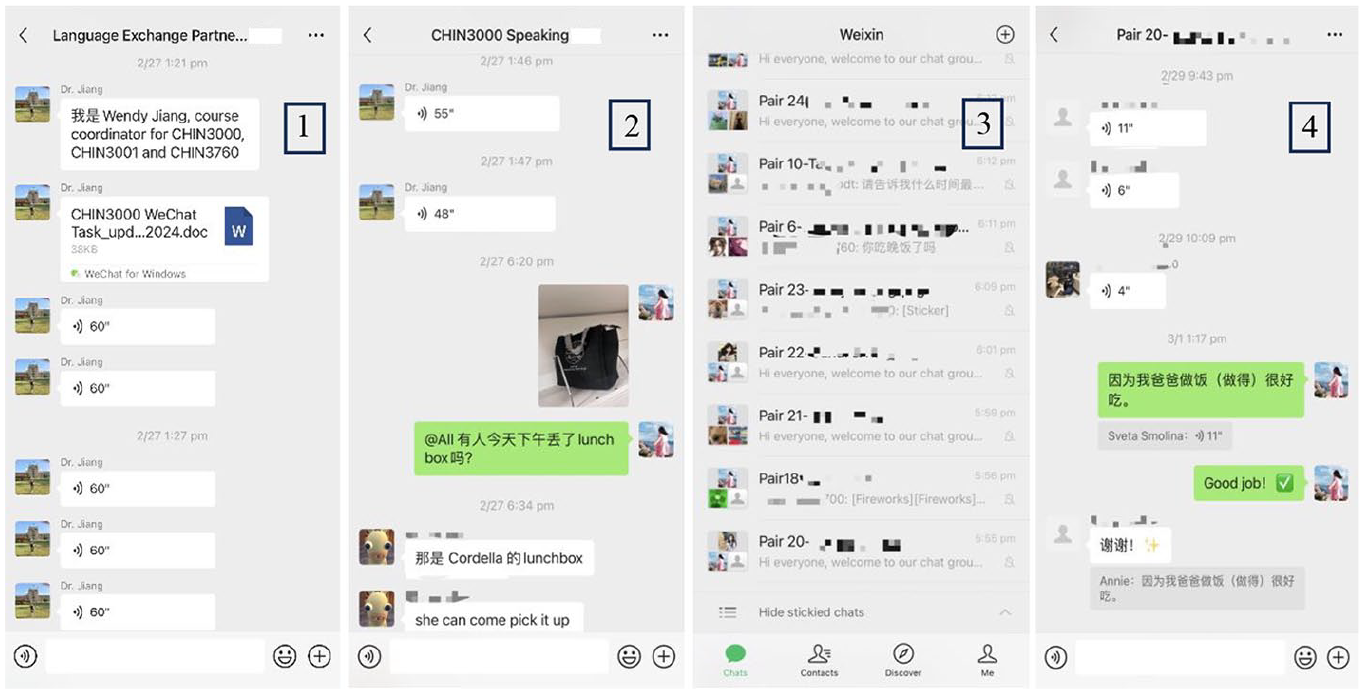
Screenshots of different WeChat groups.
c Specification of the WeChat task
Keep in mind that the learner group and the NS group were used for passing through instructions and sharing resources; it was each learner-NS group that was used for weekly ask-and-answer interaction. On every Monday morning, the course coordinator assigned a topic related to the lesson covered in the previous week (in Table 1) within the learner group and the NS group and provided several example questions. Each learner-NS pair were expected to ask and answer five topic-related questions respectively in Chinese by pressing the button ‘hold to talk’, which was then kept as audio recordings of the interaction. This question–answer design was essential for the novice CFL learners to have effective communication in Chinese (W. Jiang & Li, 2018). The learners and NSs were all recommended to number their questions and answers; for example, wenti (question) 1__, wenti 2___, wenti 3__, wenti 4__, wenti 5__; huida (answer) 1__, huida 2__, huida 3__, huida 4__ and huida 5__, which helped the marking of learners’ performance.
Topics selected for the WeChat task.
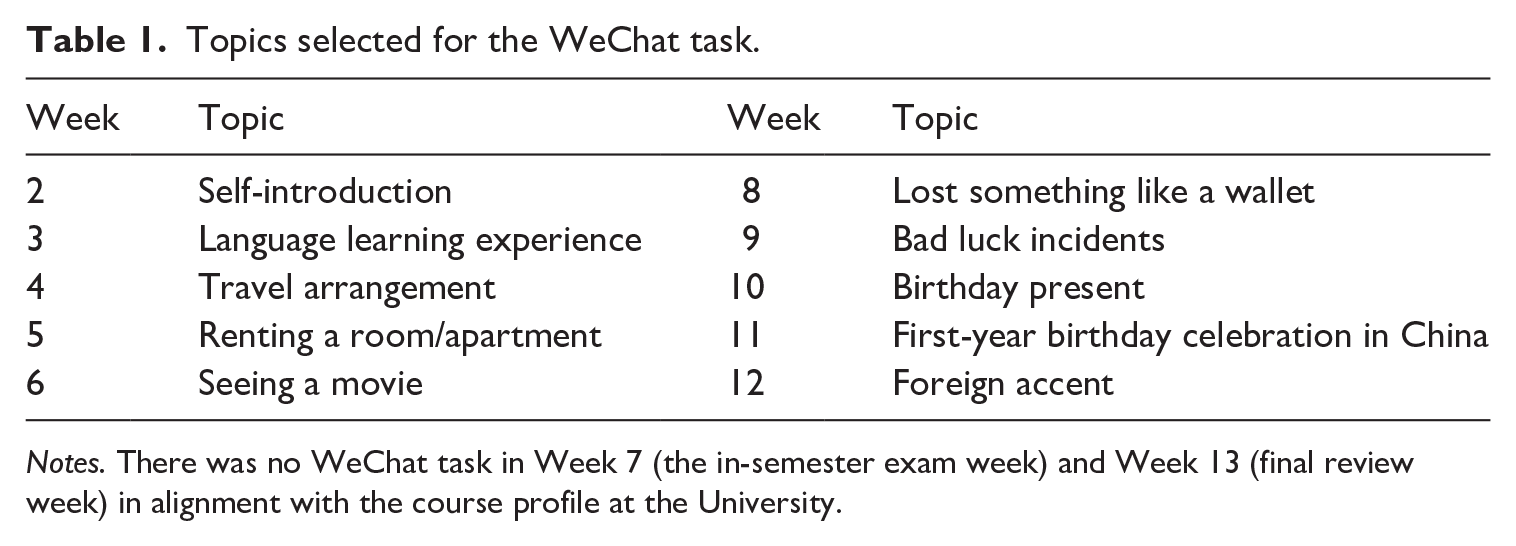
Notes. There was no WeChat task in Week 7 (the in-semester exam week) and Week 13 (final review week) in alignment with the course profile at the University.
The weekly task was due at 1pm on each of the following Monday, lasting for 10 teaching weeks (week 2–11) and weighed for 15% of the final grades. Learners’ task performance was assessed in terms of fluency, pronunciation, grammar and authenticity. The tutorial instructor who joined each pair group as a silent listener was responsible for the marking and feedback.
4 Data collection procedure
a Quantitative data: Questionnaire
The questionnaire survey is a direct approach to evaluate learners’ FLE level and any possible fluctuation of FLE. Two rounds of questionnaire survey were conducted. For the first round, the questionnaire was circulated on 24th April 2024 (mid-semester) in the form of hardcopy. There were 27 students in total by the time (one withdrew), but three students were absent in class on that day; the remaining 24 students voluntarily completed the survey. In the second round, the same questionnaire was disseminated on 22nd May 2024 (end-of-semester) in hardcopy in class; the online link was sent via email to those who did not turn up in class on that day. To ensure the reliability, twenty-four students’ survey responses were analysed, with the remaining students absent in the first round being excluded.
b Qualitative data: Email reflection
Email reflection provides details of the respondents’ perspectives on FLE, thus enabling an in-depth understanding of the moments that students enjoy. Specifically, a request for students’ reflection on the WeChat task was sent by email individually in Week 12 on 5th May 2024. Within two weeks after the email request was sent, eight students voluntarily replied the instructor with their reflections prompted by the following questions.
Which part do you like about the WeChat task? Which part you don’t like? Why?
Please describe one specific event or episode in the WeChat task that you really enjoyed, and describe your feelings in as much detail as possible.
5 Data analysis
a Quantitative analysis
The questionnaire data were analysed descriptively using SPSS, from which the reliability and mean value were generated. In addition, two rounds of questionnaire results were compared to evaluate the dynamism of students’ FLE. At both rounds, the reliability of questionnaire results was checked using Cronbach’s alpha (α).
b Qualitative analysis
Students’ email reflections were scrutinized using theme analysis based on an established coding scheme (Personal Enjoyment, Teacher Appreciation, Social Enjoyment). The coding was done by the first author, whereas the generated themes were reviewed by the second author. Discussions were conducted between both authors when discrepancy occurred, and consensus was reached eventually. As such, the inter-reliability of theme analysis was ensured. Quotations from students’ reflections were presented in line with the questionnaire results.
V Results
In response to CFL learners’ FLE level and the changes of FLE they have experienced in the WeChat task, results were presented in line with Botes et al.’s (2021) three-dimension structure. The questionnaire data collected at both mid-semester and end-semester stages were proved to be authentic, with an overall high reliability value (Cronbach’s α > 0.70) (in Table 2). Results show that students enjoyed performing the WeChat task. Their FLE level is presented respectively in line with the following three dimensions.
Reliability of the questionnaire items.

1 Personal enjoyment
Table 3 shows CFL learners’ personal enjoyment at two different stages of the task performance. Generally, students demonstrated a high level of personal FLE, with the mean value of most items above 5 (Agree). At both stages, the item ‘I’ve learnt interesting things’ scores the highest among the four.
Descriptive statistics of CFL learners’ personal enjoyment.
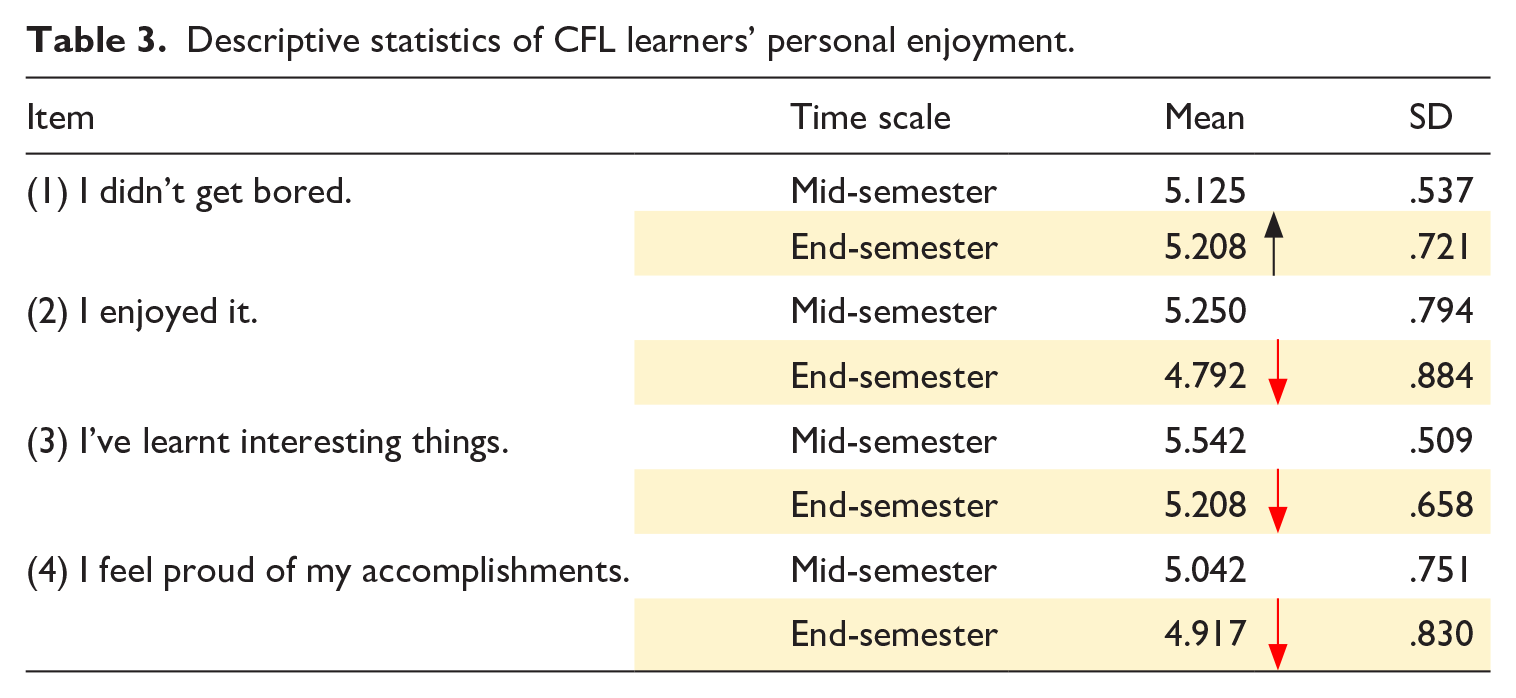
Looking at the FLE dynamically, there was a drop of enjoyment on the second item ‘I enjoyed it’, with mean value falling from 5.25 to 4.79. The average score of this item was the lowest among the four items based on end-semester results. The mean value of the third item decreased as well, indicating that students did not feel the task at the end as interesting as that during mid-semester. Besides, the degree of the fourth item slightly dropped, revealing that students felt a slightly lower sense of accomplishment at the end. Overall, the participants experienced fluctuations of personal enjoyment, mostly in a downward trend from mid-semester to end-semester. However, this cohort of CFL learners ‘didn’t get bored’ at all as the score of this item went up at the end of the semester.
In addition, more than half of the respondents achieved a sense of accomplishment at the end. As one respondent mentioned, ‘I enjoyed having the opportunity to learn vocabulary that was specific to a conversational topic (e.g. lost a wallet)’. He enjoyed the weekly interactions with his language partner. Benefits from vocabulary learning was elicited by another male student who said ‘it gave us a great opportunity to be able to learn a lot of useful, everyday vocabulary that we take for granted when speaking in English’. The part he most enjoyed was ‘being able to relate the week’s topic to myself and share some of my own life as well’. With the topic linking to a real-life story, the student didn’t get bored and experienced private enjoyment. However, two students mentioned that some topics were not interesting, as in the topic of Zhuazhou (first-year birthday celebration in China by randomly grabbing something amongst many provided), they found it difficult to construct questions.
In terms of personal achievements, one student majoring in electrical engineering described that her listening and comprehension were definitely improved; the vocabulary was broadened through WeChat communication. Another student could not pinpoint any specific episode of enjoyment, but she ‘really enjoy the feeling of accomplishment’ that she has obtained. When learners found themselves capable of understanding most of the conversations, they concurrently had a sense of achievement and enjoyment.
2 Teacher appreciation
Table 4 demonstrates the values of CFL learners’ FLE from teacher appreciation. As shown in this table, learners highlighted this dimension with strikingly the highest mean value amongst the three FLE dimensions. Interestingly, teacher appreciation manifested itself differently in its subdimensions. In particular, students enjoyed the WeChat task because of teacher friendliness and encouragement; whereas such enjoyment slightly changed with the increase of task experience. At the end of semester, students’ enjoyment was enriched owing to teacher support and feedback during task.
Descriptive statistics of teacher appreciation.
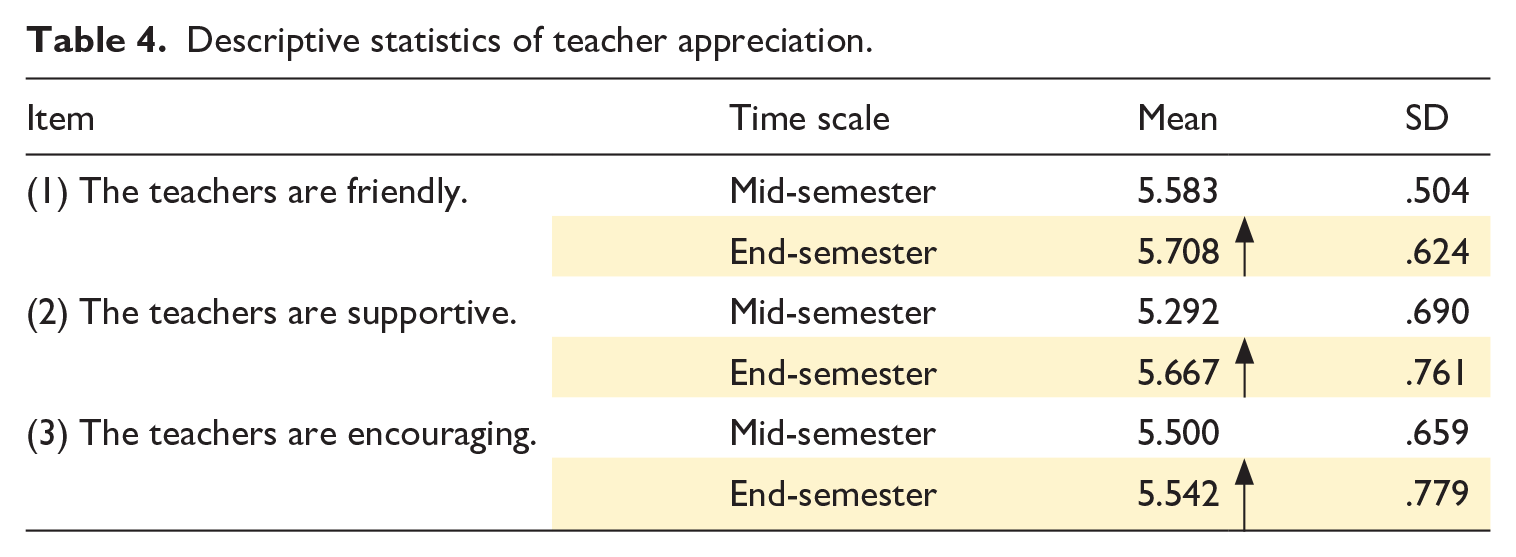
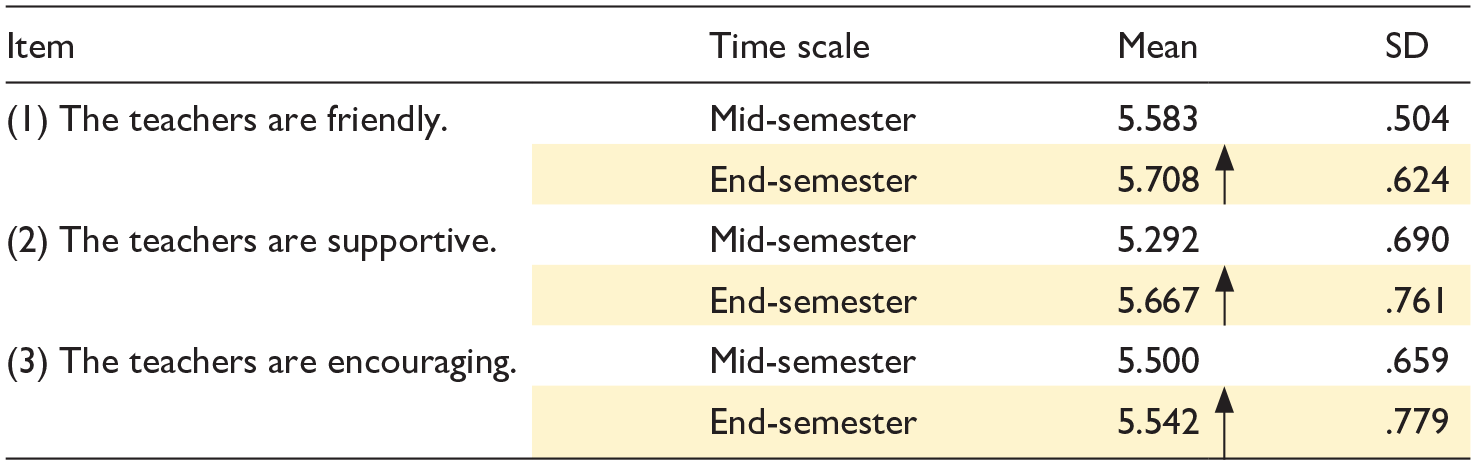
At the two stages, students experienced enhanced FLE on teacher appreciation, particularly on teacher support, which is demonstrated by the significant upward trend on the mean values of the three items for teacher appreciation at the end-semester stage. In the meantime, it cannot be neglected that teacher friendliness stayed the highest (approaching the maximum scale of 6) throughout the task.
Despite the significance of teacher appreciation, students did not mention much about teacher’s role in their email reflection, except the cases of two students, with the one who enjoyed doing the task most when the teacher ‘gave examples of what questions we can use to ask our language partners every week in the group chat. It was very helpful to give examples since sometimes I did not go to the lecture class on Monday’; and the other who enjoyed listening to the instructor’s feedback and said ‘sometimes because I sent my answers and I thought I’m not sure if that is a very good answer’. It seems that the respondents were information-oriented (example questions, feedback etc.) when talking about teacher appreciation.
3 Social enjoyment
Results in Table 5 demonstrate that students’ social enjoyment emerged out of different elements, with opinions ranging from the highest mean value (Mean = 5.542) to the lowest (Mean = 4.167) in mid-semester; then from highest (Mean = 5.500) to the lowest (Mean = 4.542) when semester ended. The lowest average score during mid-semester was generated from the fifth item ‘We form a tight group’. In comparison of the two stages, students had dynamic FLE across time, with a declining pattern three items (Item 1, 3 and 4), contrasting to the increasing trend on the other two (Item 2 and 5). Although both upward and downward trends can be found, the fluctuation was generally small. The lowest value at the end-of-semester was higher than the lowest value at mid-semester. It shows that at the end-semester, students had a more positive perspective on the item ‘we form a tight group; hence their sense of groupness was somewhat heightened.
Descriptive statistics of students’ social enjoyment.
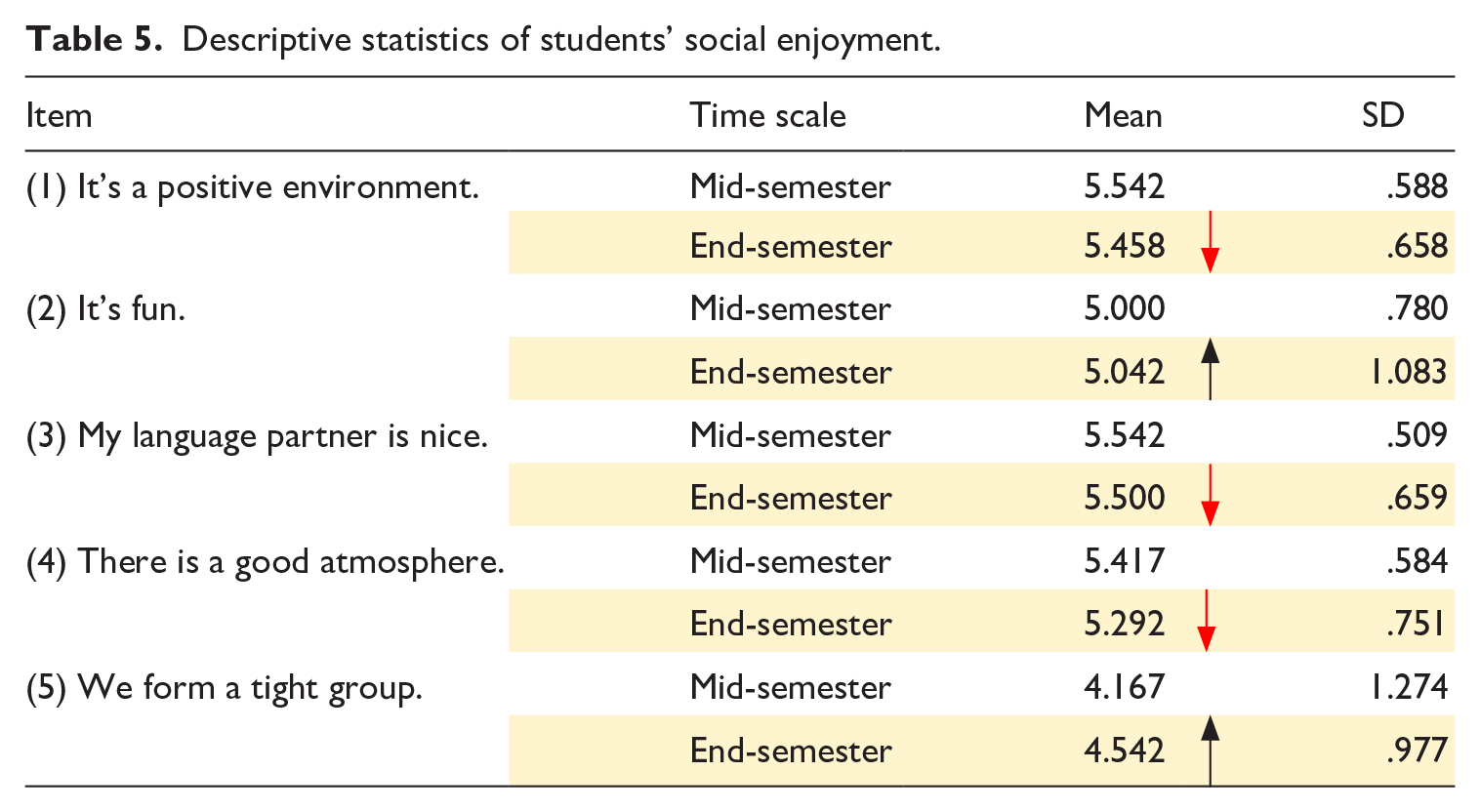
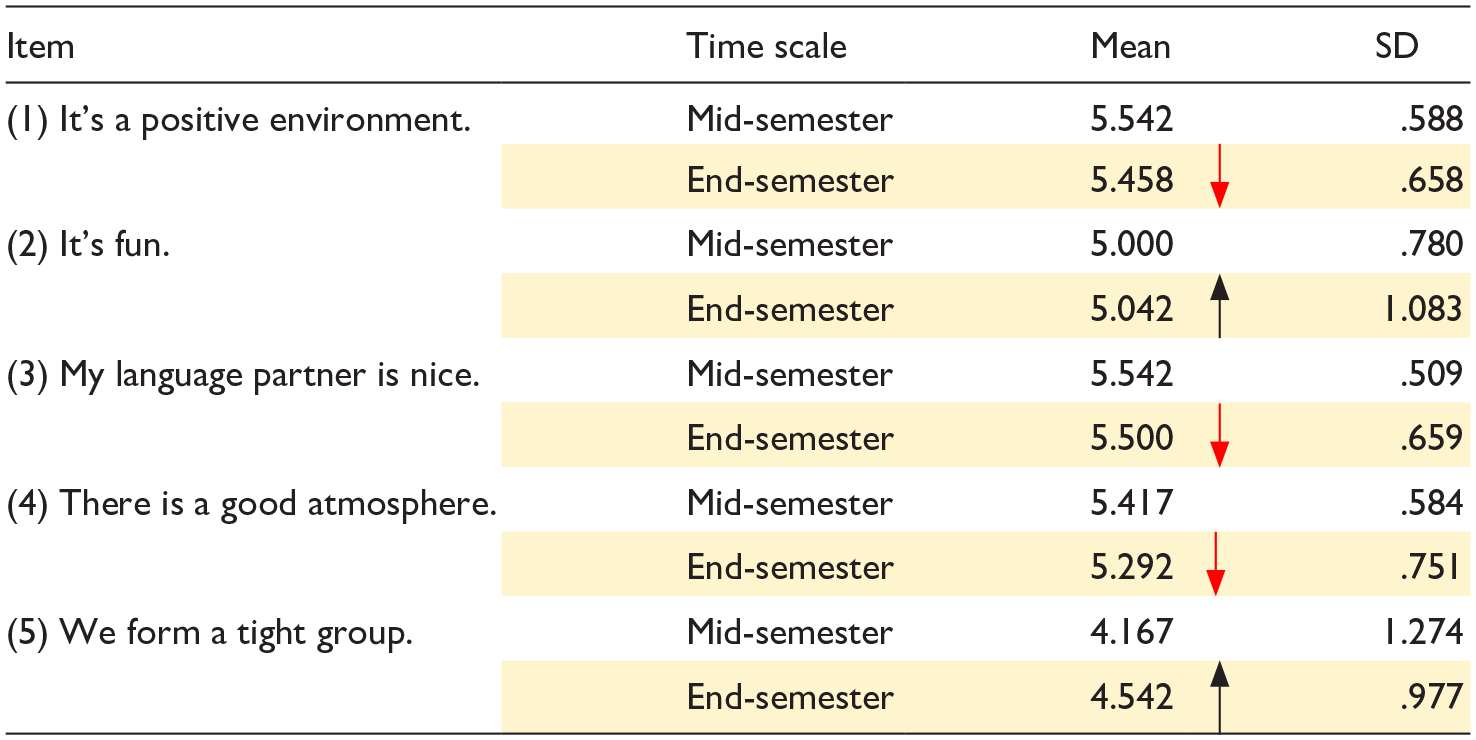
Many instances from students’ reflection with respect to social enjoyment were found. For example, one student experienced a good atmosphere when chatting with his language partner for the first time, he enjoyed it as he stated ‘as it was a good opportunity to make a new friend whilst having a unique chance to get to know them better in Mandarin’. With regards to the weekly WeChat task, another student said, ‘I really enjoyed listening to the feedback from my native Chinese language partner’. The student thought her language partner was nice, because ‘She [the language partner] was very generous with her time, and always gave her quite detailed answers to her questions’. ‘It was also beneficial to hear how she phrases her answers, because she uses modern, up-to-date language, rather than the structured text from a textbook’. By saying this, she was happy with the positive environment where they interacted. By doing the task, students were able to practise speaking in a casual manner. Moreover, students also established a tight bound with their NS language partners, because they ‘met outside of the WeChat group and met in person’. Talking about language partner, seven students commented that ‘the language partner is so kind and nice’.
VI Discussion
This study investigated CFL learners’ three dimensions of FLE and the levels of learners’ FLE during and at the end of the WeChat task. The findings indicate that the three dimensions of FLE, namely Personal Enjoyment, Teacher Appreciation and Social Enjoyment (Botes et al., 2021) generated a good reliability in explaining CFL learners’ positive emotion in both mid-semester and end-semester survey. Overall, the respondents enjoyed the WeChat task and had great experience. Their FLE level fluctuated slightly with different degrees specific to each dimension at different stages. Discussion corresponding to the three research questions is conducted in the following subsections.
1 Whether and to what extent novice CFL learners enjoy the WeChat task
Regarding whether and to what extent the respondents enjoy the WeChat task, teacher appreciation reveals a stronger statistical influence than personal enjoyment on FLE; and the influence of teacher appreciation remains stable at both stages. The result coincides with Dewaele et al.’s (2019, 2022) findings that learner-external factors such as teachers and instructions are more powerful indicators of FLE. However, not many students link their enjoyment to teachers’ role in their email reflection, probably because they felt uncomfortable to talk about their teachers, particularly they knew that the teachers could tell who said what in the email reflection. Regardless of this, the respondents appreciated teacher guidance and feedback, signifying the importance of teachers’ role to some extent.
It is also found that social enjoyment and personal enjoyment are statistically significant, with a high mentioning rate in email reflection. From the psychology of FL learning, the overall significance of FLE indicates students’ positive mindset of CFL learning competencies despite of the novice language proficiency. In comparison, social enjoyment is less strong than personal enjoyment, in part because the focus herein is mobile learner-NS interaction online, different from peer interaction in a classroom setting, learners may have a stronger awareness of personal presence in concurrence with enjoyment. In WeChat interaction, learners do not frequently meet in person, presumably they are less tightly connected. However, this does not mean an inexistence of social enjoyment. With the in-depth and more frequent interaction, the social relationship is likely to be fostered. This helps explain why the three dimensions of FLE were generally confirmed by the participants.
2 Whether novice CFL learners’ FLE changes over time while performing the WeChat task
Statistical results show that novice CFL learners experienced FLE fluctuation at different stages of the task, with FLE in teacher appreciation going up while personal and social enjoyment slightly going down at the end of the semester. The results resonate with Pan and Zhang (2023) in articulating dynamism of FLE, whereas contrast with Dewaele et al.’s (2023) report which indicates stable personal and social enjoyment but a significant dropped value of FLE teacher. The striking difference might be explained by the distinct characteristics of CFL learners from Dewaele et al.’s (2023) Kuwaiti learners of Spanish, German, French and English. The uptrend of FLE in teacher appreciation in this study might be a result of students’ recognition of teacher encouragement and constructive feedback conducive to the realization of students’ goals, being academic or emotional.
The decreased social and personal enjoyment can be most likely caused by the fact that students have substantial amount of time to construct questions and answers during the first half of the semester; at the initial stage, they may be more curious about NS language partners’ questions and responses to each new topic. Such curiosity might potentially activate students’ impetus to communicate. With the increase of communication, interesting things, real-world expressions etc. might be acknowledged, in conjunction with the enhanced enjoyment. Learners’ FLE, however, is not as sustainably strong as in the first stage, because students might be busy with other assignments and final exams at the end-semester, hence, their enthusiasm in completing the WeChat task dropped slightly due to the competition of time and energy worrying about other important schedules. Likewise, NS language partners might also have a full schedule at the end of the semester. As such, WeChat pairs might not be as tightly connected as they used to be during mid-semester.
It is uncommon to notice that although the trajectory of the three FLE dimensions is unstable, the participants did not feel bored at all in doing the WeChat task throughout the whole semester. Learners’ sustainable enjoyment in CFL learning through WeChat learner-NS interactions is presumably at least in part a confirmation of the appropriate design of the MALL task, such as being intriguing and full of fun; at the same time, the goals are achievable by novice CFL learners.
3 Novice CFL learners’ descriptions of their FLE episodes
Students’ descriptions on enjoyable episodes differ, but generally, they appreciate teachers’ encouragement, which aligns with Pan and Zhang’s (2023) findings specific to the sources of encouragement. In the present study, students’ FLE may be enhanced by the instructor’s timely positive feedback right after the submission of the audio recordings of WeChat interaction, coupled with the straightforward encouragement in class. The instructors have emphasized that pronunciation problems and grammar mistakes in WeChat interaction are subordinate to the time and effort that learners and NSs have invested, but not the accuracy of the answer. Besides, novice CFL learners have been reassured that making mistakes in WeChat communication is totally fine and no penalty is applied, so that students might be confident and proactive in performing the task (Alberth, 2023; Wang & Jiang, 2024).
In addition, it is found that students have enjoyed the task more when provided with teacher support, such as giving instructions and providing guidance questions before the task. This echoes Elahi Shirvan et al.’s (2021) finding where teacher support in producing positive emotion is underlined. Different from Dewaele et al.’s (2018) argument, respondents did not indicate the importance of teachers’ FL use. The non-significance of teacher’s FL use may be explained by the language level of the participants. As novice CFL learners, they may have difficulty in understanding the teacher if the teacher speaks Chinese throughout the class time or providing feedback in Chinese. The results might be also related to individual factors such as learners’ personality and preferences. It indicates that more students prefer to chat with the instructor for support and suggestions, despite that some may prefer to do the task independently without teacher intervention. Furthermore, a majority of the students seem to enjoy using the ‘new’ vocabulary they have heard from NSs, which seldom occurs in textbooks. They may regard the learner-NS interaction as FL learning experience distinct from classroom learning. They are particularly excited to know their language partner the moment they become WeChat friends, which underpins positive atmosphere at the start. It implies that students’ sense of self-achievement and the good atmosphere during interaction contribute to learners’ FLE.
Notably, students’ FLE from teacher appreciation is higher at the end, possibly because students have been familiar with their teacher and have better understanding of teacher initiative at the end. Trust between the students and their teacher to some extent has established. According to Elahi Shirvan et al. (2021), teacher friendliness, support and encouragement are transmitted in class and in the specific task. Although students’ FLE level is unstable, the controlling elements such as teacher friendliness and encouragement largely help maintain learners’ FLE through class contacts and interactive tasks (Pan & Zhang, 2023). In particular, more attention to students’ performance than minor mistakes made during the task highlights the cognition of learners in developing language competence alongside the FLE arisen from natural communication.
VII Conclusions
This study has investigated CFL learners’ FLE by implementing a weekly mobile-assisted CFL learning task, namely the WeChat Task. It is found that the respondents’ FLE level is very high, with degrees specific to three dimensions: personal enjoyment, teacher appreciation and social enjoyment. In addition, CFL learners experienced FLE fluctuation at the mid-semester and end-semester stages. The results imply that it is necessary to take the three dimensions of learners’ FLE into account when designing and implementing MALL tasks. In particular, teacher support is beneficial in maintaining learners’ FLE, such as showing friendliness and encouragement, providing timely feedback on learning tasks in specific. Creating a good interactive environment is also important. At the same time, the NS language partner plays a crucial role. Their warmth, such as being nice and friendly, in conjunction with their accommodating behaviour, such as speaking slowly, responding promptly and giving feedback frequently, contributes to the enhancement of learners’ FLE.
Given the dynamics of FLE, keeping on track of the trajectories of learners’ FLE is important. When learners’ enjoyment is going down, teachers might want to adjust the topics and might also need to put more efforts in making the task full of fun. Instead of textbook focused, topics can be extensive and combined with real life scenarios. As students get familiar with their language partners, emoji and joke use in online communication may also work to arouse enjoyment (Dewaele et al., 2022). In addition, attention should also be paid to the proficiency level of language learners, as for novice CFL learners in this study, the design of question–answer interactions with NSs is essential for learners to enjoy both the WeChat task and their FL learning in general.
This study is limited to the small sample size due to the comparatively small enrolment of CFL learners in the university in recent years. In addition, the present study only looks at learners’ FLE, whereas their actual academic achievement from the WeChat task has not been objectively assessed because of a lack of experiment and control group. Given the limitation, our future study may consider including more participants with a comparative analysis on learners’ FLE and the association of FLE and FL learning results.
